David Rubien

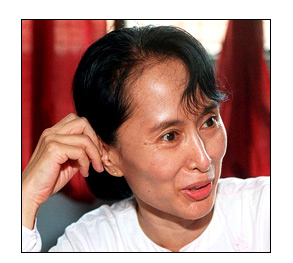
Aung San Suu Kyi

Even when she's under house arrest, the Nobel Peace Prize-winning resistance leader is a symbol of hope in the struggle for democracy in Burma.

  • more
    • All Share Services

Aung San Suu Kyi

A question that has to haunt anyone pondering the predicament of Burma’s democratic resistance leader Aung San Suu Kyi is: Why hasn’t she been killed? She is, after all, a major thorn in the sides of the military dictators who have been driving the Southeast Asian nation to ruin for the past 38 years. Certainly she would not be the first popular opposition leader to be murdered by despots.

The simple answer is they missed their chance. Suu Kyi (pronounced soo chee), 55, was first confined to house arrest in 1989, months before her National League of Democracy won Burma’s last election in a landslide. The dictators ignored the election results and proceeded to arrest all the NLD leaders they hadn’t already jailed previously, and continued the kind of repression that had been the junta’s modus operandi since 1962. But in 1991 something happened that the dictators couldn’t have anticipated. Suu Kyi won the Nobel Peace Prize. The eyes of the world suddenly became focused on this slight, Buddhist woman locked in her home, forbidden from picking up her award. But her captors came under international gaze as well, and killing Suu Kyi now would be too reckless a move even for a junta that makes murder and slavery cornerstones of its policy.

The Burmese dictatorship is known within and outside the country as SLORC, for State Law and Order Restoration Council, the banner under which the autocrats ran in the 1990 elections they conveniently dismissed. Three years ago they changed their name to the even more Orwellian State Peace and Development Council, but SLORC seems to fit them better. In the manner of many dictatorships, SLORC is fond of renaming. In 1988 SLORC decided to call Burma “Myanmar,” but most of the world, recognizing the illegitimacy of the government, ignores the name change, much in the way “Kampuchea” is now nothing more than a synonym for the evil visited on Cambodia by Pol Pot and his minions.

Under SLORC’s reign, Burma has vied with a few other countries, such as North Korea, Afghanistan and Algeria, for the honor of serving as poster child for a nation destroyed by tyrants. By any objective measure Burma — as physically beautiful and as rich in natural resources as any Southeast Asian country — is in dire straits. It was ranked second to last, after Sierra Leone, on healthcare spending per capita, according to the World Health Organization. The result is that diseases (including AIDS, malaria, tuberculosis and anthrax) are rampant. AIDS is considered more epidemic in Burma than in Thailand, on a par with the scourge in southern Africa. Contributing to the problem is a robust drug trade: Burma alternates with Afghanistan as the largest heroin producer in the world, and burgeoning drug addiction within Burma is helping to spread AIDS.

The Burmese armed forces are thought to be about 500,000 strong and are ruthless in enforcing SLORC’s will. Forced relocation is common, with entire communities uprooted and moved to slums or barren lands where they are barely able to survive. SLORC uses slave labor for construction projects, including children, and Amnesty International reports that thousands of Burmese are kidnapped each year and made to carry supplies for the army through dense, mountainous jungle, where ethnic resistance groups reside.

The Burmese economy is in shambles. People earn less than a dollar a day, and many are illiterate because SLORC has closed down hundreds of schools. The United Nations reports that Burma spends 28 cents a year per student on public schools. Four out of 10 children are reported to be malnourished, and the average life expectancy for Burmese is less than 50 years. SLORC is paranoid about people congregating, and gatherings of more than four people are forbidden. Unions, needless to say, are prohibited, and SLORC owns all the media. It’s illegal to possess a home computer. Anyone who violates SLORC’s capricious laws is subject to lengthy prison sentences and torture, which, according to Amnesty International, is a specialty of the junta.

In 1995, Sen. John McCain, R-Ariz., visited Burma while on a fact-finding mission in Southeast Asia. Newsweek reported that Lt. Gen. Khin Nyunt of SLORC welcomed McCain by screening for him a video of machete-wielding thugs beheading Burmese villagers. McCain later said of the junta members, “These are very bad people.”

Yet despite the horror, hope lives on in Burma, and much of it rides on Aung San Suu Kyi. It’s a lot for one person to bear, but Suu Kyi seems born to the task — literally and constitutionally. Not only is she the daughter of Aung San — considered the father of Burmese democracy and an assassinated martyr to the cause of freedom — and as such revered almost automatically, but her deep Buddhist training has made her uniquely fit to weather a life of confinement and isolation. She meditates daily, a discipline that provides insight into life beyond the external reality most of us perceive, and she hews strictly to Buddhist proscriptions against harming, hate, fear and ego.

In a 1995 interview with Alan Clements, an American author who lived as a Buddhist monk in Burma for several years and who wrote the 1992 book “Burma: The Next Killing Fields?” Suu Kyi alluded to another interviewer who kept asking if she really was not frightened. “Why should I have been frightened?” she said. “I’m not sure a Buddhist would have asked this question. Buddhists in general would have understood that isolation is not something to be frightened of.” Then she added, “You cannot really be frightened of people you do not hate. Hate and fear go hand in hand.”

Buddhism aside, Suu Kyi’s commitment to Burma’s freedom is bedrock, and this also anchors her. At every opportunity presented she reiterates the demand that SLORC must yield to the election results of 1990 and make the country democratic. Her steadfastness has led to some almost comical situations. In 1998, during one of the rare periods SLORC released her from house arrest — but still prohibited her from traveling outside the capital — she attempted to leave town to meet with another NLD official. When soldiers blocked her way she refused to turn back and ended up camping out in her car for six days before she was forcibly returned home. She tried it again, she was taken home again and right away she vowed to make another attempt, asserting that she was not “legally restricted in any way.” Finally SLORC reimposed house arrest.

Suu Kyi’s father was born in 1915, when Burma was a colony of Britain. A devout Buddhist, Aung San became a leader in Burma’s struggle for independence. During World War II, he believed that Japan would be the route to Burma’s freedom, and he fought with the Japanese when they invaded the country. But when they proved to be even more despotic than the British, Aung San and his compatriots switched sides and fought with the British to expel the Japanese. At the end of the war, Britain and Burma worked together to set up a parliamentary structure so that the Burmese could take control of their country. Aung San’s party swept the elections, but only months later, in 1947, he and several members of his government were shot dead by political rivals. Soon after that, Burma descended into a civil war among ethnic groups.

Suu Kyi was 2 at the time of her father’s death. Her mother, Khin Kyi, was a vital figure in the early years of Burma’s independence, serving in several government capacities. In 1960 Khin Kyi was appointed ambassador to India, moving to New Delhi with her daughter and two sons. While Suu Kyi got a good British high school education, her mother made sure that her daughter did not stray from the Buddhist path. Suu Kyi was a voracious reader and had a particular fascination with Mahatma Gandhi. In 1964, Suu Kyi enrolled at Oxford, getting degrees in philosophy and economics in 1967.

In the 1991 Nobel Prize Annual, Irwin Abrams sketched a bit of biography from Suu Kyi’s time at Oxford. “The diminutive beauty from Burma was a striking figure. Her close friend of those days, Ann Pasternak Slater, remembers how her ‘tight, trim lungi (the Burmese version of the sarong) and her upright carriage, her firm moral convictions and inherited social grace contrasted sharply’ with the casual manners and ill-defined moral standards of the English students.

“Slater recalls [Suu Kyi's] curiosity about Western ways. Despite Buddhist injunctions, she took one little sip of an alcoholic drink just to find out what it was like — and didn’t like it. And so that she could know the experience of other woman students, who returned from late dates after the gates were locked and had to climb over the garden wall of their dormitory to get in, she had a friend from India bring her back from a dinner date at midnight, so he could help her over the wall. Slater also remembers the characteristic determination with which Suu Kyi learned to bicycle in her lungi.”

After graduating from Oxford, Suu Kyi moved to New York, where she worked for the United Nations secretariat and volunteered as a social worker at a New York hospital. In 1972 she married Michael Aris, a scholar of Asian literature and history. While Aris studied in England, they had two sons, Alexander and Kim. Suu Kyi taught Burmese studies at Oxford while doing postgraduate research in her country’s history. The family returned frequently to Burma to spend time with Khin Kyi, who was retired in her Rangoon home.

Things were not going well in Burma. For years the democratic government had tried to maintain control during civil war, but a junta led by Gen. Ne Win took over in 1958, and consolidated power in 1962. He abolished the constitution, banned all political parties, nationalized many businesses, installed military personnel in government positions and announced he was leading Burma down the “socialist path.” The downward spiral had begun.

As economic and social conditions unraveled under the inept dictator’s mismanagement, civil unrest began to erupt in the ’80s. Students organized and held rallies demanding restoration of democracy and human rights. On Aug. 8, 1988, a massive general strike and demonstration were declared. Ne Win responded by calling out the troops. Over the next several days, soldiers fired on crowds, killing between 1,000 and 10,000 civilians. Still, the demonstrations continued, and the government actually seemed to back down. But then a new set of generals, calling themselves SLORC, asserted that they were in control, and ratcheted up the repression further.

Coincident with all this, Suu Kyi was in Rangoon, caring for her mother (who had suffered a stroke) and watching the tumult from the sidelines. After the massacres, she decided to take action. Speaking to a huge crowd under a poster of her father, she said, “I could not, as my father’s daughter, remain indifferent to all that was going on.” With her simple and direct demands for civil rights and her insistence on nonviolent resistance, she won over thousands of Burmese and became the country’s avatar of democracy.

Meanwhile, SLORC surprised everyone by announcing that a “free and fair” election would be held in 1989, open to all parties. More than 200 parties registered to run, but the NLD, thanks to Suu Kyi’s participation, drew the most support. The organization was also one of the few that had the courage to defy an SLORC ban on public assembly, an edict that effectively precluded anyone from campaigning. Not only that, SLORC insisted on vetting all public documents issued by political parties. Suu Kyi, the NLD’s nominal leader, simply refused to accede to any of SLORC’s demands. She continued to campaign around the country, facing phalanxes of armed guards everywhere she spoke.

In one famous incident, Suu Kyi and fellow NLD members were on the campaign trail when they found themselves staring into the rifle barrels of a squadron of soldiers. An SLORC officer seemed prepared to give the order to fire, when Suu Kyi motioned her colleagues away and walked straight toward the officer, staring him down. He ordered the troops to withdraw. “It seemed so much simpler to provide them with a single target than to bring everyone else in,” she said afterward.

SLORC finally ordered Suu Kyi into house arrest, and rounded up most of the other NLD leaders, sentencing several to years in prison. Many were tortured. But then came the real shocker for SLORC: In the election held in May 1990 the NLD won 392 seats in the National Assembly, compared with 10 for SLORC. Far from transferring power, SLORC responded with wave after wave of terror. Still, Suu Kyi would not be silenced. At first SLORC permitted her visits from her husband and sons, and she was able to get her writings out to the world through them. But in the fall of ’90 the junta forbade all visits, not even letting her get mail. SLORC tried to play the family card, encouraging her to visit Aris and the boys in England, but she refused, knowing she’d be barred from Burma for good.

In 1995 SLORC relaxed restrictions on her, and she was able to receive visitors, including several interviewers. She described her daily routine to a reporter for Asia TV: “I get up at 4:30 in the morning. I meditate for an hour. Then I listen to the BBC world service, then I listen to the VOA [Voice of America] news in Burmese, and then the BBC news in Burmese. If I could hear it, I would listen to the Democratic Voice of Burma, but that is not always very clear. Then of course I take a bath, have breakfast and then the rest of the day I divide into periods for reading, for walking around the house and for playing a bit of music.”

Were it not for the radio, she said, she would not have known she won the Nobel Prize.

In her interview with Clements, Suu Kyi elaborated on her attitude toward her captors in answer to his question, “You have been at the physical mercy of the authorities ever since you entered your people’s struggle for democracy. But has the SLORC ever captured you inside emotionally or mentally?”

No, and I think this is because I have never learned to hate them. If I had, I would have really been at their mercy. Have you read a book called “Middlemarch” by George Eliot? There was a character called Dr. Lydgate, whose marriage turned out to be a disappointment. I remember a remark about him, something to the effect that what he was afraid of was that he might no longer be able to love his wife who had been a disappointment to him. When I first read this remark, I found it rather puzzling. It shows that I was very immature at that time. My attitude was — shouldn’t he have been more afraid that she might have stopped loving him? But now I understand why he felt like that. If he had stopped loving his wife, he would have been entirely defeated. His whole life would have been a disappointment. But what she did and how she felt was something quite different. I’ve always felt that, if I had really started hating my captors, hating the SLORC and the army, I would have defeated myself.

However, in a Vanity Fair article from 1995 she detailed her tribulations: “‘Sometimes I didn’t even have enough money to eat,’ she went on. ‘I became so weak from malnourishment that my hair fell out, and I couldn’t get out of bed. I was afraid that I had damaged my heart. Every time I moved, my heart went thump-thump-thump, and it was hard to breathe. I fell to nearly 90 pounds from my normal 106. I thought to myself that I’d die of heart failure, not starvation at all. Then my eyes started to go bad. I developed spondylitis, which is a degeneration of the spinal column.’ She paused for a moment, then pointed with a finger to her head and said, ‘But they never got me up here.’”

She didn’t lose her sense of humor, either. When Clements asked her if her phone was tapped, she said, “Oh, yes, probably. If it is not I would have to accuse them of inefficiency. I would have to complain to Lt. Gen. Khin Nyunt [SLORC's military intelligence chief] and say, ‘Your people are really not doing their job properly.’”

SLORC granted Suu Kyi some freedom of movement in 1995, but that didn’t extend to meeting with NLD colleagues. Worse, SLORC wouldn’t let her family into the country for visits, even when her husband was diagnosed with prostate cancer in 1998. He was denied a visa to visit Suu Kyi a final time in 1999 and died in London. The generals hoped she would attend the funeral, but she knew the realities. She said simply, “I feel so fortunate to have had such a wonderful husband who has always given me the understanding I needed; nothing can take that away from me.”

And nothing, it seems, can take Suu Kyi away from the SLORC generals. Restrict her movement as they will, she goes on, making speeches, handing out food to the poor, issuing papers and making it clear that democratic aspirations in Burma live on. She will not stand down. And here’s something about the psychology of the totalitarian mind — the dictators must understand that Suu Kyi is good for them as well, because as long as they let her live, the international community can say, “Look, the government’s not so bad; they keep that woman around.” She’s SLORC’s trump card.

So now there is communication. For the past four months SLORC agents have been meeting with Suu Kyi regularly while reportedly releasing NLD members from prison. The content of their meetings has not been reported, and whether they have any real significance is impossible to know right now, but it’s hard to imagine SLORC ceding any real power. Yet we can hope. If Vaclav Havel and Nelson Mandela could emerge from lengthy prison sentences to lead their countries in freedom, perhaps Suu Kyi will get a turn.

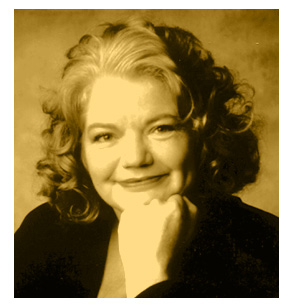
Molly Ivins

Balancing humor and passion, the proudly partisan Texas pundit elevates a profession dominated by mediocrity and received ideas.

  • more
    • All Share Services

Molly Ivins

Leave it to Molly Ivins to cut through the crap. Commentators in the Florida election morass have almost without exception lined up in strict formation based on their party affiliations, conservatives calling for a Bush anointment, liberals saying Gore was robbed. And the dialogue is getting ruder and ruder.

So which side does Ivins — probably more proudly partisan than any other pundit in the business — line up on in the biggest ballot-counting brouhaha in modern history? Well, of course she doesn’t cotton to the idea of George W. Bush as president. Let’s get that out of the way right from the start. Ivins, who writes a widely syndicated column for the Fort Worth Star-Telegram, is a native Texan who, as a lefty, has a unique perspective on W. and all the Bushes. She recently authored the bestselling “Shrub: The Short but Happy Political Life of George W. Bush” (a title she may come to regret, temporally speaking), and she commented extensively on the unique follies of W.’s dad, George Herbert Walker Bush, during the president’s glorious post-Reagan reign.

Wading into the current breach, this is what Ivins wrote in her column of Nov. 19:

Here’s the challenge: Let’s everybody with a dog in this fight — meaning either pro-Gore or pro-Bush — be obliged to make the case for the other side for at least 15 minutes.

Because I think we’re watching something important, quite aside from the fate of the nation and the future of The World’s Greatest Democracy (except for Florida).

In a mild and in some ways not terribly important case (I may have to eat those words), we’re watching why wars start. What we see is the constant presentation — because the media love to polarize — of people who are apparently incapable of imagining what the situation looks like from somebody else’s point of view.

Imagine that. A call for empathy. Because when you think about it, there really is no solution to this mess. Between the confusing ballots, the never-counted ones, the varying chad-evaluation standards, the citizens who were intimidated into not voting, the canceled recounts, the violent mobs, the tampered-with absentee ballot requests and all the rest of the chaos, there is no way of coming to a result that is free of taint. So what else is there to do but submit to the absurdity of it all, shake hands with your enemy and go have a beer?

This is a case of Ivins being a uniter, not a divider, but she would no doubt chafe at that role. She sees bringing down the powerful as her task, not “bringing people together.” But Ivins’ gift is that even while deflating the pompous she ends up being a uniter. She just can’t help it.

Other columnists might claim to bring us all together, to find the common threads that bind us in the knot of humanity, but how many make us laugh in the bargain? Ask yourself when the last time was you laughed out loud at something a political columnist wrote. Not snickered — as you might do reading Maureen Dowd or P.J. O’Rourke — but practically fell off your chair laughing. Chances are it was when you last read Ivins.

Readers seeking examples of Ivins’ wit can find them in ample quantity in her four books, the first three being collections of her columns and articles: “Molly Ivins Can’t Say That, Can She?” (1991), “Nothin’ but Good Times Ahead” (1993) and “You Got to Dance With Them What Brung You: Politics in the Clinton Years” (1998). Her latest book, “Shrub,” co-written by Lou Dubose, is a straightforward account of Bush’s record as a Texas businessman and governor. Ivins reins in much of her lacerating wit here, but she doesn’t hold back in her revelations of Bush mendacity. Here’s “Shrub” in a nutshell:

If Bush does make it to the White House, he and Laura should have Ken Starr over for dinner. If Starr hadn’t so abused the power of his office, Congress might have reauthorized the independent-counsel statute, leaving the door open for a court-appointed prosecutor to investigate a president’s son who flipped his oil companies faster than a Texas S&L can daisy-chain a Dallas condo; as a corporate board insider, unloaded his company stock shortly before its price plummeted; and walked away from the whole mess with more money than Bill Clinton ever dreamed of making on a little real estate deal now known as Whitewater.

Even though the book was on the New York Times bestseller list for several weeks — as were all Ivins’ books — it gained little “traction” in the establishment media.

“Don’t get me started about the media double standard,” Ivins says about this conundrum. “Part of it from the beginning has been that the expectations were so low. I mean every time W. pulled himself together and jumped over a matchbox, people applauded that he could jump over a matchbox.” W. said as much himself on the ‘David Letterman’ show, didn’t he?

But the media’s laxity goes deeper than amorphous standards, Ivins believes. She has repeatedly stated that the press’ sins of omission are far worse than their sins of commission. “It is the stories we don’t get, the ones we miss, pass over, fail to recognize, don’t pick up on, that will send us to hell,” she wrote in 1990, so you can’t accuse her of being self-serving.

Ivins is a political columnist, but somehow that term doesn’t do her justice. We’ve come to associate political columnists (or commentators) with the self-important talking heads who clutter the airwaves and the predictable bores who take up space on the Op-Ed pages. What she has in mind is more ambitious than that. Basically, she’s a storyteller who uses satire to drive home her points, and thus is in the rarefied line of such legendary observers as Mark Twain, Ambrose Bierce, Will Rogers, H.L. Mencken and Red Smith, all of whom considered pomp deflation and conventional-wisdom dispersal among their primary missions.

As a personality profiler, Ivins is peerless. Her essays on Barbara Jordan, Ann Richards, an anonymous visitor to the Vietnam Veterans Memorial and her own parents swing from the hilarious to the heartbreaking. As a chronicler of that perverse body known as the Texas Legislature, where humanity seems to exist in its most primitive state, she is like a griot or a James Boswell — or perhaps a proctologist.

Here’s Ivins writing in the Atlantic in 1975:

Take the last all-House duke-out. It was, distressingly enough, over ten years ago. Although there have been a fair number of fistfights in the Capitol since, none has qualified as total Fist City. On the last such occasion (the cause long forgotten), over half of the 150 House members were actively engaged in slugging their colleagues, insulting the wives and mothers of same, knocking over desks, and throwing chairs. Now, any legislature can have a mass duke-out, but where else would there be musical accompaniment? In mid-melee, four members mounted the speaker’s dais and held forth, in barbershop-quartet harmony, with “I Had a Dream, Dear.”

In a tribute to Jordan after the great congresswoman from Texas died in 1996, Ivins wrote: “But the real secret of her rhetoric, the reason she jolted everyone who ever heard her into respectful attention, was that her choice of words was just as precise as her diction. She used words to construct thoughts with the exactitude of a skilled craftsman building a limestone wall.”

Ivins could just as well have been writing about herself.

- – - – - – - – - – - -

She was born Mary Tyler Ivins in 1944 in Monterey, Calif., while her father, Jim Ivins, was serving as an officer in the Pacific at the end of World War II. Upon his discharge, the family moved back to Houston. Her mother, Margot Milne Ivins, was a Smith-educated product of East Coast gentry. Her father, raised in Chicago, struggled through college during the Depression. He was a successful corporate attorney who attained a high position with the Tenneco Corp. Ivins wrote that her mother “never mastered the more practical aspects of life — I believe the correct clinical term is ‘seriously ditzy’ — but she was nobody’s fool. She was shrewd about people and fond of fun, and at her best she could charm the birds from the trees.”

Both of her parents, upstanding Texans, were Republicans, so young Molly was a bit of a rebel. She wrote that her turn into activism sprang from the same realization that creates all Southern liberals. “Once you figure out they are lying to you about race, you start to question everything.”

Like many progressives on the front end of the boomer generation, Ivins got involved in civil rights and the early anti-Vietnam War movement. But she notes a difference between her compatriots and those who came later: “By the time of the antiwar movement we were sort of political veterans, and so I don’t think we got quite as disenchanted as some of the younger antiwar people did. I mean, as far as we were concerned you organized and changed things — because we’d seen it done and we knew it could be done. So it didn’t seem to us like the country was evil or bizarre or anything like that.”

As her mother and grandmother did, Ivins graduated from Smith College, and decided to become a journalist because it combined two of her passions — writing and politics.

She enrolled at the Columbia School of Journalism, she says, because “in those days if you were a female, unless you had an extra credential, your chances of getting hired, and then getting a good assignment, were really quite slim. In those days, if newspapers hired women at all they would send you to what they called the snake pit, which is what they called the women’s department, the women’s pages, which is where you’d spend the rest of your life writing about food, fluff and fashion. There was really quite a remarkable level of sexism on newspapers when I started.”

Ivins is fond of relating that she worked in the complaints department and was “sewer editor” at the Houston Chronicle during summer breaks from Columbia, but her first postgraduate newspaper job was at the Minneapolis Tribune, where, she says, “they let me write about the uproar of the late ’60s — the antiwar movement, black riots, angry women. It was a wonderful time.”

But you apparently can’t keep the gal out of Texas for too long, so when a job at the feisty fortnight publication the Texas Observer beckoned, Ivins bit. “I left the Trib in 1970 with the feeling that I would never have a career in establishment media of any kind,” Ivins says. “I was going off to this small one-horse progressive newspaper in Texas to sort of become a political journalist, like dedicating your life to being a nun or some damn thing.”

She refers to this six-year period as “the happy golden period of sunshine, laughter and beer and living considerably below the poverty line.” The job afforded her her first encounters with the wacky Texas Legislature, whose high jinks she advertised to the rest of the country in numerous freelance articles. And then, she says, “I quite accidentally acquired something of a national reputation.” Ivins became the go-to gal for scribes who needed to be enlightened on matters in the Lone Star State.

Then in 1976 the New York Times hired her away from the Observer, commencing a six-year period that is rife with Ivins legend. The wisecracking reporter and the Great Gray Lady did not saunter together hand in glove. First she covered New York politics, then was named Rocky Mountain bureau chief — which was great, Ivins says, because “as long as you’re a thousand miles away from them, working for the Times is wonderful.”

Problem was, the Times doesn’t do folksy. In one story, Ivins described someone as “having a beer gut that belongs in the Smithsonian.” That ended up in the paper as “a man with a protuberant abdomen.” Ivins also recalls tromping around the Times office in her stocking feet, which did not endear her to Abe Rosenthal, the paper’s executive editor at the time.

Times reporter Adam Clymer, whom Ivins had befriended, recalls her tenure. “The Times in those days was concerned that their writing was dull,” he says. “They had a theory that they could hire some great writer from some place or other, and then just polish them, just sand them down a little, and they’d be fine at the Times. Molly was one of the most spectacular failures of that theory. I mean, Molly doesn’t sand down.

“She once had a marvelous proposal,” Clymer continues. “The metropolitan desk in those days was not a very happy place. And she once suggested that what they ought to do was publish the official shit list each week — because probably more people thought they were on it than actually were, and this would be reassuring.”

What finally did Ivins in at the Times was her story about a community chicken-killing festival, which she described as a “gang pluck.” “I was sort of abruptly recalled like a defective automobile and replaced,” she says. “I had transgressed once too often.”

There are no bad feelings, though. “I must say, it was an instructive experience … to see daily journalism practiced at that level of excellence,” she says. “But they called from Dallas and said, ‘Come on down, we’re having a newspaper war.’ And that sounded to me like a hell of a lot more fun than the New York Times, so off I loped to Dallas.” In 1982 she became a columnist at the Dallas Times Herald, with license to write whatever she wanted. “I spent three years in Dallas and laughed hysterically the entire time,” she says.

But, sadly, the Times Herald lost the newspaper war; the competing Dallas Morning News bought the Herald in ’92 and shut it down. Ivins wrote of the experience in Mother Jones magazine: “My newspaper died the other day. I’d worked for the Dallas Times Herald for ten years, and its death was a kick in the gut the like of which I cannot recall ever having experienced.”

At the same time her newspaper folded, her first book, “Molly Ivins Can’t Say That, Can She?” was flying off the shelves. “It was a ridiculous point in my life where I was broke, unemployed and on the New York Times bestseller list. It was a really confusing period,” she says.

Ivins bounced back quickly, though, when another Texas newspaper, the Fort Worth Star-Telegram, offered her a column on the same terms. She toils there to this day and is syndicated in close to 300 newspapers. She is single and lives in her own home in Austin, proudly earning “less than $100,000 a year — if that’s of any interest to anyone — which is a lot less than the football writer at the Fort Worth Star-Telegram makes,” she says. She supplements her paltry income by lecturing and participating in special events such as the recent Nation cruise, in which the political weekly set sail in the western Caribbean with Studs Terkel, Jim Hightower, Barbara Kingsolver, Calvin Trillin and others, in addition to Ivins.

She has written articles for several major magazines, including Esquire and Harper’s, but has a special fondness for contributing to scrappy left-wing rags like the Progressive and the Nation, not to mention the Texas Observer, for which she raises funds and writes.

“I think it’s going to become more and more important to keep those little independent voices alive,” she says. “I really do think we’re going through a period of concentration of ownership of media, and we’re starting to see the effects at the editorial level, and it’s all bad. This increased pressure for profits every quarter, smaller news hole, less coverage of important stuff — the extent that it’s become one giant infotainment industry.”

Typically, when Ivins gets on a solemn jag like this, she checks it with a wisecrack: “I mean, what is the point of being 56 years old if you cannot sit around and bitch about the collapse of standards? That and the trouble with young people today. I love, I love, middle age. Sitting around bitching about the collapse of standards and the trouble with young people today is just fabulous.”

And this, really, is the secret of Ivins’ genius — the balance of humor and passion. There are columnists out there who have one or the other, but without the two together, there’s half a loaf. Columnist Dave Barry, for example — he beat Ivins to a Pulitzer Prize in 1988 — is funny, but you don’t get the sense that he cares particularly deeply about anything. On the other hand, a columnist like Ellen Goodman is passionate, but goes down something like medicine.

Ivins’ approach can be summed up in a comment Twain made in his autobiography, “Mark Twain in Eruption”: “I have always preached. If the humor came of its own accord and uninvited, I have allowed it a place in my sermon, but I was not writing the sermon for the sake of the humor.”

Hundreds of Ivins’ pieces illustrate this process, but here’s an example from one column, written in ’91 for the Times Herald and reprinted in “Nothin’ but Good Times Ahead.” She starts out by saying, “Phil Gramm is about to appoint fourteen new federal judges in the state of Texas. As they say in the comics, ‘AIEEEEEEE!’” Funny, but then she goes on to tell the story of a Dallas judge named Joe Fish.

Fish sentenced “socialite Carol Peeler to one thousand hours of community service because of her splendid record with the Junior League. Ms. Peeler, you may recall, was accused of tax fraud that cost the U.S. Treasury $750 million.”

Then further down: “But, my friends, there is always another side to the story, and lest you think Judge Fish is unduly lenient on white-collar crime, let me point out what happens in his court to those who are not rich, white, and socially prominent. Regard, if you will, the fate of Shirley Harris … not in the Junior League, and an Okie on top of it.

“Harris … was indicted for conspiracy, wire fraud, and mail fraud in connection with … a Dallas-based franchising business. Raphael Cosmetics accepted franchise fees averaging $8,400 from at least forty folks around the country and then didn’t make good on its promise to turn the franchises into lucrative small businesses. Shirley Harris, a Piedmont, Oklahoma, housewife, opened the Dallas office and answered the phones there during the short life of Raphael Cosmetics.

“She told the judge she had not known what her husband and her brother was doing was criminal and that she was afraid of her abusive husband. Judge Fish, proving to us all how tough he is on crime, gave Shirley Harris a sixty-year prison sentence.”

Then Ivins finishes the column: Harris “should have tried harder to get into the Junior League. And probably would have, if she hadn’t been raped when she was fourteen, forced to bear an illegitimate child at a home for unwed mothers, and then married an abusive man.

“Hey, luck that bad, no wonder she got Joe Fish for a judge.

“Fourteen new Joe Fishes on the bench.”

Sometimes, though, Ivins gets so incensed she just can’t muster a yuk. Commenting on the so-called partial-birth law that the House of Representatives passed in 1996 — and President Clinton ultimately vetoed — outlawing late-term abortions, Ivins wrote: “No one has an abortion at six months unless it means her life, or that she will never recover her health, or that the child will be hopelessly deformed and then die.

“How dare the politicians in the House intrude into a decision like that? What do they know about the complications of pregnancy for those with severe diabetes or any number of other conditions that make such decisions necessary?”

Ivins’ career has taken a couple of nasty turns, but she seems to have survived them. In a 1995 article for Mother Jones on Southern manners and mores, she extensively quoted, with affectionate attribution, statements from Florence King’s book “Southern Ladies and Gentlemen.” But for some careless reason Ivins still fails to comprehend, she left the attribution off a few King statements. In other words, she plagiarized. This, needless to say, is the ultimate no-no for a writer, and has cost many scribes their jobs. But considering the fact that Ivins’ guilty passages were mixed in with many other cases that were attributed, her crime did not seem too horrible; she apologized to King and that was the end of it.

More seriously, Ivins was diagnosed with breast cancer last year. She wrote a couple of highly unsentimental columns about it, and now seems to be recovering nicely. She says she has a 75 percent chance of being cancer-free for five years, after which the odds get even better. Of course, she jokes about it:

“One of the things I said was that I had been in great hopes that I would become a better person as a result of confronting my own mortality, but it actually never happened. I didn’t become a better person.” Then she laughs heartily.

The prospect of losing Molly Ivins to cancer is too much to bear. Leaving the punditry to the likes of George Will and Charles Krauthammer and David Broder would be hard cheese indeed for the news junkie. Because she finds the humanity in what she writes about, and makes us laugh in the process, she elevates a profession that is dominated by mediocrity and received ideas. She is, ultimately, about love — though she would undoubtedly cringe at the sentiment.

Let’s give Ivins’ buddy and former Texas Gov. Richards the last word:

“I travel all over the country, and it never fails that whatever group of people I find myself in, the No. 1 question is, ‘How is our friend Molly Ivins?’ And I mean coast to coast, border to border. She is so revered and beloved, and justifiably so.”

Continue Reading Close

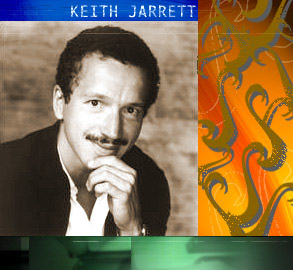
Keith Jarrett

A giant of jazz innovation finds himself reaching new heights by deftly interpreting classic tunes.

  • more
    • All Share Services

Keith Jarrett

Jazz artists who came of age in the ’50s, ’60s or early ’70s tend to place a premium on originality. These were years of rapid evolution, and players wanted to do their part to advance the music. So when, in their waning years, musicians from this era resort to playing tunes out of the standard repertory, it’s generally a sign of spiritual exhaustion — like when a movie actor lands a sitcom.

It’s interesting, then, that pianist Keith Jarrett — one of the more unusual talents in the past 35 years of the music — now finds himself in his most creative phase playing almost nothing but classics. Since forming in 1983, his trio with drummer Jack DeJohnette and bassist Gary Peacock has staked a claim as the preeminent jazz group interpreting standards; it’s probably the closest a piano trio has come to the Olympian heights of the late Bill Evans’ trios. At the piano, Jarrett, 55, has an improvisational zeal matched by a technique that is equal parts meditation and explosion. He is one of the few living jazz pianists with an instantly recognizable sound.

Little in his background suggests that standards would be his ultimate creative ticket. Growing up in Allentown, Pa., he was a prodigy, performing original pieces publicly while in grade school and gigging in jazz clubs as a teenager. Drummer Art Blakey claimed him as a member of his band, the Jazz Messengers, for a brief period in the mid-’60s, after which saxophonist Charles Lloyd introduced him to huge crowds with a group that featured DeJohnette.

Jarrett joined Miles Davis’ groundbreaking DeJohnette-propelled electric group in 1970, and soon after launched a solo career that would take him in various directions. There was Jarrett the classical recording artist, Jarrett the leader of two separate jazz quartets and Jarrett the huge-selling solo-piano improviser.

He has recorded around 75 albums, performed with top symphony orchestras around the world, rounded up numerous Grammy nominations and received a steady stream of awards and honors from governments and the press. Four years ago he was stricken with chronic fatigue syndrome — an enervating malady which the medical establishment scarcely comprehends — and was unable to play the piano for nearly two years. During his recovery an artistic breakthrough came: an album of solo piano, recorded in his home studio, called “The Melody at Night, With You.” For this 1999 release, Jarrett leaves behind his trademark effusion to focus intimately on the songs’ melodies. Ethereally delicate and almost unbearably intimate, it’s a love letter to his wife, Rose Anne, to recuperation, to the jazz repertory and to the piano.

Last year Jarrett returned to touring with the trio — albeit gingerly — recording in Paris the just-released double CD “Whisper Not,” his 12th album with the group. Last summer he played select dates with the trio, most recently closing the San Francisco Jazz Festival.

Jarrett spoke with Salon by phone from his home in rural New Jersey.

The playing on “The Melody at Night, With You” is pared down to the essence of the songs. The new live CD, “Whisper Not,” also sounds more stripped down than anything you’ve done before with the band. How did these developments come about?

Well, because of this illness, I was forced to look at what I was doing as if it would be the last thing I would ever do. I had to stop playing, because of this illness … there was no solution to this thing. I wasn’t able to play for two years. And when I started to recover, I realized that the time off I had wasn’t such a bad thing. I realized that improvisers should probably always have time off. But musicians are always gigging and never have a chance to stop for a minute — unless something drastic occurs.

So when I started recovering, I said to myself that I’d better be my own worst critic. I didn’t know if I’d keep recovering; I thought I might relapse and never be able to play again. I would listen to stuff I’d recorded and a lot of it I didn’t like. I realized I didn’t like the long intros. I didn’t like digging into the keyboard so much. Because when you do that the piano doesn’t open up as much. I decided to pare things down. I wanted to get to the heart of my playing, and to do that I really had to slice away. That’s what happens to mature artists. But it does not happen without reflection.

There is very little improvisation on “The Melody at Night, With You.”

So many people don’t understand “The Melody at Night,” because they think it’s cocktail piano. So it was gratifying to hear someone say, “Nobody knows how hard it is to do what Keith did with that record.” It’s a lot harder to play softly. But after I made the record I thought, “We’re gonna release this, and nobody’s gonna hear it.” What I was doing was not typical of what I’m known for, like improvisational virtuosity. There are no trappings. There’s no echo. And some people made the mistake of thinking they were hearing the sickness. They think it’s pale or something. But the record was actually a celebration of my recovery. I was in a state of grace. I was connected to the heart of these songs.

Some of the tunes were not even in my head when I sat down to play them. “Be My Love” was one of those — not in my wildest imagination did I think I’d play that one. But obviously it was an emotion I was trying to get out. “The Melody at Night” was an ecstatic moment in my life. I look for that experience every time I play, but how often do you get it onto a recording?

You’ve been playing standards pretty exclusively for the past 17 years or so, ever since you formed the trio with Jack DeJohnette and Gary Peacock. But before that you had built up a repertoire of dozens of original songs. Why don’t you play them anymore?

The biggest reason is, you don’t have to be coming on stage saying, “We’re playing our music.” There’s a possessiveness that goes along with that. A valuable player doesn’t have to play anything new to have value, because it’s not about the material, it’s about the playing.

Take a player like Sonny Rollins — he can play anything. If he’s having a good night, and let’s assume he is, then he completely transcends the song. And it’s obvious that it’s not about the material. Anyway, if you already have a piece of music ingrained in your body, why would you not play it?

But isn’t the music you’ve written yourself the most deeply ingrained in your body?

No. Uh uh. One time I was listening to a piece of my own, and I said, “That sounds vaguely familiar …” It wasn’t a part of me. Your own music comes out of your head and emotions, but it’s not etched in your system.

Do tunes have any meaning at all beyond how you play them?

Sure. We have to like them. For example, I don’t play “Hello Dolly” with the trio.

How did DeJohnette and Peacock react when you told them you just wanted to play standards?

At first, when I said to Gary, “Let’s just play standards; I wanna play things we already know,” Gary was shocked for a minute. But when we started to do it, he got unshocked. I surmised, when I first proposed forming the trio, that just getting together every now and then and playing — not rehearsing — would be of value to them. I was right. And that’s our approach. We really never know what we’re gonna play when we get onstage. Gary likes to know what key we’re gonna be in, but that’s about it.

With Jack and Gary, our combined experience in years is immense. Jack and Gary both lead bands. Jack has played — still plays — piano, Gary has played piano and a bunch of other instruments. I’ve played saxophone and other instruments, too. So I said, “Let’s just not worry about the material.” And it’s created a kind of freedom, I think for all of us, that we’ve never had before. We’ve gotten to a place that you can get to only when you’ve gotten all your preferences out of your system.

After one of our recent shows, I think in Boston, Gary came up to me and said, “I thought I had experienced the epitome of swing. I was completely mistaken. This was the most swinging thing I’ve ever experienced in my whole life.”

The trio can go literally any place, and we do, in concert. Once we’re inside a tune, we can do anything with it. We can end up playing completely outside, then we can play something completely familiar. We can play time, or no time. And in the rare cases where playing standards doesn’t work, we don’t have to do that either. We ended up in a hall last summer where the standards didn’t sound good in the room. So I said, Let’s not do this. So we didn’t. We played a whole concert where there was no tune.

The first time I ever saw you perform, in Milwaukee in 1974, you were opening for Larry Coryell’s electric fusion band, and not happy about it. You said some angry words to the audience from the stage. Any recollection of this?

Oh, that was with the quartet, right? And that was when Coryell was playing with the Eleventh House? That was not a well-planned thing. We were supposed to headline, but how were we supposed to come on after that? What were we suppose to do, come out and sound really tiny? So we changed the order.

When you’re up against an electric band like that, it’s like you’re on two separate planets. We wanted to make use of air, and they were using wires. It’s like a toxic exercise. I actually get a metallic taste in my mouth when I think about electric music. That’s why I don’t like recording studios — except my own, which is just a little room above the garage.

I can’t even tolerate my own playing on electric keyboards. It’s not about the musical ideas — the sound itself is toxic. It’s like eating plastic broccoli. I don’t know any jazz pianist who mainly plays electric who goes back to acoustic playing and sounds like they should be playing acoustic.

Even Herbie Hancock?

Yes. I’m not talking ideas, or even presentation. It’s like in politics: You have to sell something to become an electric player — like your skin or your heart.

With acoustic piano there’s so much more of a tactile response, so much more life in it. There are so many different ways of touching the acoustic piano, getting different sounds out, that I can’t imagine why anyone would leave it. If you’re a player, you don’t have enough time in your life to leave it.

But you don’t regret playing all that electric music with Miles Davis?

Well, the power of what we were trying to do was there. Just the instruments sucked. I don’t think I could have done it if I didn’t also have an acoustic band going at the same time. And I knew it wasn’t gonna last. We would put cotton in our ears every night — Jack and I — we couldn’t stand the volume.

But they’re gonna release the Cellar Door dates at Columbia, so you’ll be able to hear at a good length what we sounded like. These were the gigs that most of the cuts on “Live Evil” were taken from. The Cellar Door in Washington in 1970. I think they’re gonna release six CDs next fall. [Note: the personnel of the Miles Davis Band then was Davis, trumpet; Gary Bartz, saxophone; Michael Henderson, electric bass; DeJohnette, drums; Airto Moreira, percussion; Jarrett, keyboards and John McLaughlin guesting on guitar.]

We were a lot freer than “Live Evil” sounds like we were. And the first four CDs will be without John [McLaughlin], because John wasn’t in the band. You wouldn’t know that from “Live Evil,” but John only played with us one night. I think it was a marketing concept to add electric guitar. It kind of threw a curve ball into the band. I wasn’t sure — nobody was sure — what the rules were.

How did you come to join Davis’ band?

Well somehow Miles heard about me. In the mid-’60s I brought a trio into this tiny club in Paris. It maybe held 10 people. The band was Aldo Romano [drums] and J.F. Jenny-Clarke [bass]. I would have brought Charlie and Paul [bassist Charlie Haden and drummer Paul Motian, with whom Jarrett mainly played in the late '60s and '70s], but I couldn’t afford to take them. So, anyway, we’re playing in this tiny club, and one night Miles walks in with his whole band. And he says [Jarrett imitates Davis' rasp], “I want these guys to hear this.”

When I was in the band Miles asked me once, “How do you play from nothing?” Because sometimes I would just play solo. I said, “I don’t know. I guess if I knew I’d be in trouble.”

Continue Reading Close

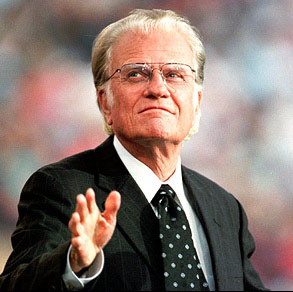
Rev. Billy Graham

At 82, the Elvis (and Marshall McLuhan) of preachers is still the king of ecumenical evangelism.

  • more
    • All Share Services

Rev. Billy Graham

The Rev. Billy Graham, for 50 years Protestant Christianity’s leading Pied Piper, is ailing. He turned 82 on Nov. 7, and has been grappling with Parkinson’s disease and other infirmities. Yet he recently told the Associated Press that his crusading days are far from through. As his son William Franklin Graham Jr. stands by to assume control of the Billy Graham Evangelistic Association, the elder Graham just presided over one of his patented crusades, a Jacksonville, Fla., wingding that featured performances by Johnny Cash, June Carter Cash and Charlie Daniels. As usual, Graham convinced thousands of attendees to make their “decisions for Christ.”

He’s been doing this since 1947. Depending on the source you consult, he’s corralled between 200 million and 225 million souls for Jesus. He’s sermonized in almost 200 countries, following the biblical dictum to “Go ye into all the world and preach the gospel to all creation” (Mark 16:15). The only religious figure of comparable influence is the pope, and there have been five of them since Graham started doing his thing. Popes come and go, but the right reverend endures.

Graham’s specialty — the crusade — has been the medium for the most extravagant Christian spectacle of the last century. Part circus, part holy pilgrimage, part evangelism school, part TV miniseries, part Bill Graham Presents rock concert, these events sometimes go on for weeks. Yet the message he communicates is profoundly simple: Confess your sins, accept Jesus Christ as your lord and savior and get your ticket to salvation. Or, to quote Graham quoting the Bible, “By faith, commit your life to Christ. God’s promise is true: ‘Everyone who calls on the name of the Lord will be saved’” (Acts 2:21).

It’s the lowest common denominator of Christianity: Faith is its own reward. It’s not about doing good works. It’s not about giving up your material goods. It’s simply about belief and surrender. Graham doesn’t hector. He doesn’t condemn. He doesn’t intellectualize. He doesn’t even talk about hell much. He merely extends a hand. And if he is controversial at all, it’s because his “the other shoe doesn’t have to drop” theology offends some Christians who see religion as more complicated. Namely, fire-and-brimstone preachers, Christian academics, Christian-right moralists and Catholics. But to these folks Graham has said: Come on into my tent. It’s a big tent. And most of them have agreed. He’s made joint appearances with popes, rabbis, Buddhists, even African tribal leaders. Graham is the world’s leading ecumenical preacher. He doesn’t bother about categories at all. And with numbers like he racks up, why should he? Does General Motors worry about Jaguar?

Or, a better question might be: Did Elvis worry about Eddie Cochran? Because Graham is indeed the Elvis of preachers. Except instead of grinding his pelvis, he gyrates his arms. There’s no denying that sex appeal is part of what Graham is about, and unlike Jimmy Swaggart, Jim Bakker, the fictional Elmer Gantry and Lord knows how many others, Graham has had the good sense to make it work for him and not succumb to it. He has said that he never allows himself to be alone with a woman who is not his wife or one of his daughters.

Like Elvis, Graham has a God-given combination of looks, charisma and talent. Like his globe-spanning ministry, he is outsized — 6-foot-2 with an imposing cinder block of a head topped with a lavish crop of wavy hair. Thanks to penetrating blue eyes, a prominent nose and teeth that seem to gleam into infinity, Graham on or off the stage projects heroism before he utters a word.

At the pulpit his words spill out in an even tenor that bespeaks his North Carolina upbringing. Unlike the florid cadences of the Southern preachers who seem to dominate the airwaves, Graham’s sermons are borne on the wings of an almost Midwestern rectitude. He is passionate, but his passion is focused, tailored to the message he is delivering, not to his own ego or to any innate sense of theater. Yes, he gesticulates and bellows, but he does not sink to melodrama; he does not weep or tug at his hair or use any of the overwrought techniques of the preacher who claims to be in the mighty thrall of the Holy Spirit.

Graham learned the values of directness, hard work and faith on the 300-acre dairy farm he grew up on outside of Charlotte, N.C. He was born William Franklin Graham Jr. on Nov. 7, 1918, the first of four children raised by William Franklin and Morrow Coffey Graham, both Bible-reading Presbyterians. The Graham Brothers Dairy was a successful business that managed to survive the Depression and thrive thereafter, but young Billy wasn’t destined to farm.

His defining moment came when, at 16, he starting attending the sermons of a visiting fire-and-brimstone Baptist preacher named Mordecai Ham. Graham, in his 1997 autobiography, “Just As I Am,” describes what had happened to him after one of the sermons:

“I checked ‘Recommitment’ on the card I filled out. After all, I had been brought up to regard my baptism and confirmation and professions of faith, too. The difference was at this time I was doing it on purpose, doing it with intention. For all my previous religious upbringing and church activity, I believe that that was the moment I made my real commitment to Jesus Christ.”

Yet the moment was surprisingly dispassionate: “No bells went off inside me. No signs flashed across the tabernacle ceiling. No physical palpitations made me tremble. I wondered again if I was a hypocrite, not weeping or something. I simply felt at peace. Quiet, not delirious. Happy and peaceful.”

But before he accepted the call to preach, Graham discovered he had another skill: selling. He became the region’s most successful Fuller Brush salesman, “convinced that Fuller brushes were the best product money could buy.”

Higher education beckoned, however, and it was another preacher — a silver-tongued Methodist named Bob Jones who ran a college in Cleveland, Tenn. — who convinced Graham what to do. Jones spoke at Graham’s high school, and, with some reservations about Jones’ inflexible interpretations of scripture, Graham decided to enroll. Bob Jones College has since evolved into Bob Jones University, the Greenville, S.C., institution that George W. Bush visited during his presidential campaign even though it had a (since rescinded) ban on interracial dating. The school has always had a thing about dating. In “Just as I Am,” Graham discusses the restrictive dating policies of the college, which included strict chaperoning and proscriptions against sitting on the same sofa as your date.

But it was proscriptions of a more academic nature that drove Graham away from Bob Jones after less than a year. Graham jumped to the Florida Bible Institute in Orlando, which was almost socialist compared to Bob Jones. Teachers at FBI came from a variety of Christian denominations, and Graham thus gained his first appreciation for the ecumenical. He also got his first experience at sermonizing when he was asked to guest preach at a nearby Baptist church. He liked it, and began to practice his oratory alone on a small, isolated island near the school. Soon he was ordained a Southern Baptist minister.

After graduating from FBI in 1940, Graham pursued the dual course of evangelizing and academics. He began studying for a liberal arts degree at Wheaton College in Chicago, and also became pastor of the United Gospel Tabernacle, overseeing a dramatic expansion of the congregation. At Wheaton he met Ruth Bell, who had grown up in China the daughter of a medical missionary. After graduation in 1943, they married.

The next turning point for Graham came when, having accepted an invitation to become pastor of the Western Springs Baptist Church (Graham changed the name to the Village Church because there were more Lutherans than Baptists in the congregation), he also accepted an invitation to take over a radio show called “Songs in the Night,” broadcast from WCFL in Chicago. It became a hit. Then another radio station, WMBI, offered to broadcast his regular Sunday sermons for two months. The flock swelled.

Yet Graham had bigger ambitions. “Preaching throughout the Midwest made me restless with the pastorate,” he wrote in the autobiography. “It seemed to me, perhaps because of the war, that the whole world was ripe for the Gospel. I wanted to be moving, traveling, preaching, anywhere and everywhere.” When he got an opportunity to stage rallies with a fledgling organization called Youth for Christ International, he resigned from the Village Church and committed to full-time evangelism. Graham sermonized at rallies around the country with audiences averaging 5,000 or so, and embarked on a preaching tour of Europe with similar success. Two years later, he’d become an institution.

When Graham preached, he held people rapt to an extent that no one could match until Elvis. But there was a bit of Marshall McLuhan in Graham as well, because Graham was the first religious figure to fully harness the power of the broadcast media. Evangelists before him — starting with Charles Finney in the 19th century — understood the value of spectacle in making converts. Early 20th century preachers Dwight Moody and Billy Sunday applied advertising techniques to the proselytizing art. Graham embraced all this, but upped the ante a thousandfold by making radio and TV part of his ministry.

It all came together in 1949, when an organization of churches in Los Angeles invited him to preach during a “campaign” for Christ. The group pitched a tent in the city, planning to hold meetings for three weeks. Attendance was low at the beginning, but then two things happened. First, a popular Southern California radio announcer named Stuart Hamblen asked Graham to appear on his program. During the show, Hamblen urged his listeners to attend Graham’s meetings, and said that he was planning to himself. He did, and lo and behold, he got converted. On subsequent shows he testified about his miracle, and the crowds started to roll into the tent.

Next, a media figure of considerably more clout — William Randolph Hearst — got wind of Graham’s revivals, and ordered all his newspapers, two of them in Los Angeles, to “puff Graham.” That led to stories by the Associated Press wire service and Time magazine, and all of a sudden Graham was one of the biggest stories in the country. The tent sessions, needless to say, began to erupt into the streets, and the meetings were extended to eight weeks, ending only when the organizers became exhausted.

With the impetus from Los Angeles, Graham set up the Billy Graham Evangelistic Association in Minneapolis, and launched a weekly radio program called “Hour of Decision” that was soon picked up by more than 1,000 stations. From that came the TV version of “Hour of Decision,” which lasted until 1954, when Graham decided that the medium could be better used for broadcasting his campaigns, which he was now calling crusades. He held several of them throughout the country each year, attracting hundreds of thousands to Christianity and getting barrelsful of newspaper and magazine ink.

He took Western Europe by storm in 1954 and ’55, starting in London and hitting most of the major countries. But it was in New York in 1957 that the TV medium and the message first came together gloriously. Graham took over Madison Square Garden for 16 weeks and preached a grand finale at Yankee Stadium. The TV networks broadcast segments of the crusade for several nights, increasing the audience by millions. The tab for the whole shebang was $2 million — and that’s in 1957 dollars. After that Graham led crusades around the world unceasingly, holding more than 20 in ’60 and ’61. His domestic crusades continue to be broadcast throughout the nation and the world.

As has been frequently noted, Graham is as clean as a whistle. He has survived and thrived in a world where the Swaggarts and the Bakkers have fallen into moral and financial scandal, and where preachers of intolerance like Jerry Falwell and Pat Robertson have become figures of low comedy. The only glitch in Graham’s half-century run of salvation came in 1978 when the Charlotte Observer revealed that the BGEA had kept hidden from its members and contributors a $23 million “World Evangelism Fund.” But no one accused Graham of misusing the fund, just hiding it. And after that he opened BGEA’s books for annual accounting, even though as a charity the organization wasn’t legally required to do so. In 1976, it subsequently turned out, the BGEA took in $28.7 million and spent $27.7 million. Not much dirt there.

Graham lives modestly in the log-and-frame house he and his wife built in the hills of Montreat, N.C., in the late ’50s. There they raised daughters Gigi, Anne and Ruth, and sons Franklin and Ned. Graham takes a nominal salary from the BGEA.

Sure, Graham seems unimpeachable — but what about the sin of pride? Perhaps sin is too great a word, but Graham clearly enjoys the reflected glory that comes from basking in the presence of the rich, famous and powerful. His relationships with presidents going back to Truman are legendary, to the point that he’s become known as “chaplain of the White House.” He was closest with Richard Nixon, whom he first met in 1950 when the later-disgraced president was a congressman. He stuck by Nixon, even after Watergate, although he did say this after some of the Watergate transcripts were released: “‘Thou shalt not take the name of the Lord thy God in vain’ is a commandment which has not been suspended, regardless of any need to release tensions.”

Was Graham truly friends with all the presidents he counseled, as he would like us to believe? Yes or no, it’s clear that their relationships have served mutually beneficial purposes. They upped Graham’s publicity quotient, and they allowed the presidents to feel a little bit more holy. As of this writing, it’s not clear who our president-elect is, but if Bush is declared victor, then he already has his Graham credentials in order. Al Gore can claim he’s born again, but he can’t say, like Bush, that it was because of a walk on the beach with Billy Graham.

Faith is a funny thing. Mysterious enough on its own terms, it gets even more complicated when mixed in with religion. The story of Jesus Christ is no more or less outlandish than any other religion myth. It’s straightforward enough: Man is born to virgin, man says he’s the son of God, man is murdered, man undergoes miraculous resurrection and assumes throne in heaven. But thanks to that unruly, often contradictory document known as the Bible, Christianity has become almost a Tower of Babel, where dozens of sects compete with one another about who has the line on the truth. And the members of each sect point to the Bible for evidence of their belief system.

Graham considers himself a fundamentalist, which means he believes in the literal word and truth of the Bible. But when his desire to bring as many people into the tent as possible bumps up against some of the harsher biblical prescriptions, he goes for filling the tent every time. For this, he gets called a hypocrite. Do an Internet search on Billy Graham and you’ll find plenty of Christian Web sites casting hellfire and damnation on the preacher for his supposed flouting of biblical law.

But Graham long ago made his peace with the Bible. When he was a young man casting about in the brambles of academe, he had a crisis of confidence brought on by conflicting biblical interpretation. “‘Oh God! There are many things in this book I do not understand … There are many seeming contradictions. There are some areas that do not seem to correlate with modern science,’” he recounts praying one evening in “Just As I Am.” But then, “At last the Holy Spirit freed me to say it. ‘Father, I am going to accept this as Thy Word — by faith! I’m going to allow faith to go beyond my intellectual questions and doubts, and I will believe this to be Your inspired Word.’”

A funny thing, that faith. But it works for Graham, and it seems to work for the millions he’s brought into the fold. Whether or not you’re a Christian, you have to admit, he gets results. Numbers don’t lie.

Continue Reading Close

Seymour Hersh

The man who broke the story of Vietnam's My Lai massacre is still the hardest-working muckraker in the journalism business.

  • more
    • All Share Services

Seymour Hersh

Investigative reporter Seymour Hersh must feel like he’s howling into the darkness sometimes. His eighth and latest book, “Against All Enemies,” which gruesomely details the extent of Gulf War Syndrome and the government’s attempts to pretend it doesn’t exist, has been selling indifferently and has been ignored by a surprising number of reviewers. His 1972 “Cover-Up,” a report on the Army’s cowardly investigation of the My Lai massacre — the bloodbath Hersh had previously exposed in his blockbuster “My Lai 4″ — also sold poorly. When he revealed in 1991′s “The Samson Option” that Israel was secretly stockpiling nuclear weapons, the response was yawns. What’s the hardest-working muckraker in the journalism business to do?

Hersh’s response: Soldier on. And hope that once in a while you’ll hit a motherlode that catches the public’s imagination. Because one thing is certain: The journalistic glamour of Watergate sleuths Woodward and Bernstein’s “All the President’s Men” has long faded. The starry-eyed kids who once flooded journalism schools to learn how to root out corruption have been replaced by a crop of college grads who have concluded government is inhabited by Martians, so why bother? Better to go for the money. Woodward and Bernstein are pretty much out of the business, anyway, Bernstein writing biographies and Woodward authoring gossipy bestsellers, replete with made-up quotes, about government figures. Elsewhere, ownership of the media is being concentrated into fewer hands, which have been busy blurring the line between news and entertainment and squelching the venues for real journalism in favor of those for gossip and personality.

We live in a cynical time. Lucky for us, Hersh is too invested to turn away. “I think there are great stories to be written about this pretend government and this corporate world we now live in,” he told the Progressive magazine a decade ago. Those are the stories he writes. For a recent instance, he wrote in the New Yorker that the government pretended to have evidence that the plant the United States bombed in Sudan in retaliation for supposed terrorist activity was something other than a pharmaceutical manufacturing facility. It wasn’t, and we knew it, but we killed people anyway.

It’s been an up-and-down career for Hersh, but he was lucky to have a huge up early on — his exposi of the My Lai massacre in South Vietnam. To refresh: In March of 1968, a division of American troops called Charley Company, led by Lieut. William L. Calley Jr., entered the village of Son My (called My Lai 4 on the soldiers’ maps) and spent a few hours killing every man, woman and child — all unarmed civilians — in the vicinity, about 500 all told. Women were raped; babies were used as target practice. Hersh brought it all out in the open, and helped end the war as a result, because Americans realized that this incomprehensible conflict far away was making their boys act like Nazis.

Hersh, in 1969 a 32-year-old freelance writer in Washington, got onto the story after he received a tip that an officer was about to be court-martialed for the murder of civilians in Vietnam. From his sources in the Pentagon Hersh got a hint of what had happened, then he tracked down Calley, who was stockaded in Georgia. Calley spilled all and Hersh realized he had a career-maker on his hands. He wrote the story, but the magazines to whom he tried to peddle it turned him down. They didn’t want to know about it. But luckily a friend who ran a small newspaper syndicate offered to run the piece. Thirty-six newspapers, including the Washington Post, the San Francisco Chronicle, the Boston Globe and the London Times bought the exposi. Then TV picked it up, including “60 Minutes,” and Hersh was in the saddle.

Others had written about random atrocities in Vietnam before Hersh — most notably Jonathan Schell in the New Yorker — but most reportage on the war focused on policy. Hersh was the first to demonstrate that military brass was ordering soldiers to kill noncombatants, and once he did, Vietnam War reporting was never the same. Hersh went on to track down other members of Charley Company and reported their stories for the syndicate, all of which he collected and amplified for his 1970 book “My Lai 4: A Report on the Massacre and Its Aftermath.” He received the Pulitzer Prize for international reporting, the prestigious George Polk Award and a host of other trophies. He was a big deal, and when he wrote a follow-up piece about the Army’s prosecution of Calley, the New Yorker snapped it up. In 1972 he turned it into “Cover-Up: The Army’s Secret Investigation of the Massacre at My Lai,” the lousy sales of which gave him a quick object lesson in the topsy-turvy world of book writing. Hersh blamed the bad showing on Vietnam fatigue. “Nobody wanted to hear about Vietnam in 1972,” he told the Progressive. Apparently, in a mere two years the public’s mood had gone from outrage to ennui. “We were losing the war,” Hersh said. “Until Oliver Stone’s movie ‘Platoon’ came out, I think Vietnam was a dead issue in America.”

Seymour Myron Hersh was born along with a twin brother April 8, 1937, to a middle-class family in Chicago. His father ran a dry-cleaning plant, and he had older sisters who were also twins. In 1958 he received a B.A. in history from the University of Chicago, where he met his future wife, Elizabeth Sarah Klein, now a psychoanalyst. After flunking out of law school, Hersh stumbled into journalism when a friend told him that the Chicago City News Bureau, a crime and courts clearinghouse for the city’s newspapers, would hire college graduates with no experience for $35 a week. After brief stints there as copy boy and police reporter, he joined the Army, where he worked as a public information officer in Fort Riley, Kan. Back in Chicago in 1961 he co-founded a suburban newspaper, which quickly failed. That led to a year reporting for the United Press International wire, and then for Associated Press, which shipped him to Washington. There he proved indefatigable, and AP promoted him to Pentagon correspondent in 1966.

Hersh proved much more adept at making contacts than attending press conferences, and soon he had a raft of sources, many of whom were unaccustomed to being courted by reporters. This first paid off when he learned that the Army was busy secreting away nerve gas overseas. AP, however, was less than enamored with the story Hersh wrote, cutting it by 80 percent and rewriting it. So Hersh quit, and at columnist Mary McGrory’s behest, went to work for Eugene McCarthy’s presidential campaign, convinced that the senator was the country’s best bet to end the Vietnam War. But Hersh couldn’t stand the game-playing in politics and soon returned to journalism.

Hersh wasn’t a peacenik by birth. One might assume that Hersh, coming of age as he did in a Jewish household in the ’40s, was a red-diaper baby, but he says his family was apolitical. His anti-war convictions came strictly through “O.J.T. — on the job training. I was covering the Pentagon for AP and I’d go to lunch with officers. And what they said was that you had to be a professional liar. It was all about body counts. That’s how they measure success in the military. So they would lie about it. It turned me against the war.”

After his stint with McCarthy he authored several pieces on chemical and biological weapons for the New York Times and the New Republic. This led to his first book: “Chemical and Biological Warfare: America’s Hidden Arsenal,” a 354-page tome that exposes exactly what its title suggests, as well as cataloging all the military and academic research helping to bolster the country’s arsenal. And in his chapter on the military’s use of chemical defoliants in Vietnam, Hersh showed why his book was relevant. Certain Hersh traits emerged in “Chemical and Biological Warfare” that would characterize most of his later book writing. On the plus side, he passionately imbued his exhaustively researched, documented, footnoted and indexed work with a sense of mission. On the minus, his writing was a little dense, surviving on the quality of its information alone. More troubling, he tended to give short shrift to points of view opposed to his own, thus inviting accusations of bias.

In 1972 Hersh rode his My Lai rep into the employ of the New York Times, where he engaged in a glorious 7-year run of abundant scoops. He was the Gray Lady’s golden boy, grabbing the nation’s exalted leaders and institutions and revealing them to be twisted and corrupt. The CIA still hasn’t recovered from the thrashings Hersh administered. First he brought to light the CIA’s surveillance of domestic organizations it deemed subversive — a blatant violation of the agency’s charter to gather foreign intelligence only. Then he revealed the CIA’s covert role in overthrowing Salvador Allende in Chile. The agency came across as a bunch of Keystone Kops when Hersh exposed its hijacking of the Glomar Explorer drilling ship in a failed attempt to raise a derelict Soviet submarine.

And where the CIA dallied, Henry Kissinger, Nixon’s national security advisor and later secretary of state, could generally be found making his special mischief. Kissinger was deeply involved in the CIA’s role in Chile, and so became a big target for Hersh. Hersh blew the lid off the Kissinger-directed secret bombing of Cambodia; he revealed Kissinger’s authorization of wiretaps on his own staff and on several other White House aides; and he reported that documents in Kissinger’s office had been stolen by Pentagon operatives. Hersh had other plans for Kissinger as well, but first the Times decided to play catch-up with the Washington Post on Watergate, and Hersh was given the beat. He caught up, too, scooping Woodward and Bernstein on the coverup part of the story and staying competitive with them in other areas as well.

But thanks to “All the President’s Men,” book and movie, Watergate will always be remembered as the Washington Post’s story. To this day Hersh views Woodward with envy. Woodward’s books generally are bestsellers, no matter how tawdry, and he’s smooth and slick, the consummate Washington insider. Hersh is more like the anti-insider, all rough and blustery, given to the proletarian dress of the traditional reporter. But where Woodward now only has his celebrity and money, Hersh has his integrity.

Hersh’s friend Murray Waas, a Washington investigative reporter, says that the kind of work Woodward and other Washington reporters now do is all too common: “There’s only a handful of reporters like Hersh who are still doing investigative reporting. There’s a new crop of journalists who are what I call scandal reporters, or scandal beat reporters. They only pretend to do investigative reporting. The scandal reporters do their work by receiving leaks from partisans, congressional committees, independent counsels, public interest groups and from political operatives or ‘oppo’ folks. They get a leak from Ken Starr’s office or Sidney Blumenthal and call that investigative journalism. It’s kind of like yogurt — predigested for you. The work they pass off as their own is done by someone else. The problem with this pretend investigative reporting is that the reporters are oftentimes serving someone’s political, ideological or personal agenda.”

Hersh is not one to suffer fools gladly. His temper is legendary, and he’s been accused of bullying sources. Though he denies this — “If you piss off your sources, you’re not gonna get anything out of them,” he says — it’s clear that he is capable of working himself into a state of high dudgeon. One of Hersh’s sources told Time magazine that when he wouldn’t say what Hersh wanted to hear, Hersh yelled “Bullshit! Bullshit!” at him. There’s no question that he’s volatile. But Waas, for one, questions whether at least some of Hersh’s reputation in that regard is more folklore than reality. “It’s more shtick,” Waas says. “He knows he has this reputation so he makes fun of himself.”

Waas recalls a series of phone messages he received from Hersh the day Hersh broke a major story in the New Yorker: “‘It’s 8:30 in the morning. Why aren’t you home like every other normal person in the world having your milk and Cheerios?’” Then another message: “‘So what the hell are you doing that you aren’t home to read my story? What do you have going on in your life that’s more important than this? What do you even have going on in your life at all?’ It’s shtick,” Waas says. “It’s self-deprecation. And it’s funny as hell.”

One can imagine that at the genteel New York Times Hersh was something of a bull in the china shop, and indeed in 1979 he resigned. All the better to work on his next book, “The Price of Power: Kissinger in the Nixon White House,” which hit the shelves with a 700-page whomp in 1983. The book is a feast for Kissinger haters, revealing the Machiavellian official to be capable of practically any nefarious deed in order to stay cozied up with Nixon and dominate U.S. foreign policy. Hersh opens the book with a humdinger — that during the 1968 race between Nixon and Hubert Humphrey, Kissinger was double dealing, giving information he had collected from President Johnson on secret Vietnam peace talks in Paris to Nixon. At the same time, to curry favor with Humphrey, Kissinger offered him Nelson Rockefeller’s files on Nixon.

After Nixon was elected he hired Kissinger, and the two became locked in a pathological embrace of mutual distrust, plotting end runs on various cabinet members in order to create a kind of White House monarchy. Along the way there were betrayals, wiretaps and perverse orders to bomb countries with which we were not at war. Thousands died needlessly, and thousands of others came to know Kissinger as a war criminal.

“The Price of Power” was a bestseller, and added a National Book Critics Circle award to Hersh’s belt, but it remains a bit of a slog and got some justified criticism for its indiscriminate shoveling-on of factoids. Not to mention that Kissinger may have had the last laugh. The book “didn’t make any difference in the press’s perception of him,” Hersh said. “I can barely get through a week of ‘Nightline’ without seeing him on some panel.” On the other hand, “When the rest of us can’t sleep we count sheep, and this guy has to count burned and maimed Cambodian and Vietnamese babies until the end of his life.” Not something you can picture Woodward saying, eh?

Kissinger wasn’t a player in Hersh’s next book — “The Target Is Destroyed: What Really Happened to Flight 007 and What America Knew About It” (1986) — but his Cold War ethos is all over it. In the early morning of Sept. 1, 1983, the Soviet Union shot down a South Korean Airliner that, en route from Anchorage to Seoul, strayed far into Soviet airspace. All 269 passengers, including 25 Americans, died in what became one of the worst flare-ups in the history of the Cold War. The Russians claimed KAL OO7 was really on a spy mission, and the Reagan administration countered that the Soviets destroyed the plane even though they knew full well it was a civilian craft. Because the plane’s black box cockpit recorder was never recovered, the truth can’t be completely known, but Hersh — in a virtuoso exercise in penetrating the notoriously hush-hush U.S. intelligence community — showed that the incident was nothing more than a trivial accident compounded by a horrible one. The plane strayed off course, and the Soviets ineptly assumed, without verifying, that it was spying and shot it down. Then when they quickly realized their mistake, they never fessed up, and the Reagan administration — which well knew of the Soviet error — also clammed up. Both sides wanted to score Cold War points, and Kissinger no doubt would have approved.

Hersh’s next book, “The Samson Option: Israel’s Nuclear Arsenal and American Foreign Policy” (1991), is another tale of U.S. hypocrisy. Hersh demonstrated that the government, while preaching nuclear nonproliferation, encouraged Israel to secretly acquire and develop nuclear weapons, then kept silent about it. Cold War needs were again served, because many of the Israeli nukes were aimed at the Soviets. Among the fascinating claims in the book: Israeli Prime Minister Yitzak Shamir gave U.S. intelligence documents that had been stolen by convicted spy Jonathan Pollard and given to the Soviet Union. And: British press baron Robert Maxwell and his foreign editor at the London Daily Mirror, Nicholas Davies, were agents of Israel’s intelligence agency Mossad. Outraged at the accusation, the pair sued Hersh for libel. They lost.

A tale of intrigue that perhaps was a little too Byzantine for American readers, “The Samson Option” contained the germs of two later exposis that Hersh wrote for the New Yorker: One delved further into Pollard’s misdeeds in order to persuade Clinton not to grant him clemency, as Israel Prime Minister Benjamin Netanyahu was urging. The other, more terrifying, revealed that in 1990 India and Pakistan came close to nuclear war because the United States, under Reagan, illegally sold nuclear weapons to Pakistan, our ally against the Soviet Union in the Afghanistan war. As Hersh pointed out, this was a far more dangerous situation than the also-illegal Iran-Contra scandal, but Reagan got away with it.

Which brings us to a question: Who was the most corrupt president in the post-war era? Reagan? Nixon? Clinton? All have their advocates, but if you’re Hersh, the answer is none of the above. His choice is John Fitzgerald Kennedy. And when he made his case for that in his 1997 bestseller “The Dark Side of Camelot,” the amount of flack he received was astounding. Talk about pack journalism. The media ganged up on him like jackals circling a wounded antelope. Hersh’s sources were untrustworthy, they cried, his evidence sheer speculation and innuendo. And not only media, but academics like Garry Wills and historians like Arthur Schlesinger swarmed Hersh as well, calling him an irresponsible money-grubber. The story of the reaction to “The Dark Side of Camelot” ended up being much bigger than the book itself, which, truth be told, contained less new information than confirmation and amplification of known Kennedy misdeeds.

We know JFK was a sex addict, but Hersh tells us that prostitutes made regular visits to the White House. We know JFK was obsessed with Castro, but Hersh presents evidence that Kennedy gave the order to assassinate the Cuban leader during the Bay of Pigs invasion. We know JFK’s father, Joseph, was a crook who stole various elections for his son, but Hersh gives new sordid details. As far as brand-new information is concerned, the most damning is probably Hersh’s claim that Kennedy ordered South Vietnamese President Ngo Dinh Diem assassinated because the leader was negotiating with Ho Chi Minh to end the war, and Kennedy didn’t want the war over until after he was reelected.

Another sideshow that ended up overshadowing “The Dark Side of Camelot” was the saga of the forged documents. The smokiest of the smoking guns Hersh planned to include in the book was his discovery of a supposedly authenticated handwritten note from Marilyn Monroe to JFK in which the actress demanded the president create a $600,000 trust fund for her ailing mother. The quid pro quo was that Monroe wouldn’t reveal her and JFK’s affair. A contract spelling out the terms of the trust fund was signed by both of them. This was sizzling stuff, and there were lots of other damning documents from the same cache. Hersh used them to get NBC to sign a $2.5 million contract to make a Kennedy documentary, and when the network pulled out Hersh signed with ABC for the same amount. But when ABC had the documents tested, they turned out to be phony. Hersh had been duped, and he admitted it.

Yet even though he didn’t use any of the material for his book, he got lambasted for believing it in the first place. And he probably should have been more suspicious, because in hindsight, his attempts to peddle the papers seem unseemly. Says Hersh, “Abe Rosenthal [recently fired New York Times columnist who was executive editor during Hersh's tenure] once told me, ‘Don’t hang your ass out in the air, cause it’ll get bit.’ Well, I hung it out and it got bit.” Still, the negative reaction to “Dark Side” was way out of proportion. Why? “There’s a suspension of belief when it comes to the Kennedys,” Hersh told the Fort Worth Star-Telegram. “It’s a cult. We want to believe.”

That includes several prominent journalists, who didn’t like to be told they were wrong about Kennedy. “What does this book say about Hugh Sidey and Ben Bradlee?” Hersh asked Newsday. “They would love to see me bamboozled.” Bradlee, the dashing former editor of the Washington Post, was a friend of Kennedy’s. “I think Hersh was a pioneer,” he told Newsday. “But this is very sad what is happening now. Some of this stuff defies belief.”

Bottom line: Hersh approached “Dark Side” no differently than any of his other books. It is rigorously documented and relies on interviews with named sources, in this case several former Secret Service agents who never spoke with anyone about Kennedy before Hersh. But because this time Hersh took on the king of America’s de facto royal family, the media pored over the book as though they were scientists examining evidence in a forensics lab. Not surprisingly, not all Hersh’s information turned out to be unimpeachable — but the same could be said for all his other books. What he has been throughout his career, though, is more unimpeachable than practically anybody else. With his latest book, “Against All Enemies: Gulf War Syndrome, the War Between America’s Ailing Veterans and Their Government,” Hersh has come full circle. He wrote about chemical and biological weapons in his first book, and in “Against All Enemies” he shows that there were manifold opportunities for soldiers in the war against Iraq to be exposed to chemical agents, whether nerve gas or uranium traces or faulty vaccinations. He also cites a classified report that said up to 47 percent of the gas masks supplied to U.S. troops were defective.

The upshot: thousands of Gulf War veterans showing up at veterans hospitals have reported debilitating symptoms ranging from headaches and memory loss to chronic fatigue. It’s like Vietnam and Agent Orange all over again. But in that case it took 20 years before the government came clean about Agent Orange and started paying disability benefits.

“What we did to those kids, this is going to be an issue,” Hersh said to a newspaper while on a book tour for “Against All Enemies” in Denver. “We’re going to make this an issue. We’re going to make the American people collectively ashamed that they cared more about Monica Lewinsky than what’s going on in their own neighborhood.”

Hersh is howling again. Sounds like music.

Continue Reading Close

Garry Trudeau

The most powerful voice for truth and justice in American journalism is the junkyard dog of editorial cartooning -- and the creator of "Doonesbury."

  • more
    • All Share Services

Garry Trudeau

Much has been made of Ronald Reagan biographer Edmund Morris’ invention of himself as a fictional character in order to plumb the cryptic psyche of our cherished former president, but consider this: In 1987, Garry Trudeau, creator of “Doonesbury,” beat Morris to the punch, only inversely. Battered by the realization that after eight bizarro years Reagan was basically beyond satire, Trudeau couldn’t let go of him. So in one of “Doonesbury’s” more perverse tropes, he created a Reagan alter ego called Ron Headrest, who existed in electronic form only and mischievously popped up at will on people’s TV screens.

Based on the computer-generated, stuttering ’80s TV character “Max Headroom,” Headrest was a shtick-figure Reagan with an unleashed id who could smear the 1988 presidential candidates at will (“So is P-P-Paul Laxalt mobbed up?”) and finally declared himself one. “If elected president I promise to lie, lie!” cracked a leering Headrest from the tube. “I’ll s-s-set up illegal covert operations and lie about them to Congress and the American p-p-people! If detected I promise to falsify documents, shred evidence and preserve plausible de-de-deniability! Then I’ll take the Fifth! But with moist eyes! And selflessly …!”

It was a bit of hysteria on Trudeau’s part, and not the first time he seemed to be playing Ahab to Reagan’s White Whale. On the eve of the Carter-Reagan election in 1980, Trudeau did a series of strips in which his blowhard TV correspondent Roland Hedley Jr. took a tour of Reagan’s brain, pointing out the frayed synapses and dead neurons. It was not subtle. It was as if Trudeau, just days before the election, was using his daily comic strip as a megaphone to yell, “Reagan’s a moron! Don’t vote for him!” Now, while Trudeau may have been technically correct, you can’t really blame the various newspaper editors who refused to run the strips. On the scores of occasions editors have killed Trudeau’s strips over “Doonesbury’s” 29 years, this was probably the only time the news hacks had even a shred of justification.

But Trudeau has never had an entirely comfortable relationship with the editors who buy his strip. In fact, “Doonesbury” is one of the most controversial comic strips of all time. And it’s also one of the greatest, for many of the same reasons. He drives editors crazy, but there’s not really a whole lot they can do about it because they know Trudeau is smarter than they are. He can express ideas more clearly, succinctly and wittily than they can, and he does it through a secret weapon — a combination of images and words that we somewhat mundanely call the comic strip. The great cartoon artist Art Spiegelman may call comics “the hunchbacked, half-witted bastard dwarf stepchild of the graphic arts,” but don’t tell that to Trudeau. Out of about 250 comic strips circulated in English-language newspapers throughout the world, “Doonesbury” is in the top 10, carried in 1,400 papers. That “Garfield,” “Cathy” and “Hagar the Horrible” are carried in even more papers says little beyond elucidating the sorry state of the millennial newspaper comics page. The fact is, Trudeau has won over his millions of readers through the power of his words and ideas, without having to resort to endlessly repeating overweight gags or the foibles of neurotic cat owners.

Ah, you may ask, but isn’t that what the comics page is for? Cute drawings, gags and whimsy? Does the bleary-eyed reader, recently roused from sleep with coffee cup in hand, really need to see the president portrayed as a waffle? Or a menacing, cigarette-wielding guy in sunglasses brandishing a gun and popping pills? Or two men getting married? The numbers powerfully answer yes, but that hasn’t halted debate over whether “Doonesbury” belongs on the comics page. In fact, several papers run the strip on the editorial page, and may well be justified in doing so. Trudeau, mindful that many of his strips constitute editorializing, has said he doesn’t care where newspapers stick “Doonesbury.” In 1975 he won a Pulitzer Prize for editorial cartooning — the first time the award went to a comic strip artist — and he was a finalist for another one in 1989. But the subversive thing about Trudeau is that he gets his message across to all those comics page readers who couldn’t care less about the editorial page.

Wiley Miller, who draws a semi-political comic strip called “Non Sequitur,” calls Trudeau “far and away the most influential editorial cartoonist in the last 25 years.” That’s a bold statement to make in a journalism world populated by opinion page artists like Tom Toles, Pat Oliphant and Herblock. But while acknowledging their genius, Miller says, “They’re not influential.”

Garretson Beekman Trudeau starting drawing “Doonesbury” while he was a student at Yale in the late-’60s. The strip evolved from an earlier comic he drew for the Yale Daily News called “Bull Tales,” which gently but piquantly satirized campus life through the prism of a cast of college characters, primarily a football jock named B.D., who was based on Brian Dowling, the Yale — and later professional — gridiron hero. “Bull Tales” caught the eye of an entrepreneur who wanted to start a comics distribution outfit, and who convinced the 20-year-old Trudeau to sign on, thus launching the Universal Press Syndicate, which continues to handle “Doonesbury” along with strips like the afore-scorned “Garfield” and “Cathy.” Trudeau got the title of his new strip by combining the word “doone” — which today would translate as “dweeb” — with the name of his roommate, Charles Pillsbury. It’s also the name of the strip’s putative central character, Michael Doonesbury, who back then was a nebbish who could never get a girl, and who now is a divorced dad and head of an Internet start-up that has just had an IPO.

Like George Bush Sr., who also attended Yale and whom Trudeau has savaged with special relish, the cartoonist is well-pedigreed, with ancestors who landed in the colonies in the 17th century. His father is a doctor, as was his grandfather and great-grandfather. Other relatives include former Canadian Prime Minister Pierre Elliott Trudeau, a treasurer of the United States under Lincoln and the financier after whom New York’s Beekman Place was named. Garry grew up wealthy in the upstate New York town of Saranac Lake, attended St. Paul’s boarding school, then Yale. In 1980, while he was still living in New Haven, Conn., he married TV personality Jane Pauley, and they’re now raising three teenagers on Manhattan’s Central Park West. The family is serious about privacy — Trudeau has submitted to only two major print interviews in the past 20 years, although he delivers an occasional speech.

“Doonesbury” premiered on Oct. 26, 1970, united around a group of misfits, including B.D., Michael and Zonker, who attended fictional Walden College and lived together in a commune, making wry observations about their personal lives and world events. Trudeau thus became a member of an elite tradition of humorists who have constructed well-defined communities from which to aim their satire. His primary influences are two late comic-strip legends: Walt Kelly, whose brilliantly drawn Okefenokee Swamp critters in “Pogo” waxed on about the vagaries of life while occasionally being visited by real-life politicians in animal guise, and Al Capp, who relished deflating the rich and powerful from hillbilly Dogpatch in “Li’l Abner.” Also in this place-based camp are radio’s Garrison Keillor, who lampoons society from Lake Wobegon on “A Prairie Home Companion,” and perhaps Trudeau’s greatest progeny — Matt Groening, whose “The Simpsons” and its cast of characters did for TV what “Doonesbury” did for the comics page.

But while “Doonesbury” has unquestionably earned its way into the canon of great comic strips, it’s through no thanks to Trudeau’s drawing skills. He’s the first person to denigrate his own draftsmanship, and indeed, his characters are simply drawn, distinguished from one another by hair, nose and head shape variation alone. If Trudeau had come along in the golden age of strips when people like Elzie Segar (“Popeye”), George Herriman (“Krazy Kat”) and Winsor McCay (“Little Nemo in Slumberland”) ruled the comics pages, he would have been laughed out of the newsroom. Al Capp once said of Trudeau, “Anybody who can draw bad pictures of the White House four times in a row and succeed knows something I don’t. His style defies all measurement.”

Drawing strips consisting of four panels of the same static object, whether it be the White House or somebody watching TV, is a trick Trudeau learned from Jules Feiffer, another political cartoonist with lots to say, and it’s effective. As the words tell the story, the artwork sets the scene, and a slight modification in the last panel’s image, say, a change in facial expression, serves as a rim shot to the punch line — badda-boom! But the static-image formula is only one option available to Trudeau, and the way he alternates it with strips featuring more varied panels gives rise to a kind of meta-rhythm for “Doonesbury” over the weeks and months.

But Trudeau’s major contribution to the genre is of the content kind. He was the first — and is still one of the only — strip artists to pick real people and real current events as the targets of his humor. This was nothing new to editorial cartoonists, of course, but they didn’t have the luxury of being storytellers. Trudeau could creep up on his targets and then destroy them like a great stand-up comic. Ah, but if only Lenny Bruce had had an audience of millions every day.

Trudeau is dangerous — arguably the most powerful voice for truth and justice in American journalism — and he’s hilarious. Steve Benson, widely syndicated editorial cartoonist for the Arizona Republic and president of the Association of Editorial Cartoonists, calls Trudeau a “demigod.” “He takes on all comers. He’s like a junkyard dog — he just doesn’t let go. But he mixes up his punches. Sometimes he can work like a skilled surgeon. Sometimes he can be like a chainsaw. And I think he’s at the top of his game.”

Trudeau had the luck to introduce “Doonesbury” in a defining moment of postwar America, when a youth counterculture preaching equality, fraternity and love was hitting the streets and trying to take back a country deemed hijacked by war-making white men driven by greed and indifference to human life — Richard Nixon, of course, being the epitome. But if all Trudeau had to offer was anti-war propaganda, “Doonesbury” never would have succeeded. He was as apt to make fun of his campus radical exemplar, Mark Slackmeyer, as to give him a platform, and the same could be said for all his characters. With the possible exception of B.D. and his bimbo wife, Boopsie, who are reactionary comic foils, each member of the “Doonesbury” crew is as multidimensional and fully realized as humans can be in a comic strip. They’ve earned their characterizations over 29 years. And each has evolved, in synch with Trudeau’s finely tuned radar for the themes that have defined the American landscape.

Lovable Mike, the Pinocchio-nosed schlemiel who seems to have finally made good, is the “Doonesbury” figure who most captures the tenor of the times. Starting out as the most adrift of the Walden commune members, he entered the ’80s as a classic Reagan Democrat, later to turn Republican. Trudeau, cynically but tenderly, led Mike further and further down the sellout trail, until he went to work for an ad agency and created the enduring Mr. Butts character for the tobacco industry. (His ex-wife, J.J., sold out, too, making art for Donald Trump, who, now that he’s seeking the presidency on the Reform Party ticket — real-life here, folks! — is already beginning to suffer some fresh barbs from Trudeau’s pen.)

Mike, relocated to Seattle with his computer-genius daughter, Alex, has borne the brunt of Trudeau’s Internet Age satire. As a non-computer-savvy baby boomer, Mike found himself in a bewildering culture of e-mail chat groups, programming geeks, corporate downsizing, Microsoft domination, venture capital and initial public offerings. In one of “Doonesbury’s” current story lines, Mike has launched on IPO on the struggling Internet start-up he runs with his new Gen-X bride, the Vietnamese Kim. Trudeau takes this opportunity to bash an industry that seems bent on rewarding money losers, and along the way he gets in some scathing shots at Nike, which employs one of Kim’s relatives in a Vietnamese sweatshop.

Neither has the rest of the “Doonesbury” crew sat still. Mark became a left-wing radio host, came out of the closet and married a conservative businessman. “I can’t imagine what you have in common with my son,” Mark’s appalled father, Phil — a former Reagan official who served time for insider trading and who’s now a tobacco lobbyist — says to Chase in one strip. “Well, it’s physical, of course,” chimes in Mark.

Eternal hippie and ever-unemployed Zonker achieved glory as a competitive tanner, served as nanny to the children of Mike and J.J. and B.D. and Boopsie, won $20 million in the lottery, purchased a British peerage title and squandered all the dough. Feminist icon Joanie Caucus got a law degree and went to work first for liberal Republican Rep. Lacy Davenport — who later developed Alzheimer’s disease and bequeathed her fortune to a homeless woman — then President Clinton. And Zonker’s drug-addled, gun-crazed Uncle Duke, modeled on gonzo journalist Hunter S. Thompson, has been involved in adventures ranging from being ambassador to China to turning up as the 53rd Iran hostage to cocaine smuggling to working for David Duke, Oliver North and Donald Trump to running an orphanage to becoming a zombie who gets sold into slavery in Haiti. “He could use the discipline,” one of his friends says.

Then there’s the politics — the ruthless savaging of politicians, public figures and attending sycophants that drives so many newspaper editors crazy. Trudeau’s treatment of his first presidential victim, Nixon, was almost tender, such an easy target was he. President Ford had to veto a bill Congress passed to lay him off; the Carter administration was dominated by his Secretary of Symbols, who really flourished on the Jerry Brown campaign; Reagan was so baffling that even his own handlers couldn’t fathom him, much less the press corps; Bush was the invisible man, unable to take a position on anything, who when campaigning had his manhood placed in a blind trust; Quayle was and continues to be depicted as a feather; Newt Gingrich was a bomb that Trudeau took great pleasure in finally exploding; Clinton is a waffle who seduces not only woman but all the reporters covering him.

And that’s just the presidents. Trudeau has delivered indelibly sly, vicious portraits of Yasser Arafat, Fidel Castro, Pat Buchanan, Eldridge Cleaver, Alfonse D’Amato, Ed Meese, Jesse Jackson, Michael Huffington and on and on and on.

Trudeau has rendered an account of our times so rich in detail it makes you gasp. And if he has proven one thing in the nearly 10,000 strips he’s drawn, it’s that there’s nothing new under the sun. Think George W. Bush’s “compassionate conservatism” slogan is an original concept? Zap back to a “Doonesbury” from 1981, when Walter Mondale describes his philosophy as “neo-nice.” Was it not clear that the Desert Storm invasion of Iraq was for the benefit of big oil? Well, Zonker learned something like that in 1980 when, while registering for the military as per President Carter’s request, he was asked, “If called upon by your country, would you be willing to give your life to protect the interests of U.S. oil companies?” (When Zonker screeches “OIL COMPANIES!?” the clerk responds, “It’s only hypothetical. We’re just trying to get a head count.”) Was it funny to you when Sonny Bono was elected mayor of Palm Springs, Calif., in 1988 and later to Congress? At a benefit concert he was about to play in 1976, rock star Jimmy Thudpucker says, “Awe-inspiring isn’t it? One vibrant kinetic mass of 30,000 sun-bleached Santa Monica rock junkies. You know, it’s a good thing that vote can’t be harnessed, or our next governor would be Sonny Bono.” Remember Dana Carvey, doing his spot-on impression of George Bush at the debate with Clinton on “Saturday Night Live,” waving his arms around and pleading, “Please, oh please, don’t let me be a one-term president!”? Wonder if Carvey had in the back of his mind the 1980 “Doonesbury” in which Bush, then ambassador to the United Nations and a presidential candidate, is summing up his storied career to a group of prep school kids. When one asks him how long he’d like to be president, Bush replies, “The big four. I’m an optimist. I think I can go the distance.”

A steady stream of news items, editorials and letters to the editor about “Doonesbury” has served as a kind of chorus to Trudeau’s influence. Newspapers have taken reader polls asking if “Doonesbury” should stay or be banished. Editors pondering killing certain strips or moving them to the editorial pages question Trudeau’s fairness. In a 1990 interview with Newsweek, Trudeau said fairness isn’t the issue: “Criticizing a political satirist for being unfair,” he said, “is like criticizing a nose guard for being physical.” Trudeau said he’s propelled “by a sense of moral indignation, which you hope doesn’t slip into malice when you’re executing. The critical difference is that you’re not only against something, you’re for something. It springs out of a sense of hope. The day I start writing from a scorched-earth viewpoint is the day I don’t think I can justify my presence in the business.”

And it’s true, nobody thinks of Trudeau as a curmudgeon. “Doonesbury,” harsh as it can be, has a warm, fuzzy quality that celebrates the inherent absurdity of Homo sapiens. And he rarely takes himself seriously. One color Sunday “Doonesbury” from ’93 had Zonker picking up the White House while explaining to readers that it’s just a scale model. Then he tosses it, with a little Clinton voice yelling, “Aiee!” and says, “Of course, what really counts are the regular characters.” In another strip, an especially sexily drawn, bikini-clad Boopsie, getting photographed for Sports Illustrated’s annual swimsuit issue, wonders if there’s a sweeps week on the comics page.

And you gotta love a guy who wants to better himself. In the winter of ’83 he began a 21-month sabbatical from the strip to try his satirical hand at play writing, collaborating with musician Elizabeth Swados first on the Broadway version of “Doonesbury,” which ran for about five months, and then on a musical revue called “Rap Master Ronnie,” which traveled around the country for several years. He returned to the strip with a bigger-is-better approach, enlarging his characters literally and philosophically, and using his clout to demand that editors run “Doonesbury” at least 7.33 inches wide, which was a former standard that cost-conscious editors had been steadily eroding. Other comic strips ended up running larger as well, thanks to Trudeau’s influence.

Later in the decade he demonstrated his writing chops for a brilliant HBO film series (available on video) called “Tanner ’88.” Directed by Robert Altman, it introduced a fictional neoliberal presidential candidate into the ’88 campaign, pitting him against the real contenders. Like “Doonesbury,” only live-action, it blended fact and fiction to mordantly skewer political institutions and the press that attends them.

But Trudeau has insisted that pumping out “Doonesbury” is his primary gig, one he’ll continue unto old age. At this point, it’s hard to imagine living without it. It almost makes you happy that George W. Bush could be elected our next president. On the other hand, that might just drive Trudeau crazy.

Continue Reading Close

Page 1 of 2 in David Rubien