Deanne Stillman

Hell’s author

Legendary badass biker Sonny Barger and his roaring Harley are burnin' up the highways on a ... uh ... book tour?

  • more
    • All Share Services

Hell's author

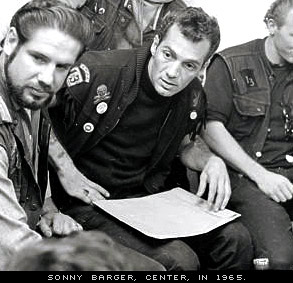
In 1982, after smoking three packs of Camels a day for 30 years, Sonny Barger, the founder of the Oakland Hells Angels motorcycle club, was diagnosed with cancer of the larynx and his vocal cords were removed. On the way to the operating room, he smoked one last cigarette. “They cut a hole in the front of my neck,” he writes in his new autobiography, “Hell’s Angel: The Life and Times of Sonny Barger and the Hell’s Angels Motorcycle Club.” When he recovered, he had to learn how to talk again. “I put a finger over the hole,” he continues, “and vibrate a muscle in my throat.”

As I talk with Barger at a movie producer’s office in West Hollywood, two bodyguards — Pete from the Dago chapter (San Diego) and Bobby from Cave Creek (Arizona, where Barger now lives) — sit on a couch across from us and look on from behind their shades. Also present is Fritz Clapp, Barger’s lawyer and associate, a non-Angel out of prep school and Dartmouth, by way of the Marines. After a while, when it is evidently clear that I am not an actor in some greater play involving Barger’s very life, they leave.

At 61, Barger, still stocky and buffed, moves with the quick edge of a street-fighter. I ask him how he heads into the wind with a hole in his throat and pipes that don’t work the old-fashioned way. He explains that since his operation, he has worn a full-face helmet (though he is still not in favor of helmet laws). His bike has a windshield. There is an “obvious economy of speech,” a phrase from his book, yet one senses that back in the day, before the cancer, his rap was quite engaging.

Barger is a perpetual and metaphorical fugitive, ever on the road, except for when he’s been in jail, time which amounts to a total of 13 years. “They can’t scare you once they put you in jail,” he says. His rap sheet has become a calling card, and he includes it at the end of his book, as others might list sports stats. The arrests — 21 of them — began in the ’50s for drunken driving and continued through the next 30 years, with Barger charged with, among other things, attempted murder (charge dismissed), kidnapping (time served), drug possession (disposition unknown) and racketeering (59 months).

The mythology around him has swirled accordingly. He’s either a bad guy as in really cool, or a bad guy as in he really is not a nice person, depending on one’s value system. Either view has attracted women and journalists. All previous accounts of him are inaccurate, Barger says, referring to Hunter Thompson’s “Hell’s Angels: A Strange and Terrible Saga” (which he agrees is well-written) and Yves Lavigne’s atrociously written informant-based reports called “Hell’s Angels” and “Hell’s Angels: Into the Abyss.”

Now, with the publication of “Hell’s Angel,” Barger is telling his own story. To promote his book, he has embarked on what might be called a road jaunt, though he now sleeps in hotels and friends’ homes instead of stopping wherever he chooses and taking a pill to knock himself out as he used to. But there’s still an element of bad in the book tour.

The tour began in Chicago on Michigan Avenue at a Barnes & Noble, and it was not lost on some observers that it had kicked off in the heart of Angels’ enemy territory, the Midwest and particularly Illinois — the home turf of the Outlaws, a rival club. Was this a ballsy strike on Barger’s part, or did the publisher start the tour here to take advantage of a package deal on a room at the Hilton? Who knows. If the Outlaws ever have a book signing in Oakland, I guess we’ll learn the answer.

Yet turf matters not to the devoted; often, wherever Barger has gone, from bookstores to Harley dealers, he’s encountered a writer’s wet dream: selling 500 to 700 copies at a pop, as legions of his fans wait in long lines for a papal visit and blessing. The book’s first printing of 45,000 copies has sold out and there have been several additional print runs. It’s hovering at No. 15 on the New York Times bestseller list, and is under option to producer Ben Myron with Tony Scott set to direct and Barger and Clapp to produce.

“Maybe it’ll be good,” Barger says. “I like what Tony has to say about riding. He used to ride, you know. In England. But I have no idea who should play me. The only actor I like these days is Jim Carrey.”

In his book, Barger takes on his enemies, informers, cops, the RICO act and, to this gal’s delight, the Rolling Stones. He blames the Stones for the famous incident at Altamont in which a fan pulled a gun and was killed by an Angel. I’ve always hated the Stones; I know a good garage band when I see one and the Stones ain’t it. Barger likes to tell this story about Altamont: “The crowd was waiting all day to see the Stones,” he recalls, “and they were sitting in their trailers acting like prima donnas … They got the crowd worked up and they used us to keep the whole thing going. All that shit about Altamont being the end of an era was a bunch of intellectual crap. It was the end of nothing.”

It’s true that eras do not begin and end with music festivals, yet Barger’s disclaimer may have come too late; as it has been decreed in the press, Altamont may forever remain the epitaph for the ’60s.

Barger is no stranger to the fable factory. All his life, as he tells it, he has been misunderstood by the culture that both builds and feeds off his myth. Pegged as a bad boy, he does not shy away from the characterization. He readily talks about his run-ins with cops, Angels who have been killed in fights or bike accidents, years of drug abuse, the toll that it took on the people around him, particularly his second wife who after years of doing speed with him finally left, but not before passing him off to the woman to whom he is now married. He laughs about how the cops are still, and probably forever, on his tail.

At a book signing in Albuquerque, N.M., someone was arrested for carrying a firearm. “There are undercover cops at all my signings,” he says. “The store in Albuquerque had two parts — one was a bookstore, the other was a restaurant which sold wine. You’re not supposed to bring a firearm into a place that sells liquor so that’s what they used to arrest the guy, even though the place was also a bookstore.” At the signing in Glendale, Calif., evidently a high-ranking member of the police department had parked his car outside the Harley dealer to keep an eye on things, but sent an emissary in to buy an autographed copy of Barger’s book. “Cops are like children,” he says.

One could say that Barger was first busted as a baby. When he was born, his father, Ralph Hubert Barger Sr., worked in California’s Central Valley, laying down pavement for Highway 99, drinking and sleeping in motor courts in the accompanying little towns. Sonny’s mother, Kathryn Carmella Barger, would take Sonny and his older sister, Shirley Marie, to visit Ralph, shuttling “like gypsies” between Oakland and Modesto, Calif., on a Trailways bus. When Sonny was 4 months old, his mother ran off with the bus driver, landing in Twentynine Palms, Calif. (once-and-future way station for the country’s wanderers), leaving her son with a babysitter in Modesto who alerted the cops. Came the call from the police department: “Mr. Barger, we’ve got your son down here.”

When old enough, Barger began to escape. His first runs were to San Francisco — on his 26-inch Schwinn one-speed with coaster brakes. Later, after a stint in the U.S. Army and a series of dead-end jobs (including a shift on a potato chip assembly line), he hooked up with other war vets who had seen the world and weren’t happy with the one they found back at home. They set up shop in Oakland, and enacted a set of rules that comprised a fun house mirror image of military structure: on California runs, weapons will be shot only between 0600 and 1600 hours; Club will furnish patch which remains club property; there is a five-dollar fine for fighting among club members (“Hardly a deterrent,” Barger says); no spiking the club’s booze with dope; no messing with another member’s old lady. (“Big-time rule,” says Barger; “There are 50 million women in the world, which leaves only a few thousand Hells Angels old ladies you can’t fuck with.”)

But in talking to Barger, there is the sense that he would like to make yet another escape — from the myth around him, the one that he’s out on the road, selling. He prefers Japanese bikes to American, says they’re better, but continues to “buy American.” He talks about encroachments on freedom. “They’re taking away our guns,” he says. He lives in Arizona because it has fewer laws than other states. “I love the desert,” he says. “It’s like California used to be.”

Barger continues to name other signs of what he sees as impending fascism. “Did you know that the Army’s helmets look exactly like Nazi helmets in World War II? They’ll never tell you that but take a look. They’re getting us ready,” he says. Ready for what? “Well, this is how it starts. Little things.” I ask when the Army adopted the helmets. “Ten years ago,” he says, and then trails off as the answer itself seems to indicate that the helmet style, like Altamont, has not heralded the beginning or end of anything, except as Barger then points out, “They’re Kevlar; maybe bullets bounce off them better.”

The following evening Barger appears at a book signing at Beyond Baroque, an ever-hip literary establishment in Venice, Calif. About 100 have come for the meet-greet-and-buy (far fewer than the throng that had shown up earlier at the Glendale Harley dealership). Dennis Hopper introduces Barger, calling him his hero. The connection isn’t clear: Hopper’s street creds appear to come simply from his appearance in “Easy Rider,” which Barger writes is a movie about drug dealers who happen to ride motorcycles. But no matter, flanked by the bodyguards from Dago and Cave Creek, Barger tells a quick anecdote about an old friend and a Chevy El Camino and then signs books for his fans: members of the Vietnam Vets MC, the Chosen Few and other Angels who have made the pilgrimage.

“This is the first time I’ve bought a book,” one says. Barger poses for pictures and listens intently as people recall meeting him at this or that rally — Sturgis ’85 or the river, last year. Later, outside, in the dark, he flirts with a few girls, then jumps on his bike, heading for Modesto to count more coup in the form of books, going from zero to really fast on the sidewalk and then into the streets, gunning those Harley pipes, and that sweet badass sound — siren echo of his own gone voice — lingers in the night like a strange American lullaby as he escapes again into the mists.

The last Oscar speech

On the night of the Academy Awards one actress will have the courage to stand onstage, her statuette clutched to her bosom, and speak directly from her heart ...

  • more
    • All Share Services

Ladies and gentlemen, members of the
academy:

Gee, where do I start? There have been
so many people who haven’t helped me
over the years. Please forgive me if I
fail to mention some of your names
tonight when it really counts, as you
have failed to mention mine so many
times over the years.

First of all, I would not like to thank
my family. They were never there when I
needed them and, of course, they’re all
here now. Mom, Dad, Grandma, Grandpa,
you were always the first to say,
“You’re right. You can’t do it. Why
don’t you make us all feel comfortable
and give up?”

Then there’s my industry family. I’ll
start with my agent. He once dislocated
both shoulders describing the fish he
caught. Jeremy, what can I say? You
didn’t get me this part and you almost
blew the deal. You’re fired. Not that it
was such a great part anyway. As we all
know, the person it was written for has
the acting range of a doorbell. When she
turned it down, I got the part because
my agent said that I’d work for food.
Sorry, is that too bitter? It’s just
that I’m dying. Really. Why so quiet?
Everyone knows that I’ve got six weeks.
Isn’t that why I’m getting this award?

Well, I see that Elizabeth Taylor’s face
has just dropped, and I have many more
people I do not wish to thank. So with
your unkind permission … Where was I?
Oh, yes, my so-called director. Please
hold your applause. The man never once
helped me with a performance. He was too
busy worrying about his own …
[imitating director] “That’s a wraaaap!”
And “Cuh-ut! Holy Christ, that was good
for me! Stef-ahhhhhn? Good for you?”

Well, you know what, ladies and
gentlemen of the academy? It was never
very good for me. Except with Cheryl,
the producer of the film. That’s right,
Cheryl and I go way back. In fact, we
had an affair during her second
marriage. Actually, it’s still going on.
But you know, in all the years I’ve
known this woman, she never once invited
me to screenings. The only time I see
free movies is when they show clips on
“Live at Five.”

But I digress. I’m supposed to be
telling you about all the people I don’t
have to thank. So another big no thank
you goes to my manager, Larry, the first
man in the business to tell me that I
could never replace Ellen Barkin.

And let’s not forget my acting coach,
always consistent in his belief that I
should find another career, not to
mention my accountant who’s so crooked
he has to screw his socks on, or my many
foul-weather friends in my Adult
Children of Alcoholics program who
secretly want me to fail so I can phone
them and talk about low self-esteem.

I could go on, but I see that it’s time
for somebody else to come up here and
have their name mangled by some has-been
actor who is too vain to wear reading
glasses.

Let me just quickly tip my hat to my
gaffer. Really, Frank, I was so poorly
lit in this film that even my ex-husband
who left me for a piece of jailbait
called to say that I’m much prettier in
person. And how could I honestly accept
this acclaim without mentioning my
co-star? … What was her name again?

And now I find myself reaching the end
of my list. It’s time to mention the one
person who I can honestly say was there
for me whenever it really counted — my
dry cleaner. Jimmy, you overcharge and
you ruin anything that says “handle with
care.” But even during the lean years,
you kept my picture on your wall, and I
remember.

So what can I say other than if I’ve
neglected to mention anybody, the
omission was purely intentional. Those
of you who have slammed a door in my
face — you know who you are. So why
don’t you just turn your backs to your
neighbor and all give yourselves a great
big sloppy bear snub from yours truly?

In closing, I’d like to tell all of you
that I’ll treasure this little guy
forever [fondling the award], but
frankly, he’s too little too late. What
do you expect from a guy named Oscar?

No thank you and good night.

Continue Reading Close

Decade of the infamous phallus

Saturating the nation in one scandal after another, the American male member takes center stage in the last decade of the millenium.

  • more
    • All Share Services

Rarely do topics or attitudes that have come to characterize decades actually span their particular decade. The ’60s — a mind-set meaning everything from “do your own thing” to “love the one you’re with” to “everyone is a star” — did not really kick in until 1964 or so. Nor did they end in 1970. The ’70s were permanently dubbed “The Me Decade” because of the proliferation of self-help groups, although these groups didn’t really sprout en masse until the middle of the decade. And although “The
Greed Decade” of the ’80s certainly saw its fair share of freebooting — so
has every decade in American history: Why nail one 10-year span with the
country’s curse?

Yet this decade stands apart. One topic, and one topic only, has
obsessed the entire period. The male unit. The obsession has been gathering
steam since Elvis twisted his pelvis on the Ed Sullivan show in 1956 and
shows no hint of getting tired. But it wasn’t until the ’90s that the
phallic fixation exploded. Unfortunately, the endless media gangbang has
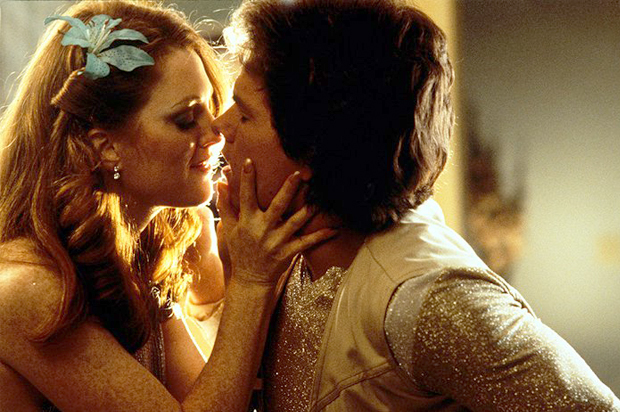
rendered us comatose and barely able to notice. Gay men have not only proclaimed that they’re here, they’re queer, get used to it, but that the erect cock is a beautiful thing — especially with its foreskin surgically reattached, and when it belongs to a body with flat abs — worthy of federal funding. For the first time in non-X-rated cinematic history, a semi-turgid cock seized the spotlight, when Mark Wahlberg whipped out a 14-inch schlong in “Boogie Nights,” causing so much speculation that publicists had to admit that it was a fake.

Now, as the century grinds its pelvis forward for a couple of final rounds, the Christian right in its New Testament raincoat skulks around the fun house, trying to shut it down while listening at the door for squeaky mattress springs and praying for jism-stained laundry. Yes, thanks to its enemies, pornography has gone mainstream, rendering
smutmeister Larry Flynt a harmless defender of the First Amendment as he
mounts an X-rated jihad financed by peddling women. Both sides have been
abetted by another dirty old man in disguise: the media. Here’s a scoop for
you: Hiding behind that straight face of objectivity is a big, greasy leer
and a mouthful of rotting yellow teeth waiting to chomp on any piece of
meat it calls a story.

And for the past 10 years, as the media would have it, there’s been just one. Indeed, this era has been so seamless and so unfettered by other possible thematic distractions that it’s possible to survey it simply by following a trail of penile scandals. From 1990 through to the present, not counting the O.J. Simpson trial or the murder of JonBenet Ramsey (both tangentially related to this theme), the national conversation has been one endless variation on the same narrative, dominated by the following seven episodes:

Erik and Lyle Menendez: Their arrest on March 11, 1990, for the murders of their parents set the tone for the decade. During their trial, a new phrase — “the abuse excuse” — entered the lexicon, with younger brother Erik testifying that his rich father first “massaged” Erik’s penis when Erik was 6, continuing every one to three months until shortly before Erik and Lyle killed him. A week before his 16th birthday, Erik said, his father entered his bedroom and ordered Erik to get on his knees and perform oral sex.

How does the country know this? Well, we let our fingers do the surfing, and when we caught the wave of Court TV, we had a nice long ride. The Menendez drama gave Court TV a launch worthy of NASA, not to mention the career of courtside commentator Laurie Levenson, the first of hundreds to collect a paycheck for the “yardage gained” style of analysis of the decade’s most sensational trials. Weirdly, the penis of Menendez père was discussed for six years, through two trials, with an early timeout in 1991 for discussion of the Clarence Thomas hearings (see next page). In 1996 the brothers were convicted of first degree murder, and presumably are now forced to play hide-the-salami behind bars.

Clarence Thomas: With the weird foreplay of the Menendez trial, the conversation quickly escalated when in 1991 a Supreme Court nominee was accused by a former assistant of sexual harassment. At congressional hearings in October of that year, the country came to a halt while Anita Hill testified about the strange sexual behavior of her former boss. “He got up from the table where we were working,” she said, referring to several incidents in 1982, “went over to his desk to get a Coke, looked at the can and asked, ‘Who has put pubic hair on my Coke?’” On another occasion he referred to the size of his own penis as being “larger than normal.” As the nation leaned closer for a collective listen, Hill testified that, in his attempts to seduce her, Thomas invoked the notorious porn star Long Dong Silver — immediately resulting in a massive upsurge in the renting of the videos featuring the super-size performer.

Meanwhile, the country was ripped by a new skirmish in the ongoing gender war: Was Hill telling the truth? While thousands of women affixed “I Believe You Anita” bumper stickers to their cars, men hunkered down at the office water cooler and whispered nasty jokes. Thomas survived the battle and ascended to the Supreme Court, but years of guffaws ensued. The episode was finally put to bed in 1998 when Fox Television scrapped plans to air “Strange Justice,” a movie based on a book about the Thomas hearings, perhaps because the Murdoch-owned network feared upcoming Supreme Court hearings about cable operations.

William Kennedy Smith: With his arrest in 1991 for rape, the decade’s baton was passed to a perennial player, the Kennedy family. Once again, the country pondered that pesky question: Whither the royal unit and was it on the guest list? Too far and no, claimed the woman who pressed charges. While the Menendez tale played on, Patricia Bowden testified in a Palm Beach, Fla., courtroom that Smith raped her at the Kennedy family’s compound after a night of partying with Uncle Ted. Along with Smith, it seemed as if the entire family were on trial, as prolonged public discussion of Kennedy sexual conquests and the disaster at Chappaquiddick dominated the ether.

The mild-mannered female district attorney in Palm Beach was no match for Smith’s high-priced gun; Smith was acquitted, paving the karmic way years later for renewed interest in the case of Martha Moxley, a teenager murdered in Greenwich, Conn., in 1975, allegedly by Ethel Kennedy’s nephews.

Lorena and John Wayne Bobbitt: With Lorena’s arrest in 1993 for castrating her husband, the drama reached a climax as women across the country hit the media streets in support of their new heroine. After being raped (she said) by her ironically named husband, John Wayne, Lorena fulfilled the nomenclatural destiny of their mutual surname and cut off his penis. Whereupon she took it for a ride and tossed it into a neighbor’s yard. The dismembered unit was found by a maintenance man, driven to the hospital and reattached.

With this story, the press got two for the price of one; the old newsroom adage “If it bleeds, it leads” became “If it’s big and hard, it stars.” While John recuperated and the world waited for news of how fared his member, Lorena’s trial for malicious wounding unfolded. In the end she was found not guilty by way of temporary insanity and sentenced to 90 days in a mental institution. The rising tide of this episode floated many boats, include that of the castrato himself. John Wayne Bobbitt became a porn star and stripper, Jay Leno had jokes for the next two years and the country was giddy with cock-related queries such as, Can he get it up? For how long? And how long is it?

For those wondering, the answer apparently is more or less. In his video “John Wayne Bobbitt Uncut,” he boffs a number of horny starlets, despite evident battle damage. And it seemed to be in working order in 1997, when he was fired from his gig as doorman at the Moonlight Bunny Ranch in Carson City, Nev., because he reportedly could not stop manhandling the girls. 1997 was an equally bad year for Lorena — she was arrested for beating up her mother.

Michael Jackson: The accusations of child molestation against this chart-topper broke in 1993, providing no quarter for those already weary of the avalanche of sex scandals, and kicking off a media feeding frenzy that almost brought down a record label. On Aug. 17, the Los Angeles County Department of Children’s Services received a report in which a 13-year-old boy told of a sexual relationship with the self-styled bump-and-grind king. While sleeping in the same bed with Jackson over a period of four months, the boy alleged, the two had kissed and fondled each other and Jackson allegedly masturbated. On Aug. 22 and 23, Jackson’s Los Angeles and Santa Barbara homes were searched for pornography. Then someone sold a copy of the boy’s report to the tabloids. Jackson’s lawyers accused the boy’s father of extortion. The boy sued Jackson for sexual battery, which Jackson denied. On Dec. 1, 1993, Jackson hired Johnnie Cochran. Ten days later, the Santa Barbara district attorney photographed Jackson’s genitals, introducing the term “distinguishing characteristics” into the public discourse. “There were definite markings on Jackson’s genital area,” the D.A. said, “including a discoloration on his testicles,” which the boy had described.

The country — nay, the planet — was again consumed with questions such as, How big is it? Two days before Christmas, broadcasting from his Neverland Ranch, Jackson proclaimed his innocence. On Jan. 25, 1994, Cochran announced a settlement. In June 1995, Jackson, appearing with wife Lisa Marie Presley (offspring of Elvis the Pelvis), proclaimed his innocence once more, this time on “PrimeTime Live.” In 1996, the boy’s father sued Jackson for breach of contract. In 1998, a final settlement was reached, but by then, of course, after five years’ worth of discussion about the Prince of Pop’s penis, a new and bigger drama had replaced “The Story of the Jackson Five Inches.”

President Clinton: — Call this one “The State of the Unit.” Just as the economy is in a state of prolonged tumescence, so, it seems, is the presidential groin. Perhaps the country would still be telling Michael Jackson jokes if Paula Jones hadn’t surfaced in 1994, declaring in court that while she was an Arkansas state employee in 1991, then-Gov. Clinton “lowered his trousers and underwear, exposed his penis (which was erect) and told me to ‘kiss it.’” While Clinton denied the accusations for the next four years, Jones claimed that she could prove that the president dropped trou: She knew what his penis looked like. In court papers, she described it as “bent to the right” (perhaps an early indication of Clinton’s plan to roll back welfare, had anyone bothered to listen to Jones). Within moments of the affidavit’s unsealing, every major publication from the New Yorker to the Los Angeles Times reprinted the verbal portrait of the presidential penis. For many, the 24-7 coverage of this topic proved that Western civilization had finally collapsed, while perhaps in the view of some gay men, it was now peaking. Did Clinton himself invite this tribulation when he metaphorically unzipped his pants and discussed his underwear on MTV? Possibly, yet it seems that by 1997, when this information surfaced and the president was truly left naked before the world, his background had finally caught up with him: You can take the boy out of Arkansas but you can’t take the Arkansas out of the boy (I believe you, Paula).

But it was the relationship with Monica Lewinsky, who, according to a former boyfriend, had announced early in the decade that she was heading to the White House to secure her “presidential kneepads,” that sent the decade into phallic overdrive. Seeds for scandal have never fallen on such fertile soil. Anchor yentas, now more securely employed than ever, spent the coming year agonizing in public over whether to keep talking about blow jobs. Op-ed pages were filled with screeds penned by disturbed parents — how dare the networks talk such trash! What can we tell our children? they demanded, as if the news without blow jobs were perfectly acceptable. And meanwhile, the country — not just a few chicks — continues to suck the president’s dick. “Oooh, Bill,” the polls say, “thanks for the big 10-inch economy. You taste sooo good.” Which leads us to the guy that Clinton had to cream in order to get millions of citizens to simultaneously feel — and relieve — his pain …

Bob Dole: In 1998, just when the memory of Bob Dole’s post-election Visa card commercial was beginning to fade, he embarked on a round of talk-show appearances to promote Viagra. “Hey, everybody!” he seemed to say, “don’t forget about my penis!” On the payroll for Pfizer, the manufacturer of the male performance enhancer, Dole explained that “I’d already lost the election, and I wasn’t looking for the erectile dysfunction vote. Viagra is a great drug.” Was the election loss to Clinton in 1996 an emasculating experience? Did it make Bob Dole wonder who Bob Dole really was? When you always talk about yourself in the third person, and then that third person disappears from the exit polls, does a problem not ensue? In all fairness, it’s far more likely that Dole’s performance troubles resulted from his battle with prostate cancer, although the failure to reach the goal of a lifetime couldn’t have helped. But no matter — hats off to the future first man. Flaccid or hard, he’s the only stand-up guy in this sorry pack.

Of course, it’s no accident that the national obsession with such matters comes along at this time. The celebration of male culture has gone underground. Which is not to say that Super Bowl Sunday is soon to become a secret rite, but that the public discussion of such activity is now carried on in the most defensive of ways. Commercials during football games present married men who mount elaborate subterfuges so they can drink beer with their buddies. Clint Eastwood has been replaced by Ben Affleck and a generation of “The Good, the Bad, and the Ironic.” “Saving Private Ryan” came along too late to save Bob Dole, an actual World War II hero.

Today’s military battles not war, but for its existence; in spite of appearances to the contrary, such as the bombing of Iraq and Clinton’s call for increased weapons spending, downsizing at military bases continues apace. And in their defense of Paula Jones, Republicans celebrate feminism. Even if they’re doing it to bring down a president, as many believe (I don’t happen to find their motives so monochromatic), it’s still an astonishing act from which there can be no return. I don’t know why so many people say the women’s movement is dead — these, and the above-mentioned scandals, show that it is almost in complete triumph. I say “almost” because Monica still had to produce the dress before Bill admitted having the affair (and, let’s face it, to paraphrase the bumper sticker, shit like rape still happens), although most people already believed her, not the president.

The ’90s proclaim that male culture will not be denied, no matter how frenzied and bizarre the assertion. Odd, isn’t it? After 10 years of sexual humiliation, castration, penises that are bent and flawed, lost elections and lost erections, the penis now looms over public consciousness like a shadow of the Washington Monument, dominating the gabfest of a feminized terrain in a posture that is grotesque and stripped to the bone. (In fact, the monument is being renovated, something the masculine symbol could use as well.) Will the 21st century mark curtains for the world-renowned organ? Well, according to my interpretation of scripture, the Decade of the Dick, the Epoch of the Cock, is destined to erupt in … The Second Coming. Whether this is good or bad for you or me, whether it unfolds on Court TV (“The antichrist on Trial”) or at the Kennedy compound, I cannot say, but after the last 10 years, one thing is for sure: We’ve had the mother of all lube jobs.

Continue Reading Close