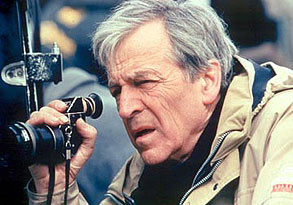
Dimitra Kessenides

“The role of art is to be ahead of its time”

Film's premier polemicist Costa-Gavras on his new movie "Amen," the responsibility of artists, and waiting around for history to prove you right.

Costa-Gavras has been film’s leading political dramatist since bursting onto the scene with “Z” (actually his fourth film) in 1969. That film, a docudrama about the assassination of a leading leftist by the military junta in his native Greece, set the template for much of the director’s subsequent work. Costa-Gavras (the hyphenated name, by the way, is an abbreviated version of his birth name, Konstantinos Gavras) has documented the struggle between the government of Uruguay and leftist guerrillas in the early 1970s (“State of Siege”), the abduction of an American human-rights worker by Chilean death squads at the moment of a U.S.-sponsored coup (“Missing”) and the war-crimes trial of a former Nazi official (“Music Box”).

Although sometimes derided by American critics as an old-line Euro-leftist, Costa-Gavras has never shied away from a direct assault on authority or from staking out controversial positions. “A film contains a director’s or writer’s philosophy of life, so that makes it almost immediately political,” he says. “In my films, because I’ve treated many themes that have rarely been treated by the cinema — and I handle them in a personal way — that makes them more political than others.” With “Amen,” his 19th feature film, Costa-Gavras, who will turn 69 in February, tackles yet another hot-button issue — the complacency of the Vatican during the Holocaust.

You’ve said that your films aren’t about the past but about the present, no matter what you’re specifically depicting. What, then, does your new film about the Vatican and Pope Pius XII and his inaction during the Holocaust tell us about the present?

It is a metaphor about the present. It’s about silence and indifference — the indifference that happened at that time toward the Jews and the Gypsies in Europe. This is the same indifference we have today about other tragedies around the world. Like the state of Africa. Or the silence of the Vatican about the atrocities of various dictatorships in Latin America. All the dictatorships there were backed to some degree by the church.

Did you encounter any resistance at all in making “Amen”?

Very little. After it came out, there was criticism. There were letters from the Catholic Church, from the extreme right of the church. I didn’t expect the criticism to be to the extent it’s been, so aggressive. This was not a new story, it was based on Rolf Hochhuth’s play “The Representative,” and I relied a lot on David Wyman’s book “The Abandonment of the Jews.”

But I don’t think about resistance to the film when I’m making it. I think about how I can tell the story, a better story, for the audience. And in the end, the surprise for me was that they attacked the film indirectly, by attacking the poster. It worked: The result was to create a kind of negative ambience around the movie. But then people saw it, and became quite attached to the movie.

How carefully do you consider the criticism?

I look first at who is criticizing and what they’re saying about the movie. Their criticism on other matters, the rest of their behavior in life, makes them believable or not to me.

Does it surprise you that a religious institution deals with problems and criticism much in the same way a government or a corporation might? And that its followers defend it so?

Unfortunately no. They try to justify their silence by apologizing after the fact. They think that is sufficient. Most of the Catholic churches and the Protestant churches in Europe apologized for their silence and inaction during the Holocaust. Priests from the Chilean and Argentinean Catholic churches asked to be pardoned for not speaking against dictatorships in those countries. That was also the situation in Rwanda. Eight hundred thousand people were slaughtered in three months, hundreds per hour. We know very clearly today that the Catholic Church knew about it, and priests and bishops were close to the party behind the massacre. The point is to speak during the time that something is happening. They try to defend themselves by recognizing that they did something wrong, and by asking to be pardoned.

What hope then is there that people see the faults of those making the mistakes, and understand what’s going on around them?

Well, it takes time, and they need to be educated. But it’s not my role to educate people. I make movies, and I try to say what I think about some situation, like in “Missing” about the repressive regime in Chile at the time, or the assassination of an MP in Greece in “Z.” The viewers have to decide for themselves how they should react.

But you must hope that your films will make people look at a situation differently, whether it’s a political situation or something in their daily lives?

First, everyday life is politics. When I make movies, or others write books, or people direct plays, they’re all political acts. An Italian historian once said something very true about the relationship between a socialist society and the cinema and history. He said that a film can bring a viewer into a historian’s or sociologist’s workshop. And from there, the viewer can decide what to think and which direction they will go. I try to make my films with that specific idea in mind.

Whether or not you’ve set out to make explicitly political films or not, that is the end result. What makes a film political in your mind?

A film contains a director’s — or writer’s — philosophy of life. So that makes it almost immediately political. In my films, because I’ve treated many themes that have rarely been treated by the cinema — and I handle them in a personal way — that makes them more political than others. I don’t use happy endings, I try not to glorify any of the characters. So this could be one explanation.

There is a danger of coming off as self-righteous, though. How do you counter that?

The only way to do this is to be as sincere and as accurate as I can be with the real characters and situations I’m treating. When we finished “Missing,” a lot of people jumped on it aggressively in the U.S. and said it was not true, they said it was anti-American. I knew it wasn’t made up, I knew it was real. I had to wait nearly 10 years, but through official lines, finally we were told that what we had depicted was in fact real. If I wasn’t sure that what I was showing was the truth, I wouldn’t have made the movie the way I did. Most of the time there is some validation down the road. Art and cinema should be, and it is sometimes, ahead of society.

Is it the responsibility of artists today to inform us in some way about things happening in our world? I mean, you can argue that the news media isn’t really doing all it should. Do the arts then fill the void?

Again, it’s the role of art to simply be ahead of its time. Go back to the Greek tragedies. They were ahead of their own time, and even to some degree our time. Look at “Oedipus,” it’s still very modern. Of course, the media and those with power have to follow the dominant ideology. Let’s talk about [former Chilean dictator Augusto] Pinochet for example. At the time, a lot of media outlets were defending Pinochet, saying he saved Chile from communism, and so forth. So there was a reason for that. But from what I knew of Pinochet and his regime, I saw them as bad. The dominant ideology was to protect, as much as possible, the regime against communism.

That’s not so different today, is it, this impulse to protect a regime, a government?

We have a good example today. There’s the example of terrorism. Everybody’s against it, everybody. But go back, and look at which of today’s chiefs of state were once considered terrorists. We can start in Israel, over to Africa to Latin America. Look at Arafat, he was a major terrorist for everyone years ago. And today people accept him as a leader — even Sharon has said, in a way, that he accepts him as that. What I’m trying to say, then, is that the problem of terrorism has to be approached in a different way. It has to be fought, but it’s important to study the reasons behind it. Terrorism can be reduced if political or economic or military actions are taken. This is an example of a general, accepted ideology.

Many of the themes in your films seemed somewhat at odds with some of the methods of production, and distribution; I mean, working on them in the Hollywood studio system.

Well, Hollywood’s production and distribution methods have changed considerably in the last few years. The only cinema in the world that is made by companies without any state help is the American system. All the others, in order to exist and to produce movies with ambitious subjects, need some state support. The best country for this, no question, is France. But it’s still very difficult.

Does the change in Hollywood reflect the interests of the general public in what they want to see? Are people not as engaged and as politically aware as they were in the late ’60s? Maybe they’re happy being indifferent?

That’s a very difficult question. What comes first, what the audience wants to see or what the production wants to sell them? I believe it’s a kind of education for the audience. If you give them big action movies all the time, far away from everyday problems, they probably will prefer to see that. But if you offered them different films, they’d go to see them. Of course it’s the kind of risk the producers and financiers generally don’t take.

What about for the filmmaker, the director? What, besides money, does he need to make films that are about more social and political themes, that are perhaps more difficult?

Well, they have to have a stronger eye on our society and our problems, instead of having an eye on succeeding and making a lot of money. It’s a question of how you’re willing to perceive our society. Make the film you’re willing to make, it should be as personal as possible, and that’s the most important thing, first. But a movie is a show; people go for pleasure, to laugh and to cry, to be moved, whatever the reason. The movie’s not there to teach a lesson or to teach history.

Is that why you’ve made mostly dramatic features rather than documentaries?

Oh, yes. And with documentaries it’s impossible to use the metaphor. A movie is a metaphor, through the story we tell, about other moments, other countries, other situations. Art is metaphor for truth. Documentaries are direct and deal directly with a subject.

And how do you deal with people who might say what you depict in a film is not true? How do you gain an audience’s trust?

I just write what I know is the truth, or a concentrate of the truth, because to tell an entire story takes too long. I have two hours. The basic truth is there. When politicians or others are against it, all I can say is, wait and see. I can show them the books I’ve read, the papers I’ve read. When I made “Betrayed,” for example, Mr. Buchanan said I was a European Marxist and that this would never happen in the U.S. Well, a few years later, you had the Oklahoma City bombing, and the people behind that were the same as the ones in “Betrayed.” Or whoever it is that spread the anthrax scare more recently.

Again, I can understand that people are ready to defend a system or an ideology, because they are so convinced themselves. The most difficult thing in our society, and without education, is not to change our opinions, but to reevaluate them, to see if there’s something wrong with our opinion.

Is there any institution, body of people, government, that isn’t tainted, that has some moral and ethical authority?

There are many, sure. Even when we talk about the church. There are individuals in the church who have a lot of moral authority, and probably we should look much more to the individuals than to the institution (or guilds or unions or governments). There are millions of people in the world who have a moral and ethical position on something, they’re writing about it, talking about it, and they’re doing what their ethical philosophy dictates to them. And maybe we should listen more to these people than the chief or head of whatever. The situation isn’t desperate, there is a lot of hope. Because if you go back to my generation, the kinds of discussions we have today you couldn’t have when I was younger, and the kinds of movies being made, you wouldn’t see.

Most of your films have a trial as a key element, as the means of achieving justice. Do you think this is still how justice is attained?

I believe in our societies there are two essential elements: religion and justice. Their reason for existing is to ensure human justice. Whereas institutions with power, democratic or not, they can move in different directions away from justice and they can very easily contradict themselves. So the role of religion, and of justice, through trials, is to balance the different forces in a society, to judge how the system works.

Does art flourish in today’s world?

The role of art today, again, is to be ahead of the times, to try to criticize and to be very aggressive against the injustices in our societies. There’s an extraordinary exhibition in Paris now on surrealism, the revolution of the cult of surrealism. You can see the surrealists went against the traditional ways of making art, and they changed the world. So that’s the role of art. But more and more, art today is in the hands of political and economic powers. Both are trying to say that art is for art, it’s not there to criticize or to be against. It’s to be aesthetic. But art has to play the former role.

Mormon misogynist goes soft

Director Neil LaBute surprises everyone but himself with "Possession." On the eve of its release, LaBute talks about a case of mistaken identity.

Most of us heard the name Neil LaBute for the first time five years ago. It was August 1997; “In the Company of Men,” his first feature film, opened; and suddenly the new director was thrust into our consciousness. LaBute was labeled a misogynist, a man with a cruel and dark (and, perhaps, accurate) take on the capacity of men to be downright evil. And he was a Mormon, no less, a fact that added a bit of mystery and confusion, but, mostly, we made up our minds about LaBute: He was a creative brute likely to be in favor of polygamy.

His next film brought further affirmation. The lineup of despicable characters in “Your Friends and Neighbors” differed from “In the Company of Men” only in number (more of them), and gender (some nasty women were thrown in for good measure). But then, along came “Nurse Betty,” a comedy, albeit a very dark one. It had moments of downright giddiness, and we had to wonder: “Is Neil LaBute going soft on us?”

Could be. LaBute’s newest film is the recently released adaption of British writer A.S. Byatt’s 1990 novel “Possession.” It is a romance, a poignant one, and a period film, to boot. Critics of the film have focused on LaBute’s surprising “departure,” but the director says it is he who is surprised — by the world’s insistence on defining his interests based on two or three films. “Possession,” he says, clearly connects to the main focus of all his work — relationships.

“It’s about two sets of people who are in love and in relationships, at least, and things happen to them where they’re emotionally tested,” he says. “I have always written about that, not just as a filmmaker, but as a playwright, and now, as a sometimes short story writer.”

LaBute was in New York recently on the eve of his film’s release and one month before his short play, “Land of the Dead,” was to be performed as part of the commemorative program “Brave New World,” a three-day marathon of readings and performances about the aftermath of Sept. 11. He talked about overcoming the assumptions of his audience, as well as movie executives — about his interests, his abilities and his religious beliefs, which, he points out, do not include polygamy.

Are you surprised by some of the reaction to this new film, that the one thing people say is how much of a departure it is for you? How do you deal with it?

It’s sort of a you-can’t-win situation. I don’t know if I’m comfortable with it, but I’m comfortable knowing it. It’s difficult to think of “Possession” as a departure when I’ve done so few films. The first two were so steadfastly one way. “Nurse Betty” was different from the first two, and that was surprising. This one is a surprising move away from that again. I guess it shows the breadth of my interests, that it’s wide-ranging in terms of what I might do as a director. The writing I’ve done and continue to do remains pretty constant. I guess it’s more surprising to people from a directing sense.

Why did you want to make this particular film?

I read the book and I loved it. I enjoyed the twin engines that it worked on, and in a very intellectual way. I thought it was well-written, and emotionally I felt very satisfied. It had a great ending, which is often the thing you carry around. Endings are hard to do, in books, films, whatever it is — they’re hard to get right. When you do see one that works for you, you often think of the book on those terms.

At some point, during a relatively brief career, I asked my agent about who held the rights to it. I’ve been an Anglophile for a long time, and I’ve been both a student and a teacher, so most of the elements of the book were appealing to me. I hadn’t done anything in period — I had onstage — but I hadn’t done anything on film that would test me that way. And I’m always looking for a test, a risk.

Was it a good risk?

Sure, it paid off in the sense that I feel like what I set out to do was accomplished. Tackling the period from two points of view, that is a very immediate thing to me. It’s not precious. These people don’t know they’re in a period film, they’re just alive, and feeling these emotions. You want to get the manners and the mores right — the look of the hat, all of those things — but it would be a pretty hollow exercise if that’s all you cared about, was to get the carriages going in the right direction. You have to make the emotional points. That’s what really interested me. And the two separate relationships.

And that’s the through line, that’s the line I used to sell myself to Warner Brothers initially: “Look, I may not be the obvious choice for this material, but I think I’m a good one because it’s about two sets of people who are in love and in relationships at least, and things happen to them where they’re emotionally tested. And I have continued to write about that, not just as a filmmaker, but as a playwright, sometimes as a short story writer.”

You can always hire people to do the rest. You can hire a costume designer. But believe me, you don’t want just costumes. You really want to believe in the predicaments of these people. [Warner Bros.] seemed to believe that and I set about doing it. Also, there are a couple of highly questionable nasty boys along the way, who seem to fit my interests. Not that I look for stories with just bad men — they just happen to show up.

How much convincing did it take with the studio?

It took a bit of dancing and singing, and I don’t sing and dance well. It was the volume, I think, of singing and dancing. It really exponentially grows from the kind of project it is, to how much money the project is going to cost. Had this been a little small endeavor, relatively small compared to a studio’s thinking, there probably wouldn’t be as much hand-wringing about it as for, say, something that’s $25 million.

It’s a bigger investment, so there’s more curiosity, more interest about it. It either happens or it doesn’t. You just hope for the best. In this case, Warner Bros. said yes, but they wanted to work with another studio and split the costs. That was their safety valve. Another safety valve, I’m sure, was the casting of Gwyneth Paltrow. That made complete sense to them. On all the fronts we could come up with — period film, romantic film, someone who’s done a dialect, someone who’s had success at the box office, has personal success — all of those things were green lights.

What was it like adapting a book for film?

It was hard. At the base of it, it was a book I respected as a fan. And you have a living author that you don’t want to let down. I didn’t want her to look at it and go, “Well what was it about it that you loved? Because you decimated it. I recognize the title.”

The book had been optioned about 10 years before I started at Warner Bros. We had the benefit of where everybody else had gone before. But the key was seeing this series of notes, from A.S. Byatt, in response to earlier drafts of other writers. For someone who doesn’t write screenplays, she seemed to really know what a movie was. She was able to say, “Look, it can’t be like the book; Roland cannot be the same kind of character that he was on the page of the book.”

We wanted to be, not reverential, but certainly respectful of the book. And yet we knew there were great episodes that would be lost and characters who would not exist any longer. The mandate was sort of to get the spirit of the thing. Of course you just want to make a good movie that people enjoy, but for that next layer of people who have read the novel, you want them to say, “Yeah, they got it.” That’s pretty key.

There are such rabid fans of the book, that even during production, I was getting e-mails (how they got my e-mail I don’t know; it speaks to their tenacity) questioning my choices. It becomes a bit of a bible to them. So if it’s different than on the page, they say it’s wrong. Whereas A.S. Byatt was much more open to changes.

When it comes to working in theater and film, do you have a preference? Do you feel more comfortable in one than the other?

I don’t tend to get bored with one and then do the other; it’s just that I like them both. I always liked movies but never studied them or how to do it. I always imagined myself doing theater. I think film, which I haven’t done for very long, has afforded me the chance to go back and do theater. I like that so much that I can’t imagine a time where I would not want to do it. Whereas the pressure of film, I can see where people take periods of time away from it, because there are just so many other demands on you, beyond the elements that you really like. I like working on the script, I like working with the actors. There are so many technical demands that I am just still learning about and the less you know the harder it is to keep up.

The big difference between theater and film for me, and what makes theater so attractive, is the very clean delineation of purpose. In the theater there is a very delineated time in which the process takes place, and in the end of that, it’s all culminating in the product. So you know the pressure of, “We’re opening six weeks from now, so we need to do X.” It’s all very concentrated on the elements that I handle. Like, “Let’s sit around and rehearse the script.” Then we add on the costumes and all. You’ve got just the last few days to deal with that, costumes and lighting.

In film, there is no such demarcation. The first day of the film you’re filming. You may have a little rehearsal and preproduction, but that’s not the process, that’s part of it. When you go to work, and you’re setting up the lighting and all of that, then at some point during the day you have to film and that’s the product. That raw footage you took on day one is going to end up in the film. So you have to be as good on day one as you are on day 60. That’s a little more pressure, I think, for everyone. It’s like, “I know this is a really hard scene, but we have to film it today because we lose so and so on Thursday. Even though it’s kind of the climax of your relationship, we’re going to have to film that right away, and so off you go.” I find that a little more daunting.

The stakes are higher in film?

Not the personal stakes. But the stakes are made to feel higher because there’s more money involved. So more people are constantly around watching their investment. There’s no question about that. Even if it’s not hands-on, you just feel the presence of people watching what you’re doing, which I completely understand. If I were making an investment like that I would be a little curious as well. They’re not going to say, “What the hell, let’s just give you $20 million and see what comes of it.” That is just not the way it is handled.

When you’re in the theater, you’re talking about thousands of dollars usually. I don’t believe it’s just monetary, but I can’t imagine it’s just a trust issue either. Because the theater people that I’ve worked with I don’t know any better than the film people, but they tend to stay away and come to previews.

When you talk about yourself as a filmmaker, you speak as though you’re a novice.

There are so many elements in film — I’m a quick learner, but I think I’m constantly learning technical things that you never face in the theater. You don’t edit, you don’t do sound mixes, you don’t do computer-generated effects. For the most part they’re very different disciplines. Do I think I’m any better at one than the other? Not necessarily.

I’m probably more comfortable as a writer than as a director, because I’ve done it longer. I feel more comfortable at it, just the experience of it. I imagine myself capable of any number of things. I don’t think most people would have expected this film to come from me, just in terms of scope, the fact that it’s period.

You’ve said about your work — in theater and film — that you try to challenge people’s sensibilities. Does that involve challenging your own sensibilities?

I think I’m the first audience, so I challenge myself by extension of openly challenging others. When I write and I don’t know where I’m going and it surprises me when it comes out — I look back on a few pages I’ve written and go, “Yeah, strange monologue to come up with” — that’s a really pleasing thing. An audience is pleased in the same way. They can look at something and say, “Wow, I had no idea where that story was going.”

The positive responses to a film like, say, “Nurse Betty,” were more geared in that direction. There are so many elements to that screenplay and the way that film was made. You can recognize it as a road picture, satire and soap opera, and it’s got philosophical killers — but I never knew exactly where it was going to end up.

The surprise of the journey is important to me. In the same way that the pleasure of the process is important to me. It’s sort of a buyer’s market in casting people and in hiring crew — there are so many people with talent at a certain level, that you can kind of pick really carefully. But I’m very curious about and interested in getting people who I think will be a pleasure to work with. It’s not worth it to say, “Well, we made a great film, but it was just hell.” I’m not so into suffering that it just doesn’t matter if I suffer personally for a year as long as the movie is good. I think one can do both; they can enjoy the process and make a substantial product.

Audiences, and critics, consider personal details, like the fact that you’re a Mormon, when evaluating your work. Is that fair?

I don’t know why it should be an issue. I can say that obviously, being a Mormon has an influence, as much influence as being a man or being of the political persuasion that I am, or being born in this part of the century. It does not have undue influence on me.

I do find [people's fascination] curious. It’s often writers. Often with the writer it’s the first thing they’ve considered about me. “Well, this is what a Mormon is supposed to be, and yet this guy is writing this and he calls himself a Mormon and that seems like an odd thing.” So they just want to not even justify it but make sense of it to themselves. But the end result of that is me getting asked that a lot. And me getting over it.

You’re a practicing Mormon?

Well, yeah. I need more practice, apparently. I’m still a Mormon. I had some difficulty with a play I wrote called “Bash,” and I was dis-fellowshipped from the church because of that play, which is not like being excommunicated. One is still in the church, and can go to services, but can’t take the sacrament — there’s a certain set of things that come with that. As long as I don’t write bad things again, I might get back into their good graces.

Maybe we’re just curious about it because we don’t really understand what it means to be Mormon. What do you think we misunderstand about it?

I guess the polygamy question, which I still get. Someone just asked that question this weekend, like, “Can you have more wives if you wanted, do you still endorse that?” So sure, there’s a certain, not even mystique, there’s a mysteriousness with the church. It is probably the only American religion that was founded in America, that I’m aware of. That may be the case.

I think the questions have less to do with Mormonism than [the fact that] I’m meant to be part of an organization that is supposed to be sort of righteous and all of this, and then I write fairly unrighteous characters. So how do I rectify that, how does the church feel about that?

Will you continue to look at relationships, the dynamics of relationships in your work?

I would be hard-pressed to say that I ever plan to get away from the examination of relationships. One of my favorite filmmakers is Eric Rohmer. The way things go in and out of style, he’s incredibly constant about the way in which he shoots, what he’s interested in. For the most part, his films are very simple meditations on the kind of quiet craziness that men and women have toward one another.

I quite firmly believe that he imagines, no matter how many films he makes about that, he’ll never get it completely — not right, but he’ll just never corner the market on what there is to say about that. I have been able to find plenty of reasons to continue writing about that. There are a couple of projects out there that are certainly different on the surface, but my inherent interest remains very much rooted in how people deal with one another.

Continue Reading Close

The kid is back in the picture

Robert Evans, the infamous movie producer who, by his own count, is on his fourth life, talks about breaking the rules and brushes with death.

Hollywood can play rough. Sure, it’ll scoop you up and smother you with kisses when you’re on — you look good, you say the right things, you make somebody else rich, and it doesn’t get any better. But you blow it, and it’ll blow you off. One false move — you’re used, abused and left for dead.

But if you leave big, there’s always room for a sequel. Robert Evans is proof. The legendary producer was, in his first life, the leading man of a classic Hollywood saga: A handsome young actor, perfectly at home in the business called show, gets discovered not once, but twice, and, at the tender age of 35, is handpicked to lead production for Paramount Pictures with little more than a couple of acting credits to his name. As head of production at Paramount Pictures he rolled out “Love Story,” “The Godfather,” “Chinatown” and “Rosemary’s Baby.” A burst of extraordinary moviemaking, fueled by a binge of dangerous merrymaking, follows and then screeches to a dramatic halt after a drug bust in the early ’80s, followed by a link in the press to the murder of an investor in one of his films. (It was “The Cotton Club,” and Evans eventually was cleared of any connection to the crime.)

Dumped and disgraced, Evans withdrew from public view for a good long while. He hit bottom in 1997 when, after three strokes in two days, he says he “died” for a moment or two. Then, Hollywood being what it is, or Robert Evans being who he is, or both, a miraculous recovery set in.

Evans is now 72 — or, by his reckoning, a mere 5 years old counting forward from his brush with death — and he is back. His 1994 autobiography, “The Kid Stays in the Picture,” sparked a conflagration of cultlike celebrity in the industry, especially when the taped version of the book — read by Evans in his supersuave growl — began making the rounds and generating giddy buzz, particularly among the younger ranks of actors and others aspiring or thriving in the biz. A filmed version of the book, which just opened in New York and Los Angeles, will roll out nationally over the next three weeks, bobbing along happily on a growing wave of critical acclaim.

Evans the senior citizen remains perfectly suited for stardom: He’s got the tan, the shades and the voice — as sweet and low as it ever was. And in the voice, a new cavalcade of swank and frank utterances. He’s delightfully old school, and the crowd loves it. “My own life makes a better job than the job itself,” he says when asked about being scooped up and smothered with kisses all over again. “I’ll tell you something else, it’s a lot more fun looking at it than living it.”

Captured briefly on the phone, Evans reflects on his rekindled romance with Hollywood, and imparts the wisdom of a man who has been there and back.

You’re riding a whirlwind. Has it been fun?

I’m tired, but I must tell you, tired good, not tired bad. It’s been a very exciting experience.

Is it different — the whirlwind, that is — the second, third, fourth time around?

Well, let’s put it this way. You look at it differently when it’s your own ass on the line. I’ve never in my history — I’ve been in this racket for 40 years — had a response to a film of my own life. My own life makes a better job than the job itself. I’ll tell you something else, it’s a lot more fun looking at it than living it.

That can’t be true.

That is true. The lows can be very low, baby.

C’mon, watching it can’t come close to some of the real experiences.

Well, I can say I’ve led a very adventurous life. I have broken all the rules. I believe in breaking the rules, that’s the way you move forward. If you live by the rules you stay still, and by breaking them you get in a lot of trouble. I keep moving, and I feel as though I’m 5 years old, even though I had a stroke five years ago. They thought I wouldn’t live and here I am talking to you.

So you still feel like a kid?

I celebrated my birthday on June 29, and Sumner Redstone made a big cake and a huge card that said, “Happy Fifth Anniversary Kid!”

Any drawbacks to the attention you’re getting right now?

No, it’s all a high. Because I’m not only doing it for this. I have another movie going right now, with Matthew McConaughey and Kate Hudson. I’m writing a sequel to my book called “The Fat Lady Sang,” and I’m going to do the story on Sidney Korshak called “Power.”

Busy as ever.

I want to keep busier.

But really, does Hollywood take someone of your age seriously? This is a young person’s world, especially in Hollywood.

The thing is, they’re taking me more seriously than ever. Not my peers, but the young people, like [director] Wes Anderson. He’s a pal of mine. And David O. Russell’s a good friend of mine.

Maybe it’s because I’m a rebel, because I don’t go by the rules. I believe they have respect for me. Whereas some of my peers don’t because I don’t play by the rules. I don’t show up to the office — even when I was head of the studio — before 11:30 in the morning. I’m not a good morning person. I learned that from Darryl Zanuck many years ago. He never showed up till 2 in the afternoon. I ain’t a breakfast guy.

What’s the best time of day for you?

Starting at around 4 in the afternoon till 4 in the morning.

Quite a stretch.

Then I get six or seven hours of sleep, have breakfast and I’m off for my day. I never make luncheon dates either. Because while people are at lunch on the West Coast, I’m doing business with the East Coast. I don’t allow any of my people to go out to lunch because when they’re out to lunch, we’re on the phone to New York. Let the others eat, we do business.

You probably couldn’t have lived the life you’ve had anyplace but California, wouldn’t you say?

Well I love it out there, it’s kept me sort of alive.

What’s the scariest experience you’ve ever had?

It doesn’t get more scary than dying. I had three strokes in two days, and they didn’t think I’d make it, and they said I’d never walk again. I went through three years of therapy to learn how to walk. I couldn’t pick up a fork for six months.

Your recovery seems unbelievable then. What do you attribute it to?

Staying in the picture. The will to live. I could have been a cripple, I could have been paralyzed, but I worked eight hours a day on physical, occupational and speech therapy. The whole right side of my body was paralyzed. I couldn’t move my toes. I had to learn to walk. Still, to this day when I get up I do heel, toe, heel, toe, heel, toe, because my right leg was totally gone. From your brain, when it closes up, the motor nerve doesn’t go to your leg. They definitely thought I’d be in a wheelchair.

You still have a great voice. What would you say it’s gotten you??

Yes, I have my voice. It’s gotten me a lot. I was a radio actor as a kid, I was a disc jockey when I was 17 in Miami, Palm Beach and in Havana. But my voice wasn’t as deep when I was 14. It doesn’t do me bad with girls. Especially if I talk low.

If there’s anyone who subscribes to the belief that there are no second acts in life, they’ve never met Robert Evans.

I’m on my fourth act. I lived a three-act story but when I died, I got my fourth act. And I’m now 5 years old. I may only live till 7, but for now, I’m 5. I’m going to stay at this for a while.

Tell me about success and some elements of success. How much does looking good matter?

If you look good, you feel good, you act good. Most people think they don’t look good. Looking good is to make everything background be background, and make you foreground. It’s how you look, not what you wear.

How about charm?

Charm and seduction totally differ. One gives you an attack of the heart and the other gives you a heart attack.

Honesty, do you need that for success?

I believe I’ve been the most honest person of anyone I know. For one reason: It has nothing to do with morality, it just makes life easier. You never have to remember what you’ve said. It gets you in trouble at times, but I can walk into a room three years later, and see people I haven’t seen and say the same thing. It makes body language easier, verbal language easier. However, there’s an abstract to it. Omission isn’t lying.

Dishonesty comes back to bite you in the ass. And the worst thing is a half-truth because it carries with it a veracity you can believe, and the rest is made up. So success is easy when you tell it as it is, when people question you and requestion you and requestion you.

Sincerity and insincerity — how much or how little do you need of these?

These are subjective. Because if I believe in something, I can be Elmer Gantry. If I don’t believe in it, I will not allow myself to fake it, I don’t know how to fake things.

And the power of persuasion?

I have great power of persuasion when I believe in something. I have none when I don’t believe in it, and that goes for everything.

Do you need to have connections to powerful people?

You don’t need it. It doesn’t hurt. I’ve always had it. I’ve had connections to people of power, but I’ve had it all my life. I didn’t have power, I gained power through giving. I’ve gained power for inventing things. It was never handed to me. I gained power by meeting people of power through giving as well as taking. I’ve always believed in giving more than taking. That to me is power.

Also, power is being remembered; that’s far more important than money. And don’t take yourself too seriously. In order to have power, you should be able to make fun of yourself and be self-deprecating. People who aren’t sure of themselves boast. People who are very rich don’t talk about their money.

I think self-deprecation is one of the greatest attributes in the world. I’m that in my own way, because I have a lot to be self-deprecating over. I’m a lousy businessman, I’m a bad executive. I don’t live by the rules, I live to break them.

Should you really be going on the record as saying you live to break the rules today, when the news is filled with the terrible fallout from so many people breaking the rules?

There are different ways of breaking rules. I’m not speaking of breaking the rules by being dishonest; I’m speaking of breaking the rules about your own habits and how you live your life. I mean, I’ve been married four times and I’ve never paid $1 of alimony for one reason: Every wife ended up making more money than me. And I helped them make it.

Are they paying you alimony?

No, but we’re all great friends. Breaking the rules also is showing up at work at 2 in the afternoon, and getting the job done better. Breaking the rules is in my contract. I never, ever had to go to any awards or events, I would only go to what I wanted to. I didn’t believe in a social life, I believed in making films. This is my contract. Breaking the rules is going and giving up my job unless I had total autonomy. That’s what I call breaking the rules. Breaking the rules is a celebration of the individual.

How important is it for people to develop a personal sense of style? You’ve got one — the clothes, the glasses.

I don’t believe in labels. I don’t believe in wearing Ralph Lauren or Calvin Klein; I certainly wouldn’t wear pants with their name on the outside. I mean, that’s not me. I’m like Popeye the Sailor, I am who I am, that’s all that I am.

That’s not today’s world.

Well, it isn’t, but it’s mine.

We’re talking about all this stuff, success and style and how people react to you, how you treat people. Any thoughts on Michael Ovitz and his seeming meltdown in a recent issue of Vanity Fair?

I have no opinion of it, I don’t wish to give an opinion of it.

Any opinion of people who talk out of school?

I don’t want to know them. One thing I’ve learned, I learned this from a very important guy, my godfather, Sidney Korshack. Continued silence is the greatest insurance policy for continued breathing.

What gives you great pleasure in life?

The greatest pleasure is to see a woman blossom. So many women underestimate themselves because they make the wrong choices. To give them the opportunity in making the right choices and see them blossom is a great feeling for me. And I helped make that happen for many, because I like women. Most men don’t. They like to lay them, parlay them, relay them, have them on their arm. I like a woman’s brain, I like a woman’s instincts, I like a woman’s focus and I like a woman’s strengths.

Do you think you’ve figured women out?

Any man who thinks he can read the mind of a woman is a man who knows nothing.

Any regrets?

The second half of my life. A lot of it. I went from royalty to infamy in one day. Royalty pays and infamy stays. So I’ll live the best in the world of infamy and enjoy it.

Continue Reading Close

Harry Shearer

The comic genius of "This Is Spinal Tap" fame talks about corporate corruption, the art of the American apology and his new film, "Teddy Bears' Picnic."

Rich white men — corporate titans, leaders of industry, politicians, celebrities — get fairly leveled in Harry Shearer’s newest film, “Teddy Bears’ Picnic.” The movie spoofs the annual power orgy that is Bohemian Grove, the exclusive, all-male retreat in the woods north of the San Francisco Bay Area. From Enron’s collapse to the unfolding tragedy of Global Crossing, there couldn’t be a better time for this movie.

Perhaps most memorable as heavy metal bassist Derek Smalls in the 1984 mockumentary classic “This Is Spinal Tap,” the actor, comedian and satirist is also no slouch when it comes to more serious cultural criticism. There’s his weekly radio program, “Le Show,” writings for the online magazine Slate, commentary for programs like “Now with Bill Moyers” — public television’s sleeper hit of the season — and even a brief column in Salon. And Shearer’s list of film and TV credits is endless.

His take on power and corruption is a nuanced one. To Shearer, what’s most compelling about the Enrons of the world is that their corruption is largely circumstantial; give anyone that kind of wealth and the results won’t be pretty. From the rich down to the poor, we’re a partially defective species. “That’s what’s funny,” Shearer explains. “We wouldn’t be able to laugh at Shakespearean comedy today if we weren’t the same flawed people that we’ve been for a long time.”

“Teddy Bears’ Picnic,” which Shearer wrote, directed and executive produced, opens Friday in limited release. He recently spoke with Salon about his film, Jimmy Swaggart, Starbucks, Linda Tripp and the general state of the world.

Your film is about a bunch of white men and the havoc they can wreak. It seems pretty timely, given the state of thing like Enron, K-Mart and Global Crossing. Did you see this all coming?

It’s not so much that I saw it coming, but that I see it being. It doesn’t change really. There was a period last fall when I would watch the movie at film festivals where I thought, maybe people aren’t ready to see this view of those in power yet. But thankfully that moment has passed. This was conceived some time ago, when it was a different group of people who were messing around like this. It seems like there are always going to be these folks. The show goes on.

It’s all about flouting the rules. Doesn’t it seem like everybody lives by that today?

Not everybody. The iron law is when there’s this much money at stake people are going to be fairly crudely rational creatures and, rules be damned!

Then who does live within the rules?

Most people who don’t have access to power and large amounts of money. Those are the two goads to cheat. I thought, when I first started seeing high-money show business, that it was a sort of iron law that the more money on the table, the worse the behavior. I haven’t been around that much power but I think people, when faced with huge, insane amounts of money and seductive amounts of power, are weak creatures. And the rest of us who aren’t so tempted find it easier to say, “Oh, no parking here at 9, OK. I’ll move my car.”

Are we just suckers then?

We’re just the same people put in different circumstances. That’s the difference between conventional satire, which says, “ooh, the powerful are bad people,” and what I think is a more comedic view, which is, if you or I were faced with these temptations and these seductions, we might act just as badly as these folks do.

What would you say to the point that some people make, that the state of our union has never been stronger?

I think the difference between a better time and this one — and it’s strong in my mind because I’m a part-time resident of a place where it isn’t true — can be found in the relative weakness of community at this point in time. The individualist ethic has so triumphed over the community ethic. They should exist in some sort of balance but nothing exists in a balance in American society. Either it’s too much of one thing or too much of another. So we right now have way too much emphasis on “I got mine,” and way too little emphasis on things that bind communities together.

As I say, I live part-time in New Orleans where there is so much more spirit of community that it puts what goes on in the rest of America kind of in dramatic relief. People aren’t different but the circumstances that they are in as living arrangements tend to either push them toward more of that or less of that.

You see a yearning to get more of that again in these Main Street-style malls that are being built, which are trying to summon the semblance or a simulacrum of community without actually the essence of it. So there’s clearly a feeling that we need more of this but we don’t know how to get it at this point. “Let’s all read the same book” is as close as we can come.

And wear the same clothes, and drink the same coffee. Yet you’ve bemoaned the lack of a Starbucks in an airport when you’re stuck there for an hour and a half waiting for your luggage.

I sure do. Because Starbucks is not the problem. The problem is the fact that the only place in town where people sit for any length of time and maybe talk to each other is Starbucks. That’s the problem. The problem is that Starbucks filled a hole — Starbucks didn’t invent that hole. There might not be so many Starbucks if there were more plazas, if there were places that older cities discovered were good ideas for people to hang out, where they don’t have to spend $3 to get in.

Let’s go to Enron. What if Enron had never existed?

It’s this weird cycle. It’s hard to remember back to the beginning of the ’90s, oddly enough, when everybody was sort of shaking themselves like wet dogs after the go-go cycle of the ’80s. The materialist, greed-is-good, Michael Milken-fueled ’80s saying, “Whew, we’re not going to do that again.” Then within three years, we did it all again, so much bigger and so much grander, at the loss of so much more money to so many more people.

It just makes you kind of tremble at the thought of what lies ahead for us two years from now, when we’ve kind of shaken this off and gone, “Whew, we’re not going to do that again.” I think the four least believable words in American public life are, “once and for all.” When you hear a politician say, “once and for all,” you know he’s lying. It’s going to happen again.

So our problem is a short memory?

Well, that is the American gift, you know — to have a short memory. Hence, Jimmy Swaggart can make a comeback. Anybody can make a comeback, anybody can make three comebacks in this country. Why I like California is because this is the personal reinvention capital of the world. It’s got the shortest memory span because it’s got the least things to remember.

Any shocking comebacks?

Start with Ted Kennedy, that’s a favorite of the conservatives. Jimmy Swaggart, who is now a fairly successful gospel singer. Jim Bakker gets out of jail and goes right back to a ministry. The guys who don’t do well in this country are the guys who don’t figure out that you just have to fall on your knees and go, “I am so sorry.” And then you get to do whatever you want after that.

That’s sort of the formula. It’s why, for example, the Protestant clergy who misbehave get it, because this is a formula that sort of comes out of the Protestant experience, whereas the Catholic pedophile priests don’t get it and end up being protected for years and then reviled. But they never realize, that — well, pedophilia is not something you can apologize for anyway. Whole different category of event. We’ll drop that …

Let’s get back to politics. How about Dick Cheney having to hand over documents about his energy task force and policies? A step in the right direction?

If you live long enough, one of the rewards is to get the privilege of seeing each political cliché mouthed in turn by partisans from each side. So that the same people who were desperately demanding that we know chapter and verse about Hillary Clinton’s top-secret healthcare task force are now saying, “No, no, no, confidentiality, it’s an important principle.” And vice versa.

It explains why, or it’s a consequence of the fact that most of our politicians are trained as lawyers. Because that’s exactly what lawyers are trained to do: Take this side, all right, now take this side. That’s what they do. And anybody who thinks that they’re doing anything else is welcome to bid for some Enron stock certificates on eBay, because that is the game.

Who do you look to for moral leadership?

My own conscience.

Maybe you were brought up right. What about the rest of us?

Well, I was brought up by wolves. Never trust that.

“Teddy Bears’ Picnic” offers a bleak picture of things. These powerful white men who make a mess of everything — they’re not going anywhere, right? They’ll have their clubs and groups and continue to make a mess of companies and people’s lives.

One of the things I find so unsatisfying about an awful lot of Hollywood formula comedies is that they do feel the need to be hopeful. People learn stuff and people change and people get better and they learn to hear each other and talk to each other and understand one another. I don’t know what’s funny about that. I know what’s funny about that as a premise, which is that it’s ludicrous. I don’t know what’s funny about the resulting work.

To me what’s funny is how flawed we are, that’s what’s funny. And you know, we wouldn’t be able to laugh at Shakespearean comedy today if we weren’t the same flawed people that we’ve been for a long time. Shakespeare was drawing on a lot of the same stuff as the comedies of ancient Greece. It’s hard to resist the idea that we’re the same flawed people that we’ve always been. So to sell fake hope about us changing is the funniest thing of all.

Why do we expect that we shouldn’t be flawed? And isn’t there any hope?

There’s hope and there’s dismay in equal measure. It’s not a totally dark view of the world. One of the things I was trying to do — I feel a little presumptuous at even mentioning my little film in the same context — but I always admired Billy Wilder’s ability to create stories that felt like [they had] happy endings until you thought about them, and then they weren’t, really.

What New York went through, it has this in equal measure. You’re surprised by the ability of people to just pitch in and help in difficult times, and then you’re surprised or dismayed by the ability of people to wrangle about, “well, they’re getting more money than we are,” immediately afterwards. And both things are true. It’s an imperfect view of the species to insist that we’re only one or the other.

But isn’t it distressing that not even something of the magnitude of Sept. 11 would make us stick with the good and not veer to the bad?

I think it’s amazing that in the face of something so bad the good immediately is the first thing to come out. It takes people about a week to figure out, let’s make T-shirts out of this.

Back to this question, again: How much of us being this way is the effect of those powerful, rich people?

I don’t think it’s “poor pitiful us.” As I say, I do think the comedic view of this is that if we were subject to their temptations and their seductions most of us would act exactly the way they do. They’re us and we’re them. That’s what makes it comedy and not stick figure satire in my mind — it’s not “They’re evil and we’re good and we’re corrupted by them.” They’re us in different circumstances. Like Linda Tripp said: “I’m you!”

Are there people out there who’ve impressed you with their ability to avoid that temptation?

The people that inspire me more often than not are artists who keep on plugging away despite the lack of great commercial success. I take great strength from the fact that, Jesus, if they can keep going, what the hell do I have to complain about? That functions more as a beacon for me than a guy who runs a company. That’s so much more of a foreign environment to me. It doesn’t relate as much to what I have to do every day, so it doesn’t have exemplary power for me.

The one place where I feel some degree of resonance with them is directing. When all is said and done and you’ve had all the great ideas, directing is an exercise in management. So people who have interesting ideas about managing people, I relate to that because I think a lot about the task of managing people on a movie set. You have to get a bunch of different people with different crafts and different ways of looking at the world and basically who speak different languages — all of them stemming from English — to kind of do what you want them to do most of the time, and also to share with you their questions and their thoughts in a reasonable way. That’s a management task. That’s about the most I can empathize with the corporate guys.

In movies, too, there are directors who feel that it’s important to hold information close and there are directors who feel that it’s important to distribute information widely. And I think that’s sort of the template for good and bad managers in corporations. You know, people who jealously guard information and keep little fiefdoms, as opposed to people who believe that, you know … George W. Bush keeps preaching the idea when he goes abroad, that “we love transparency.” But it’s more in the preaching than in the doing among his circle, I fear. Bob Dole used to bellow, “Where’s the outrage?” and I used to bellow, “Where’s the transparency?”

Were you a transparent director?

I tried to be. Some things are personal. I tried to tell everybody what was going on as much as possible. And to hear their feedback. I can only run things measured by the way I’d like them run if I were a cog in the machine. I think that whatever people think of the film, most of the people who worked on the film had a nice experience. That’s not the ultimate measure, but it’s something you’d like people to do. Especially with comedy. I’ve never understood people having a bad time making comedy. Why would you do that? One of the prerequisites to making people laugh, it seems to me, is kind of being in an easy, jocular mood yourself.

Continue Reading Close

“The Execution of Wanda Jean”

Director Liz Garbus talks about the death penalty and her documentary on a woman executed for murder.

Wanda Jean Allen was executed in January 2001, after spending nearly 12 years on death row in Oklahoma for murdering her former girlfriend, Gloria Leathers. Three months before the scheduled execution, filmmaker Liz Garbus (who previously co-produced and co-directed 1998′s “The Farm: Angola, USA”) traveled to Oklahoma to document the efforts to have Allen’s death sentence commuted to life without parole. The legal arguments hinged on evidence that wasn’t introduced in the 1989 trial — most important, that Allen, as her legal team contended, was borderline mentally retarded. “The Execution of Wanda Jean,” the resulting documentary directed by Garbus and produced by Garbus and Rory Kennedy, premiered on HBO Sunday night (it will also run on March 18, March 20, March 22 and March 28).

“Wanda Jean” comes to American TV at a time when issues of mental competence and guilt or innocence are highly charged. In the enormously controversial Andrea Yates case, the prosecution and the defense agreed Yates was mentally ill, yet she was convicted, and sentenced to life in prison on Friday, under Texas’ strict insanity defense standard. Throughout the country, death penalty issues, including whether mentally retarded people should be executed, are under scrutiny. In February, the Supreme Court heard arguments in a case involving a Virginia death row inmate who is mentally retarded: the Court is considering the question of whether such a conviction is constitutional. Currently 18 states prohibit capital punishment for the mentally retarded, and stays of execution have recently been issued even in states where there is no such law on the books. And in Illinois, Gov. George Ryan has said he plans to review the cases of all 163 people on death row in his state before his term ends at the end of the year.

Her goal in making “Wanda Jean,” Garbus says, was to show a death row inmate as a human being. “People facing the death penalty are not equal to the worst things they’ve done … People sit on juries. And it takes a unanimous vote to get a death penalty verdict. So you hope that one person sees the film and says, “You know, it didn’t really accomplish much to kill Wanda Jean.”

Salon spoke with Garbus recently about the death penalty, her film and the state of documentaries today.

The legal landscape is somewhat different today than it was a year ago — particularly with the Supreme Court’s recent stay of an execution in Texas and the arguments before that court about whether the death penalty should be applied to mentally retarded people. What do you think the outcome for Wanda Jean would have been if her execution date had been set for this year?

The landscape is a little different. Just the other day, Gov. Ryan of Illinois said he’s considering pardoning all 163 people who are on death row in his state … About two weeks ago there was a case involving someone who had borderline retardation in Georgia, whose jury did not know about the mental retardation. It was a very similar case to Wanda Jean’s. And Rosalyn Carter and some others got involved with the case, and he ended up getting a commutation from the governor. So if you look at that and you look at Wanda Jean’s case, you’d think, Well, maybe given the circumstances and the political moment right now, Wanda Jean would have had a better shot.

But I feel like Oklahoma was pretty set on executing Wanda Jean. That’s just me. Oklahoma in some ways was immune to a lot of things, because some of this stuff with the death penalty was already happening a year ago. It did not seem to have a big impact in Oklahoma. It was definitely an environment there of, “Let’s get these executions done,” because these folks had been on death row for quite a while.

The clemency board felt like Wanda Jean had killed twice, and I felt like they really believed that she was a cold-blooded killer. They were not persuaded by arguments about her mental capacity. I’m not sure that it would have made a difference for Wanda Jean. She had a bad set of cards, and she basically did not get a break along the way, ever. Not from the first moment of her family hiring a private lawyer and him trying to recuse himself from the case and get her a public defender. This was a case where the public defender would have been a better thing for her. And the judge didn’t allow that. Her family was essentially unable to help her because of their own mental issues and incapacities. So she couldn’t get a break.

Why did you pick this person? And this issue?

When I sat down with Sheila Nevins at HBO, who runs the documentary unit there, we talked about the idea of doing something about a woman on death row. At that point, when we decided we wanted to do something, there were 55 women on death row in America. I just started looking at the different cases. There was a certain kind of case I was looking for. I didn’t want to do a case where the person said they were innocent. If the person has claims of innocence, then it’s very clear the death penalty is wrong. It’s a simple slam-dunk.

I was interested in somebody who had said they’d done it — then look at the morality of the death penalty in that situation. In looking at the list of names, I came to Wanda Jean Allen. The issues in her case, which were so timely, interested me. When I flew down to Oklahoma and met with Wanda Jean, I was so taken with her and her legal team. And they were willing to work with me.

Did you have some sense that’d she’d be executed, because of the facts and circumstances of her case, the state she was in?

I had a sense that there was a very strong possibility that she would be executed. When I get involved in these cases, I become very sympathetic to the people I’m working with. I became sympathetic to both the victims and to Wanda Jean. And I began to develop sort of unreasonable hopes. The state of Oklahoma clemency board had never granted legal clemency. Yet I, like her legal team and like Wanda Jean, walked in there that day believing there was a shot that she could get clemency. You kind of get swept up in the emotions of it. After the clemency board turned her down, it was pretty clear what was going to happen. My intellectual mind said that she most likely would be executed, but emotionally you begin to have hopes that something will intervene.

Was it a deliberate decision to present her as a sympathetic figure?

You know, you walked into a room and Wanda Jean was extremely charming and charismatic. She had done some terrible things, but a human being is not equal to their two worst actions. She had a whole range of behaviors and capabilities that was more worthy than the two murders she committed. Basically, when I make films, I don’t make films about people I dislike. I find that too unpleasant and morally compromising. So I generally have to find something I can relate to and I do bring that out to the audience. Bringing out her humanity, bringing out what was likable about her, was important to me. If I were just to bring out the negative parts of Jean, it’s a less interesting story. And it’s just not true.

How do you see where Americans stand on the issue of capital punishment? How might this film affect that?

When you ask, “How do people in American generally think about this?” I say they don’t. They don’t think about what people are like who are on death row. I think that’s part of the political incentive — to keep these folks unknown. That way we’ll think, This person is totally different from me, this person is not like anybody I know, and it’s OK that they go quietly into the night.

I think by showing that these people are human beings, that they’re not equal to the worst thing they ever did — maybe some of them need to be kept behind bars, but it’s really not such a huge social price to just keep them behind bars and not kill them — that’s the goal.

People sit on juries. You hope that people, somebody who sees this film, will think about this. It takes a unanimous vote to get a death penalty verdict. So you hope that one person sees the film and says, “You know, it didn’t really accomplish much to kill Wanda Jean.” That’s the hope.

Was there anything about the issue of the death penalty that you learned or that you were surprised by in making the film?

Because I’ve been down this road a couple of times in filmmaking, I’ve been exposed to the deliberations of the boards and the machinations of the midnight executions. The thing that I felt overwhelmingly during the making of this film, because we did spend a lot of time with the victims, was this lingering question, “In whose name is this execution being carried out?” That’s the emotion I kept going through, a ticker in my head. The state would claim the execution is carried out in the name of closure and retribution for the victims. And it was so clear that wasn’t what was happening here. I found the victim’s family not unanimously believing this. It was very moving. They really clarified my feelings about how the death penalty does or does not serve the victims.

Did you first become interested in issues of legal justice, or did you first want to be a filmmaker?

Both. They were intertwined. In college, at Brown University, I was always someone who was a social activist, but I dabbled in experimental filmmaking classes. It became clear as I got into the real world that there was a way to combine these two interests. Specifically, my interest in prisons came through reading a book written by an inmate, Wilbert Rideau. He wrote “Life Sentences: Rage and Survival Behind Bars,” and it struck me that this was a way to explore the issue. There had been a lot of prison films made, but a prison film with the guidance of someone like Wilbert Rideau [an inmate in the Angola prison] could be new and special.

I contacted him and that relationship ultimately led to the making of “The Farm.” And so the interest in prisons came in many ways through Wilbert. An interest in social justice and activism was sort of always in me. My father is a civil rights and civil liberties lawyer. Growing up, around the dinner table, the discussions were always about these issues.

Would you describe yourself as an activist filmmaker?

I think there are people for whom that term is more appropriate than me. And there are social advocacy films, which are funded by foundations, and can be very clear about their political agenda. I work within the system. This film was financed by HBO, which doesn’t have a position on the death penalty, as a corporation.

I’m a storyteller, so no one says you have to be balanced. But I am working within the system, and central to my mission is to be a storyteller first and a social advocate second. Not a lot of people are going to watch my films unless they’re good stories. It’s kind of a dance between the two.

People believe that documentary films should be the same as other forms of journalism — balanced, incorporating all views, objective. Do you see that as a problem?

You could make a film about child molesters without talking to the victims, and that would be a valid mission if you had something to say about the child molesters. And that also would make people furious. I think documentary filmmakers [are] not journalists. We are storytellers. The end products of what we do play in movie theaters or on TV for an hour and a half. So they have a different role. There have been people, with “Wanda Jean” or with some other films I’ve made, who say the victims don’t get enough space and I’ve spent too much time with the perpetrators.

With this film, my mission was really to tell Wanda Jean’s story. It was one woman’s story. There has been criticism from people who have said that it should be more balanced. I just don’t agree with that. I did include the victims in this film, but I could have not included them at all. Again, it was one woman’s story. And anybody who’s looking to a documentary for objectivity is misguided. There are many other venues where they can find things that are trying to be a lot more objective.

But there is that expectation of objectivity.

Because these are real events. And people have a sense that life has to be fair, and we need to represent each side fairly. But of course that’s not what happens in a fiction film. People accept those as stories without balance, necessarily. I think the documentary, particularly verité documentaries covering present-day events as opposed to historical ones, look like news sometimes. So they want that balance, particularly people whose sensibility I’ve offended.

Do you plan to keep pursuing social justice issues in future projects?

Every film has led to the next film for me. With “The Farm,” after spending so much time in the Angola state penitentiary, I felt that I wanted to go and spend time in the juvenile justice system. The juvenile system is supposed to be about rehabilitation and turning people around so they’ll be ready to be fully functional adults. I spent time in the juvenile system with boys and actually learned girls are the fastest-exploding parts of the juvenile system. Girls who commit violent crimes are the fastest-growing part of the juvenile justice population. Then I started to spend some time with those girls, and I’m still working on that film. That work led to “Wanda Jean.” Now I’m working on another project with HBO, which is in the very, very early stages — about the human toll of the three-strikes law. It’s not about death behind bars the way “Wanda Jean” is, but it is in another way. Maybe I’ve gotten to the end of that series of “everybody’s dying.” I think, unfortunately, the American criminal justice system gives me lots of things to sink my teeth into.

Continue Reading Close

Gods and monsters

The director of the acclaimed new movie "Wendigo" talks about horror, terror, metaphysics, mythology, constructing a moral order and how Sept. 11 undermined his agenda.

Filmmaker Larry Fessenden’s horror movies aren’t the blood-and-guts fare typically associated with that genre. “On the most practical level I’m trying to separate my films from conventional horror films,” Fessenden says. “My agenda is to take people into a disorienting place where they’re both thinking about horror and how it plays into our lives as well as experiencing the movies.”

Over the last few weeks, Fessenden’s newest film, “Wendigo,” has opened in New York and Chicago. It will open in other cities across the country before the end of March. “Wendigo” is the third in Fessenden’s trilogy of revisionist horror films that started with 1991′s “No Telling” and continued in 1997 with the vampire cult favorite “Habit.” In “Wendigo,” Fessenden continues his focus on alienation and the loneliness of the human experience. In presenting a Manhattan couple and their son displaced from their urban setting for a weekend away in snowy upstate New York, he immediately sets up a story of conflicts rooted in both real and imagined horrors. On the drive up, when the family’s car hits a deer, the accident leads to an encounter with some local hunters. That in turn sets in motion a series of events that turn the idyllic weekend away into an unsettling and menacing trip.

Fessenden approaches this horror scenario from a philosophical angle, deconstructing the genre by delving into our mythologies. “I think horror is a remaining place for this — horror archetypes are mythological in stature in our culture … I feel there is a lost quality to modern man, if you will. I’m more interested in exploring all of that than, for example, what the current trend of horror is, just a spectacle of terror and gore.” Recently, Fessenden talked with Salon about what he sees as the metaphysical aspects of fear and terror, and his interest in doing something quite different with horror films — cinema, he says, that “gets at the stuff of dreams and mortality.”

Getting people to separate from the traditional forms of horror is a pretty tall order. People’s ideas and images of it seem so firmly stuck on Freddy Kruger and “Nightmare on Elm Street.” How do you get them away from that?

Well, that’s sort of my point, that there is also another type of horror, one that is rooted in existentialism, where you’re actually called upon to confront death and somewhat the meaninglessness of life. That’s what I find most interesting, the loneliness of experience in a human-centric world where there’s no God and where nature is disparaged.

Most movies seem to distract us from the heavy stuff you’re talking about.

Exactly. Indeed, it’s a tall order. But, I mean, look at the story of Frankenstein. It’s a cautionary tale about science and playing God. It’s also a good yarn, and there’s emotion in it. But the creature is both pathetic and a victim of the doctor’s ambition. So even the great horror films have other ambitions than just to shock. I think it’s really the recent ones, when Hollywood got on board in the ’80s, because of the success of “Nightmare on Elm Street” and “Halloween,” I think that’s when things started getting a bit more trite.

The emotional element is key, then. It’s probably the most terrifying.

Yes. But you’re experiencing other emotions beyond terror. You could write a book on the difference between horror and terror. Terror tends to be a more immediate fear of perhaps physical harm. Horror is more about existential dread, I would say. Even though you don’t hear about terror movies. But you could start to divide films into those categories and perhaps others as well.

Do you completely shun the accepted traits of horror films in your movies? You probably need some of those elements.

Absolutely, and that’s the pleasure of a horror film. Because I think people are endlessly curious about real fear. That is another role of a horror film, to take you to a place that you don’t want to get to in real life. But one is preoccupied by the sensation of fear and the choices that either help you escape or make you succumb to it. And you get to go on that ride and experience it while in the safety of the theater.

I try to address the disparity between things that really pose a daily threat and then the more imagined fear. And I try to play off of those two things. My second film, “Habit,” is really about a guy who’s addicted to booze, and he’s deluded, and he’s deluding himself into believing his girlfriend is a vampire. But what we’re really witnessing is someone falling apart. And that’s a perfect example of what interests me. I’m playing with a genre. And everyone knows where they stand in the archetype of the vampire story. I’m trying to prod them into recognizing that these are very real horrors as well.

The latest film, “Wendigo,” is really about conflict between people who can’t communicate. There’s a kid who sort of invents this monster to make things right, to interpret a totally arbitrary clash.

You do have a monster. That’s pretty standard in horror films. Where’d your monster come from?

I was haunted by this Native American legend of the Wendigo. I heard it when I was a very young kid in third grade; a teacher told it in class. I was very struck by it. But the way the film ended up coming out on the page, there isn’t a real monster, or it doesn’t need to be real. It’s more this kid who encounters the idea of this monster, and he conjures it up. So there’s a parallel universe of the supernatural living with the everyday. I’m sort of observing that that’s the nature of life. We have our fictions, our concepts, and we experience life through that filter of our expectation.

Why is your monster so humanistic?

Well, if you think about the opening of the movie, there’s a werewolf doll fighting with a robot doll, and I always see that as the two world views. There’s one that’s based on nature and animal, where man and animal are sort of fused. There’s something natural about that. That’s one kind of archetype. And then there’s the robot man, which is this futuristic man, completely disjointed from an organic world. Those things are in conflict in the little vignettes in the beginning. That is sort of the two directions that humanity can take. And so there is an affectionate tribute to the werewolf in having the Wendigo be a kind of deer-man, a sort of animal spirit, which is obviously from Native American folklore.

That’s what the kid responds to. He’s got all these books about Greek mythology and he’s reading books about Indians, and it’s just like a child’s imagination. When you’re young you really are exposed to all these incredible monsters and myths, and it shapes your thinking. And then when life turns against you, as it does against the child, he takes all that source material and conjures up this avenging spirit that’s both horrifying and yet comforting. In a bleak world of meaninglessness and no moral order, look how we yearn for avenging spirits and ghosts and goblins. Something we can give meaning to, whether they’re evil or bad.

It’s OK for kids to be into this stuff. But when grownups get into it, they’re marginalized.

Ah, those are the joys and the sorrows of the horror genre. It is a marginalized genre that’s considered childish, tomfoolery. Yet through metaphor one can begin to get at real truths even more so than with a very telling, realistic drama, which is considered the appropriate fare for an adult.

What horror movies influenced you and have stuck with you over the years?

The Universal horror movies really endure, like “Frankenstein” and “The Wolf Man” and this sort of fare. I’m a big fan of Roman Polanski, who tells extremely realistic stories with a supernatural bent. “Rosemary’s Baby” and “The Tenant,” which is purely a psychological breakdown. And then I like the realism of movies like “The Texas Chainsaw Massacre” and “Night of the Living Dead.” Those movies are powerful, they’re relentless and bleak, as the ’60s were a difficult time. So those three different types of movies are influences.

Did you discover any truths about life through those films?

Well, none actually. Go read Joseph Campbell if you need reminding that there is sort of a commonality in all cultures, this yearning for giving face to our fears. Every horror film has comforted me. As for discovering a truth, I’ve discovered that life is meaningless but there is great comfort in the archetypes, and that’s sort of how one constructs a moral order in order to go forward.

Do you think that’s why horror films make such an impact and leave such a lasting impression?

It’s because they get at the stuff of dreams and of mortality. As much as people go about their daily business, this is on the mind. I believe that fear is a motivating factor in most human interactions. Even greed is somehow trying to stave off death and by definition all things associated with recoiling from the house. Fear is a huge motivator in even the most trivial transaction. And I admit that that’s because I see the world that way and that’s just a character trait. So I’m not trying to convince you it’s the only emotion or point of view to put forth, but it happens to be what interests me.

How does what happened on Sept. 11 change any of your thinking on this?

That was abject terror. For the people involved it was a meaningless act. And yet there are other ways to look at it. There are so many players, there are righteous proclamations and then there’s the relativism of it all. Who’s to say that Osama bin Laden didn’t have his own reasons, from his point of view? That’s when you get into horror in a sense, because I’m talking about a world of complete relativity. There’s no moral order, there’s our cultural orientation in which he is the evil one. But when you can see his point of view, then you enter into a world of horror.

In “Wendigo,” even though it seems to be from the point of view of a family, I try to suggest that these city people are disconnected from certain realities. And on it goes. All these people are standing on the backs of the Indians. The reservoir that’s briefly alluded to is taking over all the towns upstate in order to serve the city. So I’m talking about a constant churning, a Darwinistic reality in which there are winners and losers. And that’s a horror because it’s an indifferent reality.

That’s so purely pessimistic. Do you think you’re reflecting our world and lives today?

I found 9/11 to deeply undermine my agenda, which was to remind people that the world was not roses and cream. I felt that horror had a purpose to do that. The fact is that horror came home to the nation, and now they don’t need reminding. It’s a reality. But believe me, when you had a decade of merriment, there was an urgency to make people aware that there’s scary things out there. It actually changed.

So horror films for you don’t serve any other purpose, a purely entertaining or even a somewhat cathartic purpose?

I think horror films are pretty bleak and they deal with bleak issues. I mean, you’re wondering: Why all this darkness? Give us some other tonality. That’s fair. I think one reason one is preoccupied with the dark side is because you yearn for the light side to have a chance. You want people to wake up and embrace life and celebrate small treasures and not be so brutal. I think it comes from a tremendous sentimentality almost, to really insist that people see this. My films are openly sad. They’re really about loss, and I think when you have horror without sadness, that’s where you have just mere exploitation, where the audience is invited to see other people suffer. Whereas I’m trying to get you to know the characters so that when they encounter hardships, you really experience it and you try to see or understand what is brutal in the world. I’m saying all of that could lead to a greater cherishing of the good things.

Maybe you’ll make a lighter movie one of these days, a comedy?

Sure, I’m not all that committed to the genre. The dark side will always be there, though, even if I make a comedy. Something like the films of Jacques Tati, or I love Wes Anderson’s movies. They’re very whimsical, there’s also a melancholy to them. It’s not all about laughing, it’s about enjoying the bittersweetness. Every time, I end up with a little pang of melancholy. It seems like Mel Brooks thinks that everything’s a hoot, but I think inside there’s a certain pain and substance. It’s all a matter of how we want to portray our pain.

How about a Mel Brooks horror flick?

What about “Spaceballs”? C’mon now, Mel. That was pretty horrific.

Continue Reading Close

Page 1 of 2 in Dimitra Kessenides

www.salon.com/writer/dimitra_kessenides/index.html