Douglas Brinkley

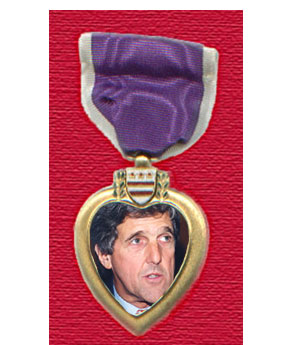
Why Kerry threw his ribbons

The veterans who tossed their medals at the steps of the U.S. Capitol in 1971 just wanted to wake up their country to the disastrous tragedy of Vietnam.

Just days before Christmas in 2002, I interviewed Sen. John Kerry about his Vietnam combat experiences at his cluttered study high atop Boston’s Beacon Hill. This is where Kerry keeps his Vietnam War archive, including artifacts from his swift boat days. At one juncture during our interview session, he pointed above his desk to a frayed American flag tattered with bullet holes. It was the one that had fluttered from PCF-94 over Kerry and his crew through the Viet Cong attacks they had survived together on the narrow waterways of South Vietnam in the first three months of 1969. We spoke about the harrowing day he saved the life of Jim Rassmann, a Green Beret who fell into a river amid a hail of mortar rounds.

“Do you still have the Silver Star,” I asked Kerry. “Yeah,” he said, “do you want to see it?” My answer was yes. He walked across his study to a secondary desk with clutter on top, mainly books, and opened the top right drawer. This is where he keeps all of his war medals.

“Nothing too fancy,” he said as he pointed to the various boxes in which his medals were kept. “They don’t bring back good memories.” After glancing at them briefly we went back to our taped interview.

Out of all the stories that have hounded Kerry on the campaign trail, the issue of whether he threw away his ribbons or his medals is the most mendacious. Last week the media demanded to view Kerry’s military records. The reason for the urgency was that Grant W. Hibbard, a lieutenant commander during Kerry’s swift boat days in Vietnam, asserted that Kerry’s first Purple Heart was undeserved. According to Hibbard, Kerry had a tiny scratch. The Boston Globe quoted him as saying, “I’ve had thorns from a rose that were worse.” Over 35 years after the fact, Hibbard, a Republican, was trying to belittle, embarrass and malign Kerry.

But the release of Kerry’s war record put an end to the flap. Stuck in the middle of released documents was an evaluation of Kerry by Hibbard, filled out two weeks after he supposedly told Kerry he didn’t deserve a Purple Heart. Nowhere in Hibbard’s evaluation did he mention any problem with Kerry over Kerry’s winning a Purple Heart. In fact, Hibbard wrote that Kerry was one of the best sailors he knew in three categories — initiative, cooperation and personal behavior. Why, if he thought Kerry was trying to finagle a Purple Heart, did he give him such high marks for personal behavior? As Katherine Q. Seelye reported in the New York Times once the document was released, Hibbard went underground, unwilling to grant interviews, hiding from the press in his retirement home in Florida. The story went away.

What we also learned from the release of his medical records is that Kerry still has shrapnel in his body from Vietnam. It often causes him discomfort.

The media showed little interest in that story. However, when ABC News showed an old clip of Kerry talking on a WRC-TV program called “Viewpoints” on Nov. 6, 1971, claiming he gave back medals during the famous Dewey Canyon III march in Washington in April of that year, they pounced. Why did he say on that show that he gave back medals when he was telling everybody else it was ribbons? Which Kerry was telling the truth?

Here is what happened on April 23, 1971, the day of the medal ceremony: First, Kerry had been in Washington for over a week organizing the Vietnam Veterans Against the War march on Washington. Before that he had been fundraising in New York City. His medals had been left back in Waltham, Mass. What he had brought with him, and often wore, were his ribbons. This made perfect sense. His medals were too clunky to wear on his Navy blues. When Kerry testified before the Senate Foreign Relations Committee on April 22, for example, he wore his ribbons, not his medals. Throughout the week of Dewey Canyon III, the White House was worried sick about the medal-returning ceremony. Its main fear was that VVAW was going to abandon the Capitol and hurl them over the White House gate instead. President Nixon and his advisors considered having a U.S. military representative accept the medals in front of the White House — such a gesture would ensure there was no violence or wild TV images. But historian Tom Wells, in “The War Within,” explains that Gen. Don Hughes, Nixon’s chief military aide, found the idea repulsive. Meanwhile, the word “throwaway” jarred veterans worldwide. Many were insulted by the prospect. “I did not admire the throwing of medals on the steps because I did not believe it was appropriate when so many brave men and women had sacrificed in order to get those same medals,” former POW John McCain told me in 2003. “John [Kerry] and I later became great friends. But I never addressed this one issue with him directly.”

While McCain’s sentiment was held by many sailors, particularly careerists, others on active duty cheered VVAW onward. In “Who Spoke Up? American Protest Against the War in Vietnam, 1963-1975,” Nancy Zaroulis and Gerald Sullivan detail how much internal sabotage was going on within the Navy. In 1971 alone, 488 cases were reported (191 sabotage, 135 arson, 162 wrongful destruction). Stories of “fragging” also became widespread. Angry GIs sought revenge on officers and men in their platoons or units. The Nixon administration feared widespread mutiny.

So, as its closing salvo, VVAW, in a carefully planned action, had 800 veterans congregate near the Capitol’s front steps. Jack Smith of West Hartford, Conn., a Marine Corps veteran, read a statement explaining why men who earned Purple Hearts and Bronze Stars were now giving them back to the government. For over two hours, men hurled their medals and ribbons over the fence toward a statue of John Marshall, the first chief justice of the United States. Dramatically, veterans from all branches of the armed services broadcast their names, units and citations, and then rid themselves of their mementos in disgust.

Words cannot properly describe the chilling effect the event had on the speakers and participants. Each soldier had his own horror story that had brought him to this precipice. As an antiwar action — or a piece of street theater — it was a powerful demonstration. But it was more than that. The bitterness and rage exhibited by these soldiers ripped at the nation’s conscience. Anybody who heard, for instance, Paul F. Winters pray for forgiveness as he hurled his Silver Star, Distinguished Cross and Bronze Star over a fence and then watched him limp away was forever scarred by the memory.

Some men, however, were not quite so dramatic. They gave only their first name and a calm statement: “Robert, New York, and I symbolically return all Vietnam medals and other service medals given me by the power structure that has genocidal policies.” Others vented their spleens, which were bursting with defiance: “Here’s a bunch of bullshit,” one veteran shouted as he hurled a handful of medals.

Over the years some have asked why Kerry chose to dispose of his ribbons, not his medals. Critics saw him as trying to have it both ways. It gave credence, they believed, to what A.J. Liebling of the New Yorker once claimed of Rough Rider Theodore Roosevelt: He was a “dilettante soldier but a first-class politician.” Further confusing the issue was the fact that Kerry did lob the medals of two no-show veterans toward the Marshall statue at their request. “The point of the exercise was to symbolically give something up,” Kerry recalled in his defense. “I chose my ribbons, which is what many of the veterans did.” The medals he tossed had been given to him by two angry veterans who wouldn’t make it to Washington; he was merely serving as their surrogate. Before Kerry discarded his ribbons, he declared: “I’m not doing this for any violent reason, but for peace and justice, and to try to make this country wake up once and for all.”

Kerry spent much of his time that afternoon with two Gold Star moms, Ann Pine of Trenton, N.J., and Evelyn Carrasquillo of Miami. He stood by them as they hurled medals back at the government. As a World War II veteran played taps and about 500 people gathered around, the names of men who died in Vietnam were called out. Watching TV that evening was Rich McCann, who had traveled the Mekong Delta rivers with Kerry and was now a graduate student at George Washington University. “When he threw those medals over the fence, I was pretty upset,” McCann recalled. “I was grappling with a lot of issues myself. It was hard to accept that I had given a year of my life for a lost cause. In retrospect, however, what he did was right.”

Not all the men gave up medals or ribbons. Many chose to turn in hats, jackets and military documents. A photograph taken by George Butler of VVAW shows that the offerings included recruitment letters, induction papers and discharge forms. Historian Andrew E. Hunt, in his superb “The Turning: A History of the Vietnam Veterans Against the War,” explains the rationale of several veterans for returning personal possessions. Ron Ferrizzi, for example, a Philadelphia native, disowned his Silver Star and Purple Heart against the pleas of his family. “My parents told me that if I really did come down here and turn in my medals, they never wanted anything more to do with me. That’s not an easy thing to take. I still love my parents. My wife doesn’t understand what happened to me when I came home from Nam. She said she would divorce me if I came down here because she wanted my medals for our son to see when he grew up.”

For a World War II veteran, the tossing away of medals must have been a painful sight. They didn’t know whether these long-haired hippies were on drugs, or whether something had happened in Vietnam that they couldn’t fully understand. As the memorabilia piled up and the media took it all in, it was clear that the antiwar movement had just turned a sharp corner. First Kerry’s testimony before the Fulbright committee, now this.

Butler captured the emotions of the afternoon with his camera. Collectively, his photographs speak of personal liberation. For many of the veterans, the discarding of military paraphernalia set them psychologically free. It was as if the U.S. government had corrupted them, seized their moral compass with shiny pin-on honor. “You have no idea how healing the whole experience was,” Bill Crandell recalled. “It was our hour of claiming ourselves back.”

Julia Kerry, John’s former wife, who was with her husband the entire week, came to the conclusion that the veterans had been in deep depression and denial. “There was so much buried pain,” she recalled. “It was numbing to witness.” On the last day the veterans also planted a tree, as a symbolic gesture for the preservation of life over death. “The truly impressive thing was that no acts of violence had been committed that entire week,” Sen. Kerry recalled. “We had just promised to be nonviolent and we were.”

Recent critics of Kerry assert that his Dewey County III ceremony is a metaphor for a lifetime of political flip-flopping. For Kerry, giving up his ribbons — the objects he had with him in Washington that week — made perfect sense. To his way of thinking, he was symbolically returning his medals to the U.S. government by tossing his ribbons. Even Sen. Stuart Symington, D-Mo., when preparing to cross-examine Kerry at the Fulbright committee meeting, asked him what the “medals” on his chest represented. They weren’t medals, they were ribbons; it was — and is — a common mistake. From Kerry’s vantage point, there is nothing contradictory about his statement to “Viewpoints” that he had given back “six, seven, eight, nine medals.” To have said that he had given back ribbons but that his medals were at home would have simply confused the TV audience.

Still, the persistent resurrection of this issue means Kerry should have been more exact in his language back in 1971. Clarity is usually a virtue in politics. But we should also remember that he earned those medals/ribbons. The shrapnel in his thigh should remind us of that sacrifice. It is a tangible souvenir from Vietnam that is still with him every day.

John Kerry’s first Purple Heart

With questions lingering over President Bush's service in the Guard, conservatives hope to diminish Kerry's Vietnam heroics -- but they can't erase his real battle record.

It was Dec. 2, 1968, and Lt. j.g. John Kerry was on a special nighttime covert mission in Vietnam. He had been ordered into a Viet Cong-infested peninsula north of Cam Ranh Bay to disrupt a smuggling operation. His vessel was a Boston Whaler, a boat that could float after taking 1,000 rounds of automatic weapons fire. Much of the evening was spent apprehending fishermen in a curfew zone. At approximately 2 a.m., however, they proceeded up an inlet with wild jungle on both sides of the boat. As they approached a bay, Kerry’s whaler fired flares into the air. To their horror, not far from them, were a startled group of Viet Cong smugglers trafficking in contraband.

“We opened fire,” Kerry told me in a Jan. 30, 2003, interview. “The light from the flares started to fade, the air was full of explosions. My M-16 jammed, and as I bent down to grab another gun, a stinging piece of heat socked into my arm and just seemed to burn like hell. By this time one of the sailors had started the engine and we ran by the beach strafing it. Then it was quiet.”

Kerry and crewmates blew up the smugglers’ beached sampans and then headed back to Cam Ranh Bay. “I never saw where the piece of shrapnel had come from, and the vision of the men running like gazelles haunted me,” Kerry continued. “It seemed stupid. My gunner didn’t know where the people were when he first started firing. The M-16 bullets had kicked up the sand way to the right of them as he sprayed the beach, slowly walking the line of fire over to where the men had been leaping for cover. I had been shouting directions and trying to un-jam my gun. The third crewman was locked in a personal struggle with the engine, trying to start it. I just shook my head and said, ‘Jesus Christ.’ It made me wonder if a year of training was worth anything.” Kerry, never trying to inflate the incident, called it a “half-ass action.” Nevertheless, the escapade introduced Kerry to the V.C. and earned him his first Purple Heart.

As generally understood, the Purple Heart is given to any U.S. citizen wounded in wartime service to the nation. Giving out Purple Hearts increased in 1968 as the United States Navy started sending swift boats up rivers in the Mekong Delta. Sailors — no longer safe on aircraft carriers or battleships in the Gulf of Tonkin — were starting to bleed, a lot. Vice Adm. Elmo Zumwalt himself would pin the medal on John Kerry at An Thoi about six weeks after the doctor at the Cam Ranh base took the shrapnel out of the young officer’s right arm. “He called me in New York to tell me he had been wounded,” his then girlfriend and later wife, Julia Thorne, remembered. “I was worried sick, scared to death that John or one of my brothers was going to die. He reassured me that he was OK.”

Now it is 2004, John Kerry is the presumptive Democratic nominee for president, and a couple of reporters are bringing into question whether he deserved a Purple Heart for that daring action. The Boston Globe and the New York Post have run hurtful stories quoting Kerry’s commanding officer that evening, Lt. Cmdr. Grant Hibbard, now a retiree in Gulf Breeze, Fla., grouching that Kerry’s wound wasn’t large enough. Hibbard was not even on the Boston Whaler when the firefight erupted. Nevertheless, the New York Post quotes Hibbard — a proudly registered Republican — as griping Kerry’s injury “didn’t look like much of a wound to me.”

In the wake of the controversial Bush National Guard story, reporters today, anxious to break a headline, are combing through Kerry’s Vietnam past. The name of the game is to find a conservative ex-Vietnam hand to say something negative about Kerry. It’s an automatic newsmaker, guaranteed to get picked up by Newsmax.com, the Weekly Standard, Rush Limbaugh, the New York Post and other conservative outlets. At issue is an attempt to downgrade Kerry’s Vietnam War heroism. The major anti-Kerry Vietnam War Internet complaint, it seems, echoes Hibbard: that his minor wounds weren’t big enough to warrant Purple Hearts. Unfortunately neither the Boston Globe nor New York Post takes the time to explain to readers that Purple Hearts are not given out to soldiers/sailors for the size of the wound. Only by the grace of God did the hot shrapnel that pierced Kerry’s arm not enter his heart or brain or eye.

For the record, Purple Hearts are given for the following enemy-related injuries:

a) Injury caused by enemy bullet, shrapnel or other projectile created by enemy action.

b) Injury caused by enemy-placed mine or trap.

c) Injury caused by enemy-released chemical, biological or nuclear agent.

d) Injury caused by vehicle or aircraft accident resulting from enemy fire.

e) Concussion injuries caused as a result of enemy-generated explosions.

Examples of injuries or wounds which clearly do not qualify for award of the Purple Heart are as follows:

a) Frostbite or trench foot injuries.

b) Heat stroke.

c) Food poisoning not caused by enemy agents.

d) Chemical, biological, or nuclear agents not released by the enemy.

e) Battle fatigue.

f) Disease not directly caused by enemy agents.

g) Accidents, to include explosive, aircraft, vehicular and other accidental wounding not related to or caused by enemy action.

Given the hurly-burly circumstance of Dec. 2, 1968, Kerry — and the other men on the mission — are not sure whether they were hit by enemy fire or if shrapnel from one of the other men on the Boston Whaler injured Kerry. It could have even been Kerry’s own M-16 backfiring that caused the shrapnel wound. It doesn’t really matter. The requirement makes it clear that you are awarded a Purple Heart for “Injury caused by enemy bullet, shrapnel or other projectile created by enemy action.” Does anybody dispute that Kerry’s wound was created by enemy action? As the stipulation also makes clear, Kerry would have been awarded a Purple Heart even if he never bled, if, for example, he had suffered a concussion from a grenade. So to set the record straight: Kerry deserved his first Purple Heart — period. To say otherwise is to distort the reality of the medal.

Unfortunately, the Boston Globe and New York Post stories omit fully reporting the bylaws. They present Hibbard at face value, downplaying the fact that he is a Republican criticizing a fellow veteran hoping to cause him public embarrassment. According to the Globe, Hibbard — in classic blowhard fashion — said Kerry “had a little scratch on his forearm, and he was holding a piece of shrapnel.” Adding further verbal insult, Hibbard apparently claimed: “I’ve had thorns from a rose that were worse.” The straight-faced Globe reporter, in fact, claims that Hibbard told him that Kerry’s wound resembled a “scrape from a fingernail.” Not included in either newspaper account, however, is Kerry’s medical report from the incident. He shared it with me last year when I was writing “Tour of Duty.” It reads: “3 DEC 1968 U.S. NAVAL SUPPORT FACILITY CAM RANH BAY RVN FPO Shrapnel in left arm above elbow. Shrapnel removed and appl. Bacitracin. Ret. to duty.” Is shrapnel removed from an arm really like a “scrape from a fingernail”? Or a thorn prick? The answer, of course, as any sensible person can surmise, is no.

Which raises the question: Why the medical record omission? Why the cruel attempt publicly to mock Kerry for his wound? Why the media need to play “gotcha” with something as sensitive as a war injury? This Dec. 3 medical report is proof that Kerry had shrapnel taken from his arm. According to Kerry, who should know, the doctor wrapped a clean white bandage around his arm. After the procedure he rightfully put in for a Purple Heart. Kerry clearly met the requirements — as listed above — for deserving one. From the hospital room Kerry returned to duty. That’s apparently when he held the shrapnel out in his palm for Hibbard to see.

The Globe, however, let Hibbard off the hook, no serious questions asked. On the one hand he claimed Kerry was holding his shrapnel and then he also claims it was a scratch. Are we to believe that following his surgical procedure Kerry went to Hibbard and ripped off his battle dressing to show him the wound that looked like a “scrape from a fingernail”? Or is Hibbard simply surmising it was a thorn prick? Worse still, Hibbard now claims that he was opposed to Kerry being awarded the Purple Heart. Really? Then why didn’t he fight against it harder? His superficial answer can be found in the Globe: “I do remember some questions, some correspondence about it. I finally said, ‘Ok, if that’s what happened … do whatever you want.’ After that I don’t know what happened. Obviously, he got it. I don’t know how.” Does this sound like a reliable source? Is that fuzzy-mindedness worth reporting as serious news? Why wasn’t Hibbard asked why he stayed quiet for 35 years?

Let me offer Hibbard an answer to his question. The U.S. Navy chose to award Kerry a Purple Heart because he qualified for it. Only a fool — or an exceedingly modest man — wouldn’t apply for a Purple Heart that was due him. Kerry was neither. But Kerry did not receive it because, as the Post claims, he had “strong ties to the Kennedy machine in Massachusetts (Bobby Kennedy speechwriter Adam Walinsky wrote Kerry’s famous 1971 antiwar Washington speech).” Kerry’s only tie to the “Kennedy machine” was that as a college student he slapped a “Ted Kennedy for U.S. Senate” bumper sticker on his VW and campaigned for a summer around Cape Cod. As for Walinsky writing Kerry’s famous April 22, 1971, speech/testimony — it’s utter nonsense. Walinsky has consistently denied the rumor. At his Boston home Kerry has a file brimming with his various drafts of the speech/testimony. He, in fact, had delivered parts of the speech months beforehand. Why is it so hard to accept the fact that Kerry — like thousands of other Vietnam Vets — was awarded a Purple Heart as a small token of appreciation for risking his life for his country?

Back in 1964 Bob Dylan wrote a lyric for the song “It’s Alright Ma (I’m Only Bleeding).” At one point in it he asks whether nothing in American life is “really sacred.” When retired U.S. naval officers, 35 years after the fact, start whining to the press that a war wound wasn’t big enough to warrant a Purple Heart — and the Boston Globe goes along for the ride — you realize Dylan’s prophecy. Today the tabloids truly are king. Call me naive, or too pro-veteran, but it seems to me we should be thanking every Purple Heart recipient for their duty to country, not demanding of them explanations for why their wounds weren’t bigger or fatal. Ridicule Kerry on his liberal Senate record, or so-called aloofism, or even his outspoken Vietnam Veterans Against the War protests, but leave his old battle scars alone.

This story has been corrected since it was originally published.

Continue Reading Close

Clinton’s lust for legacy

Jimmy Carter's biographer says that Camp David II could give the president an accomplishment that history will notice before the sexual peccadilloes.

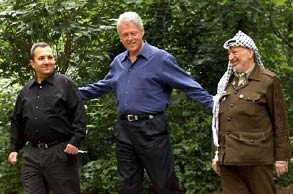
New York Times columnist William Safire quipped in 1994 that Jimmy Carter was really globetrotting to satisfy a “lust in his heart for a Nobel Prize,” hoping to recast his legacy from that of a failed president to a world statesman. That aside has new meaning when applied to President Bill Clinton’s current attempt to broker a Middle East Peace accord at Camp David, one that would almost guarantee him the coveted honor. Tens of thousands in Tel Aviv may be chanting “Jerusalem is not for sale!” but for a U.S. president obsessed with his legacy, an Israeli-Palestinian agreement would mean that the opening paragraph of future textbooks would offer something else besides impeachment and sex scandals.

Only two U.S. presidents have received civilization’s most august award: Theodore Roosevelt won in 1906 for mediating a conclusion to the Russo-Japanese War, and Woodrow Wilson won in 1919 for his role in overseeing the Versailles treaty, which ended World War I. A technical snafu in Oslo denied Carter his rightful sharing of the Nobel Peace Prize with Israeli Prime Minister Menachem Begin and Egyptian President Anwar Sadat for brokering the Camp David Accords in 1978, and a movement has been underfoot to compensate him for the oversight. Just months after Carter left the White House Sadat, in a forceful letter to the Nobel Peace Prize Committee dated April 11, 1981, nominated his American friend for the honor, citing his “unwavering commitment” to Middle East peace as evidenced at Camp David, and his tireless efforts to find a solution to the Palestinian problem.

Carter, the man most responsible for integrating the term “Camp David” into diplomatic parlance, has been nominated for the award every year since for any number of humanitarian good deeds, but it has thus far eluded him. So now, as the retired Carter sits in Plains, Ga., writing a novel on the Revolutionary War, it is Clinton’s turn to broker a peace that could change his legacy status forever from amicable rake to statesman.

With the exception of choosing Camp David as the convocation spot, there is nothing unusual about Clinton trying to orchestrate a comprehensive Middle East peace plan. The U.S. government has taken the lead in trying to achieve peace in the region ever since hostility erupted in 1948. But when Palestinian leader Yasser Arafat and Israeli Prime Minister Yitzhak Rabin met in Oslo in December 1993 to iron out political differences, Clinton stood on the sidelines. The outcome of Oslo, an Israeli-Palestinian Declaration of Principles, stipulated the removal of some Israeli troops from Arab towns in the occupied West Bank and granted Palestinian Authority self-rule by mid-1996. Although the two Middle East leaders signed the declarations at an elaborate White House ceremony on September 3, 1993, the president was more approving spectator than active participant. Compared to the hands-on role Jimmy Carter had played in the Camp David Accords, Clinton was at best a genial facilitator, as evidenced by photos of the famous Arafat-Rabin handshake for peace, which showed a smiling Clinton hovering behind the two leaders.

The Oslo Accords brought Arafat and Rabin Nobel Peace Prizes: The non-essential Clinton, by contrast, was granted a photo-op to display on his study wall. From that moment on, Clinton — who three months into his presidency had explicitly complained that “foreign policy is not what I came here to do” — began focusing on a peace plan for both the Israeli-Arab dispute and the civil war in Ireland. And in both areas he achieved some measure of success. He helped Jordan and Israel overcome their differences, clearing the way for signing of a formal peace treaty in October 1994. He also opened a new dimension of the peace process by organizing economic summits with Middle East leaders at Casablanca, Morocco; Amman, Jordan; and Cairo, Egypt - these were encouraging and important new steps toward normalizing relations between Israel and its Arab neighbors.

A cynic who wants to question Clinton’s commitment toward achieving an historic breakthrough in the region should consider this: During his first term he dispatched Secretary of State Warren Christopher to Damascus 27 times, hoping to forge a peace treaty between Syria and Israel, but instead catching criticism in the press for his administration’s empty-handed efforts.

Clinton has achieved, however, the respect of both Yasser Arafat and Israeli moderates. Since Clinton became president the Palestinian leader has visited the White House a record-breaking dozen times. More significantly, in December 1998, Clinton became the first U.S. president to visit Arafat in his Gaza home.

The Palestinian people have learned to both like and trust Clinton. On the other hand, Clinton scored points with Israeli moderates when he led a delegation to Tel Aviv following Rabin’s assassination. “Those who practice terror must not succeed,” Clinton announced on a visit to Israel a few months after Rabin’s death. “We must seek them out, and we will not let them kill the peace.”

And, of course, Clinton remained vigilant in dealing with the Middle East’s wild card, Saddam Hussein. In October 1994, the administration dispatched a full reserve of U.S. planes, ships and ground troops in response to renewed Iraqi military activities around the Kuwaiti border. Clinton deployed nearly 30,000 U.S. troops to the Gulf during the crisis in the name of preserving peace in the region. Clinton made it clear in his famous “dual commitment” speech to the World Jewish Congress in April 1995 that he was not going to let either Tehran or Baghdad destabilize the Middle East:

“[Iran and Iraq] harbor terrorists within their borders. They establish and support terrorist base camps in other lands. They hunger for nuclear and other weapons of mass destruction,” he said. “Every day they put innocent civilians in danger and stir up discord among nations.”

It is Clinton’s full understanding of Israel’s security needs, which he also demonstrated at the Wye, Md., summit in October 1998, that brought Barak to Camp David II. With Clinton leaving office in six months, Arafat ill with Parkinson’s disease and Barak the leader of a fragile coalition government, this summit represents a unique window for a peace plan that would deal with the thorny issue of Jerusalem.

But it won’t be easy. “God, it’s hard,” Clinton said Sunday in his first public assessment of the talks. “It’s like nothing I’ve ever dealt with. All the negotiations with the Irish, all the stuff I’ve done with the Balkans at Dayton … I’m more optimistic than I was when they first got here. We might make it — I don’t know.”

Choosing Camp David as the meeting grounds is more akin to rubbing a ceramic Buddha’s belly and praying for luck than a grandstand display of presidential hubris. After all, Carter was successful at Camp David. If Clinton fails, historians will note that when it came to tough negotiations the Arkansas politician just didn’t have the right stuff. At one juncture in 1978, for example, the determined Carter physically blocked a doorway at Camp David and refused to let Begin leave the compound. When that moment of reckoning strikes Camp David II, one can only hope Clinton isn’t out delivering an NAACP stump speech or concentrating on a backslapping rapport.

If he strikes the jackpot at Camp David II, his foreign policy stock will soar. Clinton trumped Carter by being the first Democratic president to gain reelection since FDR. But a Nobel Peace Prize might even give him status as a global statesman surpassing Carter’s.

Continue Reading Close
www.salon.com/writer/douglas_brinkley/index.html