Gordy Slack
Texas on evolution: Needs further study
Although the state ruled that schools must support Darwin's theory, creationists are singing the praises of Friday's decision.
Language matters. And we are lucky that some people will go to the mat over a few words. In Austin, Texas, this week, scientists and creationists battled over whether to include the words “strengths and weaknesses” in the state’s official statement about evolution. The words would influence how evolution is taught in Texas classrooms and would be immortalized in Lone Star textbooks. As the largest textbook market in the country, the decision could pressure other high school textbook publishers to conform to Texas standards.
Dan McLeroy, the Texas State Board of Education chairman, a dentist and self-described creationist, led the charge to mandate teaching the “strengths and weaknesses” of the theory of evolution. After three days of high-pitched argument on both sides, the 15-member board, by a vote of 8-7, rejected the language, relieving textbook authors and publishers of the pressure to insert what opponents called “junk science” into their pages. But in a compromise that alarms and dismays many science education advocates, the board did adopt language that attempts to cast a shadow of doubt over the validity of the central evolutionary concepts of natural selection and common ancestry.
Proponents of the theory of intelligent design, and other brands of neo-creationism, argue that evolution is inadequate to the job of explaining the diversity and history of life on earth. If they can cast doubts about evolution’s validity, they have a chance to fill the authority vacuum with the tenets of creationism. But since late 2005, when a federal judge in Dover, Pa., ruled that intelligent design was a form of creationism, and that its introduction into public high school curricula was unconstitutional, advocates of teaching neo-creationism have been forced to seek other ways into public science classrooms. Enter the “strengths and weaknesses” strategy, crafted by the Seattle-based, pro-intelligent-design think thank, Discovery Institute.
Eugenie Scott, director of the National Center for Science Education, an Oakland, Calif.-based organization dedicated to protecting the integrity of science education in the public schools, says that once McLeroy and his allies failed to pass the “strengths and weakness” language, “they had a fallback position, which was to continue amending the standards to achieve through the back door what they couldn’t achieve upfront.”
And they succeeded. Casey Luskin, a Discovery Institute lawyer, and its guy on the Austin scene, was psyched by the outcome. “These are the strongest standards in the country now,” he says. “The language adapted requires students to have critical thinking about all of science, including evolution, and it urges them to look at all sides of the issue.”
One amendment calls for students to “analyze and evaluate scientific explanations concerning any data on sudden appearance and stasis and the sequential groups in the fossil record.” The key words are “sudden appearance” and “stasis.” McLeroy argues that “the sudden appearance” of forms in the Cambrian period, when there was a rapid multiplication and diversification of species, and the persistence of forms over long periods of time (stasis) are evidence against evolution. And thus for creationism.
In 2012, when the board next selects textbooks, anti-evolution members will be able to argue against books that don’t sufficiently “evaluate scientific explanations” concerning stasis or so-called sudden appearance. Another amendment requires that teachers and textbooks include language to “analyze and evaluate scientific explanation concerning the complexity of the cell.” Arguing for the “irreducible complexity” of cells is another key creationist theme.
Each of the amendments singles out an old creationist argument, strips it of its overtly ideological language, and requires teachers and textbook publishers to adopt it. In other words, says Joshua Rosenau of NCSE, if the books don’t at least pay lip service to criticizing natural selection, they risk not being adopted.
However, the overwhelming scientific consensus is that neither periods of rapid evolution, nor the persistence of forms that have adapted successful ways of surviving for long periods of time, poses any threat to the theory of evolution. Yes, cells are complex, but so are the explanatory tools of modern evolutionary theory. Over the history of the debate, critics of evolution have invariably said something or other was too complex for Darwin’s theory to explain. Yet scientists have consistently pointed out that two of the critics’ favorite examples, the human eye and the bacterial flagellum, have been illuminated by and explained in terms of natural selection.
“The theory of evolution has no weaknesses,” says Kenneth Miller, a biology professor at Brown University. There are many unanswered questions about how organisms evolve and diversify, and what drives them to do so, but Charles Darwin’s 150-year-old insights that all life on earth descended from one or a few simple common ancestors, and that natural selection explains how they did, remain solid foundations of modern biology. As the late, great biologist Theodosius Dobzhansky is famous for saying, “Nothing in biology makes sense except in the light of evolution.”
Not that science makes sense to a creationist like McLeroy. “Scientific consensus means nothing,” he tells Salon. “All it takes is one fact to overthrow consensus. Evolution has a status that it simply doesn’t deserve. People say it’s vital to understanding biology. But it’s genetics that’s the foundation for biology. A biologist once said that nothing in biology makes sense without evolution. Well, that’s not true. You go into the top biology labs, and it makes no difference if evolution is true or false to what they’re doing and studying. It makes no difference.”
It makes all the difference in the world, says Miller, who notes the irony of McLeroy quoting Dobzhansky, one of the fathers of the modern evolutionary synthesis. Adds Miller: McLeroy’s “fundamental misunderstanding of the way genetics and evolution have produced a unified science of biology is nothing short of breathtaking.”
You are not your brain
We have become too reductive in understanding ourselves, argues philosopher Alva Noe. Our thoughts and desires are shaped by more than neurons firing inside our heads.
For a decade or so, brain studies have seemed on the brink of answering questions about the nature of consciousness, the self, thought and experience. But they never do, argues University of California at Berkeley philosopher Alva Noë, because these things are not found solely in the brain itself.
In his new book, “Out of Our Heads: Why You Are Not Your Brain, and Other Lessons From the Biology of Consciousness,” Noë attacks the brave new world of neuroscience and its claims that brain mechanics can explain consciousness. Nobel Prize-winning molecular biologist Francis Crick wrote, “You, your joys and your sorrows, your memories and your ambitions, your sense of personal identity and free will, are in fact no more than the behavior of a vast assembly of nerve cells and their associated molecules.” While Noë credits Crick for drawing popular and scientific attention to the question of consciousness, he thinks Crick’s conclusions are dead wrong and dangerous.
Continue Reading CloseExpel, expelling, expelled!
Richard Dawkins inadvertently smuggled into a private screening of pro-creationist documentary.
A soon-to-be-released Ben Stein movie, “Expelled: No Intelligence Allowed,” which attacks evolutionary theory and its defenders in the culture war, has been screening to hand-picked audiences around the country for the past couple of weeks. Yesterday, PZ Myers, an evolutionary biologist and blogger, says he was politely waiting to take a look at the film when he was hand picked by a policeman to leave the theater. The cop told Myers that the producer had ordered him to leave.
Continue Reading CloseThe evolution of creationism
After their notorious legal defeat, intelligent design proponents are resurfacing with insidious new assaults on science.
Two years ago, Pennsylvania federal Judge John Jones III handed down a stunning decision that many said would take down the intelligent design movement. But American creationism doesn’t die. It just adapts.
Decades earlier, when the courts deemed creation science — proto intelligent design — a religious view and not constitutionally teachable as science in public schools, it adapted by cutting God off its letterhead and calling itself “intelligent design.” The argument for I.D., and for “scientific creation theory” before it, is that evolution isn’t up to the task of accounting for life. Given biology’s complexity, and natural selection’s inability to explain it, I.D. thinking goes, life must be designed by a, well, designer. I.D.ers skirted any mention of God, hoping to avoid getting snagged on the First Amendment’s prohibition against promoting religion by arguing that I.D. was just a young and outlying science.
Continue Reading CloseI feel your pain
New proof of "mirror neurons" explains why we experience the grief and joy of others, and maybe why humans are altruistic. But don't call us Gandhi yet.
A young woman sat on the subway and sobbed. Her mascara-stained cheeks were wet and blotchy. Her eyes were red. Her shoulders shook. She was hopeless, completely forlorn. When I got off the train, I stood on the platform, paralyzed by emotions. Hers. I’d taken them with me. I stood there, tears streaming down my cheeks. But I had no death in the family. No breakup. No terminal diagnosis. And I didn’t even know her or why she cried. But the emotional pain, her pain, now my pain, was as real as day.
Continue Reading CloseInside the Creation Museum
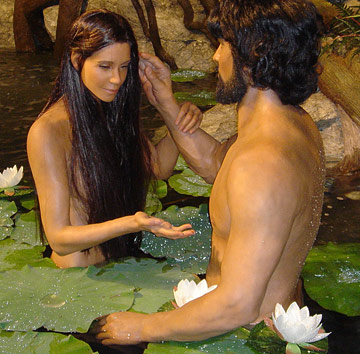
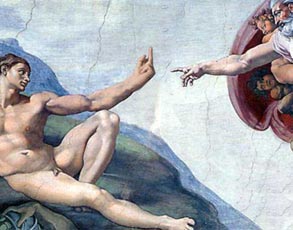
Adam and Eve frolic amid the dinosaurs in the new $27 million museum that demonstrates Darwin has nothing on the Book of Genesis.
The Creation Museum swung open its stegosaurus-guarded gates to the public Monday, and I have to say it’s out of this world. For those of us raised in natural history Meccas like the American Museum in New York, the Smithsonian in Washington, or the Field in Chicago, the beautifully designed museum induces an eerie vertigo. All the familiar characters are here: T. rex, giant skeletons of triceratops and apatosaurus, a pterosaur spreading its wings above the crowd, live exhibits of birds, amphibians and reptiles, and the dripping, hooting and chirping soundtrack of the primeval forest. There are also a couple of unfamiliar faces, for a natural history museum, in the tan and finely muscled bodies of Adam and Eve.
Continue Reading ClosePage 1 of 2 in Gordy Slack