Gray Miles

New Orleans dodges disaster

A milder than predicted Gustav spares the city, but the region's hurricane response remains in tatters.

  • more
    • All Share Services

New Orleans dodges disaster

It is just after 2 p.m. central time, and some of the handful of residents who rode out the storm in Uptown New Orleans have begun venturing out. In the wake of Gustav’s hot winds, most people are relieved. But even in Uptown, which was spared much damage during Katrina, there are some houses with torn roofs, and wind-strewn debris lines the streets.

Tim Lefevre, a fireman patrolling the streets for damage, said, “You can’t believe everything you hear about this one. Everybody’s out walking their dogs already. It’s just wind damage mostly.”

When it made landfall in South Central Louisiana at 11:15 Monday morning, hurricane Gustav was a weak Category 2 storm, with winds reaching a top speed of 115 mph, and as it moved inland it rapidly lost strength. In New Orleans, winds barely reached 60 miles per hour. The storm surge, although large in some areas of the storm’s path, was moderate in the city. Water leaked over the tops of the levee in New Orleans’ Ninth Ward, but it was not enough to cause any real flooding. Even the rains, which were thought to have flooding potential, were relatively mild.

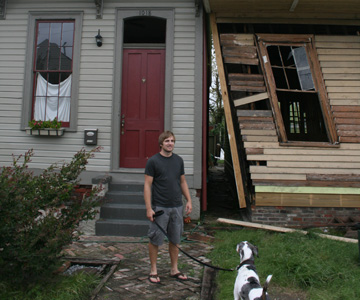
Robert Bandzuch is standing outside his house in Uptown, which he rebuilt himself after Katrina. His neighbor’s unfinished two-story house partially collapsed and leans precariously into his one-story shotgun, which must bear the additional weight. He is worried about his house flattening him while he’s sleeping tonight. Regardless, he’s unlikely to leave New Orleans in the case of a future hurricane just because officials declare a mandatory evacuation. “Because of his personality, the mayor said things that weren’t true,” said Bandzuch. “That’s not a good way to get people to pay attention.”

Bandzuch, 33, a Slovakian woodworker, along with his Catahoula breed dog, Lasky, walked the streets together examining the downed limbs and power lines littering Magazine Street.

In the post-Gustav news conferences, there will be handshakes and good cheer about a planning and evacuation job well done. Republican presidential candidate John McCain is no doubt relieved that he can now make a presidential-sounding statement of satisfaction about the proceedings, and maybe rub away some of the stink of the Bush administration’s legacy of failure during Katrina.

City and state officials will get in on the group hug — “You did a great job!” “No, you did a great job!”

But self-congratulation doesn’t address the real wounds left over from the neglect of the city during Hurricane Katrina. As the estimated 90 percent of the city’s residents who evacuated this storm return over the next couple of days, big questions about the city’s relationship to natural disasters remain.

Because of Katrina, many New Orleanians distrust and resent the government, yet they remain completely dependent on government for help. A myth persists among a small group of New Orleanians that some nebulous group of actors in “the government” purposely dynamited the Lower Ninth Ward levees that failed during the Katrina storm surge.

So now that this time around the government managed to coordinate a successful response and evacuation, what will the effect be? There are two likely options.

One, the more rosy scenario, is that this process will become embedded in people’s idea of what it is to live here. Every year, we evacuate. We take care of our friends and neighbors, have established relationships with people or church groups in the region where we can stay, and this is what we will continue to do. This scenario will require New Orleanians to forge a new relationship with their elected officials. Rather than seeing them as cynical profiteers, they will understand the leading role government plays in a natural disaster scenario.

Two, the more cynical scenario, is that politicians engage in a big group hug about how great a job they did, how we dodged a bullet. That will remain the extent of lessons learned. New Orleanians won’t be challenged to make this kind of exercise a part of their life; they will be encouraged to go back to business as usual. And next time around, it will take another display of either bumbling incompetence or hysterical pleading to get people to get out of harm’s way.

Meanwhile, the real underlying challenge for New Orleans remains obscured: The behavior of hurricanes is almost impossible to predict. Virtually everything forecasted about Hurricane Gustav was inaccurate, with the exception of its projected path. As Gustav approached, the attention of TV watchers was yanked from the Republican convention in Minnesota to the Gulf Coast. We watched dueling headlines: There won’t be storm surge flooding, declared the Army Corps of Engineers. Yes there will, said FEMA.

Rather than create a sustainable culture of natural disaster preparedness, city officials choose to browbeat residents into leaving. The result is a pendulum swing between fear and nonchalance. “People here had a change of mind-thought after Katrina,” said Sgt. Maj. Edward Daigle of the Louisiana National Guard, as he kept watch over the streams of evacuees leaving New Orleans’ Greyhound bus station on Saturday. “They used to feel that they could handle anything, but now they know they’ve got to leave.”

Until next time, that is, when people will remember how Mayor Nagin cried wolf and they spent two nights on the floors of high school gyms across the South when they could have been at home, nervous but comfortable. Jack Olson, an Uptown resident out for a stroll as the winds died down, said, “I can’t watch TV because it’s all a bunch of doom and gloom and paranoia that I don’t care much for.”

This isn’t the only place where storms are a fact of life, where the sea is trying to reclaim the dry land. Many areas from Cuba to Indonesia regard storms as a challenge that must be continuously met. The question is, can politicians in this country be counted on to react to major storms responsibly, and not just use them for their own political expediency? The city dodged disaster this time, but if New Orleans is to survive, it must reenvision itself, from the “the city that care forgot” to the city that cares for its own.

New Orleans worried about levees

Locals are jazzed by the swift emergency response to Hurricane Gustav. But doubts about post-Katrina repairs to the flood-control system have the city shaking.

  • more
    • All Share Services

New Orleans worried about levees

On Monday morning, when Hurricane Gustav hits the Gulf Coast, all of what New Orleans was not able to repair post-Katrina will be thrown into relief. Businesses have reopened, neighborhoods have come back, and the city’s reputation has been restored since Katrina, at tremendous personal expense to the people who live here. But the elephant in the living room, the federally engineered flood-protection system, must perform in the face of a probable Category 3 storm on Monday afternoon. If it doesn’t, many of New Orleans’ painstaking repairs may have been futile.

Gustav is expected to be comparable in strength to Katrina, which was also a Category 3 hurricane. However, Katrina, which breached levees and flooded low-lying areas like Lakeview, Gentilly and the Lower 9th Ward, made landfall east of New Orleans. Gustav is on track to hit west of the city, and those eastside levees that are still not fully repaired may not have to bear the brunt of the storm surge. In 2008, the levees on the west bank of the Mississippi River are more threatened.

This time, at least, city and state officials have done an excellent job of getting everyone out. President Bush may be headed to Texas, and Republican presidential candidate John McCain may have had his picture taken with Mississippi Gov. Haley Barbour, but in Louisiana, the state where the storm will actually come ashore, local officials are responsible for coordinating the evacuation. The news media aided in the evacuation by trumpeting Gustav’s approach early and often, and New Orleanians listened. By Tuesday, TV journalists began their mantra of “evacuate as soon as possible.” Many residents who had stayed for Katrina and suffered decided to heed the advice. By Wednesday, a ticker ran at the bottom of all local news broadcasts with phone numbers to call and procedures to follow for people who wanted to leave but who had no car. The city’s never-before-tested hurricane protocols were rolling into action. By Thursday, lines were beginning to form at gas stations.

On Friday, the third anniversary of Hurricane Katrina’s Louisiana landfall, public transit buses were commandeered to serve as shuttles to the city’s Greyhound bus station, ferrying citizens without cars to the buses that would take them to shelters as far away as Tennessee. Many evacuees who were upbeat getting on their shuttle to the bus station — a successful and smooth process by most accounts — became despondent while waiting in line to get on a bus to an unknown location. “I just wish we knew where we were going,” said Anthony Jones, 16, who sat on the curb with a group of friends. When asked to comment for the article, Alethia Smith, 18, smiled sarcastically. “Just tell them we poor, but we happy.”

Barbara Shields, 68, was waiting in a section of the bus station designated for people with disabilities, all of whom would be sent to a specific shelter. “My grandson called me this morning,” she said. “He told me, ‘Grandma, don’t let them people take you! They’ll take you anywhere!’ And I said, ‘Baby, my legs may be bad, but my brain ain’t bad.’”

By Saturday, the Louisiana National Guard was fanning out through the city on patrols and the majority of those who were relying on buses were in the process of leaving. The Orleans Parish Prison had been evacuated, as had most hospitals and nursing homes. Anytime a microphone was in front of them, city officials praised the efficiency of all of the evacuation efforts under way. Aid agencies were in top form. Unfortunately, no one could say the same for the city’s levee system. The Army Corps of Engineers has been rebuilding the city’s levees for three years but cannot guarantee their effectiveness beyond a Category 3 hurricane, and even then a large storm surge could easily overwhelm them.

Back at the Greyhound station, empty pet kennels were stacked up next to a large pet-registration area. The Louisiana SPCA was overseeing a tightly organized pet evacuation, loading crated animals onto refrigerated semis to be taken to Shreveport, La., where their owners could collect them. The mood around the pet evacuation area was, not surprisingly, all about compassion and gentleness — somewhat in contrast to vibe at the large-scale human evacuation going on farther down the sidewalk.

Volunteers had driven down to New Orleans from all over the country to help move out the pets. Their actions could well prove beneficial to people: Three years ago, it turned out that many of people who did not evacuate for Katrina stayed behind because they couldn’t bear to leave their animals. A pet-evacuation procedure was considered crucial to post-Katrina preparedness.

But the benefits for the human population of New Orleans didn’t seem to be the driving force for at least one of the ASPCA volunteers. When asked how she would respond to the observation that they were doing a better job with the pets than with the humans, a volunteer from St. Louis choked up. I paused, worried I had said something insensitive about the evacuees or about her motives. But I had misunderstood her. “What you have to understand,” she said, composing herself, “is that there is no difference between companion animals and people.”

By Sunday morning, 24 hours before Gustav’s expected landfall, New Orleans had largely emptied. There appeared to be a roughly 1-to-1 ratio of citizens to law enforcement in the city. Checkpoints were being set up at major intersections, and entire sections of the city were more or less blocked off to through-traffic. While trying to get our press credentials, we were stopped by some National Guardsmen.

Not everything about the response to this storm is different, however. New Orleanians are cynical about government. Gustav is not necessarily being overhyped, given how horrible Katrina was and how vulnerable the city remains, but there is suspicion about the motives of the responsive, attentive local officials. Hurricane Katrina’s aftermath reflected horribly on the federal and local governments, and politicians cannot afford to repeat that. The mandatory evacuation protocols for Gustav have been thorough and swift-moving, whereas the protocols for Katrina seemed improvised and last-minute. Residents wonder whether by being vigilant — or hysterical, depending on one’s perspective — officials are putting themselves in a position to be able to say “I told you so” if anyone stays behind. This time around, Mayor Nagin and all disaster-response spokespeople are making it clear that if you stay behind and are stranded on your roof waving a flag made from a bedsheet, it is you who will be held accountable, not them. Many who are riding out the storm feel that’s the motive behind Nagin’s emphatic plea during a press conference Saturday for citizens to flee “the mother of all storms,” and “get their butts out of New Orleans.”

Nagin is famous in New Orleans for his catchy sound bites, and this is only the latest in a series that began during Katrina’s aftermath, when he really found his voice by telling the feds to “get off their asses” in a live radio interview. Although New Orleanians loved Nagin for that comment, many were wary of Saturday’s hysterical press conference appearance. People having their final pre-storm restaurant dinner in the French Quarter were heard murmuring about the government “coverin’ their asses.” This time around the city may have acted with the utmost caution and thoroughness in its coordination of agencies and resources. But it might be generations before New Orleanians let go of the grudge they hold against the government — city, state, and federal — for its failure to protect against and respond to Katrina.

“The city learned a lot of lessons three years ago, not just humanitarian-wise, but image-wise,” said Mary Beth Romig, of the New Orleans Convention and Visitors Bureau. One of the image lessons was that stranding tourists inside moldering, sweltering hotels is bad for business in the long term. So all the hotels asked all their guests to leave, then locked their doors.

This is not good news for the swarm of media that have shown up for the show, many of whom have no place to stay in the city. Some journalists are bunking down inside TV trucks parked along the Canal Street streetcar line.

Whereas hurricane parties raged until Katrina’s winds began felling tree limbs, most bars are boarded up. Previous storm threats have prompted New Orleanians to spray paint taunts on their boarded-up windows: “We don’t run from hurricanes, we drink them!” Or “No hurricane can hold us down!” This time around, those sentiments are muted.

Everywhere, that is, except a two-block stretch of Bourbon Street, where the remains of the canceled Southern Decadence festival, an annual gay bash held in the French Quarter, was in full swing. Decadence, scheduled for this weekend, was officially canceled, but revelers had flown in from all of the country, and they were partying with fierce determination. At the Lafitte in Exile bar, the dance floor was packed, and a Tina Turner concert video was being projected on the building across the street. There was a line out the door at the Clover Grill, and a man in a cowboy hat led a pair of miniature ponies around in the street.

A New Yorker named Mike told us that most attendees were flying out Sunday, but the element of anxiety lent an exciting urgency to the party. “My friends in New York are freaking out, like, ‘When are you coming home?’ And I’m like, ‘I’m not coming home yet! Hurricane sex is the best!’”

Some locals, meanwhile, seemed committed to upholding an ancient, pre-Katrina New Orleans tradition: remaining blasé in the face of an incoming hurricane. On Magazine Street in the Uptown neighborhood, an area that did not flood during Katrina, a few tattooed hipsters were sitting on their front porch, smoking cigarettes and listening to the grimly familiar silence of an empty city. The silence was broken by a police cruiser that rolls by with a bullhorn aimed out the window. “Mandatory evacuation! Y’all gotta get out!”

The hipsters shrugged their shoulders, and the cruiser moved on.

Continue Reading Close

Out of the nightmare, into the Astrodome

Safely in Houston, Louisiana evacuees tell nightmarish tales of the Superdome and blast the relief effort.

  • more
    • All Share Services

Out of the nightmare, into the Astrodome

As they drove into Houston on Interstate 10 Thursday morning, evacuees from the New Orleans Superdome saw a “Welcome” sign. Local residents had hung bedsheets over the edge of overpasses and erected signs on trucks with messages like, “Welcome New Orleans, Our House Is Your House.”

“They were playing Lil’ Wayne [a popular New Orleans hip-hop artist] on the radio when we drove into town,” says Augustus Warren Williams, 45. “They are treating us better than our own people.”

For the desperate, dirty, overwhelmed people arriving at Houston’s Astrodome, which took in 11,000 evacuees until authorities closed the door Thursday night, the contrast with the situation at the Superdome is stunning. They describe a nightmarish scene: tens of thousands of people packed into a stadium surrounded by overflowing sewage, piles of rotting garbage and corpses, in delirium-inducing heat, without adequate food or water. Hostilities rose and violence erupted. Law enforcement was grossly inadequate. Evacuees told stories, some of which have been confirmed by authorities, of rapes, fighting and a suicide. Their relief at having arrived at a place with food, water, sanitary facilities and proper security was palpable.

After initially planning to shelter 23,000 evacuees, authorities decided Thursday night that the Astrodome could only accommodate 11,000. Buses were rerouted to surrounding towns like Huntsville, with San Antonio and Dallas each preparing to receive 25,000 people. So far, families that were split up before evacuation have no way of contacting each other.

None of the volunteers available for comment could provide any idea of how long the refugees will be housed in the Astrodome or in Houston at large. Although the Houston school system has taken on thousands of displaced kids, they have no idea how long this situation will last. No officials would comment on the subject of resettlement, leaving the long-term fate of Hurricane Katrina’s refugees uncertain.

As we approach the designated volunteer and press entranceway to the Astrodome, the blast of cool air conditioning is a relief from the scorching Texas sun. Inside the dome, cots are organized in rows according to occupants’ last names, so that family members can better find one another if they have been separated in transit. At the Superdome, evacuees were forbidden to leave because of flooding. At the Astrodome, everyone is given a pink wristband upon arrival so that they can come and go as they please.

A bewildering array of volunteers move among the cots, including medical technicians, psychologists and local volunteers registering names and handing out donated food and water.

The contrast between this scene and the one at the Superdome is not lost on evacuees. “It was inhuman and disgusting in the Superdome,” says Nathaniel Brooks, 71. “They had us cooped up in there and some of the younger boys were going crazy. Fighting, hurting each other, arguing. I couldn’t wait to leave.”

The evacuees, most of them poor and black, blast officials for the failed relief effort. “The mayor couldn’t stop the rain, but I know he could have done a lot more to help his people,” says Brooks.

Laverda Suber, 50, evacuated New Orleans, but her brother and nieces decided to stay, and ended up trapped in the Superdome’s catacombs. “My family was calling me from the Superdome, and they couldn’t find where the rations were being distributed,” says Suber. “They went hungry and were dehydrated.”

Hurricane Katrina stripped the Superdome of its Teflon cover, caused leaking, and left the shelter without power.

Evacuees say New Orleans and federal officials failed to provide them with adequate services. They say they were grossly understaffed. “Five or six buses showed up at the Superdome and there was no one to tell anyone what to do — I got crushed,” says James Matthews, 61, who is handicapped and suffered a sprained wrist in the stampede. “This is 99 percent better.”

For their part, furious local and state officials are demanding answers from federal agencies about the abysmal federal response to the catastrophe, which left thousands trapped in a lawless city for days without food, water or medical help. The mayor of New Orleans, Ray Nagin, was actually reduced to sending out “a desperate SOS” for help.

As the city became aware of the storm’s approach, Nagin repeatedly referred to the Superdome as a shelter of “last resort,” emphasizing evacuation as the only safe choice for New Orleanians. However, it was widely known that New Orleans could suffer catastrophic damage in a storm of Katrina’s magnitude, and it was also widely known that tens of thousands of people lacked the means to evacuate. The question in many people’s minds in the Astrodome today is, Why weren’t better evacuation and shelter contingency plans in place?

At the Astrodome, plates of sausage, eggs and tortillas are being distributed. A crush of people surrounds a station at which Red Cross volunteers are passing out underwear, stockings, socks, T-shirts, diapers and toiletries. The bleachers are festooned with wet clothing set out to dry in the neon lights. The showers are supplied with soap, and the bathrooms are equipped with industrial-sized pumps of hand sanitizer. On one set of seats hangs a sign announcing free children’s events, including a trip to the Houston Zoo.

Despite the appearance of centralized management behind this rescue operation, the relief efforts taking place at the Astrodome are entirely ad hoc. “I was at work this morning minding my own business when I got a mass e-mail from my company saying that we are in great need of volunteers at the Astrodome,” says Bryce Giescer, in his mid-50s. “I just showed up, found a Red Cross person and said, ‘Point me and push,’ and they did.” Giescer is an employee of the Reliant Energy Co., which provides most of the electricity for the Houston area. Other companies, including Continental, Shell Oil and BP, are providing a staff of volunteers.

Across the 610 expressway from the Astrodome is Astro World, an amusement park that has offered free entry to anyone staying at the Astrodome. Houston’s Third Ward Bike Shop is donating 50 bicycles to evacuees, and kids can ride around the vast and empty parking lot that surrounds the stadium.

Despite the vastly improved conditions at the Astrodome, there are some problems. Several people have been arrested for fighting over cots, and 30 guns were confiscated. Several evacuees have been seen repacking suitcases full of looted merchandise. In the bathrooms, one emergency medical official who declined to be named ordered some New Orleanians to cease using drugs in the stalls. The days spent in the Superdome have left people in varying states of trauma.

The dramatic failure of authorities to deal with the New Orleans catastrophe has caused darker thoughts to surface among former residents. “In some places, the streets are totally dry,” says Nathaniel Brooks. “And in other places you can’t see the tops of the houses. I don’t know how to account for this. But it seems like something’s not right.”

While kids appear to be content coloring in donated coloring books and playing on the rolled-up bolts of Astro-Turf, many adults lie in their cots staring blankly into the distance. As we approach people, many are indifferent about speaking to us. They have gone through enough already and don’t seem to feel that talking to the media will do anything to improve their situation. But traces of the old New Orleanian civility remain. People who do feel able to talk with us shake our hands and tell us to be safe and to take care of ourselves.

Some refugees from Katrina feel betrayed by their city to the point that they are ambivalent about returning. “I’ve put in my application at the Holiday Inn down the street,” says Johnraver Prince, 19. “New Orleans is not doing what they can for us. I’m thinking to stay.” Other evacuees echoed these sentiments. Some say their lives in New Orleans have been completely destroyed.

Continue Reading Close

Inside New Orleans

Sneaking past the police lines, we find a surreal scene where tourists are sleeping on bridges, restauranteurs are eating high on the hog, and looters lurk on every corner.

  • more
    • All Share Services

Inside New Orleans

Nineteen miles west of New Orleans, near the LaPlace exit on Interstate 10, there’s a roadblock where harried police officials check vehicles and press credentials. We tell an officer we’re with the press, although we don’t have an official badge. “You’ll be in the way,” he responds, and turns us back. But we manage to enter the city by state Highway 90, slipping into the cracks of a porous rescue operation.

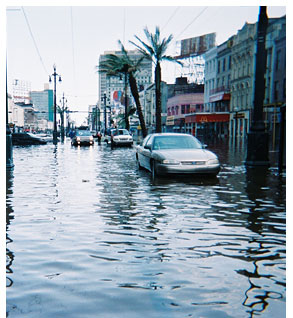
Passing over flooded thoroughfares, Highway 90 cuts through the suburban community of Metairie. Dodging windfallen corrugated roofing and downed telephone poles, we pass a man determinedly mowing his lawn, and drive by an evacuated hospital, where bewildered people still wearing backless patient tunics wade through flooded streets. A plainclothes detective gives us a hint as to how to proceed downtown, and we ford a street under 3 feet of swamp water.

Along River Road, which runs along the Mississippi, things dry out. Although tree limbs are scattered about, we almost believe that it’s not quite as bad as it seems. As we drive through the stately Uptown section of New Orleans, it appears that there is no one around at all. Finally, we come upon a lone pedestrian carrying a garbage bag on his back. He angrily yells at us for a ride, but we don’t stop.

On a peaceful, dry side street, an elderly woman is holding court on her front porch while her family mills about on the street. Rose Jerrell, 65, has weathered the storm with her three children and several grandchildren. Now that the weather has blown over, they’re sitting on the porch eating corn on the cob and listening to the radio. They’re not planning on leaving, no matter how long it will be until services are restored. “We’re just fine here,” she says. “We don’t run from hurricanes. You guys going sightseeing?” she asks us with a grin as we head toward downtown.

The only accessible roads into the city that have not been flooded are in a narrow stretch running along the Mississippi levee, which forms the highest point of land in the area. The Mississippi levee that protects the French Quarter and Magazine Street district from the river is a large earthworks structure, and one of the first levees built in New Orleans. Throughout Katrina, the levee kept the river from overflowing and joining the waters of Lake Pontchartrain coming in from the north side of town. The newer, heavy-duty steel canal floodgates broke under the strain of the battering storm surge.

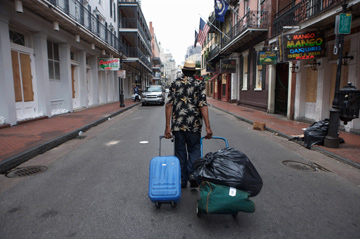
Surrounding this slice of passable streets are scenes of grim destruction. Smoldering ruins, twisted pieces of corrugated metal, hundreds of downed and uprooted live oak trees litter the streets. On the outskirts of downtown, clusters of shellshocked survivors wander down empty thoroughfares, pushing what’s left of their belongings in shopping carts and strollers.

“I don’t really know where I’m going,” says Kendall, a woman from the Ninth Ward neighborhood, who declines to give her last name. “Wherever they take me, I’m going. Anywhere with electricity. At the Ninth Ward, the water is 20 feet. The water ain’t draining. We have got to start all over.” She rejoins a long, aimless caravan of New Orleanians from the eastern side of the city, who are congregating in the business district.

The Ninth Ward is one of the most flood-devastated neighborhoods. Lying to the east of the French Quarter, the Ninth Ward, which is predominantly African-American, is one of the poorest parts of New Orleans, and was also the area that sustained the most damage from Hurricane Betsy in 1965, in which 200 residents died.

On our way into the city, most of the media appeared to be gathering on the expressway, waiting for the evacuation to begin before rolling camera. Inside the city, where contaminated floodwater is beginning to stink in the midday sun, a few camera crews remain. The CNN crew stands in the middle of Canal Street, downtown New Orleans’ main thoroughfare, bargaining to buy a truck from a soon-to-be evacuee. “How much gas does it have in it?” asks a producer. “Will you throw in the canoe? Can we siphon some gas off another vehicle?”

On Wednesday afternoon, helicopters begin lifting evacuees from shelters to a designated stretch of I-10, where dozens of school buses wait to take people west toward Houston. National Guard military trucks packed with people barrel out of town toward the makeshift transport hub, but tens of thousands of people remain stranded in downtown New Orleans, without any idea of where to go, or how to get there.

Rescue efforts did not begin in earnest until late Wednesday afternoon, although the worst of the storm passed mid-morning on Monday. Initially, Coast Guard helicopters transported a few stranded flood victims to storm shelters around the city, while camera crews beamed the images of rooftop rescues. Mayor Ray Nagin had warned before the storm that shelters would be places of “last resort,” and in stifling heat that reached 95 degrees, with no running water or electricity, they became chaotic scenes of desperation.

We talk to a few of the thousands of people for whom no shelter was provided. Tourists have been some of the unlucky ones. “We were kicked out of our hotel several days ago; we were thrown out onto the street with no food or supplies or anything,” says Betty Ellanson, a 60-ish woman from Sumter County, Ga. “We’re on our own. We’ve been told that by law enforcement and the National Guard.” Ellanson is camping out, sleeping on a cement pedestrian bridge that runs between the convention center and the Riverwalk shopping mall with a makeshift clan of 50 other tourists, who had been expelled from the same hotel for “liability reasons.” They have been scavenging the streets for food and water, hoarding peanuts and soft drinks among their Samsonites.

Lacking any reliable source of information about how to proceed, residents from the flooded eastern parts of the city and stranded visitors wander westward in a state of desperation. People shout at cars, pleading for rides to anywhere, and ask each other where they’re headed. Several thousand residents forced from their homes line Convention Center Avenue, where rumor has it evacuations were set to begin. National Guard personnel say they had no immediate plans to begin evacuations from that location.

While chatting with some of the National Guardsmen, another guardsman approaches and informs us that a woman is in the middle of a stroke around the corner. The guardsmen shrug. There is no emergency medical tent in the downtown area, and many people in need of medicine have no way of getting what they need, even inside the shelters. On our way into the French Quarter, a wild-eyed man flags down our car, begging us for insulin or information about where some can be found. We cannot help him.

In contrast, some residents of the French Quarter appear comfortable, well-fed and relaxed. About 150 New Orleans police officers have commandeered the Royal Omni Hotel, part of the international luxury chain of Omni hotels that is housed in an elegant 19th century building, complete with crystal chandeliers and a rooftop pool. “All of the officers that are here, I can tell you in a classical sense, are gladiators,” says Capt. Kevin Anderson, commander of the Eighth District of the NOPD (French Quarter). “To be able to put your family’s concerns aside to protect the citizens of New Orleans, it’s just an awesome job,” he says.

Across the street from the Royal Omni at the Eighth District police department, several police officers keep a wary eye on the street with shotguns at the ready, while some fellow officers grill sausage links over charcoal barbecues. They are under strict orders not to communicate with the media. Capt. Anderson does confirm, however, that locations where officers were housed came under gunfire on Tuesday night. No officers were injured. “It is a very dangerous situation that we’re in,” Anderson says.

Apart from rescue operations, the police department patrols for looters, who have ransacked stores in virtually every part of the city. Looters are visible on every street corner. Every kind of business, from rundown corner markets to the Gucci storefront on South Peters Street, has been looted.

We walk half a block down Royal Street from the Eighth District headquarters and come upon Brennan’s Restaurant, one of New Orleans’ most venerable dining institutions. The Brennans are a high-profile family of restaurateurs and run several of the highest-end eateries in town. Jimmy Brennan and a crew of his relatives are holing up in the restaurant along with the chef, Lazone Randolph. They are sleeping on air mattresses, drinking Cheval Blanc, and feasting on the restaurant’s reserves of haute Creole food.

The atmosphere in the French Quarter, while relatively quiet, is decidedly tense, but Brennan isn’t worried. “We’re not too concerned. The police let us go over to the Royal Omni, to take a shower, freshen up, and we cooked them some prime rib. We take care of them, they take care of us,” says Randolph. Two Brennan emissaries whisk past, bearing multilayer chocolate cakes, headed toward the precinct. “This has been working out real well for us,” says Jimmy Brennan.

Contrary to many reports, the French Quarter remains undamaged by flooding. The streets are dry and damage to the 18th and 19th century buildings appears to be minimal. Heavily pierced French Quarter denizens are emerging slowly, almost groggily, and some are looking to evacuate. One woman, wearing a black lace slip and fanning herself with a souvenir fan from a production of “Les Miserables,” makes her way toward the Superdome, carrying no luggage.

“The Quarter always survives!” declares Finnis, the owner of Alex Patout’s restaurant on St. Louis Street, who declined to give his last name. Standing in front of his restaurant, he sips champagne with several friends, insisting that his restaurant’s gradually warming walk-in fridges will provide them with sustenance for up to a month.

Indeed, food doesn’t seem to concern those who intend to stay through the rebuilding process. Back Uptown, Jerrell and her sons will avail themselves of the local A&P, which has long since had its doors broken off. It will be a long time before it reopens, and until then its shelves will be a lifeline for many.

While the water appears to have ceased rising since Tuesday night, the French Quarter is hemmed in by water on three sides. Four blocks away from the Eighth District headquarters and Brennan’s restaurant lie mile-long stretches of the stinking floodwaters of Lake Pontchartrain.

Back on Canal Street, no one seems to be going anywhere. Despite the city having shut off the water supply in an attempt to force evacuation, many New Orleans citizens don’t seem intent upon leaving. Others, who wish to leave, are in the dark as to how. With authorities saying that services may not be restored for one to two months, the question of what will become of these thousands of New Orleanians remains the most unresolved issue in Katrina’s aftermath.

As the afternoon begins to wane, we hasten to leave the downtown area. Nighttime is pitch-black in New Orleans now, and martial law has not succeeded in quelling the sense that total anarchy is just a few more hot days away.

Continue Reading Close