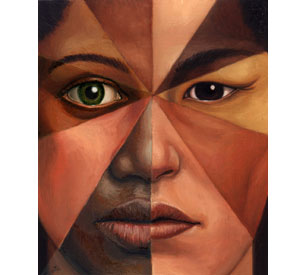
Gregory Rodriguez

“We're patriotic Americans because we're Mexicans”

Along the Texas-Mexico border, Latinos dress like George Washington and forge a new American identity.

  • more
    • All Share Services

After George Washington’s Birthday morphed into Presidents Day, the father of our country lost much of his iconic luster. Department stores that once hawked discounted goods in his name every Feb. 22 now celebrate Lincoln, too, and schoolchildren are likely to focus on all U.S. presidents this time of year rather than just the nation’s first.

But in Laredo, Texas, a booming border town of 200,000 residents — 95 percent of whom are Latino — Washington’s Birthday remains a huge holiday. Laredo just wrapped up the finale of the nation’s oldest and largest Washington’s Birthday observances, a 16-day ritual of partying and patriotism, pomp and populism, with events ranging from a popular parade and a jalapeqo-eating contest to a ritzy colonial ball and a straight-laced U.S.-Mexico bridge ceremony.

One highlight of the parade is a series of floats featuring the Martha Washington Society debutantes, wearing handmade colonial velvet and satin gowns that cost from $15,000 to $25,000. The society’s founders were mostly Anglo women, but today’s members and debutantes are mostly wealthy Latinas. Among the Laredo elite, intermarriage has been the rule rather than the exception, and Anglo newcomers still tend to assimilate into a bicultural, bilingual society.

Francisco Canseco, 50, was chosen to represent George Washington at festival events this year. The son of a prominent doctor from Monterrey, Mexico, the successful corporate attorney took the role to heart. “When I told the kids all about George Washington and why he was an American hero, I was speaking to [children named] Juan Garcia and Fernando Lopez. I told them that he held together the emerging United States, which included people of all backgrounds and origins.”

Like other Laredoans, Canseco stresses his city’s “Americaness.” “We’re as American as anywhere else, whether it’s Pasadena, Calif.; Alexandria, Va.; or Bangor, Maine,” he says. He grouses that the rest of America does not understand what is so obvious to him and other Laredoans — that biculturalism is not synonymous with binationalism, and that Latinos can retain their love of Mexican culture while considering themselves fully American.

While artists, academics and CEOs of multinational corporations all have gleefully declared the dawn of the era of transnationalism and the end of borders, Mexican-Americans in the Texas border region reaffirm the presence of the international frontier on a daily basis. While immigration-restriction advocates fear that newcomers are undermining U.S. sovereignty and refusing to assimilate to American life, Mexican-Americans on the border prove otherwise. Laredo, which has had a Hispanic majority since its founding in 1755, also gives us a glimpse of what other rapidly Latinizing regions of the country may look like within a generation.

Laredoans are both economically dependent and culturally defined by the border. Indeed, this is one of the few border cities to benefit from the North American Free Trade Agreement, and it has done so with a vengeance. The unemployment rate, which was a tragic 15.3 percent in 1987 had fallen to 6.8 percent in 1999. The average wage also went up considerably in the 1990s. Last year, Laredo was named the second fastest growing city in the United States after Las Vegas.

Laredo’s George Washington celebration was founded in 1898 by the Society of Red Men, a fraternal order made up largely of Anglo immigrants from the north. Although Laredo became an American city in 1848, in political and economic terms, the town continued to be culturally Mexican. American political and legal practices prevailed, but they were being conducted in Spanish. But in 1881, not one but two railroad lines were completed to connect the border town to the American interior. Consequently, the 1880s and ’90s saw Anglo-American influence in Laredo reach an all-time high. In 1900, Laredo was fully 25 percent Anglo, the highest it has ever been .

By setting up this patriotic festival, the Red Men sought to bring an American-style holiday to a largely Mexican community. But the Washington celebration, which started as a method of acculturation, quickly evolved into something that reflected the unique bicultural blend of the border region.

By the 1920s, Washington’s birthday organizers had instituted a Noche Mexicana, a night of Mexican music and food that quickly became a centerpiece of the celebration. By that time, Laredoans had become particularly proud and protective of their unique bicultural lifestyle. In 1925, an article in the Laredo Times noted that “one thing we may pride ourselves upon … is the Mexican music that springs simultaneously from all sides when we celebrate a fiesta of any sort.”

In fact, there have never been enough Anglos in Laredo to create the dual, competing cultures of towns like McAllen or Brownsville in the Lower Rio Grande Valley. When Anglo and European immigrants arrived in Laredo, they tended to marry Mexicans and became Mexicanized. Their children grew up speaking Spanish. “In Laredo, there has always been the process of Mexicanization and Americanization going on simultaneously,” says Stan Green, a Laredo historian and professor at Laredo’s Texas A&M International University.

Over the years, the celebration has maintained its border biculturalism. Libby Casso, this year’s president of the Martha Washington Society, is an Anglo from Kentucky who came to Laredo by way of her college sweetheart and husband, Alfonso Casso Jr. She considers her three children Julia, Liz and Alfonso to be Hispanic. Her neighbor, Gloria Canseco, a past president of the Martha Washington Society and former head of the Webb County Heritage Foundation (and the wife of this year’s George Washington), is cheerfully chauvinistic about Laredo’s Latino cultural dominance. “We’ve always been among the dominant class. We were secure enough not to feel insulted whenever we visited places like McAllen, where they had signs saying “No Mexicans Allowed.” Back in the 1940s, my mother used to giggle at their stupidity.”

And even as they celebrate their closeness with Mexico, most Latinos along the frontier show wide support for strong border enforcement. Indeed, near the front of the Washington’s Birthday parade last weekend were officers in Border Patrol cruisers strolling down San Bernardo Avenue waving at the crowd. In California, the idea of Border Patrol agents riding in local parades would be unthinkable. But along the frontier here, most Mexican-Americans have made their peace with the contradictions of the border.

In El Paso, for instance, 600 miles up the Rio Grande in West Texas, a predominately Mexican-American electorate sent Silvestre Reyes, a former ranking INS official to Congress in 1996. Reyes had gained recognition as the architect of Operation Hold the Line, the labor-intensive INS strategy to prevent illegal immigration along the El Paso border. In a 1994 El Paso Times poll, 78 percent of local Latino respondents said they were generally in favor of Operation Hold the Line, while 17 percent opposed. No such polls have been taken on the Laredo equivalent of the Hold the Line, Operation Rio Grande, but local observers estimate that the support would be just as lopsided.

Texas Latinos are more likely to be multigeneration Americans and have greater distance from the immigrant experience than do their counterparts in California. Plus, in the past Mexican-Americans here were not able to appeal to a large number of sympathetic white Texans to help them alleviate the severe indignities and discrimination that many experienced before the civil rights era. As Carlos Guerra, a columnist for the San Antonio Express-News and a founder of the radical Raza Unida Party in the late 1960s puts it: “We never had the liberal escape valve like you did in California. You were not going to guilt Anglo Texans. The Gandhi stuff didn’t work here. That made us more pragmatic.”

The state’s 840-mile border with Mexico also helps shape Latino consciousness here in a way that it does not elsewhere. The starkness of a border puts whatever inherent contradictions there are between its two opposing sides in sharp, dramatic relief.

As Rick Lucio, a Mexican-American Border Patrol agent in El Paso told me last summer as he pointed to a concrete slab in the desert that marked the U.S.-Mexico border: “[The marker] is important because if you’re born on that side of the line, you’re in America, and you have opportunity, and if you are born on the other side, you’ve got nothing. It’s a strange way to do things, but that’s how we do them.”

Facing such a stark contrast, it’s understandable that South Texas Mexicans would be eager to acknowledge the border and which side of it they were born on. In the fall of 1997, Mexico’s Ciudad Juarez hoisted an enormous Mexican flag near the border that was easily visible from most points in El Paso. When asked by the El Paso Times whether their city should respond by hoisting an equally large American flag in downtown El Paso, more Hispanics said yes than did non-Hispanics.

“South Texas culture is sometimes a reaction to the border,” says Thomas Longoria, a political scientist at the University of Texas at El Paso. “Maybe embracing America became a coping mechanism. We’re saying that we’re not any less American than anyone else.”

Thomas Moore Jr., the Latino editor of LareDos magazine agrees that Mexican-American patriotism “grew out of being on the border and wanting to emphasize our Americaness. The burden of proof is on us,” he says.

And yet Mexican-Americans in Laredo and throughout the border region are particularly grateful for what the border provides them culturally. Because they adhere more deeply and organically to Mexican culture and language than do Mexican-Americans further inland, Latinos on the border can be chauvinistic toward their ethnic brethren in Dallas, California and even nearby San Antonio, a city that has successfully marketed itself as the quintessential Mexican-American city.

“San Antonio has an identity crisis,” says Gloria Canseco. “They’re so disconnected from their roots that they’re becoming as plastic as Santa Fe,” she says. “They all see the world through Frida Kahlo and pop-Mexican culture.” LareDos publisher Maria Eugenia Guerra also levies the charge of faux Hispanicity at San Antonio, which is only 150 miles north of Laredo. “They’re Sandra Cisneros Mexicans! Worse yet!” she yells, referring to the popular Chicana novelist.

But academic surveys have shown that while Mexican-American political loyalty to the U.S. may be more pronounced along the border, it is not exclusive to this region. In 1992, the Latino National Political Survey, the largest Hispanic opinion poll of its kind, revealed that Mexican-Americans and Anglo-Americans registered equally positive attitudes toward the United States. The same survey found that while they generally look fondly on Mexico as a country, few Mexican-Americans follow Mexican political events closely.

As a further sign of Mexican-American political disassociation from the home country, few immigrants have taken advantage of the newly granted option of dual nationality. In April 1998, Mexico began allowing emigrants to retain their Mexican nationality even as they became naturalized American citizens. But after the first nine months of the program, only about 7,000 out of a pool of 4 million eligibles bothered to apply.

Of course, none of this was on the minds of last weekend’s revelers at the Washington celebration in Laredo. Being bicultural and uni-national is a given to people here. Besides, Laredoans were more concerned with having a good time than with making self-conscious appeals to the flag.

Long-time observers comment that the parade was much more overtly patriotic in the 1950s and 1960s. Certainly Laredo, like all of America, is changing. Here, like in other once-isolated regions of the South, consumer behavior is beginning to conform to national norms. Choked by traffic, fast- food joints and suburban sprawl, the city offers fewer and fewer aesthetic reminders of Mexico.

Last weekend the number one requested song on 98.1 FM, Laredo’s most listened-to radio station, was Madonna’s new version of Don Mclean’s “American Pie.” While Tejano music is still popular among kids, the so-called Latin music explosion — featuring Puerto Rican singers Ricky Martin, Jennifer Lopez and Marc Anthony — is now drawing more listeners.

Yet, with all the changes Laredo will continue to go through, its Washington’s Birthday celebration is likely to remain a comforting constant. Frank Gonzalez, Jr., 49, the head of the local League of United Latin American Citizens chapter (which sponsors three Washington’s Birthday events), believes that it is precisely Laredoans’ keen ethnic heritage that will keep events alive for future generations. A Vietnam veteran who volunteered for service out of a sense of obligation, Gonzalez sums up his theory in one sentence: “We’re patriotic Americans because we’re Mexican.”

Do the multiracial count?

This year the Census Bureau will finally let mixed-race Americans tell the truth about their backgrounds. So why are civil rights groups upset?

  • more
    • All Share Services

Do the multiracial count?

Within just a few weeks, the U.S. Census Bureau will begin mailing out questionnaires to every household in America soliciting personal — and, we’re assured, confidential — information about us and our loved ones. While most items have become more or less standard over the past few decades, the 2000 census will contain a new twist to an old query that could fundamentally alter the way America views itself. For the first time, Americans can check as many boxes about race as there are racially distinct branches in their family tree.

Since the 1960s, data on race and ethnicity have been used extensively in civil rights monitoring and enforcement, covering areas such as employment, voting rights, housing and mortgage lending, health care services, and educational opportunities. In the 1970s, the federal government standardized racial and ethnic categories in order to streamline civil rights monitoring. Henceforth, Americans would have to identify themselves as American Indian or Alaskan Native, Asian or Pacific Islander, black or white. In the one adjoining category on ethnicity, they could also choose to select whether they were of Hispanic or non-Hispanic origin.

But the logic and strength of the mutually exclusive racial categories were not destined to survive long in a diversifying nation. In the early 1990s, these standard classifications came under fire from a growing number of Americans who believed that the bare-bones options on the census questionnaire did not reflect the new demographic reality wrought by two decades of high immigration and increasing intermarriage rates.

On the 1990 census, a mixed-race American was forced to either identify himself with one ancestry or put an X by the ignoble and anonymous “other” category. As a result, advocacy groups for racially mixed Americans called for a “multiracial” category on the 2000 census, an idea uniformly opposed by traditional civil rights organizations that feared the new classification would diminish their constituencies as well as complicate the task of monitoring discrimination.

Caught in a political tug-of-war, the Clinton administration stumbled on a compromise in the fall of 1997. The Office of Management and Budget, which incidentally was headed at the time by Franklin Raines, an African-American with a white wife and mixed children, directed that federal forms, including the 2000 census questionnaire, must now tell respondents to “select one or more” racial categories to identify themselves. By choosing multiple categories, respondents could indicate a multiracial identity.

At the time, few could have predicted that this small, politically expedient yet significant change in the questionnaire’s fine print would make much of a difference in this country’s stagnant racial dialogue. But on the eve of the 2000 census, demographers, statisticians, and bureaucrats around the country are still not sure how they will process and present the data that is due on the president’s desk by the end of the year.

While it is clear that the new multiple race option will give us a more accurate and complex view of America’s racial landscape, it is also certain to create a great deal of confusion — and perhaps conflict — for years to come. The NAACP as well as the Asian American Legal Defense and Education Fund are urging any of their constituents who may be part white to identify themselves as simply black or Asian on the census. Other civil rights organizations are already pressuring the government to “reassign” multiracial Americans back into the traditional racial categories, to resist dilution of any individual non-white racial group.

Although the census has never been able to formally count the multiracial, surveys and estimates do show that the number of racially mixed Americans has skyrocketed over the past quarter century. In 1970, there were an estimated 321,000 interracial unions in the United States. By 1990 that number had increased to 1.5 million. Surveys also indicate that the number of children in interracial families grew from less than one-half million in 1970 to roughly 2 million 20 years later. And these numbers don’t include intermarriages involving Latinos, because Hispanic is an ethnic and not a racial category.

If Hispanics are taken into account, an estimated 7 percent of contemporary Americans could be considered multiracial/multiethnic. And a recent analysis of birth records by the Public Policy Institute of California indicated that 15 percent of all births in the Golden State are multiracial or multiethnic.

In the nation’s most demographically diverse state, 53 percent of multiethnic births are to Latino/white couples. At 15 percent, Asian-white children are the second most common combination, followed by black-white (9 percent), Hispanic-black (7 percent), and Hispanic-Asian (6 percent) children.

While categories and classifications have evolved over time, the census has been collecting some sort of data on race and ethnicity ever since it was first undertaken in 1790. America’s ever-changing ethnic composition and shifting political moods long have been reflected in the very questions the census poses. In 1850, a growing national awareness of immigration led census takers to ask respondents’ place of birth as well as that of their parents.

Forty years later, a heightened interest in miscegenation spurred census officials to track the mixed ancestry of the people we today label as African-Americans. A person was considered black only if he had three-quarters or more black blood, mulatto if he was three-eighths to three-fifths black, and “quadroon” or “octaroon” if he claimed one-quarter or one-eighth African ancestry.

Over the decades, there have been many other changes in the terms we use to identify and classify ethnic groups. Asian Indians, for example, were counted as Hindus in censuses from 1920 to 1940, as white from 1950 to 1970, and as Asians or Pacific Islanders in 1980 and 1990.

But if the new census will more accurately reflect the nation’s reality, no one is clear on how to read the results. “It will be a statistical mess,” says Bill Frey, a demographer at the Milken Institute in Santa Monica, Calif. “What we do know is that it’s going to use up a lot of RAM.”

In this year’s census, the racial categories will remain essentially the same as in 1990, with a few exceptions. Black, white and American Indian or Alaskan Native and “other” will all remain unchanged. But the old category of “Asian or Pacific Islander” will be split into one classification for Asians and another for native Hawaiians and Pacific Islanders. Hispanic will continue to be a separate ethnic category.

Although there are only six major categories to select, it is the 63 possible combinations of them that could give statisticians headaches. And that’s not taking into account whether those possible combinations are Hispanic or non-Hispanic. That brings the number of potential racial/ethnic mixtures to a grand total of 126.

“I can’t see having to make 63 charts,” says Jeffrey Beckerman, the head of statistics for the Los Angeles City Planning Department. “But I suppose that somebody might.” Local officials throughout the country are still awaiting word on how the Census Bureau will release the final data. But as of early February census officials in Maryland still haven’t finalized their plans. “We’re still not sure how we’re going to show all the information,” says Arthur Cresce, a bureau demographer. “We’re still working through how to do it.”

“We’re going to have get over the idea that everything adds up to 100 percent,” says Linda Meggers, a demographer for the Georgia Legislature. Racial figures in the United States will soon resemble religious data in Japan, where 186 million people are counted as members of various sects when there are only 121 million souls in the country. In Japan, it is common for people to label themselves as adherents to more than one faith.

We do know that the bureau will release the data in a variety of formats. It will be obliged to present the entire range of combinations, but then there will also be the more abbreviated categories. The most common tables will probably be those showing the six major groupings plus one additional category in which all multiracial Americans are lumped together.

It may also choose to highlight the four major racial combinations, which in all likelihood will be white-black, white-American Indian, white-Asian, and black-American Indian. There will also probably be tables presenting “single-race” Americans alongside constituent combinations, i.e, a black alone category alongside a category for black combinations.

But despite the obvious complications in presenting the data, the real problems will come in the myriad ways people and public agencies will choose to use the numbers. And that’s where the fighting begins.

For instance, it is easy to imagine advocacy groups suing over the number of members of a particular racial group. For example, a pan-Asian organization may choose to combine “single-race” Asians with Asian combinations to create a super Asian category. It is conceivable that a competing activist group, say on behalf of mixed-race Asians, could argue to have the categories tallied differently.

In fact, civil rights groups are already pressuring the federal government to develop a method of “reassigning” multiracial Americans into the traditional racial categories in data that serves civil rights purposes.

The government has discussed various ways this could work, but the final plan of action is still unclear. One option is to automatically assign people who check white and another race to the nonwhite category. Another is to have people who are a mix of two non-white groups assigned to the smaller — and theoretically more vulnerable — category.

Much like their contrary stance in the debate over the self-standing multiracial category, this posturing puts traditional civil rights groups in the odd position of upholding the old, zero-sum racial scheme. Indeed, some black groups, such as the NAACP and the Black Leadership Forum, a national coalition of the leaders of major civil rights organizations, are encouraging people to check just one box this year. The nuances and complexities of the multiracial future may be too threatening to the stark civil-rights era perspective forged in the segregationist past.

“I’m sure everything will end up in court,” says Mary C. Waters, a sociologist at Harvard University. “Whenever you have something where resources are involved, you can imagine people arguing about it.” Civil rights groups, such as the NAACP, fear that if enough African-Americans choose the multiracial over the single-racial option, they could weaken majority-minority voting districts set up in accord with the Voting Rights Act.

While recent lawsuits and legislation have reduced the role of race and ethnicity in public policy, there are still plenty of race-conscious statutes on the books. Federal policy under legislation like the VRA, the Civil Rights Act of 1964 and aid to bilingual education is based on the percentage of a certain racial group in a given place. Also, lawyers in employment discrimination suits will sometimes try to prove that a firm is biased by comparing the number of blacks in particular jobs with the percentage in the local population. Any such lawsuits could be affected if a large number of African-Americans identify themselves as multiracial.

The counting of multiracial Americans could also affect the data many counties use to monitor the racial makeup of jury pools, as well as complicate the tallying of hate-crime statistics.

Curiously, it’s the keepers of health and vital statistics in states like California who may have the hardest time adapting to our increasingly multiracial reality. “I’ve applied to get a bunch more staff [to process the data],” says Jane McKendry, who heads the Center for Health Statistics for the California Department of Health Service. “But I don’t know if I’ll get them.”

She admits that the department still does not know how it will classify data on mixed-race people. For instance, they have not decided what to do with an infant mortality case involving a self-described “white-black” woman — whether it should be added to white or black infant mortality rates. “Race means a lot of things in health,” says McKendry. Black infant mortality is twice as high as white in many cities, for a complicated tangle of medical, economic, cultural and perhaps biological reasons, and race-targeted strategies have brought down the mortality rate in black sections of Oakland, Calif., Baltimore and Savannah, Ga. Such strategies could be harder to pursue without an accurate count of the black population.

McKendry fears that data on multiracial Americans could get lost in a useless “mishmash” category, and that it will be hard to draw comparisons between pre- and post-2000 data. But she also speculates whether all this confusion could one day cause health professionals to wash their hands of race and concentrate solely on access to care for all Americans — which wouldn’t be a bad thing.

But, truth be told, most demographers do not expect many Americans to avail themselves of the new multiple race option, at least not this first year. In 1998, the Census Bureau ran a dress rehearsal in three sites around the country and the overwhelming majority of respondents ticked off one of the standard categories. In Columbia, S.C., only .08 percent of respondents selected more than one racial category. In Menominee County, Wis., only 1.2 percent of respondents did. But in Sacramento, Calif., 5.4 percent of respondents selected more than one race on the questionnaire.

The dress rehearsal indicates that intermarriage is a largely regional phenomenon. “There are going to be a lot of empty [bubbles] in North Dakota,” says Frey, whose research has shown that the much ballyhooed ethnic diversification of America will mostly occur in the 10 states — California, Texas, Florida, New York, New Jersey, Illinois, New Mexico, Nevada, Arizona and Hawaii — that have become gateways to contemporary immigration.

The confusion about the census seems fitting, because it matches our racial reality much more than four neat little categories. It will also provide a welcome opportunity to reconsider the way we look at race in America. For starters, the multiple-race option undermines the logic of the so-called one-drop rule, the notion that any person with any amount of African-ancestry must be considered black.

While no one is naive enough to think that official recognition of multiracialism means that Americans will suddenly stop seeing race as a question of either/or, this still amounts to a significant first step. For instance, although the vast majority of African-Americans share some white ancestry, it is doubtful that many black Americans will label themselves as multiracial on the 2000 census. But if race is a social construct — as social scientists love to remind us — then it can also be deconstructed. The loosening of strict, mutually exclusive categories begins to allow for a more fluid conception of race.

After the 2000 census, the danger will be the tendency to “reassign” multiracial Americans to the old categories, or create new racial labels to “make sense” of our diversity. The more Americans identify themselves as multiracial, the less the strict categories of race will make sense in the end. But that won’t keep people from trying to parse America up into four or five familiar pieces.

In 1998, for instance, the number of applicants to the University of California who flat-out declined to state their racial/ethnic backgrounds jumped a phenomenal 190 percent in one year. But university admissions officers dug into the students’ SAT records to try to deduce their ethnic backgrounds without their consent.

Over the next few years and perhaps decades, there will be a heightened battle between the old and new ways of seeing race. A victory for multiracialism may not portend a new era in which all Americans are joined in a raucous chorus of “We are the World,” but it would free us to concentrate on what is rapidly becoming this nation’s primary demographic divide: class.

“The government really shapes whole issues of identity,” says Harvard sociologist Mary C. Waters. “Over time, people will begin to answer [the race question] in more complex ways.” Before the changes in this year’s census, the federal government had essentially refused to properly acknowledge mixed-race Americans, the living and breathing solutions to racial tensions. The establishment of the multiple-race option was a clear recognition of a significant demographic trend.

Does all this mean that America is beginning to shed the remnants of a segregated and sordid racial past? Not necessarily. But at least now we can begin to visualize the melting pot we Americans have claimed to desire for so long.

Continue Reading Close

The GOP's Hispanic high hopes

George W. Bush's symbolic gestures to the Texas Latino community have gone a long way. But will the approach work in states like California?

  • more
    • All Share Services

On Sept. 2, Republican presidential front-runner George W. Bush gave a major educational policy speech to the Latin Business Association in Los Angeles. The speech highlighted the stark contrast between Bush and Vice President Al Gore in their efforts to court the increasingly significant Latino electorate. It also illustrates why George W. Bush has made such historic gains among Latino voters back in his home state.

While Gore continues to court Latinos by insisting that they are still excluded from the mainstream and therefore deserve protected status through affirmative action programs, Bush has developed a powerful and optimistic message of inclusion and unity. Typically, when speaking to Latino audiences, the Texas governor stresses Latinos’ ability to overcome persistent obstacles. In his address to the Latin Business Association, Bush deftly balanced challenges with opportunities. He lauded business leaders for creating “a Latino economic miracle,” even as he insisted that America must close the academic-achievement gap between whites and minorities.

Many political analysts and Latino activists have correctly pointed out that Bush’s Hispanic appeal is largely symbolic. They are confident that Latino voters will base their votes on policy and not on posturing. But as one examines Bush’s success with Latino voters in his gubernatorial reelection campaign in 1998, the power of ethnic symbolism should not be underestimated.

Last year, a combination of his symbolic appeal and Democratic inertia conspired to help Bush win an unprecedented percentage of Latino votes in Texas. His success in his home state serves as a cautionary tale for Democrats across the country. As the GOP first began to emerge as a major force in Texas politics in the late 1970s, Democrats found comfort in the belief that they could rely indefinitely on the traditional loyalty of the state’s growing Mexican-American population. Since the 1980s, conventional wisdom has held that in order to win statewide elections, Democrats would have to offset the Republican urban vote by garnering large margins of victory in heavily Latino south Texas. But that did not happen in 1998. Bush received 40 percent of the state’s Latino vote, unprecedented for any Anglo Republican statewide candidate.

Pundits have credited Bush’s strong showing among Texas Latinos in 1998 either to his message of compassionate conservatism or to his limited Spanish-language skills. While much of Bush’s appeal came by default — both a weak and underfunded Democratic opponent and a strong economy served the incumbent well — the good will Bush did manage to earn among many Hispanic voters was hard won and had little to do with language, ideology or partisanship

Bush’s one-time success in winning 40 percent of the Hispanic vote is specific to the governor and does not presage a Latino political mutiny toward the GOP. However, it does provide an important model of how a strong, ethnically sensitive GOP candidate can capture significant numbers of Hispanic votes.

Undoubtedly thinking ahead to his presidential bid in 2000, Bush made unprecedented — and electorally unnecessary — efforts to court voters in traditionally Democratic, heavily Mexican-American counties. He made repeated visits to El Paso, a place statewide Republican candidates routinely write off and which Democratic candidates long have taken for granted. There he tapped into the city’s strong sense of isolation from Austin and made compelling arguments about how the future of Texas rests on the well-being of the border region.

“Gov. Bush has given El Paso and the border unprecedented attention,” says Mike Acosta, associate director of the Texas Centers for Border Economic Development. Rejecting the old images of the border as a haven for crime, drugs and pollution, Bush has argued that the region was an asset rather than a liability. Because in Texas parlance the border is synonymous with Mexican Americans, this economic message has ethnic implications. “When you say the border is good, you’re saying Mexicans are good,” says Thomas Longoria, a political science professor at the University of Texas at El Paso. “When you say the border is worth investing in, you’re saying that Mexicans are worth investing in.”

However, Bush could not point to a substantive policy record when wooing voters along the border. Still grappling with the sometimes destabilizing effects of NAFTA, the Border region — which includes several of the poorest counties in the United States — has received no clear political benefits from the popular Republican governor. In fact, at the end of the last legislative session, Bush let die a bipartisan package that would have funded infrastructure improvements along the border.

Nevertheless, many voters felt that Bush’s mere attention to the region was enough of a reason to vote for him. Last November, the governor received 39 percent of the Mexican-American vote in El Paso, enough to put him over the top and make him the first Republican gubernatorial candidate ever to win there. Carlos Ramirez, the Democratic mayor of El Paso, who endorsed the governor’s reelection campaign, claims that Bush’s Hispanic outreach has made the Mexican-American vote more competitive than before. “You can’t vote straight ticket anymore,” he says. “You have to exercise your political muscle.”

Bush has continued that strategy as he takes his campaign national. He continues not only to court black and Latino business groups, but he regularly visits low-income schools and minority neighborhoods. His speeches at these schools vary little from his standard stump speech, and still have more to do with style than substance. How else to explain the campaign’s recent unveiling of Spanish-language radio ads in Iowa?

An unintended byproduct of Bush’s “Tejano” strategy has been to give the Hispanic electorate more clout, at least for the moment. “One of the real winners [last November] was the Mexican-American voter,” says Jerry Polinard, a political scientist at the University of Texas Pan American. “Clearly, they’re the vote to be courted. With Republicans making gains among Latino voters, the Democrats can no longer take that vote for granted.”

The same can be said for Latinos nationwide. The Bush campaign has forced Gore in particular to campaign hard in places that had been considered Democratic bastions. Whether the strategy will pay off for Bush remains to be seen.

During the 1980s, former San Antonio Mayor Henry G. Cisneros not only embodied the hopes of Texas’ ascendant Mexican population, he represented the future of the Democratic Party in Texas. Statewide strategists had hoped that Cisneros, who was as effective in the barrio as he was in the board room, would one day bring to all of Texas what was perhaps his most valued political skill back home: his ability to appeal to Anglos even as he galvanized a Latino base. Many believe that, had it not been for personal scandal, Cisneros would have long ago been elected either Texas governor or U.S. senator. And that would have guaranteed the Democrats’ fortunes with Latino voters.

But when Cisneros left elected office in 1989, Texas Democrats didn’t have another potential statewide Latino candidate of his stature to turn to. And they still don’t. Despite the party’s heavy reliance on Hispanics — the Mexican-American Legislative Caucus makes up roughly half of the Democrats in the state House — the Democratic leadership has been slow in recruiting and supporting viable Latino candidates for state office.

In perhaps the strongest sign of his commitment to broadening the base of his party, Bush has made it a point to create diverse tickets. Last November, he strongly supported former Secretary of State Tony Garza’s successful bid for railroad commissioner. His administration has already created a dream team GOP ticket for Texas in November 2000. If Bush wins the Republican nomination for president, he will be at the top of the ballot. Right below him would be a female candidate, U.S. Sen. Kay Bailey Hutchinson. Third and forth would be Al Gonzalez, a Bush-appointee to the Texas Supreme Court and Michael Williams, an African-American railroad commissioner who was also appointed by the governor.

By contrast, the top of the Democratic ticket in Texas during next year’s presidential election will likely be comprised of four white males. “It’s an embarrassment to our party,” says Democrat Rene Oliveira, chair of the Ways and Means Committee in the Texas House and head of the Mexican American Legislative Caucus.

Many Democratic Latino officials share Olivera’s frustration that their party has done little to reach out to Hispanics over the past decade. Former Attorney General Dan Morales blames inertia and general disarray for the party’s inattention to such a crucial constituency. “The Republican Party is doing a better job creating diverse tickets,” he says. “And we’re just standing here twiddling our thumbs.” Now in private practice in Austin, Morales says he had to fight the Democratic apparatus when he first sought the Democratic nomination for statewide office in 1990. Ironically, his own personal decision not to run for reelection last November handed Bush another advantage in an already lopsided race.

Bush faces a much more difficult road in California, the nation’s largest state and political grand prize with 54 electoral college votes. Unlike Texas, the Democratic Party controls the governor’s mansion, both state houses and both U.S. Senate seats in the Golden State. It is also a state in which Latinos, galvanized by ethnic scapegoating, have been registering and voting overwhelmingly Democrat over the past five years. It is, in many ways the opposite image of Texas, and will be the real test of Bush’s Latino appeal next fall if he is the Republican presidential nominee.

In his home state, Bush has been immensely successful in limiting the political discussion to only a few core issues. To his credit, he consciously steered clear of discussing immigration in his first term and in his reelection campaign. He could not have succeeded with his moderate, inclusive message had he not challenged the cultural conservatism of the state GOP. Not wanting to incite the kind of pro-Democratic Latino backlash that former California Gov. Pete Wilson created in that state, Bush encouraged restraint on hot button issues. And much to the dismay of state Democrats, the right wing of the GOP respected Bush’s popularity enough not to force him to take a stand on the topic. “Thirty-three billion dollars in trade with Mexico buys a hell of a lot of [ethnic] tolerance in Texas,” says Arnold Garcia Jr., the editorial page editor of the Austin American-Statesman.

But neither economic imperatives nor presidential aspirations fully account for Bush’s tactful dealings with Mexican-Americans in Texas. Not unlike President Clinton’s relationship to African-Americans, Bush seems to have a rapport with Mexican-Americans that comes from experience. What he doesn’t know he learns from senior media advisor Lionel Sosa, a veteran Latino advertising guru from San Antonio. Sosa crafted Bush’s brilliant Latino-targeted campaign ads in 1998. In both English and Spanish, the radio and television spots stressed the commonality of values between Texas Anglos and Mexicans. While soft-selling the Bush “name brand,” the ads revisited the message that the hard work, pride and strong family values of Mexican-Americans are quintessentially Texan. “They reach the heart of Mexican values,” says San Antonio political consultant Richard Gambitta. “It’s really corazon conservatism. Bush has embraced cultural symbols without developing policy that would help many Latinos move up the economic ladder.”

The challenge for Bush now is to repair the national image of his party, the way he did in Texas. The party has been marked nationally with the stigma of intolerance in the wake of President Clinton’s impeachment, and the Bush tag lines of compassionate conservatism and prosperity with a purpose are aimed at reversing that perception.

Even if Bush is successful in piggy-backing Latino support to the White House, his Republican colleagues may have a hard time finding his coattails among Hispanic voters. Even as significant numbers of Hispanics crossed party lines to support Bush in 1998, they still voted heavily Democratic at the bottom of the ticket. In short, there is little indication that they were abandoning the Democratic Party. Despite the novelty of Bush’s Latino strategy, it was only a matter of time that Texas Republicans began to court Hispanic voters in earnest.

Demographers predict that Anglos will become a minority in the state by 2008. Currently 13 percent of all Texas voters and 15 percent of the California electorate are Latino. Within a decade it will be difficult for any candidate to carry the two states without some measure of Latino support.

Nonetheless, given that the Republicans’ rise to prominence in the South began with Richard M. Nixon’s “Southern strategy” — the use of racial wedge issues to drive traditional white voters to the GOP — it is nothing less than historic that a conservative Texas governor would seek to solidify his power by pushing a message of ethnic cooperation. In Texas, even Bush’s detractors credit the governor for placing Latinos more firmly on the political radar than they’ve ever been before. The latest polls show Bush and Gore running dead even among Latino voters in Texas. The governor’s chances of polling anywhere near 40 percent of Hispanic voters in California are virtually non-existent. But no matter how Bush fares among Latinos in his bid for president, he has already upped the ante on what it will take to win over this growing and increasingly important electorate. If nothing else, Bush’s Latino outreach has put smug Democratic strategists on notice.

Continue Reading Close