Jason Vest

Armies of the Knight

Young devotees of "The General" rage at the toppling of their idol, but those with longer memories realize that Indiana's coach, like all demagogues, had to fall someday.

  • more
    • All Share Services

Armies of the Knight

Late Sunday afternoon, Ron Felling stood with a knot of friends before the rail at Yogi’s, a local sports bar, looking melancholy.

Some of the patrons who recognized him seemed perplexed; it was as if they expected to find Felling gloating at the news of Indiana University basketball coach Bob Knight’s firing. A former assistant coach to Knight for 15 years, Felling is suing his former boss and the university. Felling claims Knight assaulted and fired him earlier this year after eavesdropping on a private conversation with a former colleague in which he discussed Knight’s propensity to “rant and rage.”

But as discussions all over Yogi’s raged about Knight, Felling seemed remarkably subdued. Citing his pending case, all he would say for the record about Knight’s sacking, as he gently shook his head, was “It’s unfortunate. But it’s over.”

In one sense, Felling couldn’t have been more wrong.

While Knight is also known as “The General” for his Patton-like style of coaching, the sobriquet is also apt for the Castro-esque cult of personality Knight commands in Indiana. In the Hoosier State, basketball has been the ribbon that binds the state’s cities and small towns together; while Texas communities have their sacred Friday night football games, the holy rites of hoops reign supreme here. And no ground is more sacred than I.U.’s Assembly Hall, presided over for nearly three decades by one man whose rapport with his fans bears more than a passing resemblance to the relationship between another set of obsessive students (circa 1978) and a certain zealous imam.

So it was hardly surprising that last night Indiana University went from being a picturesque campus to a grotesque parody of a half-assed banana republic coup.

Early in the evening, a throng of at least 2,000 students showed up at I.U. president Myles Brand’s house, where they burned him in effigy. From there, they proceeded down 7th Street and then cut over to Kirkwood Avenue — Bloomington’s main drag — where they gathered in front of venerated local watering hole Kilroy’s, alternately chanting “We want Bobby!” and “We want beer!”

“We’re on Kirkwood, dude … there’s, like, business to smash up here!” one of the many shirtless, backward ballcap-wearing students marveled, as he and others beheld a line of Bloomington cops in full riot gear. “This is not going anywhere,” a cop said into a walkie-talkie.

Eventually, after a few near run-ins with baton-wielding cops and irked by the non-welcoming townie response, the crowd turned around and headed for campus.

“Obviously, we’re pretty mad,” Kurt Squire, a 28-year-old grad student majoring in information technology, said as his large, black dog trotted along next to him. “The students weren’t involved in the process.” As if to underscore his point, at that moment, half a dozen students set upon the well-planted placard to Franklin Hall, rocking it violently and uprooting it, while yards away, two guys went to work on uprooting a street sign, drawing the wrath of a cop who took off after them and, in turn, found himself pursued by hundreds of students, chanting variations of “kill the pig.”

The march then turned toward the cathedral of Indiana hoops, Assembly Hall. Tumbling down Dunn Street like the bull runners at Pamplona, the crowd made straight for the array of TV satellite trucks, exploding into cheers anytime a mobile camera’s light shone on a swath of crowd. Various chants were screamed, ranging from “Fuck Myles Brand,” “Go to hell Harvey” and “Die Harvey die” (for Kent Harvey, the freshman who last week accused Knight of grabbing him and angrily rebuking him for failing to address him as “coach” or “Mr.”) to “Kill Harvey.”

Though the crowd was by and large peaceful, some seemed ready to rush the boys in blue in the name of Knight. Some in the crowd tried to set fire to trees in front of Assembly Hall, spurring one person to ask, “What’d the trees do to Knight?” Others set fire to pictures of Harvey or banners bearing his name. In the end, the mob dispersed and left. Or so it seemed.

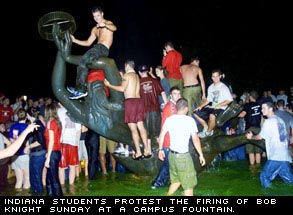
Protesters reconstituted and joined up with another pack at I.U.’s Showalter Fountain, wading in and wrenching exceptionally heavy iron dolphins from their cabled moorings. (The vandalism at the fountain offered a sharp contrast to the last time students attempted to deface the statue — during post-game hijinks after Knight led the Hoosiers to a 1987 NCAA win.)

Meanwhile, not far from the fountain, the I.U. president’s house had come to resemble that of a besieged head of state’s residence under the protection of U.N. peacekeepers. Instead of blue helmets, the two dozen state troopers deployed around Brand’s house wore Smokey the Bear hats. While some officers were resolute (“ain’t no one gettin’ in this house tonight”), others looked nervous as the roar of the unseen horde filtered through a misty grove of trees now littered with uprooted iron light posts.

Back at the fountain, it was an angry bacchanalia: Adding a touch of Mardi Gras to the protest, chants had expanded to include “Tits for Knight” and “Boobs for Bobby,” requests some of the drenched co-eds were only too happy to entertain. Having given up on their attempt to remove the entire statue of Venus, a handful of young men hefted one of the iron fish up and carried it, surrounded by a protective crowd chanting everything from “Fish! Fish! Fish!” to the now-standard assortment of pro-Knight, anti-Brand/Harvey riffs, back over a mile to Assembly Hall.

One young man, who would only give his name as “John,” bore the brunt of the purloined fish’s weight, carrying it for at least a mile over earth, tarmac and gravel, bereft of shoes, before depositing it as an offering of sorts at Assembly Hall. Passionately but calmly, he explained his ardor. “He’s been at I.U. for almost 30 years — we’ve grown up being proud of Bob Knight for what he’s done for this state and this university.

“He’s the reason most of us come here — he’s part of a tradition,” he earnestly continued. “You take that tradition away, it’s like taking part of our hearts, part of our spirit, away.” He added that while removing the fish from the fountain had not been easy, “Our spirit and determination for Bob Knight carried us through.”

And then, Generalissimo Roberto himself emerged from Assembly Hall. Reported to have been in Canada on a fishing trip, he had apparently returned, and the crowd went wild. “I want all the police officers behind me,” he said, driving the crowd into a frenzy of delight.

Then, after Knight offered a brief defense of the cops, the crowd listened attentively as he explained that he would call an assembly of students later in the week and tell them “my side” of recent events. And with that, he accomplished what squadrons of police hadn’t: He got the crowd to go home, peacefully.

By any standard, Robert Montgomery Knight has had an exceptional coaching career. Though he has not won an NCAA championship since 1987, he has delivered three such titles to Indiana University over three decades. Save one other coach, no man has won more college basketball games than he. Knight also presided over the 1984 U.S. men’s Olympic basketball team, which took the gold. And he has been widely praised for running an ethical program that doesn’t quietly pay players or their families, has no patience for prima donnas and extols the virtues of teamwork.

On the other hand, Knight’s career has been one of the most controversial in American athletics, owing largely to what even his partisans see as an anger management problem. In 1979, while serving as U.S. coach at the Pan American Games, he was convicted in absentia in the American territory of Puerto Rico for hitting a police officer. In 1985, angered by a referees call, he registered his displeasure by hurling a chair across a basketball court.

The recipient of scores of game ejections and costly fines for his tongue-lashings of referees, a university investigation earlier this year concluded that he had engaged in a pattern of inappropriate actions — including manhandling at least one player — and could only stay at I.U. if he accepted a $30,000 fine, a three-game suspension and adherence to a “zero tolerance” conduct policy.

The policy hadn’t even been drafted yet when, last week, Harvey — who just happens to be the stepson of local attorney and ex-radio talk-show host Mark Shaw, a vociferous Knight critic — saw Knight and said, “Hey, what’s up, Knight?” Knight then allegedly grabbed Harvey and lectured him (perhaps in colorful language, perhaps not) about the importance of addressing elders with the proper honorific.

As Brand explained at the Sunday press conference announcing Knight’s firing, Knight was not being canned over the Harvey incident, but for a pattern of “uncivil, defiant and unacceptable” actions since the conclusion of the earlier investigation. It’s the type of stuff that few in the public or private tolerate: refusal to acknowledge his superior, athletic director Clarence Donninger (only recently given any real authority over Knight), refusing to meet with alumni and loud badmouthing of just about everyone. Salon has also learned that recently, when I.U. counsel Dottie Frapwell went to meet with him to discuss defense strategy regarding Ron Felling’s lawsuit, he “blew up at her and ran her out of his office,” according to a source familiar with the situation.

To an older generation of Bloomingtonians, none of this is surprising, and they’re relieved that the boom has finally been lowered on Knight. It’s not that his iconoclastic, politically incorrect style irks them; even if one disagrees with his principles (and he has them), he’s always been tremendously entertaining. But that he’s assiduously built and cultivated a power base on appearing to be the maverick but is, in fact, a bully who operates with impunity, has been profoundly disturbing to some.

“He’s a demagogue, and any demagogue needs worshippers, and he certainly has a houseful of kids here who don’t know the history that older alums who live and work here do,” one local merchant says. “I can say a lot of good things about the guy. But what’s scary about him is how he gets people to not only believe his myth, but believe it so strongly and blindly they don’t think.”

He chuckles. “There was a guy I knew who was the biggest Bob Knight fan in the world. Dan Dakich (a former assistant coach) brought him down to the locker room once to meet Knight, and for no reason, Knight made this guy feel like two cents waiting for change. His faith was destroyed. He should have known better. But to a lot of people, especially the kids, Knight can do wrong.”

The NRA goes global

The National Rifle Association uses Australian crime protests and fear of global domination by the United Nations as a fund-raising tool at home.

  • more
    • All Share Services

Ivy Skowronski was tired of living in fear, and decided to do something about it. The time was last year, the place South Australia, and what had Skowronski furiously indignant were the shortcomings of the law.

A number of citizens, most of them elderly, had experienced hours of terror in their own homes after burglars entered, tied and beat them; though the perps were caught and convicted, the sentences, as Skowronski and scores of others saw it, seemed woefully inadequate. So the 79-year-old pensioner undertook what became one of her country’s most successful petition drives ever, getting 102,000 signatures in support of a new, tougher law meting out harsher sentences for violent “home invasion” burglaries. The campaign made Skowronski the star attraction at a 2,000-person rally in Adelaide last October.

Simon Royal, a TV reporter with Australian Broadcasting, was on hand to cover the event when he noticed another film crew, fronted by a woman. Curious, he approached and asked where they were from.

The United States, came the response.

Intrigued by the notion that anyone in America would care about Australian sentencing guidelines, Royal began filming an interview with the woman. “I asked what program this was for, and she said that actually, she didn’t work for a specific program, but was working on a documentary about crime around the world, and that she was an independent TV producer,” says Royal. “In hindsight, however, some of her answers kind of gave away her agenda.”

The woman in question was Ginny Simone, an ex-local newscaster employed by the Mercury Group, the Washington affiliate of advertising giant Ackerman-McQueen, which has handled all the National Rifle Association’s advertising and public relations since 1981. Simone is quite literally a public face of the NRA; visit the “live news” section of the NRA’s Web site any day and you’ll see her presenting “news” gun lovers can use.

Last week, courtesy of Australian Broadcast Corporation news reports, Skowronski and the rest of Australia saw, for the first time, an NRA fund-raising infomercial that is being broadcast in the United States. The infomercial claimed Australia is awash in criminal violence because of legislated gun buybacks passed in the wake of the devastating Port Arthur massacre, where 35 people were gunned down by Martin Bryant using an automatic weapon. Simone’s “documentary” included footage of Skowronski’s rally, as well as an interview with Skowronski herself, and came complete with a toll-free fund-raising number for the NRA at the bottom of the screen.

Just as the war of words between President Clinton and the NRA’s Wayne LaPierre has increased fund-raising for the gun group, so too has the ginned-up threat of foreign subversion. The NRA uses hazy fears of a universal disarmament scheme masterminded by the United Nations as a fund-raising device.

And now Skowronski is more than a little angry with the NRA.

“My petition had nothing to do with guns or anything else at all. It was purely to get heavier sentences,” she said. “Personally, I would like to see less guns in our society. I think there are too many, and would like to see them reduced.”

Skowronski is hardly in a minority of Australians. After Port Arthur, public support was overwhelmingly in favor of a law mandating a 640,000-gun buy-back program. Nor is Skowronski the only Aussie who’s angry with the NRA. Last week, Australian Attorney General Daryl Williams fired off a piqued letter to NRA president Charlton Heston, telling him that while “there are many things Australia can learn” from the United States, “how to manage firearm ownership is not one of them.”

At issue: the statistics about Australian crime cited by the NRA in its infomercial. According to the NRA’s video, since the change in gun laws, “armed robberies have skyrocketed, up 69 percent; assaults involving guns rose 28 percent [and] gun murders increased 19 percent.”

In fact, Williams told Heston, the latest figures from the Australian Bureau of Statistics “show that firearms are being used less often in murder, attempted murder, assault, sexual assault and armed robbery.” Further noting that the figures show a decrease in firearm homicides from 99 in 1996 to 54 in 1998 and that “the number of murders involving a firearm is now lower than at any time since 1994,” Williams ended his riposte with a demand for Heston to “withdraw immediately the misleading information from your latest campaign.”

“This was a case of very selective reporting [on the NRA's part],” says Don Weatherburn, director of the New South Wales Bureau of Crime Statistics and Research. “It is true that armed robbery has gone up, but our robbery problem is largely a byproduct of the big growth of heroin use — and ‘armed robbery’ covers every kind of weapon, not just guns.” While Weatherburn says he himself is “agnostic” about whether or not Australia’s new gun laws will produce sweeping changes, “The NRA was arguing that things have gotten a lot worse.”

The NRA often highlights international gun issues to raise money from its 3 million-plus members in the United States. Past fund-raising mail by the NRA have focused on gun buybacks in Australia as well as gun-control efforts in South Africa, Canada and the United Kingdom. The organization characterizes these efforts as part of a campaign of “third world dictatorships plotting through the United Nations to eliminate your Second Amendment rights.” Their objective, says LaPierre in the “Global Gun Grabbers” infomercial, is “international gun registration and global gun confiscation,” and the U.S. is squarely in the crosshairs.

As the NRA chases dollars by stoking its members’ fears of one-world government, it continues to actively engage with the United Nations. In fact, its status as a nongovernmental organization is higher than most arms-trafficking watchdog groups. More often than not, it gets its way. Over the past several years, NRA lobbyists have been an effective, and sometimes rabble-rousing, presence at U.N. meetings focused on reining in the international arms trade. Apparently believing that the best defense against the global anti-gun menace is a good offense, the NRA has tried to foist the uniquely American Second Amendment on countries and cultures that find it as alien as Heston found the Planet of the Apes.

“There are some countries who are pushing for very stringent controls, and there are people who want gun-free societies who call for that in international meetings, but I have to be very clear: There is no chance the United Nations will adopt any measure along those lines,” says Michael Klare, professor of peace and world security studies at Hampshire College. “In practice, nothing the U.N. does is of consequence to the NRA, because the U.S. has said that it will not accept an international agreement that would infringe on domestic law. I think this is about creating the mythology that the U.N. is in a position to endanger gun ownership in the U.S., which has no reality whatsoever. That’s why I think this is much more valuable as a fund-raising matter.”

Domestically, money has always been very, very important to the NRA. According to the Center for Responsive Politics, between 1991 and 1996, the U.S. gun lobby gave over $6.1 million to national parties and candidates. In the 1997-98 electoral cycle, it dropped almost $2.3 million in PAC, soft money and individual campaign contributions, predominantly to Republicans. Ninety percent of those contributions came from the NRA. And in 1997 and 1998, the gun-rights lobby — again, primarily the NRA — spent a whopping $8.2 million lobbying legislators and administration officials. Between 1991 and 1998, the NRA spent an additional $12 million on independent expenditures — money that can be spent, with no limit, advocating the election of candidates the NRA likes, or the defeat of contenders the NRA finds problematic.

So in the early ’90s, when Australian gun advocates came asking for help, the NRA willingly lent a hand. Gun money had been kicked around Australia before, but mainly from manufacturers; in 1988, Tasco, an arms importer, gave over 1 percent of sales to the NRA in the service of opposing anti-gun candidates, while the Australian subsidiary of venerable arms-maker Winchester kicked in $100,000. By 1990, the NRA’s Australian equivalent, the neophyte Sports Shooters Association of Australia (SSAA), was journeying to Washington to learn at the feet of the master; while the NRA dispensed advice, no funds were forthcoming.

But after a rousing appearance by then-SSAA chief Ted Drane at the NRA’s 1992 convention, the NRA threw a little seed money Drane’s way, which was used to start up SSAA’s Institute for Legislative Action, a mirror image of the NRA’s ILA, which runs a formidable grass-roots lobbying operation and solicits political capital (money) from its members. Adopting the NRA’s approach to furthering its cause with money in politics, the SSAA was, by 1996, spending hundreds of thousands of dollars to back pro-gun candidates. The NRA also sent money the way of the Sports Shooters Association of New Zealand, which, seven years back, set up a stealth front-group aimed at ousting two prominent anti-gun legislators.

Still, as evidenced by Skowronski’s success, not everyone is buying the NRA line.

“Don’t let me get on my high kangaroo, but they’re doing us wrong two ways — painting this picture of Australian citizens as cowering in fear and that we’re all named Paul Hogan and have all hunted crocks with guns for years,” fumed one Australian diplomat. “The fact is, we’re not a gun culture like yours.”

Continue Reading Close

Made for each other

Why do residents in a depressed corner of the Midwest keep sending back to Washington the man perhaps least likely to improve their fate?

  • more
    • All Share Services

In the end, party loyalties, internal and external, won the day for the national candidates in Ohio. But as Tuesday night progressed, watchful glances were cast by both parties at what had been an unexpectedly tight congressional primary, in Ohio’s 17th District.

On the defense is Rep. James Traficant Jr., a Democrat who had a tense several days after a poll last week showed him in a dead heat with the one of three primary challengers. (He also anticipates being indicted for corruption.) The implicit message: The 17th District was tired of throwing a nearly two-decade tantrum that has done it no good.

Standing in the crowd at a Jewish community center groundbreaking ceremony last week, local AFL-CIO head Larry Fauver was talking about how he knew that the steel mills and their high-wage jobs that once made Youngstown a postwar workers’ boomtown are long gone. And he affirmed his belief in the need to attract modern manufacturing and high-technology jobs to this once-thriving industrial town.

But, he added, he does not believe Traficant (whom he used to campaign for) is still the man to do it. That Traficant himself was standing a mere 20 feet away, shooting Fauver menacing looks and shaking a clenched fist at him, only seemed to buttress the points Fauver and a number of other citizens here have made: that Traficant’s behavior, by turns notoriously eccentric, erratic and arguably amoral, has lately done more harm than good to this economically depressed, crime-ridden community.

With a number of officials here under investigation or indictment (last Thursday, the latest one in a string of local judges was arrested by the FBI), it’s no wonder, Fauver said, that it has been hard to attract new businesses. When one’s congressman has a historical knack for alienating other House members, however, and openly talks about his own probable corruption indictment, “it surely doesn’t help” Youngstown clean up its act, or get access to badly needed federal dollars, he added.

Fauver and others had rallied around Bobby Hagan, a veteran state legislator who argued that Traficant’s time had come and gone. “He’s a demagogue,” Hagan said, and a sign at his campaign headquarters indicated Traficant was something else, too. Adorning the front door is a graphic showing Traficant at the center of a spider’s web connected to a number of convicted felons. “When the mills left, people got angry, and Jim played to that. It might have been therapeutic, but has it given us anything tangible?” asked Hagan. “It was important to people to see someone who thumbed his nose at authority and the law, but we’re at the point where it runs out.”

Or not, as Tuesday night’s returns showed when Traficant emerged as the victor with just over half the vote. While the immediate threat to Traficant’s political survival may be over, the problems for his Mahoning Valley remain. If one looks at the information-based economy as an autobahn, the exit to Youngstown leads to a dead end. While some vestiges of quaintness and dignity remain — in the form of turn-of-the-20th-century houses, signs inviting anyone to walk into mayor’s offices in the surrounding townships and the palatial monument to native son William McKinley in neighboring Nile — everyone around here agrees that the community’s leaders have failed it by constantly searching for one big, quick economic fix that simply isn’t there.

The critics include former Democratic Rep. Dennis Eckart (whose district abutted Youngstown) and Staughton Lynd, a veteran left-wing activist and lawyer who has lived in the area since the early ’70s.

“They tend to look for grand-slam home runs, like a regional airport. There’s been one or two schemes like that, where with one fell swoop, we’re going to generate 20,000 jobs,” sighs Eckart. “But as we’ve learned from other places, like Cleveland and Pittsburgh, it’s a variety of solutions, not a single grand stroke.”

As the community has grasped at the economic brass ring that isn’t there (“No wonder none of the presidential candidates stopped here — they wouldn’t know what to do with this place,” says Lynd), problems of crime, corruption, education and poverty have all fed off one another.

“All these things are intertwined here,” says Ann York, a French professor at Youngstown State University who also heads the public-corruption task force of the citizens group ACTION. “I actually thought this would be a good place to bring my son up in, but I can’t open the paper each day without reading about some official being indicted. Between the strong opinions of longtime families that influence opinion here and the malaise the economy breeds, there’s a real resistance to change. But people are standing up and being counted because they’re tired of corrupt practices.”

Last year, a number of local activists, religious leaders and concerned citizens formed ACTION, creating task forces to confront urban sprawl, education, economic development and corruption. At one of the corruption group’s meetings last year, 2,500 people showed up to watch a number of local officials sign a responsible-government contract. Several hundred showed up in January to watch more officials do the same.

Conspicuously absent was Traficant, whose name has come up repeatedly in an ongoing federal grand jury probe of corruption in Youngstown. (Thus far, federal and state investigations have convicted 78 people here, including two former Traficant aides, on corruption or organized-crime charges.)

Not that this is unfamiliar territory to the congressman. As Mahoning County sheriff in 1983, he successfully defended himself against corruption charges from the FBI, convincing a jury that his pledges of loyalty to the area mafia were, in fact, just an act in the service of what may have been the most secretly compartmented sting in the annals of local law enforcement.

It’s not that those dissatisfied with Traficant necessarily dislike him; even his detractors praise his refusal to foreclose on some imperiled properties back in his sheriff days, and speak with gritty affection toward his “thumb in the eye of power” legislative acts (Exhibit A: A law reining in the Internal Revenue Service’s property confiscation powers). But they now wonder if his notoriously Lear-like approach to congressional representation might be seen by prospective business and House colleagues as an impediment to investing private and public monies in Youngstown and its environs.

“I will be surprised if Jim loses,” says former colleague Eckart. “I think his heart is absolutely in the right place. But I used to tell people that as a congressman, you have to win two elections: first in your district, second with your colleagues, which is a measure to a large degree [of] how effective you can be for your district. Jim has never spent a lot of time trying to win that second election.”

Which may be why, given the palpable sense of alienation here, Traficant once again carried the day Tuesday.

Continue Reading Close

This isn't Michigan

Unlike their neighbors to the north, Ohio voters go with the front-runners -- and bury the insurgents.

  • more
    • All Share Services

When former Democratic Rep. Dennis Eckart went to vote in his Cleveland precinct Tuesday morning, he could not help noticing the large anti-voter-fraud poster behind the check-in table.

As he sees it, the sign’s presence was not rooted in civic nobility. “Ohio does not have a big tradition of party switching, and there is a provision that says if you want to vote in the Republican primary, you have to sign an affidavit affirming your loyalty to the Republican Party,” fumed Eckart, a John McCain supporter. “If you’re coming in and someone challenges you and you see this poster with 8-inch-high letters, it’s going to have a chilling effect. The party here should be excited that there’s someone who makes people want to go out and vote Republican, but no, they want to make it more difficult.”

Doubtless there were some challenges. But as the numbers came in, it didn’t seem that any strong-arm effort by the Republican establishment killed McCain here. While the Arizona insurgent did draw crossover voters, he was never destined to repeat his Michigan success for the simple reason that there was a Democratic primary here, too. And in the end — despite a projected higher-than-usual turnout — the presidential tallies came in as expected in the Buckeye State, with voters picking each party’s Chosen Ones: Al Gore defeated Bill Bradley 75 percent to 25 percent, while George W. Bush beat McCain 59 percent to 37 percent.

Prospective wins here for either McCain or Bradley were always rooted more in wishful thinking than in economics: “Ohio’s a tough state, because you’ve got seven different media markets, and if you want to make a dent, you’ve got to spend the money on TV in at least Cleveland, Columbus, Cincinnati and Dayton,” said Ohio State University political science professor Herbert Asher, who also cited the lack of organizational strength of the overwhelmed McCain effort and the underwhelming tenor of the Bradley endeavor. “Gore had organized labor from the beginning. Bush had the endorsement of just about the entire Republican establishment except Sen. [Mike] DeWine, and Bush had more resources.”

There were, nonetheless, high hopes for McCain, whose stops brought out citizens in droves. On 18 hours’ notice last week, a former McCain staffer here pulled together an event that brought out 5,000, and McCain ended up signing around 1,200 copies of his book. And McCain was a good draw up to the end; while a Bradley rally in the Cleveland suburb of Brook Park on Sunday drew about 400 people (virtually all Democrats), a McCain rally earlier that day in nearby Broadview Heights brought out 2,000 people of reportedly varying ideological stripes.

Continue Reading Close

Secret lives of the Republicans, Part One

How Dan Burton outed himself in a preemptive strike against an upcoming Vanity Fair expose.

  • more
    • All Share Services

(Editor’s Note: First Dan Burton, now Helen Chenoweth. A confessional zeal seems to have seized Capitol Hill these days, and is threatening to grow into a flood now that the Starr Report has landed. Maybe soon it will even become fashionable to out oneself. Part One in a series of continuing reports.)

The words spoken on Aug. 31 sounded eerily familiar: an admission of regret, an attempt to deflect the moral issue by assurances that no law was broken, acknowledgment of pain caused to family, a dash of self-flagellation — but no specifics, no formal apology and, finally, a burst of defiance. But unlike the prevaricator in chief’s half-assed attempt at an apology and explanation for what we’ve known about all along, conservative Rep. Dan Burton, R.-Ind., wasn’t responding to any public allegations.

Unnerved by the thoroughness with which independent journalist Russ Baker and others have been probing his apparently active life, Burton outed himself. Believing Baker’s piece was going to be in the upcoming Vanity Fair, Burton decided to cryptically pseudo-confess a slew of past sins with a kind of preemptive strike. “If something comes out that you read about, that you think Danny shouldn’t have done, I will own up to it. I won’t lie about it. I will tell the truth,” the congressman said, leaving one to wonder if he’d let us know what “it” was, should no story ever appear.

By week’s end, Burton — by now fearing that revelations were imminent in the daily Indianapolis Star — further allowed that his definition of family values included an old adulterous affair followed by financial support of (but no personal contact with) an illegitimate son.

But sprinkled throughout Burton’s hedges and acknowledgments were accusations — charges that journalists’ strings are being pulled by “friends of the president” who have been “spreading rumors” about his personal life. While it is entirely possible that the Clinton White House has been up to no good in this case, those who have participated in or covered Indiana politics over the past 25 years found Burton’s conspiracy theory laughable for one simple reason: Tales of Burton infidelities, true or not, have abounded in Indiana political and journalistic circles for years.

In fact, had it not been for a certain comment Burton himself made back in March, odds are that word of the tales would never have appeared in print at all. But after years of tolerating Burton’s roguish hypocrisy, an alternative newsweekly editor in Indianapolis named Harrison Ullmann finally decided earlier this year that Burton had crossed a line, and he decided to publish a column that broke the silence, thereby providing the impetus that has subsequently propelled Baker and the Indianapolis Star into action.

“I can assure you I have had no contact with the White House or any friends of Clinton’s,” Ullmann, editor of the newsweekly NUVO, says. “In fact, if Burton’s district wasn’t on the fringe of our circulation area, I wouldn’t have written anything. But with the one comment, he made it relevant.”

The comment? When Burton called President Clinton a “scumbag.”

A 30-year veteran of Indianapolis, Ullmann, as a general rule, subscribes to the old-school rules when it comes to political reportage: Private lives are off-limits. “Going back to when I started as a reporter in Cleveland, there was just this kind of feeling that most of that stuff really doesn’t tell you anything relevant about a guy’s capability as a public official,” he says. “In the old days here, we’d see guys gambling at the Columbia Club, even though it was illegal. Or we’d see these guys drunk at parties. Did we report that? No.”

After a few years in the Statehouse, recalls Ullmann, Burton was well-known in the bird-dogging department. Not that he was different from many of his brethren: “In terms of sex, the first place the ’60s got to in Indianapolis was the Statehouse — this was a time when hookers would come in and leave cards on legislators’ desks,” Ullmann says. “Getting a piece was rampant in the General Assembly then. And within that context, Burton had a major reputation.”

Indeed, says Ullmann, Burton’s reputation was so secure that the newspaperman once colluded with several lobbyists and legislators to play a joke on the legislator. “There was this night we knew it would be impossible for him to get away, and we told him we were putting together this party and some really great women would be there. He was going nuts, trying to get out of whatever he was locked into.”

Though Ullmann says he’s been bothered more and more in recent years at the hypocrisy of Burton’s posture as a “family values” candidate, he still did not wish to delve into Burton’s sex life. After all, Burton’s public life provided more than enough fodder for tough stories — on strange fund-raising relationships with Sikhs, on bizarre legislative crusades, on unique ideas like the use of nuclear weapons to win the Gulf War.

But however probing or critical the coverage, Burton, unlike most politicians, has never had to worry about antagonizing or being antagonized by Indiana media: His district is one of the most conservatively Republican in the country, and the largest newspaper, the Star, is a paper that runs a Bible verse on the front page every day and is owned by Dan Quayle’s family.

In March 1998, at a meeting with the Star’s editorial board, Burton — himself under federal investigation for possible campaign improprieties — uttered his infamous riposte about Clinton the fund-raiser: “If I could prove 10 percent of what I believe happened, he’d be gone. This guy’s a scumbag. That’s why I’m after him.”

At this point, says Ullmann, the fact that Burton was referring to campaign finance misdeeds and not sex became moot. As he considered the years of unpursued leads, Ullmann says he thought that in areas of genuine concern to his constituents — Burton’s campaign slogan includes “character does matter” — Burton too might be characterized as a scumbag.

So Ullmann cut loose. “Back when he had a seat in the General Assembly and back during his early terms in Congress, Dan Burton had a reputation for sex with convenient women that was at least as awful and awesome as the Clinton reputation,” Ullmann wrote. “When Hoosier politicians and pundits gathered, they would tell each other stories about Burton scoring with interns and pages, scoring with staffers in his offices and staffers in his campaign, scoring with Carmel housewives and some fine and famous Christian women elsewhere in his district. The stories were never told elsewhere to anyone else, either by politicians or pundits,” Ullmann continued. “But neither were any of the stories seriously investigated … and maybe it was just as well until now. Even so, there are times when private lives are relevant to public life.”

Ullmann went on to pose, open-letter style, a list of pointed questions — questions that NUVO reporter Brian Howey had planned to ask Burton in a scheduled interview for a hard news story. Burton had backed out of the interview, and Howey and co-author Mark Schoeff Jr., a former Republican Senate staffer, published an article that raised a new on-record character allegation from John Domi, a former gambling lobbyist. “Every time he’d go on one of my junkets [to Las Vegas], he’d have a different gal,” Domi told NUVO. “I watch him in Congress and his committee and all I have to say is, let he without sin cast the first stone. Danny forgot himself. And if I saw him, I’d tell that to his face.”

It was this column, not anything involving the Clinton White House, that brought Burton’s past into the open. Like Clinton, perhaps, you could say that Burton has no one to blame but himself.

Continue Reading Close