Jesse Drucker

Hillary and the court

How an upcoming ruling on partial-birth abortion could send shockwaves through the New York Senate race.

Within the week, perhaps as early as today, the U.S. Supreme Court is expected to decide the legality of a Nebraska law criminalizing the procedure commonly known as “partial birth” abortion. Regardless of what the court ultimately decides, the ruling is likely to play a significant role in the increasingly heated U.S. Senate race between Hillary Rodham Clinton and Rep. Rick Lazio.

Unlike the debate on the national level — or in so many other states — New York’s Senate race is no mere contest between a decidedly pro-life Republican and a proudly pro-choice Democrat. Rather, in this heavily pro-choice state, the contest is between two pro-choice candidates. And like so many New York races in recent years, it is already featuring efforts by a Democrat to prove that the allegedly pro-choice Republican is, in reality, a threat to abortion rights.

In this race, Clinton has already leveled criticism at Lazio based on his abortion stance. Lazio claims he is “pro-choice,” but his voting record on the issue is decidedly mixed. He is opposed to Medicaid funding for abortions, opposes the so-called “partial birth” procedure, and voted to prohibit women in the military from receiving abortions in military hospitals — even if they offer to pay for it privately.

“Americans have a great number of rights that are not subsidized by the federal government,” said Lazio spokesman Dan McLagan. “This is an instance where he supports a woman’s right to choose, but doesn’t support public funding. You have a right to go and get a driver’s license, but it doesn’t mean the government is going to go and get you a car.” Asked how abortion differs from the numerous other medical procedures that are eligible for public funding, McLagan replied, “He just doesn’t believe that it’s appropriate for the taxpayers to fund abortions.”

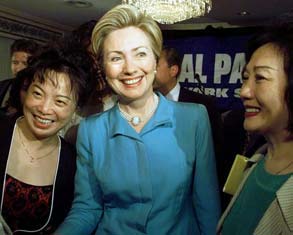
At a fundraising breakfast at the Waldorf-Astoria in Manhattan on Wednesday, Clinton denounced Lazio on this very issue. “When it comes to a woman’s right to choose, I know that my opponent calls himself pro-choice, but if you look at his record, he’s apparently pro-choice for rich women,” she said to the overwhelmingly female crowd.

“I’m committed to supporting Roe vs. Wade,” she added to loud applause. “Not just in rhetoric, but both with my voice and with my votes on behalf of any nominee to the United States Supreme Court because that is where the fight will be waged.”

And that, according to one Clinton advisor, is where her campaign plans to hammer away at Lazio, who has declared he will not use support for Roe vs. Wade as a basis for voting for a Supreme Court nominee.

“I think you get the groups — the NARALs, the Planned Parenthoods — to go out and make the case that he can’t be counted on,” said one Clinton campaign advisor. “I think the big issue which will make or break this is the Supreme Court justice issue, because by the time the fall rolls around, I think it will become clear that the next senator will vote on Supreme Court justices.”

Jim Chapin, a historian and occasional advisor to New York City’s Public Advocate, Democrat Mark Green, said that Clinton’s abortion strategy may be most effective for its connection to what could ultimately be the decisive factor in the campaign: She is a Democrat in a state where the Democratic presidential candidate is expected to win in a landslide.

“She’s trying to use abortion to tap into the partisan linkage. Remember, Gore is going to win the state by a million votes or more,” said Chapin. “Hillary wants to nationalize this race. What Lazio wants to do is localize the race.”

So while Lazio continues to hammer Hillary on the carpetbagging issue, Clinton continues to paint her opponent with the widest of brushes as a right-wing extremist. Though Lazio voted for the Brady Bill, which requires local vendors to conduct a background check on anyone who wants to buy a handgun, Clinton has criticized Lazio for not supporting registration of all new handguns. “Apparently he is more willing to go along with the Republican leadership and the NRA than the children and families of New York,” she said.

Abortion is a linchpin to that strategy. Kelli Conlin, the executive director of NARAL/New York, said that her organization plans to wage a campaign to force Lazio to take a position on Supreme Court nominees who have publicly opposed Roe vs. Wade.

A pair of recent polls, however, offer varying evidence as to just how important voters will find this issue. According to the Quinnipiac University Poll released in early June, half of New Yorkers think abortion should be “generally available to those who want it.” The same poll found that 34 percent think there should be “stricter limits” on the procedure. (Only 13 percent of the state’s residents think it should not be permitted at all.)

That support for abortion grows slightly in the suburbs (to 60 percent) and shrinks among upstate voters — who are considered among the most important swing voters in this election — to 38 percent.

A more recent New York Times/CBS News poll found less support for abortion on demand and more support for more restrictions. The Times/CBS poll also found that New Yorkers are divided — 44 percent for and 45 percent against — on the issue of public financing for abortion.

That’s a lot of numbers, but does it tell us anything about whether people might actually choose to vote for one of these people based on their abortion stance? Well, that’s unclear. The two polls offer strikingly different figures on how important an issue New Yorkers consider this to be.

According the New York Times/CBS poll, 63 percent of respondents said that their candidate’s position on abortion was the most important single issue for their vote. But when the Quinnipiac poll asked voters to name the issues or problems that they want to hear Lazio and Clinton discuss — without specifically mentioning abortion — it ranked a distant 7th — behind things like education, taxes and healthcare.

And observers are divided on a central question: Will voters find it sufficient if Lazio says he is pro-choice? Or will a detailed critique of his position by the Clintonites hurt him? Or, oddly, could it hurt her?

“I think the typical swing voter probably agrees with him,” said one Democratic analyst of Lazio’s pro-choice-with-major-restrictions position.

“Republicans get stigmatized by being threatened on the issue of abortion,” said Republican consultant Kieran Mahoney. “That stigma doesn’t work if you’re multiple-choice. The conclusion is that you’re not rigid, you’re not an ideologue. Going after him for being against partial birth and some forms of funding is not gonna work. I think the only people you’re going to get [by attacking him] is some hard-core Democrats, by and large” who will vote for Clinton anyway. Indeed, in the last few years, several local New York races have featured Democrats questioning their Republican rivals’ pro-choice bona fides.

But the effectiveness of these attacks has never been entirely clear. In 1994, then-Gov. Mario Cuomo attacked George Pataki for his apparently changing views on abortion over the years. But Pataki won anyway (albeit against a deeply unpopular incumbent). In 1998, Chuck Schumer unseated the longtime pro-lifer Al D’Amato, attacking his abortion stance near the end of the campaign. But D’Amato had successfully run three times before that, and even Democratic political operatives acknowledge that — since Schumer won by more than 10 percent — it’s nearly impossible to gauge what role the abortion attacks played in Schumer’s victory.

Republican consultant Roger Stone is skeptical of the Clinton strategy, but said that Lazio cannot continue to let Clinton frame this debate. “It depends on whether he drives the right message,” said Stone. “If she keeps riding along on the Supreme Court, and Rick says nothing, he could get hurt. But he if says it’s not about that, it’s about partial birth or about parental consent, then he could jam her. It’s a shouting contest.”

Finally, there may be some question about whether Lazio is the only “multiple-choice” candidate here. In a 1992 interview with WNYC radio’s Brian Lehrer, Clinton said she supported laws requiring that parents be notified — although not that they provide consent — before a minor seeks an abortion.

“I favor parental notice,” she said in 1992, “because I view it as a way of trying to keep a family together wherever that is possible. And I recognize that in many instances, there has been a breakdown in the family relationship, and that a young woman might better be served by seeking the advice or counsel of a preacher or a teacher or another family relative.” According to campaign spokesman Howard Wolfson, Clinton now does not support such laws, and would vote against such restrictions as a senator.

Wolfson contended that Clinton — who, unlike Lazio, has no voting record to worry about — had not merely flip-flopped to appease pro-choice New York voters. Her opinion in 1992, he argued, was in the context of a debate in Arkansas between a parental notification bill and a parental consent bill. (Clinton was also quoted in an interview with the New Republic from late 1992 supporting parental notification — with no mention of the Arkansas debate.)

“I would argue that it is not a change of mind,” said Wolfson. “In the context of this particular debate in Arkansas between parental notification and parental consent, she came out in favor of parental notification as the lesser of two evils.”

Separated at birth?

For a mainstream Republican, Rep. Rick Lazio's politics are awfully similar to those of "left-wing" Hillary Clinton.

It was supposed to be the proverbial War of the Worlds: Rudy vs. Hillary. The big bad Republican mayor vs. the Democratic first lady. Alas, high-minded observers opined, this is just a race about personality. These two agree on too many issues, the pundits complained. So, Rudy dropped out and Rick Lazio, a Republican congressman from Long Island, stepped in. The pundits rejoiced. Now the contest would be between a real Democrat and a real Republican. There would be real disagreements about issues of substance.

They spoke too soon.

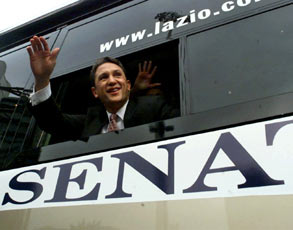
As Lazio spent Wednesday and Thursday touring upstate New York on his fittingly named “Mainstream Express,” it became less clear whether things had really changed in a substantive way. As his bus snaked through upstate New York, one couldn’t help but wonder whether he, like Rudy Giuliani, has the political positions to stand out from Clinton or anyone else.

Despite Lazio’s laudable efforts to make himself more accessible to the media than the annoyingly press-shy and poll-tested Hillary Rodham Clinton, efforts to pin him down generally failed. Indeed, at times he sounded eerily like his Democratic rival.

As the “Mainstream Express” creeped down Second Avenue on Thursday, en route to Katz’s Delicatessen, Salon asked Lazio: How are you different from the “left-wing” rival you hope to defeat in November?

“I’m a man,” Lazio quipped.

“I think there’s a lot,” he said, striking a more serious note. “I’ve been serving for eight years. I’ve been a legislator. I’ve been working in a bipartisan way. I’ve been out working on issues unique to New York. I don’t have the White House behind me. We travel differently …”

Enough, already. Is there anything of substance to contrast the two?

“Well, probably health care,” Lazio responded. “I believe in the ‘public-private partnerships.’ I think we can extend healthcare using the number of different tools without turning it over to sort of a faceless bureaucracy that will make things worse.”

That answer was easily anticipated. Fair enough. But here are the facts: Both Lazio and Clinton support gun control, the death penalty, welfare reform, abortion rights (albeit with several onerous restrictions, in Lazio’s case, like his opposition to Medicaid-funded abortions), free trade and an increase in the minimum wage. Both oppose gay marriage, etc., etc. So are there any areas where these candidates clearly differ? Pick one, congressman. Any one.

Lazio wouldn’t bite.

“I think people just need to look at my record and what I’ve done and make judgments based on that,” he said. “I would rather focus on that because I think that builds more positive momentum for me than focusing on what Mrs. Clinton hasn’t done. So I’d like to spend more of my time focusing on the positives of cleaning up the Long Island Sound, the Hudson River, dealing with acid rain in the Adirondacks; making sure that we have incentives for job creation; using our universities more effectively and our national labs more effectively for research; making sure that we address high incidences of mortality rates for cancer.”

Reducing acid rain? Job creation? Surely Clinton supports all of these proposals. Indeed, they seem precisely like the types of uncontroversial issues that Hillary (“I’ve-spent-30-years-working-to-help-families-and-children”) Clinton would embrace. Is there any other difference?

“You can look to my record,” he said. “You can determine what kind of senator I would be by what kind of congressman I’ve been, passing (legislation) in a bipartisan way. Being a centrist, legislating, doing the hard work beforehand, not shooting from the hip, building credibility, building bridges.”

Still not convinced? We tried.

All of this may not matter to upstate voters.

It’s Wednesday afternoon at the Corning Glass Museum in Corning, N.Y., (pop. 12,000). Lazio gets off his bus, his wife Patricia at his side, and wades into a cheering crowd. Theresa Johnson, a retired nurse who lives on a farm in nearby Addison, clutches a pair of red, white and blue pompoms and cheers the youthful Long Islander on.

“I think he’s a great family man,” Johnson says. “I like his issues.”

And they are?

“He’s for family,” she explains. “He’s for good education and I think he has his eye on some environmental issues.”

And the first lady?

“No. No. No,” Johnson says, shaking her head. “She’s just a politician, and I think she just wants to use us in New York.”

A few hours later, we arrive in Elmira, N.Y., (pop. 33,000). The Mainstream Express has made its way to the lush green campus of Elmira College. Graduation is four days away and a crowd of Lazio supporters are getting down to James Brown’s “Living in America,” which is blaring from the bus’s speakers. Lazio, sporting an Elmira baseball cap and a pink polo shirt, is autographing campaign T-shirts.

Lois Kirkendall, a retired librarian who lives in nearby Horseheads, is taking it all in through oversized sunglasses. She grasps a tiny American flag and explains that she is a registered Republican but voted repeatedly for Daniel Patrick Moynihan, the outgoing Democratic senator whose seat Clinton and Lazio are vying for. Kirkendall says she will for Lazio.

“It’s the first time I’ve seen him, and I think he’ll do fine,” she explains. “He’s a New Yorker and we need a New Yorker. I do not believe he’s an elitist.”

And how about Hillary?

She peers out from under her straw sun hat and looks at a reporter as though he were daft. “You heard me,” she instructs. “I think she’s been quite an enabler. She could’ve saved this country a lot of money by facing things a lot earlier. I don’t have a lot of sympathy for these women who say ‘I’m a poor victim.’”

That’s not all: “I didn’t care for the secrecy about the health plan. And then they lied! I didn’t like her with Gennifer Flowers. That put my ears up, she had to know those things!”

And there is an air of Clinton sleaze that she won’t abide: “Did you read today that (Juanita) Broaddrick,” who last year accused President Clinton of rape, “is being investigated (by the IRS)?”

Now, this should not suggest that Lazio and Clinton are identical twins. Lazio’s hometown paper, Newsday, analyzed the congressman’s voting record and found that, until the Newt Gingrich-led Republican revolution of 1994, he frequently supported President Clinton. After that, however, he started backing his party’s congressional leadership with greater frequency. (An editorial in the same issue of Newsday ran with the headline “Hillary’s foe has record of moderation, equivocation.”) Not exactly a screamer.

Asked about this apparent tendency to get along, the ever-moderate Lazio denied it.

“I don’t think its true,” he told Salon.

“In terms of voting … I am right in the middle … which is exactly where I was when I started. I supported national service. I supported family and medical leave. I supported the environment — I support the environment now. I support tax relief and balanced budgets. But I also support helping disabled Americans, helping the homeless, helping public housing residents, and I think that’s the mainstream electorate, and if it isn’t then I don’t know what a moderate is.”

Continue Reading Close

The battle with Hillary is joined

Rick Lazio is formally christened as New York state's GOP nominee for U.S. Senate.

It’s official. The understudy is now the lead — for good.

Eleven days after Rudy Giuliani dropped out of the most overheated local political race in the country, and 10 days after Rep. Rick Lazio, R-N.Y., announced he would take his place, the New York State Republican Party officially nominated Lazio as its candidate for U.S. Senate Tuesday afternoon.

The 42-year-old, four-term congressman took the stage at the Hyatt Regency Buffalo accompanied by the theme from “Rocky” and holding his wife’s hand, waving and giving a thumbs-up to the crowd. (The “Rocky” theme may have had a double meaning: Lazio was sporting a severely swollen and stitched-up lip Tuesday, the result of a slip and fall during a Memorial Day march.)

Standing before a huge, Patton-like American flag, Lazio didn’t quite match the level of vitriol that the day’s other Republican elected officials directed at his opponent, Hillary Rodham Clinton. But, using the carpetbagger issue which has been the early focus of his campaign, he quickly staked out his turf as the true New Yorker in the race and painted himself as the underdog.

“I begin this campaign with no illusions,” he said, in a delivery that rarely deviated from his prepared script, which even included directions for him to smile at a certain point. “I am the underdog in this race. My opponent is better financed and better known. She comes to New York with the support of every left-wing special interest, from Washington insiders to the Hollywood elite. But as I’ve said before, ‘Bring ‘em on.’”

In his roughly half-hour speech to more than 400 GOP delegates, Lazio never mentioned Clinton by name, but devoted much of his speech drawing a distinction between him and his unnamed opponent. “I have on advantage she will never have: I can be myself,” he said. “I am a New Yorker. You see, for me, New York is not just a mailing address, it’s my home.”

Immediately after his speech, Lazio sped over to Dunn Tire Park, the home of the Triple-A Buffalo Bisons, where — backed by fireworks and exploding confetti — the campaign unveiled the John McCain-style bus Lazio will use to tour the state during the next three days: The Mainstream Express!

No joke. That’s really what it’s called.

Much of Tuesday’s nominating convention, which was emceed by state Republican Party chairman William Powers, consisted of the state’s top Republicans stepping to the podium and taking turns soundly whopping Clinton upside the head.

Former Republican Rep. Joseph DioGuardi: “Hillary Clinton likes to say how much she loves New York. That’s great. We love tourists, too, don’t we?”

Erie County Comptroller Nancy Naples: “Maybe they anoint their senators in Arkansas, but in New York, Mrs. Clinton, we elect our senators.”

Gov. George Pataki, who formally nominated Lazio, said: “They’re running someone who’s not a New Yorker, someone who hasn’t paid taxes in New York, someone who hasn’t gone to school in New York or sent a child to school in New York, someone who has never lived in New York and understood the pain that the Cuomo policies inflicted on the people of New York state. We’re not gonna go back to that! … Rick Lazio, when he wears a New York hat — a sports team hat — it actually fits.”

Joseph Bruno, the always intriguing state Senate majority leader, offered some humor not directed at Clinton: “My wife saw Rick on TV,” he explained. “She hadn’t met him. She said, ‘What a great looking guy. What a great guy.’ And you know, when you talk to people, they’re right, he projects out, he acts and looks like a winner. But you know, he was so handsome he had to take a tumble. He has now a big lip. … But he’ll get over that.”

The Republican state convention consisted of roughly 1,000 people filling a modestly sized hotel ballroom. It was a far cry from the state Democratic convention in Albany two weeks ago, where roughly 11,000 filled the enormous Pepsi Arena to nominate Clinton, and where the event nearly acquired the feel of a national political convention.

Giuliani did not attend Tuesday’s Republican convention, but Lazio, who had publicly toyed with entering the Senate race several times over the last year before Giuliani announced he had cancer last month, opened his acceptance speech by paying tribute to the New York mayor. “Our thoughts and prayers are with you,” he said.

Accepting the nomination capped a busy Tuesday of campaigning for Lazio, which began with an early morning appearance before a throng of reporters in front of the Kastas Restaurant on Hertel Avenue in Buffalo. Again, Lazio flaunted his New York credentials.

“This is all going to be about New Yorkers electing a New Yorker, a New Yorker who’s been with them for eight years, not someone who’s just shown up when they want something,” he told the assembled scribes and television cameras crowded around him on the sidewalk.

In response to a television reporter’s question about whether he was “going negative,” he replied: “I don’t think I’m being negative at all. Do you think that raising residency and commitment to New York for eight years is going negative? Then I guess we’re on a different wavelength … (New Yorkers) shouldn’t be looking for a candidate who’s not been with them just over the last five or six months, but been with them for the last eight years, delivering.”

From the diner he proceeded to the Statler Towers in downtown, for a $25-per-head “Women for Lazio” luncheon in the hotel’s chandeliered grand ballroom (circa 1921). There, he worked the roomful of Republican activists, operatives and local businesspeople.

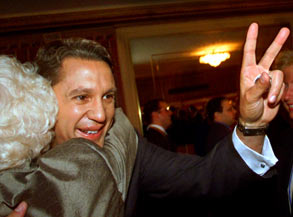
He hugged. He shook hands. He stared out at people in the crowd and gave the two-part wave/thumbs-up, sputtering out standard grip-and-grin salutations: “How are you?” “Good to see you!” “Oh, thank you!”

He was introduced by Lt. Gov. Mary O. Donohue, who couldn’t resist taking her own jab at the first lady. “Hillary is scared,” she declared. “She’s so scared, she’s forgotten her last name.”

But Lazio warned his supporters about cheap shots expected from the other side. “We’re going to have a lot of mud thrown at us,” Lazio told the crowd. “You should be ready for that. That’s the modus operandi on the other side, and they’re going to find something out about this New Yorker and about our New York state: We don’t back down from a fight!”

In what has become a staple of the modern political contest, the Clinton campaign wasted little time firing off the obligatory e-mail response to Lazio’s address almost immediately after he finished his roughly 30-minute acceptance speech.

“Today Rick Lazio offered the people of New York recycled insults and rhetoric that doesn’t match his record,” wrote Howard Wolfson, a spokesman for Clinton’s campaign. “Time and time again Rick Lazio has voted against New York’s working families in Washington. Hillary Clinton has been running an inclusive campaign since day one and fighting for children and families for thirty years. New Yorkers will always be able to count on Hillary to stand up for them in the Senate.”

Continue Reading Close

Giuliani stays on the fence

The mayor teases the public with an interview on MSNBC, but still doesn't announce a decision about his political or medical future.

Will he make a decision already?

New York Mayor href="/politics2000/directory/senate_candidates/rudy_giuliani/">Rudy
Giuliani spoke before a crowd of upper East Siders in a nationally
televised town hall forum/interview with MSNBC’s Andrea Mitchell on Thursday
night. But the foremost question on virtually everyone’s mind — Is he in
or out of the U.S. Senate race against href="/politics2000/directory/senate_candidates/hillary_clinton/">Hillary
Rodham Clinton — still isn’t
answered.

Instead, Giuliani again said he was still weighing the various treatment
options and contemplating the personal tumult spurred by the revelation of
his ongoing extramarital relationship and decision to separate from his
wife. The state’s Republican convention, at which the party must nominate
a Senate candidate, is a mere 11 days away.

“I kind of approached it as if this was a big case, or
a budget decision, or, you know, one of the millions of other decisions
that I have made,” he said of the process of deciding what course of
treatment to pursue and whether to continue with his Senate candidacy.
“This is a different kind of decision. It involves thinking about your
life, mortality, the quality of your life, and the choices are more
difficult than I thought they would be.”

Much of the evening featured Giuliani at his masterful best, appearing
calm, highly reasonable, and unlike his prospective Democratic Senate
opponent, not reciting lines as though they were from cue cards stored in
his head. Instead, he knowingly ticked off statistics on the city’s low
rates of police shootings and crime, and explained how chopping the
welfare rolls was actually very, very helpful to people. (An annotated
version of his recitation, however, would have mentioned that his
administration has repeatedly and illegally denied welfare benefits to
needy people, according to both the state’s highest court and the federal
government.)

When asked by an audience member about his frayed relationship with the
city’s African-American and Hispanic communities, he talked of the city’s
growing economy and offered up the following — seemingly rational –
explanation:

“I guess maybe it’s the way I approach things. It’s different than the way
politics used to be practiced,” said Giuliani. “I don’t do the ‘Here’s my
Hispanic program, here’s my Italian-American program, here’s my
African-American program.’” At this he was interrupted by thunderous
applause from the virtually all-white audience at the 92nd Street Y.

Mitchell didn’t ask, and the mayor obviously didn’t mention, how a Daily
News investigation revealed that his administration has steered thousands
of day care vouchers to a handful of the city’s Orthodox Jewish communities,
which have been consistently supportive of the mayor, and in some
cases bypassed thousands of families on waiting lists. He also didn’t
mention that perhaps he has such low standing among African-Americans
because his administration has virtually no black people in
high-ranking positions.

At various moments, however, Mitchell questioned him on touchy subjects and
the mayor wavered a bit. After months of polls showing public outrage at
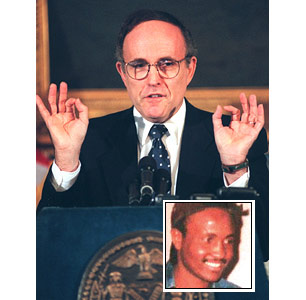
his handling of the police shooting of an unarmed security guard —
you might recall that Giuliani responded by releasing the man’s
juvenile arrest record — he acknowledged that he had “made a
mistake.”

“I should have also conveyed the human feeling that I had of compassion and
loss for a mother,” said Giuliani. “And I think if I could do it over
again, I would try to have balanced it more.”

And Mitchell asked him about a Giuliani campaign fundraising letter
sent out earlier this year accusing Hillary Clinton of being
anti-religion. “Do you really believe that this woman, who is a
devout Methodist, an observant religious person … is waging a war
‘against America’s religious heritage?’” she asked.

Giuliani first claimed that passage was taken “out of context” and tried to
steer the discussion towards public funding for offensive art. But Mitchell
pressed on: “Do you really think she’s anti-religious?”

“No,” he hurriedly acknowledged, “I don’t think she is.”

But the evening’s most intriguing exchange may have come with an audience
member. Ryan Mora, an earringed suburban high school senior, asked the
question that so many have wondered aloud and asked in print during the
last week but never articulately put to Giuliani: “We’re all wondering how
you will continue to uphold yourself as a moral leader given some of the
events that have occurred in the past few weeks.”

There was a smattering of applause from a group of Mora’s friends.

Giuliani, who had briefly put on his glasses, took them off and replied: “I
guess I would just ask people to take a look at me and say I’m a human
being.” He was interrupted by another round of thunderous applause.

“I’ve never pretended to be a, I’m not a religious leader,” added
Giuliani (whose aforementioned fundraising letter also attacked
Clinton for opposing the posting of the Ten Commandments in public
schools). “And I’m not a, I’m a governmental leader and it’s my
public record and my public actions and the things that I do as the
mayor that you should mostly be concerned about. And your moral
concerns, and I say this in the most respectful way possible, should
be with your own private life.”

Continue Reading Close

Democrats make Hillary legit

New York's party convention officially nominates the first lady for the U.S. Senate while a certain mayor goes unmentioned.

At a time when New York’s political world is intensely focused on whether Mayor Rudy Giuliani will continue his Senate run, the state Democratic Party — yawn! — formally nominated Hillary Rodham Clinton as its Senate candidate Tuesday night.

It was a peculiar day and evening, since much of the buzz on the floor of the Pepsi Arena in Albany remained centered on whether Rudy Giuliani would stay in the race. However, despite roughly five hours of Democratic speeches and several attacks on Republicans — Newt Gingrich, George W. Bush, Dan Quayle, Alfonse D’Amato — Giuliani’s name was not mentioned a single time by the state’s leading Democrats.

The evening’s biggest surprise came when Hillary Clinton, wearing a bright yellow outfit and a pearl necklace, finally took the stage after 9 p.m. — accompanied by her husband.

Indeed, midway through her speech, the first lady seemed to delight in the presence of the president, perhaps providing a subtle reminder of the personal difficulties currently plaguing the mayor. After crediting New York’s Democrats with giving rise to the labor, civil rights and gay rights movements, she eagerly pointed to the improved economy and declining crime rates of the past eight years.

“Thanks must go to Vice President Al Gore and President Bill Clinton,” she declared to applause. At that, her husband stood up and waved to the roughly 11,000 delegates in the crowd, many toting “New York Loves [with that little heart] Hillary” signs. “I would not be standing here tonight were it not for Bill and were it not for all he has done for me. And I could not be prouder as an American and as a New Yorker.”

She added: “We are a better country than we were in 1992.”

At one point, she went out of her way to issue a disclaimer about not mentioning you-know-who: “Make no mistake about it, this election is not about me or about any Republican opponent. It is about the people of New York, and the common mission that we are pledged to.”

With the exception of a few mentions of the balanced federal budget, her address seemed in many ways a throwback to New York’s history of progressive politics. Although not focused on any single theme, her speech was peppered with an attack on HMOs, an assertion of the need for women to receive equal pay, calls for a state hate-crimes bill and better coverage of mental health care and an assurance that there would be no more “forgotten New Yorkers.”

At the end of her speech, confetti and balloons rained down on the crowd, and a recording of the theme from “Chariots of Fire” started playing. It was a glittering end to hours of mostly soporific speechifying by the state’s leading Democrats.

The evening was punctuated by some memorable moments: A farewell to retiring Sen. Daniel Patrick Moynihan featured a clip reel of his appearances over the years on “Meet the Press”; Bronx Democratic boss Roberto Ramirez pumped up parts of the crowd by calling for an end to test bombing in Vieques, Puerto Rico (“Roberto’s in the House!” the Bronx delegation chanted); somnolent Assembly Speaker Sheldon Silver twice quoted Brooklyn native Jackie Gleason (“How sweet it is!”); model Christie Brinkley bizarrely recounted “trudging through the snow of the New York winters to spread Al Gore’s vision” (she is running on Wednesday to be a delegate at large for Gore at the Democratic Convention); and there was a video address from the predictably wooden Gore.

The most intriguing subplot at the convention was the jostling between the two leading contenders for New York’s gubernatorial Democratic nomination in 2002. U.S. Department of Housing and Urban Development Secretary Andrew Cuomo and State Comptroller H. Carl McCall, the state’s highest-ranking African-American elected official (and recipient of the evening’s loudest applause directed at anyone not named Clinton), both gave rousing speeches attacking Republicans (though not each other) while hinting at the 2002 contest.

President Clinton didn’t decide to attend the event until the last minute, so his presence on the stage was a surprise. As late as Monday, his aides said he wasn’t coming. “I just decided I ought to be there,” he said before leaving Washington. “It’s a big deal for her, a big night for her, and I want to be there with her. I just want to be there to support her.”

The convention came on the same day that a new poll showed the Clinton-Giuliani race deadlocked. Despite the seeming insanity surrounding Giuliani’s personal life in the past week, a Quinnipiac College Polling Institute survey showed Clinton leading the mayor by a statistically even 44 to 43 percent.

The Republican State Convention in Buffalo, N.Y., is in two weeks, and Giuliani is expected to announce by the end of this week whether he plans to remain a Senate candidate. On Monday night he said he was “very much inclined” to stay in the race, but still had to determine his course of medical treatment for his prostate cancer before deciding.

Despite the agreement among Democrats not to attack Giuliani, the Republican mayor’s campaign didn’t return the favor: Shortly after 5 p.m., just as the Dems began their convention, the Giuliani campaign e-mailed a statement to reporters:

“No matter how hard Mrs. Clinton tries to reinvent herself, there is still only one candidate in this race with the record of success and follow-through that has improved the lives of New York families,” wrote campaign spokeswoman Juleanna Glover Weiss. “When New Yorkers think about their futures, about lower taxes, new and better jobs, health and education reform, safer neighborhoods, and a better quality of life, they think about Rudy Giuliani.”

Continue Reading Close

Rude Rudy returns

Meekness gone, his temper flares as everybody wonders: Will he or won't he?

So, is he in or is he out?

As if that question hadn’t been asked enough during the two weeks since New
York Mayor/U.S. Senate contender Rudy Giuliani announced he had prostate
cancer, the viability of his candidacy now seems more tenuous then ever.

With Giuliani’s pronouncement on Wednesday that he is seeking a separation
from his wife, Donna Hanover — and Hanover’s subsequent announcement that
their marriage had failed in part because of his relationship with his
former press secretary — rumors of Giuliani’s political death have reached a fever
pitch.

Despite his seemingly imminent demise, however, two Republican elected
officials said they received calls from Giuliani’s campaign Thursday insisting that the mayor will remain in the race. One of the officials is Rep. John Sweeney, former executive director of the state’s Republican Party and a close confidant of state Republican Party Chairman William Powers.

The speculation about Giuliani’s future came on a day when the mayor denied
several news reports that he was leaning toward dropping out of the race.
“I haven’t made up my mind if I have the energy and the capacity to run,”
he said Thursday in the lobby of an East Village elementary school jampacked with reporters and television cameras. “I made no decision yet to drop out of the Senate race,” he said. “I didn’t discuss that with anyone. I didn’t say that to anyone.

“Rumors of my demise,” he later added with a chuckle, “are greatly exaggerated.”

Despite his comments, other potential candidates for the Republican
nomination are circling. Rep. Peter King, R-N.Y., told the Associated Press that he “would seriously consider running.”

“I’ve been making some phone calls and doing some television appearances
to get my name out there,” said King. “If there’s some significant support,
I’ll definitely go.”

In addition, Rep. Rick Lazio, King’s fellow Long Island congressman, and Wall Street financier Theodore Forstmann have said that they would consider running if Giuliani withdraws.

State Senate Majority Leader Joe Bruno, whose comments a day earlier that
Giuliani needed to resolve the issues in his marriage seemed to push
Giuliani to finally announce his separation plans, said Thursday: “I expect
him to stay in the race.”

But New York’s top Republicans may have reason to worry about Giuliani’s ultimately being their Senate candidate. Bruno controls only a slim majority of Republicans in the state. A battered U.S. Senate candidate at the top of the party’s ticket in the fall could hurt local legislators running for reelection and cost the Republicans their state Senate majority — as well as the considerable patronage, contracts and other assorted goodies that go along with it.

As one longtime local political operative explained: “You’re a conservative
Republican from upstate. You hate Hillary, you hate the Clintons. You say,
‘OK, Rudy’s from the city, but I’m still going to vote for him.’ Then you
read about all this stuff and there’s a feeling in the pit of your stomach
that this is not what you’re going to elect, and you’re not going to vote
for Hillary, so you say, ‘Fuck it. I’m not going to vote at all.’ And if you
don’t vote for him, you don’t vote for the lesser people on the ticket either.

“For Bruno to have made those comments the other day shows that he’s very
worried,” he added.

In contrast to his performance of a day earlier — when the mayor was
uncharacteristically open about his decaying marriage to Hanover and his
close relationship with drug company executive Judith Nathan — Giuliani
pointedly refused Thursday to answer questions raised by Hanover about
his relationship with his former press secretary, Cristyne Lategano. For
years, the mayor denied rumors that he was having an affair with the
much younger Lategano, now 35.

Indeed, on Thursday he appeared to be very much the old, testy Giuliani.
“Don’t you guys have the slightest bit of decency?” he asked. “Do you
realize you embarrass yourself doing this in the eyes of just about
everybody?”

Reporters on Thursday attempted several times to ask him whether he had had an
affair with Lategano, but he swatted them away each time, offering the
explanation that he had already responded to the question in the past.

While the mayor’s relationship with Lategano may seem like fodder for
the supermarket tabloids, the details present genuine ethics issues
for the Giuliani administration. First, Lategano was a city employee, not
merely — as the mayor has referred to his new lady friend — a “civilian.”
Second, she received a promotion — from press secretary to communications
director — and a sizable pay increase, despite near unanimity that she
was genuinely awful at what she was being paid to do: respond to questions
from the press.

Finally, Lategano was hand-delivered a golden parachute of sorts upon
exiting City Hall: She was appointed head of NYC and Co., a private
organization that promotes tourism in the city but that receives about 40 percent
of its funding from the city. (The previous head of the convention bureau
was also a former high-ranking Giuliani administration official foisted
upon the group by City Hall.)

But the mayor would have none of it when questioned on Thursday. “I think you’re trying to dredge up history that was covered a long, long time ago,” he said. “You’ve all covered this many, many times. You’ve all asked me about it. I’ve answered it. And it has no bearing, no relationship, not the slightest bearing or relation, to what’s going on right now. I think that what’s going on right now has to do with Donna and me. And what you’re trying to do is a backdoor way of trying to dredge this all up so you can write more salacious stuff.”

While Hanover did not make any more public statements on Thursday, the
usual talking heads fear that her accusations about her husband on Wednesday — “I made a major effort to bring us back together … He chose
another path” — could injure his candidacy.

“What Donna Hanover’s statement did was tell everyone that Rudy is not
‘Rudy the Good,’” said Democratic political consultant Henry Sheinkopf, who
had predicted Wednesday that Giuliani would be helped by the
announcement of his separation — until his wife’s statement later in the
day. The “Rudy who said he was going to protect his family was not protecting
his family. He was reckless. The person he had made himself out to be was
not who he was. The moral messenger was not very moral at all.”

The impact of these recent events on the decisions of voters may be
overblown. Indeed, there is virtually no history to guide Giuliani or his campaign. But in a tightly contested race
with Hillary Rodham Clinton, attacks on Giuliani by his wife could hurt him with crucial swing voters.

“It’s going to resonate with suburban women, who are going to walk away from
him,” said Sheinkopf. “It’s going to resonate with upstate voters, who didn’t know much about him anyway. They knew that he was Rudy Giuliani, the mayor of New York with an Italian last name who has cancer.

“Now he’s Rudy Giuliani, the mayor of New York with an Italian last name
who has cancer [and] who cheats on his wife.”

Continue Reading Close

Page 1 of 4 in Jesse Drucker

www.salon.com/writer/jesse_drucker/index.html