Joel Keller

PCs killed the mix-tape star

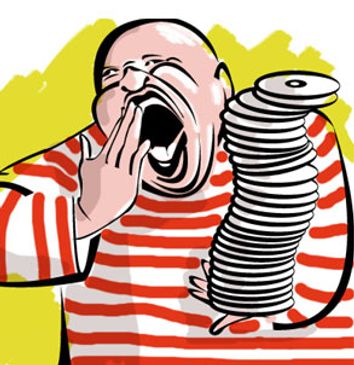
Putting together a home-brewed compilation of songs used to be an act of love and art. Now it's just too damn easy to be worth caring about.

  • more
    • All Share Services

PCs killed the mix-tape star

I miss the way I used to make mixes. I’d sit in front of my tape deck, with a stack of CDs or records on one side of me, and a beverage (adult or otherwise) on the other, and spend a couple of hours or more finding just the right combination of songs to put on the tape. The levels would all match; loud songs got softened and soft songs got a boost. I would attempt to take the mix right to the end of the tape; I’d spend over an hour finding that perfect minute-and-a-half song or snippet that would fit musically with the rest of the mix.

All the while, I would be swigging the beverage, and listening to each song as if it was the first time I’d heard it, usually with head down and some appendage keeping time. After a side was done, I’d rewind, punch out the tab, put on a custom-made label, and go to bed knowing that I’ve made something that I or my friends were going to enjoy for years to come.

This experience is not unique among music fans, as any die-hard song mixer will tell you. Mix tapes have been mentioned in various pop culture forums almost since the invention of the cassette, the most famous and loving example being in Nick Hornby’s novel “High Fidelity.” In the book, Rob Fleming, the owner of a London record store and the main character of the novel, explains in extraordinary detail what doing a proper mix tape entails: “You’ve got to kick off with a corker, to hold the attention, and then you’ve got to up it a notch, or cool it a notch. You can’t have two tracks by the same artist, unless you’ve done the whole thing in pairs, and, oh, there are loads of rules.” Most of us who’ve poured hours and hours into our mix tapes would be able to rattle off a similar set of rules.

But “High Fidelity” was released in 1995, a time when the music-listening world did not have CD burners, high-speed Internet access, and MP3 players. In the nine years since the book came out, the way most people listen to music has changed dramatically. All of the above methods of music listening are created by the PC, a device that is decidedly different from the old stereo system that Rob Fleming used to record his meticulous mixes. Unfortunately, the technological advances that have made music portability easier to accomplish have taken the entire visceral experience of making the mix and reduced it to just another procedure that can be executed with a few clicks of a mouse.

Because a temperamental tape deck in my old car kept eating my tapes, I started making CD mixes about three years ago. Compare the way I used to do my tape mixes with the way I do things now: I sit in front of my PC and either rip an entire CD to disk or download files from any of the legal services like iTunes or Musicmatch (in pre-litigation days, I will admit I downloaded the occasional song via Kazaa). I drag the song titles from my song list to the playlist window; I check to see if there are any abrupt endings or bad transitions, but I rarely listen to the songs all the way through. Once I’m satisfied, I pop in a CD-R, hit “record” and go to sleep. No muss, no fuss. And not nearly as much fun.

Many people who don’t have the same passion for the mix as I do simply copy entire collections of MP3s to CD or onto their iPod, not caring what order the songs are in. “I can now rip or download the songs I want to MP3. Then I dump them onto one of my MP3 players. The way the process has improved for me is that I can just hit shuffle and not know what the order [of songs] is always going to be,” says Jason Meurer, an engineer from New Jersey. He is one of the people who answered my e-mail queries regarding people’s mixing methods. From the limited sample I received, I noticed that while a fair number of people still perform meticulous mixes, just as many play randomly from their massive MP3 collections. No one has made a mix tape in years.

That’s a shame. The process of making a mix tape gave people a connection with music that the electronic version simply can’t replace. Because it is so easy to drag and click a mix into existence, the sense of satisfaction with making what many feel is a work of art gets diminished.

“On the subways you see people with iPods. They have, what, a thousand songs on them. Ten thousand, even. They stare random-glared into oblivion. [R]obots with shitty music taste and too much money to spend on music-listening hardware and shoes, in that order,” is how Sal Tuzzeo Jr., a music writer, describes the phenomenon. Fewer people who are connected to the music they listen to translates into a less critical and picky audience for the crapola that the record companies and radio stations promote. The quality of music overall goes downhill.

Why don’t I just go back to doing tapes, then? Well, I could go back, but I would have nothing to play those tapes on. Most cars no longer come with tape decks as standard equipment. Tape-based boomboxes are rare finds. MP3 players are smaller and easier to take on a jog than a tape-based Walkman. When making the decision between practicality and artistic merit, I’ll choose practicality more often than not. I may be wistful for the old days, but I’m not an idiot.

So let’s have a moment of silence, for the mix as we used to know it is dead. Technology has overtaken the experience and made it cold and impersonal. But it’s time to look forward, as the Internet has allowed us to trade and download more varied types of music, making for better-sounding, albeit more antiseptic, mixes. One of these days, Nick Hornby should do a sequel to “High Fidelity” and list Rob’s Top 5 music downloads. I’m sure it’ll be a nice read. But it just won’t be the same.

Want to stop your job from being outsourced? Join a union.

At least one systems administrator has had enough: It's time to hit the picket line.

  • more
    • All Share Services

When I was a kid, my dad’s pager was the least favorite item in our house. When he was on-call, my family couldn’t go to dinner or a movie or Grandma’s house, for fear that the contraption would go off and call him away to the office. When it did go off, and there weren’t many weekends when it didn’t, my dad would trudge to the phone, speak into it using loud and profane words, and then, if needed, put on his coat and shuffle off to the location of the latest emergency. Things got so bad, I seriously considered running over his beeper with my neighbor’s Big Wheel.

Was Dad a doctor, volunteer fireman or paramedic? Nothing of the sort. He was in I.T., before the term “information technology” ever existed. As a mainframe technician, he would be called in at a moment’s notice to replace a defective board or swap large DASD units in order to keep a customer’s big iron running.

Although he endured many lost weekends and dirty looks from his wife and children, he did so knowing that his sacrifices would be rewarded with overtime pay, at time-and-a-half rates on many occasions. His sacrifice enabled my family to live a comfortable middle-class existence and provided my brother and me with quality college educations. In fact, both of us have followed in his footsteps, working as system administrators to pay the bills.

Of course, in the modern world of I.T., emergencies still occur. When an Internet worm like last summer’s MSBlaster cascades through the networks of unprepared corporations, knocking servers off-line, admins like myself put in 16-hour days for as long as needed to get things running properly again. When the network goes down or the power goes out, we are the first ones on the scene to bring things back online, no matter what time of night it is. Holidays, vacations and personal commitments are secondary to our availability to work in an emergency. We are asked to work mandatory unpaid overtime and be held prisoner by our pagers, all under the constant threat that our jobs may be eliminated or sent to some distant and cheaper land.

Unfortunately, for most people in I.T., the days of getting overtime pay have ended. So, what do we now get in return for sacrificing our time? A small raise in our base pay? Sometimes. Extra bonus money? Not in this economy. Compensatory days off? Yes, but it never makes up for the time put in. A pat on the back? Maybe, but those “attaboys” are quickly forgotten. The only thing that information technology workers can count on getting in return for their efforts is insomnia, ruined weekends, angry families and stress-induced heart conditions.

During this post-boom era in the technology industry, managers have been telling their underlings that they are lucky to even have jobs, and that they should just take what they can get and wait for the market to improve. But they say these things knowing that, individually, each person has little power to make things different for him- or herself. It makes a person wonder: In the face of longer hours, cuts in pay, and the outsourcing of jobs overseas, why haven’t more I.T. workers organized themselves into unions?

The technology sector is grossly underserved by organized labor. According to the Bureau of Labor Statistics, only 10.8 percent of the over 4 million people working in technology in 2002 were members of unions. The only lower percentages were seen among categories that are traditionally perceived as not needing union representation: managers and executives, salespeople, farmers and general service workers. Meanwhile, according to Forrester Research, 3.3 million white-collar jobs will be permanently sent overseas by 2015, the leading category of which will be I.T. workers. Other estimates suggest as many as 14 million jobs may be at risk from offshoring.

A massive unionization of information workers would put them in a position to collectively bargain with companies about hours, wage increases and benefits. Workers would no longer be ordered to work mandatory unpaid overtime; if there was a call for their services on weekends, holidays and overnights, they would be able to sacrifice their time knowing it will be duly compensated. Limits on layoffs can also be negotiated into a collective bargaining agreement, assuring workers that their jobs won’t suddenly be shipped where labor is less expensive (at least until the CBA comes up for renewal). Through collective bargaining, I.T. workers will receive time flexibility, something they have not had in quite a while.

Of course, there are several drawbacks to unionization. Since the pay and bonuses are structured by the CBA, top performers cannot be rewarded as highly as they might be now, while bottom feeders will be equally rewarded for substandard work. Deadwood cannot be cut by layoffs without the union getting involved. CBA negotiations, as Verizon workers found out this past year, can be contentious, played out through mudslinging media campaigns. Union workers may end up on strike, without pay, for long periods of time. Finally, unions that have gotten too much power have been known to stand in the way of efficiency, as their negotiated rules of what work they can and cannot do become more restrictive over time. This breeds tension and resentment between the nonunion workers who just want to get the job done and the union workers who are constantly filing grievances when they are asked to do work not in the contract (or, conversely, when a nonunion worker performs tasks union workers are contracted to do).

Even with all the caveats that come with joining a union, I.T. workers need to seriously consider this option. Without the strength in numbers that collective bargaining provides, conditions for technology workers are bound to get worse, especially if there are fewer jobs to be had.

There’s always going to be a crisis. Someone will unleash another virus, another hard drive will go down, another blackout will occur. As always, we in the I.T. ranks will be there, working late into the night to get things back to normal. It’s a part of the job we can’t avoid. The time has come, however, for us to get something back for our labors other than just a handshake and acid reflux disease. It’s only fair.

Continue Reading Close