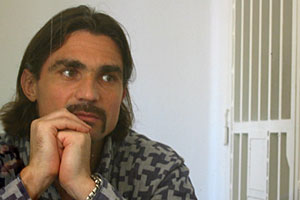
Julian Rubinstein

The Whiskey Robber talks!

He made bank tellers swoon. He was madly pursued by the Mound of Asshead. In a rare prison interview, the Robin Hood of Hungary looks back at his wild ride through the ruins of the Soviet bloc.

  • more
    • All Share Services

The Whiskey Robber talks!

Three and a half hours northeast of Budapest by train, in a quaint village in a rural, hilly part of Hungary near the famous Tokaj wine region, sits a rarely visited tourist attraction. Were it easier to enter the hulking yellow limestone building on Satoraljaujhely’s Main Street, perhaps more people would have heard of the place. But the former underwear factory, situated between a barber shop and a pizza parlor, now serves as the country’s maximum security prison. And among its inmates is the man who may be the world’s most popular living folk hero.

As if something out of either a Coen brothers comedy or a Shakespearean tragedy, the “gentleman bandit” Attila Ambrus grabbed a piece of post-Iron Curtain history and ran with it so outrageously through 1990s Budapest that he has inspired a cabaret theater show, a hit song, a Hollywood film deal and a worldwide following that continues to grow. On Oct. 6, 2005 — a full six years since his capture following the largest manhunt in modern Eastern European history — supporters in 12 cities around the world toasted the so-called Whiskey Robber’s 38th birthday.

“Too bad I won’t be able to clink glasses with anyone,” Ambrus told Salon in a visitor’s room in the prison where he is serving a 17-year sentence. “But I’m not a folk hero.”

In fact, Ambrus, who hails from a one-street village in Transylvania, is the very definition of such a figure, a man whose legend came to symbolize his countrymen’s frustration with their corrupt leaders. From 1993 to 1999, he robbed 29 formerly state-owned banks, post offices and private travel agencies in a crime spree that played out like a serialized satire of the times. Like the rest of the former Soviet bloc, Hungary was struggling with byproducts of democracy it hadn’t before seen: unemployment, homelessness and a spiraling crime rate.

Wearing a flea-market selection of bad costumes and hairpieces, Ambrus handed flowers to female bank tellers during his heists, mailed bottles of wine to the police chief and once disguised himself as the head of the robbery division to pull off a job. Since his identity was then unknown, the media dubbed him the “Whiskey Robber” because witnesses always spotted him downing shots of Johnnie Walker in a pub across from the bank before shaking the place down. “He didn’t rob banks,” editorialized the Hungarian daily Magyar Hirlap after Ambrus’ arrest. “He merely performed a peculiar redistribution of the wealth that differed from the elites only in its method.”

In Hungary today, popular support for Ambrus has dipped from its 80 percent peak in 1999, when his streak came to a wild end. But he is enough of an antiestablishment figure that his name is still invoked at protest rallies. His man-of-the-people image, good looks and “bandit honesty” have given him a universal third-party-candidate appeal. He is often referred to as the “modern-day Robin Hood,” even though he did not share his loot with the poor. And he is distinct from other internationally known modern folk heroes such as John Dillinger and Ned Kelly, in that he never hurt anyone in the commission of his crimes.

Not that that has won everyone’s heart. “I can’t believe that several million people exist who can be a fan of a criminal,” says Lajos Varju, the robbery-division chief of the Budapest police department who unsuccessfully tracked Ambrus for six years. “But the social situation created this.”

- – - – - – - – - – - -

Today, Ambrus resides in a small cement cell in the Satoraljaujhely (pronounced roughly as sha-toh-rai-oh-hay) maximum security prison, along with several hundred of Hungary’s most violent criminals. Ambrus, despite having never seriously injured anyone, is treated as a major security threat, mostly because of the cartoonlike escape he made in July 1999, rappelling from a bedsheet from a fourth-floor window of the Budapest city jail.

That event made his story international news, with coverage of the frenzied hunt for him making papers from London to Sydney to New York (and in Salon.) After three more outlandish robberies — he once had to outswim police in the Danube River — Ambrus was finally captured, convicted and sentenced.

I first interviewed Ambrus four years ago in the Budapest Municipal Courthouse during a break in his sentencing hearing. On that occasion, when I asked if he’d ever consider escaping again, he said, while eyeing the flock of armed guards hovering over us, “I couldn’t say. I wouldn’t be sincere.”

Today he’s mellowed, but the fighting spirit that took root in his rocky childhood doesn’t need much provocation to show its face. When the prison guard, who was smoking a cigarette outside the small glass-partitioned booth in which we are speaking, tells us we have only half an hour left, Ambrus immediately begins arguing that more time should be added because of the wasted minutes bringing him down from his cell. (He eventually loses the argument, turning to me and rolling his big hazel eyes.)

Even dressed in thick prison-issue black-spotted shirt and gray pants, it is easy to see why Ambrus has had a Stockholm-syndrome effect on those around him, particularly women. (One female teller, who was a victim before Ambrus thought to bring roses with him to the banks, was quoted in the Hungarian media as saying, “It’s a shame we were at the beginning, because we didn’t get the flowers.”)

Bearing a close resemblance to Colin Farrell (though Johnny Depp is reportedly interested in portraying him in a Warner Bros. production), Ambrus has a strong jaw, an easy, knowing grin and an athletic build befitting the day job he held during the years he was robbing: goaltending for one of Hungary’s biggest professional hockey teams.

Ambrus’ exploits on the ice, however, were not as successful as off. “I was a disaster as a goaltender,” he admits. Which is something of an understatement. In a single game in 1995, he gave up 23 goals, needless to say in a losing effort. During one five-game stretch, he gave up 88. But he was kept on because the team had no money to pay better players and also because he was so devoted — never missing a practice — that his discipline and maniacal work ethic were legendary around the league.

Now, because of his notoriety as a bank robber, a flag flies above the dilapidated outdoor UTE stadium where he played, reading “Tallyho Whiskey Robber!” His jersey, or replicas of it, are regular items at Budapest auctions, reportedly garnering a few hundred dollars apiece.

“I can’t believe how many times they’ve sold ‘my’ jersey now,” he says, shaking his head and comedically raising his combable eyebrows. For all of his exploits and derring-do, he is humble and down-to-earth, sheepishly admitting his inability to be faithful to any of his girlfriends and the justice of his being incarcerated. “I’m a criminal in every bone of my body,” he says.

But he clearly thinks of himself as distinct from the rest of the prison population. “I don’t mean it as a claim,” he says, “but the people here aren’t exactly graduates of the National Science Academy.” Nor of course is Ambrus. But for an autodidact refugee, he has come a long way. He recently finished his general equivalency high school degree (with straight A’s) and is trying to figure out if he can continue on to college via correspondence courses.

Although his mood is decidedly better and he is no longer threatening suicide, as did when I first began visiting him, he is still bitter about the government’s attempt to try him for attempted murder. “The one thing I swore I would never do was hurt anyone,” he says. But what really gets him on a roll is the news. He watches CNN on a 14-inch color set mounted in the corner of his cell and reads six or seven newspapers a day from the library. While I’m turning a page in my notes, he mentions Jayson Blair and Judith Miller, saying, “What’s the story with the New York Times? You can’t trust that paper, can you?”

This feeds into a rant that seems to go on as long his robbery spree. “It’s the same throughout history,” he says. “Whoever has the money has the power. They are the establishment and they fix the system, make the rules … Hungary is not so different now than it was under communism. As soon as someone new gets into power, they eat up everything. Sometimes there’s no other way to fight.” He mentions that gangs from Sicily and Marseilles and outlaws from Che Guevara to the IRA all supported their political causes by robbing banks.

In retrospect, however, he says that his streak continued at least in part because he “got caught up in the consumerism … In America for instance, I wouldn’t last 15 minutes without being arrested,” he says, meaning the temptation to steal something would be too great. “But I can’t say that I regret it. I tried a lot of other paths that didn’t work out. I guess this was my destiny.”

The Whiskey Robber’s streak began on Jan. 22, 1993, Bill Clinton’s first day as president of the United States. The world geopolitical order, it would turn out, was in a brief hiccup, the post-communist era. It was a disillusioning time for the people and for some of the political leaders. The economy in Hungary was so bad that the prime minister decided to bring in extra money by renting out rooms in Parliament.

Corruption and cronyism, thought to have been rampant under communism, were plaguing the process of privatizing the country’s resources, real estate and businesses, leaving nothing for those without connections to power. The level of disgust was so high that people began describing the era they were living in as szabad rablas, or “free robbery,” a term that hadn’t been used in Hungary since the Nazis pillaged Budapest at the end of World War II.

In 1993, Ambrus had only recently secured a position on the UTE hockey roster. He still had no Hungarian citizenship despite having applied for political asylum after escaping from Ceausescu’s Romania in 1988 underneath a freight train. After a month in Hungary, he phoned the UTE hockey club, which had won seven straight national championships.

Claiming to be a goaltender, he talked his way into getting a tryout that went so incredibly badly — the players made a sport of trying to break his nose and succeeded — that out of pity, he was taken on. “We thought it was simply amazing that someone wanted to be a part of our team so badly even though they’d obviously had nothing to do with hockey in their life,” says George Pek, the team’s captain.

Ambrus was made the club’s janitor. Among his duties was to drive the Zamboni around the rink before games and between periods. He slept on a cot in a closet at the stadium. “He had literally nothing,” says Janos Egri, a UTE player.

Ambrus ate his meals at churches and, to make ends meet, worked as a gravedigger, a door-to-door pen salesman, a dog walker and a building superintendent. In 1991, he found that he could make money smuggling animal pelts from a poacher in Transylvania to a mountain-lodge owner in Austria’s Tryoleans. The scheme worked for two years until the border guards began demanding too much bribe money to let him through.

By January 1993, Ambrus was deep in debt from a bribe paid to a ministry official he hoped would get him his citizenship papers. “I tried to toe the line,” he says. “But I finally realized I didn’t have a chance.”

There was a post office down the street from his apartment that many people used like a savings bank. It clearly had no security guard or security camera and operated with a staff of just two or three.

Ambrus skipped hockey practice and stayed home (he’d moved from the stadium first to a former horse paddock and then to a small apartment) for three days, drinking whiskey and pondering the commission of a robbery. It wasn’t as though he’d never done such a thing. He had spent two unspeakable years in a Romanian juvenile detention facility for stealing music instruments from a local pub in Czikszereda, the eastern Transylvania mountain town near his birthplace, Fitod (population 1,500). That conviction had earned him a classification as a “class enemy,” further darkening whatever bleak future awaited him there.

Seeing no other good options, he decided to do the job but resolved not to hurt anyone. He went to a flea market and bought a wig and a toy gun. The following afternoon, he burst into the small post office, yelling, “Freeze!” Within minutes, he collected the loot from the tellers, locked the employees inside, and then ran a circuitous route home, where he promptly puked.

His haul wasn’t much by Thomas Crown standards, but the 548,000 forints ($5,900) was more than he’d ever seen in his life. In fact, the problem was that it was too easy. Within a year’s time he’d pulled 10 jobs, and the Budapest police — and media — realized they had a serial robber on their hands.

- – - – - – - – - – - -

“We used to say he was born under the star of luck,” says Varju, the robbery-division head who dejectedly quit the police force in 1998 with the Whiskey Robber still at large. Puffing on a Salem, Varju concedes that only recently has he been able to talk calmly about the case that dominated his life for six years.

Fairly or not, Varju took most of the heat for the slapstick mishaps that enabled the Whiskey Robber’s streak to continue. Once the police confused another building for the victimized bank and ran right past Ambrus. Another time, two members of the department crashed their cars into each other en route to a robbery scene.

But the bigger problems with the investigation had little to do with Varju, who for lack of a better training program taught himself to be a detective by watching “Columbo” reruns. He led his 13-man team from a ramshackle command post on the fifth floor of robbery headquarters, with no working computer. His deputy had crashed so many police cars that he had earned a nickname that translates as “Mound of Asshead.” His forensics expert, who occasionally reported for duty in top hat and tails, was known as Dance Instructor because he taught ballet on the side.

The department had so few cars that his men often had to hitch rides with the media to crime scenes. Once in 1996, after Scotland Yard pronounced a discount bin surveillance camera tape of the Whiskey Robber in action worthless, Varju resorted to seeking help on the case from a psychic.

“We knew he was a soldier or some kind of athlete because he ruled the situation when he was in action and would jump over counters like a cat,” Varju says. “He was really focused, really disciplined and oddly, really polite.”

It wasn’t much to go on, but the media ate it up. “It’s not impossible that he’s giving the money to the poor,” wrote the daily Nepszava in 1996.

In fact he wasn’t. Ambrus became a regular fixture at the city’s roulette tables and at the Cat’s Club, a high-class brothel frequented by politicos and mobsters in Szentendre, 45 minutes north of Budapest. (The owner, who was later killed in a mafia car bombing, used to yell, “Chicky Panther!” when Ambrus showed up, referring to his hockey nickname that was derived from his catlike speed and his roots in Czikszereda.)

Ambrus had also never been on a plane before, but after becoming a bank robber he visited exotic locales around the world, including Egypt, Tunisia, Kenya, Thailand and Bali, with a revolving group of girlfriends.

His teammates were shocked when he first showed up at the stadium in a shiny new Opal. “After all, he was wearing our underwear,” Egri says. Ambrus claimed he was working as a bodyguard for important people or that the pelt-smuggling business was going well. No one pried further. Almost all of them had their own questionable side endeavor, and Ambrus was generous with the money, paying for food and drinks and solely financing the renovation of the team’s fetid locker room.

As the years wore on and his criminal profile grew, the strain of living a double life began wearing Ambrus down. He was worried about being recognized. And thanks to his well-publicized success, the banks around town were hiring armed guards and installing alarm systems and time-lock safes.

But Ambrus couldn’t stop. “It became like an old-fashioned game,” he says. “Once I got into the role, I got a kind of urge. And I managed to give the authorities a ride so many times, it became something of a sport. After a while, my main point was to succeed.”

He spent nights scouring the city, drawing up an encyclopedia of Budapest’s financial institutions, diagramming each one and giving each a score between 1 and 5 for degree of difficulty.

In the summer of 1996, he took on an accomplice, his teammate Gabor Orban, whose father was the team’s coach and one of the most famous names in Hungarian hockey history. The two UTE players pulled off 13 robberies together, once hitting two banks in the same day, disguised as policemen.

Their last gig was on Jan. 15, 1999. The police were on their heels as soon as they burst out of the bank, and they caught up with Orban on the Buda side of the Danube. Ambrus made it back to his apartment, where he grabbed his passport, his dog and his car and zoomed off toward the Romanian border. Only minutes before he approached the checkpoint, a fax came through at the guard station with his description. He surrendered without a fight.

Ambrus, who somewhat gleefully confessed to all of his crimes, was relieved at first to be in custody. Finally he could tell his secret — and because he turned out to be handsome and bright, every media outlet let him do exactly that. The Hungarian rapper Gangsta Zoli wrote a chart-topping song called “The Whiskey Robber Is the King.” A cabaret show played in one of Budapest’s theaters, including a number in which a female bank teller sings about wanting to get robbed by “You superprince, the Whiskey Robber.”

Then, six months after his arrest, Ambrus learned that the government was filing attempted murder charges against him. Though he had started using a real gun after the first few robberies, he had never fired it except at the scene of one crime. Ambrus was adamant that those shots were clearly fired into the sky to ward off a group of people who had given chase. (The court ultimately agreed and dismissed the charges.)

Ambrus told his captors he would escape in protest but since no one had ever escaped the facility, he wasn’t taken seriously. But on July 10, 1999, Ambrus climbed a wall in the courtyard, got into the adjacent administrative building, then lowered himself nearly 50 feet to the ground on a line made of bedsheets, shoelaces and phone cable.

Over the next three months, despite being the target of a massive manhunt that included forces from Interpol, he pulled off three more robberies. Meanwhile, “Go Whiskey Robber” T-shirts and pins were being sold on street corners. Newspapers featured doctors giving advice on what type of plastic surgery he should have to elude capture. People were quoted saying they wouldn’t help the police even if they saw him. The bedraggled Budapest police chief finally emerged with a statement, saying only, “This is human stupidity. Full stop.”

Finally in October the police got a tip that led them to the apartment where Ambrus was hiding, right in the middle of the city. He was recaptured in a raid and thrown in an all-glass cage built for a serial killer. In all, the total take from the robberies was 195 million forints, or $840,000, a large chunk of which went to his partner Orban, who had a 50 percent cut on his jobs. “One less small fish,” read a headline in Nepszava.

- – - – - – - – - – - -

“I’ve retired my business card,” Ambrus says now, shaking his head and smiling in disbelief at the craziness of his life on the run. “I’m through with the circus. I just want to have a peaceful life.”

Regardless of what his future holds when he is released in 2016 at age 49, Ambrus seems destined at least to remain a relic of a bygone era, a figure trapped inside the postcommunist snow globe he penetrated when he rode into Hungary beneath a train in 1988, just before the whole scene was shaken up. Like Dillinger during the American Depression, it is all but certain that Ambrus could not have carried out his 29-robbery streak — or become the sensation that he did — at any other time or place.

Whether that makes Ambrus feel like one of the luckiest or unluckiest people in the world is not a question he knows yet how to answer. On the floor of his cell is a large encyclopedia of Hungarian history, Magyarok Kronikaja. On page 816, next to the entry about the Balkan War, the chronological reference book tells the story of the Transylvanian hockey goalie who became known as the Whiskey Robber, “a national fairy tale hero.” On good days at least, Ambrus says he can read it and convince himself it was worth it.

“Anyone can go there and grab the money,” he says. “But that’s not the point. I wanted it to have an afterlife.”

The hall of shame

From the murder to a football star's pregnant girlfriend to the retirement of four sports icons, 1999 was a bad year to be a sports fan.

  • more
    • All Share Services

1999 was a terrible year for sports fans for a lot of reasons. It was the year of predictability, with both the New York Yankees and Denver Broncos repeating as champions in their sports. The en masse retirements of such
peerless icons as Michael Jordan, John Elway, Wayne Gretzky and Steffi Graf marked the low points of a year that was filled with its share of shameful and ignominious moments. Here are the 10 most disgraceful and dishonorable sports stories of 1999.

The Rae Carruth story

Without question, the most deplorable story from the sports world this year is the one still developing in North Carolina. Carolina Panthers wide receiver Rae Carruth was arrested in the trunk of a car in Charlotte and charged with first-degree murder. The victim was Carruth’s 24-year-old pregnant girlfriend Cherica Adams, who died Dec. 14, about four weeks after being shot in the neck, chest and abdomen as she was driving her black BMW through a residential neighborhood last month. Sources close to the investigation say police believe Carruth, a third-year player who has been injured most of this season and was suspended by the Panthers without pay when he was made a suspect, masterminded the shooting of Adams. Police reportedly believe Carruth was riding in an SUV in front of Adams’s car and was in cell phone contact with another vehicle containing three gunmen, who have also been arrested. Adams’s child, a boy, was
delivered 10 weeks prematurely and is in fair condition at an area hospital. It is not known if Carruth is the father.

Catcher in the wry

No catcher since the fictional Crash Davis (from the classic 1988 baseball film “Bull Durham”) has had the audacity to do what minor leaguer Jeff Alfano did this season. Weeks after serving a six-game suspension for trashing the clubhouse buffet table after being criticized by his manager, the Hunstville (AA) Stars player found a more creative method of working out frustrations with another member of his team, pitcher Robert Theodile. In extra innings of a tense late-season game he was catching, Alfano began telling opposing batters what pitches
Theodile was throwing. In the top of the 17th inning, the Stars opponents, the Orlando Rays, put the information to good use, blasting a grand slam off Theodile that won the game and earned them a trip to the playoffs. Alfano, who later admitted his transgression, was suspended for 30 games beginning next season.

Hockey coaches lead by example

The NHL has always had a problem curbing on-ice violence enough to satisfy some purists. But after this season you can’t say the anti-fight club didn’t make their feelings known. Following a September preseason game in which he was disgusted by the violent tactics employed by the Chicago Blackhawks against his team, Washington Capitals general manager George McPhee stormed into the Chicago
locker room and began pummeling Blackhawks coach Lorne Molleken. Several Blackhawks players and arena security people jumped in to stop the fracas, but not before McPhee had blackened one of Molleken’s eyes. McPhee himself was bleeding from the face and missing an entire arm of his suit jacket. But at least he’d made his point: Violence has no place in this game.

A runner’s million-dollar strategy

Hoping to generate publicity, the Golden League, Europe’s premiere track circuit, decided to offer a $1 million bonus this year to any athlete who could win all seven meets in their respective event. And after Kenyan Bernard Barmasai was victorious in each of the circuit’s first five 3,000-meter steeplechase races, the gimmick seemed to be paying dividends as the track community, particularly in Europe, buzzed with speculation about Barmasai’s potential record windfall. But the notion was so enticing even to Barmasai that at the sixth meet, on Aug. 11 in Zurich, he convinced countrymen Christopher Koskei, another top steeplechaser, to deliberately lose, thus helping to keep his bid for the jackpot alive — and ultimately embarrassing himself and his sport. “It was not cheating,” Barmasai maintained when Golden League officials learned of the
fix and disqualified him amid a flurry of negative press. “It was tactics.”

The real deal?

In March, 48-year-old Atlantic City, N.J., municipal accounts clerk Eugenia Williams came to Madison Square Garden thinking what fun it would be to judge the heavyweight title fight between Evander Holyfield and Lennox Lewis. She never
imagined that scoring the bout in Holyfield’s favor would launch a thousand
investigations and knock the already wobbly sport onto the ropes. After all, Don King, Holyfield’s notorious promoter, was paying her $5,150 for the gig and she was just an anonymous occasional fight judge who’d recently declared bankruptcy. Why would this be any different from, for instance, the lightweight fight she judged last December between Ivan Robinson, a family friend, and Arturo Gatti. (She scored it for Robinson, who won a unanimous decision.) So this time, even though Lewis landed nearly three times as many punches as Holyfield, Williams scored it how she saw fit: 115-113 for “The Real Deal” Holyfield. Conflict of interest? Please. “I was just doing what I was hired to do,” she said.

Olympics bribery scandal

The Olympic movement was rocked by revelations of corruption and vote buying
this year that resulted in the overhaul of the Salt Lake City 2002 Winter Games organizing committee. But the real degenerate to emerge from the sordid ranks was formerly venerable International Olympic Committee President Juan
Antonio Samaranch, who only recently had been thought of as a potential candidate for a Nobel Peace Prize. Samaranch is actually little more than the spoon-fed ringleader for a group of pampered princes and princesses so bereft of
leadership and ethics that bribing them was practically considered de rigueur for cities that wanted a shot at hosting the Games. That much was made clear from dossiers written by Atlanta’s successful bid committee, which were released in September by a Congressional committee investigating the abuses. The Atlanta group’s
extensive “research” included the following: “Raymond Gafner [U.S. Olympic
Committee representative from Switzerland]: Fan of ice hockey. Perhaps we should
get a stick signed by Wayne Gretzky. Maybe a hockey puck that we would say is
from some famous game (whether that is true or not.) Louis Guirandou-N’Diaye:
Gifts are okay. Gift of female okay.”

Falling off the wagon

After battling well-documented eating disorders and alcoholism for years, golf
great John Daly decided he needed a life change in 1999. After missing the cut
at the St. Jude Open in Memphis, Tenn., in June, he broke 26 months of sobriety by downing a 12-pack of Miller Lite while driving home, saying later, “It’s sad but it’s great to be free.” Callaway, his major sponsor, which had previously paid off
$1.7 million of his gambling debts, terminated Daly’s $3 million contract, which
seemed fine by the new Daly. “I’d rather just be Chris Farley and play some golf,” he said in August, before pulling out of the PGA Championship and heading to Vegas, where he lost a cool half-million bucks. “We only live once,” the 33-year-old Daly said. And hey, Farley almost made it to 34.

The umpires strike back

In July more than 50 of Major League Baseball’s 93 umpires signed letters of
resignation at the behest of their longtime union leader Richie Phillips, who’d
convinced them that the way to guarantee higher wages than their current $200,000 per year average (for working six months of five-hour days) was to threaten mass resignations in mid-season. It proved to be among the worst
strategies in organized labor history; the owners simply accepted the resignations of 22 umps, many of whom scrambled unsuccessfully to rescind their letters. The owners were happy to see them go, and called up a new crop from the
minors to fill their jobs. Any hope of Phillips rehabilitating his reputation as a labor leader was destroyed in September, when it was discovered that a company he owns and runs, Pilot Air Freight, does $375,000 of business per year with
Major League Baseball and that two umpires who did not sign letters of resignation, but who are union members, are on his payroll. In November, after having lost all of their bargaining power and a score of jobs, an overwhelming majority
of the umps voted to decertify their union and form a new one — putting an
embarrassing end to the reign of the only union leader they’ve ever had.

I wanna be like Mike

When Ike “The President” Ibeabuchi knocked out highly touted heavyweight Chris
Byrd in May to become the division’s No. 1 contender, it appeared he had overcome the demons that made him kidnap his ex-girlfriend’s 15-year-old son last year and drive with him at 70 mph into a concrete pillar, severely injuring
the boy. But when he lunched with HBO boxing chief Lou DiBella in New York two
months later to discuss a deal that would make him a heavily promoted star, “the President” broke protocol and began waiving a steak knife at DiBella, demanding millions more per fight than was being discussed. Within a month, Ibeabuchi had been arrested for raping a Las Vegas call girl, flown out of control during his arraignment and allegedly bitten a guard in Las Vegas jail, thus securing the right to star in an upcoming episode of the fight game’s sick and twisted maniac
comeback series.

Here’s to you, Mr. Robinson

For all of the NFL’s overly rigid rules regarding player’s on-field celebratory
antics and gestures, it’s hard to imagine a more blatantly overindulgent pre-game gambol than that of Atlanta Falcons safety Eugene Robinson on the eve of January’s Super Bowl XXXIII. Hours after receiving the Bart Starr Award for
outstanding leadership at home and in the community from the Christian group
Athletes in Action, the pious Pro Bowler went cruising the streets of Miami for
a pre-game blow job. Heck, his wife, Gia, was already asleep back at the hotel
and he still had 21 hours before kickoff of the biggest game of his career. Unfortunately Robinson, heretofore known to his teammates as “The Prophet,” saw
something else coming when the woman he solicited for the $40 job turned out to
be an undercover cop, and Robinson ended up spending the wee hours of Super Bowl Sunday
in the county clink. After serious contemplation, Falcons coach Dan Reeves decided to play Robinson against the Denver Broncos anyway. It’s a decision he and the team may now regret: Robinson, who admitted he didn’t sleep all night, was burned on two big plays, including an 80-yard touchdown pass, and broke his pinkie trying to tackle Terrell Davis in the Falcons 34-19 loss. At least God, he says, has offered him forgiveness.

Continue Reading Close

Slam it, baby!

The women of the WNBA still don't dunk. But do male sportswriters really want to see women dunk so badly, or just dunk badly?

  • more
    • All Share Services

That last month’s inaugural WNBA All-Star Game at Madison Square Garden was attended by Tipper Gore and several members of the victorious women’s World Cup soccer team was particularly fitting, and not just because the WNBA has a reputation for marketing savvy. In the last few years, women’s sports have become inextricably entwined with politics. And as the WNBA championship series between the Houston Comets and the New York Liberty gets under way, the basketball court is the latest battleground in the gender wars.

The issue: dunking. Or, rather, the absence of dunking.

In the three years the WNBA has been playing (and the two and a half years of its now-defunct rival, the ABL), no woman has ever dunked in a game, and only one has even tried to — although about 10 current WNBA players have enough “ups” (jumping ability) to successfully jam in practice sessions.

This isn’t much of an issue for the women in the league. But men just can’t leave it alone.

During the week of the All-Star Game, the mostly male sports media became “almost obsessed,” in the words of Comets All-Star guard Sheryl Swoopes, with this singular physical act. The New York Times’ William C. Rhoden wrote a column the day of the game titled “A League In Search of a Moment,” the moment being the dunk. Never mind the fact that even in the men’s game the dunk is almost entirely a style over substance move — not to mention that by all appearances women journalists, the players and their approximately 10,000 rabidly loyal fans a game (70 percent of whom are women) couldn’t care less about seeing it, at least for the time being.

The players’ feelings were made obvious during some tense exchanges in the locker room following the somewhat lopsided West team victory.

“I don’t know why you guys are so overly concerned with women dunking,” two-time MVP Cynthia Cooper of the Comets snapped at me when I became the umpteenth male member of the press core to approach her about the topic. “People need to realize that we play a different kind of game. If a woman dunks, great, more power to her — but it’s not what determines whether our game is exciting or not.”

The issue’s sexual overtones took on comical proportions in the response of another player, the Phoenix Mercury’s Jen Gillom, who told me, “It’s just different for us. For us to do it, everything has to be just right.”

Thanks to her towering stature, the Utah Starzz’s 7-foot-2-inch Margot Dydek can dunk with ease — as she, and a few other women, have done in European leagues, to little fanfare. But she prefers to lay the ball quietly off the backboard. “Why should we care about the dunk?” she said in a phone interview. “Two points is two points. When dunking is worth five points, then I’ll think more about dunking.”

Of course, women pros also know that a major appeal of sports is aesthetic, and they’re the first to admit that no woman now has the kind of leaping ability that would enable them to dunk with the kind of grace worthy of slow-motion replay. They know they look a lot better, and are equally, if not more, effective, banking the ball off the glass than attempting a stilted and risky jam.

It is precisely this all-too-obvious point — along with the fact that, especially in the sports arena, men have always seemed a little too eager to point out that they have something they think that women want — that makes me suspicious of pieces like Rhoden’s or the one by the San Francisco Chronicle’s Jonathan Curiel, who wrote last year that the dunk “could revolutionize the way women’s basketball is perceived.”

What the dunk really is is a marketing ploy. Take last year’s dunk contest, staged by the now-defunct ABL. Hoping to increase its marketability, the ABL organized the event to coincide with its own All-Star Game in Orlando, Fla. Five players participated in the contest, which was won by the 6-5 Sylvia Crawley, who performed a somewhat awkward one-handed jam while wearing a blindfold. Sports Illustrated, not surprisingly, called her dunk the “poster-perfect moment” for the league. ABL commissioner Gary Cavalli likened Crawley, who was not a standout player, to a pied piper, saying that because of her dunking ability it was “apparent that [the league] needed to keep her.” But by year’s end, the league had folded, few people had ever heard of Crawley, and when the WNBA held a special draft this year for teams to snap up the best former ABL players, Crawley wasn’t among those chosen.

Even in the NBA, players dunked for years before anyone cared about the move. Not until the acrobatic, high-flying Julius Erving arrived on the scene in the ’70s did the dunk pique fans’ interest. True, the first woman to do it will make headlines for a couple of days and probably a nice chunk of change from some sponsor. (Why else would the male agent of Los Angeles Sparks star Lisa Leslie, whose miss in the WNBA’s first-ever game three years ago was the only time anyone has tried to dunk in a game, needle her to make another attempt?) But to make the dunk out to be some kind of revolutionary benchmark, or the sine qua non of the sport, is a joke.

The real question is not what the dunk could do for women’s basketball, but what it would do to men.

The dunk, in many ways, symbolizes the final frontier for women athletes to conquer, the co-opting of the single most macho act in all of sports. It can be viewed both as a sign of progress that women find themselves on the verge of achieving this once-unattainable goal, and an indication of how far we still have to go that men are reacting to the situation with such oafishness and insincerity.

In the three years since the gold-medal success of the U.S. women’s basketball, soccer, softball and gymnastics teams at the Atlanta Olympics helped propel women’s professional team sports to new heights, a majority of the dialogue on women’s sports — thanks to men’s dominance of the sports media — has focused on what won’t work or what the women can’t do. (That is, when the papers deign to cover women’s sports at all.) Thus it is hardly surprising that in a summer when the Anything You Can Do I Can Do Better sentiment hit a new high thanks to the women’s World Cup soccer team — and Nike, which was there to cash in on it — there has been a backlash. As soon as the World Cup ended, a spate of columns by male journalists appeared declaring that while the women’s World Cup was a “marketing” victory, women’s soccer would never succeed as a professional sport, a sentiment all-too-familiar to women athletes, feminists and female sportswriters.

“The thing that was recurrent in all those columns was the supposition that men won’t watch, as if it couldn’t exist without them,” says one of the best women sportswriters, columnist Johnette Howard of Newsday. “If women waited for men’s approval to do anything, they wouldn’t be where they are now. And I think this thing with the dunk is another example of women being told what they do isn’t good enough, no matter how good they are, because they don’t dunk.”

The WNBA players are reluctant to characterize their feelings in such starkly political terms, but it is obvious in talking to them that they are well aware of the sexual politics of the dunk.

“You hear it all the time,” says Rebecca Lobo of the New York Liberty, one of the WNBA’s biggest stars. “Guys on the street will be like, ‘Hah, I can dunk on you,’ or ‘Can you dunk?’ That’s the question they always ask. Just because you can dunk doesn’t mean you’re a better basketball player. But in their minds it’s: ‘I’m more powerful. I can jump higher. I’m better than you.’”

It isn’t that women players are averse to the dunk — who doesn’t like a good dunk now and then? But the taunting has rankled the women and their fans enough to cause an undeniably political reaction.

“I think a lot of women don’t want us to do it now,” says Lobo, “because I think they like seeing us separate and different from the guys. I want to keep the essence of what women’s basketball is.”

That essence, rooted in passing and defense, is a world away from the show-offy men’s game, where the dunk is an exclamation point. The women, who are on average six to eight inches shorter than the men, play the game well below the rim. Some basketball purists, most notably legendary former UCLA men’s coach John Wooden, say they actually prefer the teamwork- and fundamentals-oriented women’s game to the increasingly selfish men’s version. Either way, taste should be subjective. But a look at the gender breakdown of the commentary on women’s basketball is enough to make you wonder if male sportswriters lack an enzyme that would enable them to properly digest it.

Take, for instance, the coverage of last month’s All-Star Game. Lisa Olson of the New York Daily News wrote a column praising the event as a total success, saying, “It didn’t matter that none of the players could do a tomahawk dunk.”

But the Associated Press account, written by Hal Bock, that appeared in the majority of the country’s papers included the line “But sorry, still no dunks.” Jerry Brewster’s gamer in the New York Times, while one of the few stories not to mention the dunk, included — in the lead, no less — the laughably alpha-male statement that the game was good “despite too much defense.”

If men are so intent on using the men’s game as a means for comparison, why don’t we hear instead, for example, about the women’s free-throw percentages, a significant measure of individual skill. This past season, the accuracy for the WNBA and NBA were almost identical: 73.3 for the WNBA; 74.4 for the NBA.

What really doesn’t add up is that if the WNBA is as public-relations savvy as the media has always claimed (sometimes derisively), then shouldn’t these same sportswriters trust that WNBA commissioner Val Ackerman knows what she’s doing when she says she has no plans to stage a dunk contest and doesn’t believe the dunk is a vital part of the women’s game?

In fact, Ackerman and her players seem to know exactly what they’re doing. By waiting for the right moment to do the dunk, they will be able to perform the act on their own terms, and therefore have more control of the outcome. Before the All-Star Game began and when no media were present, the players did discuss the possibility of dunking that night. The Liberty’s Kym Hampton, who was playing for the East All-Stars, told Leslie, who was playing for the West, that if she wanted to try a dunk, she should signal to her and she would allow Leslie a clear path to the hoop. The situation never presented itself during the game — though Leslie did throw down a well-thought-out two-handed dunk during the pre-game warmups before most fans had taken their seats.

During a telling sequence in the second half of the game, Sacramento Monarch Yolanda Griffith, who is also able to dunk, found herself alone on a breakaway, and as an entire row of male journalists in my section rose to their feet, she laid the ball gently off the glass.

When I caught Griffith alone in a corner of the locker room after the game and asked her why she didn’t dunk, she told me, “I thought about it, but I’d been missing a lot of shots and I figured I better just lay it in. It wasn’t meant to be a dunk tonight. Maybe one day.”

But less than a minute later, a horde of men closed in on her asking the same question, and her answer and her mood quickly changed. “No,” she now said testily. “I didn’t even think about it. No.”

The gender divide over the dunk ranks it right up there with masturbation as one of the most revealing symbols of the sexual and cultural differences between the sexes. (Should we even attempt to consider how long an NBA player could go without dunking?) For men, the point of the act is to assert dominance, and often, to degrade the opponent. With little other real value, it is among the most selfish acts in team sports. For women, on the other hand, the move must have purpose, requires forethought and will not (and perhaps cannot) happen without the support and assistance of teammates.

This paradigm may not be the most useful way for women to view the debate, however, since the limiting nature of gender stereotypes is exactly what they have been running from. But each time they seem to be making a big leap forward, men seem more inclined to trap them by clinging to their own traditional notions of gender roles and sexuality — as in the recent reemergence of “guy” magazines, TV shows and movies.

Last year when Howard, who was then a senior writer at Sports Illustrated, turned in an assigned feature on 7-2 Starzz center Dydek, the (all male) editors made her rewrite the piece so that the dunk, which had been addressed in her original version, was the lead of the story. “That was all they cared about,” she says. Then again, why else would Dydek be of interest to the magazine’s largely male readership?

This current hue and cry for women to dunk, coming from men whom Lobo called the “beer-drinking, hot-dog eating fan who only gets out of his seat at an NBA game when he sees a monster Latrell Sprewell-type jam,” makes one seriously wonder: Do men really want to see women dunk so badly, or just dunk badly?

As Comets coach Van Chancellor, who has spent his entire career coaching women, says, “The men who are bitching about women dunking are the same guys who if they were married to Vanna White would want her to cook too.”

At least now, women have come far enough to know that they don’t need men’s approval to become, as they say, legit. Call them dunk teases, but they’ll dunk when they’re good and ready, and you better believe they’re going to enjoy themselves when it happens. “I think everyone in here dreams of dunking,” the Mercury’s Gillom told me in the locker room after the All-Star Game. “But I don’t think we should be in any rush. I think we’re still maybe a year or two away. But when it does happen, I’ll be there cheering my head off.”

Continue Reading Close

The rehabilitation of Latrell Sprewell

The Knicks star has gone from villain to hero -- because he challenged authority in a city sick of The Man.

  • more
    • All Share Services

Four months ago, on the day the New York Knicks opened their season with a loss to the Orlando Magic, the front pages of New York’s papers were all reporting the same dispiriting news that would set the tone in the city for months to come: An unarmed immigrant named Amadou Diallo had been inexplicably gunned down by police in a hailstorm of 41 bullets. At the time, of course, the incident appeared to have nothing whatsoever to do with the distressing reports already peppering other sections of the papers, in which the newfangled Knicks were being sold down the river — prematurely, it turns out — for having traded away the gritty, popular guard John Starks for the flashy, coach-choking villain Latrell Sprewell.

But now, as those same down-and-outcast Knicks arrive home for Games 3 and 4 of the NBA Finals, trailing 2-0 to the San Antonio Spurs, it’s past time to recognize the fact that the sudden, and frighteningly messianic, popularity of this band of ragamuffins — and Sprewell in particular — is directly related to the Diallo shooting and its aftermath. Quite simply, the ne’er-do-well Knicks, who had been unjustly beaten down by the media and their own hellish corporate management, unsuspectingly became the living embodiment of New York’s roiling anti-establishment fervor.

Of all the Knicks’ hobbling and homely players, the fortunes of Sprewell have surely changed the most dramatically this season. Less than two years after he was tossed out of the league for choking and threatening to kill Golden State Warriors coach P.J. Carlesimo (an ugly incident he made worse by playing the race card, bringing in Johnnie Cochran and suing the NBA), Sprewell finds himself not only strutting on the NBA’s biggest stage but starring in a national television spot for apparel company And 1 sports, which starts with him admitting he’s made mistakes and finishes with him staring into the camera and saying, “Some people say I’m America’s nightmare. I say I’m the American dream.”

Not surprisingly, much of the media reacted with horror, accusing the ad of glorifying a bad guy. The New York Post’s Phil Mushnick wrote, “The commercial portrays him as an unapologetic creep who couldn’t care less what you think of him.”

New Yorkers’ relationship with Sprewell has been complex from the beginning. Many Knicks fans were uneasy about the baggage he brought, and not entirely convinced that he wasn’t a bomb waiting to go off. If anything, the media was more alarmist than the public. As the Knicks began their amazing postseason run, however, fans and the media alike began to take a kinder view of the enigmatic star.

The venerable hometown New York sports media, which has had a rather unpredictable season of its own, has totally misfired on its analysis of the political overtones of Sprewell’s redemption saga, oversimplifying it as merely another deplorable example of the way sports figures have only to win to find their moral characters magically elevated. Some of Sprewell’s newfound hero status (in a sure sign of his deification, Spike Lee has begun wearing his No. 8 to the games) is no doubt attributable to the upturn in the team’s fortunes. but more is involved. While other rehabilitated or quasi-rehabilitated stars, such as Roberto Alomar of umpire-spitting infamy or rapist and ear-biter Mike Tyson, may eventually have their transgressions forgiven, it is quite another thing for the offending act — particularly the attempted strangling of one’s coach — to become a badge of honor.

Enter Diallo. For many New Yorkers, white and black, united in outrage as they have not been in years at a police department that gunned down Diallo and was proved to have been responsible for the torture of another immigrant, Abner Louima, the fearless defiance Sprewell stood for was emboldening. (Even Roseanne, on a visit last week to the David Letterman show, sang Sprewell’s praises.) And when the team began to show signs that it still had some life left after all the abuse it had taken from impatient ownership and a cynical media, it was a short step for Sprewell to be heralded as the Take Back Our Team player in a Take Back Our Town time.

This remarkable foible reassignment process is part of what has lazily been called the “intangible” edge the Knicks hold in this series — a factor that must be exercised if they are to avoid being dominated by the Spurs’ unstoppable twin towers, David Robinson and Tim Duncan. For the Knicks, winning this series is all about Sprewell. This is his moment to seize.

Unfortunately for Knicks fans, though, he may not be mature enough to take it. Days before the Finals began, Sprewell told teammates that he wouldn’t play for coach Jeff Van Gundy next year, an ill-timed power play that can only hurt the Knicks’ cohesiveness. Yet fortunately for Sprewell, the New York media (and in particular the venerable New York Times, which has yet to right a series of missteps on the Knicks beat) has been too preoccupied with making up for months of scathing and often unfair criticism of him to do much of anything with such a newsworthy nugget. Instead, Times NBA columnist Mike Wise is still doing penance for the 3,000-word piece he wrote about Sprewell for the May 2 Sunday magazine, in which he portrayed Sprewell as a selfish punk who represented the rotten core of the Knicks. “Their goal was a noble one: to transform a good player on a bad team into a great player on a championship team,” Wise wrote of the Knicks’ acquisition of Sprewell. “They never imagined that player could take a good team and play a major role in turning it into a very bad one.”

The day after the piece was published the Knicks clinched a playoff spot, and with Sprewell leading the way, began their improbable march to the Finals. There were plenty of others who had also prematurely dismissed the Knicks, including the team’s upper management, who on April 21 fired general manager Ernie Grunfeld, who is responsible for bringing in Sprewell and trading for “soft and unfocused” (see Wise, Times) forward Marcus Camby in what now looks to be a stroke of genius. Particularly with players union president Patrick Ewing (who did himself and his fellow players no favors during the lockout last fall by actually proposing a charity game to help the game’s needy, unemployed millionaires make their half-dozen mortgage and car payments) out with an Achilles tendon injury, Camby’s rebounding, particularly on the offensive end, has been the most vital contribution from an otherwise thin Knicks front court.

But it was Wise’s constant drubbing of Sprewell — he referred to him as “rudderless” and a “Gen X knucklehead” — that ended up drawing a foul call from, of all people, the New York Post’s strident NBA columnist, Peter Vecsey, making this a memorable if not winning season for Knicks scribes. In his May 28 column, Vecsey, who had defended Sprewell as a player, called Wise the “class creep from the Times” and suggested that Wise was being used as a tool of coach Van Gundy to denounce Sprewell, a charge Wise denies.

Finally, as the Knicks were polishing off the Indiana Pacers in six games in the semifinals, Wise — who broke the story that Knicks president Dave Checketts had met secretly with former Bulls coach Phil Jackson to discuss the possibility of taking over for Van Gundy as coach — began reeling off columns praising Sprewell. In his June 13 column, headlined “Sprewell Has Changed a Critic’s Perception,” he actually reprinted sections of his magazine story followed by the terse mea culpa: “In retrospect, I did not get it.”

Lamentably, the tone of Wise’s recent columns, in which he has praised Sprewell’s attitude as the thing that “made everyone settle down and reevaluate what this team was truly about,” in addition to his unwillingness to call Sprewell on the carpet for his selfish comments about Van Gundy, makes one wonder if he gets it now. It all sounds disappointingly similar to the aforementioned win-you’re-a-hero, lose-you’re-a-bum mentality. If the Knicks lose in the Finals, as they likely will, will Sprewell go back to being a scary, corn-rowed thug?

In the end, the truth is that most of us know very little about who Sprewell really is. As is so often the case with sports figures, he is a blank screen onto which we project our own fantasies, desires and obsessions. Someday, maybe Sprewell will be neither the American Dream nor the American nightmare — he’ll just be a ballplayer who screwed up, paid some dues and resumed making gazillions of dollars. But this is New York, where business, culture, politics, the media and Madison Avenue are always colliding, and so this isn’t just the NBA Finals — it’s a racial morality play, a live psychoanalysis and a struggle for redemption rolled into one. Don’t take your eyes off the screen.

Continue Reading Close