Karen Houppert

Does being a good mom mean feeling like a bad one?

Family coaches. Advice books. Parenting experts. The more I read and listened, the more anxious and miserable I got

Last fall, I spent months reporting a story about the new trend in “family coaches,” folks who promise to hand you the keys to the kingdom: Perfect Parenting. Yep, add to the list of fitness coaches, life coaches, financial coaches — the family coach. As the latest manifestation of Americans’ driving quest for clean closets, superkids and tidy lives, family coaches are newly minted experts who’ve sensed a void in American life and stepped forward to fill it — for a fee that, in the D.C. area, ranges from $350 to $450 a month for weekly 45-minute sessions. A cross between “Nanny 911” and “Clean House,” family coaches promise a personalized system of parenting that will help (mostly) moms hone their communication skills, set goals for their kids, prioritize, organize and streamline their busy lives.

They join a $2.1 trillion “mommy market,” according to the marketing firm BSM Media, which specializes in the field — from Arts ‘n Motion for your baby Botticelli to Gymboree for your kid Komenich. And what if you resist such costly “enrichment” for junior? Bad mommy!

In a flurry of insecurity about whether we’re adequately preparing our kids, we turn for advice to the professionals — who proliferate. Search Amazon, for example, and there are 87,608 experts telling us how to be better parents. From “Confident Parenting” to “Connection Parenting” to “Screamfree Parenting” to last year’s “Revolutionary Parenting” and this year’s bestseller “NurtureShock,” the books are testament to our boundless quest for the holy grail of parenting.

How come all these well-intentioned tips just stoke my anxiety?

Driving home from observing my first family coaching session, which was chock-full of advice on how to be a better parent and a more productive entrepreneur, I am stressing out. I am on the Beltway in D.C. Traffic is crawling. My thoughts, racing. This is totally unproductive time, I think. Someone slices across the lanes and cuts in front of me. I hate him.

I tick off the suggestions this family coach made to her client as she patiently explained what every entrepreneurial mom needs for success. A business plan? I have no five-year business plan. Never have. (Maybe that’s why I’m always broke?) Charts? I have no charts that look at my job cycle next to my husband’s to make sure our busy periods are staggered. Never have. (Maybe that’s why breakfast is a tense wrestling match over whose schedule reigns supreme: “Are you getting Zack from school today — because I can’t?”) I have no clear boundaries with my child. Never have. (Maybe that’s why he is so contrary?)

By the time I get home, I’m in a snit.

“Have you done your homework? How about your 20 minutes of typing practice? How come your cereal bowl is still on the table from breakfast? Why are your shoes and socks in the middle of the living room floor?”

Suddenly, I am looking at my son through somebody else’s eyes, and he is found lacking in the responsibility department. Maybe I am one of those “helicopter parents” that the family coach and attendant experts insist are coddling today’s youth? (Columns and books are filled with dire warnings regarding the dangerous slew of infantile slackers such parenting has spawned.) I’ve been doing too much for him. How is he going to make it out there in the world if he can’t even remember to put his socks in the hamper? Will he grow into one of those men who struggle loudly with a jammed Xerox machine as they wait for a female co-worker to come along and fix it? Look at him, he’s 11, and he has to be asked to put his cereal bowl in the sink.

Clearly I’m doing something wrong.

As I hustle him out the door later, dragging him to a neighborhood planning meeting I have to attend, I tell him to bring a book to read so he won’t be bored. He grabs “Charlie Bone.” And a tennis ball.

“Why are you bringing the ball?” I want to know as we stride down the street — late — and begin the five-block rush to the meeting.

He shrugs. He sees it as a rhetorical question. He always has a ball in his hand.

He bounces the ball. Catches it. Bounces the ball. Catches it. Bounces the ball. Misses — and goes for it with both hands, letting the book he held in his left hand flutter down onto the sidewalk.

“Mom, can you take my book?” he asks.

“Pick it up yourself,” I say. Who does he think I am? His servant?

He picks it up. “Will you carry it for me, though? So I can bounce the ball?”

“Cross!” I say, ushering him across the street. “No, carry it yourself.”

“Please,” he says.

“No!” I say. “You’re 11 years old. I think you can carry your own book five blocks.”

“But I can’t bounce the ball at the same time,” he pleads.

“Put it in your sweatshirt pocket,” I suggest.

He tries but the book, slightly oversize, won’t fit. “Here, try this,” I say, taking the book from his hand and tucking it into the hood of his sweatshirt. It sort of works. For a minute. Both hands are free and he bounces the ball and catches it. Then he bounces the ball and lunges for it, sending the book hurtling up into the back of his head where it ricochets off his noggin onto the ground.

He looks at me, hoping I’ll offer to pick it up for him since he has raced farther up the sidewalk in his chase while the book lies at my feet. “Pick it up,” I tell him. I am looking at him through the family coach’s eyes. Objectively, I tell myself, I am seeing him. And I am growing angrier. Because he is 11. Because he can’t carry a book five blocks. Because he presumes I will solve this dilemma. Because I must have been “rescuing” him too much. Because I’m a bad mom. Because. Because.

“Cross,” I say.

And I am cross.

So I try to trace the origins of my irritation, why I grow impatient with who he is when I hear these parenting “experts” whisper in my ears who he ought to be. Maybe it’s the squeeze between an external developmental timeline that spells out exactly where my kid should be — and I actively seek out this yardstick in moments of anxiety — and a reality that doesn’t jibe. How come my son still can’t write in cursive? Forgets to punctuate? Lacks the focus to play a musical instrument? Am I doing everything I should, I wonder.

And the “shoulds” run rampant — and conflict.

“The nurturing mother is always there for her children,” say those who suggest child rearing is incompatible with ambition. “Over-involved parents are creating a generation of irresponsible students,” scold the teachers as stay-at-home moms run in their child’s forgotten homework. “How can her mother let her wear that?” chide the moms on the playground as a tween in a tight camisole strides by. “How can his parents let him walk home alone?” tsk the parents who carpool. “I’ve never seen his mom at a soccer game,” accuse the moms in the bleachers. “I’ve been to all my son’s games.”

As our culture assails us with fantastical standards, the definition of “good mother” shifts under our feet like sand.

Enter the experts who reassure us they’ve got all the answers, including a system of steps and processes with charts and wheels and evaluations to gauge the efficacy of modifications. (Hey, it works in the military and business — why not standards-based parenting?) Surely the keys to success are similarly identifiable, quantifiable and teachable? No matter that “family life” has layers of emotions that cloud each moment with secret histories (“Why do you assume it’s my job to clean up after you?” a harried feminist asks her adolescent son) or times when we channel our own parents (“You’re thirsty? Swallow your spit,” a father tells his whining children on a road trip as his father regularly told him). This is not psychotherapy, in which folks are asked to look deeply at what drives them. This is parenting advice, where folks are asked to note that what drives them is counterproductive. The experts lure us with “10 easy steps to better parenting” and we’re hooked on the promise that bad patterns can be broken with a smattering of tricks, a smidge of willpower and a few strategically placed buzzwords: Just be “proactive,” the experts reassure us (“Buy my book now”).

There is no need to wade through our personal, emotional history to discover how it colors our parenting, the experts assure us. And there is certainly no need to shine the light of inquiry on our ultimate goal: the good child. Is the “good child” we’re working so hard to mold simply a euphemism for “the good worker” society’s really after?

Don’t even go there, the experts advise, there’s no profit in it.

Introspection is hard to package — and doesn’t sell. 

I have been at work all day, and I am tired and cranky. Worse, in the eyes of my 11-year-old, I am cruelly forcing him to learn to type. Every day he has to practice for 20 minutes. Rain or shine. Sundays and holidays. No rest for the weary.

And he complains. Endlessly.

He hates the software, Mavis Beacon Teaches Typing. Misremembers her as Beavis Butthead Teaches Typing. Gripes at her insincerity (“I could get 100 percent of the paragraph wrong and she’d still say, ‘Nice work. I’m seeing steady improvement’”). Complains she is a snob.

“How can she be a snob? She’s an animation,” I point out. “She’s not even a real person.”

“Yes, she is!” Zack says.

“She’s a product line,” I insist.

“You can be a product line and a real person,” Zack argues. He loves to argue. “Look at Harry Potter. Harry Potter dolls. Harry Potter wands. Harry Potter Bertie Bott’s Jelly Beans.” He is triumphant.

Should I point out that Harry Potter is a fictional character, I wonder? Zack is 11. He knows that. Just like he knows there is no Santa. But he still retains the ability to believe — and to simultaneously know otherwise. All he requires to adeptly straddle the rational and imaginary worlds is an interior consistency in both. Still, this is an argument, and I would like to win it. “Umm, Zack,” I say, pointedly. “Harry Potter?”

He looks at me for a moment, blank-eyed. And then: “Oh, yeah,” he says sheepishly.

In my own head, Zack is winning the argument (Martha Stewart towels, Paul Newman salad dressing, Kathie Lee Gifford frocks). “Get typing,” I say. My finger is poised over the timer on the stove, ready to activate the 20 minutes.

He scowls at me, real venom creeping into his voice — and hurls the time-honored epithet: “You are such a mean mom.”

It doesn’t take much to create disequilibrium for mothers. Motherhood, a sense of oneself as a Good Mom, is frequently precarious and doubt is always ready to creep in. A comment on the playground can do it. (“Your son’s very competitive,” a mom says, breaking up an argument over kickball. “Oh, God, I haven’t taught him to be a good sport,” you think.) A column of parenting advice read while waiting for a dentist appointment creates paroxysms of doubt. (“Don’t be too quick to the rescue. Let your child work out petty playground arguments himself. It’s all part of learning to negotiate with others,” an expert advises.) Parenting tips in the school newsletter can throw you. (“Always be there for your kids. Support them as they learn to assert themselves,” the expert insists. “Have I?” you wonder.) And, in this swirl of conflicting (constricting?) orders, even the most confident mom can be thrown off balance.

“You’re a mean mom!”

“Could be,” we shrug off in our most confident moments.

“Am I?” we worry, in a flurry of insecurity.

These are the moments when we turn to the experts — Parenting, Parents, and BabyTalk, iVillage, the seven shelves of parenting advice books at the local Barnes and Noble — plunking our money down to contribute to the $668 million Americans spent on self-help books in 2005 (44 percent more than they spent a decade ago). We pretend to read them for advice — What do I do about this preteen obstinacy? — but really we are looking to see whether, according to the markers, our kid is normal. We are hoping against hope that the experts will tell us “good job” (the near-meaningless mantra we reflexively toss our kids, but we’ll take it!) and “stay the course,” and reinforce the parenting we’re already doing — because, heck, that’s pretty much the best we can do at the moment.

There are a few books out there that take a different tack. The Gesell Institute of Human Development series — “Your One-Year-Old,” “Your-Two-Year Old,” “Your Ten-to-Fourteen-Year-Old,” etc. — can be reassuring since the authors are more descriptive than proscriptive:

“Eleven tends to burst, to bounce, to throw self around. Activity, especially when the child is in any way confined (as when sitting in a chair during an interview), is so constant that one almost becomes seasick when watching … Hands seem to be in constant motion. If there is an object in hand, such as a ball or a glasses case, they repeatedly toss it up and down.”

The Gesell books don’t tell parents what to do with this irritating, irrepressible energy, but at least they assure you that your kid is not a freak of nature. Originally published in the 1950s, the Gesell books’ tragic flaw is the gender stereotypes that proliferate:

“Boys and girls mostly separate in their choice of outdoor activities. The girls are busy at jacks, hopscotch, jump rope and roller-skating. The boys may join in at times, but they prefer to hunt or fish if they have the opportunity.” 

Fortunately, the gender stereotypes are so dated and outlandish that one is quick to dismiss their relevance. Unfortunately, they are delivered with such authority — and are so clearly wrong — all expertise is suddenly rendered suspect. What do they know?

———

I awake at 2:30 a.m. gulping for air in a mini panic attack.

I do this every night at 2:30 — and have been doing so ever since my now 11-year-old son was an infant and chose that as the time for his nightly feeding. That year-long night shift of breast-feeding wore a groove in my subconscious that interrupts my REM like a needle skipping the same scratch on an LP. I bolt up, my heart racing slightly, and then try to trace my thoughts back to my dream and the anxiety that yanked me out of sleep this time.

Usually it is work I am fretting about. Often it is money. Occasionally it is my son. Sometimes — jackpot! — it is all of the above. In my calmer moments, I look at my son with equanimity, confident that he is happy, challenged intellectually at school, has good friends, moves through his world with confident ease, leads a rich life.

But it doesn’t take much to throw me: an article, a stray comment, a grim headline.

My son is not worried. He has his future all mapped out. Replete with backup plans. He intends to be a rock star when he grows up. If that fails — or doesn’t produce adequate income — he will be a major league baseball player. Barring that, he will be a Blue Angel, one of the Navy’s finest stunt pilots. Worst-case scenario, he will be a commercial airline pilot for JetBlue (you know, the airline with a mini TV for each passenger), because, certain that the pilots share this amenity, he is looking forward to navigating the plane while simultaneously watching Cartoon Network.

The future doesn’t worry him a bit.

Me, I am waking up at 2:30 a.m. panicked. I trace my insane thought process backward, thinking to dispel my fears by naming them. Like any crazy person’s thoughts, mine have their own interior logic.

Tonight, my scorched-earth scenario goes like this: I had thought that teaching my son to type would free him. He lacks fine motor skills, which severely hampers his handwriting — a condition that got worse when he broke his right arm at age 8. He can write, but it is slow, laborious and nearly illegible. When he types, his fingers can almost keep pace with his thoughts — and any teacher can read it. But suddenly, a sentence that I read in an article the day before jumps out and grabs me in a stranglehold: This particular article on college admissions made passing reference to the newly required essay component of the SATs. At 2:30 a.m., I have suddenly realized that six years from now my son will be forced to handwrite an essay in order to ace the SATs. If he doesn’t score well on the SATs, how will he get into a good college — and how will he get the scholarship he needs in order to attend that good college?

Fortunately, I fall back asleep before I have a no-more-wire-coat-hangers moment with the computer keyboard.

Fortunately, sanity returns with the sun.

Unfortunately, the low-level anxiety about the future stays with me for days and the minute I let my guard down, my thoughts go back to their warring ways where they line up behind opposing generals. You know, the “troop buildup” general who says marshal all forces to secure the future (guitar lessons, Little League, typing, test prep) — no matter the cost to the present. And the “draw-down” general who knows less is more. I wrestle with these things because I’m his mom — for better or worse — in the hopes that he won’t have to. And I try to resist the temptation to mold his plastic mind in preparation for successful living when he is already happily living the good life right now.

Much better than I am, thank you very much.

He is peacefully sleeping at 2:30 a.m. 

How could a mother eat her own baby?

The case of Otty Sanchez is shocking and gruesome. But it's also a cautionary tale about how we treat new mothers

This July 18, 2009 photo released by Scott Buchholz shows Otty Sanchez with her son Scott Wesley Buchholz-Sanchez in San Antonio. Sanchez, 33, is charged with capital murder in the baby's death and could face the death penalty. When authorities found the infant's body Sunday, July 26, 2009, Sanchez told officers the devil made her do it, police said.

As news of the 33-year-old Texas woman who murdered her infant son and then ate bits of his brain and a few toes zips around the Internet, our morbid curiosity grows. The story of Otty Sanchez taps deep veins, unfolding like a Greek tragedy: A new mother breaks with her lover three weeks after giving birth to their child. Insane with grief, she hears voices telling her to kill her baby — the fruit of their union. After murdering the infant, she begins to consume him, returning him to the body from whence he so recently came. In a moment of clarity she sees what she has done. Horrified, she tries to take her own life, stabbing herself in the heart and slitting her own throat.

Our literature profs would have us list the sweeping, irresistible themes: love, abandonment, insanity, infanticide, cannibalism, religion, an epic battle between the forces of good and evil (“He made me do it,” Sanchez allegedly wailed in the aftermath, referring to the devil), divine retribution.

As fiction it is high art.

The Sanchez incident nestles neatly into a literary canon that packages parental ambivalence into clear plots and simple motives: Abraham, who is told by God to sacrifice his son Isaac as a burnt offering; Medea, who kills her two sons to punish their father for leaving her; Hansel and Gretel, abandoned by selfish parents because it was so costly to feed them (leaving them prey to a mean old woman who planned to eat more than their brains and toes).

Alas, the details of the Otty Sanchez incident are now trickling out, ruining our tidy narrative with a clutter of problematic facts. Already our story is getting unruly.

Both Sanchez (mom) and Scott Buchholz (dad) have schizophrenia. Sanchez was off her drugs. She was in counseling for postpartum depression — but there were signs that it was worsening. Sanchez and Buchholz separated when the baby was 3 weeks old. Sanchez came by Buchholz’s house a few days later and “stormed out” when Buchholz demanded a copy of the birth certificate. Buchholz called the police when Sanchez put the baby’s car seat in the front, neglected to strap him in, and sped off. The police followed up in a lackadaisical manner. Sanchez, possibly experiencing the onset of a psychotic break, sought help in a local hospital emergency room but was released in less than 24 hours and sent home to care for her newborn. Sanchez heard voices. The voices told her to kill the baby. She gave the baby to her sister, who shares the house with her; she did not want the child near her. Then, when Sanchez finally seemed calm, the sister returned the baby to her. Sanchez killed the baby, tried to kill herself, but did not succeed.

Questions muddle up our clean story line.

What was going on between Buchholz and Sanchez that they separated three weeks after their baby was born?

With all new parents this is a stressful time. We are all reeling during these early days, struggling to define what our roles will be, how to distribute baby care fairly (or, in any case, develop a job-share we can live with), suffer from sleep deprivation, are anxious about our new identity, remain frazzled by a crying infant and, for moms, are still recovering physically from giving birth. Buchholz and Sanchez, with a history of mental illness, are hit with a double whammy here; coping was clearly especially difficult.

How is it that Buchholz has known Sanchez for six years, lived with her, and had a baby with her, as the AP reports, but professes to be unaware until last week that she had been diagnosed as schizophrenic?

Since Buchholz himself is schizophrenic, currently on a six-drug daily regimen, this does not seem like something Sanchez would be too embarrassed to share with him. Maybe she did mention it, but he forgot? Or perhaps he was in denial, dismissing her behavior as “baby blues” or simple “bitchiness”?

Why was Sanchez, who was in counseling for postpartum depression and who had a history of mental illness, off her meds?

Women get a lot of mixed messages about the dangers of drugs during pregnancy and while breast-feeding — even though postpartum is a particularly dangerous time for women to do without. They want to do right by their baby, but aren’t sure what “right” is. And doctors often don’t know much about how such drugs affect the fetus or breast-feeding newborn. Historically, physician drug labels have simply sorted the level of danger into vague categories without providing specific information about the quantity of the drug transferred to the infant via breast milk, nor of the impact. In 2008, the FDA began changing its labeling criteria to provide more detailed information — but doctors are still behind the curve here. When in doubt, many are reluctant to prescribe drugs, especially ones considered optional, like antidepressants, to pregnant or nursing women. The bible of women’s healthcare, “Our Bodies, Ourselves,” advises women to “work with a provider who is knowledgeable about medications and breast-feeding” but such folks can be hard to come by. Weigh the pros and cons, the authors suggest, adding that “[w]hile the second generation of antidepressants do pass into breast milk, the short-term negative effects on babies, if any, appear to be transient.” Still, in what has become an enduring refrain when it comes to drugs, pregnancy and breast-feeding, the authors note: “Additional research … is needed.”

Finally, one has to wonder how it is that a new mother diagnosed as schizophrenic and suffering from severe postpartum depression showed up in a hospital emergency room in some kind of mental health crisis and was blithely sent home?

The details of just what transpired at the hospital haven’t been released yet, but if Sanchez’s postpartum psychosis went untreated, that would not be unusual. According to the American Psychological Association, mental health issues are regularly missed in hospital emergency rooms. Indeed, a 2005 article in the organization’s Journal of Consulting and Clinical Psychology found that emergency room doctors routinely overlooked problems like schizophrenia, depression and anxiety, finding a psychiatric diagnosis rate of 5.27 percent in emergency rooms, compared to a national prevalence rate of 20 to 28 percent. For African-Americans, the rate of under-diagnosis is even higher. (The study did not look at rates for Hispanics.)

These particulars, after a while, make it hard to shoehorn the Sanchez story into our fictional literary canon. After all, Medea and Abraham and the old witch in Hansel and Gretel are buoyed along on a current of “inevitability” that floats our fictional narratives of infanticide. This Sanchez case suggests — oh, bother — that there are some steps we as a society should be taking to support new mothers and the mentally ill.

Indeed, the Sanchez story seems to fit better among the nonfiction narratives of mothers like Susan Smith, Andrea Yates and Banita Jacks. Smith is the one who drove her two boys into a South Carolina lake in 1994. Yates is the Texas mom who drowned her five kids in a bathtub in 2001. Banita Jacks is the mother who killed her four children in 2008 and lived with their decomposing bodies in a D.C. rowhouse for months. Sanchez joins this illustrious list, becoming the latest in a long and baffling history of “killer moms” (she has already been dubbed “Cannibal Mom“) who pop up as salacious reading before dropping out of sight. With these stories devoid of any context, the media and the public tease out the narrow specifics of each crime and use each fact as a brick in the wall that divides these women from the rest of humanity, separates us from the “monsters.”

But juries, who sit through weeks of testimony, hear these women’s lives unfold in complex ways. Their acts are “heinous,” but the women themselves grow increasingly humanized. It is not simply depression, schizophrenia or postpartum psychosis that are invoked in their defense. (Plenty of ordinary murderers plead not guilty due to insanity.) It is the fact that these women have killed out of misguided love. “I felt I couldn’t be a good mom anymore, but I didn’t want my children to grow up without a mom,” Susan Smith confessed, explaining that she intended to kill herself along with her children. “I felt I had to end our lives to protect us all from any grief or harm.” (Toni Morrison beautifully explores aspects of this phenomenon of “protective murder” with the ex-slave mother, Sethe, in “Beloved.”) Juries may convict these moms — and it’s hard not to since the evidence is typically irrefutable — but they are almost always reluctant to mete out harsh sentences.

Problem is, the thick brick wall prosecutors try to construct to separate “monster moms” from the rest of us is more like a porous membrane. Not because most of us have considered killing our kids. On the contrary. Most of us would do almost anything to protect our kids. But, if these moms, in their insanity, thought they were, in fact, protecting their kids from an untenable life or the grasp of the devil or an eternity in hell, then we empathize just a bit too much with this impulse to “save” our babies.

Scott Buchholz is now screaming for the death penalty, insisting that the mother of his baby ought to “burn in hell” for this. But most of us know that, as drugs and therapy usher Otty Sanchez back to reality, she won’t need the law or religion to punish her; she has constructed her own hell from which she’ll never escape.

This is the fate that Otty Sanchez is condemned to share with all women in the “killer mom” canon.

It is something that lawmakers in England — and 29 other countries, including Australia and Canada — have long understood. In 1938, England passed the Infanticide Act, which automatically reduces a mother’s murder of her baby to a manslaughter charge, understanding much better than Americans that mothers like Sanchez are clearly operating from a twisted reality over which they have no control.

Sentencing, really, is superfluous.

Continue Reading Close

Death-wish granny

A lifelong member of the Hemlock Society, my 87-year-old grandmother is frail, housebound, nearly blind -- and ready to die. Why won't anyone let her?

My 87-year-old grandmother wants to die.

And no one will let her.

She has not arrived at this decision lightly. Nor even lately. She has been wanting to die for a long time — and she is probably, practically, a founding member of the Hemlock Society. She has been on its mailing list for years; its literature sits on her coffee table nestled between the Time Life books on undersea life and the space program. It has been there since that table was eye level to the toddler me. I am 43.

She answers all my phone calls these days with gallows humor.

“How are you?” I ask.

“I’m still here, sorry to say,” she answers.

My grandmother describes herself as “pro-choice.” She believes she has the right to decide her own fate. She thinks that she has lived a full life and now — when her world has narrowed such that she can no longer drive or even go to the bathroom by herself, when she is in pain from multiple vascular surgeries, when macular degeneration has left her eyesight so poor that she is unable to read a book or even watch TV, when she has fallen and broken her hip twice, her arm once, and her shoulder once — her time has come. She believes she has the right to end her life at the precise point in time when she, as the author of her own narrative, sees it as over.

She is wrong — and found this out the hard way.

A few years back, she wrote to Dr. Jack Kevorkian asking for help. He called her back. My mother, who happened to be at my grandmother’s house that afternoon, answered the phone. Worried that this voice she didn’t recognize was a sales call, she asked who it was. Dr. Kevorkian identified himself. Tears in her eyes, my mother wordlessly handed the phone to her mother, who lay in her darkened bedroom recovering from yet another surgery. By the end of the call, it was my grandmother who wept. Dr. Kevorkian would not help her; technically speaking, none of her ailments were fatal.

A few years after that, housebound and in considerable pain from unrelenting vascular problems in her legs, my grandmother attempted suicide with a rich stew of pills. Unfortunately for her, she had forgotten that her cleaning woman had a scheduling conflict that week and was showing up a day early. The cleaning woman called 911. The hospital had misplaced her do-not-resuscitate orders. Grandma was revived.

She was furious. To make matters worse, she was mandated into the hospital psychiatric ward as “suicidal” in the aftermath of this. She railed against fate: “How can they say I’m crazy when any sane person would find this life depressing?”

While my mother, who lived close to my grandmother in Sarasota, Fla., battled with hospital officials for access to the “closed to visitors” psych ward, I took to the phones trying to find a lawyer who would call me — a new client — back on a weekend. My mother, my two sisters and I were trying to figure out how to spring my grandmother, but the legal limbo was a geriatric patient’s Catch-22.

“Apparently,” as I explained to my grandmother on the phone, “it’s illegal to take your own life. If a person tries to kill themselves, they’re considered mentally incompetent — that’s why they’ve committed you.”

She gave a snort of disgust.

“So the state intervenes.”

“I’ll say!”

“It’s kind of the same language they use with abortion,” I mused, “where the state argues it has a ‘vested interest in preserving life.’”

My grandmother is a cynic: “A vested interest in making these doctors and hospitals rich,” she said. “Do you know how many old people are in here with me having their lives ‘preserved’?” I laughed and changed the subject. “How are the group therapy sessions going?” I wondered, trying to picture my grandmother in her polyester pantsuit surrounded by schizophrenics and addicts. She gave her raspy chuckle: “Better than the soaps!”

- – - – - – - – - – - – - – - – -

My grandmother is ardent. Fervent in her belief that she has the right to call the terms of her own death. She is, perhaps, unusually outspoken about her desires.

But she is not alone.

Seventy-five percent of Americans believe in euthanasia, according to a May 2005 Gallup poll. And an April 2005 Harris poll found that 34 percent of adults have living wills spelling out their end-of-life wishes. Whether these wishes are honored or not is another story, according to Compassion and Choices, an advocacy group that evolved out of merger with the Hemlock Society and other death-with-dignity organizations. In fact, it’s very hard to die in this country, even when every cell in your body is screaming its readiness.

But my grandmother’s a radical. Her rhetoric in defense of her right to die goes even further than most of the aforementioned organizations, which are taking baby steps to procure palliative care or doctor-assisted suicide for the terminally ill. My grandmother, who, again, is not technically “terminal,” insists she should nonetheless have the right to call the shots based on her own deteriorating quality of life. (Indeed, after a few old-fashioneds she has been known to argue quite heatedly that “we’re all terminal, for chrissakes!”)

She has learned that even when you want nature to take its course — or “God’s will to be done,” if you want to put it in religious terms — you have to fight. Hard.

For example, a month ago my grandmother was called in for a visit to her vascular surgeon’s office. The doctor had noted an unusual and dangerous aneurysm on her leg. (Both my mother and my grandmother had been watching this growth since 1996, had pointed it out to the doctor’s staff several times and were puzzled that the doctor was only now remarking on it.) What was once a small bump had grown tremendously and was an artery ready to burst at any moment. The doctor recommended immediate surgery. My grandmother declined.

The doctor tried to scare her. “You could die,” he said. “Any day.”

It was the wrong tactic.

He pushed. “It’ll be awful.”

“How so?”

The doctor, as my grandmother later told me on the phone, then explained that the vessel would inevitably burst — in a day, a week or a month — and blood would fly.

“So it’ll be messy?” she asked him.

He confirmed this.

She considered it a small price.

He said that she would feel cold for a few minutes, then pass out and die.

“I can live with that,” she said. Pause. “Or whatever …”

Later, as she sat in his reception area for 45 more minutes, waiting for him to come out and sign yet another do-not-resuscitate form because, although my grandmother has littered such forms in her wake in all her doctors’ offices and hospital medical files for years, he had apparently misplaced it, she griped to my mother. “I almost hope it’ll burst right here,” she said wryly, “all over his pretty office.”

- – - – - – - – - – - – - – - – -

My grandmother, Hazel Brys, died in the middle of the night, peacefully and quickly bleeding to death in her bed, about three weeks after this visit to the doctor.

Continue Reading Close

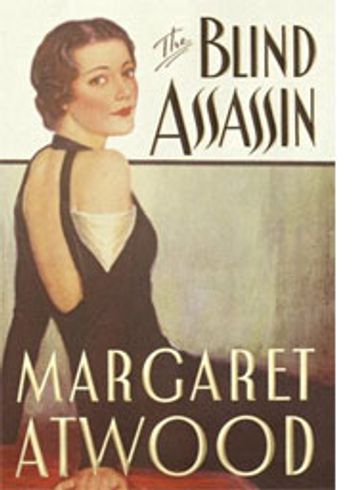
“The Blind Assassin” by Margaret Atwood

The novelist's latest masterwork blends mystery, futuristic fantasy and family saga.

Margaret Atwood poses a provocative question in her new novel, “The Blind Assassin.” How much are the bad turns of one’s life determined by things beyond our control, like sex and class, and how much by personal responsibility? Unlike most folks who raise this question so that they can wag their finger — she’s made her bed, and so on — Atwood’s foray into this moral terrain is complex and surprising. Far from preaching to the converted, Atwood’s cunning tale assumes a like-minded reader only so that she can argue, quite persuasively, from the other side.

Iris, the elderly protagonist who narrates this story of her family’s life, starts with a dispassionate observation: “Ten days after the war ended, my sister Laura drove a car off a bridge.” When a police officer suggested that the brakes failed, Iris says, she nodded in agreement, but believed otherwise. “It wasn’t the brakes, I thought. She had her reasons. Not that they were ever the same as anybody else’s reasons. She was completely ruthless in that way.” Iris speculates about her sister’s last moments: “The white gloves: a Pontius Pilate gesture. She was washing her hands of me. Of all of us.”

So begins the story of the Chase family, wealthy industrialists whose rise and fall reflects shifts in Canada’s ruling class over the last century. Iris and Laura are the pampered but isolated children of a button manufacturer. Unraveling why her sister drove off a bridge at 25, and why she is still consumed by guilt and bitterness half a century later, Iris pens this 521-page letter to her estranged granddaughter. Interspersed with Iris’ own words are newspaper clips and vignettes through which Atwood also lets the story unfold. A small-town newspaper reports on the annual button factory picnic, the last before the onset of the Depression and labor trouble; the Toronto Star society page notes Iris’ marriage to her father’s rival. A bleak honeymoon follows. More Chases are born; more Chases die.

This family saga is sketched with Atwood’s trademark dark humor and deft hand. For example, the Chase family’s precipitous rise during World War I is explained thus:

War is good for the button trade. So many buttons are lost in a war, and have to be replaced — whole boxfuls, whole truckloads of buttons at a time. They’re blown to pieces, they sink into the ground, they go up in flames.

The war takes two of the Chase boys and irreparably damages the third, but it makes the family rich. And this money, insidious, corrosive but empowering to the family, ultimately makes Iris herself powerless.

Complementing the historical plotline of Iris and Laura’s coming-of-age between the world wars, Atwood braids in two other strands that keep her tale moving at a brisk clip. One is Laura’s posthumously published novel of dystopia, the futuristic story of a city’s demise at the hands of a blind assassin and his mute lover. This novel-within-a-novel picks up on the interplay between optimism and despair being dramatized politically on the streets of Canada during the Depression. The other is the story of Iris’ contemporary life, that of an elderly Canadian woman whose mundane treks to the converted “Button Factory Mall” and the donut shop mask her monumental struggle for independence and status in a suburban culture in which she’s deprived of both. Of a male family friend who, after assembling a fan for Iris, says, “That should fix her,” she observes:

Boats are female for Walter, as are busted car engines and broken lamps and radios — items of any kind that can be fiddled with by men adroit with gadgetry, and restored to a condition as good as new. Why do I find this reassuring? Perhaps I believe, in some childish, faith-filled corner of myself, that Walter might yet take out his pliers and his ratchet set and do the same for me.

Iris, alas, is forced to live her life in a kind of purgatory of regrets, never quite “fixed.” Awareness, or sight, comes to her too late.

In presenting Iris’ story, Atwood culls from all the themes and styles she’s explored in the past. There is a little of “The Handmaid’s Tale” in the sci-fi dystopian novel-within-a-novel and much of “Cat’s Eye” in the protagonist’s reflective journey back in time. “The Blind Assassin” takes Atwood fans to all their favorite places — and ups the ante. This is a dark masterpiece in which tension comes from the sharp juxtaposition of worlds and in which futuristic fantasy interrupts and reflects a disquieting reality.

Meanwhile, Atwood has chosen an unlikely guide for the journey. “The Blind Assassin” is one of those tricky novels that features a near-distasteful hero or heroine (think Ignatius in “A Confederacy of Dunces,” or Harry in “Rabbit Redux”). Because Iris has moved through her life in a fog of others’ expectations, incapable of identifying her own needs and responsibilities, the impulse to grab her by the shoulders and shake her is strong, particularly when she sleepwalks into an arranged marriage and passively permits her sister’s institutionalization in a mental hospital. But stoking readers’ frustration is, of course, intentional on Atwood’s part. (Good progressives, inclined to blame the repressive social environment that created this passive heroine, will have to contend with their own internal counterpoint, the one that goes, “yeah, but still, how could she do that?”)

That internal dialogue leads us right back to the question of responsibility. Is Iris culpable, or is she a pawn, innocent of wrongdoing in her sister’s death? Since the notion that Laura accidentally drove her car off the bridge was never a plausible scenario, the haunting question at the book’s heart becomes, did she jump or was she pushed — by Iris?

Continue Reading Close

“Windchill Summer” by Norris Church Mailer

The Vietnam War comes home to Arkansas in a Nancy Drew novel for adults.

Norris Church Mailer’s debut novel is the story of a good girl, Cherry, coming of age in Sweet Valley, Ark., in the summer of ’69. And yes, this Mailer is related to that Mailer — wife of Norman, successor to the one he stabbed in 1960; and yes, she’s actually known as a painter, not a writer; and yes, the pair’s blended family of nine children must be so over their parents’ obsession with the ’60s.

All that said, this gentle thriller isn’t bad. Imagine a Nancy Drew in her 20s — having sex and smoking pot for the first time, but still managing to solve mysteries and get lost in caves when her flashlight battery burns out — and you’ve got “Windchill Summer.” (And as a Nancy Drew fan, I mean that as a compliment, not a slight.)

Cherry and her best friend, Baby, are spending the last summer before they graduate from college living at home, hanging out at the Kwik Kurl and the Freezer Fresh diner and working the night shift in a pickle factory. But when, after two of their childhood friends have died in Vietnam, another one turns up dead, her body mutilated and dumped into a lake, their languid and lazy days come to an end:

“The third one of us,” Baby said. “The third one of our class to die. First Bobby, then Jerry, and now Carlene.” It was bad enough to have our boys fighting in that insane war clear on the other side of the world, horrible enough that Bobby Kennedy and Martin Luther King had both been murdered in cold blood last year, but now some maniac right here in Sweet Valley, Arkansas, had killed Carlene Moore.

With these three deaths, the distant war moves from the background to the foreground of Cherry’s world. And soon its walking, talking casualties come to Sweet Valley.

First, Cherry falls in love with a handsome young Vietnam veteran who drifts into town and lands a job at the pickle factory. (But can he be trusted?) Second, a high school friend returns from Vietnam and, having spent most of the war crawling through miles of Viet Cong tunnels, sees danger where there is none and finds comfort only in the cool, dark caves of the Arkansas upcountry. (Is his link to reality tenuous and fraying?) Finally, a packet of letters reveals that the murdered Carlene’s boyfriend sent her information and film after he witnessed the massacre at My Lai. (Was someone out to destroy it?) With these threads Mailer weaves an intrigue that connects the events of “that insane war clear on the other side of the world” to sleepy ol’ Sweet Valley.

Put the events at My Lai, described in vivid and terrifying letters from Carlene’s boyfriend, next to our young protagonist’s woes — Can anything tame her curly hair? Will she go to hell for smoking pot? Is her boyfriend going to paint a bikini over his nude portrait of her before he shows it to anyone? — and you’ve got some idea of the Vietnam-vs.-apple-pie juxtaposition Mailer is after. And while it seems like the more interesting question would be “How do the young soldiers move from the horror of their past into the mundaneness of their present?” Mailer keeps her young heroine’s POV at the novel’s center.

It’s a strange choice — mostly because Cherry evinces only the mildest curiosity about events outside Sweet Valley. She cares because she cares about her friends, but her coming-of-age epiphanies are of the “Gosh, this war’s a nasty business” variety rather than the “This war’s destroying us and it’s gotta stop, damn it!” variety. Per coming-of-age protocol, in the course of the book Cherry learns a lot about the big, bad world, but somehow we’re never quite sure how much it resonates in her little blond head. The war blows into town in “Windchill Summer,” but our heroine barely shivers.

More thriller lite than “The Catcher in the Rye,” “Windchill Summer” is a snappy read — fast and engrossing and well constructed. If it’s profundities you’re after, this ain’t your book. But if you’re too old for the Nancy Drew books (or maybe you’ve read them all already?), then “Windchill Summer,” with its airy heroine, is perfect for the beach.

Continue Reading Close

Freudian fear and cooked statistics

The recent media alert about sex-crazed "tweens" is mostly a lot of hoo-ha with naught behind it.

Last week, in what has become a rite that recurs every decade, Newsweek magazine sounded the alarm. “Tweens: Are They Growing Up Too Fast?” asked the cover. Yes! shouted the copy inside. The age of puberty in this country is plummeting! Ours is a nation of sexually sophisticated kiddies!

“They are a generation stuck in fast-forward, children in a fearsome hurry to grow up,” said the authors. “The girls wear sexy lingerie and provocative makeup created just for tweens in order to complete what some parents call the Lolita look.” Precocious, strangely seductive young girls in 1999 are “8 going on 25,” Newsweek warns, and they “becoming sexually active at an alarmingly early age.”

Newsweek is just the latest publication to join the chorus of media decrying a new phenomenon of early blooming, sexually precocious “tweens” — a marketing term for children between 8 and 12. The Des Moines Register, the Plain Dealer, the Ft. Lauderdale Sun-Sentinel, the Seattle Post-Intelligencer, the Washington Post and the New York Times have weighed in on the topic with headlines like “A Woman Too Soon: The Dangerous Trend Towards Early Puberty” and “Too Young to Be Women.”

As the end of the millennium nears, girls “are facing teenage hormones before they’ve learned to multiply or write their names in cursive,” Redbook announces, fretting that these child-women will spark demand for “Disney deodorant and Baby Bop bras.”

Taken as a whole, the stories have a telling subtext. Barely hidden is the terror that reporters and editors seem to feel as their daughters and their friends’ daughters — daughters everywhere — evolve into sexual beings.

Obviously missing are the boys, good, bad or indifferent. They mature later and become interested in sex earlier, but this, apparently, is of no concern. Instead, each story contains a gender-specific warning label hundreds of words long: Remain alert and vigilant, parents of girls! They will bloom before they (read: you) are ready and disastrous consequences will ensue! Freud would be amused by the undercurrent of hysteria: Clearly, Daddy is struggling mightily with the fact that his girl may be attractive to other men cuz — yikes! — she’s even looking kinda sexy to him. Hands off, she’s mine!

In each dread-filled tome, “scientific evidence” is used to show that girls are maturing earlier these days. And each of the articles assumes, in a knee-jerk reaction born of parental anxiety, that early puberty means one thing: early sex.

Both lines of reasoning are flawed. The onset of puberty appears to have stabilized 50 years ago. The age of first intercourse leveled off 10 years ago. More than half U.S. teenagers remain virgins until age 17. But interestingly, the science hasn’t gotten in the way of a good story.

Nearly all the stories originate with a 1997 report in Pediatrics magazine. Benignly titled “Secondary Sexual Characteristics and Menses in Young Girls Seen in Office Practice,” the 1997 study analyzes physical attributes of 17,000 girls seen in pediatricians’ offices across the country. Newsweek used a later report published in this month’s Pediatrics, “Reexamination of the Age Limit for Defining When Puberty Is Precocious in Girls in the United States: Implications for Evaluation and Treatment,” that reaches similar conclusions.

According to the 1997 study’s principal author, Dr. Marcia Herman-Giddens, the age of the onset of puberty (i.e., first signs of pubic hair and breasts) is much younger than previously believed. While medical textbooks had put the age of puberty onset at between 11 and 12, the study found that the average age for white girls is actually closer to 10. For African-American girls, the study reported, puberty usually starts just under age 9.

News of this decline set off alarms and mutated, in the popular press, into a story about teen sex, where early puberty became early sex and led inevitably to early pregnancy. Doctors, nurses and teachers who had noticed such things, like girls with breasts in the second grade, were quoted and the study was heralded as proof positive that the age of puberty was free-falling ever downward.

But was it?

“The truth is that the old data is inaccurate and the textbooks were wrong — for a long time,” says professor Dr. Robert Blum, director of the University of Minnesota Pediatric Department’s adolescent health program. The Herman-Giddens report may be accurate, he says, but it simply states what has been true for decades. “We simply are not seeing this rapid decline in the age of puberty,” he insists. “Short of doing tests of hormonal levels in girls, the most concrete specific measure we have is menarche (the onset of menstruation). And when you look at the age of menarche, you don’t see any decline that has occurred recently.”

Speculating that the old medical textbook charts were based on scant study of the subject, he says that menstruation is a more reliable marker of puberty and the age that girls get their periods — 12 and a half — hasn’t changed since the 1950s. Even Herman-Giddens herself acknowledges that the old textbooks, with figures describing puberty’s onset at 11 or 12, might have been wrong in the first place.

Though she declined to be interviewed by Salon Mothers Who Think, Herman-Giddens told the Ft. Lauderdale Sun-Sentinel last year that “the onset [of puberty] does seem to be occurring earlier, but the problem is there is no good data with which to make a comparison so that we can say with absolute certainty that this is so.”

Others, perhaps with less at stake, are more definitive. “Why would menarche be still taking place at the same age, if the onset of puberty was truly earlier?” says Rose Frisch, a professor of population sciences at the Harvard School of Public Health, who is doubtful about any recent drop in the age of puberty. Frisch, who has studied menstruation extensively, insists that the age of menarche reached a plateau 50 years ago. She’s puzzled why people are acting like puberty is dropping now, in the ’90s.

Noting that the “TV hostesses” have been all over her to talk about this trend, she says, “I’m very surprised by the response in the popular press. Mainly, I think the American public just didn’t know about this research.” When she considers the leap the media makes, from early puberty to early sex, she says they’re barking up the wrong tree. “Environmental factors may be influencing girls’ behavior, but not biology. That hasn’t changed since the 1950s.”

But no matter. The press still loves this story, or non-story, which has been a perennial favorite for almost 25 years.

Before the Herman-Giddens study there was the J.M. Tanner study, which appeared in 1976 and is resurrected regularly in the press as a scientific novelty. Tanner discovered that the age of menarche had fallen dramatically among Americans. While the average age of menarche in the United States today is approximately 12 and a half, Tanner, an authority on physical development, noted that in the early 1800s, the average age at the onset of menstruation was 17.

More current academic work on the topic suggests a far less precipitous decline, from 14 in 1890 to 12 today, where it leveled off in 1947; and, in fact, this irrefutable marker of puberty hasn’t changed since. Tanner’s report, like the Herman-Giddens study, was hardly earth-shattering and probably would have slipped quietly into academic obscurity. Instead it contributed to an outbreak of inflammatory rhetoric about adolescent promiscuity and a teen pregnancy epidemic.

Even though Tanner’s contemporaries, like historian Vern Bullough, immediately questioned the study’s accuracy, it was snatched up by Newsweek, Time and the Nation, among others. Their stories all hyped the trend as current; none noted that the trend toward early menarche had stopped 30 years earlier, in 1950.

In September 1980 Newsweek went with “The Games Teenagers Play.” They used Tanner’s study to confirm that “something has happened to those enduring young charmers who used to wobble around playing grownup in Mom’s high heels.” With a predictable swipe at working moms, reporters explained that kids “are reaching puberty earlier, finding new freedom from parental restraints, taking cues from a pleasure-bent culture and playing precocious sex games in the bedroom — often while Mom and Dad are at work.”

The danger was not randy boys, but Lolita girls. “For adolescent boys, sex has always been regarded as a rite of passage, like getting permission to drive the family car,” Newsweek allowed. Bemoaning “sexual adventurism among young girls,” the teen-pregnancy “epidemic” and the “rampant” venereal disease resulting from this “carnal knowledge,” the magazine then used the Tanner study as a springboard to launch into a diatribe about girls whose “sexual awareness thus runs breathlessly ahead of their emotional development.” Full of euphemisms for sex, like “stampeding into sin,” “going over the brink” and “unseemly sexual stirrings,” Newsweek fanned the flames of “precocious puberty” alarmism, roundly condemning this new breed of copulating schoolgirl.

Fast-forward a decade and Newsweek runs the same story. As news. This time, the magazine calls the article, “The End of Innocence” and places the story in the May 1991 special issue on kids. Again, Tanner’s study on the declining age of menarche becomes the basis for a warning that girls today are, sexually speaking, “two to three years ahead of their counterparts a quarter of a century ago.”

Perhaps because the sexually active teens that the magazine excoriated a decade ago had become the parents of young children, the magazine upped the ante a bit by suggesting that vigilance needs to begin even sooner — with toddlers. “The sexual acceleration starts early and holds throughout adolescence,” Newsweek wrote. “A 3-year-old who no longer holds her mother’s hand becomes a 9-year-old who can discuss homosexuality, AIDS and transsexual surgery.”

The article continues to blame the media (the pop song “Me So Horny” takes a hit) and moms (“Most mothers aren’t home when their kids return from school and can’t exert day-to-day control”).

By 1999, Newsweek hits its stride. Last week’s cover story — with a nod toward the healthy economy and the buying power of 27 million American “tweens” — manages to hit all the familiar bases. The new Pediatrics study — regurgitating the same stats that show white girls beginning puberty around age 10 — is cited to prove that the age of puberty is plummeting and this segues — surprise! — into a paragraph on premature sexual activity.

Blame is dispersed. A finger is pointed, once again, at working moms: “The vast majority of their mothers — more than 75 percent — are in the workforce,” and that and divorce mean “they’re often alone in the afternoons.” And the media is scolded for fostering a “tweens” love affair with the TV show “Friends” and an obsession with Brandy, Backstreet Boys, Pokimon and Quake III — all proof of untoward sophistication.

Newsweek does not manage to provide proof that early bloomers are having intercourse sooner or that absentee moms, along with a premature dousing of hormones, are to blame. Probably because it doesn’t really exist.

“Actually, new studies have found that, if you control for the age of the peer group, there is no association between pubertal maturation and the age of sexual debut,” says Dr. Blum. In other words, girls who get breasts sooner are treated like they’re older than they are — by boys and their parents. They can attract the attention of older, more sexually experienced guys. They can incur fear and guilt and premature leniency or restriction in their parents.

“Early puberty actually catapults girls into an older peer group, and thus there is an association with early puberty and sex,” says Blum, “but it’s actually related to who you hang out with, not hormones.”

In pointing out the difference between social maturation and physical maturation, experts tend to agree that parents and educators need to be sure they are not treating girls who may look sexually mature as though they are more mature. They point out that attraction is quite different from action in young teens — a fact that Newsweek and other media alarmists seem too panicked to accept.

And these days, even further distinctions have to be made. While articles about these sexually sophisticated teens seem to have only one thing on their minds, the teens who contemplate “sex” do not. Sexual intercourse is the publicly-stated “problem” in the press, partly because it allows the authors to bring up the specter of unwanted teen pregnancies. The leap from there to a teen pregnancy “epidemic” is easy to make. But the teens who call themselves “active” often have never had sexual intercourse and have no intention of doing so anytime soon. Sex, to them, is about blow jobs, hand jobs and heavy petting.

In fact, the rate of teen births in the United States has actually dropped in the past few decades. According to the National Center for Health Statistics, the rate has declined from 525,000 teen births in 1956 to 513,000 in 1995. While any births to girls who aren’t ready to be mothers is problematic, it’s important to put the “crisis” in context. What has changed since the 1950s is not that more girls are having babies, it’s that more girls are having babies out of wedlock. Those numbers have shot up, so that while only 15 percent of teenage girls who gave birth in 1960 were unmarried, 75 percent were unmarried in 1994. In other words, the number of shotgun weddings has declined.

The evidence, old as it may be, that some girls start puberty at age 8 or 9 has obvious policy implications. But those implications just don’t make great cover stories. There have been plenty of studies that show that the key to healthy sexuality and a lower teen pregnancy rate is good sex education. But the same fear and ambivalence that spawn hysterical media spam about “tweens” inhibits the creation of decent education programs about sex.

“Puberty education is essential and needs to start earlier,” says Peggy Brick, a longtime sex-ed teacher who now works as a sexuality-education consultant in New Jersey. “It helps kids understand that this happens to everybody. It normalizes things instead of everybody feeling these changes are secret or nasty.”

Secret and nasty. Sounds like a cover line. Look for it 10 years from now at a newsstand near you.

Continue Reading Close

Page 1 of 2 in Karen Houppert

www.salon.com/writer/karen_houppert/index.html