Kimberley Sevcik

Reservation for death

Jeff Weise's murderous rampage at the Red Lake Indian reservation horrified the nation. But in this closed and despairing world, shocking levels of violence are normal. A Salon exclusive.

  • more
    • All Share Services

Reservation for death

The first time Jeff Weise tried to commit suicide, in the spring of 2004, he couldn’t bring himself to complete the task. He sliced his wrists with a box cutter, but he lived to chronicle the incident on the Web in characteristically dramatic prose. “I had went through a lot of things in my life that had driven me to a darker path than most choose to take,” he wrote. “I split the flesh on my wrist with a box opener, painting the floor of my bedroom with blood I shouldn’t have spilt.”

The second time Weise tried to kill himself, a few months later, he looped a belt around his neck and pulled it taut. A friend found him and called the tribal police on the Indian reservation of Red Lake, Minn., home of the Ojibwa tribe. As the squad car pulled away from his house, Weise leaned toward the officer in the front seat and said, his voice raspy and strained, “I need help.”

The third time Weise attempted suicide, the 16-year-old not only pulled it off but also took nine people with him. Last March, in an incident that has been classified as the worst school shooting since Columbine, Weise shot his grandfather and the woman who lived with them, and stole his grandfather’s 12-gauge shotgun, Glock .40-caliber semiautomatic handgun, and police cruiser. He then drove to Red Lake High School, where he killed an unarmed security guard, a teacher who summoned God for help, and five students, before turning the gun on himself.

A few weeks after the shooting, a memorial was erected on the chain-link fence that runs in front of the high school. Posters and teddy bears and dream catchers were gaffer-taped to the metal, as were notes from high school students from around the country: “I know it sucks for you right now, but hope will prevail,” read one. “Sorry for your shooting,” read another. In the midst of it all was an unsigned poem, the only tribute to Weise among the dozens of photos and prayers that had been dedicated to his victims.

Cold as winter, strong as stone
He faced the darkness
All alone
A silver god, a reflection
not his own …
He stares down at a shattered youth
A shattered mirror shows
The shattered truth

- – - – - – - – - – - -

Jeff Weise was raised in a mobile home behind a pickle factory in Minneapolis, the only child of an alcoholic, abusive single mother. From time to time, she would shuttle Jeff up to Red Lake, four hours northeast, to see his father, Dash Weise Jr. Dash was known to his neighbors as “a real nice guy when he was sober.” When Jeff was 7, his father holed up in his house in Red Lake and killed himself with a shotgun blast to the head in a standoff with police, as his own father tried, unsuccessfully, to talk him down. Two years later, Jeff’s mother was injured in a drunken-driving accident that left her brain damaged and confined to a nursing home. After that, Jeff was shipped off to Red Lake to live with his grandmother.

The Red Lake reservation, which sprawls across more than 400,000 acres of woods and wetlands, is a world unto itself, isolated politically and geographically from the rest of the state. The closest city, Bemidji, population 12,000, is 30 miles down an unlit country road. Growing up in Red Lake, a kid might learn to ice fish or hunt deer. He might go with his family to weekend powwows. But when adolescence rolls around and kids start craving something more, life on the rez gets frustrating. There are no malls in Red Lake, no bowling alleys or Pizza Huts or McDonald’s — no real restaurants at all, in fact, unless you count the casino, which is off limits to minors. Teenagers out for a good time on a Friday night are pretty much left to cruise around aimlessly in their parents’ cars, license or no license, or hang out at each other’s houses taking turns playing “Halo,” an ultraviolent video game.

All Indian land in the United States is sovereign, but among Native Americans, Red Lake is considered the most sovereign. Over the past 200 years, tribal leaders have essentially sealed the reservation’s borders from outside influence. In the late 19th century, when the federal government offered aid to those reservations agreeing to open their borders to development, Red Lake flatly rejected the proposition, although it does receive some government money through grants. It also resisted a 1953 law giving states criminal and civil jurisdiction over reservations. Today, as a result, Red Lake is one of only two reservations in the country classified as closed, meaning that no one outside the tribe can own land or live there — the population is made up entirely of Ojibwas. The reservation also runs its own police force and courts, handling all crimes internally except for murder and other capital offenses.

The Ojibwas are not shy about exercising their right to eject outsiders from their territory. In the early 1980s, the tribal council twice passed resolutions banning news media from the reservation, as well as requiring non-Ojibwas who visited the reservation to apply for passports. A few years ago, when a small plane piloted by an outsider alighted on the lake for a little ice fishing, tribal authorities not only seized the plane, but put it on display in front of the local casino, a kind of battle trophy.

But for all its seclusion, Red Lake is hardly pastoral. It’s like a ghetto in the country, camouflaged by towering evergreens and shimmering lakes. Over the past five years, there have been a dozen murders and seven cases of manslaughter on a reservation that is home to 5,000 people. In the Red Lake tribal court, where misdemeanors are prosecuted, more than 3,500 cases were filed in 2004. And those are only the episodes that make it into the public record. The domestic violence, the drug trafficking, the drunken-driving accidents generally stay behind Red Lake’s metaphorical firewall. During the two weeks I spent on the reservation, I heard unsolicited anecdotes of violence or death from everyone I met: the mother whose son had kicked her face in because she yelled at him for stealing her car; the man who was bludgeoned to death with a hammer by a crack addict in desperate need of cash; the keg parties that invariably escalated into shootouts. “When you look at all the violence that occurs in Red Lake, the shooting was mostly shocking because it happened all in one day, in a school, a place that should be safe,” says Amy Randolph, a former youth counselor at Red Lake Middle School. “But the extremity of the violence — that’s not shocking up there.”

And then there are the suicides. In a 2004 survey of ninth-grade girls at Red Lake High School, 81 percent said they had contemplated suicide. Nearly half said they had attempted it — a figure staggering even for an Indian reservation, where suicide rates routinely run well above the national average. A few weeks before I arrived on the reservation, a 14-year-old girl hanged herself over a failed romance. While I was there, driving by the gas station on Red Lake’s main drag, a local pointed out another teenage girl who had lost a friend to suicide in the past year, then showed me the spot on the bluffs overlooking Lower Red Lake where an 18-year-old drove his car over the edge last year in a futile attempt to end his life. A few days before I left the reservation, a 15-year-old girl hanged herself with a belt. Her death, like many other suicides in Red Lake, was not reported in the local paper. Because they’re dealt with internally, by Red Lake’s tribal police, news of them doesn’t carry beyond the reservation’s borders.

- – - – - – - – - – - -

Before the shooting, Jeff Weise wasn’t known as a violent kid. He was an introvert who spent most of his time around the house, drawing, writing and playing guitar. Some of the kids at school found him a little dark, a little odd, but when they teased him about the spiked collar he wore, the motorcycle chains that swished against his pants as he walked, he ignored them rather than respond with his fists. Even in his yearbook photo, in which his dark hair is sculpted into spindly horns, he is an unconvincing Satan, the sweetness of his baby face undercutting the intended menace.

One of his closest friends, 16-year-old Carter Hart, describes Weise as kind and empathic. “He was the one I talked to about my problems,” she says. “He was trustworthy, and he always understood what I was going through.” In the eulogies written by his friends, Weise comes across more as victim than perpetrator. “He often used to say that he wished he had a dad to show him things and give him some guidance,” says “Jace,” a rangy 19-year-old friend of Weise’s who didn’t want to give his real name.

In private, however, Weise harbored plenty of rage and despair. He was fascinated with horror stories and war, and he carried a notebook labeled WARNING: VERY FUCKING OFFENSIVE, its pages filled with ghastly drawings of skeletons engaged in warfare, of SS officers carrying out executions of Jews, women, children and communists. With no parents or siblings to turn to, Weise retreated into cyberspace, where he found connection, distraction and identity.

The Web writings that survive him reveal a tormented kid who slalomed from irreverence to nihilism to gloomy introspection. On his Web page, he listed his marital status as “single, not looking” and his occupation as “doormat.” Responding to the cheerful prompt, “a little about me,” Weise laid out his pain bluntly: “16 years of accumulated rage suppressed by nothing more than brief glimpses of hope, which have all but faded to black” — as well as sounding an alarm: “I can feel the urges within slipping through the cracks, the leash I can no longer hold.” Much of his writing is like that — not so much a means of self-expression as a desperate bid for help.

Weise also used his postings as a way of giving his anguish and rage a larger meaning. Last year, on the Web site of the Libertarian National Socialist Green Party, he began ruminating on the importance of racial purity, using the aliases NativeNazi and todesengel, or Angel of Death. Later, reading about his Nazi sympathies, people on the rez would express bewilderment that a Native American kid could endorse an ideology that posits the supremacy of the Aryan race. But Weise’s party of choice, the LNSG, promotes cultural purity, not white power.

If you were looking for foreshadowings of the massacre, you could certainly find them on Weise’s MSN page, which has since been taken down — in the description of his hobbies (“planning, waiting, hating”), in the picture he posted in lieu of his own (a still from Gus Van Sant’s film “Elephant,” inspired by the Columbine shooting), in the animated short he posted titled “Target Practice” (which depicts a man shooting people with a rifle, then putting a pistol in his mouth and blowing his brains out). Weise also posted his own explicitly violent stories online. One tale, “Surviving the Dead,” begins with what appears to be a school shooting but winds up being an invasion of the undead — hordes of townspeople who have come back to life and are now stalking their own friends and family, eating them alive. The story is set in the small town of Grovers Mill — which could easily be a stand-in for Red Lake. (Grover’s Mill was the landing site of the Martians in Orson Welles’ “War of the Worlds.) The town, Weise wrote, is “nearly forgotten by all except those who lived there,” a place of “dull, barren streets … completely void of anything living.”

The story follows Max, the protagonist, and his best friend, Morticia, as they flee the zombies. Along the way they meet an SS officer who has come with a battalion of soldiers to kill the undead and save the town. In one scene, Weise describes a family, freshly murdered, who turn on their own son and devour him.

“Everyone’s real nervous,” one of the SS officers muses in the wake of the incident. “There’s thing’s happenin’ here that shouldn’t be happenin’ … Dead people comin’ back to life, mothers and fathers eatin’ their children … It ain’t right.”

- – - – - – - – - – - -

School officials first flagged Jeff Weise as a problem kid during the 2003 school year when, during the national anthem at a Red Lake High School basketball game, he thrust out his arm in a Sieg Heil while the rest of the crowd dutifully pressed their palms to their hearts. Later that year, he claimed that his Nazi leanings had made him the prime suspect in a bomb threat against the school.

In the wake of the Nazi salute and his suicide attempts, Weise was sent to a school counselor — whom he described to a friend as “about as useful as a Billy goat’s tit.” He was also put on the antidepressant Prozac, which he often fretted about to his friends: He prided himself on his sharp mind and worried it would muddle his thinking. Then last fall, at the beginning of his junior year, Weise stopped attending classes at Red Lake and enrolled in the school’s homebound program, which allows students to complete their schoolwork at home. The program was created as a last-ditch effort to help at-risk students graduate. But Weise’s grandmother, Shelda Lussier, says Jeff chose to go on the program because he was sick of being taunted by fellow students and snubbed by teachers. “The teachers purposely ignored him when he tried to participate,” she says. “He challenged them, he asked too many questions, and they didn’t like that.”

Whatever his reason for studying at home, Weise’s friends think that his isolation only deepened his depression. “Jeff often said his friends were the only thing he had in life,” says his friend James King. “Going on homebound cut him off from them and gave him too much time to think about how crappy his life was.”

At home alone all day, Weise’s writings became more tormented and hopeless. “The instrument of my resurrection was supposed to be freedom,” he wrote in his online journal in January. “But there isn’t an open sky or endless field to be found where I reside, nor is there light or salvation to be discovered. Right now I feel about as low as I ever have.” Reading his words, you get the sense of a kid buried alive — sequestered in a dark, stuffy bedroom in a forgotten corner of the country, shouting into a void. Despite his discomfort with the Prozac — and despite recent research that links antidepressants with suicidal behavior in teenagers — his dosage was doubled.

Two weeks later, on March 21, Weise entered Red Lake High School with the bravado of a gunslinger in an old western. He screeched up to the school’s double doors in his grandfather’s police cruiser and swaggered inside, brandishing a weapon in each hand. His first shot, which killed a security guard, sounded to students in Neva Rogers’ class like someone dropping a stack of textbooks on the floor. The second and third shots sounded like what they were. Rogers flipped off the lights in her classroom and ordered the students to hide in the back of the room. For a few minutes the room was silent except for the sound of breath rising and falling, students crouching beneath desks, jammed up against bookshelves. There was the sound of the door handle jiggling. The sound of a pane of glass shattering. A hand reached through the jagged hole where the pane had been and opened the door.

Glass crunched beneath Weise’s boots when he stepped into the classroom. Ashley LaJeunesse, 15, dared to glance up at him. Her eyes met Weise’s, and he fired at her. LaJeunesse ducked, and the bullet hit and killed Chase Lussier, another 15-year-old who was huddling in front of her. “God be with us,” Rogers murmured. Weise pointed the gun at her and pulled the trigger. He turned to another student, Chon’gai’la Morris, and pointed the gun at the boy’s face. “Do you believe in God?” he demanded.

“No,” Morris replied. Weise turned away.

Weise then shot four more students as they huddled on the floor: Dewayne Lewis, Chanelle Rosebear, Thurlene Stillday and Alicia White. He left the classroom, spraying bullets randomly until he saw two students staring at him through the windows of Ray Rowell’s biology class. It was Cody Thunder and Weise’s friend Carter Hart peering into the hall, anxious and curious about the banging that sounded like gunfire but couldn’t really be. Weise smiled at Hart, then scowled at Thunder and fired at him through the glass, grazing his hip with a bullet. “At that point I didn’t realize Jeff had a real gun,” Hart says. “I thought he was messing around with a BB gun. I remember thinking, ‘Boy, is he going to be in trouble.’”

Students and teacher fled into an adjacent office and Rowell locked the door. As Weise shot again and again at the lock, Rowell held the door to the room closed, yelling to the students, “Run! He’s coming! Just fucking run!”

Only 10 minutes had passed since the killing spree began, but across the street at the Red Lake convenience store, parents had already begun to gather, searching frantically for their children, clutching them to their hearts when they found them. Inside the school, Weise was confronted by two cops who shot at him, wounding him in the hip and the leg. He stepped back into Rogers’ classroom, yelling, “I’ve got hostages!” but he didn’t shoot any of the terrified kids cowering below him. He put the gun under his chin and pulled the trigger.

That night, Tom Barrett, a serious, contemplative Red Lake sophomore, sat numb in front of his computer reading about the shooting on the Internet. He’d been there, in the second classroom, but there were things he needed to know. He’d heard that his best friend Alicia White had been killed. He was looking for confirmation, and he got it. To commemorate her, he had an angel tattooed on his forearm, with “R.I.P.” hovering above it. In spite of the pain of losing her, he doesn’t feel anger toward Weise. “I don’t think it was Jeff shooting that gun,” Barrett says. ” I guess he’s like a lot of us — we live in our own little worlds. Jeff just lived more deeply in that world. He lived in more of a fantasy. I just tell myself that Jeff didn’t mean what he did.”

- – - – - – - – - – - -

Almost everyone in Red Lake seems to be related, whether through blood or marriage, so news there travels fast. It didn’t take long for rumors to start zipping around the reservation about the FBI investigation into the shooting. Federal law prohibits agents from disclosing any information about the case until the investigation is complete, but the rumor that’s circulating among the tribe is that Weise might have had conspirators. Two weeks after the shooting, the FBI allegedly arrested 16-year-old Louis Jourdain, the son of Red Lake tribal chairman Floyd “Buck” Jourdain, in connection with the incident. The unofficial word on the reservation — echoed in my conversations with several people — is that Jourdain, who was in the library at the time that Weise went on his rampage, defied a teacher’s orders to stay put and bolted into the hallway, where he allegedly confronted Weise for acting without him. Shortly after Jourdain’s arrest, at least seven students were subpoenaed by a Minneapolis grand jury, and rumors persist that other kids will eventually be charged with conspiracy, that there may be evidence that they were urging Weise on, on the Internet. There is also talk that a map of the school was found, charting two separate entrances for two separate gunmen, as well as sniper positions for other kids on the roof of the school, to ward off police.

When I arrived in Red Lake a few weeks after the shooting, the high school had reopened, but the halls were virtually empty. Two-thirds of the students were out, still too traumatized to return. The first day back had been much worse. Barrett, the sophomore valedictorian, was the only student who showed up to some of his classes.

Even before the shooting, getting kids to go to high school was a challenge at Red Lake. Nearly half the class of 2004 did not graduate, and school officials fear the dropout rate may increase in the wake of the shooting. In 2000, 33 percent of Red Lake teens between 16 and 19 were neither enrolled in school, employed or looking for work. Most kids are afraid to leave the reservation. People think they talk funny. They’re not go-getters. They’re on “Indian time.” Even those who do want to leave, like Barrett, who wants to go to UCLA, plan to come back. “I feel welcome here,” he says. “I know everybody and everybody knows me, and we respect each other.”

There aren’t a lot of job prospects for Red Lake youth if they stay on the reservation; unemployment currently hovers around 60 percent, and it has been as high as 80 percent. They can become police officers or run for the tribal council. They can work at the solid-waste transfer station. They can become loggers. And of course, they can work at the casino, which seems to be more a joke than an aspiration among ambitious kids: No straight-A student aspires to cook hot dogs or exchange paper bills for buckets of quarters. Then, too, Red Lake’s casino doesn’t serve alcohol or pull in outsiders with fat wallets, so it hasn’t been the kind of economic boon most casinos are to reservations.

Because so few Red Lakers seek out lives beyond the reservation, those who do feel a lot of pressure to make the tribe proud. Charlie Norris, a hulking guy with thick black hair that grazes his deltoids, had a successful run as a World Championship Wrestler for three years. He traveled to places his friends and family had never dreamed of — Japan, Australia, Papua New Guinea — earning six figures a year. “Everyone always knocks us Red Lakers down,” Norris says, “but when my people saw me out there, on TV all the time, they thought, ‘Hey, he can make it, we can make it in the world, too.’” Then the head of the WCW proposed that Norris dress up as a John Wayne-style Indian, the kind that claps his hand to his mouth in a war cry and talks without verbs. When Norris refused, he was fired. “I felt like I’d let the entire community down,” he says.

Today, Norris works as a trainer at Red Lake’s diabetic fitness center, testing clients’ blood sugar, monitoring their exercise programs, that kind of thing. The fitness center isn’t exactly a community gym, but with so few places to congregate, teenagers sometimes drop by to fool around on the machines, just for something to do. That’s where I met Weise’s friend Jace Hixon. He loped up one afternoon following a pretrial hearing, looking for company. He had the slouchy, unhurried gait of a kid with an image to uphold. Hixon has two felony counts against him, one for assault with a weapon, the other for concealing stolen goods. He’s not scared of getting locked up, though — his cousin has been in prison and he says it’s a cakewalk if you’re an Indian. “Natives run the prison, so everyone is scared of us,” he says. “We got a reputation for being crazy.”

Hixon is in some kind of gang, though he wouldn’t divulge his affiliation. He doesn’t really want be a gangster, but he feels he doesn’t have much choice. It’s a family thing — his cousins, his uncles, they’re gangsters, too. “When you grow up with it, man,… ” he says, his voice trailing off. The drugs, too, are hard to avoid. Where Hixon lives now, a neighborhood called the West End, is crack central. “Sometimes I feel endangered, living there,” he says. “All kinds of people going in and out of there. Shootings. I’m scared for my life sometimes, you know?”

- – - – - – - – - – - -

There is a paragraph in “Surviving the Dead” in which Max, the protagonist, realizes that he is probably going to die, and he is suddenly flooded with regret:

“He pondered on his loved ones, and his friends … He began to doubt that he would ever see them again, that he would ever wake up Saturday mornings to the smell of his mother making breakfast … Saturdays were always special, more tears began to well up in his eyes as he realized he would never see another Saturday morning.”

I wondered if Weise was describing a Saturday morning from his own life, or someone else’s Saturday morning, the way he imagined it might be for another kid in another family in another town.

In the end, Max does die. Weise seems to revel in the description, which is predictably gory — blood and body fluid shooting up his throat and out his mouth, fountaining to the ground. But then Weise’s writing gets quiet, even vaguely spiritual for a kid who openly scorned religion:

“Max closed his eyes as everything seemed to be getting brighter, though it didn’t hurt his eyes, he knew soon he would be seeing Morticia. His breathing slowed, his fists uncurled, his body went limp, the warmth already fleeing, his last breath escaped freely carrying away his soul, he was leaving hell behind…”

“Surviving the Dead” ends with a military general’s perusal of a file on the annihilation of the population of Grovers Mill, which is revealed to have been a secret government operation. Unable to contain the rampage of the undead, the government simply doused the town with a toxic chemical, leaving the town of 650 to die.

Weise appears to have logged on at some point after he posted the story — it could have been a few days, it could have been weeks — hoping for feedback, finding none. Below the words “The End,” he gave it one last try. “Any comments?” he typed. “Any at all?”

There was no reply.

Christian party animals

Evangelizing to the young and wasted in party centers around the globe, members of the 24-7 Prayer team hope to bring Jesus to the raving, godless masses.

  • more
    • All Share Services

Christian party animals

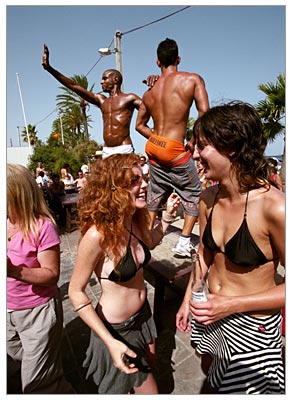
By their eighth night in the West End, Ibiza’s low-rent nightlife district, the members of the 24-7 Prayer team don’t flinch at anything they see: not at the woman lifting her skirt to ask a group of men what color panties she’s wearing; not at the guy with papier-mâché breasts strapped around his waist, standing beside a sign that says “Dexter has the clap”; not at the guy mooning the girl who just spurned his advances, or the one across the street, pulling his dick out of his pants and flopping it on the table for the viewing pleasure of two horrified, delighted young blonds.

They press through the crowds, four sober people among the drunken masses, looking for openings: a friendly face who wouldn’t mind a little unsolicited conversation; a swerving body that could use a steady arm to help it home. The bar promoters are the easiest ones to approach. They’ll talk to anyone — most of them work on commission, and every conversation is a potential sale.

A guy with spiky blond hair in a “FCUK” T-shirt calls out to two of the missionaries, Lorraine Joslin and Charli Franklin. “Hey ladies, what you doing later? Stop by for a drink?”

“Sorry, we’re not drinking tonight,” says Franklin, a throaty-voiced 21-year-old with a tiny rhinestone stud in her nose. This elicits protests and confusion from the tout.

“We’re praying,” she says.

He looks even more confused.

Franklin and Joslin introduce themselves, and so does he. His name is Mark. “Is there anything we can pray about for you, Mark?” Joslin asks. She’s 23, a witty brunet with Cleopatra eyes who gets a kick out of belching in people’s faces.

He thinks for a minute, then grins. “Yeah,” he says. “Pray that I live until September.”

“All right,” Joslin says. She sounds a little uncertain. “What makes you think you won’t make it until September?”

“I’ll probably die from all the drugs I’m doing.” He turns toward another group of women, stuttering past on high heels. “Ladies, can I interest you in a drink tonight?”

The missionaries are headed for the Bull Bar, a sour-smelling grotto with a reflex tester on the bar that rewards low scorers with a free drink. The Bull Bar serves as the base of operations for the 24-7 Prayer team on Tuesday and Friday nights. While 24-7′s very own DJ, 21-year-old Matt Riley, mixes acid-house music for a crowd that would rather be gyrating to Beyonce, the rest of the team passes out free fruit to patrons. As they see it, handing out fruit is a way of doing something generous in a place where most people are bent on maximizing their own pleasure. It’s also a way of warming people up to talk about Jesus.

Riley has been DJing since age 15, when he took a workshop with a Christian youth group. He was hooked from Day 1. He felt as if God had ordained him to DJ, to lead worship through the decks. There was only one problem: Becoming a good DJ required hours of practice, and hours of practice required buying his own decks. But decks cost about 800 pounds each, and 15-year-old Riley didn’t have that kind of money in his piggy bank. He wrote to church members and family friends saying, “I’m really feeling this is from God, and to get good at this, I have to get my own decks.” Within a couple of months, he had 1,000 pounds in donations. “It was good,” says Riley, “because they weren’t really my decks, were they? They were God’s. So I had to come through for him.”

The Bull Bar isn’t exactly a dream gig for a DJ looking to build a career. But Riley, who runs a popular club night called Rubik’s Kube back home in the U.K., says he’s not playing at the Bull Bar to advance his reputation. “There’s a need for 24-7 in the West End,” he says. “If Jesus were in Ibiza, he’d be at the Bull Bar.”

Ibiza, an island off the eastern coast of Spain, is known as the clubbing capital of the world, a place that’s fueled by the kind of unabashed hedonism that characterized New York’s Studio 54 in its heyday. Its excesses are legendary: the orgies on the yachts that cruise the harbor, the club owners who conceived their first child during a live sex show before 12,000 people. Club kids, models and playboys come to Ibiza to breathe the same air as Paris Hilton and dance at the altars of DJs like Pete Tong and Roger Sanchez, jacked up on half a gram of coke or a hit of Ecstasy or both. Around 6 a.m., everyone cabs over to a day rave, where, jacked up on another half-gram of coke or hit of Ecstasy, they continue to dance until 2 or 3 in the afternoon, then pass out on the beach for a few hours before doing the whole thing again.

Across town, in the West End, soccer hooligans and construction workers spend their evenings downing pitchers of Sex on the Beach, gawking at the abundance of cleavage on display, making clumsy attempts to appropriate it for the night, then staggering home alone, only to wake up face down in a gutter.

You would expect the typical evangelical Christian to be horrified by Ibiza. But the 24-7 Prayer missionaries aren’t your typical evangelicals. They tend to be pierced and tattooed, antiwar and pro-fair trade, and the minute they get off prayer duty, they put on halter tops and body glitter and wristbands and go clubbing until noon the next day. They might even have a drink or two. They don’t do drugs — which alone sets them apart from most ravers. Most eschew premarital sex, although they try not be judgmental about others’ sexual behavior. Like all missionaries, they want to be down with the people whom they’re preaching to, but in the case of 24-7, they’re not faking it. The primary difference between the average Ibiza clubber and a 24-7 missionary is what gets them off. “To know that the God who made the heavens and the earth loves me and wants to know me — that’s an amazing high that lasts much more than a few hours,” says Bruce Gardiner-Crehan, 25, a 24-7 missionary with the beatific countenance of a Caravaggio apostle. As members of a generation that came of age with house music, the 24-7 Prayer team finds it a lot easier to commune with God while dancing at a rave than while kneeling in a church, listening to an organist drone on.

It’s not that the 24-7 missionaries don’t see the devil lurking in Ibiza. They know he’s there. And they plan to do something about it — by bringing God into the clubs with them so other ravers can feel his presence, too. As born-again Christians, they view the whole world as a battleground between God and Satan; but in Ibiza, the struggle is concentrated. Their role, as they see it, is to wrest the island from Satan’s clutches and help deposit it safely back in God’s hands. “Ibiza offers a drug option, a sex option, a clubbing option — everything but a God option,” says Vicky Ward, 30, who came to Ibiza with 24-7′s first mission team five years ago. “I’d like to think if we gave people that option, some of them would choose it.”

24-7 Prayer’s mission to Ibiza grew out of a prayer movement that was itself inspired by rave culture. The movement was launched in 1999 as an around-the-clock worship session in a warehouse in southern England, with Moby playing on a boombox and 22-year-olds showing up at 3 a.m. to dance and pray and shout out to God. The intention was to pray in shifts all day, every day, for a month; it went on for almost four. Today there are prayer rooms in 55 countries, including 130 in the United States.

“We had a sense that people would be more excited about praying at 3 a.m. on a Thursday than they would at 11 a.m. on a Sunday,” says Pete Greig, the 35-year-old pastor who helped found the 24-7 Prayer movement. “Young people are drawn to extremes.” Greig himself isn’t a raver — he’s a family man, vaguely bookish in his wire-rimmed glasses and oxford shirts. But he’s savvy enough to know that he’s not going to get the next generation excited about Jesus by throwing mixers in the church basement. He and his 24-7 colleagues are doing their best to make Jesus relevant, whether through trendy gear (dog tags and hoodies inscribed with fragments of Scripture) or seminars offering tips for praying online and missions to what Greig calls the “high places of youth culture.” For the past five years, 24-7 missionaries have been taking the gospel to skate parks and music festivals in the U.K., as well to party destinations around the world such as Puerto Escondido, Mexico, a surfing and ‘shrooming mecca, and Ayia Napa, Cyprus, the hip-hop fan’s version of Ibiza.

In August, Greig embarked on his own mission: He moved his family of four from England to Kansas City, Kan., to set up a 24-7 Prayer base in the United States, where he will doubtless find fertile ground. For the past decade, the evangelical movement has been attracting American students in record numbers, and a 2003 Gallup poll estimated that a hefty 46 percent of Americans consider themselves evangelicals.

For the moment, though, 24-7 is primarily a European movement — which may be why its form of evangelism seems looser than the Ashcroftian brand that winces at topless statues. Of the two dozen 24-7 missionaries who traveled to Ibiza this summer, only two were American: Heather and Jonah Bailey, a young married couple who provide moral support and guidance to the prayer teams. Even they don’t fall cleanly under the umbrella of U.S. evangelicalism. They hail from Bakersfield, Calif., but they live in Seville, Spain; and they’re vehemently anti-George W. Bush.

Dismayed by Christianity’s diminishing influence in the postmodern world, 24-7 dreams of sparking a worldwide revival among the generation that is coming of age. Its goal: to turn the tide in youth culture from what Greig calls a “godless, materialistic, self-destructive force” to a generation that loves and worships Jesus. “For centuries, Christians were among the major architects of culture,” Greig reminded 100 members of his flock at 24-7′s annual conference in Amsterdam, the Netherlands, in September 2003. “Today,” he challenges, “are we even on the map?”

This year, 24-7 Prayer has sent two types of prayer teams to Ibiza. Short-term teams come for two weeks, and they take the blitzkrieg approach to evangelism — strolling up to drunken strangers in the West End and offering to pray for them. Long-term team members settle in Ibiza for the whole summer, and they’re less direct about their intentions. Their approach seems inspired by a bit of Scripture from Matthew, found on the last page of the 24-7 Prayer Manual that all missionaries are encouraged to read. “I am sending you out like sheep among wolves,” it says. “Therefore be as shrewd as snakes and as innocent as doves.” The teams infiltrate the community, working as club promoters and waitresses, initiating friendships and doing good deeds. Eventually, they hope, they’ll find an opportunity to slip in a few words about Jesus.

“Telling people right away that you’re here on mission can impede friendships,” says Ward, “because as soon as you say that, people begin to worry that you’re going to start preaching to them, or to wonder what your ulterior motive is. But the people we’re friends with know that’s not what we’re about.” She smiles slyly. “Not always.”

When the prayer team reaches the Bull Bar, the rest of the 24-7 missionaries are milling around outside, looking dejected. They’ve just gotten some bad news: DJ Riley has been sacked, and the fruit handout is off. Business has been flagging, so the 25-year-old Czech woman who manages the bar has come up with a new marketing strategy: She’ll be replacing Riley’s house music with the kind of cheesy ’80s hits that inspire inebriated people to dance. From now on, touts will offer a free drink to any woman who comes in and dances.

Ejected from their base of operations, the prayer team trudges down the West End’s sticky cobblestone street to a fountain where a trio of musicians is playing jaunty Balearic folk music. They form a prayer huddle and ask God for some advice. Gardiner-Crehan wonders if they should just give up. “It’s OK if that’s what you want, Lord, it’s really cool.” Twenty-two-year-old Katie Crossley asks God to bind up the demons in the Bull Bar, to foil their plans to boost business by selling sex. Joslin tries to think positive: “I’m sure you’re up to something cool behind the scenes, God, something that we just can’t see.” She seems less dismayed than the rest of the group. Dismayed isn’t her style. She has a mercurial, “wildest girl at the party” energy about her, anchored in a rigorous morality. Her mother was a “Ban the Bomb” hippie. She was also a devout Christian who forbade Joslin to wear a bikini.

After about 20 minutes of pleading and questioning and praising, the prayer team is rejuvenated. They set out again, striding purposefully up the West End’s main drag. At the top of the hill, where the herds of partyers begin to thin out, they run into Gary.

Before setting out that night, the team made lists of people they’d met previously in the West End whom they hoped to encounter: These are their salvation prospects, their unwitting partners in a sort of spiritual buddy system. At the top of Gardiner-Crehan’s list was Gary. He’s a tout for one of the trendy clubs in Ibiza Town, and he’s handsome the way a Ken doll is: well-groomed hair, clean Aryan features. Gardiner-Crehan asks if there’s anything he can pray about for him. Gary shakes his head, polite but reticent. “Don’t think so. It’s all good, thanks.” But Gardiner-Crehan isn’t giving up. “Anything I can get you to help your night go better? You need an ice cream, something, to keep up your energy?”

Gary looks surprised. “Sure, man, that’d be cool.”

Heading back down the hill in search of ice cream, they spot another salvation prospect. Jonney Silvester, 22, is standing in front of Ground Zero, the rock club where he works as a promoter. His dark hair is scraped back in a ponytail, his nails are painted black, and he has a serious eyebrow piercing. Silvester’s name cropped up on a couple of people’s prayer rosters. Franklin had him on her list. So did a guy named Tom Godec, a soft-spoken 21-year-old with the icy good looks of a Calvin Klein model: shaved head, searing blue eyes, silver stud in his chin. “The first time I talked to Jonney, it was a bit intimidating,” says Godec, “because he looks like quite a hard guy. But he’s very open. We’ve had some good talks about religion.”

Godec is relatively new to Christianity, and he still seems slightly self-conscious talking about it. He tends to use a lot of qualifiers. Godec found Jesus at age 17, after a girlfriend broke his heart. “This is kind of embarrassing,” he says, “but I was so lonely I asked my mom to sleep in my room for three nights.” Picking up on Godec’s despair, a friend invited him to go to church with him. He said it might lift Godec’s spirits. He was right. “People at the church nurtured me for who I am,” he says. “It sounds cheesy, but it’s the truth.”

Franklin and Godec aren’t sure Silvester is ready to be prayed for, so when they see him, they keep the conversation light and nonthreatening: They ask him how his night is going and what he’s doing when he gets off work. “We don’t want to do cold-calling evangelism,” says Godec. “We try to meet people where they’re at.”

The missionaries know that proselytizing about damnation is no way to make friends and influence people — particularly since their audience has come to Ibiza to indulge in carnal pleasures. Better, then, to ease people in by emphasizing the altruistic side of their work. When asked what they do, the 24-7 missionaries generally tell people that they’re with a Christian charity that cleans beaches, that sort of thing. If the listener asks more questions, he or she will get more answers. Most don’t. A lot of bar promoters in the West End think of 24-7 as a bunch of nice Christian kids who hand out fruit, nothing more.

Giving away prayer and refreshments may not be the fast track to winning converts, but it seems to move things along. By the end of the prayer walk, Gary has invited Gardiner-Crehan to go with him to a club promoters party later that week, and a tout named Simba has offered to help him clean the beach.

The other missionaries aren’t quite as fortunate. They weave through the crowds in groups of two, asking to pray for one bar promoter after another, most of whom are already trashed by midnight. They talk to Simon, who says it’s too late for prayers because he’s already broken every one of the Ten Commandments; to Rupert, who forms a crucifix with his index fingers to ward them off; and to Claire, a diminutive blond in taxicab yellow pumps. One of the missionaries asks if she can pray for her, and Claire says, “What a nice question.” For a moment, it seems as if Claire might cry. Then she says, “Can you pray that I find 1,000 pounds?”

Evangelizing among the wasted can have its benefits, though. People who might otherwise tell you to piss off are a little more open, a little friendlier. Last week, Gardiner-Crehan had one of the biggest breakthroughs of the mission at the Bull Bar. At around 1 a.m., he tried to start a conversation with a trio of brooding guys hovering over their pints. Nothing.

Within an hour, one member of the trio, Matt, sought out Gardiner-Crehan on the dance floor and greeted him like they were old buddies. “They’d taken some Ecstasy and it must have kicked in, because he became incredibly friendly,” says Gardiner-Crehan. Suddenly, no topic was off-limits: They talked about music, about school and finally, finally, about religion.

Matt must have gone back to his table raving about the second coming of Christ because the next thing Gardiner-Crehan knew, Matt’s friend Brian approached him. He wanted to let Gardiner-Crehan know that he had a bum leg and couldn’t walk properly. “I told him that I believe that Jesus can heal people,” says Gardiner-Crehan, “and I asked if I could pray for him.”

Ten minutes later, the third guy, John, took Gardiner-Crehan aside for a full-on spiritual counseling session. He told the missionary he was terrified of dying and that he couldn’t sleep. He’d been seeing a counselor for two years, but nothing helped. “By then, I was going for it,” says Gardiner-Crehan. “I said, ‘Listen: I believe Jesus can touch your life if you let him. Can I pray for you?” John was happy to submit. Afterward, Gardiner-Crehan advised John to get himself to a church as soon as he got back home. “I said, ‘You need to find some people you can talk to about Jesus.’” They all bear-hugged Gardiner-Crehan goodbye, and the next day, the three guys got on a plane back to England.

Among his peers, Gardiner-Crehan is known as a crack evangelist. His tremulous excitement about his faith seems to transcend any self-consciousness he might have about spreading the Word. Where some of the other missionaries are fettered by inhibition from time to time (“Hey, we like to look cool, too,” says Franklin), Gardiner-Crehan is irrepressible: He doesn’t seem to think twice about approaching the fiercest-looking person in the West End and offering up a prayer. Of course, he’s hardly an amateur when it comes to evangelizing. Born into the charismatic church, and educated at Bible college, Gardiner-Crehan went on his first mission at age 16. Ibiza is his fifteenth.

Still, he feels a bit frustrated at having only two weeks in Ibiza. He’d like to move beyond a few powerful prayers. He’d like to have his own Andres Isea story.

Isea is 24-7′s trophy boy, the mission’s one bona fide convert. After four years of cleaning beaches and massaging strangers’ feet and escorting drunken people to their hotels, the 24-7 missionaries finally reaped a little harvest this year.

Restless and itching to see the world, Isea left his native Venezuela at 18 and has been living in Spain ever since, scraping together a living, bouncing from one wretched apartment to the next, with intermittent periods living on the street. Isea is the kind of guy that backpacker chicks go crazy for. There is something raw and untamed about him: His hair is wild and full, his nose is pierced, and he wears a string of puka shells around his neck and the laces of his trainers untied. The church he attends is constantly harassing him to cut his hair and take out his piercings, but he refuses. “I’ll do it when God tells me to,” he says. “Not before.”

When the 24-7 prayer team met Isea last summer, he was living in a squat, shilling for the Bull Bar and dealing drugs. He was doing a lot of drugs, too — popping pills, smoking pot, and snorting coke. “I was really disappointed with myself,” says Isea. “I’d left Venezuela because I wanted to avoid all that.”

Isea was disarmed by the 24-7 missionaries. They weren’t like the other Christians he’d met, who were quick to judge him. “The more bad stuff they saw me do, the closer they got to me,” he says. “If I was drugged up, they would grab me, put their hands on my head and pray for me.”

Before leaving Ibiza, three members of the prayer team invited Isea to a cafe to talk about God. One of them felt he was getting a prophetic word from God for Isea, and he passed it along: God wanted Isea to know that he was his son, and that he was pleased with him and loved him. “To be honest,” Isea says, “I wasn’t sure if it was God or that guy who was speaking, but it was stuff I needed to hear.” Isea broke down crying and, to the surprise of the tourists sipping cappuccinos around him, yelled out, “I need you, God!”

For a couple of months after the 24-7 team left, Isea tried to hang out with churchgoing folks and stay straight, but life kept getting in the way. He lost his job at the Bull Bar. His roommate was shot to death while on holiday in Switzerland. He thought about giving up the whole Christian thing, about going to the Canary Islands and giving himself over to partying again. But he decided to give God one last chance. “I made a deal with God; I said: God, I’ll stay in Ibiza, and do the best I can to seek you, but you’ve got to take care of me.”

God came through. Within a couple of weeks, Isea got a job as a stripper one night a week. He earned about $50 a week, barely enough to live on, but it left him plenty of time to pray and read the Bible. He began going to church again, and a 24-7 missionary named Tim Hirst continued to e-mail him, encouraging him to stay the course.

When Hirst returned to Ibiza this summer and called Isea, the first thing Isea wanted to do was pray together. Hirst was thrilled. Now instead of hanging out at the Bull Bar, they hang out at the prayer room that 24-7 has established, sitting on the floor with their arms around each other and a Bible between them.

There are Christians who look at the 24-7 missionaries and say what they are doing is ungodly, even dangerous. “Dressing up sexy and going out dancing — what kind of example are you setting?” they say. “You look just like the rest of the sinners.” In the 24-7 prayer room, Ward met an older man one afternoon who thought she should be wearing a hair shirt. “Can you imagine?” she says. She considers it for a minute. “Actually, it might be a scream.”

Yet image consciousness is a question that 24-7 missionaries themselves have wrestled with. Twenty-five-year-old Lora Thomson, a long-term team member from Edinburgh, Scotland, who looks like she could be fronting an indie rock band, with her stubby pigtails and silver nose ring, used to believe that being a good Christian meant renouncing her trendy look and her passion for clubbing. “I thought I would have to be single forever and live in Africa and wear unflattering tops. I was totally not up for it.” To prove her devotion, however, she decided to succumb. First she stopped buying music. Then she vowed to stop clubbing. But the biggest challenge was taking out her piercings. In the middle of a Christian students meeting, she heard God command her to take out first her nose ring, then her navel ring. When he told her to take out her five earrings, though, she put up a fight. “I said, ‘This is getting ridiculous, God. Everybody has pierced ears.’” But God wasn’t letting her off the hook. “Take them out,” she heard him say. “Your identity is in me, not in what you wear.” When it was over, she looked at the jewelry in her hand and burst into tears. “I couldn’t believe I had been deriving all of my self-confidence from this little pile of metal.”

Four years later, her nose ring safely back in place, Thomson no longer feels as if she’s compromising her faith by looking trendy. “If you’re willing to sacrifice something, God will always give it back to you,” she says. Thanks to 24-7, she now sees that clubbing and Christianity are compatible, even complementary. “When I go clubbing, I know God is there, and I try to work with him, to keep him company,” she says. “I can sense the pain of the people dancing around me, and I pray for them.” Occasionally, however, she’ll be in a club, and she won’t feel God in the atmosphere at all. That worries her. “If God isn’t there,” she says, “it means his opposite is. The devil.”

That’s what the prayer team sensed one night when they went dancing at El Divino, a sprawling club on the Ibiza harbor, where VIP clients cruise up to the door in their yachts.

The music felt dark, oppressive. Women were gyrating and thrusting and running their hands over their bodies, and men were lapping it up. To combat that, Ward split up the prayer team into two groups, and they all prayed for God to make his presence felt. Joslin waved her hand over the crowd. Ward closed her eyes and opened her palms to the sky. Most of the prayer team members just seemed to be dancing, though. To the naked eye, they looked like any other clubber in the room, lost in the music and the darkness and the confusion of flickering lights.

Twenty minutes into their prayer session, the tenor of the music began to shift. The missionaries thought it sounded lighter, more joyous. OK, they conceded, it might have had something to do with the change of DJ. But what about that line she sampled from the Hallelujah Chorus, “King of kings, and Lord of lords,” looping it over and over? If that wasn’t a sign that God was in the house, they didn’t know what was.

- – - – - – - – - – - -

The evening of the short-term team’s final prayer walk, the prayer room is on fire. Exultant worship music plays on the boombox. Joslin lies on the floor, pounding it with her fists. In the corner, Gardiner-Crehan is having a fervent one-on-one with God. The walls are covered in prophetic paintings that the team has made over the week, depicting what they believe God wants for Ibiza. One is an oceanic swirl of blue and green. Another portrays revelers in the West End leaping joyously from cages.

The missionaries have a goal tonight: They want to tell everyone they’ve been praying for that they’re not just a bunch of nice people who give out fruit. They want to tell them that they came to Ibiza because of Jesus. It’s their last night. They have nothing to lose.

That said, giving out fruit is a great way to start a conversation, and they still have loads of it left over from the other night, when they were banned from the Bull Bar. They stroll through the West End like Earth-bound flight attendants, plastic trays poised on their hands, asking, again and again, “Free fruit? You like some fruit?” Some people look at them suspiciously. But most grab at it, taking three, four pieces, shoving them ravenously into their mouths. “There isn’t any vodka in it,” they mumble to one another, disappointed.

Gardiner-Crehan is standing near the corner where he last saw Gary, scanning the street anxiously. “I really hope to see Gary tonight,” he says. “I want to tell him that I’m here because Jesus died for our sins. That’s why I gave him the ice cream.” He flashes a smile at one of the touts from the Bull Bar, offering her a candy heart that says, “You’re Fab,” but his trademark enthusiasm seems to be flagging. Gary is nowhere in sight. Neither is Simba, the guy who offered to clean the beaches two nights ago.

Silvester is out, though, loping around in front of Ground Zero in a Marilyn Manson T-shirt, occasionally shouting out, “Rock and full, mother fuckers!” to passersby. Godec strolls down the hill to say goodbye and tell him that the prayer team is leaving the next day. “That’s too bad,” Silvester says. “Yeah,” Godec says. They’re both quiet for a minute. Then, before he can think about it too much, Godec takes the plunge. He tells Silvester that God loves him.

“I know it sounds kind of cheesy,” Godec says, when he recalls the conversation later, at a place called the Beaver Bar, where two fellow missionaries are sharing a farewell shot of Sprite with their favorite bartender. “But it was really important to me that he hear that before I left.” I ask him how Silvester reacted. “Well, he didn’t scowl. But he didn’t give his life to Jesus or anything.”

For the rest of the missionaries, however, the final prayer walk is a bit of a letdown. There are no prophetic words from God that night, no moving prayer requests. There is nothing to do but change out of their 24-7 T-shirts and into their rave gear and go clubbing.

- – - – - – - – - – - -

A couple of days after the short-term team leaves, I visit Silvester in the sock-strewn apartment he shares with two roommates over Ground Zero. It’s 7 p.m. He has just woken up and pulled on a pair of jeans, but his shirt is off and he has a bar code tattooed on his back, with the word “Rejected” underneath. On either side of it, riding the swell of his deltoids, are two black angel wings.

As it turns out, Silvester knows a thing or two about Christianity. He was raised a Jehovah’s Witness. It was a miserable experience. Forbidden from hanging out with outsiders, he found himself virtually friendless. At 17, he finally wrote his parents a letter telling them he was leaving the faith, and their house. Needless to say, he’s not very big on religion.

“But I really liked the prayer guys,” he says. “They were always sober, and they seemed to care about other people. They were like an oasis of sanity on the craziest street in the world.”

I ask him how he felt when Godec told him that God loved him, and he laughs, a low-pitched ha-ha-ha, each syllable distinct. “I don’t know,” he says. “It’s a nice thought, but I don’t really believe in God.” Over his head is a poster of flames shooting up from the earth, the word “Lucifer” floating above them; across from that, a drawing of a winking skull reads, “Freedom From Slavery.” So it doesn’t bother him that they want to convert him? He laughs again, and takes a drag of his hand-rolled cigarette. “Not at all,” he says. “I don’t think it will work. But I won’t hold it against them.”

This story has been corrected since it was originally published.

Continue Reading Close