Lisa Chamberlain

The future of America is blue

Almost 5 million more young people voted this time, and most went Democratic.

  • more
    • All Share Services

The future of America is blue

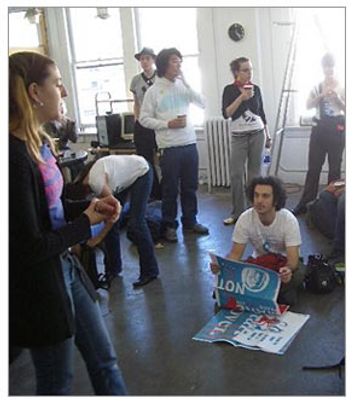
Back in the hopeful days of August, a small group of newly minted political activists gathered in an apartment on St. Marks Place in New York’s East Village — the same street where Abbie Hoffman hatched the yippie movement and Andy Warhol opened the Electric Circus. Downtown for Democracy — an arts-affiliated political action committee staffed mostly by people in their 20s and backed by New York’s cultural glitterati — was only a year old and just getting started. The activists were discussing big plans to get out the youth vote by loading up buses of volunteers and driving to Ohio to throw DJ parties and give away free T-shirts in exchange for voter registrations and contact information. Nearly everyone in the room had never been politically active before, and some had never voted.

Conventional wisdom has it that GOTV efforts by groups like Downtown for Democracy were for naught. An Associated Press story using exit poll data circulated shortly after the election reported that as a share of the electorate, the youth vote stayed at about 18 percent, the same as in 2000. Despite the predictions of record turnout among voters ages 18 through 29, observers said, they did not go to the polls in the expected numbers. Some bloggers even blamed them for John Kerry’s loss. As was the case throughout this long, excruciating election, the conventional wisdom turns out to be wrong.

According to a report by the Center for Information and Research on Civic Learning and Engagement (CIRCLE), almost 5 million more young people voted in 2004 than in 2000, an increase of 9.3 percent. The reason the youth vote as a percentage of the electorate stayed the same is simple: More people in every demographic group voted in 2004. Looking at the youth vote merely as a percentage of the overall vote to gauge their effect on the election is misleading.

“The report that young voters didn’t turn out is just so wrong,” says Kelly Young, executive director of 21st Century Democrats, an organization that has been working to get out the youth vote since 1985. Having started with a mere $8,000, the group is now the 13th largest PAC in the country. “The youth vote was up nationally, but that’s not really the best way to measure it. In swing states, where the youth vote was really targeted, it was up even more.” Some estimate it was up there by as much as 12 percent.

Although the final tally has yet to be fully dissected, 21st Century Democrats has dramatic numbers from Franklin County, Ohio, which includes Columbus, home to Ohio State University. In the precincts where the group focused most intently, the youth vote accounted for upward of 85 percent of the total vote, and Democratic turnout in those areas jumped by 128 percent. In the same precincts, the Republican turnout was up only 6 percent. “What it shows is that young voters contributed substantially to the increase in the Democratic vote. Lines at 6:30 a.m. were already an hour long, so students had to really stick with it to vote. The main voting place at Ohio State closed at 7:30. People were still voting at 9:30.”

Indeed, the youth vote is the only demographic bloc that went decisively for Kerry, both nationally and in swing states. According to exit polls, young people nationwide voted 54 percent for Kerry.

Young estimates that 21st Century Democrats spent $2 million in Ohio, Minnesota, Oregon and Nevada to build a database of more than 200,000 young voters. That might seem like a lot of money per vote, but Young believes that when all the dust settles in this billion-dollar election, the youth vote will prove to have been the cheapest to get. “We spent no money on media or direct mail. It was all peer-to-peer contact. If you add up the media budget with any other demographic, I’m quite sure those votes will prove to be a lot more costly. It’s been shown that the only thing that really influences a young person to vote is peer-to-peer contact, and that’s relatively inexpensive.”

Perhaps more important, Young believes, is that once people are engaged in the process, they’ll stay engaged. “I think we’ve literally changed a generation,” says Young. “So many people voted in this election. Once you’ve voted, there’s no going back. What’s more, it’s not just those who voted, but all these great young people who are now trained organizers; once that’s learned, you don’t forget it.”

One hopes the new activists won’t be discouraged by early press reports suggesting their hard work to get peers to the polls was wasted. “There [have] been a lot of misinformed statements in the media,” says Hans Reimer, Washington director for Rock the Vote. “The story came out early that young people didn’t vote as expected, and people jumped on it. And that story was up for a long time when no election analysis was out yet, so it filled a vacuum. When we came along the next morning to correct it, the train had left the station. I never expected we would find ourselves spinning against the media after exceeding our goals.”

Rock the Vote’s goal this year was to get the youth vote back up to where it was in 1992, a high-water mark achieved by Bill Clinton, who played his saxophone on the “Arsenio Hall Show” and gamely answered the question “Boxers or briefs?” The total number of young voters this year didn’t just match the number in 1992, it was up by 4 percent over that election. Reimer is concerned that the media’s spin on what should have been touted as an unqualified success may lead to cynicism among the people his organization spent so much time and effort engaging in the electoral process. Reimer says Rock the Vote spent $5 million this year, expanding a database of 15,000 e-mail addresses to one with more than 700,000.

“They felt like they were excited and everywhere they looked people were voting, and then to have the media say they didn’t vote, they’ll feel like the whole thing was phony. But it was real. They said they were going to vote, and they did. And the skeptics are saying that they didn’t. And that’s a tragedy. It’s one thing to be cynical about the media. It’s another thing to be cynical about your peers.”

With the ramifications of Bush’s win just starting to sink in, organizations involved with mobilizing youth may face challenges keeping them involved. While the leaders all talk about taking their organizations down to the local level, the urgency of “the most important election in our lifetime” clearly has passed.

“Honestly, we’ve been saying all along this is a process,” says Alexis McGill, executive director of Citizen Change, which harnessed the cachet of P. Diddy and other celebrities emblazoned with the “Vote or Die!” slogan. The newly formed group spent $4 million on its GOTV efforts, employing unique tactics, such as organizing DJs and getting their message out on mix tapes. “What we do know is that the youth vote really made the difference for Kerry’s campaign,” adds McGill. “The youth vote helped keep it close. I’m sure some young people will be disenchanted that he lost. But Citizen Change is going to continue. We have built an infrastructure that we’re going to keep building on. We’re in it for the long term.”

One active volunteer with Downtown for Democracy doesn’t think Kerry’s loss or the media spin will deter him or the people he’s worked with in the future. “I had an opportunity to work with some really amazing people,” says James Ryang, a 25-year-old photographer who went on five bus trips to Ohio. “They were so motivated. I probably talked to 1,000 people, just me personally. Our organization is pretty small by comparison, and we talked to 25,000 people. I think I’m in the middle of something special with young people and politics. People who have never been involved were really passionate about changing the course of this country. And I don’t think that’s going to stop.”

The power of a publisher

Some consider the Cleveland Plain Dealer's decision to endorse no one for president a victory -- the paper almost gave the nod to Bush.

  • more
    • All Share Services

Election Day hasn’t yet arrived and already a few crucial votes won’t be counted in Ohio. The Cleveland Plain Dealer, Ohio’s largest newspaper, published a nonendorsement Tuesday in the presidential election after a bitter feud erupted between the editorial board — which voted to endorse John Kerry — and the paper’s publisher, Alex Machaskee, who favors George W. Bush.

In its editorial, the newspaper acknowledged that a majority of the board had voted to endorse Kerry. (The vote has been erroneously reported as 5-2 when there are 10 people on the board, including Machaskee, although he rarely takes part in day-to-day editorial decisions.) What the Plain Dealer didn’t acknowledge, however, is the part its publisher played in squelching the majority vote. Even so it is no secret that Machaskee injected himself into one of the most important presidential elections in recent history, in one of the most important swing states in the nation.

After overruling its board, the Newhouse-owned paper was set to run an endorsement of Bush at Machaskee’s behest last Sunday, written by deputy editorial director Kevin O’Brien, a staunch conservative. Immediately before the vice presidential debate in Cleveland on Oct. 5, O’Brien wrote a column giving Dick Cheney advice on how to win the debate: “The Democrats and their media sympathizers have spent four-plus years making you out to be a mean old sourpuss who hasn’t cracked a smile since public hangings went out of fashion. Take this opportunity to remind America that you’re a human being possessed of a wealth of knowledge and experience and a wry sense of humor.”

But according to sources at the paper, longtime editorial page editor Brent Larkin stepped in to stop the Bush endorsement. As one reporter at the Plain Dealer put it, “Larkin made a Herculean effort to move it from a pro-Bush to a no endorsement. [It] must have taken a lot to back the publisher down. That’s considered a huge victory.”

In its non-endorsement, the Plain Dealer, internally deadlocked, made the case for ducking its own responsibility: “After nearly four years spent watching George W. Bush as president, and after a year of watching Sen. John Kerry campaign to oust him, we have decided not to add one more potentially polarizing voice to a poisoned debate. We make no endorsement for president this year. Our readers certainly should not take that as an invitation to walk away from the civic responsibility of casting a ballot for the man they believe best suited to facing the challenges of the Oval Office.”

“It’s not so much that the publisher overruled the editorial board,” said Bill Reader, assistant professor of journalism at the E.W. Scripps School of Journalism at Ohio University. “That happens all the time. But it’s important to pick a side and vote, not then say, ‘Well, we can’t decide, so we’re not going to.’ They in effect became the disinterested nonvoter, and in Ohio that just doesn’t fly. The Philadelphia Inquirer weighed in with something like 25 editorials about why Kerry is the pick,” Reader continued. “The Chicago Tribune has a big target on its chest for endorsing Bush. The paper in Crawford, Texas, endorsed Kerry. So some papers are being very brave.”

(The Washington Post reported Wednesday that relative to 2000, 36 papers have switched from Bush to Democratic candidate Kerry; six have switched from the Democrat, Al Gore, to Bush; and nine have made no endorsement.)

Aly Colon, ethics group leader at the Poynter Institute, an independent school for journalists, is a little more generous in his interpretation of the brouhaha. “You’re looking at a polarization that does mirror the division in the body politic itself. But it’s not uncommon that when the newspaper’s editorial board favors a particular candidate the publisher tends to have the final say on what takes place. The fact that the Cleveland Plain Dealer decided not to endorse a particular candidate officially is in many ways admirable, in that the publisher decided not to have one or the other take precedent. The endorsement issue is not the same as a vote.”

The precedent of publishers having the final say in editorial endorsements dates back to a time when cities had more than one paper and each had a clear point of view. Publishers were journalists who also happened to be business owners. Now, many publishers are not journalists at all — which is certainly the case with Machaskee.

Roldo Bartimole, a longtime critic of the Plain Dealer and an independent Cleveland journalist, has reported on Machaskee’s perceived misdeeds for more than a decade in a self-published newsletter (no longer in circulation) and through his column that has appeared in local alternative publications over the years. Indeed, one of Bartimole’s first pieces on Machaskee’s rise to power chronicled a long list of complaints lodged against him by editors and reporters at the Plain Dealer. It also cited the nickname he earned for how he acted on his way up the corporate ladder: “The Snake.”

Machaskee began at the paper as a “promotions department flack,” as Bartimole put it. His lack of journalism experience prompted him to seek membership in the journalism fraternity Sigma Delta Chi — unsuccessfully. And he may even have played a role in turning Cleveland into a one-paper town. In a book by Jim Neff titled “Mobbed Up,” Machaskee is reported to have asked Teamster boss Jackie Presser to make trouble at the rival paper, the Cleveland Press, which folded in 1982. Machaskee has denied the allegation.

A former executive editor at the paper who was pushed out by Machaskee told Bartimole in February 1990 that Machaskee’s assent to publisher “means the continuation of the encroachment into the newsroom from the business side.” Although the comment may just be the sentiment of a disgruntled former employee, Machaskee’s meddling on the editorial side has been constant, from spiking columns that reported unpleasant things about advertisers to demoting editors who shifted the placement of ads to accommodate editorial content.

In an outline of a speech he was to deliver years ago, obtained by Bartimole, Machaskee wrote, “[Reporters] seem all too ready to accept the line of various consumer activists, many of whom are acting to fulfill various personal agendas which often have nothing to do with the public good. These reporters too often fail to adequately report the utility industry’s side of a rate hike request, for example. Nuclear power’s long range benefits and its total acceptance in other countries, for example, are often overshadowed in reporting by the uninformed fears foisted on the public.”

Notably, the very utility he was defending has a long and sordid history in Cleveland. Most recently, in August 2003, it was the cause of the largest blackout in U.S. history. It also is the owner of the Davis-Besse nuclear power plant, which has been repeatedly shut down by the Nuclear Regulatory Commission for major safety violations.

It’s not just on internal matters that Machaskee has breached accepted ethical boundaries. When Cleveland Mayor Michael White (who finished his third term in office in 2001) was feuding bitterly with the Cleveland City Council, Maschaskee took it upon himself to go down to City Hall and offer his personal services as a peacemaker. That nobody had invited him seemed a matter of little concern.

In another incident, Machaskee flexed his muscle with the local National Public Radio station, WCPN, by demanding that it provide more ethnic programming. His heritage is Serbian, and some have speculated — oddly enough — that this had something to do with the endorsement meltdown. Markos Moulitsas Zúniga wrote in his weblog Daily Kos last Saturday that Machaskee was put off by the fact that former Assistant Secretary of State Richard Holbrooke, whom Machaskee considers an enemy of Serbia because of the Kosovo war, was dispatched by the Kerry campaign to press for an endorsement.

Zúniga wrote: “Word has it that after Holbrooke met with the editorial board and left the room, Machaskee looked around the room, crinkled up his nose, and said, ‘Now we’re gonna have to fumigate this place.’”

But one Plain Dealer reporter says that Machaskee and Holbrooke were never in the building at the same time. Besides, Machaskee has a history of overruling his editorial board for reasons having nothing to do with his Serbian heritage. Two years ago, the board voted to endorse Republican Gov. Bob Taft’s Democratic opponent, but Machaskee stepped in and Taft got the nod instead.

Aside from that incident, Machaskee’s meddling with editorial had receded a bit since Editor Doug Clifton took over in 1999. Clifton has largely been credited with turning a beleaguered newspaper into a mediocre one — no small feat, given the declining state of northeast Ohio’s business climate and a continuing loss of college-educated people from the region. “It’s my understanding that Alex and Clifton are feuding over this endorsement,” noted another Plain Dealer reporter. “Since Alex has had problems with editors in the past, Newhouse told him when Clifton came on board that he better not have a problem with this one. So it looks like Clifton got a partial victory with the non-endorsement.”

Over 65, Machaskee is already past retirement age and perhaps isn’t as powerful as he once was. “Machaskee has obviously lost some stature because [the editorial board] is not doing what he wanted them to do,” says Bartimole. “There’s been a combination of resistance from within and bad publicity from without that caused them to try to cut their losses to come up with this silly no-endorsement editorial.”

The paper may have cut its losses, but many reporters were left wondering why it didn’t just write an endorsement of Kerry and give Machaskee space to make his case for Bush. After all, if readers are capable of making up their own minds, as the Plain Dealer said in its non-endorsement, then why not give a full airing of the debate? What’s more, because most readers don’t necessarily understand the relationship between a publisher and its editorial board — which could have been explained — the non-endorsement has left some with the impression that it might become a metaphor for another stolen election.

“I think the endorsement was stolen from Kerry,” said Ellie Sullivan, a task force chairwoman for Ohio Women for Kerry. “I think that it’s illustrative of the despotic management style that exists at the Plain Dealer. But they had to backpedal. That was a minor victory. I think that it’s better not to have an endorsement than to endorse Bush, but still it was a robbery.”

This story has been corrected since it was published.

Continue Reading Close

GOP dirty tricks in Ohio?

Voter registration is exploding in the swing state, but a ruling by the obstructionist Republican secretary of state may result in thousands not voting.

  • more
    • All Share Services

GOP dirty tricks in Ohio?

On Monday, the final day of voter registration in Ohio, the Board of Elections in Cleveland had a line out the door. “I’ve never seen anything like this in my life,” said John Ryan, head of the Cleveland AFL-CIO. “We did a voter registration drive four years ago. We turned in 14,399 new registration forms, and we were pleased with that. This time, there are about 100,000 newly registered voters. That blows my mind. This is not Arizona with a growing population. People are leaving this area, not coming in.”

That people are moving to other states is due in no small part to the fact that Cleveland is now the poorest big city in the country, with a poverty rate of 31.3 percent, according to a recent Census report. The rest of Ohio isn’t faring much better, with poverty rates in Cincinnati at 21.1 percent, Toledo at 20.3 percent and Columbus at 16.5 percent. For those who can’t leave, voting seems to have taken on an urgency not seen in many years, if not decades.

With the registration deadline past, the focus for the numerous groups in Ohio that are working to mobilize voters has now shifted to making sure those voters get to the polls and, once they get there, are able to vote. Conventional wisdom has always held that the hard part is getting people signed up and to the polls. But with millions of dollars being spent by groups such as America Coming Together, MoveOn PAC, 21st Century Democrats and others on such efforts, a more important problem may be getting those votes counted — a fear given definite shape thanks in no small part to Ohio’s obstructionist Republican secretary of state, Kenneth Blackwell.

While there had been a lot of hand-wringing among elected officials, voting rights groups and the public over electronic voting, Ohio passed a law in May requiring that all new machines have a paper receipt by 2006. This, of course, won’t occur until after the 2004 presidential election, but the change has had a deterrent effect on a switch to electronic voting machines. According to Petee Talley, who is chairing the Ohio Voter Protection Coalition, made up of labor, civil rights, voting rights, retiree and community organizations: “Ninety-five percent of Ohio’s voters will be voting on the same equipment they did the last time.”

So, befitting the state’s anachronistic Rust Belt economy, tactics have turned to good old-fashioned voter suppression and intimidation rather than high-tech tampering. In a recent campaign stop in Cleveland, Sen. John Kerry suggested that such intimidation was already underway. His comments came on the heels of Blackwell’s backpedaling on his decision to enforce an archaic law requiring that all new registrations be on postcard-weight paper. But it seems Blackwell may have several more tricks up his sleeve.

“What’s happening in Ohio,” says Talley, “is that the secretary of state has issued a statement saying that provisional ballots should not be issued if voters are in the wrong polling location.” With tens of thousands of newly registered voters, confusion about where to go is likely. Withholding provisional ballots — which the Help America Vote Act, passed in 2002 in the wake of the 2000 election debacle, specifically mentions as an alternative voting method when valid registration is in doubt — will result in many people simply not voting.

We “sent a letter to the secretary of state saying that it’s a violation of the Help America Vote Act,” says Talley. Not getting an adequate response, the Ohio Voter Protection Coalition filed a lawsuit on Tuesday. The Ohio Democratic Party has already sued on this issue, and a judge is expected to issue a ruling on that suit by Oct. 15.

Provisional ballots might seem like small potatoes in the scheme of things. But one professor at Case Western Reserve University — site of the recent vice presidential debate in Cleveland — has crunched some numbers and he’s not at all convinced this issue is of little consequence.

Using data from the 2000 election, the professor, Norman Robbins, calculates conservatively that as many as 13,000 Clevelanders will have to use a provisional ballot as a result of clerical and other errors. The typical discard rate for provisional ballots means that nearly 2,300 of those will be invalidated. But this doesn’t include all the people who show up at the wrong polling place and don’t get a provisional ballot at all. Multiply this by the eight urban areas around Ohio and the potential for disenfranchisement is high. Considering that Al Gore lost Ohio by 165,000 votes and Ralph Nader (who will not be on the ballot) took 117,857 votes, it could impact the election not just in Ohio, but affect the outcome of the national race.

“Who does this provisional ruling affect most?” asks Robbins. “People who move. Census data shows that low-income people are 90 percent more likely to move. If you’re poor, you’re twice as likely to have to vote provisionally. On top of that, when they get a provisional ballot, they’re likely to encounter [poll workers] who give them unclear information on a complex form. That’s already difficult.

“Now, if you’re in the wrong precinct, don’t bother voting because your provisional ballot is going to be thrown out, even if it was a clerical error that got you into provisional world. These are the people who are most likely going to have two jobs. They’re not going to be able to go to another poll. They might have kids in day care. They may have no car. This ruling disproportionately targets one part of the Ohio population.” And they are, needless to say, most likely Democratic voters.

Ohio’s secretary of state was also sued because 21 counties were wrongly informing ex-felons that they had no right to vote. According to Robbins, the secretary of state’s office agreed to inform all ex-felons of their voting rights in time for the registration deadline, but then backed out based on a “distorted” interpretation of the law.

And then there is the specter of hanging chads if the race in Ohio is close enough to trigger a recount. Sixty-eight counties in Ohio (out of 88) will vote using punch card ballots. (In fact, it was little noted at the time, but Cleveland also had its very own butterfly ballot in 2000, and it was as poorly designed as Theresa LePore‘s in Palm Beach County, Fla.). Again using the 2000 election as a guidepost, Robbins says punch card ballots have nearly a 4 percent error rate. With some 300,000 voters in Cleveland, that’s nearly 8,000 lost votes, factoring in the turnout rate. He is critical of Blackwell for doing very little to educate voters about how to use punch card machines, and points to Los Angeles as having undertaken a model educational campaign that greatly reduced the error rate.

“In 2002, the Federal Election Commission said that these error rates were unacceptable,” says Robbins. Blackwell “knew the majority of counties would be using punch cards, and he’d done nothing to improve that situation until a week ago. What they’re doing now is good, but it’s very late in the day and he had to be badgered into it.”

Blackwell has defended himself and his office by saying that these criticisms did not surface until recently. But Robbins says the voter coalition he’s been working with sent letters to Blackwell on July 29 and again on Sept. 2, pointing out the problems and making suggestions.

Finally, of course, there is the specter of voter intimidation, something that — until Florida 2000 — some people didn’t believe ever happened in the United States, even though it occurred not only during the civil rights movement but has been going on covertly since Reconstruction after the Civil War.

“As someone who’s worked in Democratic politics in Ohio, I’ve seen these tactics done for years,” says Mike Casey, who runs Tigercomm, a media consulting firm in Cleveland, and is working with a newly established group called Citizens Against Un-American Voter Intimidation. “Every election cycle, you hear after the fact about the white sheriffs who sat there for five hour with guns holstered who are there to intimidate. They’re there to shave 1 percent off. With all this voter registration activity going on, some people don’t want those people to vote.”

But the Ohio Democratic Party, which has been keeping the heat on Blackwell, doesn’t think voter intimidation is going to be much of a problem this year. “There have been claims of that in Cincinnati and other places,” says Dan Trevas, a spokesperson for the Ohio Democratic Party. “But this is going to be such a heavily attended and watched election, the ability to intimidate voters is going to be very difficult, especially in places that really matter, like large cities.”

Given a recent alarming report by the NAACP and People for the American Way, the Ohio Democratic Party’s cavalier attitude may be misplaced. Citing intimidation tactics outlined in the report, such as sending security teams to minority polling places, wrongly demanding I.D.’s and taking photos of voters, the New York Times concluded, “The suppression of minority votes is alive and well in 2004, driven by the sharp partisan divide across the nation. Because many minority groups vote heavily Democratic, some Republicans view keeping them from registering and voting as a tactic for victory — one that has a long history in American politics.”

“Basic democratic rights are being tampered with by political thugs,” says Casey. “Think about that. It’s the most un-American thing you can possibly do, besides spy for al-Qaida. So we’re trying to pay heightened, advanced attention to things that rarely surface until Election Day. It’s after everything is decided [that] some evidence comes to light, and there’s some reporting by an exhausted press corps, but it’s already over. If you don’t call attention to it beforehand, to hold people accountable, then this activity pays.”

Continue Reading Close

The Bull’s-eye state

Susan Sarandon, Bruce Springsteen and an army of lesser-known door-knockers converge on Ohio to swing it Democratic blue.

  • more
    • All Share Services

The Bull's-eye state

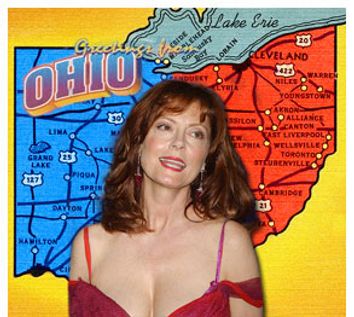
“You probably haven’t been romanced quite so much before,” Susan Sarandon told a crowd of about 300 Cleveland-area liberals at a fundraiser in Ohio last weekend. “Don’t be let down if you’re forgotten. It happens to the best of us.”

Indeed, it’s doubtful Ohio has ever been so romanced by celebrities, musicians, artists and activists. The state’s motto, “Ohio: The Heart of It All,” finally has a ring of truth to it, at least until Nov. 2, when American voters will decide what has been touted as the most important presidential election in our lifetime. Ohio is a critical swing state with 20 electoral votes that are up for grabs. The state narrowly voted for Clinton in 1992 and more decisively in 1996. Bush won Ohio in 2000 by 3.5 points with Nader taking almost 2.5 percent of the vote, a much closer election than Al Gore’s campaign anticipated, considering he essentially pulled out of the state a month beforehand.

The Aug. 14 fundraiser — attended by Sarandon, as well as Martin Sheen, Julianna Margulies, Chad Lowe (brother of Rob Lowe), Fisher Stevens and CNN humorist Andy Borowitz — was organized by Bring Ohio Back, one of more than 33 different PACs and 527s (nonprofit groups whose tax status lets them engage in partisan campaigning, as long as they don’t officially consult or coordinate with a candidate) working hard in Ohio to educate and register voters in hopes of unseating President Bush. But BOB, as it’s affectionately known, is the only organization that is locally grown and is focusing almost exclusively on the Cleveland-Youngstown area. About half of the Democratic vote must come from this corner of the state in order for Kerry to win.

“Al Gore received 140,000 fewer votes in Northeast Ohio than Bill Clinton did,” says Jeff Rusnak, a founder of Bring Ohio Back and a veteran political operative with the consulting firm Burges and Burges. “Gore lost the whole state by only 165,000 votes. So, while it’s incredibly important what the big organizations like America Coming Together and MoveOn are doing throughout Ohio, the Cleveland-Youngstown corner of the state is critical. The way we put it is, Ohio is the most important state in this election, and Cleveland is the most important media market in Ohio. Therefore, Cleveland is the most important media market in this election.”

Rusnak isn’t the only one who seems to have reached this conclusion. In fact, the very same weekend BOB brought in celebrities to a leafy-liberal suburb of Cleveland, America Coming Together held its national convention in downtown Cleveland, and featured Howard Dean and the stellar Democratic candidate for the U.S. Senate in Illinois, Barack Obama. According to the Center for Public Integrity, ACT — funded in large part by billionaire George Soros and progressive insurance millionaire Peter B. Lewis — has spent more on field operations in Ohio than in any other state, an estimated $1 million so far.

Still, eking out a victory here will be no easy task. Despite 270,000 lost jobs in the last three years, the Republican-controlled state has focused on culture-war, wedge issues, such as a year-long debate to allow “intelligent design” to be taught in Ohio’s public schools as an alternative to evolution; enacting one of the most far-reaching gay marriage bans in the country (which also prevents unmarried heterosexual state employees from extending benefits to their domestic partners); making it legal to carry a concealed weapon; and introducing a resolution to declare the Ten Commandments the moral foundation of Ohio’s government. As one Cleveland city councilman told Cleveland Scene, an alternative weekly paper, “The Dukes of Hazzard have taken over Columbus. Next thing you know, we’ll be installing outhouses.”

Ohio Democrats wring their hands about how this state — which once had two solidly Democratic senators, John Glenn and Howard Metzenbaum, and a majority in the statehouse — came to be controlled by Republicans. Aside from Ohio’s Supreme Court, there isn’t a single Democrat elected statewide in Ohio and there hasn’t been for years. For all the same reasons that Ohio is a microcosm of the country, it swung Republican in the early 1990s just as Newt Gingrich took over Congress. The Ohio Democratic Party was lackluster, there was no effort to build a farm team, and Ohio was allowed to Balkanize into urban, suburban and rural districts, with the latter two going largely Republican. But now with corruption investigations rocking top Republicans and Gov. Bob Taft’s approval rating around 40 percent, Ohio Democrats are cautiously optimistic that the party will be able to revive itself by piggybacking onto all the activity here during the presidential election and making an issue of the state’s horrendous economic performance.

“This is the largest and most sophisticated voter mobilization effort in history,” says Sarah Leonard, who’s with the national ACT organization in Washington. “We are sending canvassers to doors with Palm Pilots in hand. Throughout the conversation, data is logged into the Palm, and at the end of the night, when the canvasser is finished, they’ll sync that info into a database. So if ‘Judy Smith’ is interested in education issues, that information is used to target messages to her and continue the dialogue. We’ll send her information on a flier or through a phone call about education issues.”

One suburban Cleveland woman, for example, was highly impressed when a young, earnest ACT canvasser not only seemed to have a handle on the issues affecting her neighborhood, but showed her a 30-second advertisement from her Palm Pilot. “We’re marrying technology with grass-roots organizing. It’s never been done at this level before,” says Leonard.

Jess Goode, communications director for ACT-Ohio, says that over the past year, 250 canvassers have knocked on a million doors in Ohio and the goal is to knock on a million more by Election Day. “We’re not just dropping off literature and never talking to people. We’re returning two and three times to people’s doors and engaging them in conversation about the issues that concern them. This is the seventh largest state in the country. It should be prosperous and it’s not.”

Not to be outdone, MoveOn and Bruce Springsteen recently announced they are teaming up to put on a dizzying number of concerts in Ohio on Oct. 2, the day before registration closes. Bands affiliated with Springsteen’s Vote for Change will be playing all over the state that night, including the Dave Matthews Band, Pearl Jam, the Dixie Chicks, John Mellencamp, Bonnie Raitt and others.

MoveOn’s PAC has also launched a major grass-roots organizing effort called Leave No Voter Behind. According to Josiette White, MoveOn PAC’s Northeast Ohio field organizer, $5 million will be spent in swing states to bring out volunteers and register new voters. She doesn’t know exactly how much of that will be spent in Ohio, but it’s safe to say it’ll be a good portion.

“We had an initial organizing meeting here in Cleveland,” says White. “I was expecting about 100 people; 250 people showed up. There’s this amazing synergy and energy. We’re ready to take back our democracy in a true and literal way. People are constantly saying they’ve never been involved in politics before. I’m not willing to let Ohio come up red. Ohio is coming up blue this time, and everyone’s going to be a part of it. Once the election is over, in a perfect world, there will be a whole new group of future progressive leaders that will emerge.”

Among the projects concentrating on Ohio is a youthful arts-affiliated PAC called Downtown for Democracy, formed in New York City, which will be loading up buses full of volunteers in their 20s (many of whom have never voted before) to help rally the under-30 crowd in the Buckeye State. Everyone from designer Marc Jacobs to filmmaker Richard Linklater, along with seemingly every new bar, club and restaurant in New York City, is showering the organization with donations, time, space and cachet. This new group has teamed up with 21st Century Democrats/VoteMob in Ohio, which will do more traditional get-out-the-vote while D4D will entice kids to register by throwing DJ parties in Columbus, Cleveland and Cincinnati. In exchange for free beer and politically provocative T-shirts, e-mail addresses will be collected so potential voters can be informed about issues and reminded about where and when to vote.

Will this whirlwind of activity in Ohio give the Kerry-Edwards campaign an edge? A CNN/USA Today/Gallup poll of 761 registered Ohio voters, conducted between Aug. 13 and Aug. 15, showed Kerry at 50 percent, followed by Bush at 41 percent and Ralph Nader at 5 percent. When only likely voters are included, Kerry’s advantage dropped to 47 percent to Bush’s 45 percent with 4 percent for Nader. But MoveOn’s Northeast Ohio field organizer doesn’t think polls are terribly reliable at this point, as newly registered voters aren’t included.

Economic trends, at least, do seem to herald bad news for Bush. Not only has Ohio hemorrhaged jobs, it’s also losing more people with college degrees than any other state in the country, according to the New York Times. While other states worry about a housing bubble, real estate prices here are depressed. The Corporation for Enterprise Development gave Ohio’s economic performance a D grade in its annual report card. A ballot initiative to provide seed money for economic development failed while the sales tax has been increased. Education funding has been drastically cut.

None of this, however, seemed to be on the minds of three Republican-leaning men sitting at the bar where Susan Sarandon and company had just, with impressive sincerity, beseeched people about the need to educate Ohio’s voters. They said they were at the bar independently of the event, adding that they would be voting for Bush in November because of the war in Iraq. It wasn’t necessarily a good thing to have gone to war, they agreed, but now that we’re there, only Bush could bring this to a good conclusion. They view Kerry as a wishy-washy politician who would do more harm than good. One even claimed to have voted for Gore.

Another unsuspecting bar patron, however, offered one of the exhausted celebs a bit of encouragement. After Julianna Margulies emphasized women’s issues in her halting but heartfelt speech, a young woman approached her and said she wasn’t there for the fundraiser and in fact is a Republican. But she told Margulies she gets it now, and will be voting for Kerry.

In Ohio, it’s one voter at a time.

Continue Reading Close

The dark side of Ralph Nader

He's made a career of railing against corporate misdeeds. Yet he himself has abused his underlings, betrayed close friends and ruled his public-interest empire like a dictator.

  • more
    • All Share Services

The dark side of Ralph Nader

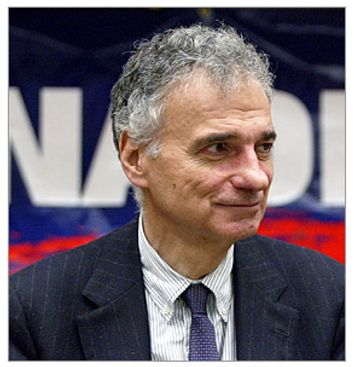
Ralph Nader spent his 70th birthday with Bill Maher on his HBO show “Real Time,” where Maher pressed him on exactly what his controversial fourth presidential campaign will contribute to the national debate. Nader repeated once again that he’s the only candidate not beholden to “corporate America.”

While Nader’s legacy as a consumer advocate is unparalleled, it is worth noting that the onetime national hero wasn’t celebrating his landmark birthday surrounded by the hundreds of people he has worked with and influenced over four decades. Indeed, virtually no one who worked with him since the heady days of Nader’s Raiders is supporting him politically or personally today. He has inspired almost no loyalty and instead has alienated many of his closest associates. The estrangement between Nader and many of his former intimates is not a new phenomenon; it’s not the result of his ruinous campaign for president in 2000; it dates back to his earliest days as a public figure.

Dozens of people who have worked with or for Nader over the decades have had bitter ruptures with the man they once respected and admired. The level of acrimony is so widespread and acute that it’s impossible to dismiss those involved as disgruntled former employees, disillusioned leftists or self-seeking turncoats. Usually it was Nader himself who ratcheted up what was often just a parting of ways into professional warfare and vitriolic personal attacks.

While Nader continues to campaign against corporate abuse, his own record, according to many of those who have worked closely with him, is characterized by arrogance, underhanded attacks on friends and associates, secrecy, paranoia and mean-spiritedness — even at the expense of his own causes. If he were a corporate CEO, subject to the laws governing publicly held and federally regulated firms, there can be little doubt he would have been removed long ago by his company’s board of directors.

Nick Jacobs’ blood boils every time he sees another poll showing Nader within striking distance of costing John Kerry the election. For him, it isn’t just that Nader was indispensable in President Bush’s 2000 victory over Al Gore. Nader’s latest run for president is infuriating for personal reasons as well.

“He puts himself out there as pure as the driven snow, and he’s not,” says Jacobs. “He’s paranoid, secretive and manipulative, at best. It galls me that he talks about how corrupt the two-party system is when he trashed someone to the FBI who was his best friend.”

That someone was Jacobs’ father, Theodore Jacobs. Ted Jacobs met Nader when they were both freshmen at Princeton and then attended Harvard Law School together. Later, as an attorney in private practice, Ted provided personal and professional legal assistance to his old college friend after he was catapulted to national prominence over the issue of automobile safety with the publication of “Unsafe at Any Speed.” Ted became, in effect, Nader’s chief of staff. And from 1970 to 1975, Ted was executive director of the Center for Study of Responsive Law, the first organization Nader founded.

The two men’s ugly and painful falling out — in which Nader trashed Jacobs to the FBI when Jacobs was up for a federal job and Jacobs retaliated with an explosive affidavit alleging financial and legal improprieties by Nader — was the first of many destructive breaches between Nader and onetime allies. The story hasn’t been told before, but the Jacobs family recently made private papers available to Salon that document the sad split.

“My dad kept everything,” said Jacobs. “He had boxes of papers in our basement. They pretty much sat there until Nader announced that he was going to run again, and I decided to go through them.” Nick was shocked by his discovery of this dark chapter in his father’s otherwise enemy-free life.

In various articles from the early 1970s, Ted Jacobs was described as “Nader’s closest friend and advisor” and the person who stood “between Nader and the world, absorbing the fury of the attacked, offering solace to the ignored, always speaking the absolute truth within the limits of what he believes Nader would wish him to reveal.” But, according to the private papers shared with Salon, he informed Nader sometime in 1974 that he planned to leave the Center for the Study of Responsive Law but would first finish several projects.

On March 8, 1975, Jacobs arrived at the office to find the contents of two large file cabinets missing (including his personal diaries and documents relating to “financial matters”) and his desk drawers ransacked. Nader arrived at the office a short while later to tell him he had ordered the files removed. In a state of near shock, Jacobs tendered his resignation and demanded to know what was going on. According to contemporaneous notes written by Jacobs, Nader said he had confiscated the files because a year earlier, Jacobs had signed checks for magazine subscriptions without Nader’s permission. Nader also accused Jacobs of writing a check to himself for about $75 for expenses. Dismayed and shaken, Jacobs searched for a new job.

He was being seriously considered for a position as a staff member on the Senate Select Intelligence Committee, which required a routine background check conducted by the FBI (which collects raw data on individuals but does not seek to confirm it). While waiting to hear about the job, Jacobs was told that questions had been raised about his character, honesty and trustworthiness. He subsequently learned that the source of the innuendoes was Nader. According to Jacobs’ son Nick, to find out why he was denied a security clearance, Jacobs asked for and received a list of the people the FBI had interviewed and what they had said. He told the agency the accusations were untrue.

Nick says he has repeatedly asked the FBI for access to his father’s FBI file, but although the agency has said the file is OK to release, he has so far not received it.

On Aug. 7, 1975, Jacobs wrote his former friend a letter expressing his distress: “I thought that we had settled after our long talk in April … If I misunderstood you that day, it was surely the most costly misunderstanding in the 24 years I’ve known you. I was prepared to let you go your way in the hope that you would let me go mine and I was feeling very kindly disposed to you. That was until I learned of your statement to the FBI. The impact of that statement was as if I had been kicked in the stomach … We must have some sort of resolution to undo the damage done by your statements. As the record now stands, it will be an impediment for the rest of my life.”

It may be hard now to fathom just how credible and influential Nader was at the time. He had taken on General Motors and won, launched a new movement on behalf of consumers and recruited earnest young Raiders to work for organizations founded solely on his credibility. By 1975, Nader was regarded as an exemplar of righteousness, the ultimate advocate of the ordinary citizen. For someone of his stature to impugn the reputation of a former employee to the FBI was devastating.

According to a statement Jacobs wrote after he was dismissed, Nader told the FBI that Jacobs was fired for skimming money from the Center for the Study of Responsive Law and other irregularities. In the affidavit that Jacobs drafted in the hope of clearing his name with the FBI, he wrote: “I was the only person Mr. Nader trusted with his extensive and complicated financial dealings … I regularly signed his name to leases, correspondence, contracts, tax returns, reports to government agencies and bank and stock brokerage accounts. Mr. Nader was aware of the fact that I regularly signed his name to these documents and would often specifically request we do so because he did not want his real signature widely known. … The fact is that I did sign the checks which were in accord with regular practice of payment of legitimate office expenses.”

In the affidavit, Jacobs indicated that the reason he decided to leave Nader’s employ was his growing concern about the way Nader handled his personal and professional finances. Jacobs outlined in some detail what he characterized as questionable practices regarding taxes, bookkeeping, investments and stock transactions. He wrote, “Although Mr. Nader was earning approximately $500,000 per year in personal income, he paid little or no taxes since he deducted various expenses of his operations as ‘business expenses’ or he made contributions to ‘charitable organizations’ controlled by him.” Jacobs continued, “He also engaged in what I viewed to be questionable end of year tax juggling, often pre-dating or post-dating checks to get a deduction in a particular year. He would often pad travel expenses and double-bill for travel expenses when he had two engagements in a particular out-of-town city.”

The former associate also charged that Nader’s nonprofit enterprises were run with very little oversight by their boards: “No independent outside audits were made of any of the Nader organizations until various states required Public Citizen statements.”

Jacobs also wrote in the affidavit that Nader was “inordinately harsh in his dealings with his employees and others. Although he had amassed a reserve of over $2 million in various foundations, organizations and in his personal brokerage account, he paid extremely low wages and often refused to pay employees and others for work done.”

Jacobs never filed his affidavit with the FBI, but some of the allegations it contains were confirmed by two former associates of Nader’s on the Congress Project, an ambitious Nader-sponsored undertaking to investigate every single member of Congress up for reelection in 1972. Attempts to verify information about other people mentioned in the affidavit were unsuccessful because they could not be found or were unwilling to comment about events that occurred 30 years ago.

“The bottom line is, my husband knew everything,” says Lenore Jacobs about her late husband. “When he died, everything died with him. Every file or notes that he had, Ralph took and would not return. There’s no corroborating it because my husband’s dead. It was a horrific time in our lives, not to put too fine a point on it.”

Whether Jacobs’ accusations about Nader’s financial dealings were true or just a counterthreat to get Nader to recant his statement remains uncertain. Salon was unable to independently confirm the allegations about legal and financial impropriety. Nader refused to comment for this story, though he was informed about the nature of Jacobs’ charges. What is certain is that shortly after Jacobs prepared his affidavit, Nader sent a letter to the FBI retracting what he had said about Jacobs. In a classic nonapology apology, Nader wrote, “This is to inform you that … all outstanding differences have been settled … [which] were insignificant in nature. In light of the above, I would now recommend Mr. Jacobs for a position of trust and confidence with the U.S. Government.”

But the damage was done. The highly qualified Jacobs didn’t get the job with the Senate Select Intelligence Committee, or any other position that required a security clearance. He reluctantly took a job on the staff of Bella Abzug, the late firebrand Democratic congresswoman from New York, and worked on Capitol Hill until he retired in 1994. Jacobs died in 1998 of a neurological disease.

“I believe the way Ted portrays things is accurate,” says Nick Zill, a former Nader associate who knew Jacobs when he worked for Nader. “Ted was a straight shooter and not a frivolous person at all. He was very dedicated to Nader’s causes.” Though Zill didn’t know the details of the men’s falling out before being shown Jacobs’ notes, he says he is not at all surprised by the characterizations of Nader’s vindictiveness. Zill and his former wife, Anne Zill, both worked for the Congress Project. The Zills, too, had a bitter parting of ways with Nader.

“While I worked for the Congress Project, I had taken an idea to Nader, the only meeting I ever had with him,” says Anne Zill. “He liked my idea about investigating how the media reports on things happening in Congress. So I worked on it during my own time, but I wasn’t able to finish it.”

Disillusioned by Nader’s autocratic management style and with the paltry wages that the Congress Project was paying them — the couple had three young children who attended a daycare center in Georgetown for the indigent while they worked — they both decided to leave the project. After Anne left to begin a congressional fellowship, she began getting harassing phone calls from people working for Nader. “I would get phone calls late at night, demanding that I turn over these notes I had taken for this idea. They said I was breaking the law, that I wouldn’t get away with this. They said my reputation would suffer.” Anne refused to turn over her work, however, based on her belief that the project had been her idea and that she had done it on her own time.

After her fellowship, Anne applied for a job with Stewart Mott, a public-spirited philanthropist who was on President Nixon’s enemies list. According to both Anne and Nick Zill, Nader attempted to torpedo her hiring with accusations that she had stolen notes from the Congress Project. She was hired by Mott anyway, and he even threw a party for her at the Kennedy Center. When Nader showed up at the party, Nick was so incensed he threw a glass of water in Nader’s face. Thirty-five years later, Anne still works for the Stewart Mott Charitable Trust.

Nader “dealt very hierarchically with people through his underlings,” says Anne Zill. “At any point, if he had asked me about the notes rather than sending his underlings to come get them, I would have talked with him about it.”

“He demanded a kind of loyalty that we found disturbing,” says Nick Zill. “Anytime he was going to come into the office, it was like the prophet Mohammed was going to appear. There was this blind obedience that we found cultlike. I think the real reason [Nader told Mott not to hire Anne] was that Stewart was an important source of funds for Nader, and he wanted someone more loyal to him in this position. This nominal dispute over notes is very similar to the Ted Jacobs situation.”

While Jacobs may have been damaged more than anyone else by Nader, he was by no means the last intimate associate to suffer Nader’s wrath. “These weren’t just marginal people who he disagreed with,” says Toby Moffett, a former Democratic congressman and another early and close associate of Nader’s. “These are people who would have fallen on a sword for him.”

Like Nader, Moffett grew up in Connecticut. Their fathers, both Lebanese immigrants, were good friends. When Moffett finished graduate school, his father urged him to get in touch with Nader, who was already a national icon. To Moffett’s surprise, not only did Nader take his call, but he asked him to return to Connecticut and start an organization that would later become the model for Citizen Action groups around the country. “I saw a lot of Ralph because he would come back to visit his parents [in Connecticut]. I would stay and eat with the family. To me he was a gigantic hero.”

After working closely with the old family friend, Moffett ran for Congress from Connecticut in 1974 and won. “Three months after I was elected, [Nader] attacked me,” says Moffett. “So our relationship began to sour pretty quickly.”

According to Moffett, Nader launched the first of numerous attacks against him over an aircraft noise reduction bill. While the bill stipulated that noise reduction measures would be funded mostly by the airlines, they were also to be subsidized by a tax on airplane travelers — not the general public — which Nader dismissed as a corporate handout. Moffett, along with nearly every environmental group, supported the bill. “It was an important piece of legislation that was supported by a coalition of progressive members of Congress, and it passed. Of course, now the Bush administration is tearing it apart.”

Nader continued to criticize Moffett during his four terms in Congress, which was disturbing enough, but as with Al Gore, Nader would eventually play a crucial part in ending Moffett’s career in elective office. After a fourth term in the House, Moffett ran for the Senate against Lowell Weicker, a Republican, in 1982. “My opponent was running these ads attacking me; the [National Rifle Association] was hammering me from the right,” says Moffett. “And then Ralph Nader came up [to Connecticut] and endorsed him. I lost by a very slim margin. My family and I, and my supporters, we just had this blind rage and fury about it. So what he did in 2000 was no shock to me. And what he’s doing now is no shock. It’s always been about him and his ego.”

“He has no interest in being a constructive part of anything,” continues Moffett. “No one can name a coalition he has been in where he really rolled his sleeves up and tried to get [something] done. He’s shown no interest in anything that could be construed as incremental change. [But] he has had success in empowering people, like Joan Claybrook and others. That’s the legacy.”

Claybrook is the president of Public Citizen, an organization that Nader founded in 1971. After Ted Jacobs left his position with Nader, Claybrook took over as Nader’s right-hand person, and she remained his closest associate until she was appointed by President Carter to head the National Highway Traffic Safety Administration, which was created in the wake of Nader’s auto safety campaign of the 1960s.

Within months of her appointment to the government agency, Nader attacked Claybrook. According to a biography of Nader by Justin Martin, “Nader: Crusader, Spoiler, Icon,” Nader wrote a vitriolic 11-page, single-spaced letter that was ostensibly addressed to Claybrook but was in fact distributed widely to the media; Claybrook herself didn’t even get a copy.

The letter, parts of which were published in the Washington Post, complained about delays in air bag safety regulation, certainly a legitimate concern. However, Nader went on to berate her for what he perceived as her many shortcomings, and even accused her of being more beholden to the auto industry than to consumers. She felt compelled to call a press conference to address the accusations, and Nader showed up and proceeded to badger her.

Claybrook did not return phone calls seeking comment.

Rather than capitalizing on his unparalleled access to the Carter administration through the dozens of Raiders and other allies working for the administration, Nader adopted a harshly adversarial stance. While many activists find it easier to criticize a conservative administration than to work with a sympathetic one, what’s different about Nader, observes one of his former supporters (who does not want to be named), is that his righteous view of himself “translates into a deeply pathological approach to targeting his allies.”

Of course, his attacks on Claybrook and other progressives during the late 1970s were outlandish. But given the effectiveness of his uncompromising positions up to that point, his behavior was mostly tolerated and sometimes forgiven. In fact, Claybrook eventually went back to work for Nader after leaving the National Highway Traffic Safety Administration. Fast-forward to the Clinton administration, however, and not much had changed. Despite having little influence during the Reagan and Bush I administrations, he picked up where he left off by attacking both people inside the Clinton White House and advocates who were trying to influence its policies.

“We worked with him on [the Clinton] healthcare initiative,” recalls a left-leaning activist who now works as a staff member for a Democratic congressman. She asked not to be identified because of Nader’s penchant for retribution. “While we didn’t necessarily endorse the Clinton plan, we worked hard to make sure it had a single-payer option. Ralph disagreed with us, completely disagreed with us, and spent time attacking us for selling out. It was a very bitter period of time. If you disagreed with him, you could very quickly become a target even if you were fighting for the same thing.”

“His organization has always been top-down,” she continues. “He has been able to say, ‘This is what it should be,’ rather than having to be accountable to people who want to move the ball forward without scoring a goal every time. We had to decide how to respond to the Clinton healthcare bill, so we had a meeting and people argued it out and then we arrived at a position. Ralph [just] sat in a room with two people and said, ‘This is what we’re going to do.’”

“He lobbied me, or maybe I should say threatened me,” says a senior official in the Clinton administration, who also asked not to be identified. “That’s what he does. He will meet with you, you’ll have a nice discussion about a policy issue, and you’ll agree on goals and debate the means, and then he’ll go out and say you’re a traitor, that you’re not a real Democrat. He’s made a career out of it. It’s never constructive, but it gets him lots of attention. The right wing, of course, loves it.”

“Ralph in practice has been tougher on his friends than on his enemies,” offers another Clinton administration staffer diplomatically, despite having been on the receiving end of Nader’s condemnation. “He has seen his role to be the last honest man.”

Bill Zimmerman, a political consultant, would probably disagree with the notion that Nader is the last honest man. As someone who has worked in progressive politics in California for the better part of 30 years, he has had numerous dealings with Nader. Indeed, one of Zimmerman’s biggest victories came about because of Nader.

In 1988, Zimmerman was part of a coalition that got a pro-consumer initiative on the ballot promising to lower auto insurance rates as well as give California drivers a rebate. Not surprisingly, the insurance industry fought back hard. On Election Day, there were four measures on the ballot claiming to be insurance reform initiatives. Nader endorsed Zimmerman’s proposal — and it squeaked through. “Nader had a huge impact on getting it passed,” says Zimmerman. “Ralph has a lot of clout when it comes to distinguishing the genuine article in a crowd of phonies.”

But after several years, it became clear to consumer advocates that the measure wasn’t delivering on its promises. Zimmerman and the coalition he worked with believed that fees paid to trial attorneys in auto accident lawsuits were a problem. “So we developed a consumer-oriented, no-fault insurance plan and got it on the ballot in 1994. It would have taken the lawyers out of the equation.”

“Not only did Nader oppose it,” continues Zimmerman, “but he wrote an Op-Ed for the Los Angeles Times calling me and other people ‘consumer traitors.’ This is typical of how Nader operates. Rather than arguing the merits or revealing his own financial support from trial lawyers, he publicly demonized the people who were advocating for consumers as shills of the industry. We never took a nickel from insurance companies. There was no logical reason for him to oppose it other than to protect his own financial interest.”

Zimmerman readily acknowledges Nader’s many achievements. But like others who had bitter fallings-out with Nader, he searches for a psychological explanation for Nader’s behavior. “In addition to living inside this bubble of fame, he leads a very monastic life. He has no intimate relationships; he lives without emotional ties to other people. As a result, he is isolated from the kinds of things that help people reach emotional maturity. He has childish and narcissistic reactions to things. If he led more of an ordinary life, some of these problems might be mitigated.”

In the past, Nader has lamented his isolated existence. “I didn’t socialize much in Washington when I was well-known and heavily reported,” he told biographer Justin Martin. “I could have easily. I’m really sorry that I didn’t do more of that. It was like postponing it: ‘I’m busy on this, I’m busy on that.’ People loom much bigger now than they did when they were within a phone call. I felt I could always meet with them, so I put it off. That was a mistake.”

It seems that the personality traits that have made Nader an effective advocate — doggedness, indignation and disdain for how he is perceived — are the same ones that foment disaster when translated into personal relationships and, more important, electoral politics.

Despite having shunned electoral politics for the better part of his career, as his influence waned in the 1990s, Nader began testing the waters. His first run for the presidency came in 1992, when he entered the New Hampshire primary race, garnering only a bit more than 3,000 votes. In 1996, he “stood” for president [Nader's terminology] as the Green Party’s candidate, but spent less than $5,000 — some say to avoid disclosing personal financial information — and got less than 1 percent of the popular vote.

In 2000, again with the Green Party, he ran a full-fledged campaign, raising and spending money to get on the ballot in all 50 states. He drew huge crowds at places like Madison Square Garden in New York and Key Arena in Seattle. While he assured Democrats that he wouldn’t campaign late in the election season in key battleground states, he reneged on that promise, zeroing in on Florida, Oregon and New Hampshire in the last few weeks before the election.

Few analysts predicted just how close the election would be, but a number of people who had worked with Nader over the years feared that his run for president would be disastrous. “When he announced [his candidacy in 2000] at a big gathering in Washington, I was the first person to stand up and say, ‘How can you say there’s no difference between Democrats and Republicans?’” says Gary Sellers, who was one of the original Raiders. “There was a big hush in the room. He had no response.” Nader was the best man at Sellers’ wedding; they no longer speak to each other.

Nader’s share of the votes was the margin that threw New Hampshire into Bush’s column and accounted for the difference in Florida that cast the state into the post-election turmoil that ended only with the 5-to-4 Supreme Court decision in Bush vs. Gore. Nader nearly cost Gore other states as well, especially New Mexico. Every study after the election determined that almost all of Nader’s votes would have gone to Gore if Nader hadn’t run, but Nader continues to insist that he bore no responsibility.

Nader’s justifications for running again are contradictory. One of his arguments is that he’ll take more votes away from Bush than from Kerry, an assertion punctured by an analysis of polling data by DontVoteRalph.net. Nader has also said that he would help Kerry get elected. When the two men met on May 19, Nader emerged with Kerry all smiles and chuckles, indicating that he wouldn’t campaign in hotly contested states. Then, just a few weeks later, he reversed that decision, saying he might campaign only in swing states. Republicans are reportedly aiding his campaign to get on the ballot in Arizona, and some conservative groups in Oregon that have helped his campaign in hopes of giving an advantage to President Bush were accused Tuesday of violating a federal campaign law that prohibits corporate contributions to presidential candidates.

Not surprisingly, Nader’s arguments for running again are being rejected by Democrats and even by the Green Party, which failed to endorse him at its convention in Milwaukee on June 26. Indeed, the Green Party selected David Cobb as its candidate for president largely because he promised to campaign only in safely Republican and Democratic states. On June 22, Nader had a heated exchange with members of the Congressional Black Caucus, according to reporters who overheard people shouting and cursing. After the meeting, from which several people stormed out, Rep. Sheila Jackson Lee, D-Texas, told CNN, “This is the most historic election of our lifetime, and it is a life-or-death matter for the vulnerable people we represent. For that reason, we can’t sacrifice their vulnerability for the efforts being made by Mr. Nader.”

“The reality is, much of the fallout from having George Bush get elected is being dealt with by people other than Ralph Nader,” concurs the chief of staff to a Democratic member of Congress. She says that very few members will even meet with Nader anymore. “I don’t know what Nader does on these issues in between elections, but we’re the ones — progressive members of Congress and their staffs — who are concerned about families who can’t get visas to come see dying relatives, people being turned away from Pell grants, the war in Iraq. Every day it’s something else. We know that if Gore were in the White House, we wouldn’t be dealing with this. If we sound bitter, it’s because we are.”

Nader’s many soured relationships have become the backbone of some well-organized challenges to his latest candidacy. United Progressives for Victory, an umbrella group that is trying to bring the various anti-Nader efforts together, is spearheaded by Toby Moffett and Bob Brandon, another early Nader associate. United Progressives for Victory has been formed as a PAC to raise money for advertising and grass-roots outreach, as well as to fund a celebrity bus tour planned for later in the election season.

In addition to legal challenges like the one in Oregon, other groups have emerged to scrutinize Nader’s efforts to get on the ballot in swing states. For instance, former organizers for Howard Dean, Wesley Clark and Dick Gephardt have launched TheNaderFactor.com, which aims to persuade younger progressives by, among other tactics, airing television ads that feature former Nader supporters talking about the real differences between Bush and Kerry. “Everyone is working on this,” says Gloria Totten of the Progressive Majority, one of the groups involved with United Progressives for Victory.

But no one expects that Nader will actually withdraw from the race — despite the fact that even among those who maintain cordial relations with him, there isn’t one former associate who thinks his campaign is a good idea. “I don’t know of a single person who is supporting Nader now,” says Don Ross, who worked for Nader years ago as head of a Citizen Action group and is a founding partner of Malkin & Ross, a progressive lobbying firm in Albany, N.Y. “There’s no one that I know of walking around with ‘Vote Nader’ buttons on.”

“He has lost credibility and respect, and he stands to lose it completely if takes enough votes away [from Kerry] to reelect Bush,” adds Harrison Wellford, the first executive director of the Center for the Study of Responsive Law, who was involved with Nader’s Raiders for Gore. He is now working with Nader’s Raiders for Kerry, yet another group hoping to persuade people not to vote for Nader. “Passions are extremely intense now. He’s taking a much bigger risk this time around. But he’s been impervious to this point. It’s difficult for him to give up the opportunity that the [presidential] stage gives him. For that reason, he’s dead set on going ahead.”

Continue Reading Close

Marching for their lives

Pro-choice activists are mobilizing for Washington with new urgency: As more than a dozen states aim to outlaw reproductive rights, a nationwide abortion ban could be next.

  • more
    • All Share Services

Marching for their lives

When an expected 1 million women descend on Washington this Sunday for the March for Women’s Lives, it will be hard for the Bush administration not to hear their rallying cry in support of reproductive rights. For some pro-choice leaders who will be there, the message to be delivered en masse will be charged with vivid personal experience and decades of dedication to the issue.

“I had an illegal abortion when I was 15,” says Renee Chelian, executive director of Northland Family Planning Center, which runs three abortion clinics in Detroit. “Now I’m 53 years old, and I’ve been working for legal abortion my entire adult life. I would like to work on other issues, maybe help battered women and children, but I’m still fighting the same battle I was in 1974.”

Michigan is one of the many states where reproductive rights have been perpetually under siege since the landmark Supreme Court decision Roe vs. Wade legalized abortion in 1973. “The right-wing extremists have lost none of their momentum,” says Chelian, who has seen the ebb and flow of reproductive battles for 30 years. “In fact, it has picked up since George Bush has been in office.”

It is in these states where the battle is intensifying, not only to put limits such as parental consent on abortion, and to inhibit family planning — even preventing women from getting emergency contraception and the birth control pill — but ultimately to overturn Roe vs. Wade. Indeed, the April 25 march on Washington, supported by a range of reproductive-rights groups from across the country, is propelled by a new urgency: Conservative politicians in more than a dozen states have been pushing radical anti-abortion legislation that, if it were to pass, would almost certainly thrust the issue before the Supreme Court once again. With vacancy on the top bench imminent, and with George W. Bush potentially deciding who fills the seat (or seats) if he wins reelection, that’s a chilling prospect for advocates of reproductive rights.

Just last month, South Dakota came within one vote of enacting a sweeping anti-abortion law that would have outlawed the procedure entirely at any stage of pregnancy with the only exception being that of saving the woman’s life. Republican Gov. Mike Rounds and many South Dakota legislators boasted that the law could become the nation’s first direct challenge to Roe vs. Wade should George W. Bush get reelected and have the opportunity to appoint several anti-abortion justices to the Supreme Court. The apparent strategy is to enact an unconstitutional law in order to draw a court challenge that would make its way up to the Supreme Court — just as Bush’s appointees are joining other conservatives on the bench.

While the bill in South Dakota failed this time, it had passed both houses of the state Legislature. Despite supporting the bill, Gov. Rounds sent it back to the general assembly with a few technical changes. It came within a hairbreadth of passing a second time, even though it was such an extreme measure that the anti-abortion advocacy organization National Right to Life didn’t support it, stating that it was “the right bill at the wrong time.” Not only would it have banned the procedure, but it would have imposed a prison sentence of up to 15 years. Because the vote was so close, that probably won’t be the last time the South Dakota Legislature takes up the measure.

“We’ve been a testing ground for the most radical things they can dream up,” says Thelma Underberg, executive director of NARAL Pro-Choice South Dakota. “I checked the names of the people who testified [at the bill's hearing]. Very few people who testified were from South Dakota. It was well orchestrated by the Thomas More Law Center of Michigan, which was started by that fellow that owned Domino’s Pizza,” says Underberg, referring to Tom Monaghan, a conservative who has been a major funding source for anti-abortion and anti-gay activism. “They came in and got a legislator who was willing to carry the legislation.”

South Dakota isn’t the only state that has attempted to ban abortion outright. A bill in the Georgia Legislature would “provide that any person seeking to have an abortion … shall first file a petition in the Superior Court.” The bill also stipulates that the woman must have a jury trial, and that the court shall balance the rights of the fetus against the rights of the person seeking to have an abortion, and finally that “no abortion shall take place unless ordered by the court.”

In one of the more macabre state-level anti-abortion tactics, a bill was introduced to the Oklahoma Legislature that would require a woman considering an abortion to obtain a death warrant. “That bill would prohibit a physician from performing an ‘execution’ without obtaining a death warrant,” says Anita Fream of Planned Parenthood of Oklahoma. “It’s anybody’s guess what that referred to. But we see between 15 and 20 anti-choice bills of various kinds every year, so you can’t stay on top of them all. For example, we’ve had a bill proposed that would allow any minor who got an abortion without parental consent to sue the physician for malpractice without any statute of limitations, even though minors aren’t required to get parental consent in Oklahoma.”

Iowa is another state that is considering a bill that would require a woman to obtain permission from a judge before getting an abortion. Under this measure, the judge would appoint a guardian for the embryo or fetus and then conduct a mini-trial to determine if she should be forced to go forward with the pregnancy. There is no exception in this legislation for the health or even life of the woman. “That bill was so extreme, even the leadership [of the state legislature], which is anti-choice, didn’t let the bill go forward,” says Brenda Kole of NARAL Pro-Choice Iowa.

According to Planned Parenthood, 14 states have introduced 29 bills banning abortion outright.

“There has been a long-term strategy to make abortion illegal at the state level,” says Nancy Northup, an attorney and the president of the Center for Reproductive Rights in New York City. “What people don’t understand is that states want to have these laws on the books and ready to go when Roe is challenged again in the Supreme Court. Two states, Alabama and Delaware, have pre-Roe anti-abortion laws still on the books. And two more states, Louisiana and Utah, have passed laws to make abortion illegal since Roe. Those state laws, and any others that are passed in the meantime, will immediately go into effect should Roe be overturned.”

Not all attempts to severely restrict abortion are quite so blatant. Back in Michigan, two court cases have already been fought over so-called partial-birth abortion laws, where the legislation was struck down both times on the grounds that the wording was so vague that abortions as early as 10 weeks could be restricted.

“If they would pass a narrowly tailored bill to ban a specific procedure,” says Chelian, referring to intact dilation and extraction, “we probably wouldn’t even challenge it. But they keep coming back with this vague language, so we go to court, and every time we win the case, we also get to collect attorney’s fees from the state. It’s the state that has to pay for the court challenge, not the anti-choice groups who push it through. It’s such a waste of the taxpayers’ money.”

Most recently, the Michigan Legislature passed the Legal Birth Definition Act that — in addition to including the vague partial-birth language yet again — defines fetal viability so vaguely as to allow restrictions on abortion in the first trimester. Gov. Jennifer Granholm vetoed the bill, but a rarely used citizen’s initiative will likely succeed in getting it enacted anyway. In Michigan, if enough signatures are collected in support of a bill, it must be taken up by the Legislature, and if it passes with a simple majority, it automatically becomes law. The governor cannot veto it. More than enough signatures have been gathered and submitted to the secretary of state for verification, which will be certified sometime this month. Since the legislation already passed the Michigan Legislature once, it is all but guaranteed to succeed again, only this time the governor will have nothing to say about it. Once again, the courts will have to be the backstop.

“The [proponents of the citizen's initiative] are following an avenue that is allowed to them under the law,” says Liz Boyd, a spokeswoman for Gov. Granholm. “But any new law that is identical to the bill that the governor vetoed, which she did because it didn’t have an exception for the health of the woman, will be struck down by the courts.” The Michigan ACLU has already indicated it will bring a court challenge if the bill becomes law.

Not all attacks on a woman’s right to reproductive freedom are coming in the form of state legislation. Last fall a concrete supplier launched a boycott of a new clinic being built by Planned Parenthood in Austin, Texas. The boycott spread to every contractor in a 60-mile radius. After the initial setback, Planned Parenthood was besieged with calls from people willing to help. Planned Parenthood became its own contractor and has had to protect its subcontractors from harassment by refusing to release the companies’ names. Still, protesters show up at the construction site with zoom lenses and threaten to post photographs of workers on the Web. Despite the ongoing harassment, the clinic’s construction schedule is back on track and is set to open in the fall of 2004.

Of course, the anti-abortion movement hasn’t limited itself to stopping abortion.

Women’s right to reproductive freedom has come under such severe attack that access to emergency contraception and even the pill are increasingly threatened. Just last month, two cases arose in Texas that seem to be isolated incidents but are in fact part of a larger trend. In one case a pharmacist in Denton, Texas, refused to fill a woman’s emergency contraception prescription — even though she had just been raped. The drug store chain, Eckerd, immediately fired the pharmacist.

Another pharmacist in north Texas refused to fill a 32-year-old woman’s prescription for the pill. Julee Lacey, a wife, mother and first-grade teacher, was incensed and took her story to the media. In this case, the pharmacy was CVS. “Our constituents who are outraged about this want to support pharmacies that react quickly and do the right thing, as Eckerd did,” says Emily Snooks, executive director of Planned Parenthood of North Texas. “Well, now we come to find out that CVS is buying Eckerd. We can’t get an answer out of CVS about what they’re going to do to prevent this from happening again and whether or not that pharmacist will be terminated.”

CVS has said that if a pharmacist objects to filling a prescription, he or she should refer the customer to a pharmacist who can be of assistance. Beyond that, the company hasn’t elaborated on its policy or said if any disciplinary action was taken against the pharmacist who refused to dispense the pill. As it stands, Texas law does not protect pharmacists who object to filling certain prescriptions, but that may change. So-called conscious-clause legislation, which seeks to protect pharmacists from having to fill prescriptions that they morally object to, is yet another trend sweeping state legislatures.

While most of the proposed conscious-clause bills started out by protecting pharmacists who don’t want to dispense RU-486, also known as an abortifacient, Virginia has gone so far as to consider a bill that would declare fertilization as the beginning of life. This would classify emergency contraception, the pill, the IUD and other methods of contraception that prevent a fertilized egg from implanting in the uterus as abortifacients. Pharmacists who are already exempt from having to dispense RU-486 could not be fired by the company for refusing to dispense birth control and emergency contraception under this definition.

After a pharmacist in Cincinnati was terminated for refusing to dispense the pill and emergency contraception at least 10 times during her seven years of employment at K-Mart, a conscious-clause bill was introduced in the Ohio Legislature to protect pharmacists from being disciplined. “Wider access to emergency contraception is the single most promising avenue for reducing this country’s rate of unintended pregnancy,” says Chrisse France, the executive director of Preterm, a nonprofit abortion clinic in Cleveland.

While pro-choice organizations and civil rights groups battle to keep contraception available, anti-abortion groups have opened another front: going after family planning funding. According to the Planned Parenthood Federation of America, just this year 12 states have introduced bills that would eliminate all family planning funding to organizations that even discuss the option of abortion or refer women to clinics that perform abortions. Last year, six states succeeded in defunding family planning: Colorado, Michigan, Nebraska, Ohio, Pennsylvania and Texas.

“The [Texas] Legislature passed a bill that attempts to take away federal funding for family planning and require any family planning clinic to suspend any abortion services,” says Snooks, executive director of Planned Parenthood of North Texas. “All the Planned Parenthood affiliates in Texas had to file a lawsuit against the state and get an injunction. The court will hear testimony regarding this issue on May 3. If we lose, that would be a loss of $13 million to clinics across Texas.

“If people knew that contraception is now being threatened, they would be outraged,” continues Snooks, who believes that people are starting to wake up to what’s happening at the state level. “We have a whole contingent of people going to Washington, D.C., for the march,” says Snooks. “Most people don’t think of North Texas as a hotbed of activism, but people are getting upset.”

Continue Reading Close

Page 1 of 2 in Lisa Chamberlain