Marcelle Soviero

My drunken Thanksgiving

I made two mistakes on the day I met my future in-laws: Trying to shed my shy exterior and, then, the casserole

(Credit: Tatiana Morozova via Shutterstock)
This piece originally appeared on Marcelle Soviero's Open Salon blog.

The first time I met my boyfriend Eric’s family my sweet potato casserole went on fire. It was Thanksgiving 2003. Eric, whom I felt funny calling my boyfriend, since we were 36 and 40 at the time with five children between us, had invited me to his sister Julie’s house for the holiday. Since neither of us had our kids for Thanksgiving that year, Eric and I would get to be grown-ups, not parents. No strollers. No strained peas.

Eric drove up to Julie’s the night before Thanksgiving to cook. An obsessed chef, Eric had spent a week planning the menu with his siblings. “I’m making my sweet potato casserole,” I said to Eric as he made a grocery list, “with mini marshmallows on top.” I sensed disappointment, a Campbell’s Soup casserole stuck out among toasted almond haricot vert and saffron-infused stuffed turkey, a recipe that involved coriander, cumin, cranberries and couscous. My mother roasted a turkey every year and we were lucky if she remembered to take the giblets out. “You don’t have to make anything,” Eric said. But alas, I insisted.

I drove the two hours to Julie’s house in Vermont on Thanksgiving Day, sweet potatoes on the passenger seat next to me. I imagined what I would say when I met Eric’s large family. Painfully shy, I needed to rehearse.

I arrived at Julie’s house an hour late due to my inability to find something to wear. Eric answered the door, handsome, his gray hair mussed, his apron flecked with gravy. He guided me inside. His two brothers, two sisters, their husbands and wives and Eric’s mother, sat on the plaid couches. Eric’s father stood in the center of the living room miming something by putting his hand over his head and squat-walking like a penguin.

Charades. A game that is pure torture for the introvert. But Eric’s family grew up in the theater. His father having been dean of the theater department at University of Vermont, his sisters and brothers all actors at some point in their lives. I was terrified when they called me into the crowded room to play the game, no doubt anxious to see what the new girl would do. And what I was wearing was just wrong, I was dressed for a city Thanksgiving with a miniskirt and see-through silk blouse, among a room of turtlenecks, wool slacks and pearl earrings.

I accepted a glass of wine without hesitation, despite the fact that drinking doesn’t do anything for my personality, other than change it completely. My shy side flips; an introvert gone awry. I talk too much, use my hands to gesticulate, and by the end of the night a few cocktails always make me sick.

But I took the drink because I could not play charades without tilting a glass. I needed a little dose of confidence before I could possibly pretend to be a snow blower in front of a room of strangers. “I have to put the potatoes in,” I said when it was my turn. Eric’s mother followed me into the kitchen. While I sipped my wine I unloaded the basket of bread that I fashioned to look like a turkey. “That’s adorable,” his mother, a warm lovely Vermonter, gushed. Then I took out my sweet potato casserole, topped in a sheet of tinfoil.

The family joined his mother and me in the kitchen. They’d moved on to martinis for the cocktail hour and I could not help but participate.

“What do you do?” Eric’s identical twin brother asked me.

“I’m a writer,” I said, tipsy, and trying to keep a straight face. For some reason looking at a carbon copy of Eric was funny to me.

“Have you published anything?” Jon asked. I felt the familiar kick in my gut, never sure how to answer that question.

“I’m an unknown,” I said, taking a sip of my martini.

“What’s that smell?” John said next, scarves of smoke coming out of the oven, a fragrance of burned tar in the air.

“Do you have a fire extinguisher?” I panicked, my sweet potatoes on fire. I jostled the hot pan of burned marshmallows in my hands, my blond hair seemingly singed while Jon put out the flames.

I recovered; Eric’s family was kind. Before dinner, I scraped off the black parts and served my sweet potatoes anyway, my brain hitting that yolk-like stage where nothing seems real. I proceeded to say the dinner prayer, which led into a long toast about how much I loved Eric. I nibbled on turkey. But I missed dessert altogether. I’d shot out of my seat at the table to go pass out in the master bedroom.

I married Eric several years later, and even today I don’t drink on Thanksgiving, still proving to my in-laws that I am not the lush they first met. Given that first impression I never expected the close relationship I share with Eric’s family now. But they love me and I love them, enough so that I play charades every Thanksgiving. And I make my sweet potatoes — minus the marshmallows.

My broken marriage in a shoebox

Nine years ago, my husband and I filed for divorce, but I still hang on to these few pieces of our life together

(Credit: Unknown)

Outside the courthouse, signed divorce papers in hand after a yearlong custody battle and proceedings that left me in financial ruins, Larry, my new ex-husband, asked a stranger to take our photo. I was shocked, and though I hated him for what he had put me through, for some reason I stood still as he put his arm around my shoulder like a football buddy. It was raining; I wore a blue cashmere sweater. A woman with maroon lipstick snapped a shot of us on the courthouse steps.

That we could stand together even for a moment was miraculous, given the lawyers and the lies. Given Exhibit A of the property settlement agreement, an Excel spreadsheet detailing what was his and what was mine. And Exhibit B, the visitation schedule for our three children, age 1, 4 and 5 at the time.

That was nine years ago. I think of that photo as I pluck items from the memory trunk I keep in my office. I wonder how we might have looked, in those moments after the divorce, when our life was a drizzle, and the rain fell like so much broken glass. I wonder if Larry still has the snapshot — and why he ever asked someone to take a picture in the first place. Maybe that was closure for him, a seam on the day once the camera clicked.

The man I married and had three children with is minimized to a shoebox inside my memory trunk now. There’s a photo of us with the ship captain on our cruise to Portofino. A photo from our December wedding, all those poinsettias. And the card Larry gave me for our first anniversary. “Love you forever,” he wrote on the popup heart; I bend it back into the box.

Why do I keep this, I wonder? Perhaps I want my children to have access to items that prove their father and I loved each other. I imagine Sophia, our oldest daughter, 13 now, finding this note I wrote to Larry after I became pregnant with her. Maybe these sealed mementos will supplement the images she must have of her father and me dropping her off at one house or another, or standing like stick figures at her back-to-school nights.

What’s left from my first marriage, in addition to the children, is what’s in this box. That’s why I can’t throw any of it away. It’s proof to me, too, that I was married to my first husband for eight years, and there was some good in it.

The other day, I ran into Larry at our local Starbucks. I was in front of him in line. “Buy you a soy latte?” I said, surprising myself by making the offer, and still knowing what he drinks. Though we communicate weekly about the kids via email, I hadn’t actually seen him for months; I studied him. His dark hair had thinned and he’d grown sideburns flecked with gray. I tripped on my oversize umbrella. “Lot of rain lately,” he said. ”A lot,” I agreed.

We sat for five minutes even though the kids weren’t there and we didn’t have to pretend. “Sophia’s a teenager now,” I said, awkward. “She is,” he said. “Olivia starts lacrosse next week,” I said. I went on like this, though I wanted to ask how he was, really. I was remarried, but he was not. Did he have someone?

Looking at him, I thought how hard it had been all these years, living five miles away from each other but rarely speaking, trying to raise three happy children from two very different vantage points. When we were married, in my mind, he was not an involved father — but now I thought how he had become one, different from the one I expected, but a father, for sure. I probably should have told him that. But instead I asked where he got his umbrella. “I like the color,” I said, though it was plain gray.

Wrapping my hands around the paper cup, I wondered what someone looking through the window might see, if it was somehow obvious that we were a couple who were married once, who had three children together. I wondered what would happen if I asked someone to take our photo now, how it might compare to the divorce photo on the courthouse steps. Would we scoot our chairs together and smile — and feel it this time, nine divorced years behind us? Would the lines in our faces be harder from the years, or less so since we live apart?

I come back to our flat conversation, stay inside safe words, afraid to trigger any of our hot issues. “Well, I have to go to Stop & Shop,” I say. Larry makes an excuse to leave as well. We walk to our separate cars, the rain falling, the puce sky the color of bruises, mending.

Continue Reading Close

Making empanadas from scratch and memory

When my kids' caregiver moved away, she left a dear friend. But we celebrate each other every year by cooking

“I’ll make the dough this year,” I tell Nelly on the phone. I’m determined, though my talents flourish nowhere near the kitchen.

“I like Nelly’s empanadas,” my daughter Olivia says when I hang up.

“Don’t make them, Mom,” Sophia adds.

In the morning we will drive two hours to Nelly’s house for Empanada Day, a self-declared holiday we’ve been celebrating the Sunday before Thanksgiving for 12 years.

“Nelly always does everything. It’s time I took a turn,” I say, unsure about tampering with our tradition, but Nelly had a hard year, suffering with health issues, and I wanted to do this for her.

I start the dough making immediately. “Get the scrapbooks,” I tell Olivia. Flipping through pages of Empanada Days over the years, I look at the pictures of the girls smushing balls of dough in their highchairs. The note, scribbled beneath the step-by-step photos, says: about half a cup of shortening for every three or four cups of flour. I have no idea how much water to use, so I try to guess at the recipe that lives in Nelly’s heart, not a scrapbook. “We can do this, girls.”

Nelly and I met more than a decade ago; she was the first and last person to come into my kitchen when I interviewed for caregivers. Back to work, I was in need of childcare for Olivia and Sophia, now 12 and 13, then just babies. Nelly lived with us during the week; a few years after she came I had my son Johnny — Juanito as Nelly called him.

Johnny hung on my hip the morning I told Nelly I was getting divorced. I’d been up all night and the tears dropped into my cold coffee. Nelly, herself a single mother of three grown children, helped us through the custody battle, that excruciating year. Six years have passed since Nelly lived with us, and in that time Sophia and Olivia have been bridesmaids in Nelly’s daughter’s wedding, and I’m aunt to Nelly’s grandchildren. Even though we no longer share our day-to-days, Nelly is still our Nelly, and Empanada Day still stands.

One morning, after Nelly had been with us for a year, she came into the kitchen, put on her red apron, and set out three pounds of London broil. “I make empanadas today,” she said, and began dicing the meat. “It take time,” she said, adding the onions. Hours later, she brought Sophia and Olivia in, and they became a part of Nelly’s handiwork, folding and kneading small balls of the dough while seated in their highchairs. Nelly made more than a hundred empanadas that day; we took platefuls to each house in our neighborhood. We agreed thereafter to make them together once a year. I have few traditions or recipes passed down from my family, so I loved borrowing from Nelly and her Bolivian roots.

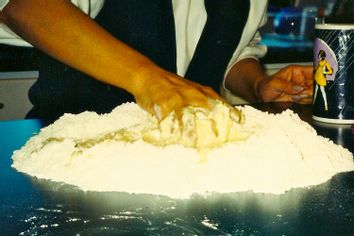
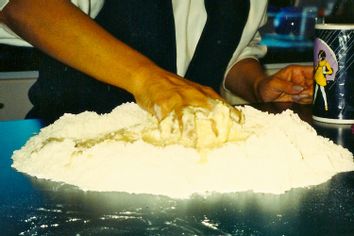
I scoop cups of flour into a mound on the counter. I make a well in the center, volcano style, just like in the old photo I use for guidance. “Is this right?” I ask as Olivia cracks eggs into the well. Sophia adds the shortening, I guess at the amount of water and attempt to knead the mixture into a ball. The dough is the size of a football, and it’s way off — mucky, sticky. I add more flour and the powder falls on the floor in fistfuls. I panic, add more flour, the ball grows. “You should have let Nelly do it,” the girls say, laughing now.

On the drive to Nelly’s house the next morning, I pull over and the girls and I run into the Stop ‘N Shop looking for the Goya aisle. I put the premade empanada dough in the cart. I’m stoic at the checkout line; the girls know not to say anything.

When we enter Nelly’s house, I blurt, “Mine didn’t work!” and pass her the plastic grocery bag with the store-bought stuff. She talks us into the kitchen of her tiny apartment with kisses. It’s as if Nelly expected this. “Come, my moneka,” she says to Sophia and Olivia and maybe me, too, her little dolls. “No importa. I do it,” she says, pulling the canister of flour from the cabinet. She is small, the same height as Sophia, her black hair cut into a bob at her chin, her dark skin smooth as a wine bottle.

Nelly is quick with her movements from sink to counter; she once again works too fast for me to transfer her spontaneous measurements to my head. She gives Olivia and Sophia each a rolling pin.

Nelly made the filling last night, a detailed mixture that includes meat with olives, hard-boiled egg and potatoes, all diced to the size of green peas. The girls and Nelly put a spoonful of meat in the center of each circle of dough, and set to work folding them into crescents, crimping the rounded side by hand, so the meat won’t ooze when Nelly fries the thin pouches. I have to crimp with a fork. I can’t pinch the edges the way they do.

As Nelly’s hands seal the dough, I think of her in the kitchen of my old house, making arroz con pollo, the girls playing with letter magnets, sticking them on the fridge. I remember those long days coming home from work late, running upstairs to see the children, bathed and smelling of baby powder, curled up on Nelly’s bed, watching Spanish soap operas. I remember the nights when Sophia was learning to read, and Nelly practiced her English alongside her. All those Frog and Toad books.

The kitchen smells of cumin and olives as Nelly fries the empanadas. She removes each pouch with a slotted spoon and places the crispy crowns on a paper towel.

I sip coffee, watching Nelly and Sophia and Olivia work. Maybe it’s just as well I wasn’t able to make the dough; the pleasure of seeing Nelly with my daughters, her hands over their hands as they roll, makes me as happy as I have ever been. And I know it will be my girls, not me, who will make the dough in the future, when Nelly and I are old, and we all gather for Empanada Day.

Nelly’s empanadas

Makes about 40 empanadas

Ingredients

Filling

  • 3 potatoes, cut in ½-inch cubes
  • 2 tomatoes, diced
  • 1 onion, diced
  • 1 green pepper, diced
  • 3 cloves of garlic, minced
  • ½ teaspoon cumin
  • 2 packets of Sazon Goya
  • 1½ pounds of flank steak, or other cut of beef, cut into ¼-inch cubes
  • ½ cup of parsley, chopped
  • 4 tablespoons vegetable oil and/or olive oil
  • salt and pepper, to taste

Dough

  • 3 pounds all-purpose flour
  • 2 large eggs
  • ½ cup warm milk
  • 1 tablespoon sugar
  • ¾ stick of butter, cut into little pieces
  • a few generous pinches of salt
  • 1 cup water, or as needed
  • vegetable oil, as needed, for frying

Directions

Filling (Prepare filling the day before)

  1. Boil potatoes with enough water to just cover until cooked. Drain and set aside.
  2. Sauté tomatoes, onion, green pepper and garlic in a pan with 1 tablespoon oil on medium-high heat. Add cumin and Goya Sazon and cook until all vegetables are tender (about 8 minutes). Add salt and pepper to taste. Set aside.
  3. In a large pot, heat 3 tablespoons of oil over high heat and sauté beef with a sprinkle of salt and pepper until cooked halfway. Then add the tomato/onion/pepper mixture into the meat and stir until evenly coated. Let cook for 10 minutes on medium heat. Stir in potatoes and let cook for 10 min. Turn off the heat and stir in parsley. Let cool and chill in refrigerator until cold, or overnight.

Dough and finishing

  1. On a clean countertop, place flour in a mound and create a center like a volcano. Beat together eggs and milk. Add egg/milk mixture, butter, salt and sugar in the middle of the mound. Begin to mix dry and wet ingredients with your hands. Add water little by little as you are kneading until the dough comes together and it is solid, but still pliable for rolling. If it is too sticky, add more flour.
  2. On a floured countertop and with a rolling pin, pinch off some dough and roll out into flat round disk 1/8-inch thick and about 3 inches in diameter. (Through trial and error, you’ll get the hang of how much dough that is.) Add a heaping teaspoon of the chilled meat mixture to the middle of the disk and fold over the dough into a half circle. Seal by pressing along the edge or with a fork or whatever creative technique you know.
  3. In a deep frying pan, fry the empanadas with vegetable oil on medium-high heat with just enough oil where you can fry one side at a time. Fry until each side is golden brown.
  4. Let cool slightly before serving.
Continue Reading Close

Beef empanada recipe

Makes about 40 empanadas

Ingredients

Filling

  • 3 potatoes, cut in ½-inch cubes
  • 2 tomatoes, diced
  • 1 onion, diced
  • 1 green pepper, diced
  • 3 cloves of garlic, minced
  • ½ teaspoon cumin
  • 2 packets of Sazon Goya
  • 1½ pounds of flank steak, or other cut of beef, cut into ¼-inch cubes
  • ½ cup of parsley, chopped
  • 4 tablespoons vegetable oil and/or olive oil
  • salt and pepper, to taste

Dough

  • 3 pounds all-purpose flour
  • 2 large eggs
  • ½ cup warm milk
  • 1 tablespoon sugar
  • ¾ stick of butter, cut into little pieces
  • a few generous pinches of salt
  • 1 cup water, or as needed
  • vegetable oil, as needed, for frying

Directions

Filling (Prepare filling the day before)

  1. Boil potatoes with enough water to just cover until cooked. Drain and set aside.
  2. Sauté tomatoes, onion, green pepper and garlic in a pan with 1 tablespoon oil on medium-high heat. Add cumin and Goya Sazon and cook until all vegetables are tender (about 8 minutes). Add salt and pepper to taste. Set aside.
  3. In a large pot, heat 3 tablespoons of oil over high heat and sauté beef with a sprinkle of salt and pepper until cooked halfway. Then add the tomato/onion/pepper mixture into the meat and stir until evenly coated. Let cook for 10 minutes on medium heat. Stir in potatoes and let cook for 10 min. Turn off the heat and stir in parsley. Let cool and chill in refrigerator until cold, or overnight.

Dough and finishing

  1. On a clean countertop, place flour in a mound and create a center like a volcano. Beat together eggs and milk. Add egg/milk mixture, butter, salt and sugar in the middle of the mound. Begin to mix dry and wet ingredients with your hands. Add water little by little as you are kneading until the dough comes together and it is solid, but still pliable for rolling. If it is too sticky, add more flour.
  2. On a floured countertop and with a rolling pin, pinch off some dough and roll out into flat round disk 1/8-inch thick and about 3 inches in diameter. (Through trial and error, you’ll get the hang of how much dough that is.) Add a heaping teaspoon of the chilled meat mixture to the middle of the disk and fold over the dough into a half circle. Seal by pressing along the edge or with a fork or whatever creative technique you know.
  3. In a deep frying pan, fry the empanadas with vegetable oil on medium-high heat with just enough oil where you can fry one side at a time. Fry until each side is golden brown.
  4. Let cool slightly before serving.
Continue Reading Close

Making peace at my ex-husband’s Seder

We fought in court over the role of religion in our children's lives. Now, it was time to let it go

I rang the doorbell of my ex-husband Larry’s house, a jar of gefilte fish in one hand, boxed coconut cake in the other. To date I’d been to the house on Thunder Lake only to drop off the kids. But today I was here with my husband, Eric, and two stepchildren, Luke and Jamie, for Seder dinner.

Given the circumstances, this was miraculous; I’d last seen Larry three weeks ago at the trial. Six years after our divorce was final we’d gone back to court over the religious upbringing of our three young children, Sophia, Olivia and Johnny. I’m Catholic; Larry is Jewish.

Eric, Luke, Jamie and I stood on the front steps. I did not want to ring the bell again. “Cool house,” Luke, 13, said, looking heavenward to where the white columns we stood between might end.

“We could leave,” I said.

“Just breathe, honey,” Eric said.

“Tell me again why I’m here?”

“For the children,” he said, taking the jar of gefilte fish and squeezing my hand.

Eric had been here for me each odd step of the journey. He’d been at the first meeting with the rabbi more than a year ago, where I sobbed, explaining I was the primary caretaker of my baptized children, and I could not raise my children Jewish.

Sophia, my oldest daughter, just 12, answered the door, welcoming me as a guest in her other home. The divorce agreement said nothing about religion, so Larry and I tried to figure out Sophia’s faith in real time. Each decision we made would mark her, and be the precedent for her sister Olivia, 10, and brother Johnny, 6. But looking at Sophia, I knew Larry and I had not damaged her permanently yet. She stood with ease in the foyer. She’d grown into a beautiful girl, her father’s dark eyes, my mother’s wide-lipped smile, her mane of black hair a gift from some former generation.

Now in a house where my children lived when they were not with me, images of their life with their father came into view, the backpacks on each hook, three jackets hung in the closet, a drawing with the words “I love my Daddy” in a frame on an end table.

I remembered a 5-year-old Sophia in the tub with her little sister just after the divorce. The girls played in the bath bubbles, splashing suds onto their chins Santa-style, and spun the rubber ducks on the surface of the water, like dreidels, singing in Hebrew. That was how I first found out that Larry had been taking the children to Temple on his weekends. He had never taken the children to Temple in the eight years we were married.

I had fallen in love with Larry at a Seder at his house when we were dating. I’d grown up in a cloistered Irish-Italian family, a plaid-uniformed Catholic schoolgirl. I had never been to a Seder and at that one I met a Buddhist and a Muslim. As the conversation developed into a theological discussion, my mind stretched past Sister Marianne McCarthy into the realm of rabbinical texts, the Tipitaka, and the Quran. My world cracked open over a candlelit table with plates of beef brisket and roast turnips. My husband-to-be was worldly, 15 years older than I, and seemed to believe in all religions, subscribing to none.

We walked to the main room. “I come bearing gifts,” I blurted, handing Larry the gefilte fish and coconut cake. Several children raced through the house and a few other couples greeted us. I knew one woman from the gym. “It’s so nice how you all get along,” she said, nodding toward Larry, then Eric. “So nice how you’re all here,” she added, her words echoing beneath the cathedral ceiling.

All of us getting here was a long story. One that began with a two-sentence e-mail I received 18 months earlier stating Sophia was enrolled in Hebrew school and her bat mitzvah was set for June 12.

My ex-husband’s e-mail, in its brevity, seemed a decision to change the course of my children’s lives without discussion. It set off a series of sparks that turned into blue-flamed anger, then action; two motions filed within two weeks, followed by a trial.

In court I sat on the bench with my lawyer, waiting for our case to be called. I shuffled papers, my hands shaking, the children’s baptismal certificates fluttering to the floor. Larry sat several rows in front of me, with a string of witnesses shoulder-to-shoulder.

Larry’s lawyer called me to the stand. I swore to tell the truth and nothing but the truth. I considered another oath I’d made before Larry, to love you in sickness and in health all the days of our lives.

The lawyer fired off questions.

“Do you know how long the children have been attending Temple?” he asked. “Have you ever taken any legal action up until now?”

I hated him, catching me on a hook like that. No, I had not taken legal action, but I had built a case with Larry outside of the court. We’d tried to talk, but the words crisscrossed before ever being heard. The talking turned into pithy e-mail exchanges, what we each thought the other’s  intent was for the religion of the children when they were born. I believed we’d agreed the children would be raised Catholic and Jewish. My problem at this juncture really boiled down to a bat mitzvah. A ceremony that would confirm my daughter in the Jewish faith, somehow separating her from me.

“Are the children presently enrolled in any other religious instruction?” the lawyer continued, tension in his voice. I thought back to my enrolling Sophia in CCD when we first moved, and how I pulled her out three weeks later. The change in homes and schools was stress enough for both of us. And I thought the allure of taking three kids to Temple would wear off for Larry.

Larry’s lawyer repeated the question. “Are the children enrolled in any other religious instruction?”

I began to explain the three-week enrollment.

“Answer yes or no,” the judge said.

“No,” I said.

“When was the last time you went to church?” the lawyer asked. “Christmas?”

Objection.

Sophia’s Hebrew school teacher came to the stand next. I had never seen this woman before. She addressed me from the stand: “Did I know Sophia already knew her Torah portion?” she asked. I did not know. That was the problem. Somehow this all happened in secret, on the one day a week the children spent with their father. The lawyer finished the show with a former next-door neighbor, who confirmed that, yes, he and his wife had attended Seders in the marital home.

Court was adjourned until a date two weeks from that day. Two more weeks. It would be unbearable.

My lawyer walked me to my car. I locked myself in, tears dripping from my eyes onto the leather seat. My mind reeled back to my childhood, me in that white dress at my First Holy Communion. I had memorized the Our Father and the Hail Mary. I’d taken the Body of Christ for the first time and had gotten stomach sick. Years later I would say my Hail Marys in succession after confession with Father Amato, where I begged forgiveness for my 16-year-old sins.

Though I’d grown up with God, that confession would be my last in a formal setting. Once I went off to college and was away from parents who did not know if I went to church or not, I opted to not. By the time I met Larry after college my faith was packaged into silent prayers at night, the ongoing giving of thanks in a private setting. I married Larry within 12 months of meeting him the first time. We divorced eight years later, to the day.

Larry and I both lost so much in the divorce. But afterward, I found Eric, and I wondered now, for the first time, if Larry found religion. Perhaps Larry was not just pushing his Judaism to control me, but he’d come to believe in it. While I reestablished my roots in an expanding family, with Eric and my children and stepchildren, Larry may have found the roots of his faith. Darkness fell, and all the other parked cars had gone. I tapped out the number of years Larry had been taking the children to Temple and Hebrew school. I tapped seven times on the steering wheel. It had been seven years.

I put the key in the ignition, wondering for the first time if I should let Larry win this one. I told myself that whether or not the children were mitzvah’d, they would choose for themselves one day. Unlike in my house where Christianity had been a given, never questioned, my children would have to think things through as they grew older. Even with a bat mitzvah, Sophia would have to question the two faiths that were rolled up inside of her.

In the morning I called my lawyer. “Settle,” I said.

Later that week, after my ex-husband heard of the settlement, I received an e-mail invitation to Seder at his house. “Please bring Eric and Luke and Jamie,” he wrote. I thought about the invitation for more than a week and decided it would be best for the children if Larry and I at last appeared to be on the same page.

I took in the scene before me now, Sophia pulling out the Scrabble game, Olivia trying to hide the afikomen while everyone watched. I went to the kitchen to pour a glass of wine and found myself alone with Larry in the kitchen. “It’s a nice party,” I said.

“I’m glad you’re here,” he said, taking the Seder plate from the refrigerator, the boiled egg rolling off onto the tile floor.

“Need help?” I asked, picking the shank bone off the counter. 

“Remember that Seder when you tried to bake shehokal?” he said. In a minute I was back in another kitchen, separating 13 egg whites, completely baffled at how to make a dessert without flour.

“I remember,” I said, the moment between us tacked to the corkboard, held still for us to observe. We were joined in a singular memory, from a time when we would have done anything for each other.

Our youngest son, Johnny, age 6, came into the kitchen, the moment broken. “Come see my room, Mom,” Johnny said, taking my hand. I looked at Larry as if to ask if it was OK for me to go upstairs. He nodded, and Johnny scooted me away taking the steps up to his room two at a time. “Here’s my bed,” he said, a 6-year-old docent. The room was blue, a framed Derek Jeter jersey hung above the headboard. Autographed baseballs were lined up in individual display cases on the dresser. Johnny hopped on his bed, and I sat next to him.

“Can we have a sleepover tonight, Mom?” he said.

“Not tonight, Champ,” I said.

After the tour, Johnny and I went back downstairs for dinner. My children, stepchildren, ex-husband and husband sat down to matzo ball soup in steamy porcelain bowls; matzo ball soup had always been a favorite of mine, the item I craved through each of my pregnancies. I had not had it in years. The smell of broth and parsley sifted through me, the lilies pushed their necks up out from the lips of the vase.

Johnny, the youngest at the table, started the Seder with the first of the four questions.

Ma nishtana ha-laila ha-zeh mi-kol ha-lelot?

“Why is this night different from all other nights?”

Continue Reading Close
www.salon.com/writer/marcelle_soviero/index.html