Mathias Muller von Blumencron

It wasn’t Wall Street’s fault

Goldman Sachs CEO Lloyd Blankfein defends bonuses and blames over-mortgaged homeowners for the financial crisis

  • more
    • All Share Services

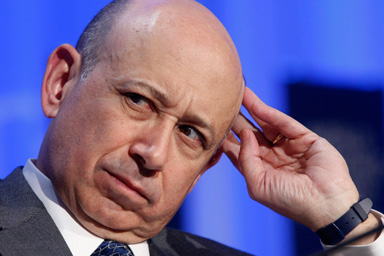
It wasn't Wall Street's faultGoldman Sachs Group CEO, Lloyd Blankfein, looks on as he attends a session at the World Economic Forum WEF in Davos January 24, 2008.

In this interview, Goldman Sachs CEO Lloyd Blankfein discusses his astronomical bonuses, the mistakes and failures of his bank prior to the start of the global financial crisis and his proposals for better regulating financial markets.

Mr. Blankfein, two years ago, your $67.9 million bonus was the largest ever paid to a Wall Street banker. You recently said that you could understand the anger that people are expressing over inflated bonuses. How are we to understand this?

I think people legitimately question whether compensation is tied to performance and, looking back, they see that some people were enriched but did not seem to have any alignment with their shareholders. A large part of the compensation paid to our senior people, including mine, is paid in shares, which may be worth less or more depending on our performance well after they were granted. This is what our shareholders want and we are convinced of this alignment of interests.

Still, $67.9 million is an astronomical sum. Is there any way to justify this?

Our board of directors sets the pay of our most senior executives, including mine. They tie pay to the firm’s performance and I believe we have established a strong track record of correlating growth in revenues to growth in compensation. The real test is whether compensation is reduced when performance changes. For example, in 1994, the firm made a loss and the partners had to pay money back to the firm so that the staff could be paid. And, in 2008, which was a very difficult year as you know, I was paid no bonus, even though the firm was profitable.

That all sounds very rational. But don’t such payments promote greed as the primary motivator?

I think we all know that greed can drive behavior, but it tends to be short-term and ultimately destructive. Our leadership team stands out because most of our people have built their whole career at the firm and stayed through many years and many changes in the market. When our people leave they tend to go on to other positions — whether in government or other forms of public service — that no one would do if their motives were financial. Those characteristics don’t make me think of “greed.”

So only modest, good people work for Goldman Sachs? We hardly believe that.

I have stated my honest view of things.

This week in Pittsburgh, the G-20 will discuss stricter regulation of bonus payments. Based on what you have said, you believe that such efforts will do nothing to prevent future crises?

That is not what I said. The incentive aspect played a role in the crisis, but it was not the primary cause — I think you have to look at the macroeconomic backdrop, the concentrations of risk in certain institutions and the fact that many, including regulators, should in hindsight have had better information and acted sooner to address capital and liquidity shortfalls.

One gets the impression that the issue of bonuses is mostly a problem of image for you. A few weeks ago, you called on your employees to act more modestly, in order not to draw undue attention to themselves in a time of government bailouts for banks. “Spend like a pauper,” was the headline in one U.S. newspaper.

That’s not exactly true — I didn’t send that message then, but it almost doesn’t matter. We are in the public spotlight. And, in any event, I think it is bad form to be ostentatious.

If you don’t consider a change in the rules regarding bonuses to be a central element for the establishment of a sustainable financial system, then what would you propose?

The system needs more capital, less leverage and, above all, greater transparency. The balance sheets of the banks must clearly depict and properly measure their risk exposures. What good does it do to mandate capital adequacy if there is no real indication of the bank’s available capital and total risks?

You are talking about the billions in off-balance sheet financial transactions conducted by the banks. They are counted among the primary reasons for the crisis, because enormous amounts of junk mortgages were bought on credit without capital backing. Have we seen the end of this era?

I think it is over. But off-balance sheet trickery was also the big problem at Enron …

… the U.S. energy company that went bust in 2001. Why didn’t anyone learn from the Enron debacle?

We learned — a few others did too.

So Goldman Sachs never engaged in off-balance sheet business?

At our bank, every transaction, and thus every risk that we take, is recognized on the balance sheet and the income statement because we use mark-to-market accounting. This is not the case at every bank. And this is one reason why companies fail.

Stronger capital bases and deeper debt ratios might indeed be the right measures to render banks less prone to crisis. But, at the moment, we are experiencing the opposite. Many institutions are still suffering from a capital shortage. Accounting standards have been relaxed. When will be the right time to turn this trend around?

First, we will have to go through a period of transition and economic recovery. We are not there yet.

Where do we currently stand in this process?

Today, we can debate the rules that will be introduced in 2012 or 2013. I would design a system under which all risks are recognized at market value on the balance sheet and income statement.

The time frame to turn the trend around may be quite small. If the lax rules remain in force too long, the next bubble could be allowed to inflate.

At Goldman Sachs, we already mark our assets to market daily, and have a capital ratio of 16 percent. So, it’s easy for me to say: “Let’s start with the new rules today.” But, the rest of the system may not be able to handle such requirements.

Even Goldman Sachs cannot survive without competitors and other market participants.

You’re right, we cannot live without a healthy system. In the days after the collapse of Lehman Brothers, when everyone was panicking, we received $5 billion from Warren Buffett and then raised $5 billion from public equity investors. But, we couldn’t make ourselves healthier than the system. Those who fail to recognize that the aid given by governments to the financial system benefited everyone are deluding themselves.


You say that Goldman did things better than many others in advance of the crisis. What was your biggest mistake?

Goldman Sachs has traditionally been strong in business with mergers and acquisitions. We also provide financing for acquisitions by companies …

… and through private equity funds, which shortly before the crisis financed corporate takeovers at astronomical prices using almost exclusively borrowed money.

When this market for so-called leveraged finance was booming, we wanted to remain competitive and maintain our market share. We extended even larger lines of credit to our clients and did so at the same time as lending terms were getting easier. When companies like Chrysler began to falter, we acted quickly, but we did not act quickly enough, which was a mistake.

Was that your only mistake?

Another area where we didn’t act fast enough was real estate. We recognized that property markets were eroding, but we didn’t realize how bad things would get or how quickly the decline would happen.

How did the massive excesses in the real estate market come to be in the first place?

Owning a home is part of the American way of life. And the dream of home ownership was furthered politically, through tax deductions for mortgage payments and the easing of credit terms, to give two examples.

But, without cheap money from the Federal Reserve Bank, the U.S.’s central bank, the real estate bubble would never have been possible.

I will not dispute that easy money policies contributed to the crisis, but they were not the only cause. There were many reasons, and it is difficult to rank them in order of significance.

Will we see a significant rise in inflation over the next five years?

The central banks are currently pumping liquidity into the markets, and thus consciously accepting inflationary risks. At the same time, however, they are also bolstering the economy. And, do you know what? It may just be that these people are doing an extraordinarily good job. Still, it is risky. If the surplus liquidity is not siphoned off soon enough, inflation will result. But I would not discount the possibility that the central bankers are doing exactly what needs to be done.

Do you invest in gold?

I am not bullish on gold.

Another problem of the financial system is the sheer size of the banks. What should politicians do to prevent a systemic crisis, like what resulted after Lehman, in the event of another bank failure?

If I were a regulator I would establish an early warning system to ensure timely identification of accumulating risks. The basis for this should be effective accounting to reflect the value of securities at market prices. As a matter of fact, I think that this alone would almost suffice as an early warning system. I would also regularly meet with my colleagues from other countries to discuss tendencies and trends in the markets and the financial industry — again with the aim of recognising irregularities as quickly as possible. Moreover, I would require the banks to maintain more capital. I would also want to establish a resolution process for a troubled bank — the equivalent of a quarantine room — so that the problem couldn’t spread.

How do you foresee that happening?

With that, I mean a system or institution under whose umbrella a beleaguered bank can be temporarily saved. This institution would ensure that the bank is able to meet its obligations — and that it doesn’t trigger a conflagration.

Wouldn’t it be much easier to simply limit the size of banks? After all, the danger of systemic contagion is less when the banks are smaller.

So what is “too big to fail”?

When a bank is so large that in the event of insolvency, it could take the entire financial and the entire economic system along with it into the abyss. The state would then rescue the financial institution with taxpayer money.

The size of the bank is not the most important factor. Whether a certain risk is bundled at a single bank or spread across several is completely irrelevant. That doesn’t diminish the size of the risk. In fact, this would only change the problem from “too big to fail” to “too many to fail.”

Wouldn’t another way to avoid such crises in the future be a reinstatement of the Glass-Steagall Act, which stipulates the strict differentiation of banks that accept customer deposits from investment banks, which can, among other things, develop, sell and trade in highly speculative capital market products?

No, I think you are assuming that this crisis was caused solely by highly complex derivative products. It wasn’t. Just look at a typical bank balance sheet. Most banks value their loans at the price at which they were issued. This applies to corporate and consumer loans, mortgages and credit card debt. All seemingly bread-and-butter transactions. And then there are a few derivatives and some more complex products.

What are you trying to say with that?

This crisis was not just caused by complex derivatives.

What caused it then?

Too much money was lent to people who had bitten off more than they could chew. When the bubble burst and recession hit, default rates went through the roof

When will the recession be over? Will the growth curve be shaped like an L, or a V or a W?

I think that we are returning to health and that growth will begin to pick back up. Emerging market countries have held up better than any of us expected in the crisis, which will also fuel growth. But despite the initial signs of recovery, there will be more job cuts — and that will have an impact on the sentiment of the people. Consequently, we have to be prepared for setbacks. However, I am generally optimistic.

Will all of the measures now being implemented by politicians really be enough? Or will it take something like a new morality in your industry?

I think so. As an industry we have an obligation to constantly reassess the way in which we do business. We have an obligation to ensure the safety and soundness of the financial system. We have an obligation to our clients and to society as a whole.

Isn’t it necessary for you to demonstrate your social responsibility once again in the wake of this crisis?

I agree with you 100 percent.

This article has been provided by Der Spiegel through a special arrangement with Salon. For more from Europe’s most-read newsmagazine, visit Spiegel Online or subscribe to the daily newsletter. 

Iraqi prime minister: Obama has “right time frame” for withdrawal

Read the interview with Der Spiegel in which Nouri al-Maliki backs Barack Obama's timetable for leaving Iraq.

  • more
    • All Share Services

Der Spiegel: Mr. Prime Minister, the war and its consequences have cost more than 100,000 lives and caused great suffering in your country. Saddam Hussein and his regime are now part of the past. Was all of this worth the price?

Nouri al-Maliki: The casualties have been and continue to be enormous. But anyone who was familiar with the dictator’s nature and his intentions knows what could have been in store for us instead of this war. Saddam waged wars against Iran and Kuwait, and against Iraqis in the north and south of his own country, wars in which hundreds of thousands died. And he was capable of instigating even more wars. Yes, the casualties are great, but I see our struggle as an enormous effort to avoid other such wars in the future.

Spiegel: Large parts of Iraq’s assets abroad remain frozen — and inaccessible to creditors. Now, victims of the Saddam dictatorship want that money to go toward reparations. What will happen to this money when the United Nations Security Council mandate for Iraq expires at the end of this year?

Maliki: We have hired several international law firms to deal with these assets. At the moment, they are protected by U.N. resolutions, American law and the personal commitment of President George W. Bush — and we want this protection to remain in place after the end of U.N. mandate on Iraq. We consider the claims being lodged against this money to be unjustified. Iraq cannot be punished for crimes that were committed by the dictator. This is very important to us and a key aspect of our negotiations over the future status of U.S. troops in Iraq.

Spiegel: Germany, after World War II, was also liberated from a tyrant by a U.S.-led coalition. That was 63 years ago, and today there are still American military bases and soldiers in Germany. How do you feel about this model?

Maliki: Iraq can learn from Germany’s experiences, but the situation is not truly comparable. Back then Germany waged a war that changed the world. Today, we in Iraq want to establish a time frame for the withdrawal of international troops — and it should be short. At the same time, we would like to see the establishment of a long-term strategic treaty with the United States, which would govern the basic aspects of our economic and cultural relations. However, I wish to reemphasize that our security agreement should remain in effect in the short term.

Spiegel: How short term? Are you hoping for a new agreement before the end of the Bush administration?

Maliki: So far the Americans have had trouble agreeing to a concrete timetable for withdrawal, because they feel it would appear tantamount to an admission of defeat. But that isn’t the case at all. If we come to an agreement, it is not evidence of a defeat, but of a victory, of a severe blow we have inflicted on al-Qaida and the militias. The American lead negotiators realize this now, and that’s why I expect to see an agreement taking shape even before the end of President Bush’s term in office. With these negotiations, we will start the whole thing over again, on a clearer, better basis, because the first proposals were unacceptable to us.

Spiegel: Immunity for the U.S. troops is apparently the central issue.

Maliki: It is a fundamental problem for us that it should not be possible, in my country, to prosecute offenses or crimes committed by U.S. soldiers against our population. But other issues are no less important: How much longer will these soldiers remain in our country? How much authority do they have? Who controls how many soldiers enter and leave the country and where they do so?

Spiegel: Would you hazard a prediction as to when most of the U.S. troops will finally leave Iraq?

Maliki: As soon as possible, as far as we’re concerned. U.S. presidential candidate Barack Obama talks about 16 months. That, we think, would be the right time frame for a withdrawal, with the possibility of slight changes.

Spiegel: Is this an endorsement for the U.S. presidential election in November? Does Obama, who has no military background, ultimately have a better understanding of Iraq than war hero John McCain?

Maliki: Those who operate on the premise of short time periods in Iraq today are being more realistic. Artificially prolonging the tenure of U.S. troops in Iraq would cause problems. Of course, this is by no means an election endorsement. Whom they choose as their president is the Americans’ business. But it’s the business of Iraqis to say what they want. And that’s where the people and the government are in general agreement: The tenure of the coalition troops in Iraq should be limited.

Spiegel: In your opinion, which factor has contributed most to bringing calm to the situation in the country?

Maliki: There are many factors, but I see them in the following order. First, there is the political rapprochement we have managed to achieve in central Iraq. This has enabled us, above all, to pull the plug on al-Qaida. Second, there is the progress being made by our security forces. Third, there is the deep sense of abhorrence with which the population has reacted to the atrocities of al-Qaida and the militias. Finally, of course, there is the economic recovery.

Spiegel: Critics have accused you of striking harshly against the Mahdi army of Shiite leader Muqtada al-Sadr, while going easy on his rival Ayatollah Mohammed Baqir al-Hakim’s Badr militia.

Maliki: That’s not true. We proceed just as firmly against anyone who breaks the law. Just a few days ago, we had an incident with a group associated with the Badr people. The army moved in immediately and arrested them all. No one was spared. The punishment is based purely on the nature of the crime, not on the identity of the criminal.

Spiegel: In southern Iraq, where you come from, you have been compared with Saddam Hussein when it comes to harshness.

Maliki: That’s the sort of thing that people say who don’t understand how urgently Iraq needs stability — or these people prefer instability. We don’t want to spread fear and terror in Iraq. We have, for example, given the militias several deadlines to hand over their weapons. Their resistance was tremendous, so we had to oppose them with tremendous force of our own.

Spiegel: What role do you envision for your chief rival, Muqtada al-Sadr? Can there ever be national reconciliation in Iraq without his participation?

Maliki: You can only reconcile with someone who wants to reconcile. His Excellency Muqtada al-Sadr can be a political partner, especially if, to that end, he draws on the great spiritual legacy he has inherited from his ancestors. He has understood that his following was eventually infiltrated by criminal elements, by men from the former regime, al-Qaida people and others. The fact that he is now in the process of systematically separating himself from these elements makes him even stronger as a political partner. As a politician, I might add, not as a militia leader.

Spiegel: You spent part of your exile in Iran, and you have visited the country several times since you took office. Can you explain to us what the leaders in Tehran are up to? Are they building a nuclear bomb? Do you see this as a serious threat?

Maliki: I have not been made privy to the details of the Iranian nuclear program. Iranian representatives assure us, however, that this program serves peaceful purposes. Even if Tehran wanted to develop a nuclear weapon, it would take a very long time, simply from a technical standpoint. It is obvious that our region is far too fragile for even a single country to possess nuclear weapons, because it will always be an incentive for other countries to also build their own.

Spiegel: Exactly 50 years ago, the monarchy in Iraq was overthrown and a republic established. But we didn’t see any celebration of this event at all. What does that day mean for the history of Iraq?

Maliki: There may have been people who celebrated. But certainly not all Iraqis. On July 14, 1958, an era came to an end, but what came afterward didn’t live up to our expectations and hopes. What came were decades of military putsches and the dictatorship. We are still dealing with the aftermath today.

Spiegel: Mr. Prime Minister, your job is probably one of the most dangerous a politician can have. How do you cope with this, and what do you do to make it bearable?

Maliki: I lead a very simple life — one that is shaped by external forces, which is apparently what fate has determined for us Iraqis. In that regard, the past few decades of dictatorship have not changed all that much. What keeps me going? The constant exertion of my job — and the successes we are now having. It means a lot to me to see how much closer we are today to a democratic Iraq, one that respects human rights, than we were only a few months ago.


This article has been provided by Der Spiegel through a special arrangement with Salon.

Continue Reading Close