Megan McArdle

Can we sue our own fat asses off?

Flush from their victory against Big Tobacco, activists are now gunning for the purveyors of junk food.

  • more
    • All Share Services

Can we sue our own fat asses off?

We celebrated World Health Day last month. The Centers for Disease Control and Prevention (CDC,) one of the official U.S. sponsors of World Health Day, says it decided to make this year’s theme “Move for Health,” which seems to be its polite way of telling us to haul our fat carcasses out of the Barcalounger and get some exercise.

The CDC probably felt it had to do something. A recent report from the surgeon general tells us what we already knew if we’d spent any time at a shopping mall: as a nation, we’re pushing maximum density. Headlines called it “an epidemic of obesity,” and the report certainly threw around some epidemic-sized numbers. Sixty-one percent of adults are overweight or obese, and the number of obese children has tripled in the last 20 years. Underneath the eye-popping statistics was an even scarier assertion: All that extra padding is costing us a lot of money.

$117 billion, to be exact, is the surgeon general’s estimate for the cost of healthcare and lost wages from obesity-related illness. And that doesn’t include any money spent at The Forgotten Woman or Jenny Craig.

In the face of this, declaring April 7 “Move for Health Day” seems hardly adequate.

But when it comes to weight loss, our public efforts mirror our private ones. Which is to say that we’re happy to do the easy things: advertising campaigns and feel-good gestures like World Health Day. Unfortunately, the easy gestures aren’t much more effective than the magic weight-loss pills or electric abdominizer gizmos gathering dust in our closets. After all, if advertising could make people embark on a fitness regime, surely the steady barrage of emaciated models in every commercial or print ad would have done the trick. Yet when it comes to the harder, more effective choices, such as raising the cost of food, or ancillary goods like healthcare, our will fails us. We bypass the obvious in search of a painless solution.

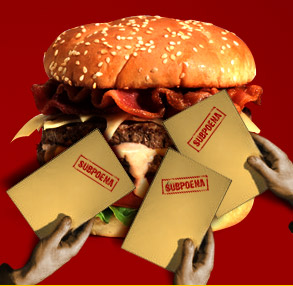
Lawyers and activists, flush from the tobacco victories, think they have found one: Sue the companies who sell us the junk we overeat. They talk about recovering the costs of obesity-associated diseases. But the real hope is that by going after the companies, they can force changes in price and marketing that will, in turn, force us to stop eating so much junk food. Corporations, after all, are much easier to regulate than the fractious individuals targeted by most public health campaigns.

There are a lot of reasons why the new legal strategy is unlikely to work. Fast food isn’t as easy to pinpoint as a killer as tobacco, and legal experts can point to an additional array of factors that will make finding corporate scapegoats for obesity far more challenging than bringing Philip Morris to heel. There are a host of legal issues, they say, that will make it difficult to even get such cases heard in front of a judge. And aside from legal strategems, successfully suing the likes of McDonald’s and KFC will require a dramatic shift in the way the public thinks about overeating — taking the focus off the individual’s responsibility for what he eats, and placing it on those corporations.

But we may be seeing the beginnings of that shift in two recent books: “Fast Food Nation,” by Eric Schlosser, and “Food Politics” by Marion Nestle. Both have advanced the argument that the way food companies manufacture and market their products makes them bear serious responsibility for our current crisis. And now George Washington University Law Professor John Banzhaf, a veteran of the tobacco battles, has publicly declared that he thinks it possible to sue companies like McDonald’s for misleading advertising, for failure to warn about the health dangers of their products and, if public opinion swings his way, for, well, making us fat.

If Banzhaf is right, we should all be nervous. Because if such cases do make it to court, they could be devastating. The economic costs alone are potentially staggering, and not just to the companies involved; the increased liability risk to all companies would almost certainly mean rising insurance premiums and interest rates, lowered profit margins and stifled innovation for fear of litigation. Not to mention the cost to our sense of justice. If you can’t be held responsible for what you put in your mouth, what are you responsible for?

Dr. Diana Berger, a public health expert specializing in obesity, notes that there are two obvious ways to make a difference in what people eat, both of which will require legislation or litigation to enact. The first is closing the information gap: letting people know about the 1,200 calories before they order their meal. And the second is what any economist could have told you: Raise the price. We turn to fast food, after all, not because it’s good, but because it’s fast and cheap.

But trying to make such a change legislatively is tough. In California, where they’ll try anything, a state legislator has introduced a bill to put a 2-cent tax on every can of soda. Now, imagine yourself in the 7-Eleven, your hand hovering between the bottled water and the carbonated sugar syrup, paralyzed by indecision. Suddenly you notice that the can of soda is 2 cents more. Decision made. You grab that bottle of spring water and march it triumphantly to the register.

You get my point: The proposed tax is too small to do much good. Oh, sure, there will be someone who doesn’t have the extra coins on the day the “give a penny, take a penny” jar is out of service. But when 61 percent of a nation as rich as ours is overweight, adding 2 cents to the price of a soda is like rearranging the deck chairs on the Titanic.

Stronger measures are bound to meet stiff opposition. Every measure designed to tax that 61 percent into giving up their high-calorie treats will catch the almost 40 percent who aren’t overweight in its dragnet — which by my calculations makes almost 100 percent of voters eager to get rid of the politicians who made them pay extra for their Big Mac attack.

Which brings us to litigation. When the tobacco suits were first brought, critics charged that the legal reasoning behind them could be applied to almost any product that was bad for you, like, say, fast food. At the time, the plaintiff’s attorneys said that this was ridiculous, a bit of grandstanding from tobacco industry apologists. Now that an anti-tobacco lawyer is training his sights on fast food, however, it seems that the slippery slope really is steep — and dangerous. All the legal experts I talked to agreed on one thing: After tobacco overturned years of legal precedent, you can’t say any lawsuit is impossible.

“After all,” said David Leebron, dean of Columbia Law School and a specialist in torts, “the great mystery of the tobacco suits is why they settled. The law seemed to be on the side of the companies.” He points to public opinion and government intervention as major forces in the capitulation. As state governments began changing their laws to make it easier to sue, and state attorneys general got involved in the suits, the companies’ risks began to rise dramatically, even as the public’s opinion of them declined.

Companies manage risk by weighing the probability of a given event, such as an earthquake or a windfall profit or, yes, a lawsuit, against the money to be gained or lost. Such calculations tend to break down, however, when a single event is both unpredictable and catastrophic; that’s why frightened insurance companies stopped offering terrorism coverage in the wake of 9/11. That’s also why tobacco companies seem to have decided to settle. With lawsuits piling up and no end in sight, they had to face the risk that, even though the law was on their side, a jury might return a verdict that would bankrupt them. This cataclysmic possibility made even an expensive settlement attractive. If such suits could be brought against the food industry, they could follow a similar course.

So the question is: Can such suits get a toehold?

Banzhaf is cautiously optimistic. He describes four different kinds of suits that could be brought, ranging from easy to difficult. The first and easiest kind is for false advertising or labeling. In fact, such suits are already being brought, notably against the makers of Pirate’s Booty brand snacks, for allegedly misrepresenting the fat and calories in their product. Another, slightly more challenging type is suing for misleading advertising; sue the manufacturer of, say, Fruity Nutrition Puffs for implying that their sugar-kibble is healthy. More difficult still are suits for “failure to warn”: sue McDonald’s for not telling you the calorie and fat content of that super-sized Big Mac meal they’re trying to sell you. (The answer, by the way, if you order a diet soda and no dessert, is 1,200 calories and 63 grams of fat. No wonder we’re gaining weight.)

But it is the fourth category of lawsuits that presents the possibility of making radical changes in the food industry, and thus radical changes in the way we eat: suing the companies to recover the costs of our national fat problem. Such suits would be very difficult to bring. But they’re also the most likely to actually make a dent in our waistlines.

Litigation lets public health advocates sidestep the messy process of attempting to regulate bad behavior and forces companies to make the changes in marketing and price that Dr. Berger suggests will change our habits.

If, that is, courts will allow the suits to be brought.

Eric Schlosser, who is certainly no fan of fast food companies, questions whether lawsuits are the answer. “It wouldn’t be my first choice,” says Schlosser; moreover, he doesn’t think it’s necessary. “Fast food companies could actually change their behavior rather easily. Tobacco companies can’t really change what they sell — it’s addictive, and dangerous. Fast food companies could just change the recipe to grilling instead of deep-frying and have a profound impact on the healthiness of what they’re selling.”

Litigation faces some hefty obstacles, as well. One of the biggest problems with class-action suits is that they increasingly rely on juries to make decisions where they’re simply not qualified to judge. As the O.J. Simpson trial demonstrated, juries confronted with complex evidence they don’t understand often just tune out. “What the juries see are dueling experts,” says Professor Leebron. “It’s very hard for a lay person to determine what the right answer is. The problems are extremely complex, and jurors often don’t have the background to evaluate competing claims.”

Unable to judge on the merits, juries often resort to emotion. This is why professor Aaron Twerski, a product liability specialist at Brooklyn Law School, thinks the tobacco suits succeeded: “A lot of what happened in tobacco is that the lawyers were able to demonize the defendants, because the consequences of using their products were so horrendous.”

Our legal system depends on judges to restrain those appeals to emotion, by refusing to certify class actions that don’t meet minimum legal standards, or by overturning outsized verdicts on appeal. This is where most legal observers expect food industry suits to fall down.

It will also be very tough even to establish sufficient causation to file such a suit. Berger says that obesity is only 60 percent environmental; the other 40 percent seems to be genetic, which places a heavy burden of proof on anyone suing McDonald’s. Moreover, tobacco is overwhelmingly linked to lung cancer; the health effects of excess weight are broader, but harder to trace to a single cause. Then there’s the “empty chair” problem: the difficulty of suing one party when other, responsible parties aren’t in the courtroom. Tobacco litigation was helped by the extreme brand loyalty of smokers, which meant only one company to put in the dock. Unless trial lawyers discover a hitherto unsuspected band of strip-mall dwellers who subsist only on Kentucky Fried Chicken, anyone suing a food company for their weight problem is going to face an empty chair that metaphorically seats thousands, from the owner of the donut shop down the block to the neighbor who brings over those divine homemade brownies.

And if you get those cases to court, you immediately have to face the issue of how to allocate responsibility between the individual and the thousands of companies from which they’ve purchased food over their lifetimes. No, it won’t be easy.

Nor will the suits pull the kind of political weight that the tobacco cases did. Remember, one of the major factors in the tobacco settlements was the state governments and attorneys general. But smokers are only 25 percent of the population; the overweight and obese not only constitute a majority, but also have a vocal advocate in the fat acceptance movement. Furthermore, almost every American eats something that would become more expensive as the result of any settlement. Attorneys general are political creatures; even with the prospect of a juicy monetary award, it would be a challenge to get them to sign on.

But even with all these persuasive arguments, legal scholars still aren’t sure that obesity lawsuits are an empty threat. Judicial culture, says Twerski, has been shifting away from strictly enforcing the standards that could keep such cases out of court and toward letting the jury decide — juries that, as already noted, have difficulty making decisions on the legal and scientific merits. Now with the public health establishment pushing us to view obesity as a disease rather than a choice, we’re moving ever closer toward an environment where such suits could become a reality.

Which means we should start worrying now. Never mind the question of whether fast food is good or bad for you. Never mind the fear that we’ll litigate some of life’s basic pleasures out of existence.

Let’s talk money.

The kinds of risk assessments that forced the tobacco companies to settle, even though the law seemed to be on their side, are performed every day by companies all across the country. Those risk assessments are a big part of the decisions they make about whether to invest in new technologies, make new products or build new plants — the innovations that improve the quality of life for everyone. Clearly, if those companies are considering investing in, oh, an atomic death ray, we want them to be restrained by thoughts of liability. But if liability is expanded too far, such thoughts can do more damage than good.

If a company can be sued because someone took a perfectly legal product and, through overuse, harmed themselves and cost the taxpayers money — well, would you risk making a new product if your customer’s misuse could bankrupt you? Would you want to sell any product that was even moderately likely to be misused? It’s tempting to dismiss such fears by saying that the economy won’t crash because we missed out on the next Mrs. Field’s cookies — but what about the next automobile, or the next aspirin? As the tobacco suits have shown, any precedent set here will extend far beyond this industry.

So while some may be tempted to root for Banzhaf — and others to dismiss him as a latter-day Don Quixote — ultimately we can do neither. We have to seek less drastic ways to address obesity. And we have to take a long, hard look at both the legal and the legislative system, and ask how, and why, these suits might succeed. Otherwise, someday someone’s long-shot lawsuit could send us all to the poorhouse.

Netscape’s folly

The loser in the browser wars has filed a private antitrust suit against Microsoft. But the company doesn't deserve to win.

  • more
    • All Share Services

Netscape's folly

Like many other technology professionals, I’ve followed the Microsoft antitrust saga the way some people follow soaps. So when the Supreme Court refused to hear the case, I confess I was secretly a little disappointed. The Court left us with an appellate court ruling that, well, just lacked drama. The ruling split the difference between Microsoft’s allegations of innocence and Judge Jackson’s sweeping, “Hang the swine from the yardarms!” district court decision.

Microsoft, the appellate court declared, is a monopoly engaging in anti-competitive practices, but that doesn’t make its every strategic move illegal; nor did the court call for the corporate equivalent of capital punishment. With this, the court handed the case back to the lower court with some no-nonsense instructions to find a less radical solution.

Show’s over; Microsoft will live. Everybody go back to arguing about sports.

Legal observers, however, were not fooled: the antitrust case might be over, but the door was wide open for civil suits. Sure enough, Netscape soon stepped through with a civil filing claiming treble damages — and I happily anticipated at least a few more years of wrangling over technical and economic arcana.

Alas, the complaint offers little in the way of argument. Instead, Netscape tries to play on our natural sympathy for a scrappy little company that’s been bullied to death. The lawyers can’t let more than a few paragraphs pass without reminding us that in 1995, Netscape had 70 percent of the market for Web browsers. This fact is reiterated in an indignant tone, as if that share is no more than Netscape’s right.

In other words, Netscape isn’t mad that there’s a monopoly dominating the market for Web browsers; the company’s mad because that monopoly isn’t Netscape.

Of course, you’d be mad, too. Battling Microsoft in the software market is like trying to beat the house at blackjack: The game’s rigged against you from the start. The tactics used to keep Netscape off the desktop would have made protection racketeers blush. If Microsoft couldn’t intimidate customers into signing exclusive agreements with its control of the vital Windows software, it made them sweetheart offers they couldn’t refuse. The complaint leaves no doubt that Microsoft acted in many ways, most of them illegal, to prevent third-party vendors from installing Netscape.

But there it rests. Netscape has proved that Microsoft engaged in anti-competitive behavior; it’s proven that during this time its own market share dropped faster than Milli Vanilli’s. Presumably the lawyers are hoping we won’t notice that they haven’t proved the one thing they need to: that the dirty tricks caused the collapse.

It’s tempting to go along; after all, the tricks were dreadfully dirty. But correlation is not causation, as any first-year statistics student will tell you. To believe that those shenanigans are the source of Netscape’s troubles, you need to make two giant assumptions: First, that the mere placement of an icon on a desktop — or its absence — can win or lose a market. And second, that Internet Explorer was inherently inferior to Netscape. Neither of these assumptions holds water.

The first argument requires us to accept, without proof, that the majority of computer users are either awfully lazy or awfully dim. So lazy or dim, in fact, that they will use whatever software happens to be installed on their computer, regardless. Yet if this is true, why has Microsoft lost so much money on MSN and Microsoft Money, both of which occupied prime desktop real estate for years?

Because AOL and Quicken were better, that’s why. Even though they had to make a special effort to do so, users sought out the non-Microsoft products because they preferred them. And though you may not remember this, the same thing happened to Internet Explorer in its first few years of life. Microsoft didn’t make any headway in the browser market until it came out with a decent product: Internet Explorer 4.0.

There is an argument to be made that Explorer is different because other products aren’t integrated with the operating system in the same way. But I can attest, from years as a computer consultant, that from the point of view of the consumer there’s little difference between the browser and MSN — it’s damn near impossible to get either of them off your machine once they’ve been installed. Yet users keep right on switching to AOL, because it’s better.

Which brings us to the second assumption that Netscape needs us to make: that Microsoft’s technology was inferior to Netscape’s. After all, if Internet Explorer had been better than Netscape, Microsoft would have won anyway. And in that case, there are no damages for Netscape to collect on.

Even a technology that was merely equal to Netscape’s is not sufficient to make its case, because the software market is so dominated by network effects. For those who aren’t familiar with the term, “network effects” refers to the fact that many products become more valuable to their users with each additional user who adopts them. It’s no good having a fax machine unless someone else you know does too. These effects often allow a single product, like Windows, to dominate its market, because users want their software to be compatible with everyone else’s. In the case of the market for browser software, the network effects stem not from the users but rather from the Web designers, who prefer to write code for a single platform. This is why most people think that over time one browser would have predominated even without the market mischief.

This is key. If the products were equal, then it was 50/50 which firm would dominate — which means that the “lost” revenues for which Netscape wants damages weren’t probable, or even particularly likely. That’s why Netscape needs us to believe that Explorer was so bad that no one would have used it unless they had been, well, tricked. Many of those pushing this idea cite wide support in the technical community, a large chunk of which hates both Microsoft’s practices and its products.

Back in my days as a consultant, I often had to fight for projects with the client’s Unix administrators. I spent long hours passionately defending my platform against opponents whose arguments ran along the lines of “Unix is just better.” Eventually, inevitably, each opponent opened his mouth with a self-satisfied look that told me it was coming: The Question. At every client, every Unix guru asked the same damn thing when he wanted to forestall argument: “Would you rather run your heart/lung machine on my platform or yours?”

Then one day, my back to the wall, I had an epiphany. “Yours,” I replied. “But I’m not building myself a heart/lung machine. I’m building an application server for Marketing. And your design costs five times as much.”

He closed his mouth.

I tell you this not to illustrate my rapier wit, but to demonstrate that you can’t talk about a technology being “better” without discussing what it is you want that technology to do. The Ferrari Testarossa may embody the finest in modern automotive engineering, but it’s not much good for hauling the kids to soccer practice.

Technology people like certain things in a system. Above all they prize reliability, followed by powerful, elegant code. Because Microsoft doesn’t do well under this set of standards, they leap to the conclusion, as Netscape wants us to, that Microsoft’s unsavory practices explain its market power. But that is begging the question. If Microsoft’s software is so bad, how did it get that power in the first place?

Unsurprisingly, ordinary consumers don’t value the same things tech people do, any more than you buy the same groceries as Julia Child. For ordinary users reliability takes a back seat to two features that neither Apple nor Sun can match Windows on: the availability of software and, most especially, the price. You just can’t buy a system from either company for $1,000 — but you can buy a really decent PC.

This price disparity has held for the entire history of the PC industry. While low price can’t overcome an awful product — no matter how little I charge for it, people aren’t going to listen to any hip-hop album cut by me — it is decisive if the products offer otherwise acceptable tradeoffs. That’s how Microsoft made such inroads into the browser market, though you wouldn’t know it from the complaint, which somehow omits one of the most powerful features Microsoft put into Internet Explorer.

It’s free.

I mentioned before that, as with my imaginary hip-hop album, Microsoft literally couldn’t give away the first three versions of Internet Explorer. It was received wisdom that Microsoft would never catch up, right up until Microsoft released IE 4.0. Oops. Most users couldn’t see much difference between it and Netscape — and while Netscape cost $40, IE 4.0 was on the house.

Netscape couldn’t compete. Oh, eventually Netscape stopped charging for its browser, which slowed the decline in market share. But it’s hard to see how that helped, really. It’s the old economist’s joke: “We’re losing money on every unit, but we’ll make it up in volume!” Netscape’s core product cost an enormous amount to develop and generated no direct revenue — and with Microsoft breathing down its neck, Netscape didn’t dare stop building the next generation of product.

Nor were losses limited to browser revenue. When Microsoft became a viable competitor, the other revenue streams on which Netscape had counted — such as selling server software that was as tightly integrated with its browser as IE is with Windows, and leasing prime space on its product to portals like Yahoo — became more competitive and therefore much less valuable. With a good competing free browser on the market, Netscape simply couldn’t make enough money to survive.

Many observers call that predatory pricing, a highly illegal tactic whereby a company sells its product below cost in order to drive its competitors out of business so it can then jack up prices even higher. There are extensive arguments and counterarguments as to whether Microsoft’s behavior fits the description, but ultimately they’re irrelevant, because Netscape doesn’t mention pricing in the complaint.

Predatory pricing is the first of three main arguments advanced to explain how Microsoft unfairly competed against Netscape. The second argument is that Microsoft abused its control over the OS code, pre-empting a long standards battle by incorporating key code into Windows. This argument is compelling, which is why, as readers may recall, the court ordered Microsoft to separate the browser from the OS.

Many critics go further, alleging that Windows programmers deliberately inserted code to sabotage Netscape’s performance, but most such rumors seem to peter out into the friend-of-a-friend-of-a-friend of urban legend. And ultimately Microsoft’s technical escapades don’t matter either; the complaint makes no mention of them.

The third argument, of course, is the leverage that Microsoft exerted on its distribution network. As we’ve seen, while this argument is true, it is not sufficient to explain Netscape’s decline. Yet the complaint presents only this, the weakest claim. It’s hard not to ask yourself: What the heck were the lawyers thinking?

The answer is that they didn’t have much choice. The appellate ruling sharply limited Netscape’s case. While the appeals court did establish the grounds for the suit by ruling that Microsoft had behaved illegally, it sharply restricted the grounds on which Netscape could sue. In particular, the court specifically excluded predatory pricing as a cause of action, which threw out Netscape’s most powerful argument — price — and severely undermined its claims about the browser/OS integration, which, after all, is just another way of giving away the product for free.

Moreover, the civil trial, unlike the antitrust action, will probably be a jury trial. Long technical arguments, which didn’t fare well even in front of the highly educated district court judge, risk alienating the jury. And, as the O.J. trial showed, jurors often ignore evidence they don’t understand. Not to mention that arguing predatory pricing means telling jurors you deserved to win so that … they could pay $40 for something they currently get for free. Not compelling. On the other hand, not only are predatory tactics easy to explain, but they also play into our twin national dislikes: big corporations and sharp dealing.

Stuck between a rock and a hard place, Netscape repeats its sad tale over and over, in the hopes that we won’t ask how, exactly, an icon on a desktop could have been responsible for so much destruction. But we have to ask, because the law demands that lawyers not only tell you how a competitor caused their client harm, but also prove it. Which they can’t, at least not with this argument.

It isn’t fair. Netscape gave us a revolutionary product that has touched the lives of everyone in America, and in exchange we took away its market and made the company a minor subsidiary of AOL Time Warner. But we can’t fix things by exchanging the rule of law for a popularity contest. I know that if it were me I’d be mad as hell — but nevertheless this is one fight that Netscape deserves to lose.

- – - – - – - – - – - -

First of a two-part series on the legal battle between Netscape and Microsoft. Read Part 2.

Continue Reading Close