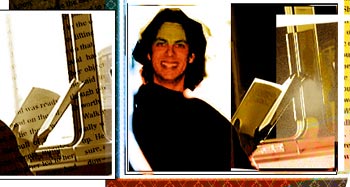
Michael Chabon

Books to snack on

The author of "Wonder Boys" selects a literary menu for blocked writers.

  • more
    • All Share Services

Books to snack on

Apart from my dictionaries — I use two — and other reference works, there are certain books that I like to keep within arm’s reach of my chair. Whenever I find myself fidgeting at the computer, blanking out, having a hard time concentrating — suffering from verbal hypoglycemia — I will reach for something and grab a nice handful: a paragraph, a page, sometimes even as much as a whole chapter. These five are among those that I’m keeping close right now. The stock changes from time to time; although there’s no poetry on this particular list, a “Complete Keats” was a popular snack item for quite some time — and most of my reading of poetry tends to get done at these odd moments.

These books are not necessarily all-time favorites, or even my favorites by their particular authors. In common they all seem to provide a high degree of stylistic nutrition per serving and a strong flavor, I notice, of the past. They’re atmospheric works in which the prevailing mood can be experienced in almost every sentence. I have read them all in their entireties at least twice, and each of them probably another whole time piecemeal.

The English Patient by Michael Ondaatje
This book and its author have such a fine reputation that they verge on the overrated — until you reread the book and remember just how vivid and convincing it is. Intense and highly flavorful. A little Ondaatje goes a long way, though, and this one is perfect for snacking because it’s rather disjointed anyway.

Love in the Time of Cholera by Gabriel Garcma Marquez
This is one of my favorite novels. It’s so dense that no matter how many times I dip into it, I manage to find something startling that I have totally forgotten. The fascinating digression, a signature mannerism of Garcma Marquez, is ideally suited to the literary snacker.

Ada by Vladimir Nabokov
I love Nabokov, but I’m not even sure I like this book. I’ve read it through three times and each time suffered transports of rapture and bouts of severe irritation. “Pale Fire” and “The Gift “are my favorites, with “Lolita” right in there. But somehow none of those novels lends itself to the nosh in quite as satisfying a way as this one. Unlike the other books on this list, with “Ada” I tend to reread the same few parts over and over, in particular the amazing honey-eating scene early in the book, which explains Ada’s system of categorizing experiences as Towers or Bridges.

The White Goddess By Robert Graves
Purportedly nonfiction but richly imaginative (not to say cuckoo), this book with its loopy poetic fervor and virile, sensible, even sober prose style caused me to become fairly demented in high school. It’s a hundred times more dense than the Garcma Marquez, yet supremely readable — Graves is a solid, elegant writer. Impossible not to stumble on some forgotten bit of erudition on the subject of Minoan ritual dismemberment that is just the ticket for a stalled moment at the keyboard.

Up in the Old Hotel by Joseph Mitchell
Maybe it’s partly because I’m writing a book set in the New York of the ’30s and ’40s, but the atmosphere and style of Joseph Mitchell’s sentences, along with a reportorial wealth of facts and information and the finite nature of the essay form, make him ideal for a quick bite.

Personal Best: The Swimmer

"The Swimmer" by John Cheever

  • more
    • All Share Services

i read “The Swimmer” for the first time on my bed in the Maryland suburbs, one winter afternoon when I was sixteen or seventeen. I’d been skimming through a battered paperback anthology my grandfather had passed along to me — “100 Stories Ruined by English Teachers,” I think it was called — starting one after another worn-out old chestnut, quickly moving on, when I reached the famous, classic, puzzling first paragraph that begins, “It was one of those midsummer Sundays when everyone sits around saying, ‘I drank too much last night.’” I knew nothing of such midsummer Sundays, in fact; but I read on, and soon found myself lost in the weird, lovely dreamland of John Cheever’s greatest story.

“The Swimmer” is a masterpiece of mystery, language and sorrow. It starts out, on a perfect summer morning, as the record of a splendid exploit — Neddy Merrill’s quest to swim the eight miles from the house of his friends, the Westerhazys, to his own, via the swimming pools of fashionable Shady Hill — and ends up as a kind of ghost story, with night and autumn coming on, in a thunderstorm, at the door to a haunted house.

Cheever’s mastery lies in the handling of Neddy’s gradual, devastating progress from boundless optimism to bottomless despair, from summer to fall, from swimming pool to swimming pool, no two alike, each described with Cheever’s lyrical precision. This progress Cheever figures through a careful manipulation of the marks of seasonal change — the leaves on trees, the wheeling of the constellations — so that as we read the story we feel time passing, before our eyes; feel Neddy losing heart, growing weary, getting old. The story has mythic echoes — the passage of a divine swimmer across the calendar toward his doom — and yet is always only the story of one bewildered man, approaching the end of his life, journeying homeward, in a pair of bathing trunks, across the countryside where he lost everything that ever meant something to him.

Continue Reading Close