Michael Dirda

The unlikely creator of John Carter

Long before the Disney movie, a failed light bulb salesman began writing stories of Mars warriors and ape men

  • more
    • All Share Services

The unlikely creator of John Carter
This article appears courtesy of The Barnes & Noble Review.

In 1911, Edgar Rice Burroughs, having failed at everything else, decided to write a novel. He was then in his mid-30s, married with two children, barely supporting his family as the agent for a pencil-sharpener business. In earlier years he’d served in the Seventh Cavalry, worked as a rancher and gold miner, started an advertising agency, sold light bulbs and candy and uplifting books door-to-door, and not really made a go of anything.

Barnes & Noble ReviewFor occasional entertainment Burroughs read the early pulp magazines, especially All-Story. Named after the cheap newsprint upon which they were printed, the pulps supplied adventure and romantic fiction to the masses for half a century. By the 1920s and ’30s newsstands around the country would display the lurid and spicy covers of Weird Tales, the Shadow, Amazing Stories, True Confessions, Dime Detective, Astounding, and Black Mask. Pulp writers would include such important literary figures as H. P. Lovecraft, Robert E. Howard, Dashiell Hammett, Raymond Chandler, Robert A. Heinlein and scores of others.

But in 1911 most of the writers weren’t of this caliber, and Burroughs was convinced he could write better adventure stories and maybe even make a living at it.

In fact he rather underestimated himself.

One hundred years ago, in the February 1912 issue of All-Story, there appeared the first installment of “Under the Moons of Mars” (retitled “A Princess of Mars” for its 1917 book publication). It starts, as all good adventure stories should, with a strange manuscript, this one a memoir penned by Captain John Carter and bequeathed to his nephew Edgar Rice Burroughs. The reader is hooked from the very first sentence: “I am a very old man now; how old I do not know.” Over the next several months purchasers of All-Story would learn of the fantastic adventures of this former Confederate soldier. Mysteriously transported to Mars, called Barsoom by its inhabitants, John Carter there battled monstrous beasts and warlike peoples, soon falling in love with the copper-skinned Deja Thoris, Princess of Helium.

The serial, needless to say, was a hit, though no one yet knew that ERB would soon become a phenomenon. His editor at All-Story quickly asked him to write a historical novel, which the obliging author produced in a few weeks, only to have the chivalric romance rejected. Eventually, it would be revised and rejected again. Putting “The Outlaw of Torn” aside, Burroughs took up his own new idea, its action set largely in Africa (where he had never been). Drawing on the classical legends of the heroic Romulus and Remus, who were suckled by a wolf, and adding a touch of Mowgli from Kipling’s “The Jungle Books,” Burroughs created one of the most famous fictional characters of modern times. In the November, 1912 issue of All-Story — only a few months after the conclusion of John Carter’s adventures on Mars — there appeared, published in its entirety, “Tarzan of the Apes.”

Readers went crazy.

They wanted more Tarzan, more John Carter, more Edgar Rice Burroughs. In part, this was because both “A Princess of Mars” and “Tarzan of the Apes” close with dramatic cliff-hangers. At the end of “A Princess of Mars,” John Carter seems to be dead on Earth. Or is he? What of that strange injunction in his will that the massive door of his tomb be “equipped with a single huge gold-plated spring lock which can be opened only from the inside?” At the end of “Tarzan,” the ape-man learns that he is the true Lord Greystoke, but he keeps the knowledge to himself, even though a word would gain him a title and the woman he loves. When asked how he came to be in the jungle, Tarzan says simply: “I was born there. My mother was an Ape, and of course she couldn’t tell me much about it. I never knew who my father was.” The end.

People couldn’t believe it. The selfless hero didn’t get the girl. While there was precedent for such noble sacrifice — think of “The Prisoner of Zenda” — it didn’t hurt that it also left open the possibility of a sequel. Readers pleaded for more tales of Tarzan and Barsoom.

And over the next 35 years they would get them. In 1913, Burroughs would produce “The Return of Tarzan,” in which the ape-man explores the lost kingdom of Opar and eventually marries his beloved Jane Porter. In “The Gods of Mars” and “The Warlord of Mars,” published in 1913 and 1914, John Carter would again face impossible odds to save his alien friends and himself from certain death and to rescue Dejah Thoris from lustful enemies. As if this weren’t enough, in 1914 Burroughs would inaugurate a third series with “At the Earth’s Core,” in which David Innes discovers that the center of our planet is hollow — and inhabited. In Pellucidar, as it is known, Innes will encounter prehistoric beasts, cavemen, and Dian the Beautiful. A few years later, in 1917 and 1918, Burroughs would produce what some critics regard as his best single work, the trilogy about evolution consisting of “The Land That Time Forgot,” “The People That Time Forgot” and “Out of Time’s Abyss”.

Burroughs was clearly on an unbelievable tear, turning out some 30 books in seven years, demanding and receiving top pay rates, and quickly amassing a fortune that would allow him to create a vast estate in what is now Tarzana, California. Soon the ape-man had become a media franchise, with Tarzan movies, toys and comic strips. In 1923 Burroughs even established his own publishing company, which sold only his books, thus cutting out agents and editors. He died in 1950, aged 74, having written 70 novels.

When I was a boy in the late 1950s, the public library refused to stock books by Edgar Rice Burroughs. They were regarded as vulgar, ill-written potboilers. One could, however, find Tarzan reprints in department stores; I found them and read them all. But somehow I missed the John Carter series entirely. By the time the Mars books were republished in the 1960s, with covers by Roy Krenkel and Frank Frazetta, my attention had turned to contemporary science fiction, and I had no time for ancient “planetary romance.” Thus, while most readers discover “A Princess of Mars” at the age of ten or twelve, I only first read it — and its two companion volumes — this anniversary year. What with the new film, “John Carter,” having just opened, it seemed the right time to fill in this gap in my literary education.

Was I impressed with this Martian trilogy? Was I disappointed? A little of both, but more the former than the latter. Burroughs’s plotting is fairly perfunctory, consisting mainly of a series of fights, imprisonments, and escapes, most undergone in the course of various suicidal attempts to save Dejah Thoris from a fate worse than death. In some ways, the three books clearly serve as a travelogue to Barsoom, a world consisting of largely antagonistic civilizations of red, black, white and yellow men. The blacks, surprisingly enough for the time, are described as the most beautiful and nobly featured of Mars’s people; the whites are depicted as cold-hearted, repulsive and evil. What’s more, except for jewelry, weapons and occasional ceremonial robes, the men and women go about unadorned, essentially naked.

Throughout the novels, the chivalric Virginian leaps impetuously to the defense of underdogs, no matter what their race or how monstrous their appearance. At times Carter seems remarkably naive and almost stupid, as he falls into one trap after another or fails to remember some obvious bit of information that would save a desperate situation. As with James T. Kirk in “Star Trek,” every beautiful female falls in love with Carter, and most are princesses, too, but he remains unswervingly faithful to the incomparable Dejah Thoris. Above all, though, John Carter lives for his honor as a fighting man. His closest comrades are all superb soldiers and swordsmen, almost but not quite his equal, even if some are fifteen feet tall with green skin, bulbous eyes, six limbs and curved tusks.

Along with racial tolerance and human nudity, the books take up several other controversial topics. “A Princess of Mars” includes a fairly overt critique of socialism, i.e., “the horrible community idea.” Carter tells one of those green-skinned Tharks, “Owning everything in common, even to your women and children, has resulted in your owning nothing in common.” As a consequence, he adds, the Tharks have become “a strange, cruel, loveless, unhappy people.” (But they are indomitable warriors. According to the old saying, “Leave to a Thark his head and one hand and he may yet conquer.”) Still, all Burroughs’s heroes — like versions of Huck Finn — shy away from civilization and its constraints.

“The Gods of Mars” addresses the ticklish subject of religion and fanatical religious belief, ultimately revealing that the Martian faith is based on a lie. Martians can live up to a thousand years, but at whatever age they feel ready to die they travel by boat up the river Iss, supposedly to a land of peace and plenty ruled over by the Holy Therns. No one ever returns. In fact, the weary pilgrims serve as the food of smugly refined cannibals and their pets, the Plant Men and the White Apes.

While most writers might assume that one false religion is enough, Burroughs figures that two will be even better. So he has the supercilious Therns believe in their own afterlife paradise, which turns out to be even more horrible than the supposedly celestial Valley of Dor. This is typical. Far too often Burroughs works the same situations and themes over and over in his books — in later novels much to their detriment. Some of his other effects are, similarly, too broad, too obvious: All but the most naive readers will immediately guess the identity of a mysterious, handsome and particularly fearless young warrior, even though the final revelation is repeatedly deferred and can come as a surprise to no one but John Carter himself.

Nonetheless, Burroughs does possess considerable poetic, virtually cinematic power. He’s a master at keeping the action moving along at a lightning pace and expert in describing fight scenes. While his prose is generally only serviceable, he can sometimes impress with old-fashioned eloquence –”the Chamber of Mystery in the Golden Cliffs beneath the gardens of the Holy Therns” — and he can produce strong paragraphs, as when one of the First Born, as the black Martians call themselves, describes the daily life of their women: “The women do nothing, absolutely nothing. Slaves wash them, slaves dress them, slaves feed them. There are some, even, who have slaves that talk for them, and I saw one who sat during the rites with closed eyes while a slave narrated to her the events that were transpiring within the arena.”

Burroughs also possesses a real gift for creating memorable, almost archetypal pictures in our minds. Many readers never forget the image of John Carter standing high on a lonely cliff stretching out his arms toward Mars. On Barsoom itself we encounter a veritable alien menagerie: the tigerish banths, the mastodonian zitidars, the equine thoats, the giant hornet-like siths, the Yeti-like apts. But there are also technologically advanced solar panels, oxygen-producing factories, telepathy, radium rifles and gigantic airborne battleships. Not least, John Carter — note those initials — gradually emerges as the savior of Mars, destroying a false religion and ushering in a new era of harmony and peace. Until, of course, the next volume in the series.

Still, to my mind, Burroughs’s greatest stroke of genius, albeit one based on contemporary speculation about Mars, lies in making Barsoom an old planet, a dying world, ravined with dried-up canals and dotted with the crumbling cities of earlier, forgotten cultures. Exploring a deserted building, John Carter and Dejah Thoris discover “real sleeping apartments with ancient beds of highly wrought metal swinging from enormous gold chains depending from the marble ceilings. The decoration of the walls was most elaborate, and, unlike the frescoes in the other buildings I had examined, portrayed many human figures in the compositions. These were of people like myself and of a much lighter color than Dejah Thoris. They were clad in graceful, flowing robes, highly ornamented with metal and jewels, and their luxuriant hair was of a beautiful golden and reddish bronze. The men were beardless and only a few wore arms. The scenes depicted for the most part, a fair-skinned, fair-haired people at play.”

One feels like a visitor to the ruins of Pompeii, glimpsing the grandeur that was Rome.

Burroughs is, in short, a master of world building, of imagining colorful dreamlike landscapes, labyrinthine underground cities, armadas of a thousand flying battleships and massed armies of millions. Yet for all this gorgeous panoply, we never quite forget that Barsoom is a world on the wane, once delicate and beautiful and now largely populated by nomadic brutes and given over to constant warfare and the fight for survival.

While “A Princess of Mars” remains a terrific planetary romance on its own merits, the novel and its sequels also lie behind many later examples of “flashing swords” fantasy and science fiction. Robert E. Howard’s Conan the Barbarian owes much to John Carter, while George Lucas’s initial “Star Wars” trilogy can sometimes feel like a set of variations on Barsoomian themes. (But then Leigh Brackett — one of the series’ scriptwriters — also wrote “The Sword of Rhiannon,” which transports the reader to an ancient Mars much like that of Burroughs.) Jack Vance’s Dying Earth stories, Michael Moorcock’s sword-and-sorcery novels, and Gene Wolfe’s “Book of the New Sun” further transform aspects of the Mars books.

Perhaps Burroughs’s final triumph lies in leaving us with a sense that his stories are still going on, that his heroes — whether Tarzan or John Carter or David Innes or Carson Napier or Carthoris — are fighting other battles even as we ourselves grow old and older. They are thus truly immortal. Burroughs scholar and collector Robert Zeuschner makes this point in an article in “Edgar Rice Burroughs: The Second Century,” a collection of essays and pastiches (“Biker Babes of Mars”) published by the National Capital Area Panthans. A Washington, D.C., chapter of the Burroughs Bibliophiles, the Panthans take their name from Barsoom’s samurai-like wandering soldiers of fortune. While neither so famous as the Baker Street Irregulars nor as thick with members as science fiction fandom, the Burroughs Bibliophiles nonetheless meet regularly as part of ECOF, the acronym for the Edgar Rice Burroughs Chain of Friendship.

Many authors of “genre” fiction write excellent prose — Conan Doyle, for instance, or Lord Dunsany or Georgette Heyer — but Burroughs is hardly on their level as a stylist. Yet despite his stilted or sometimes corny language, he does possess the one gift that really matters for a storyteller: the ability to enchant. One hundred years ago, he emerged, full-blown, as a pulp fictioneer of genius, a mesmerizing chronicler of derring-do and over-the-top comic book action. Demean not such gifts: They are as rare as the verbal magic of a Nabokov. To this day, Edgar Rice Burroughs remains, as he was during his lifetime, one of the great masters of adventure.

An epic journey through the Arabian desert

A 1940s masterpiece of English travel writing tells of two camel journeys through a disappearing way of life

  • more
    • All Share Services

An epic journey through the Arabian desert
This article appears courtesy of the Barnes & Noble Review.

For years I meant to read “Arabian Sands,” Wilfred Thesiger’s account of two punishing camel journeys during the late 1940s across Southern Arabia’s Empty Quarter. Now that I have, I can sheepishly join the chorus of those who revere the book as one of the half dozen greatest works of modern English travel writing. Thesiger’s other masterpiece, “The Marsh Arabs” (1964), is almost as good. There he describes the seven years during the 1950s that he spent living in the wetlands of Iraq’s Tigris and Euphrates rivers.

Barnes & Noble Review“The Marsh Arabs” is enthralling, yet “Arabian Sands” remains the austere masterpiece, worthy of comparison with the classics of polar endurance, like Apsley Cherry-Gerrard’s “The Worst Journey in the World,” and with those roomy mansions of desert literature, C. M. Doughty’s “Travels in Arabia Deserta” and T. E. Lawrence’s “Seven Pillars of Wisdom.” While most travel writing today is essentially journalism, Arabian Sands is an epic poem:

A cloud gathers, the rain falls, men live; the cloud disperses without rain, and men and animals die. In the deserts of southern Arabia there is no rhythm to the seasons, no rise and fall of sap, but empty wastes where only the changing temperature marks the passage of the years. It is a bitter, desiccated land which knows nothing of gentleness or ease…. Men live there because it is the world into which they were born; the life they lead is the life their forefathers led before them; they accept hardships and privations; they know no other way. Lawrence wrote in “Seven Pillars of Wisdom,” “Bedouin ways were hard, even for those brought up in them and for strangers terrible: a death in life.” No man can live this life and emerge unchanged. He will carry, however faint, the imprint of the desert, the brand which marks the nomad; and he will have within him the yearning to return, weak or insistent according to his nature. For this cruel land can cast a spell which no temperate clime can match.

This is the stirring prologue to “Arabian Sands,” yet it already sounds a faintly elegiac tone, a recognition that an ages-old way of life  is vanishing. As Thesiger writes, “I went to Southern Arabia only just in time.”

Born in 1910, Wilfrid Thesiger spent his childhood in Ethiopia, or Abyssinia, as it was then called, where his father was an important and much-admired British official. How important? In a memoir of his youth, “A Life of My Own” (1987), Thesiger opened with this dramatic sentence: “In the summer of 1924, during my first year at Eton, Ras Tafari, later to be Emperor Haile Selassie but at that time Regent, paid a State Visit to England and invited my mother and me to call on him in London.” It was from Abyssinia that Thesiger acquired his passion for harsh landscapes and people untouched by the softness and conveniences of modern life.

Something within this tough young man — he was a champion boxer at Oxford — impelled him to test his limits. Thesiger ultimately gravitated  to the Empty Quarter in the spirit of a mountaineer confronting Everest: because it was there, a desert within a desert, and one that was virtually unexplored by Europeans. Today, some  might regard his “going native” as subtly condescending, an ultra-refined form of Orientalism. After all, he could always go home to London (and regularly did). Yet Thesiger’s passion for the exhilarating freedom of the desert — or the Marshes of Iraq or the mountains of Afghanistan — seems quite genuine:

For me, exploration was a personal venture. I did not go to the Arabian desert to collect plants nor to make a map; such things were incidental. At heart I knew that to write or even talk of my travels was to tarnish the achievement. I went there to find peace in the hardship of desert travel and the company of desert peoples.

Again and again, Thesiger stresses the simplicity of the Bedu way of life — and his envy of it: “Everything that was not a necessity was an encumbrance.” He is well aware that he can be part of this Arab world only in a small, incomplete way — but for that part he is grateful. In general, he regards his companions as altogether superior to himself, models of generosity, courage and stoic cheerfulness.

From childhood, Thesiger writes, “I wanted colour and savagery, hardship and adventure.” On a visit to Addis Ababa in the 1930s, the craggy-faced young man — whose long-nosed features resemble those of the Shadow in the old pulp magazine — asked a famous explorer what remained to be discovered in Abyssinia. He was told that “the one problem left unsolved was what happened to the Awash river, which, rising to the mountains west of Addis Ababa, flowed down into the Danakil desert and never reached the sea.”

This conversation, Thesiger writes, naturally “turned my thoughts to the Danakil country where the people were headhunters who collected testicles instead of heads.” The Oxford undergraduate had only a few weeks’ vacation, but off he went into that distinctly dangerous region. It was “the most decisive month in my life.” He was “often tired and thirsty, sometimes frightened and lonely, but I tasted freedom and a way of life from which there could be no recall.”

He eventually discovered that the Awash fed into the salt lake of Abhebad. “The river,” he reflects, “had come a long way from the Akaki plains to end here in this dead world, and it was this that I myself had come so far to see — three hundred square miles of bitter water, on which red algae floated like stale blood. Sluggish waves slapped over the glutinous black mud which bordered the lake, and hot water seeped down into it from among the basaltic rocks. It was a place of shadows but not one of shade…”

As this early passage from “Arabian Sands” indicates, Thesiger can write vividly when he wants, but in general his prose is terse, declarative, coolly observational. By contrast, the many black-and-white pictures that enrich his books are suffused with barely repressed emotion. His stark landscapes of the Empty Quarter, of camel trains crossing the desert or of  barren dunes undulating into the distant horizon make clear his love for this  bleak, unforgiving terrain. His portraits are even more outstanding. When he first meets Salim bin Ghabaisha, one of the two dedicatees of “Arabian Sands,” he sees “a face of classic beauty, pensive and rather sad in repose, but which lit up when he smiled, like a pool touched by the sun. Antinous must have looked like this, I thought, when Hadrian first saw him in the Phrygian woods.” And indeed, in his photograph the young man — a future brigand — displays the sensuous good looks and tormented air of a scraggly James Dean. When Thesiger died in 2003, he left more than 23,000 photographs to the Pitt Rivers Museum in Oxford. A large volume, “The Last Nomad,” features just a fraction of his superb camera work from over 40 years of travel and exploration.

Since “Arabian Sands” was Thesiger’s first book, he presents a lot of autobiography in his opening chapters. (There is now an official life by Alexander Maitland, published in Britain 2006 but only available this fall in an American edition.) Thesiger passes quickly over his distinguished war service — largely in North Africa and the Middle East — and then slows down in 1945 when he decides to trek, Bedu-style, through the Empty Quarter, a desert that had been hitherto crossed only by two other Englishmen. His ostensible mission — on behalf of the Middle East Anti-Locust Unit — is to locate any locust swarm centers, with the ultimate hope of curtailing the almost biblical depredations of these ravenous insects.

Thesiger makes two journeys through this “wilderness of sand.” In the first, he and his Bedu companions live for weeks on a few dates and brick-hard pieces of bread, force themselves and their camels to scale mountainous sand dunes, and nearly run out of water. They worry constantly about their animals. “Twenty waterless days was the very limit that camels would stand, traveling for long hours across heavy sands; and they would only do this if they found grazing. Should we find grazing? It is the continuing problem which faces the Bedu. If we did not find it, the camels would collapse and that would be the end of us all. It is not hunger nor is it thirst that frightens the Bedu; they maintain that riding they can survive in cold weather for seven days without food or water. It is the possible collapse of their camels which haunts them. If this happens, death is certain.” Thesiger and his four companions make it across, but it is a very near thing.

On his second journey, he follows a different route, and this time the main threats to life are raiders and warring tribes. Thesiger finds himself constantly negotiating with tribal leaders, camping far from wells to avoid ambush, and generally doing his best to prevent anyone becoming aware that a “Christian” is among them. Each crossing is astonishingly suspenseful, the first for its portrayal of stoic endurance and determination, the second as a kind of John Buchan-like desert thriller. In both instances, though, Thesiger and his Bedu are nearly always hungry, always thirsty. It is to be expected, the way of life in this pitiless climate.

Yet wherever he finds himself, Thesiger looks hard at his surroundings. More and more, he detects signs of “the spoiling hand of progress” and he frequently reviles motorized vehicles, the wireless, and hideous new buildings. He disapproves of virtually every aspect of modern civilization, except its medicines and firearms. It certainly never crosses his mind to travel any way but on foot — like a native, without shoes — or on camelback:

I had no desire to travel faster. In this way, there was time to notice things — a grasshopper under a bush, a dead swallow on the ground, the tracks of a hare, a bird’s nest, the shape and colour of ripples on the sand, the bloom of tiny seedlings pushing through the soil. There was time to collect a plant or to look at a rock. The very slowness of our march diminished its monotony. I thought how terribly boring it would be to rush about this country in a car.

Thesiger’s chief Bedu companions are Rashid — longtime denizens of the desert — and none of them ever doubts his superiority to urban Arabs or to the foreigner traveling with them. All of them, writes their chronicler with admiration, would have scorned the “easier life of lesser men.” Nonetheless, an occasional springtime of rain was “all the Bedu ever know of the gentleness of life. A few years’ relief from the anxiety of want was the most they ever hoped for. It seemed to me pathetically little and yet I knew that it was magnificently enough.” Thesiger then adds, with conviction:

All that is best in the Arabs has come to them from the desert: their deep religious instinct, which has found expression in Islam; their sense of fellowship, which binds them as members of one faith; their pride of race; their generosity and sense of hospitality; their dignity and the regard which they have for the dignity of others as fellow human beings; their humour, their courage and patience, the language which they speak and their passionate love of poetry.

In their world, he stresses, “life moved in time with the past. These people still valued leisure and courtesy and conversation. They did not live their lives at second hand, dependent on cinemas and wireless.” Each time Thesiger and his companions encounter others, they stop, invite them to share their food, and look forward to exchanging the latest news. The Bedu love to talk and gossip:

There is no reticence in the desert. If a man distinguishes himself he knows that his fame will be widespread; if he disgraces himself he knows that the story of his shame will inevitably be heard in every encampment. It is this fear of public opinion which enforces at all times the rigid conventions of the desert.

Nonetheless, the Bedu know little of the world beyond their borders. When Thesiger reaches Abu Dhabi on his second trip through the Empty Quarter, he and his companions overhear talk of Palestine and the Jews. A puzzled Salim bin Kabina, the Bedu to whom Thesiger is closest, immediately asks him: “Who are the Jews? Are they Arabs?” From Abu Dhabi Thesiger then sails down the coast in a dhow to Bahrain, later treks through Oman to the quicksands of Umm al Samim, and eventually spends a month with a friendly sheik who likes to hunt with trained hawks. When Thesiger finally leaves Arabia in 1950, the oil companies have arrived, the money is starting to pour in — and the rest we know.

At least, we are lucky enough to possess this paean to a vanished way of life and this glimpse of a people now often misunderstood or vilified by the West. As Thesiger writes, “I shall always remember how often I was humbled by those illiterate herdsmen who possessed, in so much greater measure than I, generosity and courage, endurance, patience, and light-hearted gallantry. Among no other people have I ever felt the same sense of personal inferiority.”

Wilfred Thesiger, perhaps the greatest traveler in the twentieth century, went on to have many other adventures, in Iraq, the Hindu Kush, and Africa, always eager to explore places hitherto unvisited by Europeans and untouched by European civilization. But already in” Arabian Sands” he knew that “the harder the way the more worth while the journey.” If that’s not a philosophy of life, I don’t know what is.

Continue Reading Close

When the world spoke French

A new book explores the world of 18th century Europe when the romance language defined culture

  • more
    • All Share Services

When the world spoke French

Throughout the European Middle Ages and Renaissance, Latin was the language of learning and international communication. But in the early modern period it was gradually displaced by French. By the 18th century, all the world — or at least all of Europe — aspired to be Parisian.

And with good reason: France’s capital was the center of culture, wit, and fashion, the very source of savoir-faire and savoir-vivre, the dream palace where every Cunégonde could glitter and be gay and where every young man from the provinces — or from some minor duchy of the Holy Roman Empire — could make his fame and fortune. In the salons of Madame Geoffrin and Madame du Deffand, intrigues might be hatched, understandings reached, empires toppled.

If you were Frederick II of Prussia or the learned Abbé Galiani of Naples, an English aristocrat like Lord Chesterfield or even Catherine the Great of Russia, you might be compelled to live most of your life far from the galanterie of Paris, yet still you read French novels, French newspapers, French philosophers. When you wrote letters to friends, or scribbled in your journal, or chattered over dinner with a visiting dignitary or prelate, the words that flowed from your pen and the witticisms that accompanied the wine were all in the elegant tongue of Madame de Sévigné and Voltaire. French was no mere language, it was a state of mind.

When I set off to college in the mid-1960s, la belle langue was still viewed as the language of high culture. To an Ohio boy it represented world-weary Gallic shrugs and Gauloises cigarettes, existentialist thinkers in berets and Catherine Deneuve in nothing at all; French was the language of intellectual power and effortless sex appeal. By contrast, Spanish seemed utterly plebeian, German mainly for scientists, Italian for voice majors. Much has changed since then, yet to this day French possesses one outstanding attraction that no other foreign language can match: its literature.

Marc Fumaroli tells us that “When the World Spoke French” began as just a little anthology of Enlightenment prose, written by those “kings and queens, military leaders, ambassadors, great ladies, adventurers” whose Francophilia led them to express themselves with ease, grace, and precision in their adopted language. To introduce the various samplings (mainly from letters), Fumaroli needed to say a little about the lives and careers of such romantic figures as gothic-obsessed William Beckford, the urbane Prince de Ligne, and Stanislaw Poniatowski, king of Poland. As happens, though, the brief biographies often digressed into short essays on aspects of what Fumaroli calls “French Europe.”

If nothing more, “When the World Spoke French” gives substance to those glamorous names that recur throughout memoirs and letters of this period: the Comte de Caylus, the Maréchal de Saxe, the Countess of Albany, Eugène, Prince of Savoy-Carignan. For instance, I somehow own an (unread) copy of Anthony Hamilton’s “Mémoires du Comte de Gramont,” which Fumaroli informs me the aphorist Chamfort dubbed the “breviary of the young nobility.” In this account of his brother-in-law’s life, Hamilton describes Gramont’s overall joie de vivre, especially “his disdain for economy, his passion for gambling, his sumptuous expenditures, his appetite for galant intrigues, his charm and his gifts as a lover, his wit, his valor, and even his impalpable touch of cynicism.” Anthony Hamilton may have been a Scot by birth, yet his French was impeccable, even “quasi-Mozartian” in its charm, and won the praise of Voltaire: “Of all the books of this age, this is the one in which the slenderest matter is embellished with the gayest, the liveliest, and the most agreeable style.”

Intimately familiar with the literature and history of the 18th century, Fumaroli regularly pauses to reflect on various aspects of French esprit. For instance, in discussing theater, he notes how much Marivaux learned about comic drama from Italian commedia dell’arte, which emphasized irony, fantasy, physical action, quick repartee, singing and dancing. “Each actor was a complete artist who invented for herself or himself the ever-growing text of the role she or he interpreted, in intimate cooperation with all the others during rehearsal as well as onstage all’improviso.” From these Italians Marivaux discovered “the coincidence of contraries,” of “lyricism and irony, life and dream, the magic sweetness of love and the harshness of reality as calculated by vanity.” The lasting result would be such vivacious plays as “Le Jeu de l’Amour et du Hasard” (The Game of Love and Chance).

While Frederick II of Prussia never consented to speak any language but French, his courtly prose probably seems a bit too calculated and contrived for modern tastes. Not so that of his sister Frederica Sophia Wilhelmina, who displays a sparkle and frankness that her brother’s friend Voltaire might have envied. In her memoirs, she writes of a visit of the Russian tsar Peter and his wife:

The tsarina was short and squat, very dark-complexioned, and had neither grace nor bearing. One had only to look at her to perceive her low birth. She might have been taken, in the outfit she was wearing, for some sort of German actress. Her gown appeared to have been purchased at some secondhand emporium; it was in the old style and covered with silver trinkets. The front of her skirt was embroidered with all kinds of semiprecious stones, in a strange design: a two-headed eagle, its feathers embellished with tiny pieces of gold and crystal. She was also wearing some dozen medals and as many portraits of saints and relics attached to the entire length of her cloak, so that, with each step she took, one seemed to be hearing a pack mule: all those medals rattled against one another, making a considerable racket.

An ardent Francophile, Lord Chesterfield addressed a series of didactic letters to his son, emphasizing the boy’s need to acquire a Parisian-style urbanity and complete mastery of “the supreme art of pleasing.” Samuel Johnson famously dismissed the letters as teaching “the morals of a whore and the manners of a dancing master.” Fumaroli addresses this moral issue head on. Courtly conduct, he notes, raises the question of “dissimulation, and more precisely the delicate difference of degree separating this art of secrecy from simulation and lies.” In essence,

dissimulation is a political and social necessity that can and must remain invisible; simulation and lying are conspicuous vices of the heart. Dissimulation is the general index of social relations: it is inseparable from propriety, which is a penetrating attention to another person and to his singularities as much as a sort of self-protection. Simulation and lying are violent means, symptoms of a flawed mind and a weakened soul. They break the social pact and render odious those who stoop to them.

For even the ordinary well-read person, the French Enlightenment is largely restricted to the three big-name philosophes: Diderot, Rousseau, Voltaire. Fumaroli refers frequently to the author of “Candide,” in part because of Voltaire’s overwhelming dominance of intellectual Europe and partly because of his close intimacy with Frederick II. But several Francophile foreigners deserve to be known outside the halls of university French departments. The Abbé Galiani was, according to both the philosopher Nietzsche and the literary critic Sainte-Beuve, “one of the most brilliant minds of the eighteenth century and perhaps the most electrifying.” At the age of 23 “he published a treatise, “De la Monnaie,” which Marx cites in “Das Kapital” as a classic of the theory of commercial value.” Following a brief sojourn in Paris during his youth, the abbé was obliged to return to Naples, where he “became for correspondence in French what Casanova was … for French mémoires: the supreme master in his genre, besides Voltaire.” Fumaroli includes several of his delicious letters to his favorite correspondent, Madame d’Épinay.

One particularly delightful chapter of “When the World Spoke French” outlines the work of Christian apologist Louis-Antoine Caraccioli, who printed one of his books in green ink, another in pink, and one, “Le Livre des Quatre Couleurs” (The Book of Four Colors), in a surrealist “green, pink, blue and beige.” Of this last volume, a send-up of the trivial and disposable “pocket book” then fashionable, Caraccioli wrote: “I do not offer this book to posterity, for beyond the fact that it would not reach its addressee, it would then be ‘the old Gothic Book’ and no longer correspond to its title.” Instead, he hopes that his little volume will serve as the pastime for a lady’s dog, which would result in its being “elegantly dismembered page by page.” Alternately, it might provide hair-curling papers for the lady herself. “Such is the most brilliant success to which it might aspire. Would to Heaven that the majority of our writers might form no other ambition!”

America is represented in “When the World Spoke French” by Benjamin Franklin and Gouverneur Morris. Franklin, we are reminded, managed to conquer Paris by careful stage management of his image, presenting himself as “authentic,” homespun in his garb, Quaker-like in his appearance. He proposed marriage to two handsome French ladies, and when he was refused answered them in letters with the mock desolation of a practiced courtier. American ambassador Morris was a genuine ladies’ man and even stole a mistress away from Talleyrand. He provides one of the best eyewitness accounts of the Reign of Terror, which brought a centuries-old douceur de vivre to a bloody end.

Yet violent death didn’t always originate from the mob: Gustav II, of Sweden, who founded the Swedish Academy after the French original he admired, was assassinated at a masked ball, which later provided Verdi with the inspiration for his opera “Un Ballo in Maschera.” Fumaroli quotes a charming letter from a Count Scheffer instructing one of Gustav’s sons in the art of letter writing:

If your Highness wishes to know just what epistolary style is, you have merely to read the letters of Mme de Sévigné; you will have the sense of hearing a conversation, that of a mother speaking to her daughter as if they were together, face to face. If you find a good deal of wit in these letters, it is because Mme de Sévigné had a great deal of that characteristic, and because one speaks wittily when one has wit. But those letters to which I allude were never praised because they were witty; those of Voiture and Rabutin were quite as much so; rather they have been praised, admired, even adopted as models for letters because they were simple and natural, not because wit was artfully inserted within them, but as it would be found in the mouth of person to whom it has not even occurred to possess such a thing. From this you may conclude, Monseigneur, that with regard to letters, it is no more difficult to write them than to speak. All that resembles conversation is good, all that has a more prepared and affected quality good taste will infallibly condemn.

Throughout his grab-bag of a book, Fumaroli regularly praises that special quality of French culture, the art of living, “the art of rendering earth and our passage upon it more spiritual, that is to say, less ponderous, more enlightened.” In discussing the urbane Prince de Ligne, he describes this friend of Casanova’s particular spirit and wit, his exceptionally winning ways:

Esprit is a casual improvisation, free of all the stigmata of effort on which the pedant prides himself. It has everything to do with charm, vivacity, the lovable ease that becomes as irresistible in love affairs as in the great world. Epigram, pun, the quick turn of phrase, the telling characterization, the racy story — everything that adds salt to dialogue and fire to life in society enters into the felicity of the oral expression of the man or woman of wit.

Notwithstanding the overall excellence of “When the World Spoke French,” I should add one warning: at times Fumaroli’s prose — at least as translated by Richard Howard — sounds slightly overblown, its syntax unnatural. I presume this is an accurate transmission of Fumaroli’s highly rhetorical French, since the various extracts from letters and memoirs, also translated by Howard, can be quite different in style. That said, there’s so much to enjoy in these pages that this is a minor cavil rather than a major complaint.

Let me end with one of Fumaroli’s typical mini-essays, this one in praise of the late-life memoir, which he associates in its style — “the sinewy art of dialogue and narrative, the talent of portraiture and anecdote” — with letter writing and salon conversation. French, after all, is the great language of intimacy as well as worldliness:

The superiority of mémoires over the best historiography is that they show instead of trying to explain. And they show in that secondary state of a witness who knows he is going to die, leafing through his still-searing memories of what he has seen, what he has done, what he has heard, what he has felt, illuminated one last time in the gathering darkness by the light of a sun that will not rise again…. One does not forget what has made one tremble with fear or pleasure.

Continue Reading Close

Revisiting H.G. Wells’ literary masterpiece

In his highly autobiographical novel "Tono-Bungay," the famed sci-fi writer shows the extent of his talents

  • more
    • All Share Services

Revisiting H.G. Wells' literary masterpiece

Tono-Bungay! Sometimes it sounds like the name of a Polynesian Shangri-La, at other times like the magical abracadabra shouted by the carnival illusionist just before his lovely assistant suddenly disappears. Tono … Bungay! But what does the word really stand for? H.G. Wells (1866-1946) keeps the secret from his readers, providing only hints, until the second quarter of this astonishing book.

Barnes & Noble ReviewIn recent years, there’s been increasing talk that the boundaries between literary genres have been breaking down or “evaporating.” Yet this novel — generally viewed as Wells’ greatest literary achievement — manages to segue, quite smoothly and methodically, from Dickensian comedy to naturalist love story to sociological commentary to Victorian aeronautical adventure to erotic tragedy and, finally, to a kind of humanist threnody about the past, present and future of England.

Today, of course, we think of Wells chiefly as the father of modern science fiction, the author of “scientific romances” such as “The Time Machine” and “The War of the Worlds.” But during the first dozen or so years of the 20th century, Herbert George Wells was generally regarded, to use a modern locution, as England’s best novelist under 40. Even such an eminence as Henry James thought him so, and Joseph Conrad, as a sign of his esteem, in 1907 dedicated “The Secret Agent” to him.

Wells himself never viewed his science fiction classics as true novels; they were “fantasias of possibility,” allegories exploring certain aspects of contemporary technology, Swiftian parables of mankind’s hubris. His serious literary fiction directly addressed the “condition of England” or “the way we live now,” and included “Love and Mr Lewisham” (1900), “Kipps” (1905), “Ann Veronica” (1909), the serio-comic “History of Mr. Polly” (1910) and “Tono-Bungay” (1909). In an 1897 essay on the work of his friend George Gissing — today best known for the merciless “New Grub Street” — Wells wrote that certain novelists, like Gissing and himself, “have set themselves to write novels which are neither studies of character essentially, nor essentially series of incidents, but deliberate attempts to present in typical groupings distinct phases of our social order.” Beneath this sociological umbrella, Wells’ own books zero in on his favorite theme, that of personal emancipation, of how people — especially women and the lower middle classes — might escape the trammels of injurious moralities and outmoded conventions. Notoriously, in “Ann Veronica” the young heroine forthrightly tells her married biology teacher: “‘I want you. I want you to be my lover. I want to give myself to you. I want to be whatever I can to you.’ She paused for a moment. ‘Is that plain?’”

Wells himself famously disagreed with Henry James about the nature of fiction. While the Master argued that exacting control, a consistent point of view, and close attention to form were essential to true literary artistry, Wells was convinced that we shouldn’t allow the novel to be so straitjacketed or constrained. “Tristram Shandy” — a loose and baggy masterpiece in which almost anything goes — was, significantly, Wells’ choice for the greatest English novel. Authorial voice matters, he believed; it gives charm and humanity to a narrative. As George Ponderevo, the narrator of the highly autobiographical “Tono-Bungay,” announces early on:

I suppose what I’m really trying to render is nothing more nor less than Life — as one man has found it. I want to tell — myself,… to say things I have come to feel intensely of the laws, traditions, usages, and ideas we call society, and how we poor individuals get driven and lured and stranded among these windy, perplexing shoals and channels.

He adds: “Do what I will I fail to see how I can be other than a lax, undisciplined story-teller. I must sprawl and flounder, comment and theorize, if I am to get the thing out I have in mind.” Modern readers should, in consequence, slow down a bit to fully enjoy this bountiful novel’s variety and richness.

George Ponderevo is born the son of the housekeeper at a great, but decaying estate called Bladesover. He grows up in a world where a person knows his or her place and is frequently reminded of it. When the snooty Mrs. Mackeridge “told you it was a fine morning, she seemed also to be telling you you were a fool and a low fool to boot; when she was spoken to, she had a way of acknowledging your poor tinkle of utterance with a voluminous, scornful ‘Haw’ that made you want to burn her alive. She also had a way of saying ‘Indade!’ with a droop of the eyelids.”

After George fights with a young aristocrat over a little girl named Beatrice, he is sent away to become an apprentice to his pharmacist Uncle Edward Ponderevo. Uncle Edward is what Americans of that era would have called a genuine go-getter. He’s all “jump,” and crackling with ideas for making it big. However, when he invests his savings, and George’s little inheritance too, everything goes bust and the would-be tycoon is forced to sell his small-town chemist’s shop and move, ignominiously, to London. Eventually George, having won a science scholarship, also travels to the great metropolis to finish his education.

Back in those early days, he tells us, “I was serious … I was capable then of efforts — of nobilities … I thought I was presently to go out into a larger and quite important world and do significant things there. I thought I was destined to do something definite to a world that had a definite purpose. I did not understand then, as I do now, that life was to consist largely in the world’s doing things to me.”

This note of regret, especially that life hasn’t lived up to youthful dreams, recurs throughout “Tono-Bungay,” and at one point the now middle-aged George alludes to some kind of breakdown. At first this tragic tone may seem a little hyperbolic, but George really does earn his bitterness. His story unreels a series of lost illusions, about love, marriage, business, success in life, everything. If his reminiscences occasionally seem somewhat detached and affectless, that’s mainly because George is emotionally exhausted, broken by his experiences.

The young provincial’s initial impression of London is, significantly, one of congestion, grayness and slums, “a boundless world of dingy people.” However, he soon reconnects with his Uncle Edward, who on the surface appears more than ever an updated version of Mister Micawber, sure that something will turn up. “I make my plans,” Uncle Edward tells his nephew. “I rally my attack.”

What, asks George, are you talking about? The older man grows quiet, almost conspiratorial.

‘Listen!’ he said.

I listened.

‘Tono-Bungay,’ said my uncle very slowly and distinctly.

And so ends Book One of the novel.

As the second of the four sections opens, George has settled in London, where he is supposed to be studying science. But like many a young man before him, he is quickly seduced by the more profane pleasures of city life. “If I went eastward towards Picadilly, women who seemed then to my boyish inexperience softly splendid and alluring, murmured to me as they passed.” In fact, George is drawn to nearly every woman he meets. But “it is odd that I can’t remember when first I saw Marion, who became my wife — whom I was to make wretched, who was to make me wretched.”

Despite prim Marion’s general lack of ardor, George nonetheless grows hopelessly infatuated and absolutely desperate to marry her. It is at this point that one day, while strolling down a busy London street, he suddenly sees an advertising poster that reads, quite simply: “The Secret of Vigour, Tono-Bungay.”

In short order, George discovers that Uncle Edward is bottling a sham tonic, utterly devoid of any actual medicinal benefit, and advertising it with a flair that the Mad Men of the 1960s would envy.

In fact, Uncle Edward turns out to be a genius at marketing and promotion:”Advertisement,” he tells George, “has revolutionized trade and industry; it is going to revolutionize the world. The old merchant used to tote about commodities; the new one creates values. Doesn’t need to tote. He takes something that isn’t worth anything — or something that isn’t particularly worth anything, and he makes it worth something. He takes mustard that is just like anybody else’s mustard, and he goes about saying, shouting, singing, chalking on walls, writing inside people’s books, putting it everywhere, ‘Smith’s Mustard is the Best.’ And behold it “is” the Best.’”

George, knowing that Tono-Bungay is a quack elixir, is at first shocked and morally offended. But, then, Marion makes clear that she will only consent to marry him if he’s earning a solid 500 pounds a year. Desire quickly defeats ideals. So George sulkily agrees to sell out, to sacrifice “the springtime of my life, to … bottling rubbish for the consumption of foolish, credulous and depressed people.”

From the first, Tono-Bungay is promoted through an “alluring, button-holeing, let-me-just-tell-quite-soberly-something-you-ought-to-know style of newspaper advertisement.” One quarter-column ad blazes forth the headline: “HILARITY — TONO-BUNGAY. Like Mountain Air in the Veins.” This is then followed by “the penetrating trio of questions: ‘Are you bored with your Business? Are you bored with your Dinner? Are you bored with your Wife?’ “

As it turns out, Tono-Bungay is good for almost anything that ails you. It even works marvels as a “Hair Stimulant” when mixed with “an emollient and nutritious oil derived from crude Neat’s Foot Oil.” Of course, it will be “manifest to any one of scientific attainments that in Neat’s Foot Oil derived from the hoofs and horns of beasts, we must necessarily have a ‘natural’ skin and hair lubricant.” Eventually, one can even buy Tono-Bungay mouthwash: “You are Young Yet, but are you Sure Nothing has Aged your Gums?”

As the Ponderevo business empire continues to expand, George simultaneously grows increasingly unhappy with Marion. He feels half dead. His bohemian friend, the sculptor Ewart, tells him that all our trouble in life derives from the fact “that we don’t ‘really’ exist and we want to.” Tono-Bungay itself symbolizes our “hunger to be — for once — really alive — to the finger tips!” And, admit it or not, what most men yearn to be is “‘something perpetually young and beautiful — young Joves — young Joves, Ponderevo’ — his voice became loud, harsh and declamatory — ‘pursuing coy half-willing nymphs through everlasting forests.’”

Meanwhile, Uncle Edward himself pursues wealth beyond the dreams of avarice. “It’s a great world, George, nowadays, with a fair chance for everyone who lays hold of things. The career “ouvert” to the Talons — eh?” Before long, Edward Ponderevo oversees a vast conglomerate called Domestic Utilities, abbreviated as Do Ut. He has risen to become “the Napoleon of domestic conveniences.”

And yet, as George repeatedly reminds us, most of what Uncle Edward sells and owns and promises is pure sham. In essence, this corporate mogul is paid vast sums by the irrational world “for sitting in a room and scheming and telling it lies. For he created nothing, he invented nothing, he economized nothing. I cannot claim that a single one of the great businesses we organized added any real value to human life at all.”

Uncle Edward, however, remains wholly unfazed. “We mint Faith, George… . That’s what we do. And by Jove we got to keep minting!” Think back over the past decade of financial news: What has changed?

As a nouveau riche plutocrat, bumptious Uncle Edward naturally expects that he and his immensely likable wife Susan can now enter high society; he even dreams of a knighthood. Yet the couple make one egregious gaffe after another. Using a technique later perfected by Ronald Firbank in his campily comic novels, Wells evokes a crowded lawn party by simply setting down snatches of overheard conversation:

“The daughter had a disappointment and went to China as a missionary and got mixed up in a massacre… .

“Married a Papist and was quite lost to them.”

“He failed some dreadful examination and had to go into the militia.”

“So she bit his leg as hard as ever she could and he let go …”

“Preserved them both in spirits very luckily, and there they are in his study, though of course he doesn’t show them to everybody.”

To cement his new cultural identity as a connoisseur and patron of the arts, Uncle Edward acquires “The Sacred Grove: A Weekly Magazine of Art, Philosophy, Science and Belles Lettres.” Wells reproduces a facsimile of the contents page of a typical issue. Articles include “A hitherto unpublished letter from Walter Pater” and a note on “Charlotte Bronte’s maternal great aunt.” But above, below and on the sides of this list of prissy academic essays appear vulgarly ostentatious claims for the enigmatic “Twenty-Three Pill,” which is, as everyone knows, “the best pill in the world for an irregular liver.”

By this point, the reader might be starting to wonder, “What next?” and so Wells again changes key. One day the explorer Gordon-Nasmyth appears in the Tono-Bungay offices with a strange story about a substance called quap, “the most radio-active stuff in the world.” Uncle Edward has long dreamed of cornering the market on some essential consumer item, and quap, which is desperately needed for Capern’s Patent Filament, looks to be just the ticket. But quap is hardly as innocuous as Tono-Bungay. Gordon Nasmyth relates how he discovered two luminescent hillocks — “like the backs of hogs” — on a mysterious island near the coast of West Africa. A little way off from “bone-white dead trees” stood an “abandoned station — abandoned because every man who stayed two months at that station stayed to die, eaten up mysteriously like a leper.”

To establish the truth of his story, Gordon-Nasmyth hands George a small sample of quap for testing. It’s all he was able to bring back with him. “Don’t carry it about on you,” he adds in parting. “It makes a sore.”

Before the end of the novel, George himself will sail to this blasted West African landscape to retrieve the hideously valuable quap. On the journey southward, Wells’ descriptive powers attain a lushness reminiscent of Conrad:

Here and there strange blossoms woke the dank intensities of green with a trumpet call of colour. Things crept among the jungle and peeped and dashed back rustling into stillness. Always in the sluggishly drifting, opaque water were eddyings and stirrings; little rushes of bubbles came chuckling up lightheartedly from this or that submerged conflict and tragedy; now and again were crocodiles like a stranded fleet of logs, basking in the sun. Still it was by day, a dreary stillness broken only by insect sounds and the creaking and flapping of our progress, by the calling of the soundings and the captain’s confused shouts; but in the night as we lay moored to a clump of trees the darkness brought a thousand swampy things to life and out of the forest came screamings and howlings, screamings and yells that made us glad to be afloat. And once we saw between the tree stems long blazing fires.

Given all this plenty, new readers should know that I haven’t mentioned even half of what’s in “Tono-Bungay.” Little Beatrice reappears as a seductive young woman, troublingly beautiful but with a dark secret. Wells’ depiction of the high-spirited Aunt Susan makes her the most winning and three-dimensional female character in the novel. Several sections cover George’s aeronautical experiments with gliders and balloons, culminating in a frantic night-flight, during a gale, over the English channel. There’s even an almost wholly gratuitous murder. Not least, the novel closes with a long prose aria, reviewing England’s history and future, as a sleek destroyer ominously sails down the Thames at night toward the open sea.

Is the new age depicted in “Tono-Bungay” any improvement on the old? Throughout, Wells repeatedly underscores George’s ambivalent feelings about the vanishing traditions represented by Bladesover. While both author and character properly reject its entrenched class prejudices, something in them still admires the ancient nobility. “It is nonsense to pretend that finance makes any better aristocrats than rent. Nothing can make an aristocrat but pride, knowledge, training, and the sword.” In one novel or tract after another, Wells would go on to imagine a new aristocracy of technocratic wise men installed as the proper governors of the earth. This is the positive vision of a chrome-bright future we associate with the Wells-based film “Things to Come.”

“Tono-Bungay” itself, however, takes its place with Thomas Mann’s “Confessions of Felix Krull, Confidence Man” and William Gaddis’ “The Recognitions” in depicting a world of humbuggery and falsification, of a society that has lost all its authenticity, where everything has grown fake, counterfeit, just smoke and mirrors. More than once, Uncle Edward recalls both Mr. Merdle, the supreme master-financier of Dickens’ “Little Dorrit” and our own Ponzi-scamming Bernie Madoff. George ultimately sums up the Ponderevo empire “as the compactest image and sample of all that passes for Progress, of all the advertisement-inflated spending, the aimless building up and pulling down, the enterprise and promise of my age … One vast dismal spectacle of witless waste!”

Still, there’s outward waste and there’s inner wasting. In quap’s cancerous, insidious power to accelerate actual atomic decay, Wells points to “the ultimate eating away and dry-rotting and dispersal of all our world. So that while man still struggles and dreams his very substance will change and crumble from beneath him.” And leave not a wrack behind.

In this tableau of a world in transition — moving from the serene afternoon of high Victorian certainties to the modern age’s rabid commercialism — Wells is scathing, poetic, funny, heartbreaking, and powerfully contemporary. What he proclaimed at the end of his 1911 essay “The Contemporary Novel,” he actually did:

We are going to write about business and finance and politics and precedence and pretentiousness and decorum and indecorum … We are going to write about wasted opportunities and latent beauties … We are going to appeal to the young and the hopeful and the curious, against the established, the dignified and defensive. Before we have done, we will have all life within the scope of the novel.

For Wells that novel was “Tono-Bungay.”

Continue Reading Close

The letters of Pliny the Younger: Dispatches from a dying Pompeii

The letters of Pliny the Younger provide gripping insight into Roman life -- and the last hours of a city

  • more
    • All Share Services

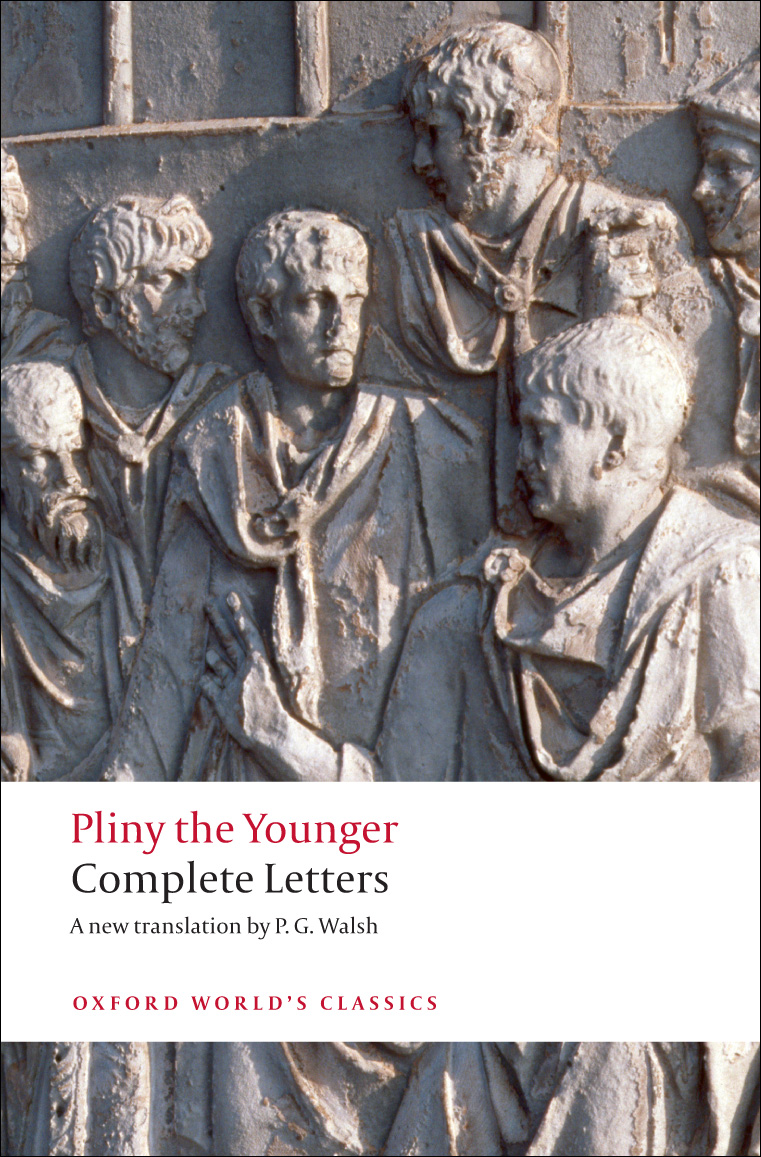
The letters of Pliny the Younger: Dispatches from a dying Pompeii"Pliny the Younger: Complete Letters," by P.G. Walsh(Credit: Cains)

A few months ago, many people who were scheduled to travel to Europe found their trips canceled at the last moment: Airborne ash from an Icelandic volcano had, astonishingly, grounded nearly all flights to England and much of the continent.

While cities weren’t buried alive beneath a drizzle of fine pumice, this strange disruption of modern life unavoidably called to mind — at least to my mind — the eruption of Mt. Vesuvius and the destruction of Pompeii, Herculaneum and Stabiae, many of whose inhabitants actually suffocated from the volcanic smoke and grit that smothered their cities. In antiquity the classic account of the eruption, and of a small part of its devastation, occurs in a pair of letters written by Pliny the Younger (61 AD – c.112 AD) to his friend the historian Tacitus. In them he relates how his uncle — in command of the Roman fleet in that part of the Bay of Naples — sailed into harm’s way, both to acquire a better idea of the scope of this natural disaster and to reassure the populace under its shadow.

Barnes & Noble ReviewAs it happens, that intrepid seaman was also called Pliny and is remembered today as an author rather than an admiral. The Elder Pliny’s “Natural History” is one of the greatest books of ancient times, a massive compendium of scientific knowledge, traveler’s tales, zoological observation and “Believe It or Not” anecdote. (This genial encyclopedia takes up 10 compact volumes in the Loeb Library, with Latin and English on facing pages, and still makes excellent bedside reading.) According to his nephew, the senior Pliny had a keen intelligence, astonishing concentration, and little need for sleep. He used to say that there was no book so bad that it was not useful at some point. He believed that any time not devoted to study was wasted.

On the day of the eruption, the younger Pliny writes, “my uncle was at Misenum, where he held command of the fleet in person. Just after midday on 24 August [79 CE] my mother pointed out to him the appearance of a cloud of unusual size and appearance. He had relaxed in the sun, had then taken a cold dip, had lunched lying down, and was at his books. He asked for his sandals, and mounted to the place from which that remarkable phenomenon could best be observed. A cloud was issuing up from some mountain which spectators from a distance could not identify; it was later established to have been Vesuvius.”

Pliny goes on to tell Tacitus about the cloud: “The pine tree, rather than any other, best describes its appearance and shape, for it rose high up into the sky on what one can describe as a very long trunk, and it then spread out into what looked like branches … Its appearance varied between white on the one hand, and grimy and spotted on the other, according as it had thrust up earth or ashes. My uncle, most learned man that he was, realized that this was important, and should be investigated at closer quarters.”

In short order, the elder Pliny “ordered a fast-sailing ship to be made ready” and, continues his nephew, “gave me the option of accompanying him if I so wished. I replied that I preferred to work at my books.” We later learn that the younger man, just 18, simply didn’t want to tear himself away from his enthralled reading of Livy’s history of Rome.

When the seas grew rough, the air dense with cloud, and stones began to fall from the sky, the older Pliny’s ships made their way to Stabiaie. There, the seemingly untroubled Roman naturalist bathed and dined at a friend’s villa, even while Vesuvius continued to pour out flames. He did his best to calm the people around him, going so far as to retire for a nap. “In fact, he relaxed in sleep that was wholly genuine, for his snoring, somewhat deep and loud because of his broad physique, was audible to those patrolling the threshold.” Before long, though, “the courtyard which gave access to his suite of rooms had become so full of ash intermingled with pumice stones that it was piled high.”

The sleeping Pliny was awakened, and a debate broke out over whether the villa’s residents should stay indoors or venture out to the coast. By now “the buildings were shaking with frequent large-scale tremors, as though dislodged from their foundations” and “seemed to shift now one way and now another, and then back again.” Pliny convinced everyone to make a dash for the sea, despite the rain of pumice and debris. “They used strips of cloth to fasten pillows on their heads as a protection against falling stones.”

By this point day had turned to night, and the little party discovered that the Mediterranean was still too “mountainous and hostile” for ships to cast off. Perhaps already starting to be overcome by the foul air, “my uncle lay down … on a discarded sail, and repeatedly drank cold water, which he had requested. Then flames and the smell of sulphur heralding the flames impelled the rest to flight and roused him. Leaning on two of his confidential slaves, he stood up and at once collapsed.” Later on, it was concluded that “his breathing was choked by the greater density of smoke, and this blocked his gullet, which was often frail and narrow, and often unsettled. When daylight was restored, two days after his eyes had closed in death, his body was found intact and unharmed. It was covered over, still in the clothes he had worn. It was more like someone sleeping than a corpse.”

In a follow-up letter to Tacitus, the younger Pliny recalls his own adventures back at Misenum. “The buildings all round were shaking,” he writes, and to his amazement the tumultuous seas were “sucked back” by an earth-tremor, leaving “many sea-creatures stranded on the dry sand.” Meanwhile, Vesuvius continued to spit forth a “black and menacing cloud, split by twisted and quivering flashes of fiery breath,” which opened out “into extended shapes of flames, like lightning flashes, but greater.”

Young Pliny and his mother soon decided to flee, despite the darkness brought on by the ash, and were nearly trampled to death by the panicked mob:

You could hear women moaning, children howling, and men shouting; they were crying out, some seeking parents, others children, and others wives, or recognizing them by the sound of their voices. Some were lamenting their own misfortune; others that of their families. A few in their fear of death were praying for death. Many were raising their hands to implore the gods, but more took the view that no gods now existed anywhere, and that this was an eternal and final darkness hanging over the world.

When true daylight finally reappeared, the exhausted survivors were “confronted with a scene of universal change, for everything was buried by deep ash, as though by snow.” At this point mother and son decided to return to Misenum and were there when “the message came about my uncle.”

Pliny the Younger’s correspondence with numerous friends — besides Tacitus, he also knew the historian Suetonius and the poet Martial — provides one of the great records of what life was like during Roman times. There are 247 surviving personal letters and 121 official memoranda to the Emperor Trajan. Only Cicero’s 914 letters (largely to his friend Atticus and written a century and a half earlier) excel Pliny’s in importance, whether as a self-portrait of the author or as a tableau of social life during the early Empire.

An experienced trial lawyer, an efficient government bureaucrat, and a trusted supporter and confidant of Trajan (who ruled from 98 to 117), Pliny often reminds me of Washingtonians I know. He’s good at his work and rightly proud of his accomplishments, and very much an Inside-the-Beltway pillar of the imperial establishment. Well-off from inheritances and land-rents, Pliny typically uses his influence to help the sons and daughters of friends, just as he regularly donates his money to worthy civic projects, such as the education of children in his hometown of Comum on the shores of what is now Lake Como.

Even though Pliny desperately yearns for literary immortality, whether as orator, poet or letter-writer, he’s clearly no genius. But he is amiable, like one of those 18th-century litterateurs such as Horace Walpole or Lord Chesterfield. This very ordinariness contributes to his appeal. We can believe what he says, whether he’s describing the structure of his villa, the beautiful springs at Clitumnus, the machinations of a shyster lawyer, or the floods on the Tiber. With at least one eye on posterity, he typically mixes little Polonius-like disquisitions about life and the proper use of one’s leisure with accounts of the latest gossip: Thus he tells of houses haunted by ghosts, reports on Vestal virgins immured alive for violating their oaths, provides instruction on how to become a better writer (through translation and imitation), confesses his sorrow over his young wife’s miscarriage, lists the traits of the ideal tutor, reflects on the opposing rhetorical styles of florid “Asiatic” expansiveness and lean “Attic” concision, and even speculates about those strange cultists known as Christians.

Sometimes Pliny seems like a charming and slightly prim eccentric: While out hunting, he takes along his tablets so that he can work on his poetry while awaiting some hapless wild boar to stray into his nets. He complains that nowadays courtrooms are filled with riff-raff and “hired claques, purchased with money.” Sport bores him: “The races were on, and I take not the slightest interest in that type of performance. There is no novelty, no variation, nothing for which a single viewing would not suffice.” Like most writers, he’s deeply sensitive to criticism, hotly defending his taste for “eloquence”: To one correspondent he complains that “you seemed to have designated some passages in my writings as inflated, when I thought them lofty, as pretentious, when I thought them bold, as overblown, when I thought them fully expressed.” He closes with an almost pathetic simper: “The impact of talent should not be confined within a very circumscribed course.”

Cultivated and well-read, Pliny — like many another Latin writer — does sometimes verge on the sententious: “There is no happiness that literature does not intensify, and nothing so sad that literature does not relieve it.” Yet he can also be quietly witty: Of one acquaintance he writes, that “his only concession to old age is discretion.” What will matter most to modern readers, though, is how much this ancient Roman resembles ourselves, how human he is. After his hated courtroom enemy Regulus dies, Pliny confesses that during trials he still finds himself looking for him, that he, in fact, misses the scoundrel. He keeps abreast of real-estate values: “Are you aware that the price of land has risen, especially around Rome? The reasons for this sudden increase have been the subject of much discussion.” When social invitations request that one attend a poetry reading if free on such and such a day, he notes that “at Rome, in fact, no one is ever ‘absolutely free’ or finds it ‘convenient’ to listen to someone reciting his work.”

There’s an immense variety in these pages, and nothing — except a couple of court cases — goes on too long. On one page Pliny might record a premonitory dream, on another a horrific murder, but he’s always aware of the latest domestic scandals, from adultery to disinheritance. One particularly charming letter marvels that a dolphin, in a lagoon near Hippo in Africa, would regularly frolic with swimmers, even allowing one boy to ride on his back. Still another reveals his own passionate love for his third wife, 30 years his junior: “My obsession with longing for you is beyond belief … The one time when I am free of this torture is when I exhaust myself in court with friends’ lawsuits.”

But repeatedly, too, there are letters of condolence and of sorrow. When his mentor and benefactor Cornelius Rufus, who has been suffering from illness, commits suicide, Pliny is devastated:

I contemplate the sort of friend, the sort of man I am now without. He completed his sixty-seventh year, a reasonable age for the sturdiest of us; I acknowledge that. He escaped from an interminable illness; I acknowledge that. He died with his dear ones surviving him, and at a time of prosperity for the state, which was dearer to him than all else; that too I acknowledge. Yet I lament his death as though he were young and in glowing health. I lament it — you can consider me a weakling in this — on my own account, for I have lost the witness, guardian and teacher of my life.

In such a paragraph, despite its emotion, there’s no disregarding the balanced sentences, the repeated phrase “I acknowledge that,” and the overall artfulness of the writing. This careful attention to style reminds us that Pliny was not only well educated in oratory, but that he was also trained by the greatest of all teachers of rhetoric, Quintilian. His prose itself might be loosely called Ciceronian, at once rhythmic and decorated with poetic tags and allusions (chiefly to Homer and Virgil). Scholars suggest that he found further models for his writing in the letters of the stoic philosopher Seneca and the verse-epistles of Ovid, such as the “Heroides” in which classical heroines bemoan their sad fates.

While an obvious source for historians, Pliny has also been, somewhat surprisingly, an inspiration to architects. His loving and leisurely descriptions of his two main homes — one on the sea at Laurentine and another in Tuscany — led architects of the Renaissance and beyond to a better understanding of Roman villas. As David Watkins has written (in “The Legacy of Rome,” edited by Richard Jenkyns): “Pliny’s Laurentine villa occupies a special place in architectural history because of the numerous paper restorations which have been inspired by his extensive and charming descriptions of it … He provided a compelling picture of the pleasure that architecture can give in its relation to sound, sight, smell, temperature, colour, water, and vegetation. At the same time, there was enough obscurity in his description to allow free rein to the imagination of countless architects down the centuries bent on reconstructing his villa.” Thomas Jefferson’s Monticello is just one of these reconstructions.

While the first nine books of Pliny’s letters follow a roughly chronological order — the author disingenuously maintains he’s just selected them casually, almost at random — Book 10 is made up of official correspondence exchanged during his tenure as governor of Bithynia (part of modern-day Turkey). Addressed to Trajan, and accompanied by the Emperor’s replies, these concise exchanges resemble office memos or short business e-mails. However, one of the few substantial letters does offer our first recorded glimpse of the Christian community by an outsider. Pliny has been investigating the religion for alleged disloyalty to Rome:

They maintained … that all that their guilt or error involved was that they were accustomed to assemble at dawn on a fixed day, to sing a hymn antiphonally to Christ as God, and to bind themselves by an oath, not for the commission of some crime, but to avoid acts of theft, brigandage, and adultery, not to break their word and not withhold money deposited with them when asked for it. When these rites were completed, it was their custom to depart, and then to assemble again to take food, which was however common and harmless.

He adds: “The infection of this superstition has extended not merely through the cities, but also through the villages and country areas, but it seems likely that it can be halted and corrected.” (Pliny was certainly wrong about that.) When Trajan writes back, he counsels restraint and tolerance, warning against any sort of witch-hunt:

Christians are not to be sought out. If brought before you and found guilty, they must be punished, but in such a way that a person who denies he is a Christian and demonstrates this by his action, that is, by worshiping our gods, may obtain pardon for repentance, even if his previous record is suspect. Documents published anonymously must play no role in any accusation, for they give the worst example, and are foreign to our age.

Since Pliny’s letters stop abruptly during his time in Bithynia, it seems likely that he died there.

While Pliny lacks the raciness of his friend Suetonius [see my earlier essay for BNR on the "Lives of the Caesars"], his is an admirably civilized sensibility. To the Renaissance he once seemed an early humanist, even as I now view him as the ancestor of today’s educated, hard-working, and much-maligned Washingtonian.

There are two readily available paperbacks of Pliny. The long-established Penguin — “The Letters of Pliny the Younger” — was translated by Betty Radice, who also edited the Latin text for the scholarly Loeb series. Her introduction is masterly and should be read. But P. G. Walsh’s Oxford World Classics edition — “Pliny the Younger: Complete Letters” — offers the advantage of extensive end-notes. These identify people and places and set the sometimes recondite material in its historical context. I have quoted Walsh here, since his seems the better book for most beginning readers of the lawyerly and industrious and kindly Gaius Plinius Caecilius Secundus.

Continue Reading Close