Murray Richmond

Reformation of an evangelical

I began college as a know-it-all Christian. But I learned how to listen to nonbelievers -- and learn from them

  • more
    • All Share Services

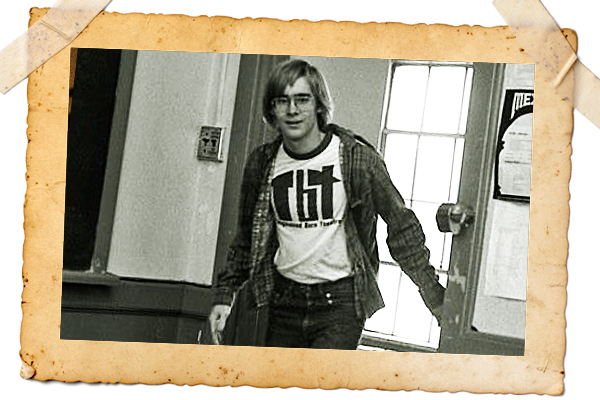
Reformation of an evangelicalA photo of the author in college. (Credit: Shutterstock/Salon)

Not long ago, presidential candidate Rick Santorum complained that he was discriminated against at the University of Pennsylvania because he was more conservative than his professors. I don’t know what his situation was. But I found that standing up for my faith was a positive experience — once I learned how to do it without being a jerk.

When I entered college, I was a bright-eyed evangelical, ready to take on the world for Jesus. Just getting to college was something of a triumph for me. To say I was a mediocre high school student would insult all the other mediocre students out there. I was on my way to dropping out when I had a religious conversion experience. The most important part of that epiphany was a new focus to my life. Once, I was just drifting. Now, I searched for meaning.

The most meaningful thing I could think to do was to tell the rest of the world how good Jesus was for me, and get them to believe as I did. So I went to the University of North Carolina at Charlotte, got involved in the campus Christian fellowship group, joined a small group Bible study, and took my first religion class — Old Testament history.

It was my first brush with academic religion — well, more like a full-scale collision. I believed the Bible was divinely inspired literal truth and a practical guide for living. My professor believed it was a historical document — an inaccurate historical document — and that if there were any truth in the Scriptures, it existed only between the lines.

My grades remained decent because I read every assigned text and did well on the tests. But at the end of the semester I did an extra-credit project to “prove” my theology was superior to his. He tried to dissuade me, but I went for it anyway.

What resulted was perhaps the first time in recorded academic history when an extra-credit project actually lowered an overall grade. His comment to me was something along the lines of, “If this is what you think an academic paper is supposed to look like, you have clearly not learned anything in this class.”

At first I was angry. I was sure he lowered my grade because he was embarrassed to be proved wrong. I wore my poor marks in that class as a badge of honor, a sign that I was standing up for God, and being persecuted for it. But then I encountered a Bible verse I had never really understood before. It was from the Book of Peter (I Peter 3:15). “Always be prepared to give an answer to everyone who asks you to give the reason for the hope that you have. But do this with gentleness and respect.”

My paper was anything but gentle and respectful. I was arrogant and rude. I never even considered the possibility that my professors might know more about the Bible than I did. And while his approach to the Bible might not have been right, I realized something profound at that moment: Neither was mine.

I changed after that class. In the four years I spent at UNCC, I didn’t stop standing up for my faith. I still challenged professors, wrote letters to the school newspaper, gave talks to student groups, and generally tried to sneak in issues of faith wherever I could. But I tried to do it with gentleness and respect. I tried to give reasons for my hope.

And I was often surprised how well my attempts were received, even by professors I viewed as adversaries. A vocal atheist who taught my philosophy class once made the off-handed comment that Paul was a real SOB for saying “If your hand offends you, cut it off.”

I raised my hand. “Sir,” I said, a little hesitantly, “I think Jesus said that.”

He slapped this away. “No, it was Paul.”

I tried to remind myself: Gentleness. Respect. “I think Jesus said it, in the Gospel of Matthew.”

“I’m pretty sure it was Paul.” He did not sound so confident now.

“I think Jesus said it in the Sermon on the Mount. Matthew 5, probably around verses 29 and 30.” OK, so I was approaching the borders of arrogance, but I also knew that my professor was just plain wrong.

“Maybe it was Jesus,” he said.

After class, as I was leaving, he called me over. I was already wondering if I needed to drop the class now that I was on his hit list. I figured he would say something like, “Don’t ever embarrass me like that again. ”

Instead, he said, “You have something that is disappearing in this country. ” His voice was wistful. “If I mention the parable of the prodigal son, or say ‘Am I my brother’s keeper,’ you know what that means. No one else in the class does. We used to have a common language, but that is a thing of the past.”

The professor and I became friends, and I took several of his classes. I never converted him, nor did he lodge loose my faith, but we had a mutual respect. We often sparred in class, and he usually won, but I came away smarter and sharper for it.

I realized that if I was going to stand up for my faith, I had to read more, and do more work than other people in the class. Jesus did not need any ill-informed half-wits trying to defend him. Standing up for Jesus stupidly made Jesus look stupid.

In English class, we were studying existential literature. Now for me, at the time, the existentialists were The Enemy. But that meant I had to read the text even more diligently than my fellow students, and that I had to know the background and philosophy of the author better than even the professor.

It was a depressing class. As we talked about the short story (Hemingway’s “The Capital of the World”) I could feel a darkness settling. We were all disheartened. But I pointed out that while Hemingway saw life as a futile quest for glory, he also sought glory and his writing was glorious — if sometimes a tad bleak. His life belied his philosophy, I said.

I didn’t mention Jesus or God or the Bible. Instead I spoke about “the hope that I had.” I don’t know if I was right about Hemingway that day, but I know spirits lifted. A few of the class members even thanked me for my remarks.

In my senior year, a traveling evangelist came to campus and gave a fire-and-brimstone harangue in the quad. During a break I suggested he might want to use more sugar than vinegar. “You are not bringing anyone to Jesus,” I told him. “You are just making Christianity look mean and insulting.”

He turned away from me, and started up his diatribe again, but this time he aimed his bile at me. “Mickey Mouse Christians like this man water down our faith, and deny our Savior. He is neither hot nor cold, and our Lord will vomit him out his mouth,” he said, quoting a verse in Revelation. But the real shock came when the group who assembled to heckle the preacher now laid into him with a vengeance — because he had attacked me. People who had previously mocked my beliefs were now standing up for me, and eventually they drove off the preacher. A few weeks later I was offered a job as news editor for our campus paper. “You’ve written so much for us already,” they said, referring to my numerous letters to the editor on faith, “we figured you should probably be on staff.”

When I hear complaints that Christians are being persecuted on college campuses, I want to laugh. Sure there are some nasty people who want to wipe out religion, but most “persecution” experienced by Christians is the result of their ham-handedness in trying to foist their faith on others. They may find themselves ridiculed, but only because what they are doing just looks ridiculous to many people. Standing up for my beliefs never required me to be obnoxious, or an idiot (although I am sure there times when I was both). I got into some pretty heated arguments, but the people I clashed with often became friends.

The important lesson on faith is not “Shut up and sit down.” It is, “Speak up, but do it with respect. And be able to back it up!” Fighting for my faith was a learning process. When I thought I knew it all, I was just a blowhard. But when I listened to my detractors — and respected them — I gained their respect, too.

I preached against homosexuality, but I was wrong

As a Presbyterian minister, I believed it was a sin. Then I met people who really understood the stakes: Gay men

  • more
    • All Share Services

I preached against homosexuality, but I was wrong

A recent poll shows a huge shift in American attitudes toward gay marriage, from a 32 percent approval in 2004 to 53 percent today.

I am one of those people who changed their minds.

In 1989 when I was ordained as a minister to serve a small church in North Carolina, homosexuality was an invisible issue. Gay rights were barely on the radar of mainstream churches. The idea of an openly gay pastor was beyond the pale. 
 I knew there were “gay churches,” of course, but I did not believe one could be a practicing homosexual and a Christian. The Bible was straightforward on this issue. It all seemed incredibly obvious to me.

But over the next five years, homosexuality not only became an issue — it became The Issue. Sides were drawn, and those of us in the middle were pulled to either end. I was a biblical Christian, of the “hate the sin, love the sinner” crowd. And so it seemed clear that I could not fully accept, ordain and marry gays. If I was going to be forced to choose a side, that was mine.

The truth is, I was put out that this was an issue. Feeding the hungry, preaching the gospel, comforting the afflicted, standing up to racial intolerance — these were the struggles I signed up for, not determining the morality of what adults did in their bedrooms.


But the debate would not go away. It came up, again and again, year after year, pushed by activists on either end. Each time, I grudgingly voted to hold the traditional line and limit the role of gays in the church. But I felt increasingly uncomfortable. What I believed was biblically correct began to feel less and less right in my heart.

While the church was fighting it out, I was going through my own battle. I moved to Alaska in 1996, but the debate followed me. And three major things happened which started to crack the wall of my complacency.

First, I had a long, online conversation with a gay Christian man who had wrestled with his sexuality and finally decided, as he put it, that God was more concerned with his pride than his sexuality. He was hesitant to talk about the subject when I first broached it, partially because every other pastor he’d talked to wanted to convert him. But in the end, he’s the one who taught me. He surprised me by saying he did not know he was gay until he was in his early 20s. (He just thought he had an extraordinary respect for women.)

Next, a parishioner asked me to do an exorcism for him because he was gay. He had tried everything else he could think of — therapy, prayer, will power, alcohol, support groups, marriage — and nothing worked. It was a heartbreaking situation. As a minister I may have questioned the sinfulness of his actions, but I absolutely knew he was not demon-possessed. 


Then I met a woman whose husband had left her for another man. They were a clergy couple, serving a small-town church. She had every right to be angry and hurt, but I was awed by her grace. She told me he was the best minister she had ever known. (From his work record, I would agree.) He simply got to the point where he could no longer live the lie of his sexuality. Of course he had to leave the ministry once he came out. It must have been a hideous choice: Pretend to be something he was not, or leave his calling because of the person he loved. 


These experiences shook my worldview. It became clear to me that none of these men had chosen to be gay, just as I had never chosen to be heterosexual. How could I condemn someone for something that was really not their fault? Meanwhile, I was experiencing the slow disintegration of my own marriage. Needless to say, it was hard for me to condemn anyone else for their relationships when mine was in such bad shape. I began moving closer to the center. If homosexuality was a “sin,” I wanted to add an asterisk to it.

Toward the end of my parish ministry, I was approached by five individuals who demanded that I do a sermon to come out strong against any acceptance of gays and lesbians in the church. They wanted to hear what the Bible said on the issue. The funny thing was, all five of them were divorced and remarried. Had I done a sermon on what the Bible said about divorce, every one of them would have left the church in a huff.

I did that sermon, however, and it was not my best hour as a Minister of Word and Sacrament. In my research, I found that the Bible was more nuanced about the issue than I previously believed, and I tried to convey that, but ultimately I still came out against acceptance of homosexuality. Now, I wish I’d been more upfront about how my own views were transforming, but I took a back-door approach to the subject. I talked about all the sins according to the Bible, and said if we were going to start throwing out sinners from our church, I wanted to start with the gossips.

Looking back, I see how much my own opinions had been formed by the fact that I was representing a split congregation. Our church, like so many, was divided. And while the people who believed it should be accepted were not going to leave if we maintained a position of non-acceptance, those who felt it was a sin would bolt in a heartbeat if we ever allowed gay clergy or gay marriage. If they bolted, half our budget would go out the door. I knew the issue could tear the church apart. What I didn’t realize was how it could tear apart the people in the church as well.

Every year we send young people to our national meeting as youth delegates. In a year when gay ordination was going to be discussed (again), I sat down with our selected delegate to share some of my own thoughts on the topic. Later, the person declined the position. I was given reasons, but none of them made any real sense until I learned, many years later, that the person had come out of the closet. What had I said back then? I couldn’t remember exactly, but I am pretty sure it boiled down to the idea that there was no place for homosexuals in our church.

In 2005 I left the parish ministry to work as a hospital chaplain. Part of the reason for leaving was my separation. But also, I was tired of trying to live up to standards that I did not fully agree with.

With distance, I could see the mean-spirited nature of the anti-gay movement, and the naked way large Christian organizations used the “gay threat” to raise money. Free from the constraints of a congregation, I could spend more time actually looking at the biblical texts that deal with homosexuality, and I was surprised to find they were not as clear as I had supposed they were. At this point, I have done a 180 on the topic. And I believe it’s a change for the good.

So why had we singled out homosexuality as a litmus test for True Christianity in the first place? Why had it become such a lightning rod for self-righteousness?

One reason, I think, is that it’s easy to condemn homosexuality if you are not gay. It is much harder than condemning pride, or lust or greed, things that most practicing Christians have struggled with. It is all too easy to make homosexuality about “those people,” and not me. If I were to judge someone for their inflated sense of pride, or their tendency to worship various cultural idols, I would feel some personal stake, some cringe of self-judgment. Not so with homosexuality. 


Now I am wondering why, if two gay people want to commit their lives to one another, they should ever be denied that chance. No church or pastor should be forced to perform those ceremonies, and they can choose not to recognize gay marriage for their adherents. But the constitution of the Presbyterian Church does not explicitly forbid a pastor from being a thief, a murderer, or an egotistical jerk. It is not designed to do these things. It does prohibit a gay person from becoming a pastor. All I can ask is: Why?

Continue Reading Close