Nancy Sathre-Vogel

My Colombian Twitter rescue

My boys and I were stranded in Bogota with nowhere to sleep. So I turned to the one hope I had left: The Internet

  • more
    • All Share Services

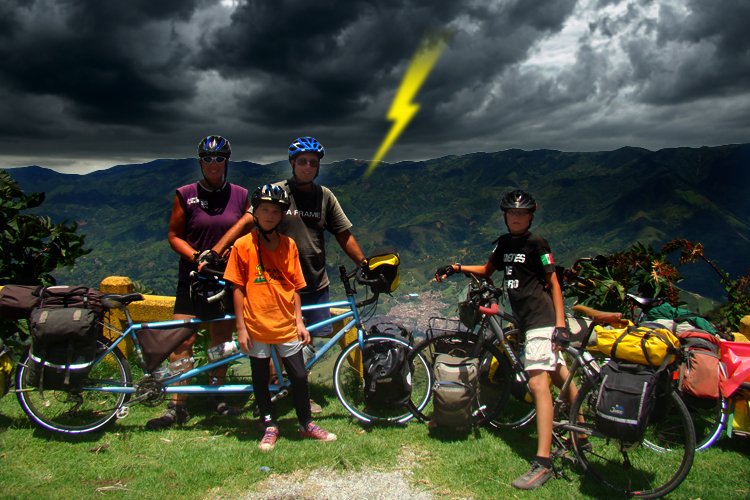
My Colombian Twitter rescueThe author with her family in Colombia.

I was stranded in Bogotá, Colombia with my two children and no place to sleep.

“I’m sorry. There is no way you can stay in a hostel in Bogotá without a passport,” the woman said. “It’s a very strict rule and no hostel will let you stay.”

I panicked. It is not an exaggeration to say it was one of the most stressful moments of my life. Nine o’clock on a Friday night in an unfamiliar city, and I was marooned with two young boys. We would be sleeping on the streets for the night.

“Do you have a computer I can use?” I asked. There was a slim chance this would make a difference, but when you’re grasping at straws, you grasp them all. My hands shook as I typed out my plea to the twitterverse:

“I need help desperately. Know anyone in Bogota, Colombia? Please RT”

And then I waited to see what happened next.

My husband and I have long been travelers. Back in 1990, we hopped on a plane and pedaled remote roads in Pakistan and India. There was no Internet then (well, we didn’t use it anyway). And to travel meant to be completely out of touch with the world save the four mail drops we arranged. Every month or so we wrote a long letter and sent it home.

The disconnection was powerful and profound, the loneliness both an obstacle and a thrill. As the Internet and 4G networks and Skype have marched across the globe, and even the most teeny-tiny, out-of-the-way places have been wired, it’s hard not to feel a shred of ambivalence. Gone are the days when you are out of reach or out of range. It’s a bit sad: The world doesn’t seem so big anymore. But then again, that’s wonderful, too.

Twenty years after our first epic journey, my husband and I decided to pack up our boys for another adventure. We would bike ride across the Americas together, from Alaska to Argentina. (I wrote about this for Salon in 2010.) By the time we started in June 2008, the Internet wasn’t a novelty; it was a given. Of course we’d chitchat with friends and family from the road. Of course we’d post updates on our Web page and Facebook. It wasn’t something I thought about at all — until that night in Bogotá.

We had been cycling through Colombia for nearly two months. I’m sure some parents just choked on their coffee at the thought of putting their kids in such danger, but after more than a year of travel I assure you what was remarkable about our journey is just how safe we’ve been. Ours is a journey marked by rewarding rides and unforgettable sightseeing. It’s one long family vacation. But after so much time on the road, certain precautionary measures had started to slip. In the two months we’d been in Colombia, we’d never had to show our passports. Each time we checked into a hotel, I presented photocopies, which had always been sufficient. Our passports remained buried at the bottom of our bicycle panniers and hadn’t seen the light of day since we checked into the country.

When the boys and I decided to leave our bikes and gear with my husband in Manizales and take a bus for the eight-hour journey to Bogotá to visit friends, I didn’t even think to pack our passports. If we hadn’t needed them for the past two months — why would we need them now?

But that’s when things started to go wrong. Thanks to a minor miscommunication, I was unable to get hold of my friend when we arrived in the capital. That was no problem; we could easily stay the night in a hostel and meet up the next day. But then, our next speed bump arrived: The passport photocopies wouldn’t work.

What to do? Where to go? Here it was: Our first real catastrophe after more than a year on the road.

When I got on the hostel computer, I logged on to Twitter and Facebook. All the scams and hoaxes out there online — I wouldn’t blame people for ignoring the plea. But they didn’t. I sent my tweet — and within minutes got a reply:

“What’s happening? What do you need?”

“We have no place to sleep,” I typed back. “Desperately need somebody who can let us sleep in their house tonight.”

Tweets ricocheted through cyberspace. Questions poured in, and as I chewed on my lip, I typed out responses — our story in 140-character bits, all of which boiled down to these three: We needed help. I didn’t know anyone from Colombia, or know anyone who knew the country. My only hope was a blind one that somehow, somewhere, in the vast seven-degrees-of-separation social network that began with the blinking cursor on my screen — someone would.

It was 45 minutes of agony. But finally, the tweet came back.

“My best friend lives in Bogota. What do you need?”

I dared not get my hopes up, but my heart skipped a beat or two when I saw it. I got the name of the friend and ran to the desk to ask for the number. Maybe, just maybe, this could work.

When the phone rang, and the hostel worker handed it to me, the floodgate broke and tears flowed down my cheeks. I started sobbing into the phone, “I need a place to stay.”

“I’ll be there in a few minutes,” he responded.

Indeed, only a few minutes later a handsome Colombian man walked into the hostel and took us to his apartment. Then he took off to spend the night with a friend, leaving the apartment to my sons and me. There aren’t words to describe how grateful I felt.

My boys learned all kinds of lessons on our adventure. Not just to cycle, but also to pacify and challenge themselves, to make goals and meet them. They learned how stunning the Americas really are, the differences between the country and the city and riding up a mountain and across a valley. But I’m glad to know they learned a lesson about the Internet, too. It is not simply a convenience and a comfort. It is a connection that can save you. It certainly saved us.

Our bike trip: 3 years, 2 continents, 1 family

Some say I'm exploiting my sons as we ride from Alaska to Argentina. I say it's the adventure of a lifetime

  • more
    • All Share Services

Our bike trip: 3 years, 2 continents, 1 family

View the slide show

It was a beautiful spring day in 2006 when my husband slumped into his favorite chair after a particularly rough day in the classroom. His eyes glazed over as he stared out the window, but I knew he wasn’t looking at the lawn that needed mowing or the barn that needed fixing.

“I can’t do this,” he said. “I need to get away.”

What he described wasn’t a vacation so much as a wild adventure: He wanted to buy a triple bicycle — a three-seater that would hold our two young boys, then only 8 — and explore the world. “We’ll be the Three Musketeers,” he said. “We’ll be Mr. Incredible and his children saving the world from destruction and injustice! We’ll be Superman and Spider-Man and the Incredible Hulk rolled into one!” He stopped his reverie for a moment to be practical. “Oh, you can come along, too.”

I had only one response. “Are you crazy?”

At the time, we were living something close to the American dream: two middle-aged parents in Boise, Idaho, with two young boys comfortably nestled in a large suburban home with a couple of cars in the driveway. My husband and I got up early and headed off to work, dropping the kids at daycare on the way. We worked all day as educators, and collapsed into bed, utterly exhausted. Our life was exactly how I always thought it should be. But after that spring day, another question nagged me: Was it really the way I wanted it to be?

Two months later we hit the road — John and the boys on a bicycle built for three and me on a single bike. Everything we needed — tent, sleeping bags, stove and cooking pot, clothes and home-schooling supplies — were lashed, strapped or buckled to the bikes. We spent the next 12 months cycling around the USA and Mexico, 12 months of pure magic. We didn’t realize it at the time, but it was only the first leg in our odyssey. By the time we got home, we had pedaled 9,300 miles, and we all agreed on one thing: We wanted more.

As I write this, I am on the road to La Paz, Bolivia, two years into a three-year bike trek that will take our family from Alaska to Tierra del Fuego, Argentina. As extraordinary as it has been for all of us, for my 12-year-old boys it holds special significance: They are en route to a world record for being the youngest people to bike across the Americas.

Children taking extraordinary risks has been a fraught topic lately. Sixteen-year-old Abby Sunderland’s attempt to sail the globe sparked national debate. Stories of Jordan Romero, who became the youngest person to climb Mt. Everest at the tender age of 13, and Jessica Watson, who completed her sail around the world at age 16, provoke familiar questions about young adventurers: Should children be at such risk in the first place? And whose dream is this — the parents’, or the children’s? I know that for my sons, this trip would never have worked if we had foisted it upon them. It has required their total commitment — and it has inspired a passion in them I never knew was possible.

I wasn’t always so confident. The idea to break a world record came up almost accidentally one night, during the year of exhausting preparation that led up to our departure. We were taking a break from the chaos — remodeling the house, finding trip sponsors, figuring out how to handle our finances from remote corners of the globe — and sitting together in the living room one night when I said to my sons, “You guys will probably be the youngest people ever to cycle all the way from Alaska to Argentina.”

“Maybe we’ll get in the Guinness Book of World Records!” Daryl said.

Then it hit us: They probably could.

“Do you want me to contact Guinness and see what would need to be done?” I asked.

“Yes!” the boys cried in unison. You should have seen the grins on their faces.

Not surprisingly, this complicated things. We had intended to begin our journey in Fairbanks, Alaska, but gunning for the record would mean cycling the Dalton Highway. Long known as one of the most challenging cycling routes in North America, the Dalton Highway is little more than a rough track carved into the countryside. As far as I could tell, Davy and Daryl would be the first children to even attempt it. Was it worth the risk? We held another family meeting.

“Here’s the deal, guys,” I said. “The record starts way up north in Prudhoe Bay. We’re planning to start in Fairbanks 500 miles south of there. If you really, really want to go for the record, we’ll go to Prudhoe Bay, but you need to understand how hard it is.”

“Five hundred miles? We can do that, Mom,” Daryl said.

“You need to know that it’s 300 miles of dirt road and when it rains the road turns to soup. It’ll be much tougher than anything else you’ve ever done. And you need to know we most likely won’t make it through — lots of cyclists way stronger than us have been beaten by the Dalton.”

They didn’t blink. “We’ll make it,” they said.

That night as I lay in bed, my mind ran amok. All along, I had figured the trip wouldn’t be that arduous — we could simply hitch through the difficult parts. But the world record upped the stakes considerably: No matter what kind of obstacles lay in our way, we would be committed to pedal over them.

I wasn’t worried about John — he’s as strong as a bear. I didn’t worry about the kids, either — they had an unending supply of energy. But me? I didn’t trust my own abilities. Could I really cycle all the way from the Arctic Ocean to Tierra del Fuego? Did I want to? I’ve always been the weak link in our family, the one who quit when things got tough. I don’t have the legs of rock-solid muscle like John and the boys; my legs were more like jelly. The extra 40 pounds I was carrying around didn’t help matters either.

And yet, I couldn’t shake the look of determination and excitement in my sons’ faces. Could I really take away their dreams before they had even started?

By morning I had made my decision — I would do it. The four of us would pedal every kilometer between Prudhoe Bay and Ushuaia together. I had no idea if it was humanly possible for me, but I was determined I would give it everything I had. If we failed, we would fail trying.

A few months later, our lives had been reduced to eight boxes — three bikes, two trailers and three bins filled with everything else we would need for the next three years. We headed to Alaska, to stare down the Dalton Highway.

We faced tremendous odds that first leg, but Davy and Daryl beat each and everyone — and I did too. We dealt with headwinds and tailwinds, smooth road surface and 3-inch-deep mud, we pedaled up impossibly steep grades and plunged back down the other side. Even though I had left the far north with over 50 pounds of food in my trailer, we ran low toward the end. John and I cut our rations to a mere 1,500 calories per day in order to give the boys more.

On Day 15 we made our final torturous descent and reached solid pavement. I climbed off my bike, did a little happy dance in my mind, and collapsed onto the side of the road. I mixed up our final packet of banana pudding and the four of us celebrated our victory. We had done it! We had conquered the Dalton! Even now, two years later, I still consider it one of our greatest accomplishments.

As we’ve continued our journey south, I’ve seen that look of determination in my boys’ eyes many times: When they’re battling headwinds along the Peruvian coast or pushing their heavy bikes through deep sand in Mexico. They weren’t always like this; their commitment came on gradually, and they’ve had their moments of doubt, too. Back in 2006, when we first embarked on our journey, we were only 10 days in when Davy decided he’d had enough. The idea of playing with his friends back home was much more appealing than cycling through sweltering heat in the eastern Oregon desert.

I pulled my little one aside and whispered in his ear, “If you hang in there, we’ll go to Disneyland when we get there.”

A smile spread across his face. “OK!” he said.

In time, he forgot about Mickey Mouse and learned to enjoy traveling on bicycles for what it was. He loved feeling the wind in his hair and the sun on his face. And when we did finally get to Disneyland? He’d completely forgotten about my promise and had to be reminded.

Years and thousands of miles later, my sons face challenges knowing they are only a small part of the journey. For a solid week, rain poured on the Icefields Parkway in Canada. We woke up in a tent buried in snow in Montana. We’ve faced temperatures so cold that our water bottles (and our fingers) never thawed out. We sweat like fevered pigs in Central America. We’ve pushed our heavy bikes up impossible 8,000-foot climbs in the Andes, and got sandblasted in the Peruvian coastal desert. Through it all, my sons’ determination has never wavered.

A few weeks ago we were climbing our highest pass yet — at 14,856 feet — when Daryl showed me, once again, just how determined he is to reach Ushuaia. That day we stood at the base of a massive seven-mile climb and could see the trucks snaking up and down the side of the mountain. And we were nearly out of water.

“Ain’t gonna happen,” I said to John. “There’s no way we’re making it up this climb with no water. You stay here with the bikes. The boys and I will hitch a ride up to get water. We’ll be back down in an hour or so.”

“You might as well stay up there,” John told Daryl. “You’ll be walking this hill for sure — no way I can get up with you on the tandem. Just stay up there and wait — we’ll be there as soon as we can.”

And Daryl’s response? “But if I stay up there, I won’t get the record. I’ll come back down.”

In the end, we hitched up, bought water and food, hitched back down, then all four of us climbed that hill.

Our trip isn’t always so arduous. Most days we only bike a few hours. We’re home-schooling the kids along the way. There’s plenty of time to relax, to read and soak in everything we’ve passed along the way. 

But that doesn’t comfort online critics like Jack Marshall, a self-proclaimed ethicist who criticized us after reading about the trip on our blog. “Davy and Daryl are simply useful tools for self-absorbed parents who are unwilling to make the necessary lifestyle sacrifices parenthood requires, or to be responsible for creating a safe, secure, stable existence for their twins during their formative years,” he wrote on a website called A Minor Consideration. “The only differences between the Vogels’ lifestyle and the Gypsies portrayed in old movies and operettas are that the Vogels have a website, don’t play tambourines, and use bicycles instead of a wagon.” (On a blog called The Ethics of Parenting, writer Brian Cuban asked of our boys: ”Whose dreams are they really following? At what cost?”)

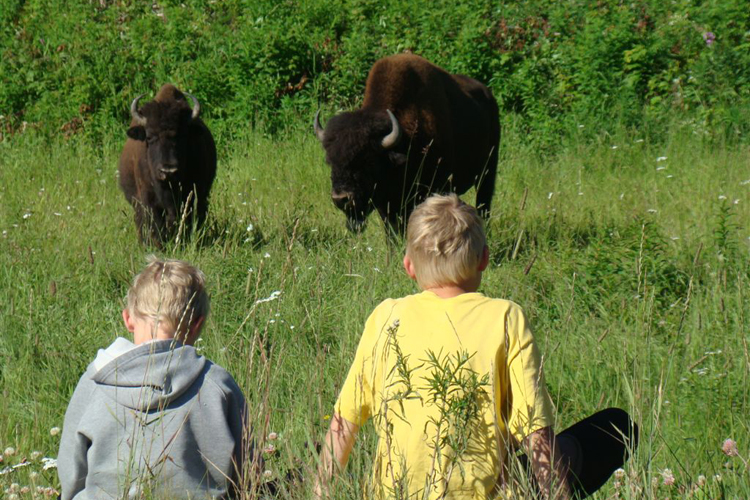
My sons could call an end to this trip any day. But here on the road with them, what I mostly see is the joy in their eyes. They have seen the stark, barren desert of Peru, no living thing for miles on end. They have seen the Amazon rain forest so thick with trees it makes getting off the road impossible. They have explored unexpected Mayan ruins hidden off the side of the road and plunged into pools fed by a waterfall. They delight in the magic of riding past bison, bighorn sheep, caribou, iguanas and vicuñas. We never know exactly what lies ahead; there is always another bend in the road.

I am convinced my sons are the luckiest boys on earth. They are learning about their world in a way few children ever have the opportunity to do. They live with Mother Nature each and every day and have seen, firsthand, the tremendous power she exerts over us. My boys have learned languages, cultures, currencies and history. No matter what happens in the next year, I can say with confidence this is not my husband’s dream, it is not my dream — it is our family’s. And we are living it.

Nancy Sathre-Vogel writes about her family’s adventure at Familyonbikes.com.

View the slide show

Continue Reading Close