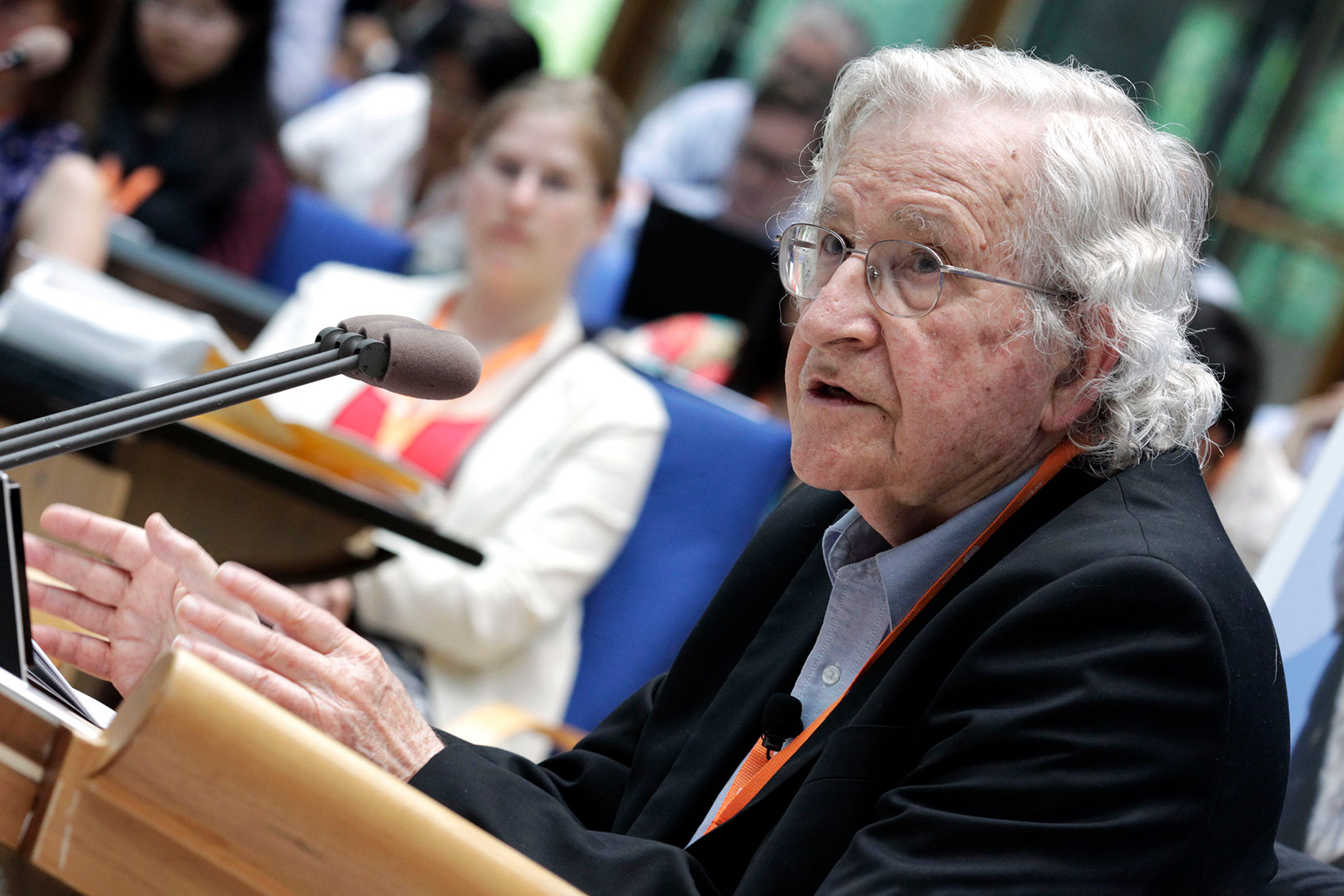
Noam Chomsky

Chomsky: “Jobs aren’t coming back”

Wealth is concentrated with the 1 percent because America no longer makes things: Financiers just manipulate money

(Credit: iStockphoto/buzbuzzer)
This article originally appeared on TomDispatch.com.

The Occupy movement has been an extremely exciting development. Unprecedented, in fact. There’s never been anything like it that I can think of.  If the bonds and associations it has established can be sustained through a long, dark period ahead — because victory won’t come quickly — it could prove a significant moment in American history.

The fact that the Occupy movement is unprecedented is quite appropriate. After all, it’s an unprecedented era and has been so since the 1970s, which marked a major turning point in American history. For centuries, since the country began, it had been a developing society, and not always in very pretty ways. That’s another story, but the general progress was toward wealth, industrialization, development and hope. There was a pretty constant expectation that it was going to go on like this. That was true even in very dark times.

I’m just old enough to remember the Great Depression. After the first few years, by the mid-1930s — although the situation was objectively much harsher than it is today — nevertheless, the spirit was quite different. There was a sense that “we’re gonna get out of it,” even among unemployed people, including a lot of my relatives, a sense that “it will get better.”

There was militant labor union organizing going on, especially from the CIO (Congress of Industrial Organizations). It was getting to the point of sit-down strikes, which are frightening to the business world — you could see it in the business press at the time — because a sit-down strike is just a step before taking over the factory and running it yourself. The idea of worker takeovers is something which is, incidentally, very much on the agenda today, and we should keep it in mind. Also New Deal legislation was beginning to come in as a result of popular pressure. Despite the hard times, there was a sense that, somehow, “we’re gonna get out of it.”

It’s quite different now. For many people in the United States, there’s a pervasive sense of hopelessness, sometimes despair. I think it’s quite new in American history. And it has an objective basis.

On the Working Class

In the 1930s, unemployed working people could anticipate that their jobs would come back. If you’re a worker in manufacturing today — the current level of unemployment there is approximately like the Depression — and current tendencies persist, those jobs aren’t going to come back.

The change took place in the 1970s. There are a lot of reasons for it. One of the underlying factors, discussed mainly by economic historian Robert Brenner, was the falling rate of profit in manufacturing. There were other factors. It led to major changes in the economy — a reversal of several hundred years of progress towards industrialization and development that turned into a process of de-industrialization and de-development. Of course, manufacturing production continued overseas very profitably, but it’s no good for the work force.

Along with that came a significant shift of the economy from productive enterprise — producing things people need or could use — to financial manipulation. The financialization of the economy really took off at that time.

On Banks

Before the 1970s, banks were banks. They did what banks were supposed to do in a state capitalist economy: they took unused funds from your bank account, for example, and transferred them to some potentially useful purpose like helping a family buy a home or send a kid to college. That changed dramatically in the 1970s. Until then, there had been no financial crises since the Great Depression. The 1950s and 1960s had been a period of enormous growth, the highest in American history, maybe in economic history.

And it was egalitarian.  The lowest quintile did about as well as the highest quintile. Lots of people moved into reasonable lifestyles — what’s called the “middle class” here, the “working class” in other countries — but it was real.  And the 1960s accelerated it. The activism of those years, after a pretty dismal decade, really civilized the country in lots of ways that are permanent.

When the 1970s came along, there were sudden and sharp changes: De-industrialization, the off-shoring of production, and the shift to financial institutions, which grew enormously. I should say that, in the 1950s and 1960s, there was also the development of what several decades later became the high-tech economy: Computers, the Internet, the IT Revolution developed substantially in the state sector.

The developments that took place during the 1970s set off a vicious cycle. It led to the concentration of wealth increasingly in the hands of the financial sector. This doesn’t benefit the economy — it probably harms it and society — but it did lead to a tremendous concentration of wealth.

On Politics and Money

Concentration of wealth yields concentration of political power. And concentration of political power gives rise to legislation that increases and accelerates the cycle. The legislation, essentially bipartisan, drives new fiscal policies and tax changes, as well as the rules of corporate governance and deregulation. Alongside this began a sharp rise in the costs of elections, which drove the political parties even deeper into the pockets of the corporate sector.

The parties dissolved in many ways. It used to be that if a person in Congress hoped for a position such as a committee chair, he or she got it mainly through seniority and service. Within a couple of years, they started having to put money into the party coffers in order to get ahead, a topic studied mainly by Tom Ferguson. That just drove the whole system even deeper into the pockets of the corporate sector (increasingly the financial sector).

This cycle resulted in a tremendous concentration of wealth, mainly in the top tenth of one percent of the population. Meanwhile, it opened a period of stagnation or even decline for the majority of the population. People got by, but by artificial means such as longer working hours, high rates of borrowing and debt, and reliance on asset inflation like the recent housing bubble. Pretty soon those working hours were much higher in the United States than in other industrial countries like Japan and various places in Europe. So there was a period of stagnation and decline for the majority alongside a period of sharp concentration of wealth. The political system began to dissolve.

There has always been a gap between public policy and public will, but it just grew astronomically. You can see it right now, in fact. Take a look at the big topic in Washington that everyone concentrates on: The deficit. For the public, correctly, the deficit is not regarded as much of an issue. And it isn’t really much of an issue. The issue is joblessness. There’s a deficit commission but no joblessness commission. As far as the deficit is concerned, the public has opinions. Take a look at the polls. The public overwhelmingly supports higher taxes on the wealthy, which have declined sharply in this period of stagnation and decline, and the preservation of limited social benefits.

The outcome of the deficit commission is probably going to be the opposite. The Occupy movements could provide a mass base for trying to avert what amounts to a dagger pointed at the heart of the country.

Plutonomy and the Precariat

For the general population, the 99% in the imagery of the Occupy movement, it’s been pretty harsh — and it could get worse. This could be a period of irreversible decline. For the 1 percent and even less — the .1 percent — it’s just fine. They are richer than ever, more powerful than ever, controlling the political system, disregarding the public. And if it can continue, as far as they’re concerned, sure, why not?

Take, for example, Citigroup. For decades, Citigroup has been one of the most corrupt of the major investment banking corporations, repeatedly bailed out by the taxpayer, starting in the early Reagan years and now once again. I won’t run through the corruption, but it’s pretty astonishing.

In 2005, Citigroup came out with a brochure for investors called “Plutonomy: Buying Luxury, Explaining Global Imbalances.” It urged investors to put money into a “plutonomy index.” The brochure says, “The World is dividing into two blocs — the Plutonomy and the rest.”

Plutonomy refers to the rich, those who buy luxury goods and so on, and that’s where the action is. They claimed that their plutonomy index was way outperforming the stock market. As for the rest, we set them adrift. We don’t really care about them. We don’t really need them. They have to be around to provide a powerful state, which will protect us and bail us out when we get into trouble, but other than that they essentially have no function. These days they’re sometimes called the “precariat” — people who live a precarious existence at the periphery of society. Only it’s not the periphery anymore. It’s becoming a very substantial part of society in the United States and indeed elsewhere. And this is considered a good thing.

So, for example, Fed Chairman Alan Greenspan, at the time when he was still “Saint Alan” — hailed by the economics profession as one of the greatest economists of all time (this was before the crash for which he was substantially responsible) — was testifying to Congress in the Clinton years, and he explained the wonders of the great economy that he was supervising. He said a lot of its success was based substantially on what he called “growing worker insecurity.” If working people are insecure, if they’re part of the precariat, living precarious existences, they’re not going to make demands, they’re not going to try to get better wages, they won’t get improved benefits. We can kick ’em out, if we don’t need ’em. And that’s what’s called a “healthy” economy, technically speaking. And he was highly praised for this, greatly admired.

So the world is now indeed splitting into a plutonomy and a precariat — in the imagery of the Occupy movement, the 1 percent and the 99 percent. Not literal numbers, but the right picture. Now, the plutonomy is where the action is and it could continue like this.

If it does, the historic reversal that began in the 1970s could become irreversible. That’s where we’re heading. And the Occupy movement is the first real, major, popular reaction that could avert this. But it’s going to be necessary to face the fact that it’s a long, hard struggle. You don’t win victories tomorrow. You have to form the structures that will be sustained, that will go on through hard times and can win major victories. And there are a lot of things that can be done.

Toward Worker Takeover

I mentioned before that, in the 1930s, one of the most effective actions was the sit-down strike. And the reason is simple: That’s just a step before the takeover of an industry.

Through the 1970s, as the decline was setting in, there were some important events that took place. In 1977, U.S. Steel decided to close one of its major facilities in Youngstown, Ohio. Instead of just walking away, the workforce and the community decided to get together and buy it from the company, hand it over to the work force, and turn it into a worker-run, worker-managed facility. They didn’t win. But with enough popular support, they could have won.  It’s a topic that Gar Alperovitz and Staughton Lynd, the lawyer for the workers and community, have discussed in detail.

It was a partial victory because, even though they lost, it set off other efforts. And now, throughout Ohio, and in other places, there’s a scattering of hundreds, maybe thousands, of sometimes not-so-small worker/community-owned industries that could become worker-managed. And that’s the basis for a real revolution. That’s how it takes place.

In one of the suburbs of Boston, about a year ago, something similar happened. A multinational decided to close down a profitable, functioning facility carrying out some high-tech manufacturing. Evidently, it just wasn’t profitable enough for them. The workforce and the union offered to buy it, take it over, and run it themselves. The multinational decided to close it down instead, probably for reasons of class-consciousness. I don’t think they want things like this to happen. If there had been enough popular support, if there had been something like the Occupy movement that could have gotten involved, they might have succeeded.

And there are other things going on like that. In fact, some of them are major. Not long ago, President Barack Obama took over the auto industry, which was basically owned by the public. And there were a number of things that could have been done. One was what was done: reconstitute it so that it could be handed back to the ownership, or very similar ownership, and continue on its traditional path.

The other possibility was to hand it over to the workforce — which owned it anyway — turn it into a worker-owned, worker-managed major industrial system that’s a big part of the economy, and have it produce things that people need. And there’s a lot that we need.

We all know or should know that the United States is extremely backward globally in high-speed transportation, and it’s very serious. It not only affects people’s lives, but the economy.  In that regard, here’s a personal story. I happened to be giving talks in France a couple of months ago and had to take a train from Avignon in southern France to Charles De Gaulle Airport in Paris, the same distance as from Washington, D.C., to Boston. It took two hours.  I don’t know if you’ve ever taken the train from Washington to Boston, but it’s operating at about the same speed it was 60 years ago when my wife and I first took it. It’s a scandal.

It could be done here as it’s been done in Europe. They had the capacity to do it, the skilled work force. It would have taken a little popular support, but it could have made a major change in the economy.

Just to make it more surreal, while this option was being avoided, the Obama administration was sending its transportation secretary to Spain to get contracts for developing high-speed rail for the United States, which could have been done right in the Rust Belt, which is being closed down. There are no economic reasons why this can’t happen. These are class reasons, and reflect the lack of popular political mobilization. Things like this continue.

Climate Change and Nuclear Weapons

I’ve kept to domestic issues, but there are two dangerous developments in the international arena, which are a kind of shadow that hangs over everything we’ve discussed. There are, for the first time in human history, real threats to the decent survival of the species.

One has been hanging around since 1945. It’s kind of a miracle that we’ve escaped it. That’s the threat of nuclear war and nuclear weapons. Though it isn’t being much discussed, that threat is, in fact, being escalated by the policies of this administration and its allies. And something has to be done about that or we’re in real trouble.

The other, of course, is environmental catastrophe. Practically every country in the world is taking at least halting steps towards trying to do something about it. The United States is also taking steps, mainly to accelerate the threat.  It is the only major country that is not only not doing something constructive to protect the environment, it’s not even climbing on the train. In some ways, it’s pulling it backwards.

And this is connected to a huge propaganda system, proudly and openly declared by the business world, to try to convince people that climate change is just a liberal hoax. “Why pay attention to these scientists?”

We’re really regressing back to the dark ages. It’s not a joke.  And if that’s happening in the most powerful, richest country in history, then this catastrophe isn’t going to be averted — and in a generation or two, everything else we’re talking about won’t matter. Something has to be done about it very soon in a dedicated, sustained way.

It’s not going to be easy to proceed. There are going to be barriers, difficulties, hardships, failures.  It’s inevitable. But unless the spirit of the last year, here and elsewhere in the country and around the globe, continues to grow and becomes a major force in the social and political world, the chances for a decent future are not very high.

America’s apocalyptic imperial strategy

In Iran, China and elsewhere, U.S. attempts to cling to power threaten to destabilize the globe

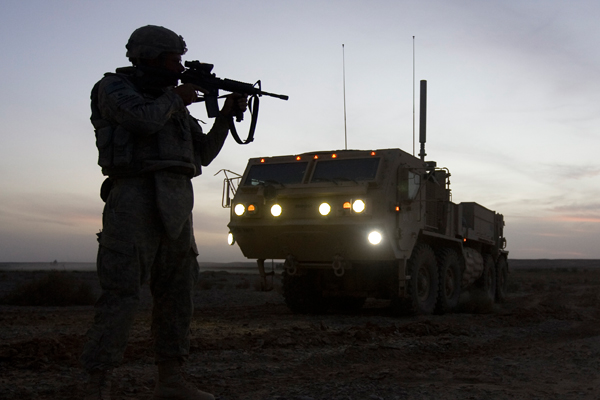
A U.S. Marine aims his rifle during a route clearance mission across a desert in Helmand province, southern Afghanistan (Credit: Reuters/Shamil Zhumatov)
This originally appeared on TomDispatch. It is the second installment of two-part series on America's decline. You can read part one here.

In the years of conscious, self-inflicted decline at home, “losses” continued to mount elsewhere. In the past decade, for the first time in 500 years, South America has taken successful steps to free itself from western domination, another serious loss. The region has moved towards integration, and has begun to address some of the terrible internal problems of societies ruled by mostly Europeanized elites, tiny islands of extreme wealth in a sea of misery. They have also rid themselves of all U.S. military bases and of IMF controls.  A newly formed organization, CELAC, includes all countries of the hemisphere apart from the U.S. and Canada. If it actually functions, that would be another step in American decline, in this case in what has always been regarded as “the backyard.”

Even more serious would be the loss of the MENA countries — Middle East/North Africa — which have been regarded by planners since the 1940s as “a stupendous source of strategic power, and one of the greatest material prizes in world history.” Control of MENA energy reserves would yield “substantial control of the world,” in the words of the influential Roosevelt advisor A.A. Berle.

To be sure, if the projections of a century of U.S. energy independence based on North American energy resources turn out to be realistic, the significance of controlling MENA would decline somewhat, though probably not by much: The main concern has always been control more than access.  However, the likely consequences to the planet’s equilibrium are so ominous that discussion may be largely an academic exercise.

The Arab Spring, another development of historic importance, might portend at least a partial “loss” of MENA. The U.S. and its allies have tried hard to prevent that outcome — so far, with considerable success.  Their policy towards the popular uprisings has kept closely to the standard guidelines: support the forces most amenable to U.S. influence and control.

Favored dictators are supported as long as they can maintain control (as in the major oil states). When that is no longer possible, then discard them and try to restore the old regime as fully as possible (as in Tunisia and Egypt). The general pattern is familiar: Somoza, Marcos, Duvalier, Mobutu, Suharto and many others. In one case, Libya, the three traditional imperial powers intervened by force to participate in a rebellion to overthrow a mercurial and unreliable dictator, opening the way, it is expected, to more efficient control over Libya’s rich resources (oil primarily, but also water, of particular interest to French corporations), to a possible base for the U.S. Africa Command (so far restricted to Germany), and to the reversal of growing Chinese penetration. As far as policy goes, there have been few surprises.

Crucially, it is important to reduce the threat of functioning democracy, in which popular opinion will significantly influence policy. That again is routine, and quite understandable. A look at the studies of public opinion undertaken by U.S. polling agencies in the MENA countries easily explains the western fear of authentic democracy, in which public opinion will significantly influence policy.

Israel and the Republican Party

Similar considerations carry over directly to the second major concern addressed in the issue of Foreign Affairs cited in part one of this piece: the Israel-Palestine conflict. Fear of democracy could hardly be more clearly exhibited than in this case. In January 2006, an election took place in Palestine, pronounced free and fair by international monitors. The instant reaction of the U.S. (and of course Israel), with Europe following along politely, was to impose harsh penalties on Palestinians for voting the wrong way.

That is no innovation. It is quite in accord with the general and unsurprising principle recognized by mainstream scholarship: The U.S. supports democracy if, and only if, the outcomes accord with its strategic and economic objectives, the rueful conclusion of neo-Reaganite Thomas Carothers, the most careful and respected scholarly analyst of “democracy promotion” initiatives.

More broadly, for 35 years the U.S. has led the rejectionist camp on Israel-Palestine, blocking an international consensus calling for a political settlement in terms too well known to require repetition.  The western mantra is that Israel seeks negotiations without preconditions, while the Palestinians refuse. The opposite is more accurate. The U.S. and Israel demand strict preconditions, which are, furthermore, designed to ensure that negotiations will lead either to Palestinian capitulation on crucial issues, or nowhere.

The first precondition is that the negotiations must be supervised by Washington, which makes about as much sense as demanding that Iran supervise the negotiation of Sunni-Shia conflicts in Iraq. Serious negotiations would have to be under the auspices of some neutral party, preferably one that commands some international respect, perhaps Brazil. The negotiations would seek to resolve the conflicts between the two antagonists: the U.S.-Israel on one side, most of the world on the other.

The second precondition is that Israel must be free to expand its illegal settlements in the West Bank. Theoretically, the U.S. opposes these actions, but with a very light tap on the wrist, while continuing to provide economic, diplomatic, and military support. When the U.S. does have some limited objections, it very easily bars the actions, as in the case of the E-1 project linking Greater Jerusalem to the town of Ma’aleh Adumim, virtually bisecting the West Bank, a very high priority for Israeli planners (across the spectrum), but raising some objections in Washington, so that Israel has had to resort to devious measures to chip away at the project.

The pretense of opposition reached the level of farce last February when Obama vetoed a Security Council resolution calling for implementation of official U.S. policy (also adding the uncontroversial observation that the settlements themselves are illegal, quite apart from expansion). Since that time there has been little talk about ending settlement expansion, which continues, with studied provocation.

Thus, as Israeli and Palestinian representatives prepared to meet in Jordan in January 2011, Israel announced new construction in Pisgat Ze’ev and Har Homa, West Bank areas that it has declared to be within the greatly expanded area of Jerusalem, annexed, settled, and constructed as Israel’s capital, all in violation of direct Security Council orders. Other moves carry forward the grander design of separating whatever West Bank enclaves will be left to Palestinian administration from the cultural, commercial, political center of Palestinian life in the former Jerusalem.

It is understandable that Palestinian rights should be marginalized in U.S. policy and discourse. Palestinians have no wealth or power. They offer virtually nothing to U.S. policy concerns; in fact, they have negative value, as a nuisance that stirs up “the Arab street.”

Israel, in contrast, is a valuable ally. It is a rich society with a sophisticated, largely militarized high-tech industry. For decades, it has been a highly valued military and strategic ally, particularly since 1967, when it performed a great service to the U.S. and its Saudi ally by destroying the Nasserite “virus,” establishing the “special relationship” with Washington in the form that has persisted since. It is also a growing center for U.S. high-tech investment. In fact, high tech and particularly military industries in the two countries are closely linked.

Apart from such elementary considerations of great power politics as these, there are cultural factors that should not be ignored. Christian Zionism in Britain and the U.S. long preceded Jewish Zionism, and has been a significant elite phenomenon with clear policy implications (including the Balfour Declaration, which drew from it). When General Allenby conquered Jerusalem during World War I, he was hailed in the American press as Richard the Lion-Hearted, who had at last won the Crusades and driven the pagans out of the Holy Land.

The next step was for the Chosen People to return to the land promised to them by the Lord. Articulating a common elite view, President Franklin Roosevelt’s Secretary of the Interior Harold Ickes described Jewish colonization of Palestine as an achievement “without comparison in the history of the human race.” Such attitudes find their place easily within the Providentialist doctrines that have been a strong element in popular and elite culture since the country’s origins: The belief that God has a plan for the world and the U.S. is carrying it forward under divine guidance, as articulated by a long list of leading figures.

Moreover, evangelical Christianity is a major popular force in the U.S. Further toward the extremes, End Times evangelical Christianity also has enormous popular outreach, invigorated by the establishment of Israel in 1948, revitalized even more by the conquest of the rest of Palestine in 1967 — all signs that End Times and the Second Coming are approaching.

These forces have become particularly significant since the Reagan years, as the Republicans have abandoned the pretense of being a political party in the traditional sense, while devoting themselves in virtual lockstep uniformity to servicing a tiny percentage of the super-rich and the corporate sector. However, the small constituency that is primarily served by the reconstructed party cannot provide votes, so they have to turn elsewhere.

The only choice is to mobilize tendencies that have always been present, though rarely as an organized political force: primarily nativists trembling in fear and hatred, and religious elements that are extremists by international standards but not in the U.S. One outcome is reverence for alleged Biblical prophecies, hence not only support for Israel and its conquests and expansion, but passionate love for Israel, another core part of the catechism that must be intoned by Republican candidates — with Democrats, again, not too far behind.

These factors aside, it should not be forgotten that the “Anglosphere” — Britain and its offshoots — consists of settler-colonial societies, which rose on the ashes of indigenous populations, suppressed or virtually exterminated. Past practices must have been basically correct, in the U.S. case even ordained by Divine Providence. Accordingly there is often an intuitive sympathy for the children of Israel when they follow a similar course. But primarily, geostrategic and economic interests prevail, and policy is not graven in stone.

The Iranian “Threat” and the Nuclear Issue

Let us turn finally to the third of the leading issues addressed in the establishment journals cited earlier, the “threat of Iran.” Among elites and the political class this is generally taken to be the primary threat to world order — though not among populations. In Europe, polls show that Israel is regarded as the leading threat to peace. In the MENA countries, that status is shared with the U.S., to the extent that in Egypt, on the eve of the Tahrir Square uprising, 80 percent felt that the region would be more secure if Iran had nuclear weapons.  The same polls found that only 10 percent regard Iran as a threat — unlike the ruling dictators, who have their own concerns.

In the United States, before the massive propaganda campaigns of the past few years, a majority of the population agreed with most of the world that, as a signatory of the Non-Proliferation Treaty, Iran has a right to carry out uranium enrichment. And even today, a large majority favors peaceful means for dealing with Iran. There is even strong opposition to military engagement if Iran and Israel are at war. Only a quarter regard Iran as an important concern for the U.S. altogether. But it is not unusual for there to be a gap, often a chasm, dividing public opinion and policy.

Why exactly is Iran regarded as such a colossal threat? The question is rarely discussed, but it is not hard to find a serious answer — though not, as usual, in the fevered pronouncements. The most authoritative answer is provided by the Pentagon and the intelligence services in their regular reports to Congress on global security.  They report that Iran does not pose a military threat. Its military spending is very low even by the standards of the region, minuscule of course in comparison with the U.S.

Iran has little capacity to deploy force. Its strategic doctrines are defensive, designed to deter invasion long enough for diplomacy to set it. If Iran is developing nuclear weapons capability, they report, that would be part of its deterrence strategy. No serious analyst believes that the ruling clerics are eager to see their country and possessions vaporized, the immediate consequence of their coming even close to initiating a nuclear war. And it is hardly necessary to spell out the reasons why any Iranian leadership would be concerned with deterrence, under existing circumstances.

The regime is doubtless a serious threat to much of its own population — and regrettably, is hardly unique on that score. But the primary threat to the U.S. and Israel is that Iran might deter their free exercise of violence. A further threat is that the Iranians clearly seek to extend their influence to neighboring Iraq and Afghanistan, and beyond as well. Those “illegitimate” acts are called “destabilizing” (or worse). In contrast, forceful imposition of U.S. influence halfway around the world contributes to “stability” and order, in accord with traditional doctrine about who owns the world.

It makes very good sense to try to prevent Iran from joining the nuclear weapons states, including the three that have refused to sign the Non-Proliferation Treaty — Israel, India and Pakistan, all of which have been assisted in developing nuclear weapons by the U.S., and are still being assisted by them. It is not impossible to approach that goal by peaceful diplomatic means. One approach, which enjoys overwhelming international support, is to undertake meaningful steps towards establishing a nuclear weapons-free zone in the Middle East, including Iran and Israel (and applying as well to U.S. forces deployed there), better still extending to South Asia.

Support for such efforts is so strong that the Obama administration has been compelled to formally agree, but with reservations: Crucially, that Israel’s nuclear program must not be placed under the auspices of the International Atomic Energy Association, and that no state (meaning the U.S.) should be required to release information about “Israeli nuclear facilities and activities, including information pertaining to previous nuclear transfers to Israel.” Obama also accepts Israel’s position that any such proposal must be conditional on a comprehensive peace settlement, which the U.S. and Israel can continue to delay indefinitely.

This survey comes nowhere near being exhaustive, needless to say. Among major topics not addressed is the shift of U.S. military policy towards the Asia-Pacific region, with new additions to the huge military base system underway right now, in Jeju Island off South Korea and Northwest Australia, all elements of the policy of “containment of China.” Closely related is the issue of U.S. bases in Okinawa, bitterly opposed by the population for many years, and a continual crisis in U.S.-Tokyo-Okinawa relations.

Revealing how little fundamental assumptions have changed, U.S. strategic analysts describe the result of China’s military programs as a “classic ‘security dilemma,’ whereby military programs and national strategies deemed defensive by their planners are viewed as threatening by the other side,” writes Paul Godwin of the Foreign Policy Research Institute.  The security dilemma arises over control of the seas off China’s coasts. The U.S. regards its policies of controlling these waters as “defensive,” while China regards them as threatening; correspondingly, China regards its actions in nearby areas as “defensive” while the U.S. regards them as threatening. No such debate is even imaginable concerning U.S. coastal waters. This “classic security dilemma” makes sense, again, on the assumption that the U.S. has a right to control most of the world, and that U.S. security requires something approaching absolute global control.

While the principles of imperial domination have undergone little change, the capacity to implement them has markedly declined as power has become more broadly distributed in a diversifying world. Consequences are many. It is, however, very important to bear in mind that — unfortunately — none lifts the two dark clouds that hover over all consideration of global order: nuclear war and environmental catastrophe, both literally threatening the decent survival of the species.

Quite the contrary. Both threats are ominous, and increasing.

To stay on top of important articles like these, sign up to receive the latest updates from TomDispatch.com here.

Continue Reading Close

The hysterical American decline

As America tries to cling to world dominance, we can learn important lessons from Vietnam and Iraq

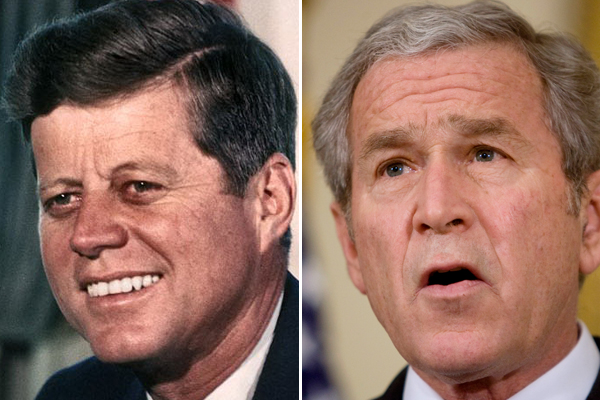
(Credit: The White House/AP)
This piece originally appeared on TomDispatch.

Significant anniversaries are solemnly commemorated — Japan’s attack on the U.S. naval base at Pearl Harbor, for example. Others are ignored, and we can often learn valuable lessons from them about what is likely to lie ahead. Right now, in fact.

At the moment, we are failing to commemorate the 50th anniversary of President John F. Kennedy’s decision to launch the most destructive and murderous act of aggression of the post-World War II period: the invasion of South Vietnam, later all of Indochina, leaving millions dead and four countries devastated, with casualties still mounting from the long-term effects of drenching South Vietnam with some of the most lethal carcinogens known, undertaken to destroy ground cover and food crops.

The prime target was South Vietnam. The aggression later spread to the North, then to the remote peasant society of northern Laos, and finally to rural Cambodia, which was bombed at the stunning level of all allied air operations in the Pacific region during World War II, including the two atom bombs dropped on Hiroshima and Nagasaki. In this, Henry Kissinger’s orders were being carried out — “anything that flies on anything that moves” — a call for genocide that is rare in the historical record. Little of this is remembered. Most was scarcely known beyond narrow circles of activists.

When the invasion was launched 50 years ago, concern was so slight that there were few efforts at justification, hardly more than the president’s impassioned plea that “we are opposed around the world by a monolithic and ruthless conspiracy that relies primarily on covert means for expanding its sphere of influence” and if the conspiracy achieves its ends in Laos and Vietnam, “the gates will be opened wide.”

Elsewhere, he warned further that “the complacent, the self-indulgent, the soft societies are about to be swept away with the debris of history [and] only the strong… can possibly survive,” in this case reflecting on the failure of U.S. aggression and terror to crush Cuban independence.

By the time protest began to mount half a dozen years later, the respected Vietnam specialist and military historian Bernard Fall, no dove, forecast that “Vietnam as a cultural and historic entity… is threatened with extinction…[as]…the countryside literally dies under the blows of the largest military machine ever unleashed on an area of this size.” He was again referring to South Vietnam.

When the war ended eight horrendous years later, mainstream opinion was divided between those who described the war as a “noble cause” that could have been won with more dedication, and at the opposite extreme, the critics, to whom it was “a mistake” that proved too costly. By 1977, President Carter aroused little notice when he explained that we owe Vietnam “no debt” because “the destruction was mutual.”

There are important lessons in all this for today, even apart from another reminder that only the weak and defeated are called to account for their crimes. One lesson is that to understand what is happening we should attend not only to critical events of the real world, often dismissed from history, but also to what leaders and elite opinion believe, however tinged with fantasy. Another lesson is that alongside the flights of fancy concocted to terrify and mobilize the public (and perhaps believed by some who are trapped in their own rhetoric), there is also geostrategic planning based on principles that are rational and stable over long periods because they are rooted in stable institutions and their concerns. That is true in the case of Vietnam as well. I will return to that, only stressing here that the persistent factors in state action are generally well concealed.

The Iraq war is an instructive case. It was marketed to a terrified public on the usual grounds of self-defense against an awesome threat to survival: the “single question,” George W. Bush and Tony Blair declared, was whether Saddam Hussein would end his programs of developing weapons of mass destruction. When the single question received the wrong answer, government rhetoric shifted effortlessly to our “yearning for democracy,” and educated opinion duly followed course; all routine.

Later, as the scale of the U.S. defeat in Iraq was becoming difficult to suppress, the government quietly conceded what had been clear all along. In 2007-2008, the administration officially announced that a final settlement must grant the U.S. military bases and the right of combat operations, and must privilege U.S. investors in the rich energy system — demands later reluctantly abandoned in the face of Iraqi resistance. And all well kept from the general population.

Gauging American Decline

With such lessons in mind, it is useful to look at what is highlighted in the major journals of policy and opinion today. Let us keep to the most prestigious of the establishment journals, Foreign Affairs. The headline blaring on the cover of the December 2011 issue reads in bold face: “Is America Over?”

The title article calls for “retrenchment” in the “humanitarian missions” abroad that are consuming the country’s wealth, so as to arrest the American decline that is a major theme of international affairs discourse, usually accompanied by the corollary that power is shifting to the East, to China and (maybe) India.

The lead articles are on Israel-Palestine. The first, by two high Israeli officials, is entitled “The Problem is Palestinian Rejection”: the conflict cannot be resolved because Palestinians refuse to recognize Israel as a Jewish state — thereby conforming to standard diplomatic practice: states are recognized, but not privileged sectors within them. The demand is hardly more than a new device to deter the threat of political settlement that would undermine Israel’s expansionist goals.

The opposing position, defended by an American professor, is entitled “The Problem Is the Occupation.” The subtitle reads “How the Occupation is Destroying the Nation.” Which nation? Israel, of course. The paired articles appear under the heading “Israel under Siege.”

The January 2012 issue features yet another call to bomb Iran now, before it is too late. Warning of “the dangers of deterrence,” the author suggests that “skeptics of military action fail to appreciate the true danger that a nuclear-armed Iran would pose to U.S. interests in the Middle East and beyond. And their grim forecasts assume that the cure would be worse than the disease — that is, that the consequences of a U.S. assault on Iran would be as bad as or worse than those of Iran achieving its nuclear ambitions. But that is a faulty assumption. The truth is that a military strike intended to destroy Iran’s nuclear program, if managed carefully, could spare the region and the world a very real threat and dramatically improve the long-term national security of the United States.”

Others argue that the costs would be too high, and at the extremes some even point out that an attack would violate international law — as does the stand of the moderates, who regularly deliver threats of violence, in violation of the U.N. Charter.

Let us review these dominant concerns in turn.

American decline is real, though the apocalyptic vision reflects the familiar ruling class perception that anything short of total control amounts to total disaster. Despite the piteous laments, the U.S. remains the world dominant power by a large margin, and no competitor is in sight, not only in the military dimension, in which of course the U.S. reigns supreme.

China and India have recorded rapid (though highly inegalitarian) growth, but remain very poor countries, with enormous internal problems not faced by the West. China is the world’s major manufacturing center, but largely as an assembly plant for the advanced industrial powers on its periphery and for western multinationals. That is likely to change over time. Manufacturing regularly provides the basis for innovation, often breakthroughs, as is now sometimes happening in China. One example that has impressed western specialists is China’s takeover of the growing global solar panel market, not on the basis of cheap labor but by coordinated planning and, increasingly, innovation.

But the problems China faces are serious. Some are demographic, reviewed in Science, the leading U.S. science weekly. The study shows that mortality sharply decreased in China during the Maoist years, “mainly a result of economic development and improvements in education and health services, especially the public hygiene movement that resulted in a sharp drop in mortality from infectious diseases.” This progress ended with the initiation of the capitalist reforms 30 years ago, and the death rate has since increased.

Furthermore, China’s recent economic growth has relied substantially on a “demographic bonus,” a very large working-age population. “But the window for harvesting this bonus may close soon,” with a “profound impact on development”: “Excess cheap labor supply, which is one of the major factors driving China’s economic miracle, will no longer be available.”

Demography is only one of many serious problems ahead. For India, the problems are far more severe.

Not all prominent voices foresee American decline. Among international media, there is none more serious and responsible than the London Financial Times. It recently devoted a full page to the optimistic expectation that new technology for extracting North American fossil fuels might allow the U.S. to become energy independent, hence to retain its global hegemony for a century. There is no mention of the kind of world the U.S. would rule in this happy event, but not for lack of evidence.

At about the same time, the International Energy Agency reported that, with rapidly increasing carbon emissions from fossil fuel use, the limit of safety will be reached by 2017 if the world continues on its present course. “The door is closing,” the IEA chief economist said, and very soon it “will be closed forever.”

Shortly before the U.S. Department of Energy reported the most recent carbon dioxide emissions figures, which “jumped by the biggest amount on record” to a level higher than the worst-case scenario anticipated by the International Panel on Climate Change (IPCC). That came as no surprise to many scientists, including the MIT program on climate change, which for years has warned that the IPCC predictions are too conservative.

Such critics of the IPCC predictions receive virtually no public attention, unlike the fringe of denialists who are supported by the corporate sector, along with huge propaganda campaigns that have driven Americans off the international spectrum in dismissal of the threats. Business support also translates directly to political power. Denialism is part of the catechism that must be intoned by Republican candidates in the farcical election campaign now in progress, and in Congress they are powerful enough to abort even efforts to inquire into the effects of global warming, let alone do anything serious about it.

In brief, American decline can perhaps be stemmed if we abandon hope for decent survival, prospects that are all too real given the balance of forces in the world.

“Losing” China and Vietnam

Putting such unpleasant thoughts aside, a close look at American decline shows that China indeed plays a large role, as it has for 60 years. The decline that now elicits such concern is not a recent phenomenon. It traces back to the end of World War II, when the U.S. had half the world’s wealth and incomparable security and global reach. Planners were naturally well aware of the enormous disparity of power, and intended to keep it that way.

The basic viewpoint was outlined with admirable frankness in a major state paper of 1948 (PPS 23). The author was one of the architects of the New World Order of the day, the chair of the State Department Policy Planning Staff, the respected statesman and scholar George Kennan, a moderate dove within the planning spectrum. He observed that the central policy goal was to maintain the “position of disparity” that separated our enormous wealth from the poverty of others. To achieve that goal, he advised, “We should cease to talk about vague and… unreal objectives such as human rights, the raising of the living standards, and democratization,” and must “deal in straight power concepts,” not “hampered by idealistic slogans” about “altruism and world-benefaction.”

Kennan was referring specifically to Asia, but the observations generalize, with exceptions, for participants in the U.S.-run global system. It was well understood that the “idealistic slogans” were to be displayed prominently when addressing others, including the intellectual classes, who were expected to promulgate them.

The plans that Kennan helped formulate and implement took for granted that the U.S. would control the Western Hemisphere, the Far East, the former British empire (including the incomparable energy resources of the Middle East), and as much of Eurasia as possible, crucially its commercial and industrial centers. These were not unrealistic objectives, given the distribution of power. But decline set in at once.

In 1949, China declared independence, an event known in Western discourse as “the loss of China” — in the U.S., with bitter recriminations and conflict over who was responsible for that loss. The terminology is revealing. It is only possible to lose something that one owns. The tacit assumption was that the U.S. owned China, by right, along with most of the rest of the world, much as postwar planners assumed.

The “loss of China” was the first major step in “America’s decline.” It had major policy consequences. One was the immediate decision to support France’s effort to reconquer its former colony of Indochina, so that it, too, would not be “lost.”

Indochina itself was not a major concern, despite claims about its rich resources by President Eisenhower and others. Rather, the concern was the “domino theory,” which is often ridiculed when dominoes don’t fall, but remains a leading principle of policy because it is quite rational. To adopt Henry Kissinger’s version, a region that falls out of control can become a “virus” that will “spread contagion,” inducing others to follow the same path.

In the case of Vietnam, the concern was that the virus of independent development might infect Indonesia, which really does have rich resources. And that might lead Japan — the “superdomino” as it was called by the prominent Asia historian John Dower — to “accommodate” to an independent Asia as its technological and industrial center in a system that would escape the reach of U.S. power. That would mean, in effect, that the U.S. had lost the Pacific phase of World War II, fought to prevent Japan’s attempt to establish such a New Order in Asia.

The way to deal with such a problem is clear: destroy the virus and “inoculate” those who might be infected. In the Vietnam case, the rational choice was to destroy any hope of successful independent development and to impose brutal dictatorships in the surrounding regions. Those tasks were successfully carried out — though history has its own cunning, and something similar to what was feared has since been developing in East Asia, much to Washington’s dismay.

The most important victory of the Indochina wars was in 1965, when a U.S.-backed military coup in Indonesia led by General Suharto carried out massive crimes that were compared by the CIA to those of Hitler, Stalin and Mao. The “staggering mass slaughter,” as the New York Times described it, was reported accurately across the mainstream, and with unrestrained euphoria.

It was “a gleam of light in Asia,” as the noted liberal commentator James Reston wrote in the Times. The coup ended the threat of democracy by demolishing the mass-based political party of the poor, established a dictatorship that went on to compile one of the worst human rights records in the world, and threw the riches of the country open to western investors. Small wonder that, after many other horrors, including the near-genocidal invasion of East Timor, Suharto was welcomed by the Clinton administration in 1995 as “our kind of guy.”

Years after the great events of 1965, Kennedy-Johnson National Security Adviser McGeorge Bundy reflected that it would have been wise to end the Vietnam war at that time, with the “virus” virtually destroyed and the primary domino solidly in place, buttressed by other U.S.-backed dictatorships throughout the region.

Similar procedures have been routinely followed elsewhere. Kissinger was referring specifically to the threat of socialist democracy in Chile. That threat was ended on another forgotten date, what Latin Americans call “the first 9/11,” which in violence and bitter effects far exceeded the 9/11 commemorated in the West. A vicious dictatorship was imposed in Chile, one part of a plague of brutal repression that spread through Latin America, reaching Central America under Reagan. Viruses have aroused deep concern elsewhere as well, including the Middle East, where the threat of secular nationalism has often concerned British and U.S. planners, inducing them to support radical Islamic fundamentalism to counter it.

The Concentration of Wealth and American Decline

Despite such victories, American decline continued. By 1970, U.S. share of world wealth had dropped to about 25 percent, roughly where it remains, still colossal but far below the end of World War II. By then, the industrial world was “tripolar”: US-based North America, German-based Europe and East Asia, already the most dynamic industrial region, at the time Japan-based, but by now including the former Japanese colonies Taiwan and South Korea, and more recently China.

At about that time, American decline entered a new phase: conscious self-inflicted decline. From the 1970s, there has been a significant change in the U.S. economy, as planners, private and state, shifted it toward financialization and the offshoring of production, driven in part by the declining rate of profit in domestic manufacturing. These decisions initiated a vicious cycle in which wealth became highly concentrated (dramatically so in the top 0.1 percent of the population), yielding concentration of political power, hence legislation to carry the cycle further: taxation and other fiscal policies, deregulation, changes in the rules of corporate governance allowing huge gains for executives, and so on.

Meanwhile, for the majority, real wages largely stagnated, and people were able to get by only by sharply increased workloads (far beyond Europe), unsustainable debt, and repeated bubbles since the Reagan years, creating paper wealth that inevitably disappeared when they burst (and the perpetrators were bailed out by the taxpayer). In parallel, the political system has been increasingly shredded as both parties are driven deeper into corporate pockets with the escalating cost of elections, the Republicans to the level of farce, the Democrats (now largely the former “moderate Republicans”) not far behind.

A recent study by the Economic Policy Institute, which has been the major source of reputable data on these developments for years, is entitled “Failure by Design.” The phrase “by design” is accurate. Other choices were certainly possible. And as the study points out, the “failure” is class-based. There is no failure for the designers. Far from it. Rather, the policies are a failure for the large majority, the 99 percent in the imagery of the Occupy movements — and for the country, which has declined and will continue to do so under these policies.

One factor is the offshoring of manufacturing. As the solar panel example mentioned earlier illustrates, manufacturing capacity provides the basis and stimulus for innovation leading to higher stages of sophistication in production, design and invention. That, too, is being outsourced, not a problem for the “money mandarins” who increasingly design policy, but a serious problem for working people and the middle classes, and a real disaster for the most oppressed, African Americans, who have never escaped the legacy of slavery and its ugly aftermath, and whose meager wealth virtually disappeared after the collapse of the housing bubble in 2008, setting off the most recent financial crisis, the worst so far.

[Note: Part 2 of Noam Chomsky’s discussion of American decline will be posted on Salon tomorrow.]

To stay on top of important articles like these, sign up to receive the latest updates from TomDispatch.com here.

Continue Reading Close

What we should have done after 9/11

In the decade since the attacks, the U.S. consistently played into bin Laden's hands. Was there another way?

We are approaching the 10th anniversary of the horrendous atrocities of September 11, 2001, which, it is commonly held, changed the world. On May 1st, the presumed mastermind of the crime, Osama bin Laden, was assassinated in Pakistan by a team of elite US commandos, Navy SEALs, after he was captured, unarmed and undefended, in Operation Geronimo.

A number of analysts have observed that although bin Laden was finally killed, he won some major successes in his war against the U.S. “He repeatedly asserted that the only way to drive the U.S. from the Muslim world and defeat its satraps was by drawing Americans into a series of small but expensive wars that would ultimately bankrupt them,” Eric Margolis writes. “‘Bleeding the U.S.,’ in his words.” The United States, first under George W. Bush and then Barack Obama, rushed right into bin Laden’s trap… Grotesquely overblown military outlays and debt addiction… may be the most pernicious legacy of the man who thought he could defeat the United States” — particularly when the debt is being cynically exploited by the far right, with the collusion of the Democrat establishment, to undermine what remains of social programs, public education, unions, and, in general, remaining barriers to corporate tyranny.

That Washington was bent on fulfilling bin Laden’s fervent wishes was evident at once. As discussed in my book “9-11,” written shortly after those attacks occurred, anyone with knowledge of the region could recognize “that a massive assault on a Muslim population would be the answer to the prayers of bin Laden and his associates, and would lead the U.S. and its allies into a ‘diabolical trap,’ as the French foreign minister put it.”

The senior CIA analyst responsible for tracking Osama bin Laden from 1996, Michael Scheuer, wrote shortly after that “bin Laden has been precise in telling America the reasons he is waging war on us. [He] is out to drastically alter U.S. and Western policies toward the Islamic world,” and largely succeeded: “U.S. forces and policies are completing the radicalization of the Islamic world, something Osama bin Laden has been trying to do with substantial but incomplete success since the early 1990s. As a result, I think it is fair to conclude that the United States of America remains bin Laden’s only indispensable ally.” And arguably remains so, even after his death.

The First 9/11

Was there an alternative? There is every likelihood that the Jihadi movement, much of it highly critical of bin Laden, could have been split and undermined after 9/11. The “crime against humanity,” as it was rightly called, could have been approached as a crime, with an international operation to apprehend the likely suspects. That was recognized at the time, but no such idea was even considered.

In “9-11,” I quoted Robert Fisk’s conclusion that the “horrendous crime” of 9/11 was committed with “wickedness and awesome cruelty,” an accurate judgment. It is useful to bear in mind that the crimes could have been even worse. Suppose, for example, that the attack had gone as far as bombing the White House, killing the president, imposing a brutal military dictatorship that killed thousands and tortured tens of thousands while establishing an international terror center that helped impose similar torture-and-terror states elsewhere and carried out an international assassination campaign; and as an extra fillip, brought in a team of economists — call them “the Kandahar boys” — who quickly drove the economy into one of the worst depressions in its history. That, plainly, would have been a lot worse than 9/11.

Unfortunately, it is not a thought experiment. It happened. The only inaccuracy in this brief account is that the numbers should be multiplied by 25 to yield per capita equivalents, the appropriate measure. I am, of course, referring to what in Latin America is often called “the first 9/11″: September 11, 1973, when the U.S. succeeded in its intensive efforts to overthrow the democratic government of Salvador Allende in Chile with a military coup that placed General Pinochet’s brutal regime in office. The goal, in the words of the Nixon administration, was to kill the “virus” that might encourage all those “foreigners [who] are out to screw us” to take over their own resources and in other ways to pursue an intolerable policy of independent development. In the background was the conclusion of the National Security Council that, if the US could not control Latin America, it could not expect “to achieve a successful order elsewhere in the world.”

The first 9/11, unlike the second, did not change the world. It was “nothing of very great consequence,” as Henry Kissinger assured his boss a few days later.

These events of little consequence were not limited to the military coup that destroyed Chilean democracy and set in motion the horror story that followed. The first 9/11 was just one act in a drama which began in 1962, when John F. Kennedy shifted the mission of the Latin American military from “hemispheric defense” — an anachronistic holdover from World War II — to “internal security,” a concept with a chilling interpretation in U.S.-dominated Latin American circles.

In the recently published Cambridge University “History of the Cold War,” Latin American scholar John Coatsworth writes that from that time to “the Soviet collapse in 1990, the numbers of political prisoners, torture victims, and executions of non-violent political dissenters in Latin America vastly exceeded those in the Soviet Union and its East European satellites,” including many religious martyrs and mass slaughter as well, always supported or initiated in Washington. The last major violent act was the brutal murder of six leading Latin American intellectuals, Jesuit priests, a few days after the Berlin Wall fell. The perpetrators were an elite Salvadorean battalion, which had already left a shocking trail of blood, fresh from renewed training at the JFK School of Special Warfare, acting on direct orders of the high command of the U.S. client state.

The consequences of this hemispheric plague still, of course, reverberate.

From Kidnapping and Torture to Assassination

All of this, and much more like it, is dismissed as of little consequence, and forgotten. Those whose mission is to rule the world enjoy a more comforting picture, articulated well enough in the current issue of the prestigious (and valuable) journal of the Royal Institute of International Affairs in London. The lead article discusses “the visionary international order” of the “second half of the twentieth century” marked by “the universalization of an American vision of commercial prosperity.” There is something to that account, but it does not quite convey the perception of those at the wrong end of the guns.

The same is true of the assassination of Osama bin Laden, which brings to an end at least a phase in the “war on terror” re-declared by President George W. Bush on the second 9/11. Let us turn to a few thoughts on that event and its significance.

On May 1, 2011, Osama bin Laden was killed in his virtually unprotected compound by a raiding mission of 79 Navy SEALs, who entered Pakistan by helicopter. After many lurid stories were provided by the government and withdrawn, official reports made it increasingly clear that the operation was a planned assassination, multiply violating elementary norms of international law, beginning with the invasion itself.

There appears to have been no attempt to apprehend the unarmed victim, as presumably could have been done by 79 commandos facing no opposition — except, they report, from his wife, also unarmed, whom they shot in self-defense when she “lunged” at them, according to the White House.

A plausible reconstruction of the events is provided by veteran Middle East correspondent Yochi Dreazen and colleagues in the Atlantic. Dreazen, formerly the military correspondent for the Wall Street Journal, is senior correspondent for the National Journal Group covering military affairs and national security. According to their investigation, White House planning appears not to have considered the option of capturing bin Laden alive: “The administration had made clear to the military’s clandestine Joint Special Operations Command that it wanted bin Laden dead, according to a senior U.S. official with knowledge of the discussions. A high-ranking military officer briefed on the assault said the SEALs knew their mission was not to take him alive.”

The authors add: “For many at the Pentagon and the Central Intelligence Agency who had spent nearly a decade hunting bin Laden, killing the militant was a necessary and justified act of vengeance.” Furthermore, “capturing bin Laden alive would have also presented the administration with an array of nettlesome legal and political challenges.” Better, then, to assassinate him, dumping his body into the sea without the autopsy considered essential after a killing — an act that predictably provoked both anger and skepticism in much of the Muslim world.

As the Atlantic inquiry observes, “The decision to kill bin Laden outright was the clearest illustration to date of a little-noticed aspect of the Obama administration’s counterterror policy. The Bush administration captured thousands of suspected militants and sent them to detention camps in Afghanistan, Iraq, and Guantanamo Bay. The Obama administration, by contrast, has focused on eliminating individual terrorists rather than attempting to take them alive.” That is one significant difference between Bush and Obama. The authors quote former West German Chancellor Helmut Schmidt, who “told German TV that the U.S. raid was ‘quite clearly a violation of international law’ and that bin Laden should have been detained and put on trial,” contrasting Schmidt with U.S. Attorney General Eric Holder, who “defended the decision to kill bin Laden although he didn’t pose an immediate threat to the Navy SEALs, telling a House panel… that the assault had been ‘lawful, legitimate and appropriate in every way.’”

The disposal of the body without autopsy was also criticized by allies. The highly regarded British barrister Geoffrey Robertson, who supported the intervention and opposed the execution largely on pragmatic grounds, nevertheless described Obama’s claim that “justice was done” as an “absurdity” that should have been obvious to a former professor of constitutional law. Pakistan law “requires a colonial inquest on violent death, and international human rights law insists that the ‘right to life’ mandates an inquiry whenever violent death occurs from government or police action. The U.S. is therefore under a duty to hold an inquiry that will satisfy the world as to the true circumstances of this killing.”

Robertson usefully reminds us that “[i]t was not always thus. When the time came to consider the fate of men much more steeped in wickedness than Osama bin Laden — the Nazi leadership — the British government wanted them hanged within six hours of capture. President Truman demurred, citing the conclusion of Justice Robert Jackson that summary execution ‘would not sit easily on the American conscience or be remembered by our children with pride… the only course is to determine the innocence or guilt of the accused after a hearing as dispassionate as the times will permit and upon a record that will leave our reasons and motives clear.’”

Eric Margolis comments that “Washington has never made public the evidence of its claim that Osama bin Laden was behind the 9/11 attacks,” presumably one reason why “polls show that fully a third of American respondents believe that the U.S. government and/or Israel were behind 9/11,” while in the Muslim world skepticism is much higher. “An open trial in the U.S. or at the Hague would have exposed these claims to the light of day,” he continues, a practical reason why Washington should have followed the law.

In societies that profess some respect for law, suspects are apprehended and brought to fair trial. I stress “suspects.” In June 2002, FBI head Robert Mueller, in what the Washington Post described as “among his most detailed public comments on the origins of the attacks,” could say only that “investigators believe the idea of the Sept. 11 attacks on the World Trade Center and Pentagon came from al Qaeda leaders in Afghanistan, the actual plotting was done in Germany, and the financing came through the United Arab Emirates from sources in Afghanistan.”

What the FBI believed and thought in June 2002 they didn’t know eight months earlier, when Washington dismissed tentative offers by the Taliban (how serious, we do not know) to permit a trial of bin Laden if they were presented with evidence. Thus, it is not true, as President Obama claimed in his White House statement after bin Laden’s death, that “[w]e quickly learned that the 9/11 attacks were carried out by al-Qaida.”

There has never been any reason to doubt what the FBI believed in mid-2002, but that leaves us far from the proof of guilt required in civilized societies — and whatever the evidence might be, it does not warrant murdering a suspect who could, it seems, have been easily apprehended and brought to trial. Much the same is true of evidence provided since. Thus, the 9/11 Commission provided extensive circumstantial evidence of bin Laden’s role in 9/11, based primarily on what it had been told about confessions by prisoners in Guantanamo. It is doubtful that much of that would hold up in an independent court, considering the ways confessions were elicited. But in any event, the conclusions of a congressionally authorized investigation, however convincing one finds them, plainly fall short of a sentence by a credible court, which is what shifts the category of the accused from suspect to convicted.

There is much talk of bin Laden’s “confession,” but that was a boast, not a confession, with as much credibility as my “confession” that I won the Boston marathon. The boast tells us a lot about his character, but nothing about his responsibility for what he regarded as a great achievement, for which he wanted to take credit.

Again, all of this is, transparently, quite independent of one’s judgments about his responsibility, which seemed clear immediately, even before the FBI inquiry, and still does.

Crimes of Aggression

It is worth adding that bin Laden’s responsibility was recognized in much of the Muslim world, and condemned. One significant example is the distinguished Lebanese cleric Sheikh Fadlallah, greatly respected by Hezbollah and Shia groups generally, outside Lebanon as well. He had some experience with assassinations. He had been targeted for assassination: by a truck bomb outside a mosque, in a CIA-organized operation in 1985. He escaped, but 80 others were killed, mostly women and girls as they left the mosque — one of those innumerable crimes that do not enter the annals of terror because of the fallacy of “wrong agency.” Sheikh Fadlallah sharply condemned the 9/11 attacks.

One of the leading specialists on the Jihadi movement, Fawaz Gerges, suggests that the movement might have been split at that time had the U.S. exploited the opportunity instead of mobilizing the movement, particularly by the attack on Iraq, a great boon to bin Laden, which led to a sharp increase in terror, as intelligence agencies had anticipated. At the Chilcot hearings investigating the background to the invasion of Iraq, for example, the former head of Britain’s domestic intelligence agency MI5 testified that both British and U.S. intelligence were aware that Saddam posed no serious threat, that the invasion was likely to increase terror, and that the invasions of Iraq and Afghanistan had radicalized parts of a generation of Muslims who saw the military actions as an “attack on Islam.” As is often the case, security was not a high priority for state action.

It might be instructive to ask ourselves how we would be reacting if Iraqi commandos had landed at George W. Bush’s compound, assassinated him, and dumped his body in the Atlantic (after proper burial rites, of course). Uncontroversially, he was not a “suspect” but the “decider” who gave the orders to invade Iraq — that is, to commit the “supreme international crime differing only from other war crimes in that it contains within itself the accumulated evil of the whole” for which Nazi criminals were hanged: the hundreds of thousands of deaths, millions of refugees, destruction of much of the country and its national heritage, and the murderous sectarian conflict that has now spread to the rest of the region. Equally uncontroversially, these crimes vastly exceed anything attributed to bin Laden.

To say that all of this is uncontroversial, as it is, is not to imply that it is not denied. The existence of flat earthers does not change the fact that, uncontroversially, the earth is not flat. Similarly, it is uncontroversial that Stalin and Hitler were responsible for horrendous crimes, though loyalists deny it. All of this should, again, be too obvious for comment, and would be, except in an atmosphere of hysteria so extreme that it blocks rational thought.

Similarly, it is uncontroversial that Bush and associates did commit the “supreme international crime” — the crime of aggression. That crime was defined clearly enough by Justice Robert Jackson, Chief of Counsel for the United States at Nuremberg. An “aggressor,” Jackson proposed to the Tribunal in his opening statement, is a state that is the first to commit such actions as “[i]nvasion of its armed forces, with or without a declaration of war, of the territory of another State ….” No one, even the most extreme supporter of the aggression, denies that Bush and associates did just that.

We might also do well to recall Jackson’s eloquent words at Nuremberg on the principle of universality: “If certain acts in violation of treaties are crimes, they are crimes whether the United States does them or whether Germany does them, and we are not prepared to lay down a rule of criminal conduct against others which we would not be willing to have invoked against us.”

It is also clear that announced intentions are irrelevant, even if they are truly believed. Internal records reveal that Japanese fascists apparently did believe that, by ravaging China, they were laboring to turn it into an “earthly paradise.” And although it may be difficult to imagine, it is conceivable that Bush and company believed they were protecting the world from destruction by Saddam’s nuclear weapons. All irrelevant, though ardent loyalists on all sides may try to convince themselves otherwise.

We are left with two choices: either Bush and associates are guilty of the “supreme international crime” including all the evils that follow, or else we declare that the Nuremberg proceedings were a farce and the allies were guilty of judicial murder.

The Imperial Mentality and 9/11

A few days before the bin Laden assassination, Orlando Bosch died peacefully in Florida, where he resided along with his accomplice Luis Posada Carriles and many other associates in international terrorism. After he was accused of dozens of terrorist crimes by the FBI, Bosch was granted a presidential pardon by Bush I over the objections of the Justice Department, which found the conclusion “inescapable that it would be prejudicial to the public interest for the United States to provide a safe haven for Bosch.” The coincidence of these deaths at once calls to mind the Bush II doctrine — “already… a de facto rule of international relations,” according to the noted Harvard international relations specialist Graham Allison — which revokes “the sovereignty of states that provide sanctuary to terrorists.”

Allison refers to the pronouncement of Bush II, directed at the Taliban, that “those who harbor terrorists are as guilty as the terrorists themselves.” Such states, therefore, have lost their sovereignty and are fit targets for bombing and terror — for example, the state that harbored Bosch and his associate. When Bush issued this new “de facto rule of international relations,” no one seemed to notice that he was calling for invasion and destruction of the U.S. and the murder of its criminal presidents.

None of this is problematic, of course, if we reject Justice Jackson’s principle of universality, and adopt instead the principle that the U.S. is self-immunized against international law and conventions — as, in fact, the government has frequently made very clear.

It is also worth thinking about the name given to the bin Laden operation: Operation Geronimo. The imperial mentality is so profound that few seem able to perceive that the White House is glorifying bin Laden by calling him “Geronimo” — the Apache Indian chief who led the courageous resistance to the invaders of Apache lands.

The casual choice of the name is reminiscent of the ease with which we name our murder weapons after victims of our crimes: Apache, Blackhawk… We might react differently if the Luftwaffe had called its fighter planes “Jew” and “Gypsy.”

The examples mentioned would fall under the category of “American exceptionalism,” were it not for the fact that easy suppression of one’s own crimes is virtually ubiquitous among powerful states, at least those that are not defeated and forced to acknowledge reality.

Perhaps the assassination was perceived by the administration as an “act of vengeance,” as Robertson concludes. And perhaps the rejection of the legal option of a trial reflects a difference between the moral culture of 1945 and today, as he suggests. Whatever the motive was, it could hardly have been security. As in the case of the “supreme international crime” in Iraq, the bin Laden assassination is another illustration of the important fact that security is often not a high priority for state action, contrary to received doctrine.

To stay on top of important articles like these, sign up to receive the latest updates from TomDispatch.com here.

Continue Reading Close

Is the world too big to fail?

As its global dominance wanes, America battles democracy, both at home and abroad

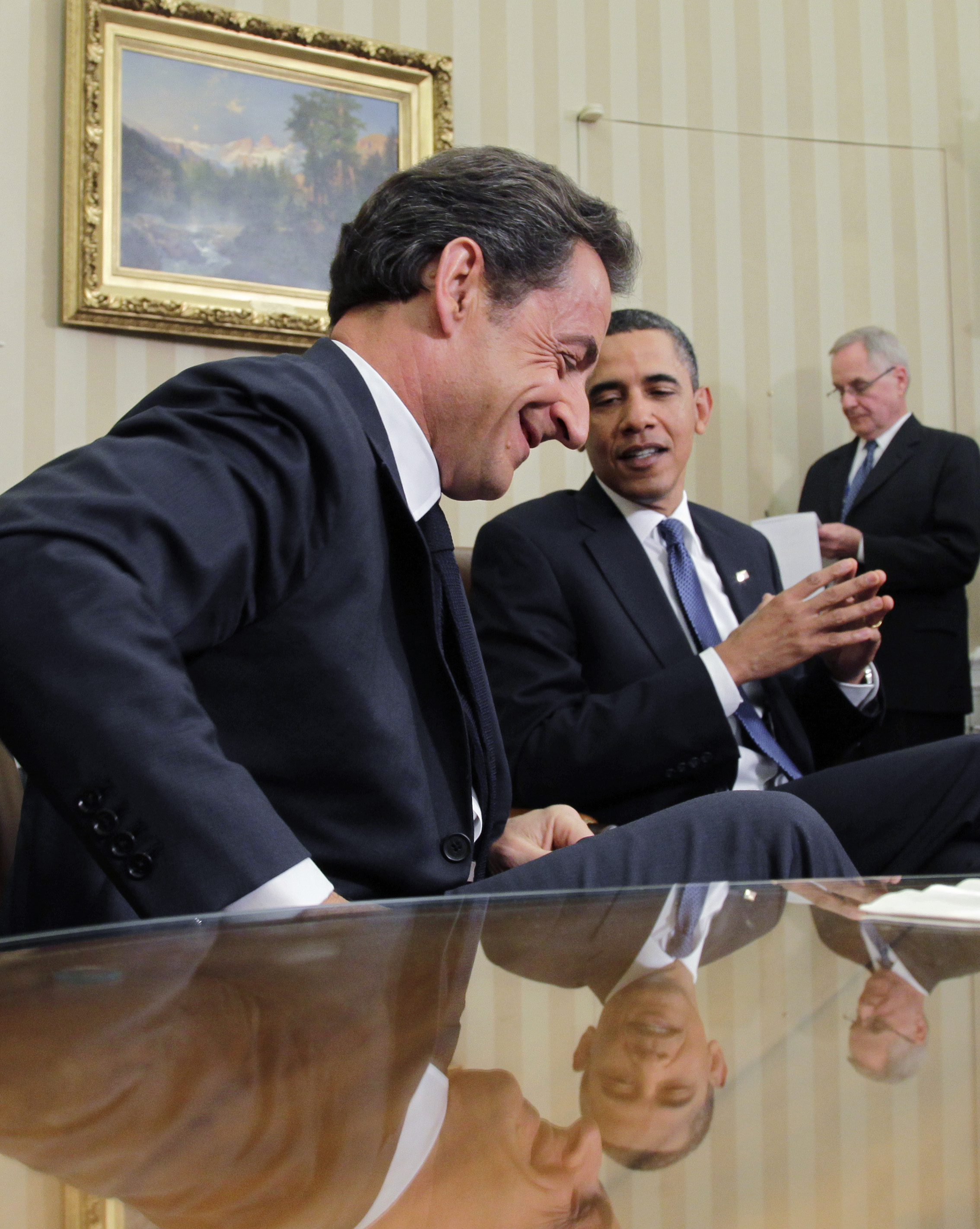
President Barack Obama meets with French President Nicolas Sarkozy in the Oval Office of the White House in Washington, Monday, Jan. 10, 2011. (AP Photo/J. Scott Applewhite)(Credit: Associated Press)

This piece originally appeared on TomDispatch.

The democracy uprising in the Arab world has been a spectacular display of courage, dedication, and commitment by popular forces — coinciding, fortuitously, with a remarkable uprising of tens of thousands in support of working people and democracy in Madison, Wisconsin, and other U.S. cities. If the trajectories of revolt in Cairo and Madison intersected, however, they were headed in opposite directions: in Cairo toward gaining elementary rights denied by the dictatorship, in Madison towards defending rights that had been won in long and hard struggles and are now under severe attack.

Each is a microcosm of tendencies in global society, following varied courses. There are sure to be far-reaching consequences of what is taking place both in the decaying industrial heartland of the richest and most powerful country in human history, and in what President Dwight Eisenhower called “the most strategically important area in the world” — “a stupendous source of strategic power” and “probably the richest economic prize in the world in the field of foreign investment,” in the words of the State Department in the 1940s, a prize that the U.S. intended to keep for itself and its allies in the unfolding New World Order of that day.

Despite all the changes since, there is every reason to suppose that today’s policy-makers basically adhere to the judgment of President Franklin Delano Roosevelt’s influential advisor A.A. Berle that control of the incomparable energy reserves of the Middle East would yield “substantial control of the world.” And correspondingly, that loss of control would threaten the project of global dominance that was clearly articulated during World War II, and that has been sustained in the face of major changes in world order since that day.

From the outset of the war in 1939, Washington anticipated that it would end with the U.S. in a position of overwhelming power. High-level State Department officials and foreign policy specialists met through the wartime years to lay out plans for the postwar world. They delineated a “Grand Area” that the U.S. was to dominate, including the Western hemisphere, the Far East, and the former British empire, with its Middle East energy resources. As Russia began to grind down Nazi armies after Stalingrad, Grand Area goals extended to as much of Eurasia as possible, at least its economic core in Western Europe. Within the Grand Area, the U.S. would maintain “unquestioned power,” with “military and economic supremacy,” while ensuring the “limitation of any exercise of sovereignty” by states that might interfere with its global designs. The careful wartime plans were soon implemented.

It was always recognized that Europe might choose to follow an independent course. NATO was partially intended to counter this threat. As soon as the official pretext for NATO dissolved in 1989, NATO was expanded to the East in violation of verbal pledges to Soviet leader Mikhail Gorbachev. It has since become a U.S.-run intervention force, with far-ranging scope, spelled out by NATO Secretary-General Jaap de Hoop Scheffer, who informed a NATO conference that “NATO troops have to guard pipelines that transport oil and gas that is directed for the West,” and more generally to protect sea routes used by tankers and other “crucial infrastructure” of the energy system.

Grand Area doctrines clearly license military intervention at will. That conclusion was articulated clearly by the Clinton administration, which declared that the U.S. has the right to use military force to ensure “uninhibited access to key markets, energy supplies, and strategic resources,” and must maintain huge military forces “forward deployed” in Europe and Asia “in order to shape people’s opinions about us” and “to shape events that will affect our livelihood and our security.”

The same principles governed the invasion of Iraq. As the U.S. failure to impose its will in Iraq was becoming unmistakable, the actual goals of the invasion could no longer be concealed behind pretty rhetoric. In November 2007, the White House issued a Declaration of Principles demanding that U.S. forces must remain indefinitely in Iraq and committing Iraq to privilege American investors. Two months later, President Bush informed Congress that he would reject legislation that might limit the permanent stationing of U.S. Armed Forces in Iraq or “United States control of the oil resources of Iraq” — demands that the U.S. had to abandon shortly after in the face of Iraqi resistance.

In Tunisia and Egypt, the recent popular uprisings have won impressive victories, but as the Carnegie Endowment reported, while names have changed, the regimes remain: “A change in ruling elites and system of governance is still a distant goal.” The report discusses internal barriers to democracy, but ignores the external ones, which as always are significant.

The U.S. and its Western allies are sure to do whatever they can to prevent authentic democracy in the Arab world. To understand why, it is only necessary to look at the studies of Arab opinion conducted by U.S. polling agencies. Though barely reported, they are certainly known to planners. They reveal that by overwhelming majorities, Arabs regard the U.S. and Israel as the major threats they face: the U.S. is so regarded by 90% of Egyptians, in the region generally by over 75%. Some Arabs regard Iran as a threat: 10%. Opposition to U.S. policy is so strong that a majority believes that security would be improved if Iran had nuclear weapons — in Egypt, 80%. Other figures are similar. If public opinion were to influence policy, the U.S. not only would not control the region, but would be expelled from it, along with its allies, undermining fundamental principles of global dominance.

The Invisible Hand of Power

Support for democracy is the province of ideologists and propagandists. In the real world, elite dislike of democracy is the norm. The evidence is overwhelming that democracy is supported insofar as it contributes to social and economic objectives, a conclusion reluctantly conceded by the more serious scholarship.

Elite contempt for democracy was revealed dramatically in the reaction to the WikiLeaks exposures. Those that received most attention, with euphoric commentary, were cables reporting that Arabs support the U.S. stand on Iran. The reference was to the ruling dictators. The attitudes of the public were unmentioned. The guiding principle was articulated clearly by Carnegie Endowment Middle East specialist Marwan Muasher, formerly a high official of the Jordanian government: “There is nothing wrong, everything is under control.” In short, if the dictators support us, what else could matter?

The Muasher doctrine is rational and venerable. To mention just one case that is highly relevant today, in internal discussion in 1958, president Eisenhower expressed concern about “the campaign of hatred” against us in the Arab world, not by governments, but by the people. The National Security Council (NSC) explained that there is a perception in the Arab world that the U.S. supports dictatorships and blocks democracy and development so as to ensure control over the resources of the region. Furthermore, the perception is basically accurate, the NSC concluded, and that is what we should be doing, relying on the Muasher doctrine. Pentagon studies conducted after 9/11 confirmed that the same holds today.

It is normal for the victors to consign history to the trash can, and for victims to take it seriously. Perhaps a few brief observations on this important matter may be useful. Today is not the first occasion when Egypt and the U.S. are facing similar problems, and moving in opposite directions. That was also true in the early nineteenth century.

Economic historians have argued that Egypt was well-placed to undertake rapid economic development at the same time that the U.S. was. Both had rich agriculture, including cotton, the fuel of the early industrial revolution — though unlike Egypt, the U.S. had to develop cotton production and a work force by conquest, extermination, and slavery, with consequences that are evident right now in the reservations for the survivors and the prisons that have rapidly expanded since the Reagan years to house the superfluous population left by deindustrialization.

One fundamental difference was that the U.S. had gained independence and was therefore free to ignore the prescriptions of economic theory, delivered at the time by Adam Smith in terms rather like those preached to developing societies today. Smith urged the liberated colonies to produce primary products for export and to import superior British manufactures, and certainly not to attempt to monopolize crucial goods, particularly cotton. Any other path, Smith warned, “would retard instead of accelerating the further increase in the value of their annual produce, and would obstruct instead of promoting the progress of their country towards real wealth and greatness.”

Having gained their independence, the colonies were free to ignore his advice and to follow England’s course of independent state-guided development, with high tariffs to protect industry from British exports, first textiles, later steel and others, and to adopt numerous other devices to accelerate industrial development. The independent Republic also sought to gain a monopoly of cotton so as to “place all other nations at our feet,” particularly the British enemy, as the Jacksonian presidents announced when conquering Texas and half of Mexico.

For Egypt, a comparable course was barred by British power. Lord Palmerston declared that “no ideas of fairness [toward Egypt] ought to stand in the way of such great and paramount interests” of Britain as preserving its economic and political hegemony, expressing his “hate” for the “ignorant barbarian” Muhammed Ali who dared to seek an independent course, and deploying Britain’s fleet and financial power to terminate Egypt’s quest for independence and economic development.

After World War II, when the U.S. displaced Britain as global hegemon, Washington adopted the same stand, making it clear that the U.S. would provide no aid to Egypt unless it adhered to the standard rules for the weak — which the U.S. continued to violate, imposing high tariffs to bar Egyptian cotton and causing a debilitating dollar shortage. The usual interpretation of market principles.

It is small wonder that the “campaign of hatred” against the U.S. that concerned Eisenhower was based on the recognition that the U.S. supports dictators and blocks democracy and development, as do its allies.

In Adam Smith’s defense, it should be added that he recognized what would happen if Britain followed the rules of sound economics, now called “neoliberalism.” He warned that if British manufacturers, merchants, and investors turned abroad, they might profit but England would suffer. But he felt that they would be guided by a home bias, so as if by an invisible hand England would be spared the ravages of economic rationality.

The passage is hard to miss. It is the one occurrence of the famous phrase “invisible hand” in The Wealth of Nations. The other leading founder of classical economics, David Ricardo, drew similar conclusions, hoping that home bias would lead men of property to “be satisfied with the low rate of profits in their own country, rather than seek a more advantageous employment for their wealth in foreign nations,” feelings that, he added, “I should be sorry to see weakened.” Their predictions aside, the instincts of the classical economists were sound.

The Iranian and Chinese “Threats”

The democracy uprising in the Arab world is sometimes compared to Eastern Europe in 1989, but on dubious grounds. In 1989, the democracy uprising was tolerated by the Russians, and supported by western power in accord with standard doctrine: it plainly conformed to economic and strategic objectives, and was therefore a noble achievement, greatly honored, unlike the struggles at the same time “to defend the people’s fundamental human rights” in Central America, in the words of the assassinated Archbishop of El Salvador, one of the hundreds of thousands of victims of the military forces armed and trained by Washington. There was no Gorbachev in the West throughout these horrendous years, and there is none today. And Western power remains hostile to democracy in the Arab world for good reasons.

Grand Area doctrines continue to apply to contemporary crises and confrontations. In Western policy-making circles and political commentary the Iranian threat is considered to pose the greatest danger to world order and hence must be the primary focus of U.S. foreign policy, with Europe trailing along politely.

What exactly is the Iranian threat? An authoritative answer is provided by the Pentagon and U.S. intelligence. Reporting on global security last year, they make it clear that the threat is not military. Iran’s military spending is “relatively low compared to the rest of the region,” they conclude. Its military doctrine is strictly “defensive, designed to slow an invasion and force a diplomatic solution to hostilities.” Iran has only “a limited capability to project force beyond its borders.” With regard to the nuclear option, “Iran’s nuclear program and its willingness to keep open the possibility of developing nuclear weapons is a central part of its deterrent strategy.” All quotes.

The brutal clerical regime is doubtless a threat to its own people, though it hardly outranks U.S. allies in that regard. But the threat lies elsewhere, and is ominous indeed. One element is Iran’s potential deterrent capacity, an illegitimate exercise of sovereignty that might interfere with U.S. freedom of action in the region. It is glaringly obvious why Iran would seek a deterrent capacity; a look at the military bases and nuclear forces in the region suffices to explain.

Seven years ago, Israeli military historian Martin van Creveld wrote that “The world has witnessed how the United States attacked Iraq for, as it turned out, no reason at all. Had the Iranians not tried to build nuclear weapons, they would be crazy,” particularly when they are under constant threat of attack in violation of the UN Charter. Whether they are doing so remains an open question, but perhaps so.

But Iran’s threat goes beyond deterrence. It is also seeking to expand its influence in neighboring countries, the Pentagon and U.S. intelligence emphasize, and in this way to “destabilize” the region (in the technical terms of foreign policy discourse). The U.S. invasion and military occupation of Iran’s neighbors is “stabilization.” Iran’s efforts to extend its influence to them are “destabilization,” hence plainly illegitimate.

Such usage is routine. Thus the prominent foreign policy analyst James Chace was properly using the term “stability” in its technical sense when he explained that in order to achieve “stability” in Chile it was necessary to “destabilize” the country (by overthrowing the elected government of Salvador Allende and installing the dictatorship of General Augusto Pinochet). Other concerns about Iran are equally interesting to explore, but perhaps this is enough to reveal the guiding principles and their status in imperial culture. As Franklin Delano Roosevelt’s planners emphasized at the dawn of the contemporary world system, the U.S. cannot tolerate “any exercise of sovereignty” that interferes with its global designs.

The U.S. and Europe are united in punishing Iran for its threat to stability, but it is useful to recall how isolated they are. The nonaligned countries have vigorously supported Iran’s right to enrich uranium. In the region, Arab public opinion even strongly favors Iranian nuclear weapons. The major regional power, Turkey, voted against the latest U.S.-initiated sanctions motion in the Security Council, along with Brazil, the most admired country of the South. Their disobedience led to sharp censure, not for the first time: Turkey had been bitterly condemned in 2003 when the government followed the will of 95% of the population and refused to participate in the invasion of Iraq, thus demonstrating its weak grasp of democracy, western-style.

After its Security Council misdeed last year, Turkey was warned by Obama’s top diplomat on European affairs, Philip Gordon, that it must “demonstrate its commitment to partnership with the West.” A scholar with the Council on Foreign Relations asked, “How do we keep the Turks in their lane?” — following orders like good democrats. Brazil’s Lula was admonished in a New York Times headline that his effort with Turkey to provide a solution to the uranium enrichment issue outside of the framework of U.S. power was a “Spot on Brazilian Leader’s Legacy.” In brief, do what we say, or else.

An interesting sidelight, effectively suppressed, is that the Iran-Turkey-Brazil deal was approved in advance by Obama, presumably on the assumption that it would fail, providing an ideological weapon against Iran. When it succeeded, the approval turned to censure, and Washington rammed through a Security Council resolution so weak that China readily signed — and is now chastised for living up to the letter of the resolution but not Washington’s unilateral directives — in the current issue of Foreign Affairs, for example.

While the U.S. can tolerate Turkish disobedience, though with dismay, China is harder to ignore. The press warns that “China’s investors and traders are now filling a vacuum in Iran as businesses from many other nations, especially in Europe, pull out,” and in particular, is expanding its dominant role in Iran’s energy industries. Washington is reacting with a touch of desperation. The State Department warned China that if it wants to be accepted in the international community — a technical term referring to the U.S. and whoever happens to agree with it — then it must not “skirt and evade international responsibilities, [which] are clear”: namely, follow U.S. orders. China is unlikely to be impressed.

There is also much concern about the growing Chinese military threat. A recent Pentagon study warned that China’s military budget is approaching “one-fifth of what the Pentagon spent to operate and carry out the wars in Iraq and Afghanistan,” a fraction of the U.S. military budget, of course. China’s expansion of military forces might “deny the ability of American warships to operate in international waters off its coast,” the New York Times added.

Off the coast of China, that is; it has yet to be proposed that the U.S. should eliminate military forces that deny the Caribbean to Chinese warships. China’s lack of understanding of rules of international civility is illustrated further by its objections to plans for the advanced nuclear-powered aircraft carrier George Washington to join naval exercises a few miles off China’s coast, with alleged capacity to strike Beijing.

In contrast, the West understands that such U.S. operations are all undertaken to defend stability and its own security. The liberal New Republic expresses its concern that “China sent ten warships through international waters just off the Japanese island of Okinawa.” That is indeed a provocation — unlike the fact, unmentioned, that Washington has converted the island into a major military base in defiance of vehement protests by the people of Okinawa. That is not a provocation, on the standard principle that we own the world.

Deep-seated imperial doctrine aside, there is good reason for China’s neighbors to be concerned about its growing military and commercial power. And though Arab opinion supports an Iranian nuclear weapons program, we certainly should not do so. The foreign policy literature is full of proposals as to how to counter the threat. One obvious way is rarely discussed: work to establish a nuclear-weapons-free zone (NWFZ) in the region. The issue arose (again) at the Non-Proliferation Treaty (NPT) conference at United Nations headquarters last May. Egypt, as chair of the 118 nations of the Non-Aligned Movement, called for negotiations on a Middle East NWFZ, as had been agreed by the West, including the U.S., at the 1995 review conference on the NPT.

International support is so overwhelming that Obama formally agreed. It is a fine idea, Washington informed the conference, but not now. Furthermore, the U.S. made clear that Israel must be exempted: no proposal can call for Israel’s nuclear program to be placed under the auspices of the International Atomic Energy Agency or for the release of information about “Israeli nuclear facilities and activities.” So much for this method of dealing with the Iranian nuclear threat.

Privatizing the Planet

While Grand Area doctrine still prevails, the capacity to implement it has declined. The peak of U.S. power was after World War II, when it had literally half the world’s wealth. But that naturally declined, as other industrial economies recovered from the devastation of the war and decolonization took its agonizing course. By the early 1970s, the U.S. share of global wealth had declined to about 25%, and the industrial world had become tripolar: North America, Europe, and East Asia (then Japan-based).

There was also a sharp change in the U.S. economy in the 1970s, towards financialization and export of production. A variety of factors converged to create a vicious cycle of radical concentration of wealth, primarily in the top fraction of 1% of the population — mostly CEOs, hedge-fund managers, and the like. That leads to the concentration of political power, hence state policies to increase economic concentration: fiscal policies, rules of corporate governance, deregulation, and much more. Meanwhile the costs of electoral campaigns skyrocketed, driving the parties into the pockets of concentrated capital, increasingly financial: the Republicans reflexively, the Democrats — by now what used to be moderate Republicans — not far behind.

Elections have become a charade, run by the public relations industry. After his 2008 victory, Obama won an award from the industry for the best marketing campaign of the year. Executives were euphoric. In the business press they explained that they had been marketing candidates like other commodities since Ronald Reagan, but 2008 was their greatest achievement and would change the style in corporate boardrooms. The 2012 election is expected to cost $2 billion, mostly in corporate funding. Small wonder that Obama is selecting business leaders for top positions. The public is angry and frustrated, but as long as the Muasher principle prevails, that doesn’t matter.

While wealth and power have narrowly concentrated, for most of the population real incomes have stagnated and people have been getting by with increased work hours, debt, and asset inflation, regularly destroyed by the financial crises that began as the regulatory apparatus was dismantled starting in the 1980s.

None of this is problematic for the very wealthy, who benefit from a government insurance policy called “too big to fail.” The banks and investment firms can make risky transactions, with rich rewards, and when the system inevitably crashes, they can run to the nanny state for a taxpayer bailout, clutching their copies of Friedrich Hayek and Milton Friedman.

That has been the regular process since the Reagan years, each crisis more extreme than the last — for the public population, that is. Right now, real unemployment is at Depression levels for much of the population, while Goldman Sachs, one of the main architects of the current crisis, is richer than ever. It has just quietly announced $17.5 billion in compensation for last year, with CEO Lloyd Blankfein receiving a $12.6 million bonus while his base salary more than triples.

It wouldn’t do to focus attention on such facts as these. Accordingly, propaganda must seek to blame others, in the past few months, public sector workers, their fat salaries, exorbitant pensions, and so on: all fantasy, on the model of Reaganite imagery of black mothers being driven in their limousines to pick up welfare checks — and other models that need not be mentioned. We all must tighten our belts; almost all, that is.

Teachers are a particularly good target, as part of the deliberate effort to destroy the public education system from kindergarten through the universities by privatization — again, good for the wealthy, but a disaster for the population, as well as the long-term health of the economy, but that is one of the externalities that is put to the side insofar as market principles prevail.

Another fine target, always, is immigrants. That has been true throughout U.S. history, even more so at times of economic crisis, exacerbated now by a sense that our country is being taken away from us: the white population will soon become a minority. One can understand the anger of aggrieved individuals, but the cruelty of the policy is shocking.

Who are the immigrants targeted? In Eastern Massachusetts, where I live, many are Mayans fleeing genocide in the Guatemalan highlands carried out by Reagan’s favorite killers. Others are Mexican victims of Clinton’s NAFTA, one of those rare government agreements that managed to harm working people in all three of the participating countries. As NAFTA was rammed through Congress over popular objection in 1994, Clinton also initiated the militarization of the U.S.-Mexican border, previously fairly open. It was understood that Mexican campesinos cannot compete with highly subsidized U.S. agribusiness, and that Mexican businesses would not survive competition with U.S. multinationals, which must be granted “national treatment” under the mislabeled free trade agreements, a privilege granted only to corporate persons, not those of flesh and blood. Not surprisingly, these measures led to a flood of desperate refugees, and to rising anti-immigrant hysteria by the victims of state-corporate policies at home.

Much the same appears to be happening in Europe, where racism is probably more rampant than in the U.S. One can only watch with wonder as Italy complains about the flow of refugees from Libya, the scene of the first post-World War I genocide, in the now-liberated East, at the hands of Italy’s Fascist government. Or when France, still today the main protector of the brutal dictatorships in its former colonies, manages to overlook its hideous atrocities in Africa, while French President Nicolas Sarkozy warns grimly of the “flood of immigrants” and Marine Le Pen objects that he is doing nothing to prevent it. I need not mention Belgium, which may win the prize for what Adam Smith called “the savage injustice of the Europeans.”

The rise of neo-fascist parties in much of Europe would be a frightening phenomenon even if we were not to recall what happened on the continent in the recent past. Just imagine the reaction if Jews were being expelled from France to misery and oppression, and then witness the non-reaction when that is happening to Roma, also victims of the Holocaust and Europe’s most brutalized population.

In Hungary, the neo-fascist party Jobbik gained 17% of the vote in national elections, perhaps unsurprising when three-quarters of the population feels that they are worse off than under Communist rule. We might be relieved that in Austria the ultra-right Jorg Haider won only 10% of the vote in 2008 — were it not for the fact that the new Freedom Party, outflanking him from the far right, won more than 17%. It is chilling to recall that, in 1928, the Nazis won less than 3% of the vote in Germany.

In England the British National Party and the English Defence League, on the ultra-racist right, are major forces. (What is happening in Holland you know all too well.) In Germany, Thilo Sarrazin’s lament that immigrants are destroying the country was a runaway best-seller, while Chancellor Angela Merkel, though condemning the book, declared that multiculturalism had “utterly failed”: the Turks imported to do the dirty work in Germany are failing to become blond and blue-eyed, true Aryans.

Those with a sense of irony may recall that Benjamin Franklin, one of the leading figures of the Enlightenment, warned that the newly liberated colonies should be wary of allowing Germans to immigrate, because they were too swarthy; Swedes as well. Into the twentieth century, ludicrous myths of Anglo-Saxon purity were common in the U.S., including among presidents and other leading figures. Racism in the literary culture has been a rank obscenity; far worse in practice, needless to say. It is much easier to eradicate polio than this horrifying plague, which regularly becomes more virulent in times of economic distress.

I do not want to end without mentioning another externality that is dismissed in market systems: the fate of the species. Systemic risk in the financial system can be remedied by the taxpayer, but no one will come to the rescue if the environment is destroyed. That it must be destroyed is close to an institutional imperative. Business leaders who are conducting propaganda campaigns to convince the population that anthropogenic global warming is a liberal hoax understand full well how grave is the threat, but they must maximize short-term profit and market share. If they don’t, someone else will.

This vicious cycle could well turn out to be lethal. To see how grave the danger is, simply have a look at the new Congress in the U.S., propelled into power by business funding and propaganda. Almost all are climate deniers. They have already begun to cut funding for measures that might mitigate environmental catastrophe. Worse, some are true believers; for example, the new head of a subcommittee on the environment who explained that global warming cannot be a problem because God promised Noah that there will not be another flood.

If such things were happening in some small and remote country, we might laugh. Not when they are happening in the richest and most powerful country in the world. And before we laugh, we might also bear in mind that the current economic crisis is traceable in no small measure to the fanatic faith in such dogmas as the efficient market hypothesis, and in general to what Nobel laureate Joseph Stiglitz, 15 years ago, called the “religion” that markets know best — which prevented the central bank and the economics profession from taking notice of an $8 trillion housing bubble that had no basis at all in economic fundamentals, and that devastated the economy when it burst.

All of this, and much more, can proceed as long as the Muashar doctrine prevails. As long as the general population is passive, apathetic, diverted to consumerism or hatred of the vulnerable, then the powerful can do as they please, and those who survive will be left to contemplate the outcome.

Continue Reading Close

A Middle East peace that could happen (but won’t)

The basic contours of an Israeli-Palestinian agreement are obvious -- if only Israel and the U.S. were serious

Israeli soldiers stand near a burnt field at the Migron unauthorized settlement outpost in the West Bank after it was demolished by Israeli troops Tuesday, April 27, 2010. Israel announced a freeze on new construction in West Bank settlements in November 2009 under pressure from U.S. President Barack Obama, who opposes settlement construction in the West Bank and east Jerusalem _ lands that the Palestinians claim for a future state.(AP Photo/Alessio Romenzi)(Credit: AP)

The fact that the Israel-Palestine conflict grinds on without resolution might appear to be rather strange. For many of the world’s conflicts, it is difficult even to conjure up a feasible settlement. In this case, it is not only possible, but there is near universal agreement on its basic contours: a two-state settlement along the internationally recognized (pre-June 1967) borders — with “minor and mutual modifications,” to adopt official U.S. terminology before Washington departed from the international community in the mid-1970s.

The basic principles have been accepted by virtually the entire world, including the Arab states (who go on to call for full normalization of relations), the Organization of Islamic States (including Iran), and relevant non-state actors (including Hamas). A settlement along these lines was first proposed at the U.N. Security Council in January 1976 by the major Arab states. Israel refused to attend the session. The U.S. vetoed the resolution, and did so again in 1980. The record at the General Assembly since is similar.

There was one important and revealing break in U.S.-Israeli rejectionism. After the failed Camp David agreements in 2000, President Clinton recognized that the terms he and Israel had proposed were unacceptable to any Palestinians. That December, he proposed his “parameters”: imprecise, but more forthcoming. He then stated that both sides had accepted the parameters, while expressing reservations.

Israeli and Palestinian negotiators met in Taba, Egypt, in January 2001 to resolve the differences and were making considerable progress. In their final press conference, they reported that, with a little more time, they could probably have reached full agreement. Israel called off the negotiations prematurely, however, and official progress then terminated, though informal discussions at a high level continued leading to the Geneva Accord, rejected by Israel and ignored by the U.S.

A good deal has happened since, but a settlement along those lines is still not out of reach — if, of course, Washington is once again willing to accept it. Unfortunately, there is little sign of that.

Substantial mythology has been created about the entire record, but the basic facts are clear enough and quite well documented.

The U.S. and Israel have been acting in tandem to extend and deepen the occupation. In 2005, recognizing that it was pointless to subsidize a few thousand Israeli settlers in Gaza, who were appropriating substantial resources and protected by a large part of the Israeli army, the government of Ariel Sharon decided to move them to the much more valuable West Bank and Golan Heights.

Instead of carrying out the operation straightforwardly, as would have been easy enough, the government decided to stage a “national trauma,” which virtually duplicated the farce accompanying the withdrawal from the Sinai desert after the Camp David agreements of 1978-79. In each case, the withdrawal permitted the cry of “Never Again,” which meant in practice: we cannot abandon an inch of the Palestinian territories that we want to take in violation of international law. This farce played very well in the West, though it was ridiculed by more astute Israeli commentators, among them that country’s prominent sociologist the late Baruch Kimmerling.

After its formal withdrawal from the Gaza Strip, Israel never actually relinquished its total control over the territory, often described realistically as “the world’s largest prison.” In January 2006, a few months after the withdrawal, Palestine had an election that was recognized as free and fair by international observers. Palestinians, however, voted “the wrong way,” electing Hamas. Instantly, the U.S. and Israel intensified their assault against Gazans as punishment for this misdeed. The facts and the reasoning were not concealed; rather, they were openly published alongside reverential commentary on Washington’s sincere dedication to democracy. The U.S.-backed Israeli assault against the Gazans has only been intensified since, thanks to violence and economic strangulation, increasingly savage.

Meanwhile in the West Bank, always with firm U.S. backing, Israel has been carrying forward long-standing programs to take the valuable land and resources of the Palestinians and leave them in unviable cantons, mostly out of sight. Israeli commentators frankly refer to these goals as “neocolonial.” Ariel Sharon, the main architect of the settlement programs, called these cantons “Bantustans,” though the term is misleading: South Africa needed the majority black work force, while Israel would be happy if the Palestinians disappeared, and its policies are directed to that end.

Blockading Gaza by Land and Sea

One step toward cantonization and the undermining of hopes for Palestinian national survival is the separation of Gaza from the West Bank. These hopes have been almost entirely consigned to oblivion, an atrocity to which we should not contribute by tacit consent. Israeli journalist Amira Hass, one of the leading specialists on Gaza, writes that

“the restrictions on Palestinian movement that Israel introduced in January 1991 reversed a process that had been initiated in June 1967. Back then, and for the first time since 1948, a large portion of the Palestinian people again lived in the open territory of a single country — to be sure, one that was occupied, but was nevertheless whole.… The total separation of the Gaza Strip from the West Bank is one of the greatest achievements of Israeli politics, whose overarching objective is to prevent a solution based on international decisions and understandings and instead dictate an arrangement based on Israel’s military superiority.…

“Since January 1991, Israel has bureaucratically and logistically merely perfected the split and the separation: not only between Palestinians in the occupied territories and their brothers in Israel, but also between the Palestinian residents of Jerusalem and those in the rest of the territories and between Gazans and West Bankers/Jerusalemites. Jews live in this same piece of land within a superior and separate system of privileges, laws, services, physical infrastructure and freedom of movement.”

The leading academic specialist on Gaza, Harvard scholar Sara Roy, adds:

“Gaza is an example of a society that has been deliberately reduced to a state of abject destitution, its once productive population transformed into one of aid-dependent paupers … Gaza’s subjection began long before Israel’s recent war against it [December 2008]. The Israeli occupation — now largely forgotten or denied by the international community — has devastated Gaza’s economy and people, especially since 2006…. After Israel’s December [2008] assault, Gaza’s already compromised conditions have become virtually unlivable. Livelihoods, homes, and public infrastructure have been damaged or destroyed on a scale that even the Israel Defense Forces admitted was indefensible.

“In Gaza today, there is no private sector to speak of and no industry. 80 percent of Gaza’s agricultural crops were destroyed and Israel continues to snipe at farmers attempting to plant and tend fields near the well-fenced and patrolled border. Most productive activity has been extinguished.… Today, 96 percent of Gaza’s population of 1.4 million is dependent on humanitarian aid for basic needs. According to the World Food Programme, the Gaza Strip requires a minimum of 400 trucks of food every day just to meet the basic nutritional needs of the population. Yet, despite a March [22, 2009] decision by the Israeli cabinet to lift all restrictions on foodstuffs entering Gaza, only 653 trucks of food and other supplies were allowed entry during the week of May 10, at best meeting 23 percent of required need. Israel now allows only 30 to 40 commercial items to enter Gaza compared to 4,000 approved products prior to June 2006.”

It cannot be too often stressed that Israel had no credible pretext for its 2008-09 attack on Gaza, with full U.S. support and illegally using U.S. weapons. Near-universal opinion asserts the contrary, claiming that Israel was acting in self-defense. That is utterly unsustainable, in light of Israel’s flat rejection of peaceful means that were readily available, as Israel and its U.S. partner in crime knew very well. That aside, Israel’s siege of Gaza is itself an act of war, as Israel of all countries certainly recognizes, having repeatedly justified launching major wars on grounds of partial restrictions on its access to the outside world, though nothing remotely like what it has long imposed on Gaza.

One crucial element of Israel’s criminal siege, little reported, is the naval blockade. Peter Beaumont reports from Gaza that, “on its coastal littoral, Gaza’s limitations are marked by a different fence where the bars are Israeli gunboats with their huge wakes, scurrying beyond the Palestinian fishing boats and preventing them from going outside a zone imposed by the warships.” According to reports from the scene, the naval siege has been tightened steadily since 2000. Fishing boats have been driven steadily out of Gaza’s territorial waters and toward the shore by Israeli gunboats, often violently without warning and with many casualties. As a result of these naval actions, Gaza’s fishing industry has virtually collapsed; fishing is impossible near shore because of the contamination caused by Israel’s regular attacks, including the destruction of power plants and sewage facilities.

These Israeli naval attacks began shortly after the discovery by the BG (British Gas) Group of what appear to be quite sizeable natural gas fields in Gaza’s territorial waters. Industry journals report that Israel is already appropriating these Gazan resources for its own use, part of its commitment to shift its economy to natural gas. The standard industry source reports:

“Israel’s finance ministry has given the Israel Electric Corp. (IEC) approval to purchase larger quantities of natural gas from BG than originally agreed upon, according to Israeli government sources [which] said the state-owned utility would be able to negotiate for as much as 1.5 billion cubic meters of natural gas from the Marine field located off the Mediterranean coast of the Palestinian controlled Gaza Strip.

“Last year the Israeli government approved the purchase of 800 million cubic meters of gas from the field by the IEC…. Recently the Israeli government changed its policy and decided the state-owned utility could buy the entire quantity of gas from the Gaza Marine field. Previously the government had said the IEC could buy half the total amount and the remainder would be bought by private power producers.”

The pillage of what could become a major source of income for Gaza is surely known to U.S. authorities. It is only reasonable to suppose that the intention to appropriate these limited resources, either by Israel alone or together with the collaborationist Palestinian Authority, is the motive for preventing Gazan fishing boats from entering Gaza’s territorial waters.

There are some instructive precedents. In 1989, Australian foreign minister Gareth Evans signed a treaty with his Indonesian counterpart Ali Alatas granting Australia rights to the substantial oil reserves in “the Indonesian Province of East Timor.” The Indonesia-Australia Timor Gap Treaty, which offered not a crumb to the people whose oil was being stolen, “is the only legal agreement anywhere in the world that effectively recognises Indonesia’s right to rule East Timor,” the Australian press reported.

Asked about his willingness to recognize the Indonesian conquest and to rob the sole resource of the conquered territory, which had been subjected to near-genocidal slaughter by the Indonesian invader with the strong support of Australia (along with the U.S., the U.K., and some others), Evans explained that “there is no binding legal obligation not to recognise the acquisition of territory that was acquired by force,” adding that “the world is a pretty unfair place, littered with examples of acquisition by force.”

It should, then, be unproblematic for Israel to follow suit in Gaza.

A few years later, Evans became the leading figure in the campaign to introduce the concept “responsibility to protect” — known as R2P — into international law. R2P is intended to establish an international obligation to protect populations from grave crimes. Evans is the author of a major book on the subject and was co-chair of the International Commission on Intervention and State Sovereignty, which issued what is considered the basic document on R2P.

In an article devoted to this “idealistic effort to establish a new humanitarian principle,” the London Economist featured Evans and his “bold but passionate claim on behalf of a three-word expression which (in quite large part thanks to his efforts) now belongs to the language of diplomacy: the ‘responsibility to protect.’” The article is accompanied by a picture of Evans with the caption “Evans: a lifelong passion to protect.” His hand is pressed to his forehead in despair over the difficulties faced by his idealistic effort. The journal chose not to run a different photo that circulates in Australia, depicting Evans and Alatas exuberantly clasping their hands together as they toast the Timor Gap Treaty that they had just signed.

Though a “protected population” under international law, Gazans do not fall under the jurisdiction of the “responsibility to protect,” joining other unfortunates, in accord with the maxim of Thucydides — that the strong do as they wish, and the weak suffer as they must — which holds with its customary precision.

Obama and the Settlements

The kinds of restrictions on movement used to destroy Gaza have long been in force in the West Bank as well, less cruelly but with grim effects on life and the economy. The World Bank reports that Israel has established “a complex closure regime that restricts Palestinian access to large areas of the West Bank… The Palestinian economy has remained stagnant, largely because of the sharp downturn in Gaza and Israel’s continued restrictions on Palestinian trade and movement in the West Bank.”

The World Bank “cited Israeli roadblocks and checkpoints hindering trade and travel, as well as restrictions on Palestinian building in the West Bank, where the Western-backed government of Palestinian president Mahmoud Abbas holds sway.” Israel does permit — indeed encourage — a privileged existence for elites in Ramallah and sometimes elsewhere, largely relying on European funding, a traditional feature of colonial and neocolonial practice.

All of this constitutes what Israeli activist Jeff Halper calls a “matrix of control” to subdue the colonized population. These systematic programs over more than 40 years aim to establish Defense Minister Moshe Dayan’s recommendation to his colleagues shortly after Israel’s 1967 conquests that we must tell the Palestinians in the territories: “We have no solution, you shall continue to live like dogs, and whoever wishes may leave, and we will see where this process leads.”

Turning to the second bone of contention, settlements, there is indeed a confrontation, but it is rather less dramatic than portrayed. Washington’s position was presented most strongly in Secretary of State Hillary Clinton’s much-quoted statement rejecting “natural growth exceptions” to the policy opposing new settlements. Prime Minister Benjamin Netanyahu, along with President Shimon Peres and, in fact, virtually the whole Israeli political spectrum, insists on permitting “natural growth” within the areas that Israel intends to annex, complaining that the United States is backing down on George W. Bush’s authorization of such expansion within his “vision” of a Palestinian state.

Senior Netanyahu cabinet members have gone further. Transportation Minister Yisrael Katz announced that “the current Israeli government will not accept in any way the freezing of legal settlement activity in Judea and Samaria.” The term “legal” in U.S.-Israeli parlance means “illegal, but authorized by the government of Israel with a wink from Washington.” In this usage, unauthorized outposts are termed “illegal,” though apart from the dictates of the powerful, they are no more illegal than the settlements granted to Israel under Bush’s “vision” and Obama’s scrupulous omission.

The Obama-Clinton “hardball” formulation is not new. It repeats the wording of the Bush administration draft of the 2003 Road Map, which stipulates that in Phase I, “Israel freezes all settlement activity (including natural growth of settlements).” All sides formally accept the Road Map (modified to drop the phrase “natural growth”) — consistently overlooking the fact that Israel, with U.S. support, at once added 14 “reservations” that render it inoperable.

If Obama were at all serious about opposing settlement expansion, he could easily proceed with concrete measures by, for example, reducing U.S. aid by the amount devoted to this purpose. That would hardly be a radical or courageous move. The Bush I administration did so (reducing loan guarantees), but after the Oslo accord in 1993, President Clinton left calculations to the government of Israel. Unsurprisingly, there was “no change in the expenditures flowing to the settlements,” the Israeli press reported. “[Prime Minister] Rabin will continue not to dry out the settlements,” the report concludes. “And the Americans? They will understand.”

Obama administration officials informed the press that the Bush I measures are “not under discussion,” and that pressures will be “largely symbolic.” In short, Obama understands, just as Clinton and Bush II did.

American Visionaries

At best, settlement expansion is a side issue, rather like the issue of “illegal outposts” — namely those that the government of Israel has not authorized. Concentration on these issues diverts attention from the fact that there are no “legal outposts” and that it is the existing settlements that are the primary problem to be faced.

The U.S. press reports that “a partial freeze has been in place for several years, but settlers have found ways around the strictures… [C]onstruction in the settlements has slowed but never stopped, continuing at an annual rate of about 1,500 to 2,000 units over the past three years. If building continues at the 2008 rate, the 46,500 units already approved will be completed in about 20 years.… If Israel built all the housing units already approved in the nation’s overall master plan for settlements, it would almost double the number of settler homes in the West Bank.” Peace Now, which monitors settlement activities, estimates further that the two largest settlements would double in size: Ariel and Ma’aleh Adumim, built mainly during the Oslo years in the salients that subdivide the West Bank into cantons.

“Natural population growth” is largely a myth, Israel’s leading diplomatic correspondent, Akiva Eldar, points out, citing demographic studies by Colonel (res.) Shaul Arieli, deputy military secretary to former prime minister and incumbent defense minister Ehud Barak. Settlement growth consists largely of Israeli immigrants in violation of the Geneva Conventions, assisted with generous subsidies. Much of it is in direct violation of formal government decisions, but carried out with the authorization of the government, specifically Barak, considered a dove in the Israeli spectrum.

Correspondent Jackson Diehl derides the “long-dormant Palestinian fantasy,” revived by President Abbas, “that the United States will simply force Israel to make critical concessions, whether or not its democratic government agrees.” He does not explain why refusal to participate in Israel’s illegal expansion — which, if serious, would “force Israel to make critical concessions” — would be improper interference in Israel’s democracy.

Returning to reality, all of these discussions about settlement expansion evade the most crucial issue about settlements: what the United States and Israel have already established in the West Bank. The evasion tacitly concedes that the illegal settlement programs already in place are somehow acceptable (putting aside the Golan Heights, annexed in violation of Security Council orders) — though the Bush “vision,” apparently accepted by Obama, moves from tacit to explicit support for these violations of law. What is in place already suffices to ensure that there can be no viable Palestinian self-determination. Hence, there is every indication that even on the unlikely assumption that “natural growth” will be ended, U.S.-Israeli rejectionism will persist, blocking the international consensus as before.

Subsequently, Prime Minister Netanyahu declared a 10-month suspension of new construction, with many exemptions, and entirely excluding Greater Jerusalem, where expropriation in Arab areas and construction for Jewish settlers continues at a rapid pace. Hillary Clinton praised these “unprecedented” concessions on (illegal) construction, eliciting anger and ridicule in much of the world.

It might be different if a legitimate “land swap” were under consideration, a solution approached at Taba and spelled out more fully in the Geneva Accord reached in informal high-level Israel-Palestine negotiations. The accord was presented in Geneva in October 2003, welcomed by much of the world, rejected by Israel, and ignored by the United States.

Washington’s “Evenhandedness”

Barack Obama’s June 4, 2009, Cairo address to the Muslim world kept pretty much to his well-honed “blank slate” style — with little of substance, but presented in a personable manner that allows listeners to write on the slate what they want to hear. CNN captured its spirit in headlining a report “Obama Looks to Reach the Soul of the Muslim World.” Obama had announced the goals of his address in an interview with New York Times columnist Thomas Friedman. “‘We have a joke around the White House,’ the president said. ‘We’re just going to keep on telling the truth until it stops working and nowhere is truth-telling more important than the Middle East.’” The White House commitment is most welcome, but it is useful to see how it translates into practice.

Obama admonished his audience that it is easy to “point fingers… but if we see this conflict only from one side or the other, then we will be blind to the truth: the only resolution is for the aspirations of both sides to be met through two states, where Israelis and Palestinians each live in peace and security.”

Turning from Obama-Friedman Truth to truth, there is a third side, with a decisive role throughout: the United States. But that participant in the conflict Obama omitted. The omission is understood to be normal and appropriate, hence unmentioned: Friedman’s column is headlined “Obama Speech Aimed at Both Arabs and Israelis.” The front-page Wall Street Journal report on Obama’s speech appears under the heading “Obama Chides Israel, Arabs in His Overture to Muslims.” Other reports are the same.

The convention is understandable on the doctrinal principle that though the U.S. government sometimes makes mistakes, its intentions are by definition benign, even noble. In the world of attractive imagery, Washington has always sought desperately to be an honest broker, yearning to advance peace and justice. The doctrine trumps truth, of which there is little hint in the speech or the mainstream coverage of it.

Obama once again echoed Bush’s “vision” of two states, without saying what he meant by the phrase “Palestinian state.” His intentions were clarified not only by the crucial omissions already discussed, but also by his one explicit criticism of Israel: “The United States does not accept the legitimacy of continued Israeli settlements. This construction violates previous agreements and undermines efforts to achieve peace. It is time for these settlements to stop.” That is, Israel should live up to Phase I of the 2003 Road Map, rejected at once by Israel with tacit U.S. support, as noted — though the truth is that Obama has ruled out even steps of the Bush I variety to withdraw from participation in these crimes.

The operative words are “legitimacy” and “continued.” By omission, Obama indicates that he accepts Bush’s vision: the vast existing settlement and infrastructure projects are “legitimate,” thus ensuring that the phrase “Palestinian state” means “fried chicken.”

Always even-handed, Obama also had an admonition for the Arab states: they “must recognize that the Arab Peace Initiative was an important beginning, but not the end of their responsibilities.” Plainly, however, it cannot be a meaningful “beginning” if Obama continues to reject its core principles: implementation of the international consensus. To do so, however, is evidently not Washington’s “responsibility” in Obama’s vision; no explanation given, no notice taken.

On democracy, Obama said that “we would not presume to pick the outcome of a peaceful election” — as in January 2006, when Washington picked the outcome with a vengeance, turning at once to severe punishment of the Palestinians because it did not like the outcome of a peaceful election, all with Obama’s apparent approval judging by his words before, and actions since, taking office.

Obama politely refrained from comment about his host, President Mubarak, one of the most brutal dictators in the region, though he has had some illuminating words about him. As he was about to board a plane to Saudi Arabia and Egypt, the two “moderate” Arab states, “Mr. Obama signaled that while he would mention American concerns about human rights in Egypt, he would not challenge Mr. Mubarak too sharply, because he is a ‘force for stability and good’ in the Middle East… Mr. Obama said he did not regard Mr. Mubarak as an authoritarian leader. ‘No, I tend not to use labels for folks,’ Mr. Obama said. The president noted that there had been criticism ‘of the manner in which politics operates in Egypt,’ but he also said that Mr. Mubarak had been ‘a stalwart ally, in many respects, to the United States.’”

When a politician uses the word “folks,” we should brace ourselves for the deceit, or worse, that is coming. Outside of this context, there are “people,” or often “villains,” and using labels for them is highly meritorious. Obama is right, however, not to have used the word “authoritarian,” which is far too mild a label for his friend.

Just as in the past, support for democracy, and for human rights as well, keeps to the pattern that scholarship has repeatedly discovered, correlating closely with strategic and economic objectives. There should be little difficulty in understanding why those whose eyes are not closed tight shut by rigid doctrine dismiss Obama’s yearning for human rights and democracy as a joke in bad taste.

[Note: All material in this piece is sourced and footnoted in Noam Chomsky's new book "Hopes and Prospects."]

© 2010 Noam Chomsky

Continue Reading Close

Page 1 of 2 in Noam Chomsky