Noelle Howey

Zen mama

Judith Warner is making me wonder: Am I stressed out enough to be a good mother?

  • more
    • All Share Services

Zen mama

Generally speaking, I am not a mellow person.

I update my checking account daily on Quicken, sometimes printing out spreadsheets so my husband can see the precise percentage of our income that goes to Target and CVS. Instead of old copies of the New Yorker, my bathroom reading of choice is the Merck Manual, which I scan for lists of symptoms — just, you know, to be on the safe side. While sitting in the subway, I’ve already gotten my $2 ready to purchase a grande coffee at Starbucks; in the line at Starbucks, I’m already searching for my work I.D.

So when I first got pregnant, I anticipated spending most nights nervously craning over my child’s crib to check if she was breathing, and studying milestone charts with the rapt attention of a Benedictine monk. I actually looked forward to having the freedom to obsess frequently, loudly and without shame. Then something unexpected happened: Once my daughter Bryn was born, I found that she was the one thing in my life I didn’t worry myself sick about.

Finding this oasis of calm couldn’t have happened at a less appropriate cultural moment. Although it’s long been an axiom that good moms worry, it’s only lately that anxiety has become a requisite part of the job description. More than ever, your success as a mother — as judged by everyone but your own offspring, anyway — appears to be directly proportional to the intensity of your hand-wringing. On TV, “Desperate Housewives’” Lynette Scavo (played by Felicity Huffman), supposedly the most relatable mother of the bunch, is neurotically fixated on what private school her kids attend and which parties and play dates they’re invited to. Michelle Herman’s new memoir, “The Middle of Everything,” details how her perfectionistic mothering may have contributed to her daughter’s having a nervous breakdown by the age of 6. And, of course, Judith Warner’s bestselling book, “Perfect Madness: Motherhood in the Age of Anxiety” — which was deemed enough of a bellwether to be featured on the covers of both Newsweek and the New York Times Book Review — chronicles the impressive diversity of maternal angst, ranging from big-picture worries over child care and an increasingly winner-takes-all society to, well, the undeniably pressing question of birthday party decorations.

Why so many worries, both large and almost insanely trivial? “All of these things we do bespeak a terrible anxiety,” Warner writes, “that our children simply will not be able to make it through life if we do not perform totemic acts to keep them on the path toward self-perfection, and keep their lives pure and unfettered by distracting emotion, personality foibles or less-than-ideal experiences.” Frankly, despite the book’s good intentions — Warner never endorses anxiety, and in fact she repeatedly exhorts women to chill out — reading it gave me the same deep fish-out-of-water unease as I had when I’d tried (and failed) to learn Lamaze breathing. By not hyperventilating over my child, was I the lunatic on the fringe?

I’d been mellow from nearly the moment Bryn was conceived. When I learned that she had a marker for Down syndrome, I was initially concerned, but once I did the research and realized her actual risk of having the condition was less than 1 percent I was able to put it out of my mind. When she was a few months late to crawl, late to walk, late to talk, I’d think, Eh. She’ll be fine. (She was.) Even when she hit the chatty age of 3 and began trying to make me feel guilty about going to the office every morning (“Bad mommies work,” she intoned one day, as though she’d been spending her afternoons surfing the Independent Women Forum’s Web site), it didn’t take. I swallowed hard, responded, “You like to eat, don’t you?” kissed her on the head and hopped on the subway. And I really, truly let it go.

I can’t totally explain why I’ve been able to compartmentalize as efficiently as I have, though I have a few theories. During the first year or so of Bryn’s life, my husband was laid off and subsisted on unemployment; I left a job that made me miserable; and we moved to two different states where we knew virtually nobody. I had every right to fall apart, but things were too genuinely dismal to allow for that luxury. So when I worried, I spent my time on immediate, urgent issues: Our health insurance policy expiring, for example, easily trumped “Bryn watched too much Baby Einstein today.”

I also credit my mother, as unruffled a parental influence as I could have had. She spent most of my childhood trying to get me to worry less, assuring me that a score below the 90th percentile on the Iowa Test of Basic Skills would not mean I was a failure in life; even encouraging me to drop advanced-placement French in my senior year of high school so I could maybe “have a little fun for a change.” I always admired her philosophy, even as I spent most of my life ignoring it. Perhaps I absorbed her lessons more than I knew.

None of this is to say I don’t get frustrated and overwhelmed on a daily basis. If I’ve had a long day at work, I’m none too Zen about watching Bryn massage a slice of cheese into the living room rug. I’m hardly a model of serenity at 2 a.m. when she haughtily announces, “Me’s. Not. Sleepy!” But those are just the everyday hassles of dealing with a toddler. And in fact, I do grow concerned about Bryn’s future whenever I read an article about the cost of future college tuition or unprotected nuclear reactor pools. But Warner details a level of neurosis among mothers that can seem nearly pathological: “We feel we can erect a protective force around our children,” she writes, “sheltering them against fat, lack of focus, immaturity, lack of muscle tone … failure.” In Warner’s upper-middle-class, striver’s world, if you’re trying to be a great mom, you’re roiled by anxiety; if you’re mellow, you must be French.

I have no doubt that Warner’s interview subjects and the others who’ve voiced their angst exist in large numbers. (In fact, I know they do: I’ve met them at the playground. They’re the moms who, when I tell them my daughter is in day care, look at me with horror as though I’d said I tie her to the subway tracks every morning.)

On occasion, I’ve even tried to participate in anxious venting with other moms, just to be social. I’ve pretended to wrestle with the moderate amount of Noggin my child consumes. I’ve feigned concern when a friend told me that she lies awake at night worrying that her daughter’s baby sitter’s boyfriend will sell her into a kiddie porn ring. It seemed nicer than asking her if she’d considered taking antidepressants, but by faking worry, I feel like I’m betraying a silent pact I’ve made with Bryn. By not stressing needlessly about my daughter, I feel like I’m passing on to her the gift my mother gave me — the realization that you don’t have to learn Mandarin and swim by the age of 4 and score perfect SATs and go to Princeton in order to have a meaningful life. I have no illusions that fretting about my daughter’s extracurricular choices will somehow make the world less chaotic or frightening.

I think there are more of us out here than the culture acknowledges — maybe because just getting along day to day isn’t nearly as interesting as being a mess. And maybe because a lot of us don’t have the disposable income that might allow us to obsess over whether we should call a parenting coach for tips on potty training. But for every friend who weeps over her inability to replicate Martha Stewart Kids projects at home, several others take their own human foibles and imperfect circumstances in stride. I know a set of parents who are having their second son, without benefit of a third bedroom, much less a full set of Pottery Barn Kids furniture. There are even recovering worriers: Gillian, 36, told me she’d been a huge stressball about her now 2-year-old daughter, Olivia, until she reached a certain point in which “I realized how stupid and unproductive that was. And so I just stopped.”

This year, Bryn didn’t have a Moon Bounce or a clown for her birthday. Because it falls just three weeks after Christmas, I hadn’t pulled everything together quickly enough for even a low-key party. Instead, she and I decided to bake a banana cake together. We chose the recipe out of a magazine, shopped for the ingredients together at the corner bodega, and spent a long snowy afternoon mixing the batter and baking it in the oven. There were no elaborate parlor games, no goody bags. We just blew out the candles and gorged ourselves on buttercream frosting. It was perfect enough.

Trans family values

HBO Films' "Normal" is supposedly a pro-tolerance paean about a marriage that survives a sex change. So why does it make us root for divorce?

  • more
    • All Share Services

Trans family values

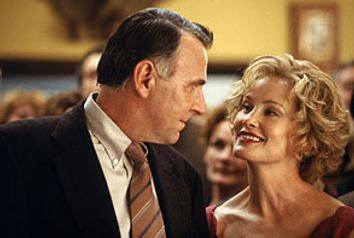
About one hour into the film “Normal” — the story of Roy, a Midwestern husband and father who decides he should have been born female — there is a scene that feels completely genuine. Irma, the suffering spouse portrayed by Jessica Lange, is perched nervously on the bed, waiting to see her husband garbed in women’s clothes for the first time. When Roy (“In the Bedroom’s” Tom Wilkinson) finally emerges from the bathroom, the camera settles on Irma, whose anxiety visibly melts into wary bemusement. “You look like my aunt Norma after her stroke,” she smirks. “Do I look that awful?” he sighs. “Yes, honey,” she giggles, “you do.”

The honesty of the moment soon fades. Irma, the whispery wife with an “oh dear me” sensibility, begins to dole out sartorial advice with all the aplomb of a seasoned drag queen. Patty Ann (Hayden Panettiere), their teenage daughter, knocks at the door, presciently yelling, “Is Daddy in drag?” And Roy, sulking over his wife’s insensitive if understandable reaction, begins to undress, revealing a slip, bra and, um, boxer shorts. A transsexual wearing boxer shorts?

That’s also the point at which my father — herself once a Midwestern husband and father who decided that she should have been born female — finally threatened to hurl the TV through the window, and I can’t say I blame her.

This film, adapted by writer/director Jane Anderson from her play “Looking for Normal,” could have been the story of our lives. Well, it could have been if my father was a humorless head case with anger management issues; if my mother was a tremulous steel magnolia for whom sexual orientation was but a minor hurdle en route to a happy ending; and if I was a preternaturally mature middle schooler with a metaphorically convenient penchant for dressing in men’s clothes.

But “Normal” is a fundamentally dishonest film, making the average Lifetime movie look profoundly nuanced in comparison. It’s virtually implausible on a medical, psychological and even geographic level. And most egregiously, it professes to be a beacon of tolerance and acceptance (last week, it was being promoted at gay and lesbian centers around the country) while presenting what might be the most negative film image of a transsexual since Buffalo Bill skinned women for secondhand clothes in “The Silence of the Lambs.” (Hey, at least that one owned up to being a horror movie; this flick is going to vie for GLAAD Media Awards.)

“Normal” is set in rural Illinois-by-way-of-Hollywood, a place in which people hang crocheted aphorisms on the walls, and eat nothing but casseroles. It’s that kind of eensy Midwestern town in which everyone knows everyone, and folksy neighborliness is a cover for what is inevitably revealed to be small-minded bigotry.

This is the phony setting where Irma and Roy have just celebrated their 25th wedding anniversary, at a party marred by Roy’s collapse and subsequent complaints of “terrible headaches.” Before he’s taken so much as an Excedrin, however, the ostensible reason for his fall is made clear: Wilkinson’s Roy — whose most discernible character traits are self-righteous vapidity worthy of George W. Bush and the hulking gait of Barney Gumble — confesses to both pastor and wife that he was “born in the wrong body” and would “rather die” than live as a man.

Roy is certain, despite his apparent lack of psychological counseling, support groups or education, that he needs to be a woman immediately. And so, within mere days of revealing a secret he’s kept totally hush-hush for 60-odd years, he wears perfume to his job at the tractor factory. He’s going to be a woman, he announces to his boss and coverall-clad co-workers, with less trepidation than one might announce a plan to get a new haircut, blissfully unaware that transsexuals across the country have been fired after just this sort of confession.

Unsurprisingly, Roy goes from pillar to pariah in about 15 minutes flat, which should make him at least the object of viewers’ sympathies. He is snubbed by omniscient cashiers who know intuitively that he’s buying women’s clothes for himself, and not his wife. He is banished from his Baptist congregation — in fact, they hate him so much that they refuse his collection money. But it’s difficult to sympathize with Roy and support him in his efforts because his journey from male to female in no way seems real.

Even after he comes out, Wilkinson gives few physical indicators that Roy is transsexual — except, bizarrely, the tendency to purse his lips prudishly like Vicki Lawrence playing Mama. And, except for an out-of-nowhere scene wherein he just so happens to find a loaded shotgun in a barn and threatens to blow his brains out, he seems rather unfazed by the entire transition. He seems, as my father pointed out, not a genuinely gender-conflicted person, but a mentally ill man in need of professional intervention.

In the real world, according to the Harry Benjamin protocol (the accepted standards of care for gender dysphoria), that’s probably what he would get. Typically, a transsexual has to live as a woman for one year and undergo extensive psychological testing prior to being approved for surgery. But in this movie, Roy is on the fast track to sex reassignment within less than a year, an unlikely timeline unless he plans to employ disreputable doctors and take black- market hormones. Roy (now Ruth) starts taking estrogen, which, almost overnight, gives her swelling breasts and, as one character sensitively points out, makes her a real “bitch.” (It’s also implied that full facial electrolysis has taken no more than a few months even though it typically takes years and Wilkinson’s 5 o’clock shadow is unaltered from opening to closing credits.)

Ruth’s transition is unintentionally comical. In one whimsical scene, Lange, Wilkinson and Panettiere all shriek at each other like the criminally insane while making breakfast — because, you know, it’s that time of the month. In another, the hormones make Ruth, a factory worker, nearly unable to open a jar; after wrenching it open, she stares in despair at her hands as though they’ve been scarred with battery acid. By the time she gives away her power tools — because women don’t need to fix things, silly! — you’re ready to call the National Organization for Women.

But all of these narrative leaps in logic, sexist assumptions and factual shortcuts are minor compared to the emotional manipulations of the film. When Wayne, Ruth and Irma’s estranged son (John Sikora), calls Daddy a bad word, Ruth punches him in the nose. Charmingly, the violence — clearly viewed by Anderson as a lesser evil than calling your dad a cunt — reconciles the father and son. The movie doesn’t do much better with the marriage between Irma and Roy/Ruth, which is supposedly the main point of the film. No matter how many times Lange weeps, screams and adopts that stoic-yet-vulnerable stance she’s perfected in the course of playing so many farm wives over the years, it’s impossible to believe in this relationship, which exists solely to debate the meaning of gender in a marriage. There’s no humor, friendship, romance or just plain warmth. When she returns to bed with Ruth, it’s supposed to be an example of how love triumphs over all, but it feels like an abdication: Ruth gains her sexual identity at the expense of Irma’s. That’s not to say that there aren’t lots of couples who stay together after a gender change, but the movie seems to imply that sexual acceptance is the only way to express unconditional love — a premise that many former spouses of transsexuals, my mother included, might argue.

My father is not Every Tran, any more than Tom Wilkinson’s Ruth should be. But “Normal” goes beyond merely being unrepresentative to being downright misleading. The film completely avoids the true complexities of how a father’s sex change affects a family. Anderson avoids the gigantic issue of what the kids are going to call Dad now, for example, or even what pronoun will be used (interestingly, HBO press materials, while touting the film’s social conscience, consistently employ “he”). There’s no discussion of how losing a father and husband — even if only in the physically superficial sense — is a true loss, nor how altering the conception of one’s family from standard American issue to “nontraditional” is a culturally challenging one.

These are issues that dogged me for a significant portion of my life — and that’s true of every family I’ve ever met who’s confronted this issue. They occupy not a frame of this two-hour film.

“Normal,” ironically, was also the name of a book about transgendered people by Amy Bloom that was released last fall. It’s a winking title that, if applied to a creative project about other minorities, like gay men or African-American women, would seem patronizing and thoroughly retrograde. But in the transgender community, so used to full-throttle vilification, even weak pleas for tolerance are welcomed with overwhelming gratitude. This movie, however well-intentioned, should not be greeted with the same.

Continue Reading Close