Pamela Burdman

Beam me up (to Youngstown)!

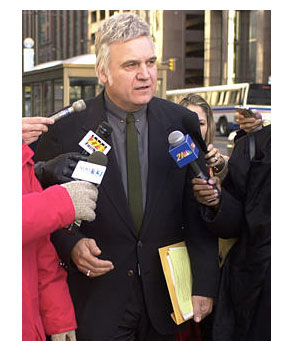
Despite his conviction, his expulsion from the U.S. House and a really bad hairpiece, former Ohio Rep. Jim Traficant will find that some in Youngstown still love him.

  • more
    • All Share Services

Beam me up (to Youngstown)!

Congress’ near-unanimous vote Tuesday night to expel nine-term Ohio congressman and convicted felon James Traficant was hardly a surprise to television viewers around the country who had glimpsed his bizarre defense against ethics charges in the past two weeks.

His references to “gastric emissions” and “Playboy bunnies” undoubtedly produced as many guffaws as his feral hairpiece and “Beam me up!” remarks on the floor of Congress regularly do. But the antics couldn’t convince House colleagues to buy Traficant’s argument that his recent federal conviction on bribery, corruption and racketeering charges was pure payback for his outspoken — and at times outrageous — views.

If Traficant’s tale played as comedy to much of its national audience, the story takes on tragic overtones from the perspective of many in his northeastern Ohio district, where his fall from folk hero to felon mirrors Youngstown’s calamitous descent from Steeltown U.S.A. to Crimetown U.S.A.

Traficant, only the second representative to be formally expelled from Congress since the Civil War, will be sentenced to up to seven years by a federal judge next week. But only the history of the once coal-rich Mahoning Valley and its fading fortunes can explain why some pundits predict that the Democrat-turned-Independent could net 20-some percent of the vote this fall for his old seat — even if he runs from prison, as he has vowed to do.

During his 22 years in public office, he routinely garnered 70 percent or more of the local vote. His support is strongest among the over-50 population, according to Youngstown State University professor William Binning, chairman of the political science department. Not coincidentally, those are the same residents with the clearest memory of Youngstown’s heyday as a steel-making giant.

While his stock has sunk since his indictment last year and conviction by a Cleveland jury in April, Traficant’s maverick “up-yours” stance has long charmed Youngstowners whose falling out with the federal government began with the first steel mill closings in 1977, when the Carter administration refused to back a local plan for worker ownership of the plants.

“He represents a … politics of resentment,” notes YSU labor expert John Russo. “It’s a resentment of the community for what happened to hard-working, salt-of-the-earth, good people who believed in the American dream.”

A Youngstown native and high school football star, Traficant entered the political scene as sheriff in 1980. As 50,000 workers lost their jobs, unemployment reached 20 percent and the hardscrabble town became fed up with empty political promises, he cemented his position as a populist champion when he refused to foreclose on houses owned by laid-off steelworkers.

“I kind of feel a devotion to him,” says Sandy Sayers, a law office clerk who grew up on the south side of Youngstown, where “black gold” once rested on every window sill and the sound of trains leaving the mills at night lulled residents to sleep. “He helped our community a lot. He’s the only one that ever comes to fight for Youngstown when we have any problems,” said Sayers, whose father and grandfather both worked in the mills. “I kind of feel that he’s guilty of what he did, but show me one of them up there who aren’t. I definitely think he was singled out.”

It isn’t the first time that Traficant’s battles have become the community’s. In 1983, when the government brought its first case against him, he became the first individual ever to beat federal racketeering charges without a lawyer: Despite taped evidence and a signed confession, he convinced a Cleveland jury that he had accepted a bribe only to carry out a one-man sting operation against local mobsters.

That defiance toward the U.S. Department of Justice only heightened his popularity, fueling his successful run for Congress a year later — even as his mythic stature angered some in the business community. “He’s personified and twisted the feeling that we’ve been left behind, that we’ve been victimized … into a political culture that’s incredibly self-destructive, and that’s the tragedy,” says Andrea Wood, publisher of the local Business Journal, who has covered Traficant since 1980, when she was a TV newscaster.

During his 18 years in Washington, he was noted for his disheveled suits and bell-bottoms, as well as his flippant one-minute speeches on the House floor. Often punctuated with the Star Trek catch phrase “Beam me up!,” the statements, catalogued on his Web site, read like a mix of populist rhetoric and rap lyrics. In one such incantation in 1998, he riffed: “Does America now have two legal standards, one for you, one for me; one for he, one for she; one for generals, one for soldiers; one for presidents, one for residents?”

In the Mahoning Valley, encompassing Youngstown, the neighboring city of Warren and various suburbs, many residents realized that the 61-year-old ex-congressman often rode a slippery edge between renegade and jester. Indeed, in the early 1980s, local Democratic Party chairman Don Hanni tried to block Traficant’s political ambitions by having a court declare him mentally ill — a move that led Traficant to quip frequently that he was the only member of Congress whose sanity was court-certified. But locals remember him most for his pork-barrel politics and hometown loyalty.

“People are somewhat unique here, but they’re not stone crazy, and if you’re winning with a 70 percent margin, obviously there are a lot of people who in one way or another you’ve touched so that they feel you can do something positive for them,” said local attorney Alan Kretzer, who was active in the Democratic Party when Traficant started his career.

Kretzer recalls Traficant ending a sidewalk conversation with him one day when an older woman “one step away from being a bag lady” asked to speak with him. “Most public officials would have said, ‘You call my office,’” Kretzer says. “He’s a demagogue, but he also ingratiates himself with normal, rank-and-file, poorer people. He probably shouldn’t have ever been in Congress. But he’s a masterful politician. He understood the mindset of the majority of his constituents.”

He also brought high-profile federal projects to Youngstown, including an U.S. Army Reserve air base, two federal courthouses and $25 million for a convention center that has yet to be built.

“Even people at the Chamber of Commerce who can’t stand the fact that he’s brought such negative attention to the valley, even they will have to admit he did a pretty good job of bringing money to this valley,” notes one-time Traficant supporter Scott Lewis, who runs a real estate firm started by his grandfather more than 50 years ago. “Whenever I would go see Traficant he was always good to me. When I would run into him, whether at a Rotary meeting or a wedding, he always remembered my name and my dad’s name. He was very receptive to business interests.”

Though Lewis said he never detected the slightest hint that the congressman expected illicit compensation, Traficant’s receptivity apparently did cross the line with other business people. Indeed, the federal government’s star witness against him was J.J. Cafaro, scion of one the area’s most powerful families (second probably only to the DeBartolo clan, which also fell into disrepute nationally when 49ers owner “Eddie D” pled guilty to charges of bribery involving a Louisiana gambling venture).

Cafaro, who pled guilty to one count of conspiracy to bribe, testified that he provided Traficant with thousands of dollars of farm equipment and other items in exchange for meetings with top government officials in order to secure deals for his aerospace company. Former Traficant employees also testified that they were required to work on his farm or expected to give him kickbacks out of their government salaries.

Traficant’s scheduled sentencing next week will cap a series of state and federal probes that netted convictions of more than 80 people in the Mahoning Valley, including judges, prosecutors, numerous local attorneys and the local sheriff. It also exposed Youngstown’s criminal underbelly to a national audience. Feature stories highlighting the lawlessness in Youngstown carried headlines such as the New Republic’s “The City That Fell in Love With the Mob” and U.S. News & World Report’s “The Sopranos Come to Youngstown, Ohio.”

According to the recent book “Steeltown U.S.A.: Work and Memory in Youngstown,” by YSU’s John Russo and his colleague Sherry Lee Linkon, the city had the nation’s highest ratio of FBI agents per capita in the late 1990s. But the outlaw mentality had an honorable heritage: Russo and Linkon trace organized crime in Youngstown back to the 1920s, when citizens banded together to protect the interests of immigrants against the Ku Klux Klan. In ensuing years, an apathetic public allowed a degree of criminality to persist. And until the late 1970s, when the steel industry abandoned the area, legitimate business kept the area economically healthy and served as a counterweight to the mob.

“After the mills shut down, you had a more pronounced vacuum and they became the only game in town. The politicians had everything to gain and nothing to lose by playing ball with them,” says Jim Callen, a local activist and director of Northeast Legal Services. “I think Jim has been characterized by some as a problem back here,” said Callen, who led a delegation to Palermo, Italy, two years ago for a symposium on the role of civil society in countering organized crime. “I think he’s been more of a symptom of a problem, just as organized crime has been a symptom of a problem. We’ve had a culture that has tolerated this corrupt behavior. We’ve had essentially a culture of lawlessness.”

As industry departed, so did many of the city’s residents: The 2000 census counted 82,000 residents in Youngstown, less than half the population of 40 years ago, though the suburbs, especially those to the south, have grown. The darkest days are over, but the local economy has yet to recover its earlier luster. In fact, during Traficant’s ethics hearing, a bankruptcy court was liquidating the retail chain Phar-Mor, whose arrival on the scene in 1982 promised to lift Youngstown out of economic doldrums. Instead, Phar-Mor founder Michael Monus is still doing time for a 1995 conviction for fraud, tax evasion, and embezzlement. The Phar-Mor closing could cost the Mahoning Valley upwards of 800 jobs, according to Wood.

“As the national economy is imploding, we are imploding here,” she says. “When you juxtapose that with the political implosion of Jim Traficant, the business community is staggering. It’s the worst it’s been since the steel shutdown. It’s very difficult to divorce the political situation from the economic situation, because it’s so bleak right now.”

It is rife with irony that one of the industries the area has turned to for economic rescue is the prison industry. In the 1990s, four prisons were built in the area, though one of them has since closed. Traficant played a role in bringing some of those lockups to the area — and was trying to bring in another to a brownfield where the old Youngstown Sheet & Tube plant once stood. Pundits speculate that he might have retired from Congress to a cushy job in the corrections industry had his federal convictions not steered him to prison in a less respectable fashion.

Like all tragic figures, Traficant was done in partly by his own hubris. First, he crossed party lines to support Republican Dennis Hastert for the speaker position. While that stunt secured a $25 million convention center deal for the area, it cost Traficant politically. The Democrats refused him a committee seat, and union officials who had long stood with him dropped their support.

Another high-wire act that Traficant will pay for was his decision to forego legal representation in his second federal trial this spring.

“Had he been represented, he would have probably won on some of the counts,” says Kretzer. “It was a try-able case. Any lawyer who followed it would agree that he did an awful job. It was too complex a case for an individual layman to handle himself.”

After losing the Democratic and union establishment, Traficant also suffered in public opinion after his conviction. But Binning, the YSU professor, says his support actually bounced up after last week’s ethics hearing, when one of the defense witnesses testified that the feds were so eager to nab Traficant that they had tried to force him to provide false evidence against the congressman.

One juror has said that he wouldn’t have voted to convict Traficant had that witness testified in court. That sentiment is winning favor in Youngstown among those who can’t forget Traficant’s defense of the area’s steelworkers – and can’t help wondering whether their hometown boy will do more time for his crimes than the Enron honchos and the accountants who aided them.

“He’s not wanted up there [in Washington],” says Sayers. “Here comes Jim Traficant, with old suits and wigged-out hair getting mouthy. He upset the wrong people, and they went after him. If they want to take him down, they should look at everybody else up there. Without him, it doesn’t seem like there’s anybody who’s going to care about a small community.”

That he managed to win his last race in 2000, even after the federal investigation against him had become front-page news, is a sign of his ballot-box prowess. And while recent redistricting as well as Traficant’s rightward tilt in the last two years will cut into his support, local experts — including Youngstown Vindicator columnist Bertram de Souza and YSU’s Russo — are still predicting that Traficant will net 20 percent of the vote, or more, in the four-way race.

“The important thing to realize is he’s not leaving,” said Wood. “As long as he’s drawing a breath, Jim Traficant will be making news in the Mahoning Valley.”

Others, however, sense the passing of an era, and some of them can’t help but be wistful.

One person who will miss him is Vindicator political reporter David Skolnick. “Traficant’s a full-time beat at times,” he says. “You never know what he’s going to do, what he’s going to say. He has never taken a phone call from me in my entire time covering him. He’s completely inaccessible. You don’t dare call him at home. You don’t dare visit him at home.

“But it’s a rare opportunity to cover someone that colorful and engaging. It makes being a reporter very interesting. Whoever replaces him, even if they’re a superior congressman, it’s not going to be the same. It’s going to be back to boring stories about God-only-knows-what.”

Diversity drama at the University of California

Black, Latino and Native American student numbers plunged when affirmative action ended. Now U.C. says they're back up -- but a close look at enrollment tells a more complex story.

  • more
    • All Share Services

Diversity drama at the University of California

In the five years since the University of California regents banished affirmative action and implemented race-blind admissions policies, enrollment news has been fairly consistent: one headline after another documenting steep declines in diversity in the U.C. system, often with the spotlight on the flagship Berkeley campus.

The reversals began in 1997, when Berkeley’s Boalt Hall School of Law revealed stunning news: a 65 percent decline in blacks, Latinos and Native Americans — minority groups considered “underrepresented” at U.C. — admitted under the new policy, and only one black student in its entering class. Then, a year later, despondent administrators announced the first freshmen admissions numbers under the race-blind regime: the proportion of so-called underrepresented minorities in the first group of freshmen admitted to Berkeley after the affirmative action ban had fallen by more than 50 percent.

Two months ago, much to the relief of university officials, the narrative changed. “Minority Levels Rebound at U.C.,” wrote the Los Angeles Times. “Admission Up for Minorities in California,” said the New York Times. “U. of California Admits More Minority Students,” offered the Chronicle of Higher Education. For the first time in five years, the stories explained, the proportion of underrepresented minorities admitted to the U.C. system for the coming fall surpassed the pre-ban level of 18.8 percent, inching up to 19.1 percent.

Affirmative action foes say that the data prove diversity can be achieved without racial preferences. “It’s really demonstrating that there are programs and practices that we can put in place of explicit preferences that will produce, for those who are concerned about such things, this racial and ethnic diversity as a natural consequence of the policies that are in place, rather than policies that engineer that outcome,” exulted Ward Connerly, the regent who spearheaded U.C.’s affirmative action ban as well as Proposition 209, which also banned race-conscious decision making around the state.

With the Supreme Court poised to review a challenge to race-conscious admissions policies at the University of Michigan, expect more attention to U.C.’s progress in achieving diversity without affirmative action. But that attention may well produce more questions, because the reality of race in the nine-campus U.C. system is far more complex than the latest headlines, or Connerly’s elation, suggest. For one thing, the drop in minority freshmen around the system was never as bad as at the selective UC-Berkeley and UCLA campuses. The modest system-wide dip of 11 percent garnered less attention than Berkeley’s dramatic 55 percent plunge. So the current headlines about a return to 1997 diversity levels in the entire U.C. system – which didn’t fall that much in the first place — are a little misleading.

Racial diversity at Berkeley is a very different story. Though it has inched up, underrepresented minority enrollment remains 30 percent below pre-1998 levels. Among students admitted to the flagship campus for this fall, 17.5 percent were underrepresented minorities — down from 25.3 percent in 1997. The decline is matched by an increase in white and Asian admissions: For this fall, 40 percent of admitted students are Asian American — up from 35 percent in 1997, and another 33 percent are white, compared to 31 percent five years ago. (The remaining 10.5 percent are students who described themselves as “other,” or didn’t state a race or ethnicity at all.)

“I think the university is distorting what’s happening,” said Bob Laird, who retired in 1999 as admissions director at Berkeley. “I think they’re doing everything they can to put things selectively and carefully in the best possible light. I don’t think it’s an accurate reflection of what’s really going on.”

The news is slightly better at UCLA, where underrepresented minority admissions declined from 21.2 percent in 1997 to 17.9 percent for 2002. Asian Americans amount to 42 percent of admits for the fall, and white students constitute 30 percent, slight changes from 40 percent and 31 percent five years earlier.

One reason the U.C. system has recovered its lost diversity is that California high school graduates have become more colorful than ever, mainly due to an increase in the state’s Latino population. In fact, black, Latino and American Indian students are actually more underrepresented at UC, compared to their statewide numbers, than they were back in 1997. The percentage of high school graduates who are Latino, for example, increased by 8 percent in the last five years of the 20th century, but as a proportion of admitted freshmen, Latinos increased by only 6 percent.

“Latinos are going to grow fairly significantly … simply because of the demographic changes of the state. African-Americans are a more difficult problem, because their population base is not growing,” said John Douglass, a senior research fellow at the UC-Berkeley Center for Studies in Higher Education.

Black students’ share of the admitted freshman class fell 11 percent system-wide during the 1997-2002 period though their proportion of high school graduating classes slipped by only 1 percent. And at UC-Berkeley, the proportion of black students is still down by nearly 50 percent from 1997.

The numbers have been even more dismal at UC’s highly selective professional schools: The case of only one black student’s being admitted to Berkeley’s Boalt Law School in 1997 was the worst of it, but the downward trend has been clear: From 1994 to 2001, the number of African-Americans admitted to the three law schools on U.C. campuses declined 55 percent, and the number of Latinos fell by 33 percent, according to numbers compiled by the office of state Assemblyman Manny Diaz, D-San Jose.

Medical school numbers aren’t much more encouraging: admission of underrepresented minorities to any medical school in California has fallen by 40 percent since its peak in 1994, according to a special report on medical school diversity. These figures aren’t expected to rebound quickly, since U.C. applicants make up a significant portion of the overall med-school applicant pool. Public health officials are concerned, given that minority doctors are more likely to work in underserved communities.

“My sense is that there’s really a crisis,” said Laird, who is writing a book about the affirmative action battles at U.C. “For African-American students at Berkeley and UCLA and UC-San Diego, I think the situation is extremely serious. I don’t see the longer-term prospect of repairing that.”

Berkeley linguistics professor John McWhorter, who is African-American, strongly disagrees. A harsh critic of affirmative action, he says black students’ numbers at Berkeley and elsewhere in the system will rise over time, as they meet the U.C. system’s high standards.

“We’re not at the point where the numbers are where they were before. But the reason why the numbers were where they were was a disabling, condescending policy that was making a lot of people feel good but was not really fixing the system,” McWhorter contends.

As McWhorter points out, Berkeley’s fall has been a windfall for other U.C. campuses — particularly Riverside — which are now enrolling more minorities than they were under affirmative action. Administrators who foresaw that pattern made a point of trying to keep their minority numbers up by encouraging applicants to consider Riverside and other less prestigious campuses. They told kids that they would get a fine education at any U.C. — and even started a “referral pool,” so that qualified students declined by one of the competitive campuses could be admitted to another campus, even if they hadn’t sent in an application.

All eight undergraduate campuses (UC-San Francisco is devoted to the health sciences) share the same minimum requirements. The prestigious Berkeley and UCLA campuses, however, turn away roughly three students for each one they admit — far more than their sister campuses. And more of the students those campuses admit actually decide to enroll than those admitted to their sister schools. For instance, 46 percent of students admitted to Berkeley and 41 percent of those admitted to UCLA last year enrolled. But at UC-Riverside, only 19 percent of students admitted by the campus enrolled last year, meaning eight of 10 chose to go elsewhere — such as another U.C. campus or, in many cases, a private school.

In a cascade effect, the other campuses are now admitting and enrolling minority students who, in the past, might have been accepted to Berkeley or UCLA thanks to affirmative action. In fact, only one campus has actually admitted a higher proportion of underrepresented minorities: UC-Riverside, a fast-growing school that, unlike some of the other campuses, is able to accept 100 percent of applicants with the minimum qualifications. But when it comes to enrollment of those who are admitted, minorities who in the past would have turned down Riverside or Irvine to go to UCLA, for example, now don’t have that option. The result: Riverside, Irvine, Santa Cruz and Santa Barbara have higher proportions of enrolled minorities without affirmative action.

“What we’ve seen is a reshuffling,” says McWhorter. “It’s not like all these kids have to go out of state or to community colleges. The idea that reshuffling is a horror seems to imply that those second-tier U.C. schools give you a raw deal.”

“There is, of course, a correlation between going to a Berkeley or a UCLA and going on to graduate school in professions that are very high paying or high status. But the correlation isn’t as high on the brand-name institutions as people think,” said Douglass.

But others at Berkeley say that even if students can survive without attending Berkeley, the declining diversity is damaging the campus itself: “It’s ridiculous for U.C. to say we have met our diversity requirement system-wide, so we don’t have to worry about Berkeley and UCLA,” said ethnic studies professor Ling-chi Wang. “We do have to worry about it, because the quality of education is going to go down. Academic excellence is linked to diversity. I have visibly seen [the number of] minority students declining in front of me each year. It’s very, very disheartening.”

At Riverside, about 26 percent of the students admitted for the fall are underrepresented minorities. That’s where Berkeley was in 1997, but no one is venturing a guess as to when — or whether — those numbers will return at the flagship campus.

Even if it hasn’t paid off yet at Berkeley and UCLA, university officials have reformed the admissions process to try to reach more of the underrepresented, without affirmative action. Without these reforms, it’s clear that such students’ numbers would have plummeted even more dramatically.

The university has de-emphasized SAT scores, for instance, in favor of the SAT II achievement tests. Some argue that the policy favors students who speak another language, such as Spanish, at home, because those students typically earn perfect scores on foreign-language achievement tests. Next month, the regents will decide whether to discard the SAT altogether or to use a new version that was revamped to U.C.’s specifications.

U.C. now also conducts a “comprehensive review” that looks at a student’s entire application, not just grades and test scores. It has also adopted a “4 percent plan” that guarantees admission to a U.C. campus for students in the top 4 percent of their high school class, as long as they take the right courses and tests. This helps ensure that kids in the top 4 percent of inner-city high schools, who tend to be low-income and minority students, get into the system alongside kids from elite prep schools.

“How much of an influence have some of these changes had on the racial mix?” wonders Douglass. “We don’t know for sure.”

Many of the top “4 percenters” would have applied and been admitted to U.C. without the program, but a university analysis suggests that the 4 percent program stimulated an additional 2,000 students to apply for the fall 2001 freshman class — out of a total of more than 48,000 applicants. The major beneficiaries of the policy appear to be Latino and rural students. For example, about one-eighth of the Latino applicants in 2001 wouldn’t have applied without the new program, the study concluded.

And the move to “comprehensive review” seems to have changed admissions patterns on some campuses as well. Until last year UC-San Diego, for example, used a numerical formula to enroll students. Under the new comprehensive-review policy, the campus admitted 32 percent more underrepresented minorities than last year. It still hasn’t hit pre-209 levels, but it’s getting close: While 15.3 percent of admissions to that campus were underrepresented minorities in 1997, this year’s proportion is 14.4 percent. The number of Asian-Americans rose slightly, from 38.1 percent to 38.7 percent, while the number of whites declined from 39.9 percent to just 36.5 percent of those admitted.

Exact freshman enrollment levels for 2002 won’t be known until the fall, but preliminary student responses suggest that 15 percent of those enrolling at Berkeley and 19.7 percent of those at UCLA will be underrepresented minorities. UC-Davis and UC-San Diego each expect to enroll classes with fewer than 13 percent minorities — apparently because some of the students they admitted opted to attend other schools.

Riverside, on the other hand, is projecting an entering class that is nearly one-third black, Latino, or Native American.

“We certainly are not where we should be in terms of diversity,” said Mae Brown, UC-San Diego’s acting assistant vice chancellor for enrollment management. “We are not where we need to be or should be in terms of underrepresented students. We were not there in 1997 or in 1995.”

“These aren’t processes that are amenable to overnight quick fixes,” concedes Richard Black, Berkeley’s assistant vice chancellor of admissions and enrollment. “It takes a sustained effort over time, and that’s what we’re doing and that’s what we’re going to continue to do.”

To that end, the university has spent hundreds of millions of dollars in the last few years on outreach programs aimed at improving public schools and steering students onto the college track. But even the most enthusiastic proponents admit these efforts will take years to yield results.

To Wang, the university should reflect the society around it: “In an ideal world, I would love to see a proportional representation in our student body. I’m hoping that as we turn into a more diverse population, the university will reflect the diversity that is so richly represented in California, but I’m kind of discouraged.”

It’s true that U.C.’s 19.1 percent underrepresented minorities admitted for this fall’s freshman class is far from the 40 percent of public high school graduates who come from those groups. And it irks some public education advocates to see private universities do a better job of reaching those groups, since the state’s ban on affirmative action doesn’t apply to them. Of Stanford University’s 2001-02 freshman students, 22.2 percent were underrepresented minorities, compared with the U.C.-wide figure that year of 17.7 percent. If the Supreme Court rules against the University of Michigan, however, and strikes down the Bakke decision, Stanford will have to operate by the same rules as U.C.

But when it comes to another kind of diversity — socioeconomic diversity — the U.C. system clearly has the edge over private colleges. For years some advocates have said universities should focus on disadvantage, not race, in selecting students. In the heyday of affirmative action, some questioned why the daughter of a black surgeon who’d gone to the state’s best schools, for instance, would get preference over the son of a white welfare mother, and the lack of attention to the socioeconomic disadvantage suffered by kids of whatever race rankled some social justice advocates. Even before it was forced to drop race-based affirmative action, U.C. had been paying attention to its applicants’ socioeconomic backgrounds, and its diligence has paid off.

When the James Irvine Foundation looked at Pell Grant recipients, it found that as of the year 2000, UCLA, UC-Berkeley, and UC-San Diego were each enrolling more poor and working-class students than any other top-ranked university in the country — public or private. (The other five undergraduate campuses weren’t evaluated, because they’re not in the nation’s top 40 schools, but they have similar enrollment patterns of low-income students.)

More than a third of the students at UCLA, and around 30 percent of those at Berkeley and San Diego, were receiving Pell Grants. The only other institution that came close was the University of Southern California, at 27 percent — and the next best performer among public schools was the University of North Carolina at Chapel Hill, with 12.5 percent. Stanford, with 10.8 percent, ranked 24th out of 40, and Harvard, at 6.8 percent, was second to last.

“For any campus, it’s important to look at the extent to which they are serving the population, whether it’s their state or country or community. It’s important to look at that in a number of dimensions. Ethnicity is one. Class is another,” said Robert Shireman, Irvine’s higher education program director.

“The fact that the U.C.’s are doing such a good job of enrolling an economically diverse group tells me that it would be difficult for them to address their low enrollment of African-American and Latino students by focusing solely on economic issues,” he added. “They’re already doing that pretty well.”

The new policies — comprehensive review, the 4 percent program, and admissions criteria that consider whether an applicant’s parents attended college — have honed the university’s ability to define and focus on promising students from disadvantaged backgrounds. Many believe a “dual admissions” program — which would offer automatic admission to certain community college students who choose to transfer to U.C. — would also help boost underrepresented minority enrollment, but that measure has yet to receive state funding.

California’s complicated racial landscape means there is no proxy for race in this state — many policies designed to assist low-income students, for example, would assist many Asian-Americans, who are not underrepresented. But there are other advantages in new policies that look more comprehensively at applicants.

“There is no magic bullet,” said Douglass. “And one doesn’t make policy only with respect to diversity and ethnicity and race. If there’s any good that’s coming out of this politically contentious period, it is a comprehensive look at why the university admits students and what are our responsibilities. It’s been a much more vigorous and critical look at policies that might better fit our social contract with the state of California. The system had become too myopic.”

“The university has been led to concentrate much more on real, fundamental disadvantages, ones over which no one has any dispute,” agrees UC-Davis chancellor Larry Vanderhoef, who suspects that many of the innovations could not have been adopted if affirmative action were still in place. Of the nine chancellors who opposed the regents’ 1995 decision, Vanderhoef is the only one still in his post, giving him a unique vantage point for making his assessment.

“I wouldn’t say I’m satisfied with the state we’re in, but I’m satisfied with the trend and the intentions,” he said. “What I know for sure is that it’s not the end of the world. It’s not the end of underrepresented minorities being able to go to the university.”

Continue Reading Close

A colorblind California?

With one in seven California kids born to parents of different races, Ward Connerly says it's time to stop collecting outmoded racial data. But even some old allies say Connerly's is an idea whose time has not yet come.

  • more
    • All Share Services

A colorblind California?

Five years ago, University of California regent Ward Connerly proposed a novel reform to the controversial UC admissions system: anonymous applications, devoid of information about race or ethnicity, a move the diehard opponent of affirmative action hoped would eliminate admissions officers’ temptation to consider such factors when deciding who attends the prestigious state system. But Connerly, the campaign chair of California’s Proposition 209, the 1996 ballot measure banning racial preferences in state decision-making, was ignored by the UC administration.

Now Connerly is taking another shot at the same goal, with a proposed statewide ballot initiative to prevent California from collecting racial data in the first place. Dubbed the “Racial Privacy Initiative” by supporters, Connerly’s proposal would eliminate the racial check boxes that Californians encounter on state government forms ranging from job applications and school enrollment papers to birth and death certificates.

“There is some vision that all of us have for this state, one in which we’re treated as individuals, regardless of our ancestry or physical traits,” Connerly says, explaining why he’s made this his new cause. “Californians are increasingly marrying across the old lines of race and ethnicity, having children, and making the race boxes essentially obsolete.” Indeed, in 1997, 14 percent of all California births were to parents of different races, making mixed-race kids the third largest group, behind whites and Latinos and ahead of Asians and blacks. (In fact, Latinos aren’t a racial group, but are treated as one on most state forms.)

Even in the post-209 era, UC and other state agencies say they have research, statistical and social policy reasons for continuing to gather racial data. But Connerly isn’t convinced. “If you can’t use race to favor or disfavor someone, then the question is why do you need the government involved in race at all?” asks Connerly. “This is a logical sequel to 209. Until I am senile or no longer draw a breath, I will constantly urge the government to embrace race-blind policies.”

But opponents say the measure would cripple racial anti-discrimination laws, thwart successful social policy that’s been appropriately shaped by race — efforts to reduce high breast-cancer death rates among black women, for instance, or cervical cancer among Latinas — and endanger the progress California has made in leveling differences among racial and ethnic groups. (Supporters say the measure would let the state continue to collect crucial racial data, including medical data, but the initiative’s true impact is hotly debated.)

And while opponents call the measure the “Connerly Initiative,” hoping to link it inextricably with a man civil rights groups consider the enemy, the opposition transcends California’s civil rights establishment: Even some of Connerly’s allies in his Prop. 209 campaign are stepping forward to oppose his new measure.

Connerly’s proposal is likely to be seen as the latest example of ballot-initiative backlash against the state’s unparalleled diversity. California voters ended affirmative action in 1996 and bilingual education in 1998, and passed a measure blocking benefits to illegal immigrants in 1994 (though that one was struck down by the courts). Other states have adopted some version of those bellwether initiatives.

Like those measures, Connerly’s new initiative enjoys an early lead in the polls. A recent Field Poll showed that 48 percent of voters were inclined to back it, with 34 percent opposed and the rest undecided. The numbers tracked pretty closely to how voters came down on 209 six years ago, said Field pollster Marc DiCamillo: “It looks like, on the first blush, it’s tapping into the same sentiment and the same voters.”

Yet six years after 209′s passage, Connerly faces a more diverse electorate, whose decisions may be less predictable, as well as an unexpected obstacle: a fight for the legacy of 209. Connerly considers racial privacy the logical conclusion of the prohibition against racial preferences — if the state can’t use racial data to privilege or discriminate against individuals based on race, he argues, why collect it at all? But at least one of Proposition 209′s authors disagrees, and he is going public to defend his baby.

“At the outset of the 209 campaign, opponents said this is just the first step by right-wing fanatics to gut civil rights in America,” recalled Thomas Wood. “I want to tell people that this was never part of the agenda of 209. It’s not 209.

“In fact, I am opposed to the Racial Privacy Initiative. The debate should be over what you do with the data. It shouldn’t be in favor of some proposal that puts us in a state of racial ignorance so that we don’t know whether the laws are being enforced. If you remove the power of the state to collect data, you are gutting the anti-discrimination laws, including 209,” said Wood, who runs the California Association of Scholars, the state branch of a nationwide network of conservative academics.

Whether Wood is correct about the initiative’s potential impact is hard to determine, because the measure itself would be tempered by a thicket of federal requirements as well as various exemptions, including those for medical research and law enforcement. Almost no two people seem to agree on the initiative’s actual effect.

And no one yet knows whether Connerly’s personal crusade has the makings of a successful political movement. But he has enough support already to qualify his initiative for the state ballot. With the 980,000 signatures turned in by the campaign last month, the measure is expected to clear the tedious counting process and win a spot on the ballot this November, though it’s possible it will be held over until the March 2004 election.

Connerly’s basic argument — that race should make no difference in public policy — is seductive in its simplicity, and has a fundamental appeal to voters weary of the state’s obsessive focus on racial categories. That obsession, his supporters say, amounts to a type of “racial profiling.” That’s just one of many novel rhetorical twists “racial privacy” proponents savor: lumping civil rights advocates in with their foes, in this case those who use racial stereotypes to justify disproportionate police investigations of minorities.

San Francisco author Richard Rodriguez praises Connerly for identifying a cultural trend that’s beyond politics: California’s erosion of racial boundaries and its celebration of racial blending. “I salute Connerly’s shrewdness in catching a moment larger than the political. Clearly the cultural moment we are entering is civilization at play, in which color is completely open and no longer fated,” said Rodriguez, outlining the central argument of his new book, “Brown — The Last Discovery of America.”

Rodriguez wouldn’t say he supports the initiative, but his take on racial categories echoes Connerly’s: “I am in a rage about these classifications that children are being forced to submit to. There are five major categories when so many children tell me they belong to more than one.”

That argument, opponents realize, is hard to dispute.

“There’s a rhetorical advantage they get by saying ‘Let’s be colorblind,’” concedes Troy Duster, a sociologist at New York University who still directs the American Cultures Center at UC-Berkeley, where he taught for many years. “It’s very hard to say, ‘Yes, we do want to keep race front and center’ without making it sound like you want to go back to some retrograde notion that race is or should be the way people are selected,” said Duster, who also went to battle with Connerly over affirmative action back in 1995.

“You don’t want to rescue an 18th century conception of race, based upon a false notion of biological differences,” Duster continues. “On the other hand, the effects of two centuries of racial stratification remain. To suddenly act as if that was not an issue is a transparent fiction.”

Duster was surprised to learn that his Berkeley colleague and frequent ideological foe, linguist John McWhorter, agrees with him on this point. A vocal critic of affirmative action and a Connerly loyalist, McWhorter he says he can’t join Connerly this time around.

While Duster’s work often spotlights racial inequality, McWhorter likes to use racial statistics to illustrate how far black people have come toward equality. Either way, the statistics are useful, he says.

“One way of approaching social change is the “as if” way — to pretend that there are not different races and that the races are not separated by vast social differences,” said McWhorter. “The other way of fostering change is to work with the grimy reality. Yes, race is a fiction. Ultimately we want to be Americans. But to get there, to get beyond race, we have to deal with it,” said McWhorter.

While Connerly’s stated goal is to get beyond racial divisions, it can also be said that he likes a good fight. A black Sacramento businessman, he launched what seemed like a quixotic battle against racial preferences at the University of California, and in 1995, a divided Board of Regents voted to dismantle most of the system’ s race-based policies.

Throughout that debate and the subsequent 209 campaign, which he chaired, Connerly clashed with university administrators and professors. He fired vitriolic memos at the likes of Angela Davis, the ’60s radical-turned-UC-Santa Cruz professor, for using her UC post to fight 209. And he suggested reforms — like anonymous admissions applications — that went nowhere. His perceived audacity made him Public Enemy No. 1 to many on the left and within the black establishment. He endured numerous personal attacks, including a public spat with state Sen. Diane Watson over his longtime marriage to a white woman. But while his rhetoric has grown a tad less confrontational than in his early UC years, Connerly’s views haven’t changed much.

In many ways, the question of racial check boxes goes right to the heart of what irks Connerly, who considers himself black but shuns the African-American label. Connerly’s ancestors include slaves of African descent, French Canadians, Irish-Americans, and Choctaw Indians. True to his personal background, Connerly seems bent on defying categorization — as he did in opposing affirmative action.

And for as long as he has spoken out against affirmative action, he has railed against the “silly little boxes.” Five years ago, for example, in a letter to President Clinton, he wrote, “Most Americans have a strong abhorrence to the counting-by-race phenomenon which currently exists. Most of us resent checking the silly little boxes which classify us.”

But while many people agree the box-checking is a little retrograde, they think they shouldn’t be eliminated, but updated to jibe with a multicultural reality.

What’s mostly gone unnoticed in the debate over collecting racial data is that California has changed its approach to collecting racial information dramatically in recent years. According to Don Fields, policy section chief at the state’s Office of Vital Records, California is the first state to go to a “multiple race” policy for birth certificates and other vital records. Race is listed on the confidential portion of birth certificates, where the mother and father self-report their race or ethnicity, with an option of listing up to three. Contrary to what is often stated in popular debate, no race is listed for the child.

“California is one of the leading states for collecting race data,” says Fields. “We’re on the forefront for collecting data because of our ethnic mix here.”

There’s little agreement in the data and policy world over exactly what the Racial Privacy Initiative would mean for academic research and policy analysis. While the initiative is unlikely to bar scholars from collecting whatever information they want in their own studies, the fact is that most researchers rely on data gathered by the state, and that is what’s in question.

Take birth records, for example. Hans Johnson, a demographer at the Public Policy Institute of California, says he uses the racial data in birth records in order to predict fertility rates for the state. Those rates differ by ethnic group, so he needs to calculate rates for different groups in order to accurately forecast population growth.

“That’s important for infrastructure planning for the state,” said Johnson. “How many children are going to be going to California schools, how many freeways are we going to need, what are the implications for road use, water use, housing? That’s an example of something you could argue isn’t completely necessary for the functioning of society, but that kind of information, I would argue, is a good thing.”

The PPIC doesn’t take positions on initiatives, and Johnson says he isn’t sure how the initiative will affect the collection of that particular data.

Nobody is.

Even supporters of the initiative have different ideas about its impact. Kevin Nguyen, executive director of the American Civil Rights Coalition, which is backing the initiative, believes that birth records would fall under patient records, which are exempted in the initiative. But Eugene Volokh, UCLA law professor and one of Connerly’s legal advisors for the initiative, has a different view: “My sense is that’s the very sort of thing this would prohibit.”

Don Fields of Vital Records said he can’t tell how the initiative would affect birth records. Though birth, death, and fetal death information is provided to the federal government for a $1.2 million annual fee, he said the state — not the federal government — dictates the contents of those records, suggesting that even if federal law allows the collection of racial data, the state’s rules would probably apply here.

And according to Carmen Nevarez, medical director and vice president of the Berkeley-based Public Health Institute, an opponent of the initiative, birth certificates are public records, not medical records, and therefore wouldn’t be protected if the initiative passes.

She predicts the same fate for race and ethnicity in disease records — which have been used, for example to target groups in order to prevent disease. For example, breast cancer attacks white women twice as often as African-American women, but black women are twice as likely to die from the condition. That information helps public health leaders target the most at-risk groups when they promote mammograms and other disease-prevention tools. In Oakland and other cities around the country, public health advocates have used a variety of geographic, cultural and even religious outreach efforts to reduce infant mortality among black families, whose rate is roughly three times that of whites. Likewise, Latinas and Korean women appear to be at greater risk of cervical cancer, and that data has helped with outreach and screening for those groups.

Initiative backers remind critics that the measure would permit the Legislature to allow the state to collect any data that serves a “compelling interest.” That doesn’t reassure Nevarez, who can envision bickering over what legislators believe is a compelling interest: “It is a scientifically valid tool that over and over again helps us understand where disease comes from and what we do to prevent disease. Why would you take it away?” And researchers at nonpartisan think tanks like PPIC say they might not be in a position to petition the Legislature.

The defection of Connerly allies like Wood and McWhorter doesn’t bode well for racial privacy as a hot new intellectual fad. But it’s not surprising that the idea wouldn’t catch fire in academia: Researchers and scholars are congenitally in favor of having more, not less, information. Many are likely to join Patrick Callan of the Center for Public Policy and Higher Education in calling Connerly’s latest gambit a “see-no-evil, hear-no-evil approach to the world.”

Says Callan, “There are legitimate questions about what the appropriate solutions are, but not knowing some things doesn’t make us better off as a society in terms of being able to solve them.”

Yet a few scholars say they are willing to sacrifice the utility of racial statistics for the greater good of moving closer to a race-blind America. Like McWhorter, Shelby Steele of Stanford’s Hoover Institution has used racial data to assail affirmative action. But, having decided that the debate itself is destructive, he is says he supports the initiative, because he sees no evidence that racial data helps craft smart social policy. Indeed, he argues that interjecting race into social policy is harmful.

“All of this number crunching has had a negative impact,” said Steele. “If you have a racial breakdown on you-name-the-problem — illegitimacy rates, literacy rates — what does that do? It doesn’t solve illegitimacy or illiteracy. It just enables the left and the right in America to fight. When we cloak these problems in race, we’re going to do one thing and one thing only — we’re going to argue over whether those problems are the result of racism and whether minorities are victims and whether they’re not, and the problems themselves get completely lost.”

Arguments like Steele’s may carry the day outside of academia. It won’t be academics or demographers, after all, but the voting public who will decide the fate of this initiative, and voters are just starting to find out about it. Only 25 percent of those polled recently were familiar with the measure.

DiCamillo of the Field Institute thinks the proposition is beatable — as, he says, was Prop. 209. “It does not have a huge lead,” said DiCamillo. “It seems to be vulnerable to a well-funded No-side campaign.” And there likely will be one: Nevarez is part of a growing network of environmentalists, civil rights lawyers, housing advocates and educators who aren’t waiting for the initiative to qualify to begin organizing against it.

And it does not bode well for Connerly that several prominent California academics who sided with him on affirmative action, including Wood’s Prop. 209 coauthor Glynn Custred, have yet to support his new initiative. It’s possible that the opposition of Wood and others could lend a critical mass to efforts to defeat Connerly’s latest crusade.

Another major difference from the Prop. 209 battle is the demographics of California’s electorate. Since 1996, whites have dropped from 76 percent to 70 percent of likely voters, with Latinos increasing from 11 percent to 16 percent, Asian Americans growing from 6 percent to 8 percent, and African-Americans holding steady at 6 percent.

And yet focusing on the declining number of white voters in California assumes that only whites will be sympathetic to Connerly’s colorblindness crusade. As Rodriguez notes, untold numbers of Latino, Asian and black voters may well agree with Connerly — not to mention the fastest growing racial group, mixed-race Californians. Though a majority voted against it, a significant number of Asian, Latino and even black voters supported Prop. 209. The number of nonwhites supporting Connerly’s initiative will likely be bigger than the civil-rights establishment expects but smaller than Connerly hopes. Still, whenever it appears on the California ballot, Connerly’s latest cause is sure to advance the debate about race in this state, even if voters decide its time has not yet come.

Continue Reading Close