Peter Van Buren

Our real Iraq losses

We left their nation in turmoil and our own country entangled in an endless "national security" nightmare

A man, left, inspects his destroyed vehicle at the scene of a car bomb attack in Ramadi, 70 miles (115 kilometers) west of Baghdad, Iraq, Tuesday, March 20, 2012. Officials say attacks across Iraq have killed and wounded scores of people in a spate of violence that was dreaded in the days before Baghdad hosts the Arab world's top leaders. (AP Photo) (Credit: AP)
This originally appeared on TomDispatch.

People ask the question in various ways, sometimes hesitantly, often via a long digression, but my answer is always the same: no regrets.

In some 24 years of government service, I experienced my share of dissonance when it came to what was said in public and what the government did behind the public’s back. In most cases, the gap was filled with scared little men and women, and what was left unsaid just hid the mistakes and flaws of those anonymous functionaries.

What I saw while serving the State Department at a forward operating base in Iraq was, however, different. There, the space between what we were doing (the eye-watering waste and mismanagement), and what we were saying (the endless claims of success and progress), was filled with numb soldiers and devastated Iraqis, not scaredy-cat bureaucrats.

That was too much for even a well-seasoned cubicle warrior like me to ignore and so I wrote a book about it, “We Meant Well: How I Helped Lose the War for the Hearts and Minds of the Iraqi People.” I was on the spot to see it all happen, leading two Provincial Reconstruction Teams (PRTs) in rural Iraq while taking part up close and personal in what the U.S. government was doing to, not for, Iraqis. Originally, I imagined that my book’s subtitle would be “Lessons for Afghanistan,” since I was hoping the same mistakes would not be endlessly repeated there. Sometimes being right doesn’t solve a damn thing.

By the time I arrived in Iraq in 2009, I hardly expected to be welcomed as a liberator or greeted — as the officials who launched the invasion of that country expected back in 2003 — with a parade and flowers. But I never imagined Iraq for quite the American disaster it was either. Nor did I expect to be welcomed back by my employer, the State Department, as a hero in return for my book of loony stories and poignant moments that summed up how the United States wasted more than $44 billion in the reconstruction/deconstruction of Iraq. But I never imagined that State would retaliate against me.

In return for my book, a truthful account of my year in Iraq, my security clearance was taken away, I was sent home to sit on my hands for months, then temporarily allowed to return only as a disenfranchised teleworker and, as I write this, am drifting through the final steps toward termination.

What We Left Behind in Iraq

Sadly enough, in the almost two years since I left Iraq, little has happened that challenges my belief that we failed in the reconstruction and, through that failure, lost the war.

The Iraq of today is an extension of the Iraq I saw and described. The recent Arab League summit in Baghdad, hailed by some as a watershed event, was little more than a stage-managed wrinkle in that timeline, a lot like all those purple-fingered elections the U.S. sponsored in Iraq throughout the Occupation. If you deploy enough police and soldiers — for the summit, Baghdad was shut down for a week, the cell phone network turned off, and a “public holiday” proclaimed to keep the streets free of humanity — you can temporarily tame any place, at least within camera view. More than $500 million was spent, in part planting flowers along the route dignitaries took in and out of the heavily fortified International Zone at the heart of the capital (known in my day as the Green Zone). Somebody in Iraq must have googled “Potemkin Village.”

Beyond the temporary showmanship, the Iraq we created via our war is a mean place, unsafe and unstable. Of course, life goes on there (with the usual lack of electricity and potable water), but as the news shows, to an angry symphony of suicide bombers and targeted killings. While the American public may have changed the channel to more exciting shows in Libya, now Syria, or maybe just to “American Idol,” the Iraqi people are trapped in amber, replaying the scenes I saw in 2009-2010, living reminders of all the good we failed to do.

Ties between Iraq and Iran continue to strengthen, however, with Baghdad serving as a money-laundering stopover for a Tehran facing tightening U.S. and European sanctions, even as it sells electricity to Iraq. (That failed reconstruction program again!) Indeed, with Iran now able to meddle in Iraq in ways it couldn’t have when Saddam Hussein was in power, that country will be more capable of contesting U.S. hegemony in the region.

Given what we left behind in Iraq, it remains beyond anyone, even the nasty men who started the war in 2003, to claim victory or accomplishment or achievement there, and except for the odd pundit seeking to rile his audience, none do.

What We Left Behind at Home

The other story that played out over the months since I returned from Iraq is my own. Though the State Department officially cleared “We Meant Well” for publication in October 2010, it began an investigation of me a month before the book hit store shelves. That investigation was completed way back in December 2011, though State took no action at that time to terminate me.

I filed a complaint as a whistleblower with the Office of the Special Counsel (OSC) in January 2012. It was only after that complaint — alleging retaliation — was filed, and just days before the OSC was to deliver its document discovery request to State, that my long-time employer finally moved to fire me. Timing is everything in love, war, and bureaucracy.

The charges it leveled are ridiculous (including “lack of candor,” as if perhaps too much candor was not the root problem here). State was evidently using my case to show off its authority over its employees by creating a parody of justice, and then enforcing it to demonstrate that, well, when it comes to stomping on dissent, anything goes.

My case also illustrates the crude use of “national security” as a tool within government to silence dissent. State’s Diplomatic Security office, its internal Stasi, monitored my home email and web usage for months, used computer forensics to spelunk for something naughty in my online world, placed me on a Secret Service Threat Watch list, examined my finances, and used hacker tools to vacuum up my droppings around the web — all, by the way, at an unknown cost to the taxpayers. Diplomatic Security even sent an agent around to interview my neighbors, fishing for something to use against me in a full-spectrum deep dive into my life, using the new tools and power available to government not to stop terrorists, but to stop me.

As our government accumulates ever more of what it thinks the American people have no right to know about, there will only be increasing persecutions as prosecutions. Many of the illegal things President Richard Nixon did to the famous Pentagon Papers whistleblower Daniel Ellsberg are now both legal (under the Patriot Act) and far easier to accomplish with new technologies. There is no need, for instance, to break into my psychiatrist’s office looking for dirt, as happened to Ellsberg; after all, the National Security Agency can break into my doctor’s electronic records as easily as you can read this page.

With its aggressive and sadly careless use of the draconian Espionage Act to imprison whistleblowers, the Obama administration has, in many cases, moved beyond harassment and intimidation into actually wielding the beautiful tools of justice in a perverse way to silence dissent. More benign in practice, in theory this is little different than the Soviets executing dissidents as spies after show trials or the Chinese using their courts to legally confine thinkers they disapprove of in mental institutions. They are all just following regulations. Turn the volume up from six to ten and you’ve jumped from vengeance to totalitarianism. We’re becoming East Germany.

What I Left Behind

There has been a personal price to pay for my free speech. In my old office, after my book was published in September 2011, some snarky coworkers set up a pool to guess when I would be fired — before or after that November. I put $20 down on the long end. After all, if I couldn’t be optimistic about keeping my job, who could?

One day in October, security hustled me out of that office, and though I wasn’t fired by that November and so won the bet, I was never able to collect. Most of those in the betting pool now shun me, fearful for their own fragile careers at State.

I’ve ended up talking, usually at night, with a few of the soldiers I worked with in Iraq. Some are at the end of a long Skype connection in Afghanistan, others have left the military or are stationed stateside. Most of them share my anger and bitterness, generally feeling used and unwanted now that they need a job rather than rote praise and the promise of a parade.

“We Meant Well” is, I think, pretty funny in parts. I recall writing it as an almost out-of-body experience as I tried to approach the sadness and absurdity of what was happening in Iraq with a sense of irony and black humor. That’s long gone, and if I were to write the story today, the saddest thing is that it would undoubtedly come out angry and bitter, too.

A Member of a Club That Would Have Me

Having left behind friends I turned out not to have, a career that dissolved beneath me, and a sense of humor I’d like to rediscover, I find myself a member of a new club I don’t even remember applying for: The Whistleblowers. I’ve now met with several of the whistleblowers I’ve written about with admiration: Tom Drake, Mo Davis, John Kiriakou and Robert MacLean, among others.

As ex- or soon-to-be-ex-government employees all, when we meet, we make small talk about retirement, annuities and the like. No one speaks of revolution or anarchy, the image of us the government often surreptitiously pushes to the media. After all, until we blew those whistles, we were all in our own ways believers in the American system. That, in fact, is why we did what we did.

My new club-mates represent hundreds of years of service — a couple of them had had long military careers before joining the civilian side of government — and we cover a remarkably broad swath of the American political spectrum. What we really have in common is that, in the course of just doing our jobs, we stumbled into colossal government wrongdoing (systematized torture, warrantless wiretapping, fraud and waste), stood up for what is right in the American spirit, and found ourselves paying surprising personal prices for acts that seemed obvious and necessary. We are guilty of naiveté, not treason.

Each of us initially thought that the agencies we worked for would be concerned about what we had stumbled upon or uncovered and would want to work with us to resolve it. If most of us are now disillusioned, we weren’t at the outset. Only by the force of events did we become transformed into opponents of an out-of-control government with no tolerance for those who would expose the truth necessary to create Thomas Jefferson’s informed citizenry. In meeting my club-mates, I learned that whistleblowers are not born, but created by a government with much to hide and an unquenchable need to hide it.

One of those whistleblowers, Jesselyn Radack, wrote a book about her experiences called “Traitor: The Whistleblower and the American Taliban.” At the dawn of the War on Terror, Radack, an attorney at the Department of Justice (DOJ), wrote a memo stating that John Walker Lindh, the “American Taliban” captured in Afghanistan, had rights and could not be interrogated without the benefit of counsel.

The FBI went ahead and questioned him anyway, and then DOJ tried to disappear Radack’s emails documenting this Constitutional violation. Ignoring her advice, the government tossed away the rights of one of its own citizens. Radack herself was subsequently forced out the DOJ, harassed, and had to fight simply to keep her law license.

As proof that God does indeed enjoy irony, Radack today helps represent most of the current crop of government whistleblowers (including me) in their struggles against the government she once served. Radack and I are now working with Academy Award-nominated filmmaker James Spione on a documentary about whistleblowers.

What Will Be Left Behind

So what’s left for me in my final days as a grounded State Department worker assigned to timeout in my own home? Given my situation, there is, of course, no desk to clean out; there are no knickknacks collected abroad over my 24 years to package up. All that’s left is one last test to see if the system, especially the First Amendment guaranteeing us the right to free speech, still has a heartbeat in 2012.

Though I could be terminated by State within a few weeks, I am otherwise only months away from a semi-voluntary retirement. Since I’m obviously out the door anyway, State’s decision to employ its internal security tools and expensive, taxpayer-paid legal maneuvers at this late date can’t really be about shortening my tenure by a meager four months. Instead, it’s clearly about mounting my head on a pike inside the lobby of State’s Foggy Bottom headquarters as a warning to its other employees not to dissent, or mention wrongdoing they might stumble across. Better, so the message goes, to sip the Kool Aid and keep one’s head down, while praising the courage of Chinese dissidents and Egyptian bloggers. The State Department is all about wanting its words, not its actions, to speak loudest.

Running parallel to the State Department termination process is an investigation by the Office of the Special Counsel into my claim of retaliation, which State is seeking to circumvent by tossing me out the door ahead of its conclusion. State wants to use my fate to send a message to its already cowed staff. However, if the Special Counsel concludes that the State Department did retaliate against me, then the message delivered will be quite a different one. It just might indicate that the First Amendment still does reach ever so slightly into the halls of government, and maybe the next responsible Foreign Service Officer will carry that forward a bit further, which would be good for our democracy.

One way or another, sometime soon the door will smack me in the backside on my way out. But whether the echo left behind inside the State Department will be one of justice or bureaucratic revenge remains undecided. My book is written and my career is over either way. However, what is left behind matters not just for me, but for all of us.

[Disclaimer: The views expressed here are solely those of the author in his private capacity and do not in any way represent the views of the Department of State, or any other entity of the U.S. Government. It should be quite obvious that the Department of State has not approved, endorsed, embraced, friended, liked, tweeted or authorized this post.]

To stay on top of important articles like these, sign up to receive the latest updates from TomDispatch.com here.

Obama’s unprecedented war on whistleblowers

From Manning to Kiriakou, critics are aggressively targeted as the White House turns a blind eye to abuses

Former CIA officer John Kiriakou and Bradley Manning (Credit: AP)
This originally appeared on TomDispatch.

On January 23rd, the Obama administration charged former CIA officer John Kiriakou under the Espionage Act for disclosing classified information to journalists about the waterboarding of al-Qaida suspects. His is just the latest prosecution in an unprecedented assault on government whistleblowers and leakers of every sort.

Kiriakou’s plight will clearly be but one more battle in a broader war to ensure that government actions and sunshine policies don’t go together. By now, there can be little doubt that government retaliation against whistleblowers is not an isolated event, nor even an agency-by-agency practice. The number of cases in play suggests an organized strategy to deprive Americans of knowledge of the more disreputable things that their government does. How it plays out in court and elsewhere will significantly affect our democracy.

Punish the Whistleblowers

The Obama administration has already charged more people — six — under the Espionage Act for alleged mishandling of classified information than all past presidencies combined. (Prior to Obama, there were only three such cases in American history.)

Kiriakou, in particular, is accused of giving information about the CIA’s torture programs to reporters two years ago. Like the other five whistleblowers, he has been charged under the draconian World War I-era Espionage Act.

That Act has a sordid history, having once been used against the government’s political opponents. Targets included labor leaders and radicals like Eugene V. Debs, Bill Haywood, Philip Randolph, Victor Berger, John Reed, Max Eastman and Emma Goldman. Debs, a union leader and socialist candidate for the presidency, was, in fact, sentenced to 10 years in jail for a speech attacking the Espionage Act itself. The Nixon administration infamously (and unsuccessfully) invoked the Act to bar the New York Times from continuing to publish the classified Pentagon Papers.

Yet, extreme as use of the Espionage Act against government insiders and whistleblowers may be, it’s only one part of the Obama administration’s attempt to sideline, if not always put away, those it wants to silence. Increasingly, federal agencies or departments intent on punishing a whistleblower are also resorting to extra-legal means. They are, for instance, manipulating personnel rules that cannot be easily challenged and do not require the production of evidence. And sometimes, they are moving beyond traditional notions of “punishment” and simply seeking to destroy the lives of those who dissent.

The well-reported case of Thomas Drake is an example. As an employee, Drake revealed to the press that the National Security Agency (NSA) spent $1.2 billion on a contract for a data collection program called Trailblazer when the work could have been done in-house for $3 million. The NSA’s response? Drake’s home was raided at gunpoint and the agency forced him out of his job.

“The government convinced themselves I was a bad guy, an enemy of the state, and went after me with everything they had seeking to destroy my life, my livelihood and my person — the politics of personal destruction, while also engaging in abject, cutthroat character assassination and complete fabrication and frame up,” Drake told Antiwar.com. “Marriages are strained, and spouses’ professional lives suffer as much as their personal lives. Too often, whistleblowers end up broken, blacklisted and bankrupted,” said the attorney who represents Drake.

In Kiriakou’s case, the CIA found an excuse to fire his wife, also employed by the Agency, while she was on maternity leave. Whistleblower Bradley Manning, accused of leaking Army and State Department documents to the website WikiLeaks, spent more than a year in the worst of punitive conditions in a U.S. Marine prison and was denied the chance even to appear in court to defend himself until almost two years after his arrest. Former chief military prosecutor at Guantanamo Morris Davis lost his career as a researcher at the Library of Congress for writing a critical op-ed for the Wall Street Journal and a letter to the editor at the Washington Post on double standards at the infamous prison, as did Robert MacClean for blowing the whistle on the Transportation Security Administration.

Four employees of the Air Force Mortuary in Dover, Delaware, attempted to address shortcomings at the facility, which handles the remains of all American service members who die overseas. Retaliation against them included firings, the placing of employees on indefinite administrative leave, and the imposition of five-day suspensions. The story repeats itself in the context of whistleblowers now suing the Food and Drug Administration for electronically spying on them when they tried to alert Congress about misconduct at the agency. We are waiting to see the Army’s reaction to whistleblower Lieutenant Colonel Daniel Davis, who documented publicly this week that senior leaders of the Department of Defense intentionally and consistently misled the American people and Congress on the conduct and progress of the Afghan War.

And this remains the most partial of lists, when it comes to recent examples of non-judicial government retaliation against whistleblowers.

Government bureaucrats know that this sort of slow-drip intimidation keeps people in line. It may, in the end, be less about disciplining a troublemaker than offering visible warning to other employees. They are meant to see what’s happening and say, “Not me, not my mortgage, not my family!” — and remain silent. Of course, creative, thoughtful people also see this and simply avoid government service.

In this way, such a system can become a self-fulfilling mechanism in which ever more of the “right kind” of people chose government service, while future “troublemakers” self-select out — a system in which the punishment of leakers becomes the pre-censorship of potential leakers. At the moment, in fact, the Obama administration might as well translate the famed aphorism “all that is necessary for evil to triumph is for good people to remain silent” into Latin and carve it into the stone walls of the CIA’s headquarters in Langley, Virginia, or NSA headquarters at Fort Meade, or the main office of the State Department at Foggy Bottom where I still fight to keep my job.

Silent State

I am told that, in its 223 years of existence, I am the only Foreign Service Officer ever to have written a critical book about the State Department while still employed there. “We Meant Well: How I Helped Lose the Battle for the Hearts and Minds of the Iraqi People“ exposed what State did not want people to know: that they had wasted enormous amounts of money in Iraq, mostly due to ignorance and a desire for short-term successes that could be trumpeted back home. For the crime of writing this book and maintaining a blog that occasionally embarrasses, State Department officials destroyed my career, even as they confirm my thesis, and their own failure, by reducing the Baghdad Embassy to half its size in the face of Iraq’s unraveling.

“The State Department was aware of Mr. Van Buren’s book long prior to its release,” explains attorney Jesslyn Radack, who now represents me. “Yet instead of addressing the ample evidence of fraud, waste and abuse in the book, State targeted the whistleblower. The State Department’s retaliatory actions are a transparent attempt to intimidate and silence an employee whose critique of fraudulent, wasteful and mismanaged U.S. reconstruction efforts in Iraq embarrassed the agency.”

Without allowing any rebuttal or defense, State suspended my security clearance, claiming my blogging was an example of “poor judgment,” transferred me from a substantive job into a meaningless telework position, threatened felony conviction over alleged disclosure of classified information, illegally banned me from entering the building where I supposedly work, and continues to try to harass and intimidate me.

My travel vouchers from as far back as the law allows have come under “routine” re-examination. My Internet activity is the subject of daily reports. My credit reports have been examined for who knows what. Department friends who email me on topical issues have been questioned by agents of Diplomatic Security, the State Department’s internal police. My Freedom of Information Act request for documents to help defend myself and force State to explain its actions has been buried.

Without a security clearance, and with my Diplomatic Passport impounded, I will never serve overseas again, the lifeblood of being a Foreign Service Officer (FSO). A career that typically would extend another 10 years will be cut short in retaliation for my attempt to tell the truth about how taxpayer money was squandered in Iraq.

All of this has taken place in such a way that I cannot challenge it (except by writing and speaking about it in public — at additional risk). The State Department has standard disciplinary procedures that it could have invoked against me, but those leave room for public challenges and, in some cases, would allow me to force documents into the open that State would rather not share with you.

Hall Walkers: Ghosts in the Machine

Before “telework” existed as an option that allowed undesirable employees to be sent home and into a kind of benign house arrest, people like me at State were called “hall walkers.” They were the ones whom the Department no longer wanted as employees, but who could not be fired due to lack of evidence. So they would have their security clearances suspended without recourse, be removed from their assignments, and yet told that, to get paid, they needed to be physically present in the main State building eight hours a day.

Since they were not assigned to an office, State was wholly unconcerned about how they occupied themselves during those long empty days. And though as a “teleworker” I am not one, the hall walkers are still with us.

The main State building is enormous, with literally miles and miles of corridors, and the hall walker might wander them, kill time at the library, have a long lunch, stop in to chat with former colleagues still willing to be seen in his or her company. Even in the first FSO training course called A-100, young diplomats are advised that the most ignominious end to a career is not failing at your job, but being thrown into the purgatory of hall walking — still on the payroll but no longer a member of the tribe. Disowned, shunned, exiled in the ancient Greek tradition.

Hall walking is a far cry from being dragged through a trial or spending two years in solitary, but it exists on the same continuum. No one at State will say how many employees still exist in the shadow world of hall walking, but at least dozens is a reasonable guess.

I am told as well that State Department officials are increasingly moving to suspend security clearances for acts wholly outside the realm of security, like blogging they find offensive. One State Department Human Resources employee confided to me that this has, in fact, become the go-to strategy for winnowing out unwanted employees in the too-hard-to-fire category, a sad evolution, given the sorry history of the State Department in the McCarthy era.

Fighting Back

For a government employee being punished extra-legally by an agency ignoring its own rules, there is still one recourse: the Office of the Special Counsel. Created in 1979, it was to be an ombudsman meant to keep an eye on governmental nastiness and ensure the implementation of the Whistleblower Protection Act. Empowered, among other things, to investigate and “make right” instances of federal retaliation against legitimate whistleblowers, the office was sidelined through several administrations.

Under George W. Bush, it was embroiled in scandal when its head, Special Counsel Scott Bloch, instead purged its staff of lawyers who disagreed with him and announced that he would not follow up on cases of discrimination based on sexual orientation. Last summer, Bloch pleaded guilty to deleting evidence from his computer while under investigation for retaliating against his own staff.

At a moment when government extra-legal retaliation against whistleblowers and leakers is on the rise, call it ironic, but the Office of the Special Counsel has seen a rebirth under its current head, Obama appointee Carolyn Lerner. As the Washington Post recently described her, Lerner has “gone to the mat and tried to expand the boundaries of the law’s protections for whistleblowers. She has lifted long-sagging morale at an agency that, instead of behaving as an independent watchdog, has treaded water for much of its existence.”

Specifically, Lerner reassignedstaff members to review a backlog of cases against whistleblowers facing reprisals, including “veterans’ hospital staff members reporting poor lab procedures [and] air traffic controllers claiming flight-pattern dangers.” She has enforced a 60-day limit on responses from federal agencies. The Office seems to have re-embraced its mission. “She’s a pit bull,” saysTom Devine, legal director of the Government Accountability Project, which defends whistleblowers.

There are other signs of resistance in Washington to the urge to cloak the government in silence. For example, Senator Charles Grassley (R-IA) launchedan investigation into the Food and Drug Administration’s secret email monitoring of scientists warning that unsafe medical devices were being approved over their objections. Whistleblowers, said Grassley, often are treated “like skunks at a picnic.”

The Senator demanded that FDA Commissioner Margaret Hamburg disclose who authorized the monitoring, how many employees were targeted, and whether the agency obtained passwords to personal email accounts, allowing communications on private computers to be intercepted. He also wants to know whether the agency’s two-year surveillance campaign is still ongoing.

In another recent case, the Office of the Special Counsel formally asked the Air Force to take harsher disciplinary action against supervisors at the Dover mortuary who had tried to fire two whistleblowers who raised accusations about the mishandling of soldiers’ remains.

The Government Accountability Project has filed a complaint on my behalf with the Office of the Special Counsel demanding that the State Department cease its retaliatory personnel practices against me. The Department is particularly vulnerable, given its drumbeat of support for the rights of bloggers and other dissidents in the Middle East and China. State has already been forced to readmit me to the building and return my access badge.  I remain an optimist, believing that my complaint will succeed and that, someday, I will return to work at a State Department where employees can talk openly about the bad as well as the good.

It Matters

Americans, who elect and pay for their government in Washington, deserve to know exactly what it does there — and elsewhere around the world — with their dollars. As in my case in Iraq, such information often is only available if some insider, shocked or disturbed by what he or she has seen, decides to speak out, either directly, in front of Congress, or through a journalist.

The Obama administration, which arrived in Washington promoting “sunshine” in government, turned out to be committed to silence and the censoring of less-than-positive news about its workings. While it has pursued no prosecutions against CIA torturers, senior leaders responsible for Abu Ghraib or other war crimes, or anyone connected with the illegal surveillance of American citizens, it has gone after whistleblowers and leakers with ever increasing fierceness, both in court and inside the halls of various government agencies.

There is a barely visible but still significant war raging between a government obsessed with secrecy and whistleblowers seeking to expose waste, fraud and wrongdoing. Right now, it is a largely one-sided struggle and the jobs of those of us who are experiencing retaliation are the least of what’s at stake.

Think of those victims of retaliatory personnel practices and imprisoned whistleblowers as the canaries in the deep mineshaft of federal Washington, clear evidence of a government that serves its people poorly and has no interest in being held accountable for that fact. This administration fears the noise of democracy, preferring the silence of compliance.

[Disclaimer: The views expressed here are solely those of the author in his private capacity and do not in any way represent the views of the Department of State, the Department of Defense or any other entity of the U.S. government. The Department of State most certainly does not approve, endorse or authorize this article.]

To stay on top of important articles like these, sign up to receive the latest updates from TomDispatch.com here.

Continue Reading Close

Inside the attack on the First Amendment

An op-ed got Davis fired from his government job. He's hardly the first to have his free speech rights trampled

Colonel Morris Davis (Credit: Wikipedia)
This originally appeared on TomDispatch.

Here’s the First Amendment, in full: “Congress shall make no law respecting an establishment of religion, or prohibiting the free exercise thereof; or abridging the freedom of speech, or of the press; or the right of the people peaceably to assemble, and to petition the Government for a redress of grievances.”

Those beautiful words, almost haiku-like, are the sparse poetry of the American democratic experiment.  The Founders purposely wrote the First Amendment to read broadly, and not like a snippet of tax code, in order to emphasize that it should encompass everything from shouted religious rantings to eloquent political criticism.  Go ahead, reread it aloud at this moment when the government seems to be carving out an exception to it large enough to drive a tank through.

As the occupiers of Zuccotti Park, like those pepper-sprayed at UC Davis or the Marine veteran shot in Oakland, recently found out, the government’s ability to limit free speech, to stopper the First Amendment, to undercut the right to peaceably assemble and petition for redress of grievances, is perhaps the most critical issue our republic can face. If you were to write the history of the last decade in Washington, it might well be a story of how, issue by issue, the government freed itself from legal and constitutional bounds when it came to torture, the assassination of U.S. citizens, the holding of prisoners without trial or access to a court of law, the illegal surveillance of American citizens, and so on.  In the process, it has entrenched itself in a comfortable shadowland of ever more impenetrable secrecy, while going after any whistleblower who might shine a light in.

Now, it also seems to be chipping away at the most basic American right of all, the right of free speech, starting with that of its own employees.  As is often said, the easiest book to stop is the one that is never written; the easiest voice to staunch is the one that is never raised.

It’s true that, over the years, government in its many forms has tried to claim that you lose your free speech rights when you, for example, work for a public school, or join the military. In dealing with school administrators who sought to silence a teacher for complaining publicly that not enough money was being spent on academics versus athletics, or generals who wanted to stop enlisted men and women from blogging, the courts have found that any loss of rights must be limited and specific. As Jim Webb wrote when still Secretary of the Navy, “A citizen does not give up his First Amendment right to free speech when he puts on a military uniform, with small exceptions.”

Free speech is considered so basic that the courts have been wary of imposing any limits at all. The famous warning by Justice Oliver Wendell Holmes about not falsely shouting “Fire!” in a crowded theater shows just how extreme a situation must be for the Supreme Court to limit speech.  As Holmes put it in his definition: “The question in every case is whether the words used… are of such a nature as to create a clear and present danger that they will bring about the substantive evils that Congress has a right to prevent.” That’s a high bar indeed.

The Government v. Morris Davis

Does a newspaper article from November 2009, a few hundred well-reasoned words that appeared in the conservative Wall Street Journal, concluding with these mild sentences, meet Justice Holmes’s high mark?

“Double standards don’t play well in Peoria. They won’t play well in Peshawar or Palembang either. We need to work to change the negative perceptions that exist about Guantanamo and our commitment to the law. Formally establishing a legal double standard will only reinforce them.”

Morris Davis got fired from his research job at the Library of Congress for writing that article and a similar letter to the editor of the Washington Post. (The irony of being fired for exercising free speech while employed at Thomas Jefferson’s library evidently escaped his bosses.)  With the help of the ACLU, Davis demanded his job back.  On January 8, 2010, the ACLU filed a lawsuit against the Library of Congress on his behalf.  In March 2011 a federal court ruled that the suit could go forward.

The case is being heard this month. Someday, it will likely define the free speech rights of federal employees and so determine the quality of people who will make up our government. We citizens vote for the big names, but it’s the millions of lower-ranked, unelected federal employees who decide by their actions how the laws are carried out (or ignored) and the Constitution upheld (or disregarded).

Morris Davis is not some dour civil servant.  Prior to joining the Library of Congress, he spent more than 25 years as an Air Force colonel.  He was, in fact, the chief military prosecutor at Guantánamo and showed enormous courage in October 2007 when he resigned from that position and left the Air Force. Davis had stated he would not use evidence obtained through torture back in 2005.  When a torture advocate was named his boss in 2007, Davis quit rather than face the inevitable order to reverse his position.

In December 2008, Davis went to work as a researcher at the Library of Congress in the Foreign Affairs, Defense and Trade Division.  None of his work was related to Guantanamo.  He was not a spokesperson for, or a public face of, the library.  He was respected at work. Even the people who fired him do not contest that he did his “day job” as a researcher well.

On November 12, 2009, the day after his op-ed and letter appeared, Davis was told by his boss that the pieces had caused the library concern over his “poor judgment and suitability to serve… not consistent with ‘acceptable service’” — as the letter of admonishment he received put the matter.  It referred only to his op-ed and Washington Post letter, and said nothing about his work performance as a researcher.  One week later, Davis was fired.

But Shouldn’t He Have Known Better Than to Write Something Political?

The courts have consistently supported the rights of the Ku Klux Klan to use extreme and hateful words, of the burners of books, and of those who desecrate the American flag.  All of that is considered “protected speech.”  A commitment to real free speech means accepting the toughest cases, the most offensive things people can conceive of, as the price of a free society.

The Library of Congress does not restrict its employees from writing or speaking, so Davis broke no rules.  Nor, theoretically at least, do other government agencies like the CIA and the State Department restrict employees from writing or speaking, even on matters of official concern, although they do demand prior review for such things as the possible misuse of classified material.

Clearly, such agency review processes have sometimes been used as a de facto method of prior restraint.  The CIA, for example, has been accused of using indefinite security reviews to effectively prevent a book from being published. The Department of Defense has also wielded exaggerated claims of classified material to block books.

Since at least 1968, there has, however, been no broad prohibition against government employees writing about political matters or matters of public concern.  In 1968, the Supreme Court decided a seminal public employee First Amendment case, Pickering v. Board of Education.  It ruled that school officials had violated the First Amendment rights of teacher Marvin Pickering when they fired him for writing a letter to his local paper criticizing the allocation of money between academics and athletics.

A Thought Crime

Morris Davis was fired by the Library of Congress not because of his work performance, but because he wrote that Wall Street Journal op-ed on his own time, using his own computer, as a private citizen, never mentioning his (unrelated) federal job.  The government just did not like what he wrote.  Perhaps his bosses were embarrassed by his words, or felt offended by them.  Certainly, in the present atmosphere in Washington, they felt they had an open path to stopping their own employee from saying what he did, or at least for punishing him for doing so.

It’s not, of course, that federal employees don’t write and speak publicly.  As long as they don’t step on toes, they do, in startling numbers, on matters of official concern, on hobbies, on subjects of all sorts, through what must be an untold number of blogs, Facebook pages, Tweets, op-eds, and letters to the editor.  The government picked Davis out for selective, vindictive prosecution.

More significantly, Davis was fired prospectively — not for poor attendance, or too much time idling at the water cooler, but because his boss believed Davis’s writing showed that the quality of his judgment might make him an unsuitable employee at some future moment.  The simple act of speaking out on a subject at odds with an official government position was the real grounds for his firing.  That, and that alone, was enough for termination.

As any devoted fan of George Orwell, Ray Bradbury, or Philip K. Dick would know, Davis committed a thought crime.

As some readers may also know, I evidently did the same thing.  Because of my book, “We Meant Well: How I Helped Lose the Battle for the Hearts and Minds of the Iraqi People,” about my experiences as a State Department official in Iraq, and the articles, op-eds, and blog posts I have written, I first had my security clearance suspended by the Department of State and then was suspended from my job there.  That job had nothing to do with Iraq or any of the subjects I have written about.  My performance reviews were good, and no one at State criticized me for my day-job work.  Because we have been working under different human resources systems, Davis, as a civil servant on new-hire probation, could be fired directly.  As a tenured Foreign Service Officer, I can’t, and so State has placed me on indefinite administrative leave status; that is, I’m without a job, pending action to terminate me formally through a more laborious process.

However, in removing me from my position, the document the State Department delivered to me darkly echoed what Davis’ boss at the Library of Congress said to him:

“The manner in which you have expressed yourself in some of your published material is inconsistent with the standards of behavior expected of the Foreign Service.  Some of your actions also raise questions about your overall judgment.  Both good judgment and the ability to represent the Foreign Service in a way that will make the Foreign Service attractive to candidates are key requirements.”

There follows a pattern of punishing federal employees for speaking out or whistle-blowing: look at Davis, or me, or Franz Gayl, or Thomas Drake.  In this way, a precedent is being set for an even deeper cloud of secrecy to surround the workings of government.  From Washington, in other words, no news, other than good or officially approved news, is to emerge.

The government’s statements at Davis’s trial, now underway in Washington D.C., do indeed indicate that he was fired for the act of speaking out itself, as much as the content of what he said.  The Justice Department lawyer representing the government said that Davis’s writings cast doubt on his discretion, judgment and ability to serve as a high-level official.  (She also added that Davis’s language in the op-ed was “intemperate.”  One judge on the three-member bench seemed to support the point, saying, “It’s one thing to speak at a law school or association, but it’s quite a different thing to be in The Washington Post.”  The case will likely end up at the Supreme Court.

Free Speech is for Iranians, not Government Employees

If Morris Davis loses his case, then a federal employee’s judgment and suitability may be termed insufficient for employment if he or she writes publicly in a way that offends or embarrasses the government. In other words, the very definition of good judgment, when it comes to freedom of speech, will then rest with the individual employer — that is, the U.S. government.

Simply put, even if you as a federal employee follow your agency’s rules on publication, you can still be fired for what you write if your bosses don’t like it.  If your speech offends them, then that’s bad judgment on your part and the First Amendment goes down the drain.  Free speech is increasingly coming at a price in Washington: for federal employees, conscience could cost them their jobs.

In this sense, Morris Davis represents a chilling precedent.  He raised his voice.  If we’re not careful, the next Morris Davis may not.  Federal employees are, at best, a skittish bunch, not known for their innovative, out-of-the-box thinking.  Actions like those in the Davis case will only further deter any thoughts of speaking out, and will likely deter some good people from seeking federal employment.

More broadly, the Davis case threatens to give the government free rein in selecting speech by its employees it does not like and punishing it.  It’s okay to blog about your fascination with knitting or to support official positions.  If you happen to be Iranian or Chinese or Syrian, and not terribly fond of your government, and express yourself on the subject, the U.S. government will support your right to do it 110% of the way.  However, as a federal employee, blog about your negative opinions on U.S. policies and you’ve got a problem.  In fact, we have a problem as a country if freedom of speech only holds as long as it does not offend the U.S. government.

Morris Davis’s problem is neither unique nor isolated. Clothilde Le Coz, Washington director of Reporters without Borders, told me earlier this month, “Secrecy is taking over from free speech in the United States.  While we naively thought the Obama administration would be more transparent than the previous one, it is actually the first to sue five people for being sources and speaking publicly.”  Scary, especially since this is no longer an issue of one rogue administration.

Government is different than private business.  If you don’t like McDonald’s because of its policies, go to Burger King, or a soup kitchen, or eat at home.  You don’t get the choice of federal governments, and so the critical need for its employees to be able to speak informs the republic.  We are the only ones who can tell you what is happening inside your government.  It really is that important.  Ask Morris Davis.

[Note on further readings: You can check out the ACLU’s full-filing text on behalf of Davis by clicking here.]

[Disclaimer: The views expressed here are solely those of the author in his private capacity and do not in any way represent the views of the Department of State, the Department of Defense, or any other entity of the U.S. Government. It should be quite obvious that the Department of State has not approved, endorsed, or authorized this post.]

To stay on top of important articles like these, sign up to receive the latest updates from TomDispatch.com here.

Continue Reading Close

Interrogated by the State Department

A month after I posted a WikiLeaks link on my blog, the federal agency I work for told me I was under investigation

(Credit: Phase4Photography via Shutterstock)

On the same day that more than 250,000 unredacted State Department cables hemorrhaged out onto the Internet, I was interrogated for the first time in my 23-year State Department career by State’s Bureau of Diplomatic Security (DS) and told I was under investigation for allegedly disclosing classified information. The evidence of my crime? A posting on my blog from the previous month that included a link to a WikiLeaks document already available elsewhere on the Web.

As we sat in a small, gray, windowless room, resplendent with a two-way mirror, multiple ceiling-mounted cameras, and iron rungs on the table to which handcuffs could be attached, the two DS agents stated that the inclusion of that link amounted to disclosing classified material. In other words, a link to a document posted by who-knows-who on a public website available at this moment to anyone in the world was the legal equivalent of me stealing a Top Secret report, hiding it under my coat, and passing it to a Chinese spy in a dark alley.

The agents demanded to know who might be helping me with my blog (“Name names!”), if I had donated any money from my upcoming book on my wacky year-long State Department assignment to a forward military base in Iraq, and if so to which charities, the details of my contract with my publisher, how much money (if any) I had been paid, and — by the way — whether I had otherwise “transferred” classified information.

Had I, they asked, looked at the WikiLeaks site at home on my own time on my own computer? Every blog post, every Facebook post, and every Tweet by every State Department employee, they told me, must be pre-cleared by the Department prior to “publication.” Then they called me back for a second 90-minute interview, stating that my refusal to answer questions would lead to my being fired, never mind the Fifth (or the First) Amendments.

Why me? It’s not like the Bureau of Diplomatic Security has the staff or the interest to monitor the hundreds of blogs, thousands of posts, and millions of tweets by Foreign Service personnel. The answer undoubtedly is my new book, “We Meant Well: How I Helped Lose the Battle for the Hearts and Minds of the Iraqi People.”  Its unvarnished portrait of State’s efforts and the U.S. at work in Iraq has clearly angered someone, even though one part of State signed off on the book under internal clearance procedures some 13 months ago. I spent a year in Iraq leading a State Department Provincial Reconstruction Team (PRT) and sadly know exactly what I am talking about. DS monitoring my blog is like a small-town cop pulling over every African-American driver: vindictive, selective prosecution. “Ya’ll be careful in these parts, ‘hear, ’cause we’re gonna set an example for your kind of people.”

Silly as it seems, such accusations carry a lot of weight if you work for the government. DS can unilaterally, and without any right of appeal or oversight, suspend your security clearance and for all intents and purposes end your career. The agents questioning me reminded me of just that, as well as of the potential for criminal prosecution — and all because of a link to a website, nothing more.

It was implied as well that even writing about the interrogation I underwent, as I am doing now, might morph into charges of “interfering with a Government investigation.” They labeled routine documents in use in my interrogation as “Law Enforcement Sensitive” to penalize me should I post them online. Who knew such small things actually threatened the security of the United States? Are these words so dangerous, or is our nation so fragile that legitimate criticism becomes a firing offense?

Let’s think through this disclosure of classified info thing, even if State won’t. Every website on the Internet includes links to other websites. It’s how the web works. If you include a link to say, a CNN article about Libya, you are not “disclosing” that information — it’s already there. You’re just saying: “Have a look at this.”  It’s like pointing out a newspaper article of interest to a guy next to you on the bus.  (Careful, though, if it’s an article from the New York Times or the Washington Post.  It might quote stuff from Wikileaks and then you could be endangering national security.)

Security at State: Hamburgers and Mud

Security and the State Department go together like hamburgers and mud. Over the years, State has leaked like an old boot. One of its most hilarious security breaches took place when an unknown person walked into the Secretary of State’s outer office and grabbed a pile of classified documents. From the vast trove of missing classified laptops to bugging devices found in its secure conference rooms, from high ranking officials trading secrets in Vienna to top diplomats dallying with spies in Taiwan, even the publicly available list is long and ugly.

Of course, nothing compares to what history will no doubt record as the most significant outpouring of classified material ever, the dump of hundreds of thousands of cables that are now on display on WikiLeaks and its mushroom-like mirror sites. The Bureau of Diplomatic Security (an oxymoron if there ever was one) is supposed to protect our American diplomats by securing State’s secrets, and over time they just haven’t done very well at that.

The State Department and its Bureau of Diplomatic Security never took responsibility for their part in the loss of all those cables, never acknowledged their own mistakes or porous security measures. No one will ever be fired at State because of WikiLeaks — except, at some point, possibly me. Instead, State joined in the Federal mugging of Army Private Bradley Manning, the person alleged to have copied the cables onto a Lady Gaga CD while sitting in the Iraqi desert.

That all those cables were available electronically to everyone from the Secretary of State to a lowly Army private was the result of a clumsy post-9/11 decision at the highest levels of the State Department to quickly make up for information-sharing shortcomings. Trying to please an angry Bush White House, State went from sharing almost nothing to sharing almost everything overnight. They flung their whole library onto the government’s classified intranet, SIPRnet, making it available to hundreds of thousands of Federal employees worldwide. It is usually not a good idea to make classified information that broadly available when you cannot control who gets access to it outside your own organization. The intelligence agencies and the military certainly did no such thing on SIPRnet, before or after 9/11.

State did not restrict access. If you were in, you could see it all. There was no safeguard to ask why someone in the Army in Iraq in 2010 needed to see reporting from 1980s Iceland. Even inside their own organization, State requires its employees to “subscribe” to classified cables by topic, creating a record of what you see and limiting access by justifiable need. A guy who works on trade issues for Morocco might need to explain why he asked for political-military reports from Chile.

Most for-pay porn sites limit the amount of data that can be downloaded. Not State. Once those cables were available on SIPRnet, no alarms or restrictions were implemented so that low-level users couldn’t just download terabytes of classified data. If any activity logs were kept, it does not look like anyone checked them.

A few classified State Department cables will include sourcing, details on from whom or how information was collected. This source data allows an informed reader to judge the veracity of the information; was the source on a country’s nuclear plans a street vendor or a high military officer? Despite the sometimes life-or-death nature of protecting sources (though some argue this is overstated), State simply dumped its hundreds of thousands of cables online unredacted, leaving source names there, all pink and naked in the sun.

Then again, history shows that technical security is just not State’s game, which means the Wikileaks uproar is less of a surprise in context. For example,in 2006, news reports indicated that State’s computer systems were massively hacked by Chinese computer geeks.  In 2008, State data disclosures led to an identity theft scheme only uncovered through a fluke arrest by the Washington D.C. cops.  Before it was closed down in 2009, snooping on private passport records was a popular intramural activity at the State Department, widely known and casually accepted.  In 2011, contractors using fake identities appear to have downloaded 250,000 internal medical records of State Department employees, including mine.  

Wishing Isn’t a Strategy, Hope Isn’t a Plan

Despite their own shortcomings, State and its Bureau of Diplomatic Security take this position: if we shut our eyes tightly enough, there is no Wikileaks. (The morning news summary at State includes this message: “Due to the security classification of many documents, the Daily Addendum will not include news clips that are generated by leaked cables by the website WikiLeaks.”)

The corollary to such a position evidently goes something like this: since we won’t punish our own technical security people or the big shots who approved the whole flawed scheme in the first place, and the damned First Amendment doesn’t allow us to punish the New York Times, let’s just punish one of our own employees for looking at, creating links to, and discussing stuff on the web — and while he was at it, writing an accurate, first-hand, and critical account of the disastrous, if often farcical, American project in Iraq.

That’s what frustrated bullies do — they pick on the ones they think they can get away with beating up. The advantage of all this?  It gets rid of a “troublemaker,” and the Bureau of Diplomatic Security people can claim that they are “doing something” about the WikiLeaks drip that continues even while they fiddle.  Of course, it also chills free speech, sending a message to other employees about the price of speaking plainly.

Now does that make sense? Only inside the world of Diplomatic Security, and historically it always has.

For example, Diplomatic Security famously took into custody the color slides reproduced in the Foreign Service Journal showing an open copy of one of the Government’s most sensitive intelligence documents, albeit only after the photos were published and distributed in the thousands. Similarly DS made it a crime to take photos of the giant U.S. Embassy compound in Baghdad, but only after the architecture firm building it posted sketches of the Embassy online; a Google search will still reveal many of those images; others who served in Iraq have posted them on their unsecured Facebook pages.

Imagine this: State’s employees are still blocked by a firewall from looking at websites that carry or simply write about and refer to WikiLeaks documents, including TomDispatch.com, which is publishing this piece.  (That, in turn, means my colleagues at State won’t be able to read this — except on the sly.)

In the Belly of the Beast

Back in that windowless room for a second time, I faced the two DS agents clumsily trying to play semi-bad and altogether-bad cop.  They once again reminded me of my obligation to protect classified information, and studiously ignored my response — that I indeed do take that obligation seriously, enough in fact to distinguish between actual disclosure and a witch-hunt.

As they raised their voices and made uncomfortable eye contact just like it says to do in any Interrogation 101 manual, you could almost imagine the hundreds of thousands of unredacted cables physically spinning through the air around us, heading — splat, splot, splat — for the web. Despite the Hollywood-style theatrics and the grim surroundings, the interrogation-style was less police state or 1984-style nightmare than a Brazil-like dark comedy.

In the end, though, it’s no joke. I’ve been a blogger since April, but my meeting with the DS agents somehow took place only a week before the publication date of my book. Days after my second interrogation, the Principal Deputy Secretary of State wrote my publisher demanding small redactions in my book — already shipped to the bookstores — to avoid “harm to U.S. security.” One demand: to cut a vignette based on a scene from the movie version of Black Hawk Down.

The link to Wikileaks is still on my blog.  The Bureau of Diplomatic Security declined my written offer to remove it, certainly an indication that however much my punishment mattered to them, the actual link mattered little. I may lose my job in State’s attempt to turn us all into mini-Bradley Mannings and so make America safe.

These are not people steeped in, or particularly appreciative of, the finer points of irony.  Still, would anyone claim that there isn’t irony in the way the State Department regularly crusades for the rights of bloggers abroad in the face of all kinds of government oppression, crediting their voices for the Arab Spring, while going after one of its own bloggers at home for saying nothing that wasn’t truthful?

Here’s the best advice my friends in Diplomatic Security have to offer, as far as I can tell: slam the door after the cow has left the barn, then beat your wife as punishment. She didn’t do anything wrong, but she deserved it, and don’t you feel better now?

Peter Van Buren spent a year in Iraq as a State Department Foreign Service Officer serving as Team Leader for two Provincial Reconstruction Teams (PRTs). Now in Washington, he writes about Iraq and the Middle East at his blog, We Meant Well. His new book,We Meant Well: How I Helped Lose the Battle for the Hearts and Minds of the Iraqi People,” was just published.

[Note: The views expressed here are solely those of the author in his private capacity and do not in any way represent the views of the Department of State, the Department of Defense, or any other entity of the U.S. Government. It should be quite obvious that the Department of State has not approved, endorsed, or authorized this post.]

To stay on top of important articles like these, sign up to receive the latest updates from TomDispatch.com here.

Continue Reading Close

What withdrawal from Iraq?

The U.S. military may slowly be leaving, but it's being replaced with an ever-growing State Department presence

U.S. Secretary of State Hillary Rodham Clinton speaks at a meeting at the U.S. embassy in Baghdad, Iraq

Way out on the edge of Forward Operating Base Hammer, where I lived for much of my year in Iraq as a Provincial Reconstruction Team leader for the U.S. Department of State, there were several small hills, lumps of raised dirt on the otherwise frying-pan-flat desert. These were “tells,” ancient garbage dumps and fallen buildings.

Thousands of years ago, people in the region used sun-dried bricks to build homes and walls. Those bricks had a lifespan of about 20 years before they began to crumble, at which point locals just built anew atop the old foundation. Do that for a while, and soon enough your buildings are sitting on a small hill.

At night, the tell area was very dark, as we avoided artificial light in order not to give passing insurgents easy targets. In that darkness, you could imagine the earliest inhabitants of what was now our base looking at the night sky and be reminded that we were not the first to move into Iraq from afar. It was also a promise across time that someday someone would undoubtedly sit atop our own ruins and wonder whatever happened to the Americans.

From that ancient debris field, recall the almost forgotten run-up to the American invasion, the now-ridiculous threats about Saddam Hussein’s weapons of mass destruction, Secretary of State Colin Powell lying away his own and America’s prestige at the U.N., those “Mission-Accomplished” days when the Marines tore down Saddam’s statue and conquered Baghdad, the darker times as civil society imploded and Iraq devolved into civil war, the endless rounds of purple fingers for stage-managed elections that meant little, the Surge and the ugly stalemate that followed, fading to gray as President George W. Bush negotiated a complete withdrawal of U.S. forces from Iraq by the end of 2011 and the seeming end of his dreams of a Pax Americana in the Greater Middle East.

Now, with less than seven months left until that withdrawal moment, Washington debates whether to honor the agreement, or — if only we can get the Iraqi government to ask us to stay — to leave a decent-sized contingent of soldiers occupying some of the massive bases the Pentagon built hoping for permanent occupancy.

To the extent that any attention is paid to Iraq here in Snooki’s America, the debate over whether eight years of war entitles the U.S. military to some kind of Iraqi squatter’s rights is the story that will undoubtedly get most of the press in the coming months.

How This Won’t End

Even if the troops do finally leave, the question is: Will that actually bring the U.S. occupation of Iraq to a close? During the invasion of 2003, a younger David Petraeus famously asked a reporter: “Tell me how this ends.”

Dave, it may not actually end. After all, as of October 1, 2011, full responsibility for the U.S. presence in Iraq will officially be transferred from the military to the Department of State. In other words, as Washington imagines it, the occupation won’t really end at all, even if the landlords are switched.

And the State Department hasn’t exactly been thinking small when it comes to its future “footprint” on Iraqi soil. The U.S. mission in Baghdad remains the world’s largest embassy, built on a tract of land about the size of the Vatican and visible from space. It cost just $736 million to build — or was it $1 billion, depending on how you count the post-construction upgrades and fixes?

In its post-”withdrawal” plans, the State Department expects to have 17,000 personnel in Iraq at some 15 sites. If those plans go as expected, 5,500 of them will be mercenaries, hired to shoot-to-kill Iraqis as needed, to maintain security. Of the remaining 11,500, most will be in support roles of one sort or another, with only a couple of hundred in traditional diplomatic jobs. This is not unusual in wartime situations. The military, for example, typically fields about seven support soldiers for every “shooter.” In other words, the occupation run by a heavily militarized State Department will simply continue in a new, truncated form — unless Congress refuses to pay for it.

It would better serve America’s interests to have an embassy sized to the message we now need to send to the Middle East, and it shouldn’t be one of boastful conquest.

A Place to Call Home

After initially setting up shop in a selection of Saddam Hussein’s Disneyesque palaces (in one of the dumbest PR moves of all time), plans were made to build an embassy worthy of the over-the-top optimism and bravado that characterized the invasion itself. Though officially photos of the inside of the Embassy compound are not allowed for “security” reasons, a quick Google search under “U.S. Embassy Baghdad” turns up plenty, including some of the early architectural renderings of the future gargantuan compound. (Historical minifact: back in 2007, TomDispatch first broke the story that the architect’s version of the embassy’s secret interior was displayed all pink and naked online.)

The blind optimism of that moment was best embodied in the international school building stuck in one corner of the embassy compound. Though a fierce civil-war-cum-insurgency was then raging in Iraq, the idea was that, soon enough, diplomatic families would be assigned to Baghdad, just as they were to Paris or Seoul, and naturally the kids would need a school. It may seem silly now, but few doubted it then.

Apartments were built, each with a full set of the usual American appliances, including dishwashers, in expectation that those families would be shopping for food at a near-future Sadr City Safeway and that diplo-tots Timmy and Sally would need their dinners after a long day at school. Wide walkways, shaded by trees and dotted with stone benches — ultimately never implemented — were part of the overall design for success, and in memory now serve as comic rim-shots for our past hubris.

In la-la land they may have been, but even the embassy planners couldn’t help but leave some room for the creeping realities of an Iraq in chaos. The compound would purify its own water, generate its own power, and process its own sewage, ensuring that it could outlast any siege and, at the same time, getting the U.S. off the hook for repairing such basic services in Baghdad proper.

High walls went up rimmed with razor wire, and an ever-more complex set of gates and security checkpoints kept creeping into the design. Eventually, the architects just gave up, built a cafeteria, filled the school building with work cubicles, and installed inches-thick bulletproof glass on every window. The embassy’s housing for 4,000 is, at present, packed, while the electrical generators run at capacity 24/7. They need to be upgraded and new units added very soon simply to keep the lights on.

And now, the embassy staff in Baghdad is about to double. One plan to accommodate extra personnel involves hot-bunking — sharing beds on day-and-night shifts as happens on submarines.

The embassy will also soon need a hospital on its grounds, if the U.S. Army truly departs and takes its facilities with it. Iraqi medical care is considered too substandard and Iraqi hospitals too dangerous for use by white folks.

You and Whose Army?

A fortress needs guards, and an occupier needs shock troops. The State Department’s army will be divided into two parts: those who guard fixed facilities like the embassy and those who protect diplomats as they scurry about trying to corral the mad Iraqis running the country.

For static security, a company named SOC will guard the embassy facilities for up to $973 million over five years. That deflowered old warhorse Blackwater (now Xe), under yet another dummy corporate name, will also get a piece of action, and of the money pie.

SOC will undoubtedly follow the current security company’s lead and employ almost exclusively Ugandans and Peruvians transported to Iraq for that purpose. For the same reasons Mexicans cut American lawns and Hondurans clean American hotel rooms, embassy guards come from poverty-stricken countries and get paid accordingly — about $600 a month. Their U.S. supervisors, on the other hand, pull down $20,000 of your tax dollars monthly. Many of the Ugandan and Peruvian guards got their jobs through nasty intermediaries (“pimps,” “slavers”), who take back most of their meager salaries to repay “recruitment costs,” leaving many guards as little more than indentured servants.

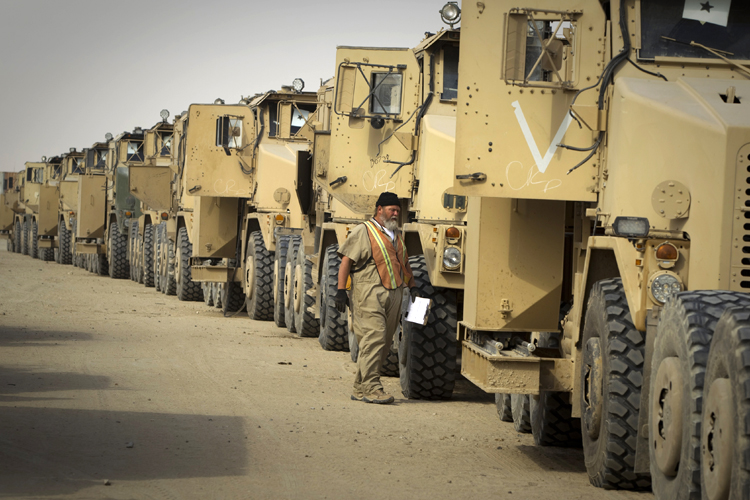
Long-time merc group Triple Canopy will provide protection outside the embassy fortress, reputedly for $1.5 billion over a five-year span. The overall goal is for State to have its own private army in Iraq: those 5,500 hired guns, almost two full brigades worth of them. The Army guards Fort Knox with fewer soldiers; my Forward Operating Base made due with less then 400 troops and I slept comfortably.

The past mayhem caused by contracted security is well known, with massacres in public squares, drunken murders in the Green Zone, and the like. Think of the mercs as what the Army might be like without its NCOs and officers: a frat house with guns.

Most of them are Americans, though with a few exotic Brits and shady South Africans thrown in. They love 5.11 clothing and favor fingerless leather gloves. Think biker gang or Insane Clown Posse fan boys.

Popular is a clean-shaven head, no moustache but a spiky goatee teased straight out. You know the look from late-night convenience store beer runs. They walk around like Yosemite Sam, arms out as if their very biceps prevented them from standing straight. They’re bullies of course, flirting inappropriately with women and posturing around men. Count on them to wear the most expensive Oakley sunglasses and the most unnecessary gear (gold man-bracelets, tactical hair gel). Think: Jersey Shore rejects.

Aggressive tattoos on all exposed skin seem a prerequisite for membership in Club Merc, especially wavy inked patterns around the biceps and on the neck. They all let on that they were once SEALS, Green Berets, SAS, or Legion of Doom members, but of course they “can’t talk about it.” They’re not likely to disclose last names and tend to go by nicknames like Bulldog, Spider, Red Bull, Wolverine, or Smitty.

If arrogance was contagious they’d all be sneezing. All Aryan, all dudely, and now all that stands between those thousands of State Department personnel and Iraq. Oh yes: the seersuckered and bow-tied diplomats are supposed to supervise the mercs and keep them on the right diplomatic path, kind of like expecting the chess club to run herd on the football team.

Air America

With the U.S Army departing in whole or in part by year’s end, most of the array of Army air assets State used will need to be replaced. A recently released State Department Office of the Inspector General’s (OIG) “Report on Department of State Planning for the Transition to a Civilian-led Mission in Iraq Performance Evaluation” explains that our diplomats will, in the future, have their own little Air America in Iraq, a fleet of 46 aircraft, including:

* 20 medium lift S-61 helicopters (essentially Black Hawks, possibly armed)

* 18 light lift UH-1N helicopters (new models of ‘Nam era Hueys, possibly armed)

* Three light observation MD-530 helicopters (Little Birds, armed, for quick response strike teams… er, um, observation duties)

* Five Dash 8 fixed-wing aircraft (50-passenger capacity to move personnel into the “theater” from Jordan)

The OIG report also notes that State will need to construct landing zones, maintenance hangars, operation buildings, and air traffic control towers, along with an independent aviation logistics system for maintenance and fueling. And yes, the diplomats are supposed to supervise this, too, the goal being to prevent an Iraqi from being gunned down from an attack helo with diplomatic license plates. What could go wrong?

How Much?

At this point, has cost started to cross your mind? Well, some 74 percent of embassy Baghdad’s operating costs will be going to “security.” State requested $2.7 billion from Congress for its Iraq operations in FY 2011, but got only $2.3 billion from a budget-minded Capitol Hill. Facing the possibility of being all alone in a dangerous universe in FY 2012, the Department has requested $6.3 billion for Iraq. Congress has yet to decide what to do. To put these figures in perspective, the State Department total operating budget for this year is only about $14 billion (the cost of running the place, absent the foreign aid money), so $6.3 billion for one more year in Iraq is a genuine chunk of change.

How Does It End?

Which only leaves the question of why.

Pick your forum — TomDispatch readers at a kegger, Fox news pundits following the Palin bus, high school students preparing to take SATs, unemployed factory workers in a food-stamp line — and ask if any group of Americans (not living in official Washington) would conclude that Iraq was our most important foreign policy priority, and so deserving of our largest embassy with the largest staff and largest budget on the planet.

Does Iraq threaten U.S. security? Does it control a resource we demand? (Yes, it’s got lots of oil underground, but produces remarkably little of the stuff.) Is Iraq enmeshed in some international coalition we need to butter up? Any evil dictators or WMDs around? Does Iraq hold trillions in U.S. debt? Anything? Anyone? Bueller?

Eight disastrous years after we invaded, it is sad but altogether true that Iraq does not matter much in the end. It is a terrible thing that we poured 4,459 American lives and trillions of dollars into the war, and without irony oversaw the deaths of at least a hundred thousand, and probably hundreds of thousands, of Iraqis in the name of freedom. Yet we are left with only one argument for transferring our occupation duties from the Department of Defense to the Department of State: something vague about our “investment in blood and treasure.”

Think of this as the Vegas model of foreign policy: keep the suckers at the table throwing good money after bad. Leaving aside the idea that “blood and treasure” sounds like a line from “Pirates of the Caribbean,” one must ask: What accomplishment are we protecting?

The war’s initial aim was to stop those weapons of mass destruction from being used against us. There were none, so check that off the list. Then it was to get rid of Saddam. He was hanged in 2006, so cross off that one. A little late in the game we became preoccupied with ensuring an Iraq that was “free.” And we’ve had a bunch of elections and there is a government of sorts in place to prove it, so that one’s gotta go, too.

What follows won’t be “investment,” just more waste. The occupation of Iraq, centered around that engorged embassy, is now the equivalent of a self-licking ice cream cone, useful only to itself.

Changing the occupying force from an exhausted U.S. Army that labored away for years at a low-grade version of diplomacy (drinking endless cups of Iraqi tea) to a newly militarized Department of State will not free us from the cul-de-sac we find ourselves in. While nothing will erase the stain of the invasion, were we to really leave when we promised to leave, the U.S. might have a passing shot at launching a new narrative in a Middle East already on edge over the Arab Spring.

Embassies are, at the end of the day, symbols. Sustaining our massive one in Iraq, with its ever-lengthening logistics and security train, simply emphasizes our failure there and our stubborn inability to admit that we were wrong. When a country becomes too dangerous for diplomacy, like Libya, we temporarily close our embassy. When a country becomes dangerous, but U.S. interests are still at stake, as in Yemen, we withdraw all but essential personnel. Similarly, in Baghdad, what’s needed is a modest-sized embassy staffed not by thousands but by scores — that is, only the limited number of people necessary to make the point that it is no longer an extension of a failed occupation.

Nothing can change the past in the Middle East, but withdrawing the troops on schedule and downsizing our embassy radically to emphasize that we are no longer in the business of claiming more space for the American empire might very well help change the future.

Peter Van Buren spent a year in Iraq as a State Department Foreign Service Officer serving as Team Leader for two Provincial Reconstruction Teams (PRTs). Now in Washington, he writes about Iraq and the Middle East at his blog, We Meant Well. His book, “We Meant Well: How I Helped Lose the Battle for the Hearts and Minds of the Iraqi People” will be published this September and can be preordered by clicking here.

[Source Note: The full text of the OIG Report on the transition from military to State Department control of the Iraq mission can be read as a .pdf file by clicking here. The OIG site is chock full of interesting documents under its "Reports and Publications" tab, including many items previously surfaced via FOIA requests. Though not cited in this article, another excellent source of primary documents about the US mission in Iraq can be found at the website of the Special Inspector General for Iraq Reconstruction.]


[Note: The views expressed here are solely those of the author in his private capacity and do not in any way represent the views of the Department of State, the Department of Defense, or any other entity of the U.S. Government. The Department of State has not approved, endorsed, or authorized this post.]

Continue Reading Close

The seductive power of the U.S. military

Why do journalists and other civilians have such trouble staying objective when they're embedded with the army?

Objective reporting on the SEAL team that killed bin Laden was as easy to find as a Prius at a Michele Bachmann rally. The media simply couldn’t help themselves. They couldn’t stop spooning out man-sized helpings of testosterone — the SEALs’ phallic weapons, their frat-house, haze-worthy training, their romance-novel bravado, their sweaty, heaving chests pressing against tight uniforms, muscles daring to break free…

You get the point. Towel off and read on.

What is it about the military that turns normally thoughtful journalists into war pornographers? A reporter who would otherwise make it through the day sober spends a little time with some unit of the U.S. military and promptly loses himself in ever more dramatic language about bravery and sacrifice, stolen in equal parts from Thucydides, Henry V, and Sergeant Rock comics.

I’m neither a soldier nor a journalist. I’m a diplomat, just back from 12 months as a Provincial Reconstruction Team (PRT) leader, embedded with the military in Iraq, and let me tell you that nobody laughed harder at the turgid prose reporters used to describe their lives than the soldiers themselves. They knew they were trading hours of boredom for maybe minutes of craziness that only in retrospect seemed “exciting,” as opposed to scary, confusing, and chaotic. That said, the laziest private knew from growing up watching TV exactly what flavor to feed a visiting reporter.

In trying to figure out why journalists and assorted militarized intellectuals from inside the Beltway lose it around the military, I remembered a long afternoon spent with a gaggle of “fellows” from a prominent national security think tank who had flown into Iraq. These scholars wrote serious articles and books that important people read; they appeared on important Sunday morning talk shows; and they served as consultants to even more important people who made decisions about the Iraq War and assumedly other conflicts to come.

One of them had been on the staff of a general whose name he dropped more often than Jesus’s at a Southern Baptist A.A. meeting. He was a real live neocon. A quick Google search showed he had strongly supported going to war in Iraq, wrote apology pieces after no one could find any weapons of mass destruction there (“It was still the right thing to do”), and was now back to check out just how well democracy was working out for a paper he was writing to further justify the war. He liked military high-tech, wielded words like “awesome,” “superb,” and “extraordinary” (pronounced EXTRA-ordinary) without irony to describe tanks and guns, and said in reference to the Israeli Army, “They give me a hard-on.”

Fearing the Media vs. Using the Media

Such figures are not alone. Nerds, academics, and journalists have had trouble finding ways to talk, write, or think about the military in a reasonably objective way. A minority of them have spun off into the dark side, focused on the My Lai, “Full Metal Jacket,” and “Platoon”-style psycho killers. But most spin in the other direction, portraying our men and women in uniform as regularly, daily, hourly saving Private Ryan, stepping once more into the breach, and sacking out each night knowing they are abed with brothers.

I sort of did it, too. As a State Department Foreign Service Officer embedded with the military in Iraq, I walked in… er, deployed, unprepared. I had never served in the military and had rarely fired a weapon (and never at anything bigger than a beer can on a rock ledge). The last time I punched someone was in ninth grade. Yet over the course of a year, I found myself living and working with the 82nd Airborne, followed by the 10th Mountain Division, and finally the 3rd Infantry Division, three of the most can-do units in the Army. It was… seductive.

The military raised a lot of eyebrows in my part of the world early in the Iraq invasion with their policy of embedding journalists with front-line troops. Other than preserving OpSec (Operational Security for those of you who have never had “The Experience”) and not giving away positions and plans to the bad guys, journalists were free to see and report on anything. No restrictions, no holding back.

Growing up professionally within the State Department, I had been raised to fear the media. “Don’t end up on the front page of the Washington Post,” was an often-repeated warning within the State Department, and many a boss now advises young Foreign Service Officers to “re-read that email again, imagining it on the Internet, and see if you still want to send it.” And that’s when we’re deciding what office supplies to recommend to the ambassador, not anything close to the life-and-death stuff a military embed might witness.

When I started my career, the boogieman was syndicated columnist Jack Anderson, then Washington Post columnist Al Kamen. Now, it’s Jon Stewart and Wikileaks. A mention by name in any of those places is career suicide. Officially, State suggests we avoid “unscripted interactions” with the media. Indeed, in his book on Iraq and Afghan nation-building, , Nathan Hodge brags about how he did get a few State Department people to talk to him anonymously in a 300-page book with first-person military quotes on nearly every page.

So, in 2003, we diplomats sat back and smugly speculated that the military didn’t mean it, that they’d stage-manage what embedded journalists would see and who they would be allowed to speak to. After all, if someone screwed up and the reporter saw the real thing, it would end up in disaster, as in fact happened when Rolling Stone’s Michael Hastings got Afghan War commander Stanley McCrystal axed as a “runaway general.”

We were, however, dead wrong. As everyone now agrees, journalists saw what they saw and talked to whomever they chose and the military facilitated the process. Other than McCrystal (who has since been redeemed by the same president who fired him), can anyone name another military person whacked by reporting?

I’m waiting.

I saw it myself in Iraq. General Ray Odierno, then commander of all troops in Iraq, would routinely arrive at some desert dump where I happened to be, reporters in tow. I saw for myself that they would be free to speak about anything to anyone on that Forward Operating Base (which, in acronym-mad Iraq, we all just called a FOB, rhymes with “cob”). The only exception would be me: State had a long-standing policy that on-the-record interviews with its officials had to be pre-approved by the Embassy or often by the Washington Mothership itself.

Getting such an approval before a typical reporter’s deadline ran out was invariably near impossible, which assumedly was the whole point of the system. In fact, the rules got even tougher over the course of my year in the desert. When I arrived, the SOP (standard operating procedure) allowed Provincial Reconstruction Team leaders to talk to foreign media without preapproval (on the assumption that no one in Washington read their pieces in other languages anyway and thus no one in the field could get into trouble). This was soon rescinded countrywide and preapproval was required even for these media interactions.

Detouring around me, the reporters would ask soldiers their opinions on the war, the Army, or even controversial policies like DADT. (Do I have to freaking spell it out for you? Don’t Ask, Don’t Tell.) The reporters would sit through the briefings the general received, listening in as he asked questions. They were exposed to classified material, and trusted not to reveal it in print. They would go out on patrols led by 24-year-old lieutenants, where life-and-death decisions were often made, and were free to report on whatever they saw. It always amazed me — like that scene in “The Wizard of Oz” where everything suddenly changes from black and white into color.

Fear Not: The Force Is With You

But the military wasn’t worried. Why? Because its officials knew perfectly well that for reporters the process was — not to mince words — seductive. The world, it turns out, is divided into two groups, those who served in the military and those who didn’t. For the rare journalists with service time, this would be homecoming, a chance to relive their youth filtered through memory. For the others, like me, embedding with the military felt like being invited in — no, welcomed — for the first time by the cool kids.

You arrive and, of course, you feel awkward, out of place. Everyone has a uniform on and you’re wearing something inappropriate you bought at L.L. Bean. You don’t know how to wear your body-armor vest and helmet, which means that someone has to show you how to dress yourself. When was the last time that happened? Instead of making fun of you, though, the soldier is cool with it and just helps.

Then, you start out not knowing what the hell anyone is saying, because they throw around terms like FOB and DFAC and POS and LT and BLUF and say Hoo-ah, but sooner or later someone begins to explain them to you one by one, and after a while you start to feel pretty cool saying them yourself and better yet, repeating them to people at home in emails and, if you’re a journalist, during live reports. (“Sorry Wolf, that’s an insider military term. Let me explain it to our viewers…”)

You go out with the soldiers and suddenly you’re riding in some kind of armored, motorized monster truck. You’re the only one without a weapon and so they have to protect you. Instead of making fun of you and looking at you as if you were dressed as a Naughty Schoolgirl, they’re cool with it. Bored at only having one another to talk to, fellow soldiers who eat the exact same food, watch the exact same TV, and sleep, pee and work together every day for a year, the troops see you as quite interesting. You can’t believe it, but they really do want to know what you know, where you’ve been, and what you’ve seen — and you want to tell them.

Even though you may be only a few years older than many of them, you feel fatherly. For women, it works similarly, but with the added bonus that, no matter what you look like, you’re treated as the most beautiful female they’ve seen in the last six months — and it’s probably true.

The same way one year in a dog’s life equals seven human years, every day spent in a war zone is the equivalent of a month relationship-wise. You quickly grow close to the military people you’re with, and though you may never see any of them again after next week, you bond with them.

You arrived a stranger and a geek. Now, you eat their food, watch their TV, and sleep, pee, and work together every day. These are your friends, at least for the time you’re together, and you’re never going to betray them. Under those circumstances, it’s harder than hell to say anything bad about the organization whose lowest ranking member just gave up his sleeping bag without prompting because you were too green and dumb to bring one with you.

One time I got so sick that I spent half a day inside a latrine stall. What got me out was some anonymous soldier tossing a packet of anti-diarrheal medicine in. He never said a word, just gave it to me and left. He’d likely do the same if called upon to protect me, help move my gear, or any of a thousand other small gestures.

So, take my word for it, it’s really, really hard to write about the military objectively, even if you try. That’s not to say that all journalists are shills; it’s just a warning for you to take care when you’re hanging out with, or reading, our warrior-pundits.

And yet having some perspective on the military and what it does matters as we threaten to slip into yet more multigenerational wars without purpose, watch the further militarization of foreign affairs, and devote ever more of our national budget to the military. War lovers and war pornographers can’t offer us an objective look at a world in which more and more foreigners only run into Americans when they are wearing green and carrying weapons.

I respect my military colleagues, at least the ones who took it all seriously enough to deserve that respect, and would not speak ill of them. Some do indeed make enormous sacrifices, including of their own lives, even if for reasons that are ambiguous at best to a majority of Americans. But in order to understand these men and women and the tasks they are set to, we need journalists who are willing to type with both hands, not just pass on their own wet dreams to a gullible public.

Civilian control of our military is a cornerstone of our republic, and we the people need to base our decisions on something better than Sergeant Rock comic rewrites.

[Note: The views expressed here are solely those of the author in his private capacity and do not in any way represent the views of the Department of State, the Department of Defense, or any other entity of the U.S. Government. The Department of State has not approved, endorsed, or authorized this post.]

Peter Van Buren spent a year in Iraq as a State Department Foreign Service Officer serving as Team Leader for two Provincial Reconstruction Teams (PRTs). Now in Washington, he writes about Iraq and the Middle East at his blog, We Meant Well. His book, “We Meant Well: How I Helped Lose the Battle for the Hearts and Minds of the Iraqi People” (The American Empire Project, Metropolitan Books), will be published this September.

Continue Reading Close
www.salon.com/writer/peter_van_buren/index.html