Rebecca Solnit
America’s real Hunger Games
Young people are already being sacrificed at the whims of the 1%. Just look at Iraq and Afghanistan
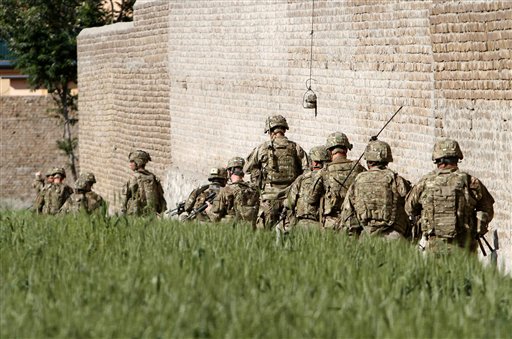
U.S. Army soldiers respond after a suicide attack on the US..-led provincial reconstruction team (PRT) compound in the Behsood district of Jalalabad, east of Kabul Afghanistan, on Sunday, April 15, 15 2012. (Credit: AP Phot/Rahmat Gul) When I was growing up, I ate books for breakfast, lunch and dinner, and since I was constantly running out of reading material, I read everyone else’s — which for a girl with older brothers meant science fiction. The books were supposed to be about the future, but they always turned out to be very much about this very moment.
Some of them — Robert Heinlein’s “Stranger in a Strange Land” — were comically of their time: that novel’s vision of the good life seemed to owe an awful lot to the Playboy Mansion in its prime, only with telepathy and being nice added in. Frank Herbert’s “Dune” had similarly sixties social mores, but its vision of an intergalactic world of disciplined desert jihadis and a great game for the substance that made all long-distance transit possible is even more relevant now. Think: drug cartels meet the oil industry in the deep desert.
We now live in a world that is wilder than a lot of science fiction from my youth. My phone is 58 times faster than IBM’s fastest mainframe computer in 1964 (calculates my older brother Steve) and more powerful than the computers on the Apollo spaceship we landed on the moon in 1969 (adds my nephew Jason). Though we never got the promised jetpacks and the Martians were a bust, we do live in a time when genetic engineers use jellyfish genes to make mammals glow in the dark and nerds in southern Nevada kill people in Pakistan and Afghanistan with unmanned drones. Anyone who time-traveled from the sixties would be astonished by our age, for its wonders and its horrors and its profound social changes. But science fiction is about the present more than the future, and we do have a new science fiction trilogy that’s perfect for this very moment.
Sacrificing the Young in the Arenas of Capital
“The Hunger Games,” Suzanne Collins’s bestselling young-adult novel and top-grossing blockbuster movie, is all about this very moment in so many ways. For those of you hiding out deep in the woods, it’s set in a dystopian future North America, a continent divided into downtrodden, fearful districts ruled by a decadent, luxurious oligarchy in the Capitol. Supposedly to punish the districts for an uprising 74 years ago, but really to provide Roman-style blood and circuses to intimidate and distract, the Capitol requires each district to provide two adolescent Tributes, drawn by lottery each year, to compete in the gladiatorial Hunger Games broadcast across the nation.
That these 24 youths battle each other to the death with one lone victor allowed to survive makes it like — and yet not exactly like — high school, that concentration camp for angst and competition into which we force our young. After all, even such real-life situations can be fatal: witness the gay Iowa teen who took his life only a few weeks ago after being outed and taunted by his peers, not to speak of the epidemic of other suicides by queer teens that Dan Savage’s “It Gets Better” website, film and books aspire to reduce.
But really, in this moment, the cruelty of teens to teens is far from the most atrocious thing in the land. “The Hunger Games” reminds us of that. Its Capitol is, of course, the land of the 1 percent, a sort of amalgamation of Fashion Week, Versailles and the KGB/CIA. Collins’s timely trilogy makes it clear that the 1 percent, having created a system of deeply embedded cruelty, should go, something highlighted by the surly defiance of heroine Katniss Everdeen — Annie Oakley, Tank Girl and Robin Hood all rolled into one – who refuses to be disposed of.
Now, in our world, gladiatorial entertainment and the disposability of the young are mostly separate things (except in football, boxing, hockey and other contact sports that regularly result in brain damage and sometimes even in death). But while the Capitol is portrayed as brutal for annually sacrificing 23 teenagers from the Districts, what about our own Capitol in the District of Columbia? It has a war or two on, if you hadn’t noticed.
In Iraq, 4,486 mostly young Americans died. If you want to count Iraqis (which you should indeed want to do), the deaths of babies, children, grandmothers, young men and others total more than 106,000 by the most conservative count, hundreds of thousands by others. Even the lowest numbers represent enough kill to fill nearly 5,000 years of Hunger Games.
Then, of course, there are thousands more Americans who were so grievously wounded they might have died in previous conflicts, but are now surviving with severe brain damage, multiple missing limbs, or other profound mutilations. And don’t forget the trauma and mental illness that mostly goes unacknowledged and untreated or the far more devastating Iraqi version of the same. And never mind Afghanistan, with its own grim numbers and horrific consequences.
Our wartime carnage has been on a grand scale, but it hasn’t been on television in any meaningful way; it’s generally been semi-hidden by most of the American media and the government, which censored images of returning coffins, corpses, civilian casualties and anything else uncomfortable (though in our science-fiction era when every phone is potentially a video camera, the leakage has still been colossal). Most of us did a good job of being distracted by other things — including reality TV, of course. The U.S. Ambassador and military commander in Afghanistan were furious not that our soldiers struck jokey poses with severed limbs, but that the Los Angeles Times dared to publish them last month. And those whistleblowers who took the effort to reveal the little men behind the throne are facing severe punishment. Witness one Hunger-Games-style hero, Bradley Manning, the slight young soldier turned alleged leaker, long held in inhumane conditions and now facing a potential life sentence.
The Return of Debt Peonage
In “The Hunger Games,” kids in poor families take out extra chances in their District lottery — that is, extra chances to die — in return for extra food rations; in ours, poor kids enlist in the military to feed their families and maybe escape economic doom. Many are seduced by military recruiters who stalk them in high school with promises as slippery as those the slave trade uses to recruit poor young women for sex work abroad.
And then there’s another form of debt peonage that is far more widespread in our strange and ever-changing land: student loans. The young are constantly told that only a college education can give them a decent future. Then they’re told that, to pay for it, they need to go into debt — usually into five figures, sometimes well into six. And these debts are, in turn, governed by special laws that don’t allow you to declare bankruptcy — no matter what. In other words, they are guaranteed to follow you all your life.
One of my close friends wept when her husband began to earn enough money to pay off her $45,000 loan, structured so that it looked like she would continue to pay interest on it for the rest of her life; not so dissimilar, that is, from the debts sharecroppers and workers in company towns used to incur.
In other words, we’re creating a new generation of debt peonage. And she’s not the worst case by far. Early in the Occupy Wall Street moment, she told me, someone arrived at Zuccotti Park in downtown Manhattan with markers and cardboard on which participants were to write their debt. What shocked her was how many of the occupiers in their early twenties were already carrying huge debt burdens.
According to the website for Occupy Student Debt, 36,000,000 Americans have student debts. These have increased more than fivefold since 1999, creating a debt load that’s approaching a trillion dollars, with students borrowing $96 billion more every year to pay for their educations. Two-thirds of college students find themselves in this trap nowadays. As commentator Malcolm Harris put it in N + 1 magazine:
Since 1978, the price of tuition at U.S. colleges has increased over 900 percent, 650 points above inflation. To put that number in perspective, housing prices, the bubble that nearly burst the U.S. economy, then the global one, increased only fifty points above the Consumer Price Index during those years. But… wages for college-educated workers outside of the inflated finance industry have stagnated or diminished. Unemployment has hit recent graduates especially hard, nearly doubling in the post-2007 recession. The result is that the most indebted generation in history is without the dependable jobs it needs to escape debt.
About a third are already in default. You can only hope that this bubble will burst in a wildcat strike against student debt, and if we’re lucky, a move to force tuition lower and have a debt jubilee.
The rest of us, the 99 percent, need to remember that, when it comes to public education, the crisis has everything to do with slashed tax rates — to the wealthy and corporations in particular — over the last 30 years. We went into bondage so that they might be free. Getting an education to make your way out of poverty and maybe expand your mind is becoming another way of being trapped forever in poverty. For too many, there’s no way out of the hunger labyrinth.
The Labyrinths of Poverty
Which brings us to the hungriest in our 2012 real-life version of the Hunger Games: the poor. The wealthiest and most powerful nation the world has ever seen is full of hungry people. You know it, and you know why. In this vast, bountiful, food-producing, food-wasting nation, it’s a crisis of distribution, also known as economic inequality, described at last with clarity and force by the Occupy movement.
One of the sad and moving spectacles of camps like Occupy Oakland last year was the way they became de facto soup kitchens as the homeless and hungry came out of the shadows for the chance at a decent meal. Some of the camps had really dedicated chefs who cooked superbly. They also had rudimentary medical clinics where the poor received the healthcare they couldn’t get anywhere else.
We are in a new era of desperation, when lots of people who were getting by these last several decades aren’t anymore. There are no jobs, or the jobs available pay so abysmally that workers can barely survive on them.
Of course, we do have one arena in which meals are guaranteed, and the population there keeps growing. Six million Americans live there, and it often does get gladiatorial inside. It’s called prison, and we have the highest percentage of prisoners per population in the world, higher than in the U.S.SR gulags under Stalin. Half of them are there for drug offenses, 80 percent of those for simple possession.
Which, as I’m sure you’ve noticed, hasn’t stopped the flow of drugs meant to numb the pain we’re so good at creating here. We should create a measure for Gross National Suffering (GNS) before we even think about the Gross National Happiness they measure in Bhutan.
And once our prisoners get out, they’re a stigmatized caste, uniquely ill-suited to survival in this economy — speaking of hunger, debt, poverty, being branded for life and hopelessness. Like universities, prisons are profitable industries, though not for the human beings who are the raw material they process. In this age, both systems seem increasingly like so many factories.
In the Shadow of 900 Tornados
But if you want to think about all the ways we’re dooming the young, there’s one that puts the others in the shade, a form of destruction that includes not just American youth, or human youth, but all species everywhere, from coral reefs to caribou. That’s climate change, of course.
Our failure to do anything adequate about it has rocketed us into the science-fiction world Bill McKibben so eloquently warned us about in his 2010 book “Eaarth.” His argument is that we’ve so altered the planet we live on that we might as well have landed on a new one (with an extra “a” in its name), more turbulent and far less hospitable than the beautiful Holocene one we trashed.
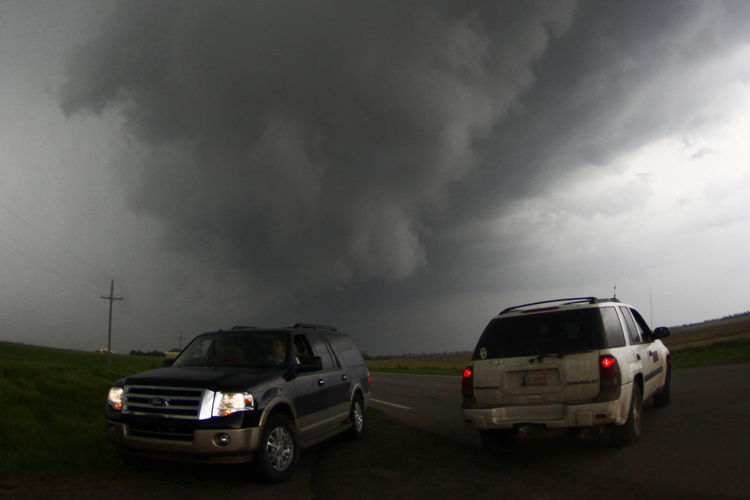
There were 160 tornados reported on March 2nd of this year. Remember that, in April of 2011, 900 tornadoes were ripping up interior United States, and this April was similarly volatile. Remember the unprecedented wildfires, the catastrophic floods, the heat waves, the bizarrely hot North American January and other oddities? That’s science fiction of the scariest sort, and we’re in it. Or on it, on the crazy new planet we’ve made ourselves. Here in the U.S.A sector of Eaarth in the year 2012, 15,000 high-temperature records were broken in March alone, and summer is yet to come. A town in north-central Texas hit 111 degrees — in April! What turbulent planet is this?
One grain of good news: a lot of us, even in this country, finally seem to be of aware of the strangeness of the planet we’re now on. As the New York Times reported, a new survey “shows that a large majority of Americans believe that this year’s unusually warm winter, last year’s blistering summer, and some other weather disasters were probably made worse by global warming. And by a 2-to-1 margin, the public says the weather has been getting worse, rather than better, in recent years.”
If you want to talk about hunger, talk about the unprecedented flooding that’s turned Pakistan from one of the world’s breadbaskets into a net food-importing nation, with dire consequences for the agricultural poor. Talk about China’s many impending ecological disasters, its degraded soil, contaminated air and water, its many systems ready to collapse. There’s more disruption of food production to come, a lot more, and lots more hunger, too.
Around this point in science fiction books and even history books, a revolution seems necessary. The good news I have for you this May Day is that it’s underway.
Revolution 2012
2011 was the year of strange weather, but it was also the year of global uprisings, and they’re far from over. They erupted in Russia, Israel, Spain, Greece, Britain, much of the Arab-speaking world, parts of Africa and Chile, among other spots in Latin America (some of which got their revolutions underway earlier in the millennium). Uprisings have blossomed even in what the rest of the hungry world sees as the elite Capitol, the United States and much of the English-speaking world, from London to New Zealand.
Remember that revolution doesn’t look much like revolution used to. That might be the most retrograde aspect of the very violent “Hunger Games” trilogy, the way in which the author’s imagination travels along conventional or old-fashioned lines. There, violence is truly the arbitrator of power, along with cunning, whether in the ways the teenagers survive in the gladiatorial arena or the Capitol, or how both sides operate in conflicts between the Districts and the Capitol. In our own world, the state is very good at violence, whether in its wars overseas or in pepper-spraying and clubbing young demonstrators. You’ll notice, however, that neither the Iraqis, nor the Afghanis, nor the Occupiers were subjugated by these means.
Violence is not power, as Jonathan Schell makes strikingly clear in “The Unconquerable World,” it’s what the state uses when we are not otherwise under control. In addition, when we speak of “nonviolence” as an alternative to violence, we can’t help but underestimate our own power. That word, unfortunately, sounds like it’s describing an absence, a polite refraining from action, when what’s at stake — as demonstrators around the world proved last year — is a force to be reckoned with; so call it “people power” instead.
When we come together as civil society to exercise this power, regimes tremble and history is made. Not instantly and not exactly according to plan, but who ever expected that?
Still, many regimes have been toppled by this power, and the capacity to do so is ours in the present. As Erica Chenoweth and Maria Stephan point out in their recent “Why Civil Resistance Works: The Strategic Logic of Nonviolent Conflict“, since 1900 people-power campaigns have been successful in achieving regime change more than twice as often as violent campaigns.
It’s May Day, a worldwide General Strike has been called, and last week tiny Occupy Norman (Oklahoma) announced that it “had won a major battle”: their city is moving all its money out of Bank of America into a local bank. Last fall’s Move Your Money campaign included city money from the outset and quiet victories like this could begin to reshape our economic landscape. Activism in the streets is so intimidating that next month’s G8 Summit scheduled for Chicago will hole up at Camp David instead.
Meanwhile last week, both the Wells Fargo and General Electric shareholders’ meetings were under siege from Occupy activists. The Wells Fargo meeting and protests took place in San Francisco, and afterward an arrested friend of mine posted this on Facebook: “I forgot to mention that Max gave me the Hunger Games salute in jail today. It was awesome.”
In this way do fiction and reality meld in misery and triumph as, this very day, janitors in California go out on strike and even Golden Gate Bridge workers will be protesting. May Day actions are planned across the globe.
Still alive and kicking, Occupy is chipping away in a thousand places at the status quo. 350.org, the little organization that defeated the Keystone XL Pipeline (so far), is holding a global Climate Impacts Day on May 5th and plans to take on the petroleum industry in its next round of actions.
Of course, this is only a beginning, and the banking and oil companies, the 1 percent, and the prison and education rackets are more than capable of pushing back. So we need one more tool in our arsenal, and that’s a picture of what we want, of what a better world looks like. McKibben’s “Eaarth” and “Deep Economy” offer such a picture, as does William Morris’s “News from Nowhere,” even 120-odd years later, but we won’t get that from “The Hunger Games,” which, for all its thrilling, subversive and surly delights, is all dystopia all the way home. We may still get it, however, on our stranger-than-fiction planet.
May Day is a day of liberation — a day to be seized and celebrated, a day to remember who was shot down on it and who fought for it. It’s a day to join those who fought and fight for liberation, to imagine what its most delicious and profound possibilities might look like.
So skip work, flip a bird at the Capitol, commit your deepest love and solidarity to the young whose lives are being gambled away, feed the hungry, take a long look at how beautiful our planet still is, find your way into solidarity and people power, and dream big about other futures. Resistance is one of your obligations, but it’s also a pleasure and a way of stealing back hope.
To stay on top of important articles like these, sign up to receive the latest updates from TomDispatch.com here.
The truth about violence at Occupy
In Oakland, the camp coincided with a significant drop in crime. But that wasn't the story we were told
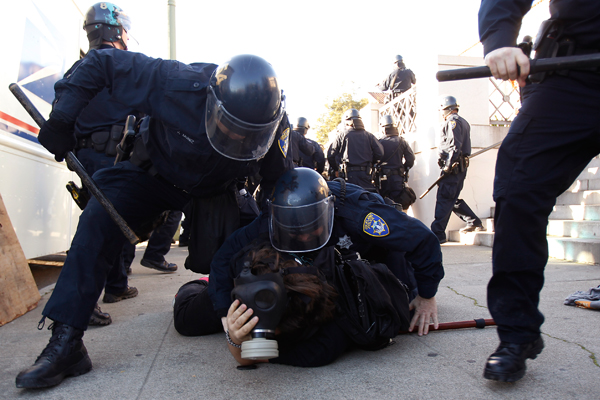
Members of the Oakland Police Department arrest an Occupy Oakland demonstrator in Downtown Oakland, California January 28, 2012 (Credit: Reuters/Stephen Lam) When you fall in love, it’s all about what you have in common, and you can hardly imagine that there are differences, let alone that you will quarrel over them, or weep about them, or be torn apart by them — or if all goes well, struggle, learn, and bond more strongly because of, rather than despite, them. The Occupy movement had its glorious honeymoon when old and young, liberal and radical, comfortable and desperate, homeless and tenured all found that what they had in common was so compelling the differences hardly seemed to matter.
Continue Reading CloseHow 2011 became the year of compassion
OWS didn't just reject unfair aspects of our economic system. It reclaimed the idea of communal solidarity
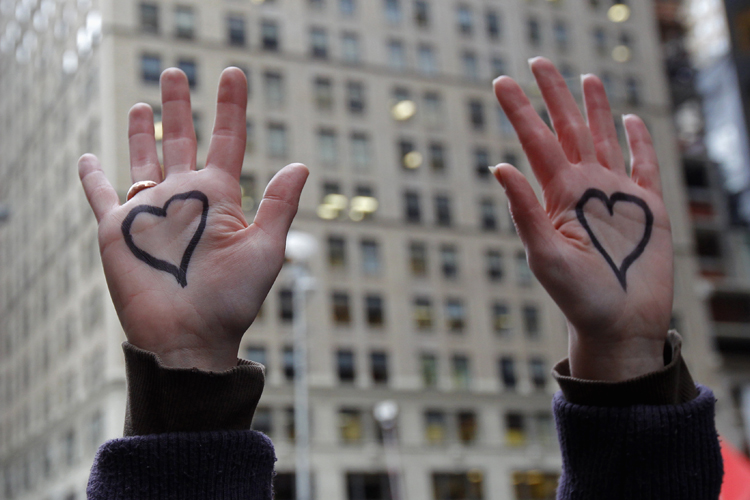
An Occupy Wall Street demonstrator raises her hands painted with hearts in New York (Credit: Mike Segar / Reuters) Usually at year’s end, we’re supposed to look back at events just passed — and forward, in prediction mode, to the year to come. But just look around you! This moment is so extraordinary that it has hardly registered. People in thousands of communities across the United States and elsewhere are living in public, experimenting with direct democracy, calling things by their true names and obliging the media and politicians to do the same.
The breadth of this movement is one thing, its depth another. It has rejected not just the particulars of our economic system, but the whole set of moral and emotional assumptions on which it’s based. Take the pair shown in a photograph from Occupy Austin in Texas. The amiable-looking elderly woman is holding a sign whose computer-printed words say, “Money has stolen our vote.” The older man next to her with the baseball cap is holding a sign handwritten on cardboard that states, “We are our brothers’ keeper.”
Continue Reading CloseHow OWS woke up our civil society
The violent response from authorities will only solidify the peaceful movement
A student holds a sign during a rally on the University of California, Davis campus in Davis, Calif., Monday, Nov. 21, 2011 after police pepper-sprayed peaceful demonstrators during a protest at the same spot on Friday (Credit: AP Photo/Paul Sakuma) Last Tuesday, I awoke in lower Manhattan to the whirring of helicopters overhead, a war-zone sound that persisted all day and then started up again that Thursday morning, the two-month anniversary of Occupy Wall Street and a big day of demonstrations in New York City. It was one of the dozens of ways you could tell that the authorities take Occupy Wall Street seriously, even if they profoundly mistake what kind of danger it poses. If you ever doubted whether you were powerful or you mattered, just look at the reaction to people like you (or your children) camped out in parks from Oakland to Portland, Tucson to Manhattan.
Continue Reading CloseThe death that sparked a revolution
In December 2010, a young Tunisian man set himself on fire. His act inspired the Arab Spring, and much more
Left: Protesters chant slogans as they hold a photograph of Mohamed Bouazizi in Tunis December 17, 2010. Right: A protester takes part in an Occupy Phoenix demonstration.(Credit: Reuters/Zohra Bensemra/Eric Thayer) Dear young man who died on the fourth day of this turbulent 2011, dear Mohammed Bouazizi,
I want to write you about an astonishing year — with three months yet to run. I want to tell you about the power of despair and the margins of hope and the bonds of civil society.
I wish you could see the way that your small life and large death became a catalyst for the fall of so many dictators in what is known as the Arab Spring.
We are now in some sort of an American Fall. Civil society here has suddenly hit the ground running, and we are all headed toward a future no one imagined when you, a young Tunisian vegetable seller capable of giving so much, who instead had so much taken from you, burned yourself to death to protest your impoverished and humiliated state.
Continue Reading CloseWhy we shouldn’t give up hope
From Murdoch to the Tea Party decline to South American progress, a look at some often underreported good news
Recently, Nelson Mandela turned 93, and his nation celebrated noisily, even attempting to break the world record for the most people simultaneously singing “Happy Birthday.” This was the man who, on trial by the South African government in 1964, stood a good chance of being sentenced to be hanged by the neck until dead. Given life in prison instead, he was supposed to be silenced. Story over.
You know the rest, though it wasn’t inevitable that he’d be released and become the president of a post-apartheid South Africa. Admittedly, it’s a country with myriad flaws and still suffers from economic apartheid, but who wouldn’t agree that it’s changed? Activism changed it; more activism could change it further.
Continue Reading ClosePage 1 of 2 in Rebecca Solnit