Richard Benjamin

Why Haiti can’t afford a rap star president

Wyclef Jean wants to be the troubled nation's next president

  • more
    • All Share Services

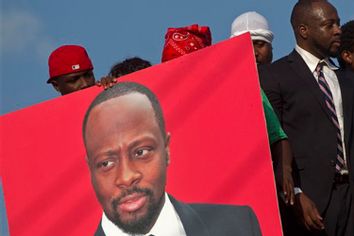
Why Haiti can't afford a rap star presidentWyclef Jean, right, leaves the electoral office in Port-au-Prince after submitting paperwork to run for president of Haiti.

If Jesse “The Body” Ventura could lead Minnesota, and Ahnoold Schwarzenegger can govern California, and Al “Stuart Smalley” Franken can represent Minnesota, Wyclef Jean can run Haiti, right?

Wrong.

The rap star’s declared candidacy and potential election would be a disaster for Haiti. Whether Jean’s intentions are sincere and pure, they reflect a deeply troubling phenomenon around the world: the unrelenting celebrity worship that ferments a trivialization of politics and a dismissal of complicated problems. The depressing thing about Jean’s candidacy is our deepening confusion of fame with virtue and celebrity with competence.

Though Jean’s humanitarian efforts after Haiti’s earthquake deserve some props, they hardly qualify him for the daunting technical tasks of effectively leading his crisis-prone nation.

First, we don’t know the details and depth of Jean’s inexperience. Why? The Florida Division of Corporations dissolved Yéle Haiti, Jean’s philanthropic organization, and its predecessor, the Wyclef Jean Foundation, several times. The offense? The organizations failed to file legally required state disclosure reports. However, the rap star’s foundation did collect $1,142,944 in total revenue in 2006, which presumably sheds light on the organization’s operating budget.

That is a modest, silly budget compared to the stakes on Haiti’s table. The overall damage and physical loss caused by the earthquake amount to $7.9 billion, according to the Interim Haiti Reconstruction Commission, the international body charged with overseeing the nation’s recovery chaired by Bill Clinton and Haiti’s prime minister, Jean-Max Bellerive. Moreover, another $5.3 billion — pledged by a host of nations — must be skillfully collected and effectively spent.

There’s a gaping mismatch between the amount of money and number of personnel the rap star has experience managing versus the skill set and level of money required to lead Haiti’s immediate and long-term recoveries.

One might argue that Haiti needs inspiration; so Jean is just the right “icon” for the moment, an ideal figurehead for a nation clamoring for hope. This argument recalls our own president’s election in 2008. Jean and Barack Obama are superstar cool — handsome, smooth and inspirational personalities who embody change and progress. But the analogy ends there. Only Obama has the demonstrated intellect and decision-making skills to steer a nation out of duress.

Amid the hype swirling around Jean’s declared candidacy, let us not fall into the trap of confusing stardom with ability, or good public relations with actionable skills. This confusion and celebrity-worship — which adulates stars for dabbling in Darfur, or commenting on Earth Day, or singing for Haitian orphans — trivializes the very problems celebrities purport to help.

In fact, celebrity misadventures in politics are legendary. But the risk that comes with electing a Ventura in Minnesota or a Schwarzenegger in California is nothing compared to the risk staring Haiti in the face. More so than any place on Earth, Haiti has no margin of error or wiggle room for failure. Roughly 1.5 million Haitians, or 15 percent of the population, have been directly devastated by the quake. Over 300,000 lost their lives and 1.3 million are still homeless. The nation needs to rebuild at least 105,000 new homes, 1,300 schools, and 50 medical facilities.

Though Jean has no credible experience in leadership, Haitians have become firsthand experts in resilience and failed leadership: Even before the catastrophic earthquake,76 percent of Haitians were living on less than $2 a day. And malaria, tuberculosis and HIV/AIDS still threaten the nation at unacceptable levels.

Haiti just can’t afford a rap-star president.

Rich Benjamin is the author of “Searching for Whitopia: An Improbable Journey to the Heart of White America,” and senior fellow at Demos, a non-partisan think tank based in New York.
On immigration, Obama is bound by race and politics

His image depends on a racial identity even while downplaying it. Which makes confronting immigration problematic

  • more
    • All Share Services

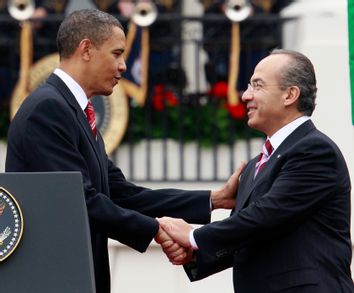
On immigration, Obama is bound by race and politicsU.S. President Barack Obama shakes hands with Mexico's President Felipe Calderon during an arrival ceremony on the South Lawn of the White House in Washington, May 19, 2010. REUTERS/Kevin Lamarque (UNITED STATES - Tags: POLITICS)(Credit: © Kevin Lamarque / Reuters)

What an awkward position Barack Obama was in Thursday! Welcoming the Mexican president, Felipe Calderón, to the White House, he could offer only boilerplate rhetoric about immigration: “In the 21st century, we are defined not by our borders, but by our bonds. So I say to you and to the Mexican people, let us stand together.”

With his crammed domestic agenda and teetering approval ratings, President Obama is moseying away from immigration reform before the midterm elections. Even as he denounces Arizona’s drastic new measure, law-professor-style, the president is sending mixed signals. In an episode still rankling Latino advocates, the president recently declared that Congress might not have the “appetite” to push for reform — just as Democratic senators were poised to roll out … a reform agenda.

Further clouding Obama’s message is the fact that more immigrants were deported during his first year in office — more than 388,000 — than any other year in the republic’s history. To progressives, the president’s apparent “security first” approach makes it seem as though he’s trying to appease conservatives at the expense of Latinos.

The big elephant in the room, one that Democrats and the media willfully ignore, is race. Not the race of immigrants — the race of the president.

As the son of an immigrant and as a black man, Obama walks a sticky briar patch in handling reform. His management of his brand identity, especially his blackness, creates an aura of historic inclusion and racial reconciliation, even while it discourages too much diversity talk or racial grist. According to this stratagem, the president is a racial prophet with no racial agenda. Race does not play a role in Obama’s national problem solving, but it is central to his novelty and political brand. His image deftly depends on a racial identity even as it downplays it.

This political and racial double bind handicaps Obama’s aptitude for immigration reform. Any race-related issue, especially immigration reform, that isn’t properly and universally feel-good, is radioactive for this president.

Political challenges lurk for all involved. Obama and a slim-majority Democratic Congress need to balance the substance of immigration reform with the competing demands of labor groups, Latinos, clergy, civil liberty advocates and others.

Little wonder that Democrats who represent majority-white and/or blue-collar districts, which have been hit especially hard by the recession, are bucking reform.

Rep. Zack Space, D-Ohio, who represents a Republican-leaning district that is more than 90 percent non-Hispanic white, recently issued a press release, “Plan to Move Forward With Immigration Reform Is Absolutely Wrong for Ohio,” denouncing an agreement between House Speaker Nancy Pelosi and Senate Majority Leader Harry Reid to move forward on comprehensive immigration reform this year.

“We need to be focusing on the economy, period,” said Space. “I am firmly opposed to these plans, and I will fight Speaker Pelosi’s attempts to move this disastrous policy.”

As if predicting the 2010 storm over immigration reform, Obama’s own chief of staff, Rahm Emanuel, declared back in 2006: “For the American people, and therefore, all of us, immigration emerged as the third rail of American politics. And anyone who doesn’t realize that isn’t with the American people.” True to racial codes, Emanuel’s “American people” apparently excludes the majority of Latinos.

While orchestrating the Democratic takeover of the House in ’06, Emanuel advised the party’s candidates to inoculate themselves against the vexatious issue by tacking to the right. With a few exceptions — illustrated by Sen. Charles Schumer and Reid’s reform agendas — Emanuel’s advice still reigns as the Democratic conventional wisdom.

Frank Sharry, a longtime pro-immigrant activist and the founder of America’s Voice, a nonprofit devoted to building support for immigration reform, mocked the Democrats’ squeamishness.

“We always get the ‘smart’ pundits who say Democrats would be foolhardy to bring up immigration: ‘You’ll drive independents away and mobilize the right wing,’” Sharry told the Daily Beast. “First of all, the right is already totally mobilized. Second, independents want solutions and not politics as usual. And third — guess what? — Latinos were a base vote in 2006 and 2008, and they’re about to stay home because you haven’t done shit for them.”

In the meantime, Republicans also need to balance substance with the political demands of tugging factions: their pro-business, pro-immigration corporate wing versus the vocal immigration-restriction movement.

And then, of course, there are Latinos. The 2010 census will likely shift power and add congressional seats to Republican-leaning states and to states with significant or fast-growing Latino populations, like Texas and Arizona.

Given Latinos’ increasing clout at the polls, each party faces short- and long-term political gains and hazards no matter what it does.

A patch of tar babies — pragmatism, centrism, geography and race — color the willingness of Obama and his fellow Democrats to undertake immigration reform. As the president juggles his record-high levels of immigrant deportation, his ambivalence over the issue, and his delicate racial karma, Democrats should not allow this political and racial calculus to foil reform.

Rich Benjamin is the author of “Searching for Whitopia: An Improbable Journey to the Heart of White America,” winner of a 2009 Editor’s Choice award from Booklist and the American Library Association.

Continue Reading Close

Inside the mind of Joe Wilson

America is changing, and that makes white people like Joe Wilson -- and Michele Bachmann -- very nervous

  • more
    • All Share Services

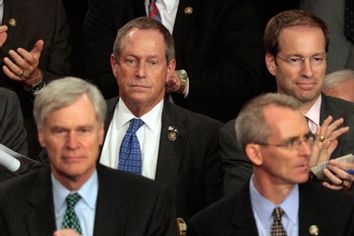
Inside the mind of Joe WilsonRep. Joe Wilson, R-S.C., center, listens during President Barack Obama's speech on health care to a joint session of Congress , Wednesday, Sept., 9, 2009 on Capitol Hill in Washington.

When he called the president a liar, Rep. Joe Wilson, R-S.C., apparently “forgot” he wasn’t at one of those rowdy town halls.

Besides the show of disrespect, and the fact that he was wrong, the legislator’s comments expose a virulent racism and paranoia against undocumented workers. As we enter Hispanic Heritage Month, America would do well to examine the legislator’s political paranoia instead of rehashing his churlish, attention-seeking outburst. The legislator’s behavior is uncommon, but his attitude is not.

As members of Congress discussed healthcare reform with their constituents over the recent recess, many faced repeated, heated charges that the reform would stick “American taxpayers” — as if undocumented workers don’t pay consumption taxes! — with the healthcare bills of illegal immigrants. If the swine flu weren’t enough to stigmatize Latino immigrants, now there’s the healthcare debate.

How did racism and xenophobia become so deeply enmeshed in this debate?

Decades in the running, a right-wing drumbeat continues telling Americans that “government is on your back,” that “you should keep your own money,” and “let the market take care of it.” This political outlook feeds resentments over race, including anger about “high taxes” for public services that are allegedly wasted on urban blacks and illegal aliens. This stubborn, pervasive mind-set fuels the myths that many Republicans and business interests bandy to explain America’s economic woes: “too much government,” “overregulation,” “wasteful spending” and “welfare abuse.”

Race — that is, 30 years of government-supported desegregation and the sharp increase of brown immigration — is not incidental to the public’s cynicism, disconnection and unwillingness to support the public sector, meaning the goods, services and places that belong to “we the people.” That’s especially true when we talk about healthcare.

Eduardo Porter, a financial journalist and editorial board member of the New York Times, has documented how “racial and ethnic diversity undermine support for public investment in social welfare. For all the appeal of America’s melting pot, the country’s diverse ethnic mix is one main reason for entrenched opposition to public spending on the public good.”

Moreover, two Harvard economists have correlated diversity with public spending in Western Europe and the United States. The economists demonstrated that half the social-spending gap between the two areas was due to the United States’ more varied racial and ethnic mix. (The other half was due largely to the stronger left-wing parties in Western Europe.)

Once upon a time in Wilson’s native South Carolina, the 1950s through the 1970s, whites fled public spaces en masse — pools, parks, schools, cafeterias — rather than share those public resources with blacks. This is déjà vu all over again: Latino immigrants are the new blacks. A truculent white minority wants to re-segregate their communities; more, it bashes the publish sphere and aims to sabotage public spending on the common good, including the president’s healthcare plans.

Put bluntly, it is not a coincidence that America’s love affair with all-things private — gated communities, private roads, private parks, private schools, private playgrounds, private hospitals — heated up during the 1950s as the federal government sought to integrate the nation.

As the U.S. government began helping everyday Americans at unprecedented levels from FDR’s New Deal on, immigration has become all the more contentious. Immigration broils as an issue precisely as this nation faces budget deficits and potential cuts in Medicare, Medicaid, food stamps, the state university systems and so on. Those institutions and services were in their infancy — or did not even exist — during the first great wave of immigration, from the 1880s to the 1910s, which brought the Irish and eastern and southern Europeans to our shores.

“Between the start of the Great Depression and the end of the civil rights era, government at all levels assumed new responsibilities to limit the misery suffered by the poor and the sick,” observes Roberto Suro in his brilliant work, “Strangers Among Us: Latino Lives in a Changing America.” “Immigration was so low during that entire period that there was no need to discuss the role of the newly arrived. Then Latino immigration began to produce a large number of new claimants on the public sector.” As the president and America debate a large, necessary overhaul of the public sector, expect more xenophobic outbursts like Wilson’s.

Tea baggers rail against social programs that are allegedly squandered on “illegal aliens.” The Birther movement rails against a supposedly Muslim president. Healthcare reform town halls combust over “government dependence.” Republicans like Michele Bachmann, R-Minn., push a boycott of the 2010 Census, fretting that immigrants and minorities will be overcounted.

A Census Bureau prediction that makes headlines across the nation is fast becoming a reality: By 2042, whites will no longer be the American majority. This demographic projection sounds a frightening alarm to the likes of Bachmann and Joe Wilson. It heralds significant change to our nation’s culture, electoral politics and distribution of resources.

We must understand Wilson’s outburst by exposing its past and future context — including what I call “The White People Deadline,” 2042. And then we must move the healthcare debate forward.

Continue Reading Close