Sally Denton

Romney and the White Horse Prophecy

A close look at the roots of Romney's -- and the Mormon church's -- political ambitions

  • more
    • All Share Services

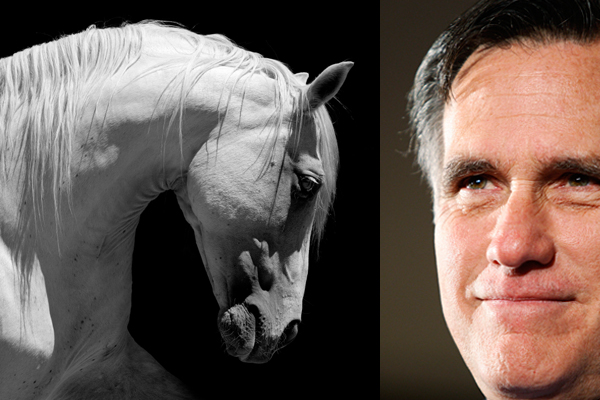
Romney and the White Horse ProphecyThe White Horse Prophecy foresaw Mormons in politics. (Credit: iStockphoto/66North/Reuters)

When Mitt Romney received his patriarchal blessing as a Michigan teenager, he was told that the Lord expected great things from him.  All young Mormon men — the “worthy males” of the Church of Jesus Christ of Latter-day Saints, as it is officially known — receive such a blessing as they embark on their requisite journeys as religious missionaries.  But at 19 years of age, the youngest son of the most prominent Mormon in American politics — a seventh-generation direct descendant of one of the faith’s founding 12 apostles—Mitt Romney had been singled out as a destined leader.

From the time of his birth — March 13, 1947 — through adolescence and into manhood, the meshing of religion and politics was paramount in Mitt Romney’s life. Called “my miracle baby” by his mother, who had been told by her physician that it was impossible for her to bear a fourth child, Romney was christened Willard Mitt Romney in honor of close family friend and one of the richest Mormons in history, J. Willard Marriott.

In 1962, when Mitt — as they decided to call him — was a sophomore in high school, his father, George W. Romney, was elected governor of Michigan.  Throughout the early 1960s, Mitt collected petition signatures, campaigned at his father’s side, attended strategy sessions with his father’s political advisors, and interned at his father’s office during all three of his gubernatorial terms.  He attended the 1964 Republican National Convention where his father led a challenge of moderates against the right-wing Barry Goldwater. Although he was fulfilling his spiritual obligation as a Mormon missionary in France in 1968 while his father was the front-running GOP presidential candidate, Mitt was kept apprised of the political developments back in the U.S.

Upon completion of his foreign mission, he immersed himself in the 1970 senatorial campaign of his mother, Lenore Romney, who was running against Phillip Hart in the Michigan general election. That same year, the Cougar Club — the all male, all white social club at Brigham Young University in Salt Lake City (blacks were excluded from full membership in the Mormon church until 1978) — was humming with talk that its president, Mitt Romney, would become the first Mormon president of the United States. “If not Mitt, then who?” was the ubiquitous slogan within the elite organization. The pious world of BYU was expected to spawn the man who would lead the Mormons into the White House and fulfill the prophecies of the church’s founder, Joseph Smith Jr., which Romney has avidly sought to realize.

Romney avoids mentioning it, but Smith ran for president in 1844 as an independent commander in chief of an “army of God” advocating the overthrow of the U.S. government in favor of a Mormon-ruled theocracy. Challenging Democrat James Polk and Whig Henry Clay, Smith prophesied that if the U.S. Congress did not accede to his demands that “they shall be broken up as a government and God shall damn them.”  Smith viewed capturing the presidency as part of the mission of the church.  He had predicted the emergence of  “the one Mighty and Strong” — a leader who would “set in order the house of God” — and became the first of many prominent Mormon men to claim the mantle.

Smith’s insertion of religion into politics and his call for a “theodemocracy where God and people hold the power to conduct the affairs of men in righteous matters” created a sensation and drew hostility from the outside world.  But his candidacy was cut short when he was shot to death by an anti-Mormon vigilante mob. Out of Smith’s national political ambitions grew what would become known in Mormon circles as the “White Horse Prophecy” — a belief ingrained in Mormon culture and passed down through generations by church leaders that the day would come when the U.S. Constitution would “hang like a thread as fine as a silk fiber” and the Mormon priesthood would save it.

Romney is the product of this culture. At BYU, he was idolized by fellow students and referred to, only half jokingly, as the “One Mighty and Strong.”  He was the “alpha male” in the rarefied Cougar pack, according to Michael D. Moody, a BYU classmate and fellow member of the group.  Composed almost exclusively of returned Mormon missionaries, the club members were known for their preppy blue blazers and enthusiastic athletic boosterism. Romney, who had been the assistant to the president of the French Mission where he was personally in charge of more than 200 missionaries, easily assumed a leadership position in the club.

Both political and religious, the Cougar Club raised funds for the school and its members emulated the campus-wide honor and dress codes, passionately disavowing the counterculture symbolism of long hair, bell-bottom jeans and antiwar slogans that were sweeping college campuses throughout America.  They held monthly “Fireside testimonies” — Sacrament meetings at which each member testified to his belief that he lived in Heaven before being born on Earth, that he became mortal in order to usher in the latter days, and that he recognized Joseph Smith as the prophet, the Book of Mormon as the word of God, and the Mormon church as the one true faith.

Such regular testimonies encouraged the students to live devout lives and to resist the encroaching outside influences overtaking the nation at large. “It helps them cope with such external pressures as evolution-teaching professors and cranky anthropologists who expect answers that conflict with LDS teachings,” according to James Coates, author of “In Mormon Circles.”

They traditionally hosted frat-like parties (Greek fraternities were banned from the campus) to raise a few thousand dollars for the college’s sports teams.  But Cougar president Romney drove the young men to aim higher, orchestrating a telethon that raised a stunning million dollars. Romney’s position as head of the club was widely seen as a calculated steppingstone for a career in national politics.

So it seemed disingenuous to his former club mates when, in a 2006 magazine interview, Romney denied his longtime political aspirations. “I have to admit I did not think I was going to be in politics,” he told the American Spectator.  “Had I thought politics was in my future, I would not have chosen Massachusetts as the state of my residence.  I would have stayed in Michigan where my Dad’s name was golden.”

Michael Moody says political success was an institutional value of the LDS church.

“The instructions in my [patriarchal] blessing, which I believed came directly from Jesus, motivated me to seek a career in government and politics,” he wrote in his 2008 book. Moody recently said that he ran for governor of Nevada in 1982 because he felt he had been divinely directed to “expand our kingdom” and help Romney “lead the world into the Millennium. Once a firm believer but now a church critic, Moody was indoctrinated with the White Horse Prophecy.  Like Romney, Moody is a seventh-generation Mormon, steeped in the same intellectual and theological milieu.

“We were taught that America is the Promised Land,” he said in an interview.”The Mormons are the Chosen People.  And the time is now for a Mormon leader to usher in the second coming of Christ and install the political Kingdom of God in Washington, D.C.”

In this scenario, Romney’s candidacy is part of the eternal plan and the candidate himself is fulfilling the destiny begun in what the church calls the “pre-existence.”

Several prominent Mormons, including conservative talk-show host Glenn Beck, have alluded to this apocalyptic prophecy.  The controversial myth is not an official church doctrine, but it has also arisen in the national dialogue with the presidential candidacies of Mormons George Romney, Sen. Orrin Hatch, R-Utah, and now Mitt Romney.

“I don’t think the White Horse Prophecy is fair to bring up at all,” Mitt Romney told the Salt Lake Tribune when he was asked about it during his 2008 presidential bid.  “It’s been rejected by every church leader that has talked about it.  It has nothing to do with anything.”

Pundits and scholars, rabbis and bloggers, have repeatedly posed the question during Romney’s run: Is a candidate’s religion relevant?  With a startling 50 percent  increase of recently polled American voters claiming to know little or nothing about Mormonism, another 32 percent rejecting Mormonism as a Christian faith, a whopping 42 percent saying they would feel “somewhat or very uncomfortable” with a Mormon president, and a widespread sense that the religion is a cult, the issue is clearly more complicated than religious bigotry alone.  Judging from poll results, Americans seem less prejudiced against a candidate’s faith than concerned about the unknown, apprehensive about any kind of fanaticism, and generally uneasy about a religion that is neither mainstream Judaic nor Christian.

Just as the Christian fundamentalism of former GOP candidates Michele Bachmann and Rick Perry informed their political ideology — and was therefore considered fair game in the national dialogue — so too does Mormonism define not only Mitt Romney’s character, but what kind of president he would be and what impulses would drive him in both domestic and foreign policy.

Romney’s religion is not a sideline, but a crucial element in understanding the man, the mission and the candidacy.  He is the quintessential Mormon who embodies all of the basic elements of the homegrown American religion that is among the fastest growing religions in the world.  Like his father before him, Romney has charted a course from missionary to businessman, from church bishop to politician — and to presidential candidate.  The influence that Mormonism has had on him has dominated every step of the way.

The seeds of Romney’s unique brand of conservatism, often regarded with intense suspicion by most non-Mormon conservatives, were sown in the secretive, acquisitive, patriarchal, authoritarian religious empire run by “quorums” of men under an umbrella consortium called the General Authorities.  A creed unlike any other in the United States, from its inception Mormonism encouraged material prosperity and abundance as a measure of holy worth, and its strict system of tithing 10 percent of individual wealth has made the church one of the world’s richest institutions.

A multibillion-dollar business empire that includes agribusiness, mining, insurance, electronic and print media, manufacturing, movie production, commercial real estate, defense contracting, retail stores and banking, the Mormon church has unprecedented economic and political power. Despite a solemn stricture against any act or tolerance of gambling, Mormons have been heavily invested and exceptionally influential in the Nevada gaming industry since the great expansion of modern Las Vegas in the 1950s.  Valued for their unquestioning loyalty to authority as well as general sobriety — they are prohibited from imbibing in alcohol, tobacco or coffee — Mormons have long been recruited into top positions in government agencies and multinational corporations. They are prominent in such institutions as the CIA, FBI and the national nuclear weapons laboratories, giving the church a sphere of influence unlike any other American religion in the top echelons of government.

Romney, like his father before him who voluntarily tithed an unparalleled 19 percent of his personal fortune, is among the church’s wealthiest members. And like his father, grandfather and great-grandfathers before him, Mitt Romney was groomed for a prominent position in the church, which he manifested first as a missionary, then as a bishop, and then as a stake president, becoming the highest-ranking Mormon leader in Boston — the equivalent of a cardinal of the Roman Catholic Church. 

Called a “militant millennial movement” by renowned Mormon historian David L. Bigler, Mormonism’s founding theology was based upon a literal takeover of the U.S. government. In light of the theology and divine prophecies of the Church of Jesus Christ of Latter-day Saints, unamended by the LDS hierarchy, it would seem that the office of the American presidency is the ultimate ecclesiastical position to which a Mormon leader might aspire.  So it is not the LDS cosmology that is relevant to Romney’s candidacy, but whether devout 21stcentury Mormons like Romney believe that the American presidency is also a theological position.

Since his first campaign in 2008, Romney has attempted to keep debate about his religion out of the political discourse. The issue is not whether there is a religious test for political office; the Constitution prohibits it.  Instead, the question is whether, past all of the flip-flops on virtually every policy, he has an underlying religious conception of the presidency and the American government.  At the recent GOP presidential debate in Florida, Romney professed that the Declaration of Independence is a theological document, not specific to the rebellious 13 colonies, but establishing a covenant “between God and man.”  Which would suggest that Mitt Romney views the American presidency as a theological office.

“The closest thing to modern slavery”

The real beneficiaries of Bush's proposed new immigration laws are not the immigrants, but the corporations that exploit them.

  • more
    • All Share Services

President’s Bush’s much-heralded proposal to overhaul the nation’s immigration laws was immediately called a political ploy by critics on all sides. But what was widely seen as blatant pandering to the critical Hispanic constituency, or even to swing voters moved by seeming White House compassion for the immigrant millions in an election year, is in fact something far more cynical.

Yes, the Hispanics are a significant factor in any presidential candidate’s calculations. But no less important to Bush are the major American corporations whose profits are dependent on illegal foreign labor and whose contributions make up the record war chests the president and his party carry into the 2004 campaign. The special interests to whom Bush is responding are not the undocumented workers, the immigrants dying in the desert as they attempt to cross an increasingly militarized border, or the millions of illegal immigrants who cannot vote in an American election. The special interests that have influenced the president in this sweeping immigration “reform” are his corporate benefactors and contributors who want cheap, exploitable, non-union laborers who can be returned to their poverty-ridden homeland at the end of a three-year work period.

Ironically, this comes as the Republicans accuse Democratic front-runner John Kerry of being unusually beholden to special interests, surely one of the most egregious cases in political history of the pot calling the kettle black. The Bush campaign recently saturated 6 million recipients with a focused attack, a one-minute video entitled “Unprincipled,” charging that Kerry has received “more special interest money than any other senator.” The $640,000 figure displayed on the video screen is so paltry compared with the tens of millions of special-interest money pouring into the Bush coffers, as documented by the Center for Public Integrity and other respected monitors, that the charge seems absurd if not grotesque. The farce, though, seems no embarrassment to the Fox News Network and other right-wing outlets that have faithfully parroted it.

Bush’s “temporary guest worker” proposal is the most sweeping immigration initiative of its kind since the infamous bracero program that operated in the United States from 1942 to 1964 and served as a veritable migrant slave labor battalion for California agribusiness. But Bush’s plan is bracero writ large, as illegal Mexican migrant workers already in the United States have swelled to an estimated 5 million, and they are no longer confined to California’s agricultural fields but span the nation. They are laborers and stonemasons, janitors and maids, bricklayers and field hands, miners and garbage collectors, washroom attendants and convenience store clerks, assembly line drones and restaurant busboys, welders and ironworkers, glaziers and heavy equipment operators, meatpackers and fishermen, manicurists and nannies, bakers and car washers, box boys and gardeners, jockeys and mechanics, gravediggers and carpenters. They live in Las Vegas and Omaha, Detroit and Boston, New York and Juneau, Atlanta and Milwaukee, and they send $14 billion a year home to Mexico — that country’s largest source of foreign capital.

Individuals and small businesses employ a small percentage of them, but large American and multinational corporations are by far the dominant employers of undocumented workers, and they are the unmistakable lobbying force behind Bush’s program. AFL-CIO president John Sweeney warns that Bush’s plan will create “a permanent legal underclass” of low-paid workers.

Those who stand to benefit the most from such a massive labor subsidy are Bush’s biggest corporate contributors — from Wal-Mart to Philip Morris, from Exxon to U.S. Sugar. Bush’s plan is being debated on many fronts, but the essence is being missed. It is less the legalization of laborers than the organization and control of the labor supply, less an employee benefit than an employer advantage, less an expansion of workers’ rights than a major economic concession to big business. A U.S. Border Patrol chaplain has called it “the closest thing to modern slavery our country has known.”

Yet for all the early criticism of his industry-driven proposal, Bush has given a valuable and ironic boost to the immigration dialogue by acknowledging for the first time the dirty little secret known to millions of Americans: There exists an invisible economy in this country, and, as the president himself said, “the system is not working.” (U.S. Federal Reserve chairman Alan Greenspan has calculated that immigrants contribute $27 billion per year to the U.S. economy — a sum that Greenspan and others admit is crucial for the solvency of Social Security and other programs.)

Bush, perhaps inadvertently, has shed light on one of the most momentous and consequential migrations in history. Every day and night, seen and unseen, thousands of men, women and children fleeing their homelands strive desperately to cross the 2,000-mile border between Mexico and the United States. Hundreds die trying. Hundreds of thousands are arrested and turned back. But many more complete one of the most contested yet most traveled passages on earth. And as they have for more than a half century, they keep coming, the thousands growing to millions. Even in an age of unprecedented migration around the world, it is the largest single shift of humanity on the planet. The vast movement of people, of promise and hope, has already transformed the economy, society and politics of the United States, and it will alter the country still more widely and deeply in the decades to come, changing America as never before.

Bush has exposed the inherent irony and paradox, the fateful contradiction, of American policy and attitude. In one dimension, the United States is virtually at war with this Mexican wave of people, from a border as bristling as any between hostile powers to the political clamor for exclusion and ever-greater fortification. At the same time, far more quietly but no less decisively, both business and the Bush government ardently tend their vested and constantly growing interest in an uninterrupted, expanding supply of migrant labor.

Characteristically, many Americans want it all. Business wants cheap labor. Consumers want low prices. Politicians want both the corporate contributions that come from supporting and tolerating the hypocrisy as well as the support of the burgeoning Hispanic constituency. But we don’t want them in our neighborhoods. We don’t want their children crowding our schools. We want them to pay taxes but don’t want them taxing our social services. We want their labor but we don’t want them to negotiate union contracts. We want to be at liberty to employ them, but we don’t want them to enjoy the protection of civil liberties.

While Bush’s plan might temporarily put him in a favorable light among some Hispanic voters, which is one of his motives, in the long run it could generate a devastating backlash for the president. As at least some Republicans recognize, the immigration issue opens the still obscure but inherent rift between Bush’s xenophobic fundamentalist constituency and his corporate funders.

The clash between those constituencies is a potential coalition-cracking fissure that is already palpable along the U.S.-Mexico border, where vigilantes and anti-immigrationists have issued a call to arms to stem the flow of immigrants. At least one outcome of the Bush immigration ploy is clear: the issue will be around in this campaign, and raging for the next presidency and well beyond.

Continue Reading Close