Scarlet Pruitt

The earth literally shakes as Mexico’s new president takes charge

Boasting a radical plan to open the border and expand trade with the U.S., Vicente Fox takes office and sets the tone for a new North American order.

  • more
    • All Share Services

The earth literally shakes as Mexico's new president takes charge

According to legend, Mexico’s flag — an eagle sitting on a cactus with a serpent in its mouth — was the sign the Aztecs received telling them to settle modern day Mexico City. Today that image better describes the challenges facing the country’s new president, Vicente Fox Quesada, a man who boldly ended seven decades of one-party rule by devouring his poisonous enemy while landing on a knot of thorns, some of which are of his own making.

Fox, a 58-year-old, tough-talking cowboy and ex-Coca-Cola executive, is the first presidential opposition candidate to ever make prey of the Institutional Revolutionary Party (PRI), a slippery entity that managed to hold on to power for 71 years by constantly shedding its skin and reinventing itself.

And if Fox’s recent Cabinet appointments are any indication, his administration promises to mark a major change of tone in U.S.-Mexico relations. With proposals to add to the North American Free Trade Agreement and loosen border restrictions for workers, Fox appears to be demanding from Washington a bigger piece of the North American pie.

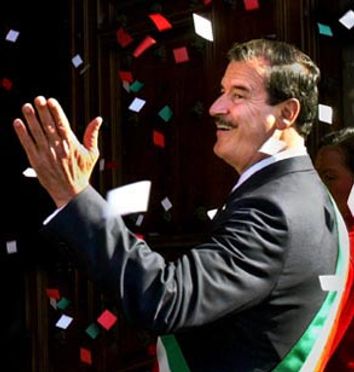
His inauguration Friday, attended by such diverse luminaries as Cuban President Fidel Castro (with whom he is friends), U.S. Secretary of State Madeleine Albright and Colombian author Gabriel García Márquez, marked an indelible moment of change in Mexico’s long and turbulent history.

“Let us proceed sensibly and bravely to demolish all vestiges of authoritarianism and to build a genuine democracy,” Fox boomed during his inaugural address.

His term as president began like no Mexican head of state’s has before. Fox awoke early and headed to the Basilica of the Virgin of Guadalupe to pray to the nation’s patron saint, as a mile-high plume of smoke from Mexico City’s Popocatepetl volcano hung above him. Afterward, he ate breakfast with capital street children, dining on sweet tamales as he pledged to make the poor and marginalized his first priorities. As Fox headed to Congress to be sworn in as president, a 5.1 earthquake shook the ground beneath him, as if even nature had to recognize the dawning of a new era in Mexico.

“I promise to be a president who is simple, close and a friend to all of you,” he told Mexicans later that day in a public address. After seven decades of authoritarian rule marked by corruption and cronyism carried out with impunity, Fox’s pro-business National Action Party (PAN) has swept into power on the shoulders of a larger-than-life man whose own bounding optimism has created high expectations for his administration.

Fox has vowed to take a hard line against crime and corruption, beginning with a complete overhaul of the law-enforcement system. He has singled out the poor, the indigenous and migrants, who have historically been ignored, as his highest commitments, creating new posts to attend to their needs.

In addition, he has pledged to open the U.S.-Mexico border to a free flow of workers and bring Mexico’s economy in line with that of the United States, under a new plan he calls “NAFTA plus,” even while railing on the U.S. for its voracious drug appetite, which he says has helped turned Mexico into a drug-trafficking den.

While these ambitious ideas and great expectations have marked Fox as a beacon of change, they could also become thorns in his side. Although Fox’s progressive domestic proposals are much needed, the PAN does not hold a majority in either house of Congress, and faces fierce opposition from the PRI, which is still smarting from a loss of power, and the left-of-center PRD, which frowns upon the PAN’s gung-ho business stance.

“I think it’s only natural that when someone brings this kind of enthusiasm, energy, vision and record of achievement onto the national stage, that it would generate a great deal of enthusiasm and expectations,” says Paul A. Laudicina, a vice president of global management with consulting firm A.T. Kearney. Laudicina predicted two years ago, based on Fox’s success as governor of Guanajuato, that he would be Mexico’s next president.

Fox is also entering a political territory so new that it makes this year’s U.S. presidential election look like mere self-reflection.

Whereas the botched U.S. election drew attention to the intricacies of the country’s electoral system, Mexico’s election was an epiphany of democracy. Aided by electoral reforms ironically put in place by outgoing PRI President Ernesto Zedillo, Fox grabbed 43 percent of the vote in a three-way race that was widely seen as the first fair election in Mexico’s history. When Zedillo went on national television July 2 to announce Fox as the nation’s next president, newscasters’ jaws gaped while PRI loyalists plotted the political lynching of their lame-duck leader.

Mexico was so unprepared for a non-PRI government that there weren’t even funds available for the long five-month transition between Election Day and Fox’s taking office. For the first few months of the transition, the Fox team had to build its new government from scratch, working out of a pair of suites in a downtown Mexico City hotel while paying the endless bills that its Herculean task required. Finally, the Finance Secretariat approved funds to finance the transition, but even that garnered flak from PAN opponents, who seemed to expect the political newcomer and his team to go it alone.

Beyond a prickly domestic political scene, Fox’s ambitious plans to reshape the U.S.-Mexico relationship have left some wondering if he has ordered his cowboy boots two sizes too big. While touring North America last September as president-elect, Fox saw his open-border proposals given the cold shoulder by both main U.S. presidential candidates and Canadian Prime Minister Jean Chrètien.

“The immigration proposals and drug-trafficking finger-pointing are going to congest the already complicated agenda between the U.S. and Mexico,” warns Joel Estudillo Rendón, director of Information and Analysis at the Mexican Institute for Political Studies.

Perhaps further complicating bilateral relations, Fox tapped Jorge Castañeda, an intellectual leftist known in the past as being anti-American and anti-NAFTA, as the new foreign relations secretary, a sticky post that involves working with the U.S. on numerous complex bilateral issues.

” I don’t think Americans like Castañeda,” Estudillo says.

But not everyone is as concerned with Fox’s radical U.S.-Mexico plans, as they recognize the need to rethink the bilateral relationship given the countries’ increasing level of economic and cultural interdependence.

Fox’s open-border plans, for example, have garnered praise from some analysts who acknowledge that, one way or another, borders become porous over time. “It’s a highly emotionally charged issue,” says Laudicina. “If one just talks about opening borders, you don’t get much dialogue. One has to peel back the leaves of the artichoke and start talking about how to meet the U.S. and Mexico’s mutual needs.”

According to John Dawson, director of Mexican affairs at the U.S. State Department, Fox’s new approach to these needs are not being ignored.

“As far as illegal immigrants go, that’s something we can easily work with him on, as Americans are realizing that they benefit [from migrants] in terms of labor,” says Dawson, referring to Fox’s new Office of Mexicans Living Abroad. Dawson also downplays concerns over Castañeda.

“He has been critical of the U.S. in the past and some congressional pundits in particular have questions about that,” Dawson says. “But in my view, this guy is brilliant. Fox will be calling the foreign policy and Castañeda will play it out.”

Indeed, a lot of high expectations for the new government depend on Fox’s own ideology. If the PRI was the fat, crooked landowner accumulating riches on the backs of the poor farmworkers, Fox is the cocky corporate raider who decided to buy the farm, fix it up and run it as a business.

Just look at the rest of his Cabinet — while political powwowing and back-scratching represented the putting together of past PRI governments, his choices more resemble a who’s who of Mexican business.

“(The Cabinet) is a very interesting mix of experienced people who seem to have all the right stuff to be able to achieve what the president wants to achieve,” says Laudicina.

New Finance Secretary Francisco Gil Díaz is the former president of long-distance telephone operator Avantel, and a reputed fiscal hardliner — a first in a country that boasts the saying, “anyone who pays taxes is just giving a gift.”

Energy Secretary Ernesto Martens, who is saddled with the task of averting a national blackout amid low energy supplies while tiptoeing around the nasty “P” word of privatization, has never before held a government office. Before taking on the post, Martens was president of an airline holding company and a large glass-making firm.

“Fox obviously has a business bias that reflects his own background,” says Dawson. “But I think his Cabinet picks show he’s interested in getting quality people rather than hacks.”

Hacks are exactly what the new government does not need. If Fox is a man of big promises, he is also a man saddled with big problems.

Despite Mexico’s recent economic upswing, and the fact that this will be the first government transition in 25 years that isn’t blighted with an economic crisis, the country remains weak.

It’s estimated that 40 to 60 million of Mexico’s 100 million citizens live in poverty. According to government figures, one-third of the country’s working population earn less than the minimum wage of roughly $4 a day. Furthermore, the gap between the rich and the poor would be better described as a grand canyon, where around 10 percent of the population holds nearly 40 percent of the wealth.

Striving to make ends meet, nearly one-third of the economically active population work in the informal sector, where they do not pay taxes. Others turn to crime. Education levels are still quite low, despite progress in recent years. The average Mexican child receives just 7.7 years of schooling, although this is a great improvement over the average 2.8 years they received in the 1960s.

Poverty, crime and a lack of education are all deeply entrenched problems that cannot be solved in just one six-year presidential term. However, Mexicans believe if there is one man who can spearhead a revolution, it is the same man who managed to swoop down and pluck the serpent from the country’s path toward prosperity.

“Today I have news for all of you. Today we celebrate not a change of government, but the first step in giving our country a better future,” Fox bellowed from the balcony of the national palace to the throngs of cheering citizens gathered in the capital’s main square Friday.

“This is a revolution of hope!” Fox screamed. “Viva Mexico!”

Fox is it

President-elect Vicente Fox, a tough-talking cowboy and former head of Coca-Cola Mexico, promises to revolutionize the nation's economy after 71 years of corruption.

  • more
    • All Share Services

Fox is it

In 1995, Vicente Fox, then governor of the Mexican state of Guanajuato, told an American reporter that he would be the Neil Armstrong of Mexican politics — the first opposition candidate to set foot in the country’s presidential palace, Los Pinos. Five years later, Fox managed to boot out the world’s longest-ruling party on his way in, in what analysts are calling the most significant event in Mexico since the revolution.

Like Armstrong, this former Coca-Cola executive and sharp-talking cowboy has opened up a new world to his people — one as different from business-as-usual Mexican politics as the Moon is from Earth.

Unlike most Mexican career politicians, Fox is a businessman, and he’s bringing a managerial style to office with him. So far, he has pledged to rule with a plural government, taking the best and brightest from all parties, rather than handing out Cabinet posts to buddies. In fact, Fox announced Tuesday that he was hiring five headhunting firms to track down worthy Cabinet members.

Fox got his start as a Coca-Cola delivery man and worked his way up to the head of Coca-Cola de Mexico. After a term in Congress, he ran for governor of his home state of Guanajuato, and lost, but ran again in 1995 and won.

Ever persistent, Fox began campaigning for the presidency three years ago, effectively imposing his candidacy on the PAN, a conservative, pro-business party. Traveling the country in his signature cowboy boots and “Fox” belt buckle, he vowed to help poor and indigenous people, to double education spending and to try to open up the U.S.-Mexico border to a free flow of workers.

His rough-and-tumble language and down-home style, while endearing him to suburban voters, ruffled the feathers of the more straitlaced conservatives. Fox threw especially sharp elbows at the Institutional Revolutionary Party (PRI). During the campaign, Fox called PRI candidate Francisco Labastida Ochoa everything from “shorty” to “cross-dresser,” cementing his own image as the biting outsider.

But while Fox’s edginess and business background attracted him to young, educated, urban voters, the preelection polls didn’t foresee the large number of undecided voters and supporters of other opposition candidates who at the last minute threw their votes to the one man who had a chance to beat the PRI.

“Fox has the authority to process change and the charisma to capitalize on it,” says John Bruton, executive vice president of the American Chamber of Commerce of Mexico.

The PAN not only took the presidency but won a majority in Congress, meaning that the change Fox represents will meet little political friction.

Fox’s landslide win last Sunday came not only as a crushing blow to the PRI’s 71-year rule, but as a complete surprise. Fox won 43 percent of the vote to Labastida’s 36 percent. Although Fox and Labastida had been running neck-and-neck in polls in the weeks leading up to the July 2 election, political pundits never predicted a decisive Fox victory. Reports of vote-buying and pressure by the ruling party prior to the election left little hope that the PRI would let go of power.

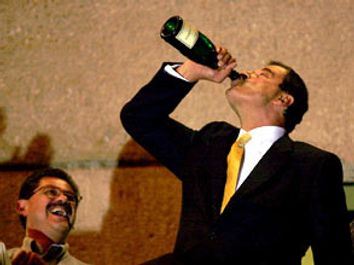
But suspense began to build as exit polls rolled in Sunday evening showing Fox with a clear lead. Mexicans sat glued to their TV sets in disbelief and excitement, watching Fox do what no man had done before: defeat the PRI for the presidency. When President Ernesto Zedillo appeared on television at 11 that night, congratulating Fox on his victory and vowing to work with him to ensure a smooth government transition, Mexicans knew that something monumental in their country had changed — they had truly achieved democracy.

Upon hearing Zedillo’s concession, thousands of Fox supporters in the capital rushed to the monument of the Angel of Independence to celebrate their triumph and listen to a speech from their new president-elect.

“Don’t fail us!” the crowd screamed to Fox, while waving his signature “V” for victory sign in the air, which also signifies his campaign slogan “Ya!” — “enough already.”

“Of course not,” Fox replied. “We are not going to fail Mexico, we are not going to fail Mexicans.” Sunday was also Fox’s 58th birthday, and as he stood on a balcony with his 20-year-old adopted daughter, Ana Christina Fox (the president-elect is divorced and has four adopted children), the crowd began to sing the traditional Mexican birthday song “Las Maqanitas.”

Mexico has now shown the world that it is capable of executing clean and transparent elections. Ironically, most of the credit for that feat belongs to outgoing President Zedillo, of the PRI, whose reforms have effectively brought about the demise of his own party.

Most analysts and international observers agree that Mexico’s leap toward democracy could not have happened without Zedillo. By pushing through crucial reforms in 1996, he created the Federal Electoral Institute (IFE), an independent body to manage the elections. In the past, elections had always been run by the government, muddying the transparency and accountability of the process.

This time, IFE carefully prepared voting credentials, redesigned voting booths to ensure secrecy and invited scores of international observers, including former U.S. President Jimmy Carter, to oversee the process. Official, reliable election results were available just hours after the polls closed — a far cry from vote-tabulating problems of the past, exemplified by the 1988 election debacle where computers crashed with opposition candidate Cuauhtimoc Cardenas in the lead, only to be recovered with PRI candidate Carlos Salinas ahead.

Zedillo was moving toward a separation between the PRI and the government. Now that separation is complete, “The most important thing is that irreversible change has happened,” says Bruton. “There is no longer a confusion between party and state.”

For international investors this means that there is a good chance to further broaden Mexico’s economic opening. For example, while Zedillo made huge strides during his administration by penning free-trade deals with countries around the globe, many investors were too scared off by Mexican tradition and national pride to even dream about getting their hands on Mexico’s lucrative oil and energy market. Under Fox, however, this could change.

Although Fox has recently said that he has no plans to privatize state-owned oil monopoly Petrsleos Mexicanos (Pemex), he hinted at a further opening of the energy sector — specifically electricity — during early campaigning.

In fact, Fox’s position as a business-minded outsider has investors in all sectors rubbing their hands together in anticipation of more open, fair and regulated markets.

“Powerful U.S. corporate sectors are expecting big changes under Fox,” says Joel Estudillo Rendsn, director of information and analysis at the Mexican Institute for Political Science. “They are expecting more transparency, more certainty.”

“His pragmatism will be new, a definite outside view from which to form an agenda,” Bruton says. “Mexico as a result will be a more understandable entity; before, things were done under shrouds and mystery.” The straight-shooter is also predicted to have a strong effect on Mexico-U.S. relations.

“Fox will positively affect U.S.-Mexico relations because he is willing to go further, to push past the limits of Mexico’s borders”, says Estudillo.

“Fox’s win not only represents a new regime, but more democracy than the country has ever seen before,” says Mexican political analyst Josi Antonio Crespa. Indeed, reactions to Fox’s unexpected triumph and the country’s embrace of democracy have been exceedingly positive. The Mexican stock exchange rocketed 6.1 percent Monday while the peso strengthened 26.7 centavos against the U.S. dollar. President Clinton, Fidel Castro and a handful of other world leaders clamored to congratulate the new president-elect.

International analysts are also hoping that ambitious economic changes that were skirted by PRI tradition can also move forward. Famed Massachusetts Institute of Technology economist Rudiger Dornbusch, the only person to publicly predict the 1994 peso crash, came out Wednesday calling for a currency board, or even dollarization, to accompany Fox’s takeover of the presidency, a goal he has been pushing for years without success.

While opposition supporters celebrate, the PRI is experiencing an internal meltdown. Shortly after Zedillo’s graceful concession to Fox’s win, the lame-duck president came under fire from hard-line members his own party, blaming him in part for the defeat.

Zedillo’s democratic reforms led to the party’s downfall, they reasoned. Also feeling the heat, PRI President Dulce Marma Sauri handed in her resignation. It was refused by the national PRI council, however, while Zedillo’s choice for a replacement was also rejected. An internal power struggle between old-school PRI members, who are fighting to grab the helm of the sinking party ship, and Zedillo’s technocrats, has left the party in limbo.

“The president can’t rule the party for one minute more,” Manuel Bartlett, who as interior secretary presided over the dubious 1988 elections, told the national PRI council Tuesday.

But while the PRI’s internal struggle rages on, Zedillo’s optimistic reforms and his refusal to bow to party hard-liners are likely to live on in his political legacy.

Until last Sunday, the line between Mexico and the PRI — which identifies itself as a party with the red, white and green of the Mexican flag — was so blurred that the ruling party’s problems became the country’s calling card.

“Fox shows Mexico should be seen as the ambitious, potentially powerful partner,” Bruton says. “It will no longer be Mexico the victim.”

While Fox’s triumph and Mexico’s newfound openness toward democracy are changing the way the world sees the nation, more importantly, they are changing the way Mexicans see themselves.

Continue Reading Close

The rise and fall of Mexico's Madonna

Pop goddess Gloria Trevi captivated a nation and became an icon of female sexuality and power -- until allegations of her involvement in a lurid child-sex scandal.

  • more
    • All Share Services

The rise and fall of Mexico's Madonna

The last time pop star Gloria Trevi was seen in her native Mexico, she was writhing on stage, belting out rebellious lyrics that made her a feminist icon to thousands of young girls. The next time Mexicans saw their diva, she was considerably more subdued, calmly being led to jail after her arrest in Brazil on charges of kidnapping, child corruption and rape.

Trevi, who rose to fame throughout the 1980s and ’90s with the bold irreverence of Madonna, was arrested Jan. 13 along with her longtime manager Sergio Andrade and fellow singer Marma Raquenel Portillo after being on the lam for almost 10 months. Charges allege that Trevi and her group, dominated by the cult-like leadership of Andrade, helped Andrade lure young girls under his musical tutelage, after which he would force sex on them and beat them. Trevi, Andrade and Portillo are all awaiting extradition to Mexico.

The day after their arrests, Trevi and Andrade’s mug shots littered the Mexican press. Trevi, not yet 30 and still girlishly attractive after being on the run, appears relaxed and smiling, in freshly applied red lipstick. Next to her stands Andrade, fat and surly, attempting a weak smile at the cameras.

The nation has turned obsessively to analyzing the relationship between this unlikely couple, and Trevi’s role as both victim and victimizer. The press, supplied with a seemingly endless amount of skimpy photos of Trevi retrieved from her racy calendar series, splashes her near-naked image on broadcasts and across front pages throughout the country.

Trevi as the devil, with tail in swing; Trevi in a baby carriage wearing nothing but a diaper, with her legs flared up in the air and her arms covering her breasts; Trevi King Kong-size, lying naked in front of miniature Mexico City monuments. The public does not seem to tire of her jaunty image, nor of her unseemly tale.

While Trevi fans search for an explanation, the scandal produces stunning new developments almost every day. Trevi’s fall from feminist role model to male-dominated sex-peddler leads the news. Headlines scream “Nailed!” and “Trevi Cries, Claims Innocence.” Both Mexico’s first-ever democratic presidential elections and the country’s paralyzing nine-month university strike are pushed to the back half-hour of TV newscasts. The torrid tale has not only soiled a national celebrity; it has incited finger-pointing at the country’s powerful media.

The controversy began more than two years ago when Karina Yapor Gsmez, a Trevi-Andrade musical protg who was legally put under the couple’s care at the age of 12, gave birth at age 15 to a baby boy. (The legal age of
consent in Mexico is 14.) Yapor, who was by then living with the couple and half a dozen other young girls in Spain, claimed that the child was fathered by a young Spanish lover, not by Andrade.

But suspicions were aroused four months later when Andrade’s ex-wife, Erika Aline Hernandez Ponce de Leon, once a starry-eyed Andrade disciple herself, came out with a tell-all titled, “Aline, La Gloria por el Infierno” (“Aline, The Glory by the Inferno”, a play on Trevi’s nickname, “La Gloria”). The book described Andrade’s dominance over Trevi and her entourage, and detailed the pair’s sexual perversity. Furthermore, the bestseller accused Andrade of forcing sex on Trevi protgs, provoking speculation as to the true father of Yapor’s baby.

In a dramatic turn of events, Yapor abandoned her then 7-month-old infant in a Spanish hospital. Six months later, Yapor’s parents went to collect the child. Upon their return to Mexico, they filed charges against Andrade, Trevi and Portillo, claiming that Andrade kidnapped their daughter and forcefully fathered her child, while the two women passively stood by. When the police began their search, the group had already disappeared.

Almost seven months later, Yapor called her parents, begging them to drop charges against Trevi and Andrade in return for her long-awaited return home. Her parents refused. Yapor then startled the nation a month later when she suddenly reappeared in Mexico on national television, defending the pair and again pleading to her parents to drop the charges.

“I owe them” — Trevi and Andrade — “a very big apology, because they were always very nice to me,” Yapor said in a statement that local press described as wooden.

Yapor, now 17, returned to her family home where she immediately fell silent. The girl’s ambivalence to say more about the scandal alarmed her parents, who stuck by their charges. In the latest turn of events, this week Yapor testified to a state judge in Mexico that Andrade did father the child, but she said he did not rape her. Lawyers say her testimony could prevent Andrade’s prosecution on felony sex charges.

The dubious pair was finally tracked down by Interpol in Rio de Janiero almost 10 months after their disappearance. They were living with six women and three babies. One of the women was Marma Raquenel Portillo (known as “Mary Boquitas”), a former Trevi back-up singer who was arrested for collusion with Trevi and Andrade. The other five young women (one pregnant) are being investigated while the three babies are undergoing DNA tests to see if they, too, are possible Andrade offspring.

The scandal has only broadened since Trevi and Andrade’s arrests. Five other young girls have come out of the woodwork, claiming that they too were taken in by promises of fame, only to become victims of Andrade’s abuse and Trevi’s indifference. The girls claimed that Andrade bullied them into orgies — even prostitution — while Trevi silently stood by.

A Chilean accuser, who recently filed rape and kidnap charges against Trevi and Andrade in Chile, says she is willing to travel to Mexico to testify against the couple. The girl joined Trevi’s group in 1995 when she was 12, and claims that she was later repeatedly raped and beaten by Andrade.

Trevi fans, who had long seen her as a progressive female role model, were shocked to see evidence that she was in fact a male-dominated puppet.

Trevi’s rise to fame was not that of a typical Mexican star. Born Gloria de los Angeles Treviqo Ruiz, she signed a contract at age 15 with the country’s powerful, and at that time only, TV network, Televisa. It was then that she was first introduced to show business — and to the man who would shape her life. Andrade managed the girl group that first brought Trevi to the public’s attention. He later stayed on as her manager. Together, they produced seven albums, a series of sexy calendars and movie appearances.

A far cry from the bubble-gum starlets the network usually produced, Trevi was edgy. Her lyrics — on everything from pregnancy to running away from home — were considered provocative and deep.

In a nation where children are expected to live at home and abstain from sex until they marry, Trevi’s lyrics hit a chord with young people who were fed up with what they saw as outdated traditions and gender roles.

Trevi’s publicity campaigns painted her as a wild woman who fought her way out of a neglected childhood to become a blockbuster star. Her primary audience, young people from poor backgrounds, fed off her streetwise style and brash independence.

Trevi’s Web site was put up at the height of her career and has not been updated since. It exemplifies the image Trevi wished to project. Recounting Trevi’s childhood in a poor, abusive family, the site describes a discarded little girl who followed her dreams.

“Doors did not open immediately for Gloria Trevi,” the site gushes. “Life in the streets was lonely and difficult for several years. She survived by singing on street corners and buses for change, selling tacos from a makeshift stand and teaching aerobics 12 hours a day. All the while, she studied music and dancing and held tight to her dreams.”

Wailing to songs like her 1991 hit “Pelo Suelto” (“Hair Down”), while wielding her ratty, auburn mane and undressing young boys onstage, Trevi shaped her raucous image. “I’m going to wear my hair down! I’m going to do what I want!” Trevi cried.

Ironically, it seems that’s exactly what Trevi didn’t do. Her career choices, public persona and private perversities were all reportedly concocted in the mind of Andrade, who used his control over Trevi to draw their entourage into a web of sex and dominance.

But Andrade’s manipulation is only one explanation for Trevi’s stunning fall. Although Mexico is a country that adores juicy scandals, the sheer amount of Trevi coverage has raised even Mexican eyebrows. The weekly political magazine Milenio, among others, has speculated that the nation’s powerful media is behind the phenomenon. Trevi once managed to step on the toes of both of the country’s heavyweight TV networks. Perhaps now she is paying the price for her insubordination.

Originally Televisa’s darling, Trevi agreed to sign a lucrative contract with newcomer TV Azteca when the budding network got up and running in the mid-’90s. Azteca management, gloating over its conquering of Mexico’s hottest star, staged a media blitz promoting its new Trevi partnership. But when it came time for Trevi to start work with the network, she suddenly returned to Televisa.

In what many see as an act of revenge, TV Azteca began publicizing the book “Aline, la Gloria por el Infierno.” The book’s allegations, fueled by Azteca’s publicity, made Trevi unwanted property. Televisa was stuck with a controversial star and purportedly fired back with its own Trevi defamation campaign. Trevi’s stardom was no longer bankable, but her infamy was.

The current media blitz is said to be the dueling networks’ final act of vengeance on their prodigal star. Thanks to non-stop coverage of the scandal, even if Trevi is found not guilty, she will be virtually unemployable.

Many of the rest of the media have also changed their tune on the star. Early coverage of Trevi’s bold and irreverent persona painted her as a role model for thousands of young girls growing up in Mexico’s male-dominated society. But some press outlets are now expressing a tangible sense of guilt and befuddlement that they did not reveal her sordid entanglements from the start.

Carlos Monsivams, a famed social and political commentator who wrote on Trevi in the early ’90s, sadly returned to his subject last month in an article entitled “Trevi: The Phenomenon” in the political magazine Proceso. “I described the festive spectacle,” Monsivmas writes, “and did not warn of what no one spoke of then — the profound antifeminist conduct of Trevi, her surrender to the most deplorable patriarchy.”

In further attempts to riddle out the Trevi mystery, claims of devil-worship have even been pinned on the group. Media have reported that Trevi’s 1994 CD “Mas Turbada Que Nunca” (“More Disturbed Than Ever”) reveals satanic messages when played backward. (The hit album shocked Mexicans when it came out, since the first two words of the title said together, masturbada, means masturbation in Spanish.)

Despite all the accusations, the nation has been left with an overwhelming sense that it is not truly Trevi’s fault. Some fingers point to the country’s two powerful TV networks; others even accuse the country’s ruling party of using the controversy to conveniently distract from the crucial upcoming presidential election. Even more people point to Andrade’s destructive machismo, which they blame for perverting their beloved star. Some Trevi fans, refusing to believe her guilt, have staged masses and marches in several Latin American countries on her behalf.

Trevi, meanwhile, maintains her innocence. Breaking a decisive silence, the star released her first public statement last month in the form of a letter to the influential daily Reforma. The missive, riddled with childish drawings, reads:

To those who love me in Mexico, to those who don’t; to my family, to my friends; to everyone who believes in me and supports me, and to my detractors: Thank you. If God wishes it, I will soon be with you.

But while the truth behind Trevi’s rise and fall has yet to be revealed, her legacy is clear. Trevi’s infamy is perhaps best gleaned in the lyrics of her 1994 hit, “El Recuento de los Daqos” (“A Recount of Damages”) from “Mas Turbada que Nunca”:

In the recount of damages … I lost my house and my friends, everything of mine that I gave you. Among the disappeared: my resistance, my will … and there was something mutilated, and I thought that maybe it was my dignity.”

Continue Reading Close

Choice or corruption?

Mexico's PRI holds its first-ever primary and -- surprise! -- the insider candidate wins.

  • more
    • All Share Services

When ruling party candidate Francisco Labastida Ochoa trounced his nearest competitor in Sunday’s primary elections, it marked a watershed event in Mexico’s political history. Not because Labastida — the widely perceived official candidate of the Institutional Revolutionary Party (PRI) — defeated his nearest opponent by a landslide, but because the primary actually took place.

Sunday’s elections marked the first time in the party’s 70-year rule that it voted on a presidential candidate, as opposed to having the candidate hand-picked by the president in a process called the dedazo, literally “the big finger.”

Although President Ernesto Zedillo rejected the official dedazo when he announced a few months ago that he was stepping out of the candidate-selection process to open the way for a broader democracy, many Mexicans perceived Labastida as the president’s favorite, leaving little uncertainty about his eventual win.

Although the PRI’s first primary election marks an important change from politics as usual, most observers believe it represents more of a gesture toward democracy than a strong, decisive move in that direction. While outside observers laud Mexico’s increasing openness, complaints of fraud and corruption persisted throughout the primary.

Labastida, the former Sinaloa state governor and interior secretary — a traditional steppingstone to the presidency — faced little real competition. His closest rival, PRI rebel candidate Roberto Madrazo Pintado, ex-governor of the state of Tabasco, began a fierce TV campaign that lost speed toward Election Day. Other candidates included former Puebla governor and old-school party insider Manuel Bartlett, and ex-PRI president Humberto Roque.

The real match was played out between Labastida and Madrazo, who, despite the lopsided results, staged a campaign never seen before in Mexico. Madrazo raised eyebrows across the nation by lambasting the PRI’s “party machinery,” which has effectively guaranteed the party’s continuous success through corruption and coercion, making it the world’s most enduring ruling party. Touting his independence, Madrazo also took on Labastida’s status as the perceived official candidate, attacking what he called thinly disguised presidential favoritism. In the end, it backfired.

Labastida walked away with 273 of the 300 electoral districts, leaving Madrazo with only 21, Bartlett with six and Roque with none. Paradoxically, the vote totals don’t support Labastida’s electoral district sweep. While Labastida gained 91 percent of the districts against Madrazo’s 7, Labastida only gained 58 percent of the vote, whereas Madrazo drummed up a significant 31 percent.

The PRI was prepared for heavy turnout. Thousands of voting booths were installed throughout the country, open to all registered voters, regardless of party affiliation; election observers were put into place to assure that there were no irregularities; and four candidates waged a two-month-long official campaign. But in the end, the voters chose not to change.

What happened? The election results seem to reflect both typical PRI corruption and genuine voter choice. Clearly, the PRI, while striving for democracy, has had a hard time changing its stripes. Reports of corruption circulated throughout the primary campaign. Everything from groceries, roof tiles and promises of government aid were reported to have been offered up to assure votes for Labastida. In addition, the tradition of the “cargada,” or political rush to support the president’s chosen candidate, remained in place despite Zedillo’s purported indifference, bolstering Labastida’s power base.

“The vote was just among the priistas,” says Mexico City pundit Alejandro Angeles, using the common term for PRI supporters. “The PRI as a group wanted to make a statement on how to do the elections the best way, without breaking the party. Each individual priista had to discipline himself [by voting for Labastida] to keep a piece of the power pie.”

But the vote also reflected the public’s fear of change after 70 years of PRI rule, analysts say. The economic crises that tend to plague Mexico every six years, in tandem with presidential elections, no doubt played a part. The public believes that the only way to avoid these devastating crises is to assure a smooth transition of power, perhaps one that they didn’t see possible under the fiery Madrazo.

And no doubt memories of the disastrous 1994 changeover still linger. The election process included two assassinations — that of PRI candidate Luis Donaldo Colosio and PRI president Jose Francisco Ruiz Massieu. Then there was the debacle of the December 1994 peso devaluation, which sent former President Carlos Salinas into self-imposed exile in Ireland. Many Mexicans are still dealing with the economic effects of the peso crash and are not prepared to weather another crisis.

From this perspective, perhaps Labastida looked like the safer choice. His platform included more spending on social programs for the working class and gradual reforms to make the PRI less corrupt. Upon winning the primary, Labastida declared to much fanfare, “The new PRI born tonight is far from the path of Salinas. This new PRI is recuperating from the ideals of Colosio and is promising to use power to serve the people.”

Madrazo, on the other hand, proposed sweeping reforms that would wrench power from the ruling party elite and perhaps create internal party ruptures. If the PRI was split by Madrazo, that would surely leave the party open to the opposition in next July’s presidential race. Most analysts never saw Madrazo as a true threat, however, assuming that he was lobbying for his own power position after the elections.

“I am sure we will see Governor or Senator Madrazo next year,” says Angeles.

Labastida’s opposition rivals in the summer election include the conservative National Action Party (PAN) candidate, Vicente Fox, and the left-leaning Party of the Democratic Revolution (PRD) leader, former Mexico City Mayor Cuauhtemoc Cardenas. Fox, former governor of Guanajuato and the strongest opposition candidate, began campaigning nearly two years ago and swept his party’s primary uncontested.

His combination of business know-how — earned when he was head of Coca-Cola exports in Mexico — and sometimes flamboyant and independent style, have made him a favorite among voters who seek some change, but not too much. The PAN platform ensures that economic policies instilled by PRI technocrats, including pro-business policies, deregulation and free trade, will not be washed away under new leadership.

Cardenas, on the other hand, has his sights set on broad social programs. Son of the popular former President Lazaro Cardenas, who gained support for his historic land reforms in the late-1930s, Cuauhtemoc Cardenas has already run for president twice before. His 1988 bid was widely seen as stolen from him by the PRI, when the computer tallying election results mysteriously malfunctioned while Cardenas was holding his own, only to be repaired with Salinas far in the lead.

Neither Fox nor Cardenas, however, is considered strong enough to beat the PRI. The PAN and PRD’s failure to form an opposition alliance due to ideological differences and individual grandstanding has reduced their chances to almost zero. The unlikely allies actually held talks to explore a common-front opposition, but they fell apart over politics and personalities.

No matter the cause, while the opposition parties battle one other, the PRI gets to plot its course serenely. The day after the primary, PRI national president Jose Antonio Gonzalez trumpeted the party’s ability to feature a primary and to emerge from it intact.

“The PAN and the PRD were wrong to not have confidence in the people,” Gonzalez said. “There are those that remember how they selected their candidates: one by self-promotion and the other by self-design — the PRI trusted in the people, made a decision to democratize and here are the results.”

Following the primary, Zedillo referred to the long-held practice of the dedazo, holding out his index finger and proclaiming, “There is one [finger] that is obsolete.” Then, sticking up his thumb, he declared that now, “This is the good one.”

Continue Reading Close