Steven Kotler

Building a better mosquito

Bioengineered insects could help defeat malaria -- or they could turn out to be Frankenbugs, wreaking havoc on our ecosystem.

  • more
    • All Share Services

Building a better mosquito

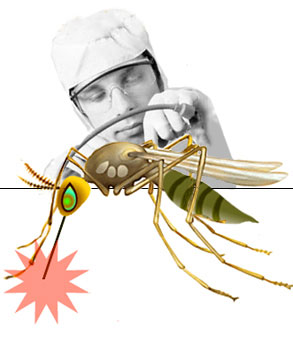
It is winter in America and mosquito season has long since passed. But the threat posed by mosquito-borne illnesses — malaria, dengue fever, yellow fever, West Nile virus — is still serious, and growing, across the world. So even as low temperatures keep these insects from breeding in their beloved boggy puddles, inside entomology departments across the country, green-eyed transgenic mosquitoes are swarming — bioengineered skeeters that represent the front line of the rush to introduce genetically modified creatures into the natural environment.

In 1897, British scientist Ronald Ross discovered that malaria was spread, or “vectored” by mosquitoes. He was also the first to propose reducing or eliminating the world’s mosquito population as a way of controlling the disease. But it wasn’t until early WWII forays into chemical warfare — leading to the discovery of insecticides ferocious enough to take on the insects — that such an idea became truly feasible.

Since that point, the fight against mosquito-vectored ailments has been a chemical battle. Scientists developed drugs that were very useful against the diseases, and insecticides that were very useful against the mosquitoes that transmitted these diseases. And for a time it looked as though we were winning the fight. Unfortunately, in the past 30 years the rules of our chemical battle have changed. Mother Nature interceded and evolution occurred. The insects are now resistant to the pesticides, and the diseases are now resistant to the drugs.

A number of these diseases are considered the deadliest on earth. Today, principally in Africa and Asia, dengue fever annually infects more than 50 million people and kills 500,000. Malaria infects about 400 million and manages to kill more than a million. More disturbingly, the combination of pesticide and drug immunities along with the rise of global transportation and current climate changes has resulted in mosquito-vectored ailments appearing in places where they have not been seen before. Last year in the United States, dengue appeared for the second time in Hawaii and the first time in the Gulf States, and last summer there were 4,000 reported cases of West Nile and 300 deaths. Malaria has so far failed to make serious new inroads into the United States, but in the slightly purple words of the Malaria Foundation International, “a plague is coming back and we have only ourselves to blame.”

To address these concerns, during the past 15 years scientists have been trying to move beyond the chemical paradigm and to a genetic one. The dream has been to build a genetically modified insect, a transgenic mosquito, that is unable to transmit such diseases. This new insect would then be introduced in the wild, thus supplanting malaria carriers with a harmless imposter. Seven teams, both in America and in Europe, demonstrating a collaborative spirit not often found in modern science, have been at work on the project. In recent months they have succeeded in achieving major breakthroughs.

It is now possible to walk into any number of molecular biology labs and peer through a microscope at a mosquito unlike any other in history. The magnified insect shows a feature not found in the wild: a pair of bright, fluorescent green eyes — the telltale sign of successful genetic modification. These eyes are proof that one of the most scientifically advanced cures for disease ever conceived is feasible. They are also proof that, if we are not exceptionally careful as this research progresses, something could go horribly wrong. We could do irreparable damage to the ecosystem or, worse, create new, more devastating ailments currently unknown to science. One thing is certain: The bioengineered mosquito hangs precariously off the cutting edge of genetic research. How we proceed is likely to set standards for how we mold our world at a time when such moldings are both probable and perhaps practical.

The successful creation of a mosquito modified to be unable to transmit disease occurred in May 2002. Working in a laboratory with a version of malaria that infects mice, geneticist Marcelo Jacobs-Lorena (then at Case Western Reserve University and now at Johns Hopkins) found a way to inhibit the disease’s transmission. In recent months, Jacobs-Lorena and other scientists building on his work have taken the process further. They feel that a transgenic mosquito that is immune to malaria and able to live in the wild is at hand.

To understand how this will be accomplished, it’s first necessary to know a little bit about the relationship between the malaria parasite and mosquitoes. There are about 2,500 kinds of mosquitoes in the world, but no more than a tiny minority have evolved to feed on humans. As mosquitoes learned to live off humans, malaria — the most prolific of mosquito-borne diseases — was learning to live off both.

Besides humans, other versions of malaria infect all sorts of mammals and birds. Up to now all of the transgenic research has been done with the disease’s avian or rodent version, but it spreads the same way in every species. Transmission begins when a hungry female mosquito (only the female feeds on blood) drinks her dinner from an infected animal, along the way ingesting the malaria parasite. In a few days’ time that parasite travels into the mosquito’s mid-gut, where it develops sexually reproductive cells. These cells mate and following fertilization release thousands of malaria sporozoites that make their way into the mosquito’s circulatory system, eventually taking up residence inside the salivary gland. The next time that mosquito bites something, malaria goes along for the ride.

Much of the life cycle of malaria was understood by the early portion of the 20th century, but most scientists date the attempt to remake insects into allies in the war against insects to the work that began in the 1930s by the late Barbara McClintock. In 1983, McClintock was awarded the Nobel Prize in medicine for her discovery in corn of the existence of short chains of DNA called “transposable elements” or, more commonly, “jumping genes.” A jumping gene is so named because the proteins it encodes can splice open a chromosome, jump inside, and then sew the whole deal back together again. This discovery excites scientists because it’s now possible to piggyback other, more helpful DNA — like DNA that would be useful in the fight against malaria — on a jumping gene and insert the whole package into a mosquito’s genome.

In 1981, building on McClintock’s work, Gerald Rubin, a scientist then at the Carnegie Institution of Washington, discovered a jumping gene known as the “P element” in the entomological workhorse, the fruit fly Drosophilia melanogaster. A year later, he and another scientist named Allan Spradling took the next step and, by using P as their Trojan horse, built the world’s first genetically modified insect. “It was a huge accomplishment,” says Peter Atkinson, an entomologist at the University of California at Riverside and one of the scientists leading the new genetic charge. “They took a gene that gives fruit fly eyes a reddish color, and attached it to P, and then inserted the whole thing into a fruit fly. That fly’s offspring were born with reddish eyes and their offspring and so on. The trait was stable and heritable.”

Scientists then believed that the P element would be found in other insect species and once found would be useful in manipulating genes in the fight against insect-borne diseases. As it turns out, P doesn’t exist in mosquitoes. “The ’80s were pretty much a wild goose chase down this road,” recounts Atkinson. “Entomologists thought that P was going to be this great breakthrough, but all that got published for a decade was negative results.”

But in 1996-97, Atkinson and David O’Brochta, a professor at the University of Maryland, found a jumping gene they dubbed Hermes, for the speedy Greek god and messenger, in houseflies. The hope was that this gene would be workable in a way that P wasn’t. And the following year, Anthony James, an insect-geneticist at UC-Irvine, proved just that. By using Hermes, he discovered a way to genetically modify a mosquito. On their fruit flies, Spradling and Rubin had only to look for a change in eye color to see proof that their experiments worked. The altered eye color is what scientists call a genetic marker, but no such marker existed for mosquitoes. The only way to find out if that insect had been genetically modified was to kill and dissect it. In 2000, Atkinson got past the problem by finding a way to insert into mosquitoes the gene that makes jellyfish glow green. Mosquitoes modified in this way produced offspring with glowing green eyes.

Then, last year, Jacobs-Lorena figured out how to insert a gene (along with a fluorescent marker) that would block the receptors in a mosquito’s gut to which rodent malaria attached itself. Because the malaria parasite can’t find any place to attach itself, it dies before it can reproduce. Because it can’t reproduce, it can’t infect anything else.

Jacobs-Lorena’s work was the culmination of 30 years of effort. “His achievement,” says James, “was the ‘proof of principle’ we’ve been waiting for. We now know it’s possible to build transgenic mosquitoes in a laboratory that can kill off rodent malaria. The question now is, how do we do this with human malaria out in the real world?”

One of the main lessons scientists learned in the pesticide wars of the last century was that both mosquitoes and malaria are highly adaptive. Therefore, despite the importance of Jacobs-Lorena’s achievement, everyone involved realizes it’s not enough. “In order to ensure success,” notes James, the UC-Irvine geneticist, “we need to build a transgenic mosquito that kills malarial parasites in a number of different ways. We need to make sure we can stay a few steps ahead of evolution.”

Due to malaria’s 10-day gestation period, scientists can attack the parasite at different places. Jacobs-Lorena blocked the receptor that the parasite binds to inside the insect’s mid-gut. James is working on the inverse. Over the past six years, he has figured out ways to block a molecule produced by the parasite that allows it to bind to the insect’s salivary glands. In that time, he has reduced malaria levels in the mosquito by 99 percent and feels it likely that he can get the level down to zero within the next year.

A very different approach is being undertaken by Alexander Raikhel at the University of California at Riverside. Raikhel has figured out how to boost a mosquito’s immune system. A mosquito’s system naturally produces certain proteins in the presence of foreign bacteria. But since malaria is a parasite, not a bacteria, it doesn’t normally have to deal with those proteins. Raikhel has figured out a way to trick the mosquito into producing them during the period of time when the malaria sits inside the insect’s gut. The result is a mosquito with a turbo-charged immune system that turns on every time there’s a chance the mosquito can get malaria — thus killing the disease before it has the chance to spread.

This work is the only such enterprise in existence. Nowhere else are scientists fiddling with genetics in an attempt to stop the spread of disease. But exciting as finding a way to kill animal malaria in the laboratory seems, it’s only the beginning of the process. The next few steps are about finding a way to make this work in the jungle.

Even the first of these steps, building a transgenic insect that exists on a par with normal mosquitoes, was thought to be a Herculean task, but in work that has just been completed (and has yet to be published) Jacobs-Lorena says that his transgenic mosquitoes have the same life span and produce the same number of offspring as normal mosquitoes. “This means,” says Lorena, “that in laboratory conditions there’s no fitness cost to building mosquitoes with an immunity to malaria.”

But the transgenic mosquito must be stronger than regular mosquitoes. “For us to really control the disease, we still have to find a way to make our transgenic insects have more offspring than wild mosquitoes,” says Jacobs-Lorena. Much of this work is being done by Atkinson and James; their computer modeling will be followed by lab studies followed by, ultimately, field studies. “We still need to understand how transposable elements move through a mosquito population,” says Atkinson, “and we need to know how to make this more efficient.”

What these scientists are looking for is a non-Mendelian mechanism for driving these genes into a wild population: They want something quicker than typical insect birth rates. The ideas being explored include using a jumping gene or attaching the malaria-blocking gene to a virus or bacterium that has the ability to rapidly travel through a wild population. Until this research occurs, no one can say how long it will take to actually eradicate the disease.

Simultaneous to this work, some of the teams are undertaking the switch from mosquitoes that carry animal malaria to mosquitoes that carry human malaria — a feat not as easy as it sounds. Not only are the mosquitoes that carry human malaria much harder to breed in captivity, but there are also differences between the animal models and the human models. The same gene that blocks malaria in Jacobs-Lorena’s mice does not work in humans, although Jacobs-Lorena has reported in another study soon to be published that he believes he’s found another gene to accomplish the task.

In experimenting with human malaria, the risks associated with the enterprise become greater. There’s no way to build transgenics with a human form of malaria immunity without first breeding insects with the human form of malaria. So now there’s a level 3 bio-containment laboratory on the UC-Riverside campus complete with multiple airlocks, electronic passkeys, and drainage systems that dump waste water, not directly into the sewer system, but into a heating chamber that cranks up high enough to boil off anything untoward.

There are sound reasons for the building’s Fort Knox approach. One concern is that some of the mosquitoes might escape and people would get malaria. Even more worrisome is a problem addressed in the fall of 2002, in a report published by the National Academy of Sciences titled “Animal Biotechnology: Science-Based Concerns.” It is primarily a study of the dangers of genetic modification and its possible impact on the environment. Starting with what we already know, that jumping genes got their name because of their ability to hop around a genome and hop from species to species, the report examines existing laboratory conditions and the amount of work currently done in these labs and then, using a low-to-high scale, ranks the chances that existing transgenic animals could escape, become feral, interbreed with wild populations and potentially produce something that we’ve never seen before. Across the board, insects rated in the high category.

And even if the Riverside containment lab does its job, and neither of those things occur, the progression of this work to the next stage brings a whole host of other ecological concerns. We know very little about how mosquitoes live in the wild. We don’t completely understand how they breed — meaning everything from how they select certain mates to why they choose to lay their eggs in one puddle of water rather than another. We lack understanding of how seasons affect population size or how wide a territory certain populations inhabit or, critically, how and why genes travel through given populations. Thus we don’t yet know all the dangers involved in tinkering with this balance. “This is a high-risk venture with a high-yield outcome,” says Collins.

To combat the risk, Collins and James and others have been advocating for just this type of basic research. Back in the mid-’90s, inspired by their anti-malaria transgenic work, insect ecologists at UC-Davis and elsewhere made long strides into understanding everything from mosquito breeding patterns to gene flow. Already, in Kenya, there exists a giant screened-in greenhouse, complete with mud huts and breeding puddles, dubbed the “malariasphere.” There scientists are studying population dynamics and transmission rates. Even so, Collins quickly points out that whatever we learn from the malariasphere is a drop in the ocean of what we need to know.

The reasons for our need to know are more than a little frightening. Mosquito-borne ailments are among the most devastating and successful diseases on earth. The chemical paradigm of the last century produced a disease immune to our drugs and an insect immune to our pesticides. What if genetically modified mosquitoes result in yet another boost for disease-carrying insects?

“The chances that we’re going to end up making a Frankenstein mosquito are pretty remote,” says Collins — but even he agrees that the possibility exists.

Even if our transgenics don’t end up vectoring a super-malaria, James points out there are other things to worry about: “If by making a mosquito unable to transmit malaria, will it suddenly become possible for that insect to vector another disease that, as of yet, is not transmitted by mosquitoes? A disease like AIDS?”

Will we assuage all these fears before releasing transgenic mosquitoes? “There’s no way to know exactly what will happen in 10 thousand generations of mosquitoes,” says Atkinson. But we do know the threat of mosquito-vectored disease is growing more serious every year, and as that threat rises so does the possibility of a new page in history.

In 77 A.D., Pliny the Elder published “Natural History,” his rather imaginative 37-volume attempt to catalog the entire contents of the world. From him, we learn that the artichoke is one of the earth’s great monstrosities; that dog-headed people who communicate by barking exist; that on islands off the coast of Germany live a tribe of people whose ears are so large they cover their entire body; and that arsenic, sulfur, caustic soda and olive oil are used to protect crops against pestilence. That last bit of information might seem wan compared to other elements in Pliny’s mythic compendium, but it is our first written record of insecticides. And now, two thousand years later, the next time someone sets out to catalog the entire contents of the world, there will be a new entry in that great list: a mosquito that lives a dual life as the direct descendent of two of Pliny’s described lineages: both a fantastical creature and a pesticide.

God’s hip language

The Kabbalah Centre has turned centuries' worth of impenetrable Jewish mysticism into a self-help fad for Madonna, Winona and 200,000 others.

  • more
    • All Share Services

God's hip language

I’m eating the world’s worst tuna-on-rye in a kosher Italian restaurant. Soggy bread, prefab cheese, some kind of special sauce that tastes like talcum powder. The good rabbi over there, on the other side of the table from me, chose the place, and while this guy may know a thing or two about the Lord of Lords, King of Kings, he doesn’t know squat about lunch.

But no matter. This lunch is like getting to play backgammon with the Buddha, patty-cake with the pope. I’m sitting across from the Man, Rabbi Yehuda Berg, son of Rav and Karen Berg, brother of Michael Berg, who collectively are the ruling family of the Kabbalah Centre — the world’s largest Kabbalah educational center and by extension the direct metaphysical descendants of everything top-secret and superholy in Jewish mysticism. Yehuda Berg is one of the people who busted the gates of secret magic wide open and, in the process, weaned Madonna off the yoga teat and sold her on bottled Kabbalah water and that nifty Hebrew tattoo she sported in her last video.

Berg busted the gates open by publishing a book in 2000 titled “The Power of Kabbalah” (Kabbalah Publishing), one of several on the topic written by members of the Berg family. On the strength of these writings and word of mouth, they’ve attracted a group of roughly 200,000 students worldwide, including not only Madonna, but her main squeeze Guy Ritchie and a host of other soul-searching notables, like Roseanne and Courtney Love. Alongside everyone else they show up at any of the 50 Kabbalah Centres spread across the globe and shell out about $24 per class for a 10-class self-help-styled workshop.

In Los Angeles and New York and Miami, where some of the largest centers are located, there are about 20 such classes a week, on topics ranging from parenting to relationships to reincarnation to healing, each drawing as many as a hundred students. A short lecture is followed by a discussion that takes place in smaller groups and is heavy on the caring and sharing. That’s about it, that’s how it works. No backwoods stream dunking or snake handling or conversion to Judaism required. In fact, 50 percent of Kabbalah Centre students aren’t Jewish. And this egalitarian approach has made the center the world’s hippest spiritual stop ‘n’ shop.

If you aren’t up on your arcane philosophies, or haven’t picked up People magazine for a while, or if you missed Madonna on “Dateline” a few months back, Kabbalah is Jewish mysticism. It’s been around for centuries, a sacred oral tradition passed from master to student, dating back (at least according to Kabbalists) to Abraham the Patriarch. The fundamental Kabbalistic text is called the Zohar and is attributed to Rabbi Bar Yochai in the second century. This text was augmented by a number of secondary commentaries, the majority of which were written down in Spain during the 13th century. Much of the actual nature of the mystical practice remained shrouded in mystery (these texts were kept hidden from non-Jews and Jews alike, becoming the purview of only a select few) until historian Gershom Scholem published his seminal “Major Trends in Jewish Mysticism” in 1946 and a dozen other books on the subject.

Explaining the underlying principles of Kabbalah is about as easy as trying to explain what red looks like to a blind man. Scholem writes in “Kabbalah” (Keter Publishing), “The Kabbalah is not a single system with basic principles which can be explained in a simple and straightforward fashion, but consists rather of a multiplicity of different approaches, widely separated from one another and sometimes completely contradictory.” The basic theory is that the Torah, meaning the five books of The Old Testament, is a giant linguistic puzzle. This puzzle starts with the phrase: “In the beginning was the word.” Kabbalists take this to mean that God spoke the universe into creation (the language of the Torah is actually, literally, the language of God) and that the goal of mankind is to figure out how He did this. Life thus becomes one big quest to learn how to speak the language of God.

This is no simple thing. As spiritual paths go, traditional Kabbalah is an especially tough one. It is both heavily symbolic and heavily philosophical, and a great number of Kabbalistic teachings seem to relish further confusing the issue (either to weed out the unholy or to toughen the holy or both). The meditations involve everything from complicated visualizations to understanding arcane numbers theory to proper ways to eat lunch. Such rigor is felt necessary because, if you succeed, Kabbalists claim you get the ultimate Cracker Jack prize: having the same powers as God.

For centuries, Jews, even those who don’t actually practice Kabbalah, have been keeping this prize a secret. It was the strength behind the religion’s power structure. Because of this there were all kinds of rules about who gets to learn it. According to tradition, you’ve got to be male and over 40 and a Torah and Talmud scholar — and really, they mean it. Ten years back I tried to do some research about Kabbalah for a novel I was writing and quickly found that not only would no one tell me squat about Kabbalah, but everyone seemed seriously pissed off that I had the chutzpah to even ask.

Now, thanks to the Kabbalah Centre, all that has changed. Since the founding of the center the mysteries have become available to all seekers, not just a select group of Jews. “Back in 1922,” Berg tells me, “an Israeli rabbi named Yehuda Ashlag started the first center in Jerusalem because he felt that Judaism had become spiritually voided. More wars have been fought in the name of religion than anything else — Judaism included. Religion’s supposed to be a way for people to get closer to God, but instead it’s become another reason for separation.” Ashlag’s remedy was to start teaching Kabbalah to everyone — not just Jews — but anyone at all who wanted to be down with Yahweh.

“Kabbalah’s supposed to be for everybody,” says Berg. “It teaches us that a relationship with God is an individual thing — no priests, no rabbis, no organized religion.” Without these things, there’s no reign of the righteous. Basically, to guard against this loss of power, Kabbalah was turned into one of history’s best-kept secrets. And it was Rabbi Ashlag who decided, much to the chagrin of many of the orthodox, that enough was enough.

Ashlag followed a centuries-old tradition and passed his torch to his prize student Rabbi Brandwein who, upon his death in 1969, passed it to his prize student named Rav Berg who, alongside his sons, is currently the lineage’s acting patriarch. It was the Bergs who decided to make Kabbalah more practical and user-friendly by adding a few smiley faces. One of the first things they figured out is that no one really cares about forbidden fruit if they can’t use it to bake a pie. So instead of having classes about God, the center has classes about the much more practical task of finding your soul mate. Along the way, what they teach might show you a thing or two about God, but their version offers some serious personal change without putting in all that time on the hard cold floors of the monastery. No fasting, no thorny path. According to Berg, all you need for change is a bit of prayer and a bit of meditation.

If this sounds a little ethereal, well, it is. This is mysticism after all — served quick and easy: You sign up, take a few classes, and suddenly, shazam: happiness, true love, career fulfillment — whatever you want on the menu is yours courtesy of a beneficent creator. Welcome one and all to the McDonald’s of Jewish mysticism.

Billy Phillips, a 45-year-old multimedia producer in L.A., who has been studying Kabbalah for the past 15 years, defends that very simplicity. “Why shouldn’t it be this simple? Everyone should be able to understand real divine truth and apply it. It becomes very elitist if truth is reserved for the most holy. If a mother has a sick child does she have to be holy to request a miracle?”

It’s hard to attribute the center’s success to one factor — though getting Madonna to shill for you on national TV doesn’t hurt. Take Wendy Gimenez, a 26-year-old New Yorker, an office manager for a commercial real estate firm (and for that matter a non-Jewish Puerto Rican), who has been attending classes for the past three months. “I first came because I was watching an interview with Madonna,” she says. “It made me curious so I went to an orientation class.”

But the celebrity factor isn’t the reason she stayed. “During the class they talked about using the power of Kabbalah to find a better life,” says Gimenez, “that while I might be fine in my present life, I could use Kabbalah to get more fulfillment.” This better life is further augmented by the fact that Kabbalah comes with a 4,000-year-old religious endorsement. But the strangest part is that while other L.A.-style fix-your-life, find-your-God spiritualities come complete with a charismatic guru of the “respect the cock” tradition — Sri Chinmoy, Sun Myung Moon or Anthony Robbins himself — Yehuda Berg is a schlub.

In person, at lunch, he has all the charisma of an eggplant. He’s disheveled, uninterested, uninteresting. In “Ulysses,” James Joyce writes, “Mr. Duffy lived a short distance from his body,” and Berg seems no different. His beard is patchy, trimmed with blunt scissors. He spends the entire meal with a ring of tomato sauce wrapping clown lips around his mouth. He speaks in a mumble and not quite badly, but absently, as if he can’t be bothered to fire up his brain to find the right word, but instead simply uses whatever comes to mind.

“There’s a tall, moody feeble about a gay wizard.”

“A what?”

“A Talmudic fable about a guy without.”

“Huh?”

Making things even more complicated is that even if you write off Berg’s lack of magnetism as profound humility (an important point since Berg teaches that ego is the main thing that stands between man and God) his book doesn’t exactly underpromise. The subhead on the cover of “The Power of Kabbalah” reads: “This book contains the secrets of the universe and the meaning of our lives.” Not bad for $17.95.

Or, take Page 6 of “The 72 Names of God: Technology for the Soul” (Kabbalah Publishing), which has already sold over 45,000 copies. “Science, physics, biology, religion, spirituality, and philosophy all have their roots in Kabbalah … Kabbalah profoundly influenced the greatest thinkers of history, including Abraham, Moses, Jesus, Mohammed, Pythagoras, Plato, Newton, Leibniz, Shakespeare and Jung.”

I know that many of the names on the list did actually peruse Kabbalah — Jesus’ participation is recorded in the Dead Sea Scrolls and Newton wrote more about Kabbalah than he did about science, though those writings didn’t surface until earlier this century. The certainty of Plato’s participation, however, is not established. When I asked Berg about this he told me that “Plato’s world of forms mirrors Kabbalistic teachings,” which is apparently proof enough for him. Either way, in his books, Berg rarely points out these facts, he simply name-drops and leaves it alone.

“The thing about the center,” says Rabbi Lawrence Kushner, bestselling author of “Honey From the Rock: An Introduction to Jewish Mysticism” (Jewish Lights Publishing) and rabbi-in-residence at the Hebrew Union College in New York, “is that it’s highly stylized and very far from traditional teaching.” Kushner scoffs at the red thread bracelets — said to ward off the evil eye — that grace the slim wrists of Winona Ryder and Demi Moore and sell for $5 in center gift shops, and Kabbalah water, blessed and “empowered” with magic, which sells for $2.50. Those items “should raise some serious yellow caution flags for the serious seeker,” he says.

Perhaps the center is not built for the serious seeker, but for someone like Gimenez — someone who doesn’t want to abandon her New York lifestyle for a world of God, but someone who simply wants a better life in New York. “It’s only been a short time that I’ve been coming to classes and practicing Kabbalah, but I’ve seen small changes in my life. Being a New Yorker, there’s so much hustle and bustle. I felt like I was living in a panic. Now that I’ve started using their meditations, I’m more relaxed. I’m much more in control.”

Which is the thing: The center prides itself on results. If you go there looking for a better life, you better find that better life. “Don’t believe a word we say,” says Phillips, the L.A. producer. “Look at the results. Kabbalah should work for everything, for every problem in life, and it should work 100 percent of the time.”

And for Phillips, it has worked. “Before I started studying Kabbalah, I was rich in business, but I was poor in life. I was completely unappreciative of my family, I was under the delusion that many entrepreneurs have that I was providing for my family. I wasn’t providing for my family, I was gratifying my ego. My kids didn’t want an extra million dollars, they wanted an extra hour with their father. My wife didn’t want a bigger house — she wanted a husband with a heart.”

Berg echoes this 100 percent results sentiment. Both of his books begin by imploring the reader to be skeptical. “If your life doesn’t get better by using these tools then stop using them,” he says. “Throw away my book, don’t come to class. Don’t waste your time.”

And while merely showing up is not enough, the meditations and spiritual exercises the center teaches are remarkably simple. Most are aimed at getting the practitioner to be “proactive” rather than “reactive” — i.e., making decisions that are not driven by ego but instead are driven by a desire to be one with God.

To make this happen requires working with “The 72 Names of God.” Berg’s instructions call for a little positive affirmation that takes the form of studying short explanations of the various names. For example: “Moses became a liberator of the very slaves he helped rule. Because of this tremendous transformation, the letters that compose his name hold great spiritual power. This particular configuration transmits the forces of healing.”

Study is followed by a little visualization (picture the Hebrew letters that make up this name of God) and a little meditation (focus on the letters, focus on your breath). The whole practice is done for about … as long as you feel like doing it. Like most other religions, Kabbalah emphasizes good works, and each of the centers has a variety of charity causes where students volunteer, but this merely greases the wheels of change. The real deal is the names-of-God meditations. When I asked Berg how long I would have to do this kind of meditation before my life got better, he said, “A month. You should notice a difference in a month.”

A month. Impressive. And not just to me: Even in superfaddish L.A., people keep coming back. Madonna herself has logged seven years of study.

Lunch is over. Berg pushes back from the table. He still hasn’t wiped the tomato sauce from his face. Does Kabbalah teach people about napkins? Who knows? I ask him why Madonna, why everyone else has stuck with Kabbalah so long — what’s their secret? “We live in the information age — people want real information about how to live better lives. Kabbalah is the world’s oldest self-help book. It had been hidden from people for too long. Our secret is that it’s finally not a secret.”

This story has been corrected since it was originally published.

Continue Reading Close