Steven R. Hurst

Palestinians won’t seek vote delay on UN bid

President Mahmoud Abbas reportedly won't cave to U.S., French pressure to push back vote on statehood

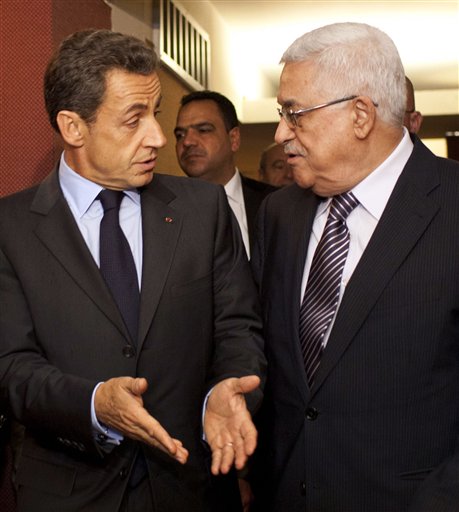
French President Nicolas Sarkozy, left, meets with Palestinian President Mahmoud Abbas at the Millennium Hotel in New York during the 66th session of the United Nations General Assembly on Tuesday, Sept. 20, 2011. (AP Photo/Andrew Burton)(Credit: AP)

A top Palestinian official said Wednesday that President Mahmoud Abbas had no plans to agree to a delayed vote on his bid for membership in the United Nations, rejecting mounting pressure from the United States and France.

The Palestinians plan to submit their letter of application on Friday when Abbas is to speak to the U.N. General Assembly, but he faced a withering lack of support as the world body opened its annual meeting. President Barack Obama said there could be no “shortcuts” in the quest for Middle East peace, a message that was echoed by French President Nicolas Sarkozy.

“We will not allow any political manoeuvring on this issue,” said Saeb Erekat, a senior aide to Abbas and former chief of negotiations.

Erekat said Abbas had made that plain in discussions with all parties involved over the last three days of meetings in the lead-up to the annual UN global gathering of presidents, heads of state and ruling royalty.

Sarkozy proposed a one-year timetable Wednesday for Israel and the Palestinians to reach a peace accord, part of a concerted push with the United States to steer the Palestinians away from an application for U.N. membership.

Sarkozy spoke shortly after Obama warned against action on the Palestinian bid before there was a peace agreement. He said negotiations, not U.N. declarations, were essential to a lasting peace.

While Obama stopped short of calling directly for the Palestinians to drop their bid for full membership — an effort the U.S. has vowed to veto in the Security Council — Sarkozy sounded a more compromising tone and urged each side, and the international community, to approach the deadlocked process with new ideas and tactics.

“Let us cease our endless debates on the parameters and let us begin negotiations and adopt a precise and ambitious timetable,” Sarkozy told the leaders and officials gathered at the U.N. “Sixty years without moving one centimeter forward, doesn’t that suggest that we should change the method and the scheduling here?”

“Let’s have one month to resume discussions, six months to find agreement on borders and security, one year to reach a definitive agreement,” he said.

A senior European Union official said the proposal laid out by Sarkozy matched one by EU foreign policy chief Catherine Ashton during a meeting with EU foreign ministers on Tuesday. The official spoke on condition of anonymity because of the sensitivity of the discussions.

Abbas’ push for full membership, which he has said would be submitted on Friday, has dominated this year’s U.N. meeting, pushing the U.S. and Israel against a wall of international sympathy for Palestinians. While the full membership bid would meet with a certain U.S. veto in the Security Council, assuming the Palestinians muster enough votes to have it approved, they have succeeded in bringing the issue again to the forefront of the world’s political discussions after years of failed negotiations, bickering and sporadic outbreaks of violence.

Sarkozy said that by setting preconditions, “we doom ourselves to failure. … There must be no preconditions.”

It remained unclear whether the latest proposal would be enough to avert a showdown over statehood that has consumed the U.N. over the past few days and sparked a frenzy of last-minute diplomatic door-knocking by the Israelis and the Palestinians, as well as a flurry of discussions between the Quartet of Mideast negotiators — the U.S., the E.U., the U.N. and Russia.

But the proposal outlined by Sarkozy received a warmer welcome from the Palestinians than Obama’s comments.

Yasser Abed Rabbo, a senior Abbas aide, told The Associated Press that the Palestinians “appreciate the speech and the positions included in that speech.”

“The Palestinian leadership will study seriously the positions and the ideas in that speech,” he said.

Obama’s remarks, however, drew a lukewarm response, with the Palestinian delegation wearing stern and disapproving looks as the U.S. president spoke.

“Peace will not come through statements and resolutions at the United Nations — if it were that easy, it would have been accomplished by now,” the president told U.N. delegates. “Ultimately, it is the Israelis and the Palestinians who must live side by side. Ultimately, it is the Israelis and the Palestinians — not us — who must reach agreement on the issues that divide them.”

Obama showed solidarity with Israel, not mentioning a return to the borders before the 1967 Arab-Israeli war in which Israel annexed territory. The remarks may rile some in the Arab world where mass uprisings against authoritarian regimes have also sparked a new measure of anti-U.S. sentiment. Obama’s words also stood in stark contrast to the image he left behind when he addressed the Muslim world from Cairo in 2009, pledging to improve relations and cooperation.

Senior Palestinian officials said Abbas will reiterate to Obama his decision to move forward with the application for membership that will be submitted to the Security Council. But they also said that the Palestinians seek to cooperate with the U.S. and will be ready to return to the negotiating table once a solid foundation for talks was in place.

Nabil Abu Redeineh said that “peace in the Middle East needs an immediate end of the Israeli occupation” and that the U.S. needs to pressure Israel to immediately withdraw from lands annexed in 1967. The Palestinians are ready to return to talks “the minute Israel accepts” those borders and stops settlement building, he said.

Obama was scheduled to meet later Wednesday with Abbas.

He met earlier in the day with Israeli Prime Minister Benjamin Netanyahu.

With Obama at his side, the Israeli premier said the Palestinian bid to appeal directly to the U.N. was a short cut that “will not succeed.” Netanyahu also lauded Obama for speaking up on principle.

The issue of Palestinian statehood has gained new momentum in the Arab world amid the so-called Arab Spring uprisings that have ousted the leaders of Egypt, Tunisia and Libya and laid the still rocky foundations for a new era of freedom and democratic nations in a region dominated by dictators, monarchs and other entrenched regimes.

Associated Press writers Mohammed Daraghmeh, Amy Teibel and Julie Pace in New York contributed reporting.

Obama stands by Iraqi troop pullout

President Barack Obama renewed his vow Tuesday to have all U.S. combat troops out of Iraq by next August, while nudging Prime Minister Nouri al-Maliki to see that his parliament quickly passes a critical election law essential to a nationwide vote in January.

Without an election law, the vote could be delayed, snarling American plans to begin significantly scaling back U.S. troop presence after the national referendum.

“We have seen in the last several months a consolidation of a commitment to democratic politics inside of Iraq,” Obama said. “We are very interested, both of us, in making sure that Iraq has an election law that is completed on time so that elections can take place on time in January.”

Vice President Joe Biden also pressed al-Maliki on the election legislation when they met a day earlier.

As Obama promised to hold to U.S. withdrawal plans, which would see all troops leave Iraq by the end of 2011, Obama also told al-Maliki that he was glad the two leaders were now able to expand their talks beyond warfare to the “enormous opportunities for our countries to do business together.”

The Iraqi leader was in the United States in conjunction with a conference designed to boost international business and investment in Iraq, where six years of war have devastated the national infrastructure, factories and all-important oil sector.

“We didn’t just talk about military and security issues,” the president said. “What is wonderful about this trip is that it represents a transition in our bilateral relationship so that we are moving now to issues beyond security and we are beginning to talk about economy, trade, commerce.”

The U.S. negotiated a status of forces agreement in the latter months of the Bush administration which commits the United States to having all combat troops out of the country by the end of August and all other forces — counterinsurgency and support troops — gone by the end of 2011.

Beyond its significance for the U.S. pullout, the January election will be critical for the Iraqis with the potential for important political and power realignments. It could threaten al-Maliki’s hold on power after the powerful political bloc of his Shiite Islam co-religionists excluded him from its coalition going into the vote.

It that estrangement holds, it would require that al-Maliki turn for political allies among Sunni Muslims, whose insurgency took the country to the brink of civil war in 2006 and 2007, and secular parties.

Al-Maliki also repeated his call for help from the Obama administration in the cancellation of all U.N. sanctions and resolutions adopted after Saddam Hussein’s 1990 invasion of Kuwait, saying Iraq is a democracy and has no weapons of mass destruction .

“This is important to move Iraq forward and to promote investment,” the Iraqi leader said.

Obama nodded as he listened to a translation of al-Maliki’s remarks, but neither leader took questions after their brief statements in the White House Oval Office.

Continue Reading Close
www.salon.com/writer/steven_r_hurst/index.html