Stewart O

Tell-tale hearts

The author of "A Prayer for the Dying" picks five tales of creeping madness.

  • more
    • All Share Services

As a lifelong connoisseur of horror writing, I find that little appeals to me as much as the inexorable spiral into madness or evil as described by what at first seems a trustworthy narrator. Poe was the first master of the genre, and since then all kinds of fine writers have tackled it. Noir giant James M. Cain specialized in the good man temporarily driven bad by his love for a woman, and Jim Thompson took it a step further, with characters who slowly revealed (and creepily reveled in) their capacity for evil. Here though, I’ve chosen five writers using the first person to describe the anger, doubt and madness behind their women narrators:

The Bell Jar by Sylvia Plath (1962/1971)
“It was a queer sultry summer, the summer they executed the Rosenbergs.” Well, hello to you too. Esther chatters and sulks at times like Holden Caulfield, but underneath it there’s a lot farther drop. When she levels her disgust at the people trying to love and help her, the reader gets a feel for that free fall, even without adding on Plath’s own pathology. Extra points for the Jesus allegory, implicitly comparing her tribulations to crucifixion.

Surfacing by Margaret Atwood (1972)
“I can’t believe I’m on this road again, twisting along past the lake where the white birches are dying, the disease is spreading up from the south …” Atwood has been gloomy in other books, but here she isolates and then breaks her heroine down to raw nerves, jettisoning the entire world to find herself. A back-to-nature Gothic.

Lithium for Medea by Kate Braverman (1979)
Like Atwood’s narrator, Braverman’s has chosen to confront everything wrong with her life simultaneously, including a sad habit of ingesting every drug that floats through her L.A. neighborhood and giving in to asshole boyfriends. One of the great deadpan junk books, along with Denis Johnson’s famous “Angels.” “The Enterprise was run by Captain James T. Kirk. Gerald dismissed him as meaningless.”

Suspicious River by Laura Kasischke (1996)
Kasischke’s Leila drifts into prostitution just for something to do — to fulfill some unknown need she can’t quite fathom. And it’s hard to say — for Leila and for the reader — whether she’s enjoying her power or it’s draining her. The writing careers from the sensual and poetic to the flattened affect of Chandler: “There are different kinds of men, I thought then, but not many different kinds.” Face it, bad things are gonna happen. But you know what? She doesn’t care.

The Devil’s Chimney by Anne Landsman (1997)
In the middle of nowhere in South Africa this old crazy drunk spins her memories, mixing things up. A girl disappeared, some other woman was murdered years ago. What the hell is she talking about? Landsman gives her wicked asides, while all the time she’s trying to charm us. Unreliable, unpredictable, funny and mean as hell.

And that’s one thing all five narrators share: how they surprise us with their angry insanity. Flannery O’Connor said the best way to get to readers was to distract them, then hit them over the head. These five do that brilliantly, suckering us in with the intimacy and warmth of the first person and then chilling us. Edgar Poe would be jealous.

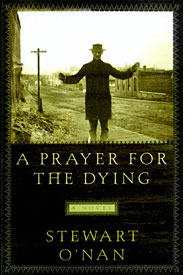
A Prayer for the Dying

  • more
    • All Share Services

A Prayer for the Dying

It’s darker under the trees, the stars peeking through the canopy, a hint of hyacinth in the air. Tomorrow’s Saturday, and you haven’t even begun your sermon. How many ways are there to say have faith? You search your memory for a parable on strength, on trusting the Lord. Abraham and Isaac come to mind, but you just did that last week. Job’s overused. Lot. You shake your head and walk on. It’ll come, just give it time. Maybe leaf through Matthew after supper, look over your old notes.

Round the bend, and there’s your house, the lamp lit, windows warm and orange as your neighbors’. Is it selfish that you give thanks for this, that the sight touches you more deeply — that it seems to mean more — after poor Lydia Flynn? If so, you don’t mean to be cruel. And you’ve done right by her, you make sure of that.

Through the gate and up the walk toward the front door. It’ll be good to get his gun belt off, the jacket, the boots. You’ve earned your supper.

Locked, just as you instructed. You jangle the big key ring, searching.

Open the door and the light blinds you. Fresh bread, and the salty crackle of fat. On the floor of the sitting room lies Amelia’s stuffed duck, toppled on its side. You undo the gun belt — Marta won’t have it around the child — and stow it high in the front closet, thumping the door shut to announce yourself. When no one comes, you make your way to the kitchen.

It’s empty, a wisp of steam floating up through a hole in the stove top.

“Marta,” you call.

In the dining room the table’s set, your milk poured, the high chair between the two seats so you can each minister to her. The tray holds a spray of crumbs, a slug of gravy. Maybe they couldn’t wait.

The back of the house is dark.

“Marta?”

You try your room first, peering in the door. She’s not on the bed, and immediately you turn to the nursery.

It’s black, and you have to leave the hallway before you see Marta sitting in the rocking chair, her hair a bright frame, her face dark, impossible to read. She’s still, hands in her lap. Amelia’s in her crib, already asleep, and softly you go to Marta.

“I’m sorry,” you apologize, ready to explain why, but she doesn’t take your hands, she doesn’t look at you, as if you’ve done something inexcusable. A wet sniff and you know she’s been crying.

“What is it?”

“She’s sick,” she says.

“What do you mean?” you ask, though you already know. Better than anyone, you know.

“She’s sick,” Marta says, and now she’s clutching at you, grabbing, crushing herself to you with a strength you find frightening. “Jacob, she’s sick.”

Continue Reading Close