Suzi Parker

Look away, Dildo Land

The author of "Sex in the South" whoops it up at a sex-toy sales meeting in Arkansas.

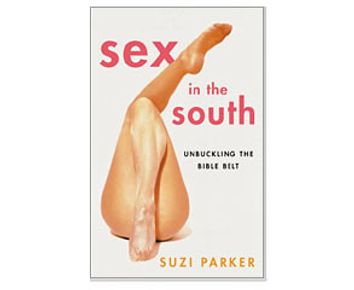
Editor’s Note: Suzi Parker is a journalist who lives in Little Rock, Arkansas. She’s been working on the book “Sex in the South” for about five years, looking for the most compelling, unusual stories that would make up what she calls “one girl’s whirlwind tour though the sexual South, rather than a dry, academic study.”

She found a lot of the stories in her native state, but after doing research she found that a whole sex underground network existed in the South — even though the outward image of that part of the country is socially conservative. Mostly it’s religion that defines the region. “We’re a region that is absolutely dominated by religion,” says Parker. “It’s not uncommon to find a town with more churches than liquor stores. In such an overtly religious region, folks naturally develop split public versus private personalities when it comes to sex … that kind of repression leads to some serious pressure building up, a pressure that gets released in some unusual, creative ways.”

This excerpt is from the first chapter of “Sex in the South” and it’s definitely about pressure being released.

“Dildo-a-rama”
Vacuums and Vibrators

MAUMELLE, ARKANSAS — It’s hard to focus on the Scriptures when you are thinking about the EZ pleaser.

Only in the South would a girl like me go to church on Sunday morning, attend the monthly Methodist potluck after the preaching, and then show up a few hours later at a local hotel to learn the art of selling sex toys to housewives. But after all, this is Arkansas, the land of split personalities, where nobody is ever what they seem.

I gobble down the last bit of Jell-O salad, a frothy green concoction of whipped cream, lime gelatin and pineapples, on my paper plate at the potluck before saying my good-byes. I don’t bother to tell my friends my afternoon agenda — that I am headed to a sex toy sales meeting at a Ramada Inn.

The motel sits perched on a hill between a chain-owned Mexican restaurant with oversized floppy sombreros on the fiesta-bright walls and a chain-owned Chinese restaurant with jumbo glittery goldfish in a man-made stone pond. I walk into the mauve and beige lobby, and before I even approach the front desk to ask where the sex toy mavens are meeting, a stern-faced man points down a hall. He obviously knows what I am looking for on a Sunday afternoon — jiggly, wiggly sex toys.

In a small conference room, a group of women — who clearly enjoy shopping at Wal-Mart and prefer casseroles to Donna Karan and personal trainers — bubble with giddy electricity. This afternoon isn’t about 12-inch dildos, fuzzy lavender handcuffs for light S/M, or even vivid violet vibrators. No, it’s all about introducing these modern-day sales folk to a new product: Pure Satisfaction.

Pat Davis, the president of Passion Parties in Brisbane, California, has flown in for this seminar. This, I soon learn, is a big damn deal. She was formerly a motivational speaker at San Diego’s Millionaires in Motion before she found a home at Passion Parties. It’s not every day the common housewife or beauty operator who sells sex toys on the weekend meets Pat Davis, a brassy woman who tells the crowd she’s been married for more than 30 years and a little romance and hoochie-coo never hurt anyone.

It’s no surprise that the president of the company would embark on a tour of the South. It’s the best-selling area in the country for sex toys. And Passion Parties, hosted by perky Passion Party hostesses (think 1970s Tupperware parties but with rubber penises instead of plastic ice trays) are all the rage in small towns across the region. There’s nothing like a bunch of women getting together on a Friday night and giggling naughtily about a piece of rubber in the shape of a dick. Unless, that is, it’s on Wednesday night. That’s when husbands think their wives are at choir practice at the Southern Baptist church, but then they come home with edible undies and a love swing under their arm instead of the Bible.

The women in this cozy conference room range in age from a bashful 22 year old to 60-plus. Some are married, some single.

“Have you tried it?” a Big Gulp-sipping woman beside me asks me point-blank.

I shake my head no. Last time I tried such a sexual aid I got into serious hot water. I prefer to go the natural route now, and if a screaming banshee orgasm fails to happen, so be it. I’ll play it safe for a while.

Oh, honey, you’ve got to try it. Make her give you a sample.”

I smile and nod. Yeah, sure thing.

Here’s how the Passion Party catalog describes Pure Satisfaction UniSEX Enhancement Gel: “An exclusive UniSEX gel for enhanced sexual satisfaction in high demand by today’s men and women. Passion Parties is the first to present a safe and natural topical Unisex gel that induces more intense orgasms in both sexes, allows for greater intimacy and maximum sexual fulfillment.” You get the picture.

Just in case I didn’t get the picture from that description — written by an established romance writer who shall remain nameless (something tells me it’s not Danielle Steele) — some of the women in the room decide to give testimonials. Just like church: Time to testify!

“I’ve always had a fantasy about having an orgasm so intense that I pass out,” says a woman in her thirties with curly brown hair.

Damn! I think, suddenly picturing this housewife starring in a snuff film.

“My husband and I applied it to my clit and to the head of his penis. Then you feel it. It’s tingling, burning, on fire. He slid into me and banged me until I had the orgasm of my life.”

The woman gasps and sweat pops out on her face. Her eyes glisten at the torrid memory. I’ll have what she’s having, I think to myself.

“But that wasn’t enough so I made him go again, and I came again.”

Oh, yeah! I’ll definitely have what she’s having.

“Then, he just couldn’t go anymore but I could. So that’s when we got out the sex toys.”

Perk! Definitely want me some of that.

“And I came so hard when he kept pushing the sex toy in and out that I passed out. I was gone. I think it scared my husband, but I came to after a few minutes.”

Hmmm, not so sure I want what she’s having after all. I’m not ready to quasi-meet my maker following a screaming O. But everyone else seems receptive and claps loudly. I’m reminded of an old-time riverbank revival: same passion, different scripture.

Get your laws off my coffin!

The funeral industry dukes it out with independent casket dealers as Americans redefine the way they deal with death.

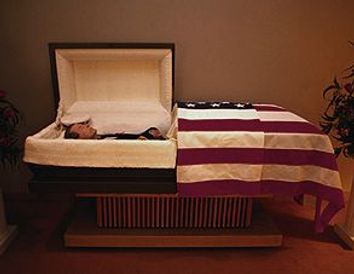
Bucky Sanders’ casket store in Hot Springs, Ark., sits near a railroad track and, appropriately enough, two cemeteries. His small shop looks more like a used auto parts store than a place where bereaved families go, but Sanders isn’t trying to affect the somber formality of a funeral home. All he’s selling are coffins.

Sanders has a clear and simple mission: to sell caskets cheap. He’ll sell you a coffin with cherubs on the corners and the Lord’s Supper on its handles for $1,800. That’s half what a funeral home charges, and if you can’t pay for it outright, that’s fine with Sanders, who worked for 43 years at a local funeral home.

“Funeral homes demand the money on the spot,” says Sanders in his Southern drawl. “A lot of people just don’t have the money. I try to work with them. I think this would be pleasing to the good Lord.”

Sanders buys his caskets from a company in Houston. At any one time, he has 12 to 15 of them in stock with price tags that range from $950 to $2,000, including free delivery to anywhere in Arkansas. Business is good, but pressure from funeral companies is a constant thorn in his side. It’s not uncommon for Sanders to get an anxious call from a customer whose funeral home has refused to use a casket from Sanders’ store. What the home is doing is against the law, Sanders tells the customer, and, in Arkansas at least, he’s right.

Twenty years ago, the only way to get a casket or cremation urn was through a funeral home. Without competition, funeral directors marked up caskets as much as 700 percent, including in that lump sum the costs of the hearse, embalming, the wake and other items.

In 1984, the Federal Trade Commission forced change on the industry, requiring, among other things, that funeral homes itemize their charges. This aspect of the new regulations turned out to be a boon for funeral home directors: Instead of including multiple services in the single casket fee, businesses simply left the inflated casket prices as they were and tacked on additional charges. Subsequently, funeral costs grew 5 to 7 percent a year.

The 1984 rules also required that casket prices, manufacturers’ names and model numbers be made available, and allowed independent casket dealers to get in on the market by supplying caskets directly to consumers. But in many parts of the country, that legislation remained toothless as long as states were permitted to limit the sales.

As family-owned funeral homes, once a staple of small-town life, give way to large corporations like Service Corporation International (whose allegedly unsavory dealings with Gov. George W. Bush were reported in Salon), Americans are pursuing other methods of dealing with their dead. Thanks in part to Jessica Mitford’s landmark 1963 book “The American Way of Death” and its 1998 sequel, they’re growing savvier to the ways of the funeral industry and challenging long-established practices.

While independent casket dealers move in on a long-protected market, families are building or designing their own caskets; they’re cremating the deceased in growing numbers and burying people in “eco-burial” grounds. Baby boomers are planning their funerals as they do their lifestyles with alternative and creative choices — designer caskets, homemade cremation urns and funky funeral services with rock ‘n’ roll replacing traditional religious hymns.

And as Sanders and other independent dealers fight for the right to sell their caskets to anyone who wants them, the last vestiges of the funeral industry’s monopoly on the way we die are slowly being wiped away.

“I get sick of seeing people being ripped off,” says Rick Dancy of Meridian, Miss., who recently earned the distinction of being the first man in the United States to be imprisoned for selling caskets from an independent dealership. A court later found the arrest unconstitutional, and Dancy continues to sell the caskets that he buys from Casket Royale, a New Hampshire wholesaler that has dealers in 44 states.

“There’s no sense in people having to pay double for a casket just so the funeral homes can make a good profit. A casket store puts the power back to the people,” Dancy says.

In effect, Dancy, Sanders and other independent casket dealers are reversing the consolidation of the funeral industry that took place over the past century or so.

The tradition of the funeral home dates back to the Civil War, when soldiers’ bodies were embalmed before undergoing the long transport back home to their families. Initially, this task belonged to the coffin maker, often a local furniture dealer who took on the job of preparing a body for burial. As Americans began to cluster in urban centers and move into smaller apartments, it became necessary to find surrogate “homes” in which to hold wakes. Thus funeral homes were established, soon becoming single-stop outlets for funeral services — embalming, viewing, hearse, flowers, casket.

For much of the century, the funeral industry faced little competition. The death of a lover or family member proved enough of a preoccupation to keep families from shopping around or demanding alternatives to the options funeral homes gave them. Even today funeral homes exploit families’ grief to extract high fees. According to Lisa Carlson, president of Funeral and Memorial Societies of America, the cheapest casket on the market is a $150 cloth-covered particleboard box that many funeral homes resell in the $695-$895 range. Funeral directors, when telling families about their options, commonly call this the “welfare box,” effectively shaming families into buying a pricier model.

Over the past few years states have slowly opened up the market to independent casket dealers. Today, only six states — Louisiana, Alabama, Idaho, Oklahoma, South Carolina and Virginia — prohibit casket sales by independent dealers.

In November, Mississippi was crossed off that list when a federal judge struck down the law that had allowed casket sales only by licensed funeral directors. The state had argued that its law addressed health concerns because human remains need to be buried quickly. But the judge rejected that claim, saying he was skeptical that “possible ignorance or incompetence of an unlicensed dealer would delay burial, as such a dealer is selling what amounts to be a glorified box.”

The casket war has also hit South Carolina, where a judge recently struck down the requirement that casket dealers have embalming rooms, chapels and hearses. To sell caskets, however, a person must still be a licensed funeral director. And in August, a federal judge ruled that Tennessee’s funeral director law violated the 14th Amendment’s protection from arbitrary regulation.

A federal court also recently tossed out a Georgia law prohibiting casket sales by any entity other than a funeral home, calling the law a blatant restraint of trade. In a desperate attempt to keep its regulations alive, the state argued that allowing independent casket dealers to engage in a price war would “promote the criminal element” — in other words, that the easy availability of caskets would encourage murder.

The country’s traditional coffin makers — Batesville Casket Co. and Aurora Casket Co., both of Indiana — still sell wholesale only to licensed funeral directors. Casket Royale has grown to be the world’s largest provider of caskets to third-party funeral merchandisers — and is a major force behind moves to open up independent casket sales in the South. The company currently services independently owned and operated retail funeral stores; it also sells directly to the public.

“We sell at least one a day to consumers,” said Mark Ginsberg, president of Casket Royale, which likes to tout itself as the Wal-Mart of the funeral industry. “We advertise on TV about 60 times a day. People are tired of being dictated to by the funeral industry.”

These days, more bereaved families are becoming savvy about funeral services — saving hundreds, sometimes thousands, of dollars when they shop to compare prices.

The National Funeral Directors Association reports that the average amount spent in 1999 for a funeral was $5,778.16, with $2,176.46 of that going toward the casket and $1,000 for cemetery charges. According to the Bureau of Labor Statistics’ consumer expenditure survey, funeral spending is on the decline, dropping an average of 7 percent annually since the mid-1980s. Some industry experts say the high cost of dying is why cremation is on the rise nationwide, even in the South, where traditional burial is usually preferred.

The development of an independent casket industry is part of a larger movement of families playing a bigger role in their loved ones’ deaths.

“This is the same generation that reinvented natural birth in the delivery room,” says Carlson of Funeral and Memorial Societies of America. “I think we will see more boomers changing the way funerals are handled and see more people having at-home funerals.”

As Arnold Goodman, a Minnesota rabbi, wrote in his 1970s book “A Plain Pine Box,” the practice of surrendering our dead to funeral homes has taken us far from the intimate experience of death that was once a part of living. “Customs of the past, which required families to wash and prepare their dead ones for burial or cremation, for the construction of the casket and shroud, the choice of which families and friends would assume responsibility for preparing the dead for burial, for making arrangements with — and for — the family for fabricating coffins and burial garments, have all but disappeared.”

When Stacy Black and Jeff Esley’s father was diagnosed with terminal cancer, they decided that his funeral should be in keeping with the way he lived life, and not take place in the decorous anonymity of a funeral home.

Esley, who is a master woodworker, built his father a casket modeled after one he’d seen in the old western movies his father loved. Black made the satin lining for the casket; an aunt made the pillow. It was a way of keeping their father’s death in the family. Black says, “It was something truly from the heart.” Since then, Esley has received calls about making caskets for other people.

New traditions are arising all across the country. Ramsey Creek Reserve offers burial sites for biodegradable caskets, and forbids gravestones or plastic flowers in a burial that costs about half the cost of a traditional funeral home burial. The Funeral Consumers Alliance directs visitors to organizations that supply all the components of a make-it-yourself casket.

Or, for those for whom “individualizing” death means expression, not austerity or environmentalism, there’s Whitelight Casket Co. in Texas. Whitelight has created “Art Caskets” that feature religious and ethnic themes, scenic landscapes, vocational and lifestyle images and symbols of patriotic pride and nationality. Designs include a rosary, breast cancer and AIDS awareness ribbons, an ocean beach, New York, the flag of Ireland, Our Lady of Guadalupe, clouds, the Last Supper and a lighthouse.

Sanders says that the movement toward independent casket dealerships is just a matter of fairness. He says that in his years in the funeral business, he saw too many families struggle to try to buy their beloved a decent funeral. When he retired, he wanted to do something to counter the industry that had fed his family for many years.

“People should have a choice,” he says. “I don’t know how funeral home directors sleep at night knowing they are ripping off people the way they are.”

Continue Reading Close

Betting on Hillary

A Web site lets you actually invest in -- and profit off -- the candidates of your choice.

When New York Mayor Rudy Giuliani announced last week that he had prostate cancer, his political stock dropped. Yes, literally. And yes, people lost real money.

Before Giuliani’s press conference Thursday morning, Rudy stock was trading at 50 cents on the Iowa Electronic Markets, run by the University of Iowa’s Henry B. Tippie College of Business. After his announcement at 10:05 a.m., buyers started selling.

By 10:20 a.m., his price had plummeted to 10 cents — the lowest price possible. By noon, the stock had crept back up to around 30 cents, where it stayed all weekend, and seems to be holding.

The markets started in 1988 as an academic experiment by three Iowa professors who looked at Jesse Jackson’s presidential race in Michigan and realized his primary win had never been predicted in the polls. The trio decided to set up a system that would create a better, more accurate predictive model — and tried to lure people to log on, invest in politicians and maybe make a little money.

It’s certainly an idea that seems inevitable. With corporate money funding politics, why not just turn the races over and let the market decide who will lead? And, of course, what more logical incentive is there to become involved in politics in these boom times than the promise of profiting off of politicians?

The people who run Iowa Electronic Markets even like to boast that they often predict winners — and losers — more accurately than popular opinion polls. In the 1996 presidential election, the markets came within two-tenths of Clinton’s win of the popular vote (Clinton over Dole, 49.24 to 40.71 percent). That was also the year the markets had a record number of investors — 8,000.

That’s not enough people, of course, to create a market big enough to make anyone rich. Each trader is limited to spending $500. But the odds are both obvious and, to the idle political junkie, somewhat attractive. If you bought $500 worth of Hillary stock on Tuesday, when she was trading at 50 cents, you make out with $500 in November when she wins. If you bought stock in Rudy instead (30 cents), you could make $700 if he becomes senator.

The hottest stock this year, of course, already soared and went bust: John McCain. Mitch Wiegner, a trader in Chicago, made about $15 on McCain. “I made it before the South Carolina debacle. A friend is a CNN junkie and he said, ‘Get out,’” says Wiegner. So he sold. Now, he is looking at the Giuliani/Clinton race as a possible investment.

“That one is getting really interesting,” says Wiegner. “I’m going to have to look at it closely.”

Unlike Wall Street, volume is relatively low, allowing a small number of players to manipulate the prices. There’s also no way — yet — to force losers to pay up; traders now only make promises to pay before they get to play.

But that’s likely to change as the market grows. So far this election cycle, almost 6,000 traders have invested $125,000 — placing their money on myriad politicians and races, including George W. Bush, Al Gore, Reform Party candidates and even the 2000 Mexican election. There’s a special market that trades over who will control Congress. (Traders are betting on a Democratic House and a Republican Senate at 51 cents a share.)

George Neumann, a professor of economics at the university and a founder of the markets, says that they can tell that the Web site receives visits almost daily from the White House, as well as from the Clinton and Giuliani campaigns.

Gore spokesman Chris Lehane, who has often said that “some candidates are blue-chip candidates; others are like junk bonds,” should be happy to know that his candidate is 4 cents ahead of Bush as of Tuesday afternoon. But it’s the Senate race in New York that has continued as the most volatile and certainly the most interesting.

Giuliani campaign spokeswoman Juleanna Glover Weiss says, “It’s certainly an entertaining phenomenon to watch. But in term of the viability of candidates, it’s simply a reflection of the conventional wisdom. I think it’s something that’s viewed more out of curiosity than any sort of serious attention.”

Then Weiss asked how Giuliani and the first lady were trading in the markets. When told the current stock quotes, she replied: “Let’s put it this way, there is no studied attention by this campaign to that phenomenon.”

That’s certainly easy to say when your man’s stock is tanking.

And Giuliani’s dive certainly reveals the coldhearted aspect of the market. In fact, the last time the markets saw such a severe dive over a candidate announcement was when it was reported that Bill Bradley had an irregular heartbeat.

“It’s much like what we saw when Bradley announced he had a heart problem,” says Jeanine Pfuntner, operations manager of the Iowa Electronic Markets. At the time, Bradley’s stock fell from 23 cents to 13 cents and, obviously, never really recovered.

Says Pfuntner: “If people think if you are going to die, they don’t want to elect you.”

And they certainly won’t invest in you.

Continue Reading Close

We are family

Not only is George W. Bush related to 16 American presidents, but he's kin to half the country, too.

It’s hardly a secret that George W. Bush has an impressive family tree. His father was president; his grandfather, Prescott Bush, was a U.S. senator from Connecticut; and his brother Jeb is governor of Florida.

But the Republican candidate for president has a richer political pedigree than the immediate family that gathers for Christmas dinners and birthday celebrations. They are, in fact, related to 16 U.S. presidents, a slew of British monarchs and even the American Indian princess Pocahontas.

Gary Boyd Roberts, a prominent genealogist at the New England Historic Genealogical Society, documented the remarkable Bush lineage in his little-noticed book “Ancestors of American Presidents,” published in 1995. According to Roberts, the list consists of George Washington, Millard Fillmore, Franklin Pierce, Abraham Lincoln, Ulysses Grant, Rutherford B. Hayes, James Garfield, Grover Cleveland, Teddy Roosevelt, William Howard Taft, Calvin Coolidge, Herbert Hoover, Franklin D. Roosevelt, Richard Nixon, Gerald Ford and George H. W. Bush.

Asked to comment on his remarkable family heritage, Bush issued a statement to Salon through his campaign on Thursday: “As Lincoln reminded the American people, even though he did not know much about who his grandfather was, he was much more concerned with who his grandson would become. While the past is important, we must always look to the future. In particular, I am proud of my father’s service to the country. He has set a great example of serving with honor. I hope to build on his legacy and the legacy of other presidents by providing America with a new style of leadership and a fresh start for America in the 21st century.”

Bush’s extensive lineage dates back to ancestors who arrived here on the Mayflower in 1620, Roberts found. His connection to Pocahontas, the Indian princess who married John Rolfe (the first colonist to grow tobacco as a crop) is through a Bush ancestor who married the couple’s only American great-grandchild.

Bush is also a descendant of Dr. Samuel Prescott, who completed Paul Revere’s Midnight Ride in 1775. And through Rev. John Lathrop, a non-conformist and founder of Barnstable, Mass., the Bushes are related to Grant and FDR.

Howard Howland, a Mayflower passenger who died in 1673, had two children, and the direct lines from them through the years lead to four presidents — FDR, Nixon, Ford and Bush.

Another Mayflower passenger, Thomas Mitchell of Holland, also had two children. Through them, George W. can trace his roots to the late Princess Diana and her two children Princes William and Harry. Taft, the 27th president, also comes from this lineage.

Many assume George W. Bush is also related to Franklin Pierce, the 14th president, through Barbara Bush, whose maiden name was Pierce. But the Bushes are related to Pierce though Daniel Brewer, who died in 1646, yielding a lineage that leads to both Pierce and Hayes.

George W. also descends from Agnes (Yeomans) Wheeler. Genealogists call her the mother of presidents because she is the only American female who has had four descendants elected to the office — Garfield, Hoover, Ford and Bush.

While genealogist Roberts has extensively researched the Bush family tree, he has never been able to link the family to America’s original Bush — the first man with that surname known to arrive in America. When Bush’s father was president, the Bushes contacted Roberts about this matter. A small English village had written the White House about a man in their village during the 1500s named Bush and asked whether he was an ancestor of the president.

“I had to tell the White House that I was unsure if that was the case,” said Roberts.

Documentation in Roberts’ book also cites Bush’s relations to five kings — Henry I, Henry II, Robert II of Scotland, William I of Scotland and Edward I of England. But Bush certainly isn’t alone in his royal bloodlines. Sixteen presidents and 14 first ladies have been descended from European royalty.

In the 20th century, Bush’s family didn’t hobnob with kings, but they certainly mingled with presidents before taking over the White House themselves. Bush’s great-grandfather was a steel and railroad magnate who became a personal advisor to President Hoover, who was in fact a distant relative. Grandfather Prescott Bush, the Connecticut senator, was a favored golf partner of President Eisenhower (not a relative). Grandmother Dorothy Walker Bush’s father founded a Wall Street investment house and was a close advisor to FDR, another Bush relative.

George W. Bush spent his childhood between the Bush homes in New York, Long Island and Connecticut; the family compound at Kennebunkport, Maine; the 10,000-acre plantation in South Carolina; and the island retreat in Florida, where their neighbors were Doubledays, Fords, Roosevelts and Vanderbilts.

“He may have a lifestyle of a Texan, but George W. is a social register Greenwich boy,” says Roberts. Certainly, when it comes to American politics, there is a dynastic process at work here. It would appear that the political system often rewards the candidates who have DNA advantages in the form of a respected family name. Whether this tendency also serves to undermine the ideal of representative government open to all, however, is a matter for debate.

But wait.

George W. isn’t just related to 16 former presidents. It turns out, according to Roberts, that he is related, ever so distantly, to roughly half of the entire American population.

So if people vote along family lines this November, Bush should sweep to an impressive victory indeed.

Continue Reading Close

Deep in the heart of Clinton country

George W. Bush travels to Arkansas' Central High School to tout his education platform.

href="/politics2000/directory/candidates/george_w_bush">Texas Gov. George W.
Bush treaded on President Clinton’s
home turf Friday, visiting Central High
School in Little Rock, Ark., a school
synonymous with the desegregation fights
of the 1950s and ’60s. But the
daylong, well-scripted affair seemed, at
times, sacrilegious and hypocritical
to many who wondered why the Texas
governor chose Central
High to tout his education reforms just
a month after visiting Bob
Jones University.

Central High School, the country’s most
powerful symbol for racial
integration, has historically been known
as Democratic territory. Bill and
Hillary Clinton attended the 40th
anniversary of the school’s integration
in
1997. Today, two-thirds of the school’s
students are African-American.

But for the Bush-led education
forum/photo-op Friday morning,
only a handful of teachers were invited
to attend the event
held in the school’s library, and just
three students, one of whom was
Gov. Mike Huckabee’s daughter, heard the
presidential candidate speak. The event
was vintage Bush, heading into territory
normally considered off-limits to
Republicans to send a vague message of
inclusiveness more symbolic than
substantive.

On a day when href="/politics2000/directory/candidates/al_gore">Vice President Al Gore
went back to school in Michigan to learn
about
education “from the people who are
actually doing the hands-on work” in his
words, Bush used the well-controlled
environment of Central as a theatrical
backdrop complete with Volume I and II
of “America” and a book about Texas
placed behind the candidate. In the
crowd were 45
special invited guests, including
Arkansas Sen. Tim Hutchinson, a graduate
of Bob Jones University.

“This is a place where African-Americans
confronted injustice,” said
Bush, “where white Americans confronted
their conscience, where the rule of
law ended the reign of segregation.”

These words were in biting contrast to
his controversial visit last month
to Bob Jones University, which until a
few weeks ago banned interracial
dating. Many saw his visit and speech
about race as deceiving, a ploy to use
Central High, like last week’s visit to
a Catholic church in Cleveland, as
another pawn to clean up the Bob Jones
mess that continues to dog Bush.

“Central High School is a symbol of many
things, including progressive
race relations,” said Vaughn McQuary,
chairman of the Democratic Party of
Arkansas. “For Gov. Bush to come to
Central High accompanied by a
graduate of Bob Jones University is an
unbelievably bad choice.”

In 1970, BJU gave up its federal
tax-exempt status rather than admit
black students.

Bush’s visit at Central High also
generated debate on his education
policies. Central High Principal Rudolph
Howard told Bush “public education
needs a lift up.” Bush interrupted the
principal, known throughout the state
as a man who rules Central with an iron
fist, and told him he shouldn’t fear
competition from charter schools.

“I’m sorry that you think I fear
anything,” snapped Howard. “If I feared
anything, I wouldn’t be at Central.”

Bush didn’t get off easy when Derrick
Williams, 18, Central
High’s student body president and a
member of the debate team, grilled him
about vouchers and charter schools.

“Public schools won’t be able to compete
with vouchers,” said Williams,
who hammered the idea that public
schools would fall behind if faced with
the
voucher and charter school programs.

Bush launched into his spiel about
meeting standards and taking education
to the local level. When finished,
Williams, who says he leans Democrat,
said, “May I rebut?” To that Bush
replied, “Sure, it’s your school,”
getting a good laugh from the crowd.

Despite a few lighthearted moments, Bush
insisted he would not be a
“federal superintendent” for the
country’s schools. He also said his
education policies are focused on
children, unlike Gore’s, which he says
are more concerned with “bricks and
mortar.” That signaled to Howard that
the $6.8 million needed for major
repairs — plumbing and
electrical wiring — as well as other
infrastructure needs would not be
granted
to the school, or any school, in federal
funds if Bush were elected president.

But Bush’s laser-focus on education, an
issue he is comfortable talking about
because he has grown familiar with the
issue as governor, appears to be paying
dividends. A new Pew Research Center
poll shows Bush holding a slight edge
over Gore when voters were asked which
candidate would “do the best job on
education.” Though clinging to a slim
44-41 percent lead, it is all the more
striking because education is typically
considered a “Democratic issue,” just as
national defense and tax cuts are
thought of as Republican issues.

Bush discovered friendlier turf a few
hours later as a host of wealthy
GOP-lovin’ Arkansans dished out $1,000
to attend a luncheon fund-raiser.

Bush pocketed $350,000 at the lovefest
that included Rep. Asa
Hutchinson, a possible attorney general
candidate in a Bush administration
and also a Bob Jones graduate; Sheffield
Nelson, one of Clinton’s worst
enemies, who has been accused of
masterminding schemes to topple the
Clinton
administration; Richard Bearden, a local
political consultant working on
Mayor Rudy Giuliani’s Senate campaign
and oil tycoon Madison Murphy, who heads
a
conservative commission to examine state
government.

Arkansas ranks 30th out of 53 states and
territories in fund raising for Bush.
Still,
the event earned Bush a hefty amount for
a state that only a few years ago
had little Republican power. It also
offered the chance for the Arkansas GOP
to take a few jabs at the Clinton-Gore
administration.

Playing on the Buddhist Temple joke that
Gore left the room when iced tea
was served, Huckabee said, “We wondered
whether to serve iced tea today. Just
remember where you were and that you
were at a fund-raiser.”

Bush shook hands, signed a GOP leather
jacket and fraternized before
giving his standard, slogan-ridden stump
speech — touting his compassionate
conservative reform results. At the
luncheon, he took only a few swipes at
Gore, but continued to try to link him
to the scandals of the Clinton White
House.

“Haven’t we had enough politics of lost
e-mails and Buddhist Temples?” he
asked. Holding his hand as if taking the
oath of office, Bush added “It’s
hard to usher in the era of
responsibility when figures of
responsibility
don’t behave responsibly.”

Bush ended his day in Clinton country in
a sultry airplane hanger at a
private airstrip with John Mellencamp’s
“R-O-C-K in the U.S.A.” blaring, where
he continued his attacks on Gore before
a crowd of 300 cheering, pompom waving
supporters.

“Al Gore may think he is going to take
Arkansas but we are going to show
him something different,” Bush screamed.
“People of Arkansas know the best
way to get the White House back is to
the end the Clinton-Gore Era in
Washington, D.C.”

Continue Reading Close

Look away, Dixieland

George W. Bush and Al Gore are coasting in the latest primaries, which are now just formalities.

For voters in six states holding primaries Tuesday, including Texas, Tennessee, Louisiana and Mississippi, taking a long lunch or sleeping a few minutes late was more appealing than going through the motions of casting a ballot, even if a local or state race was at stake. This was supposed to be Super Tuesday, Dixie style. But after last week’s departures of both Bill Bradley and John McCain, presidential choices quickly diminished. One local Republican Party official re-christened the day “Stupid Tuesday” in a New York Times article, with voters essentially asked to rubber-stamp what voters in other states have already decided for them.

With Tuesday’s victories, both Texas Gov. George W. Bush and Vice President Al Gore are expected to receive enough delegates to secure their respective parties’ nominations.

That didn’t stop the two putative nominees from going through the motions.

Gore watched the returns in Florida, hoping to send a signal that he plans to run hard in the state come November. Pundits have commonly placed Florida in the Republican column this fall because Bush’s brother Jeb is governor. So perhaps it was apt that Gore chose the auditorium at Leon High School in Tallahassee as his election night locale. Reflecting the name of the school mascot, the theater is known as “The Lion’s Den.”

“That has nothing to do with the fact that it’s just a couple of blocks from the governor’s mansion,” joked Gore spokesman Doug Hattaway.

But Hattaway did say that by spending Tuesday night in Florida, Gore hopes to send a message to Bush. “We consider Florida a battleground state, and the battle is joined tonight,” he said. “Jeb Bush or not, we’re going to do battle here in November.”

The South could be a key battleground this election year, especially since both Gore and Bush call the region home. While some think Bush could well sweep from Texas to Florida, Gore is vowing to stake out some key states to tussle with Bush this fall. Democrats are hoping to capitalize on some good news they received in 1998, picking up a U.S. Senate seat in North Carolina and the governorships of South Carolina and Alabama, and retaining the governorship of Georgia.

Since the 1960s, the South has been trending Republican, as the GOP adopted a “Southern strategy” to woo conservative Dixiecrats to the GOP banner. But with the remigration of blacks to the South, and the growth of the more liberal cities, Democrats are hoping to be competitive in certain key Southern states.

“We are not ceding the South,” said Hattaway. “The Democrats did very well in the South in ’96 with Gore on the ticket. He is a son of the South and knows the region well. We obviously can’t take any of it for granted, but neither can the Republicans.”

Jetting around the South last weekend, Bush showed no signs of letting up since vanquishing McCain last week. Bush zigzagged from Texas to Tennessee, Louisiana to Mississippi, where Senate Majority Leader Trent Lott and Nic Lott, the first black student body president at the University of Mississippi at Oxford, joined the Texas governor for a pep rally.

Meanwhile, Gore pounced on Bush territory, Texas and Florida, before heading home to Tennessee to vote Tuesday, and then back to Florida to watch returns. Gore got a Southern boost from Jim Bass, the Mississippi state director for McCain’s presidential campaign, who endorsed the vice president last week.

“I’m supporting Al Gore rather than George Bush because Vice President Gore is clearly the more experienced candidate,” Bass said, “and I agree with the direction he wants to lead the country.” He added that the vice president was “more in line with the values and priorities [of] McCain and the people who support him. Al Gore favors real campaign-finance reform, sensible tax cuts and a strong national defense.”

If there is a fight for the South in the fall, maybe voters will feign a bit more interest then. But until that time, many Southern voters are planning to just stay home.

Turnout in Louisiana and Mississippi was expected to be at an all-time low. Louisiana Secretary of State Fox McKeithen said voter turnout could reach as low as 10 percent. The state’s lowest voter turnout ever — 15.7 percent — was recorded in 1984.

“I imagine I’ll vote for Gore in the general election, but I don’t feel strongly enough for him to go interrupt my daily routine to reaffirm his selection,” says Chad Denning, a Tennessee Democrat who had planned to vote for McCain. “We have the technology now to have one primary day where people go and get to pick their favorites to run. We should have that.”

On Monday, McCain supporter Sen. Fred Thompson, R-Tenn., endorsed Bush at a rally in Tennessee in an attempt to unite the divided GOP. Former presidential candidate Lamar Alexander also came to show his support.

Still, voters don’t seem to care.

Tennessee newscasts are reporting turnout as low as 2 percent in some counties, including Davidson, which holds about 90 percent of the Nashville population. One precinct in Nashville had three voters all day.

The Southern primary was established in 1988 to give more domination to the region in the nominating process and specifically to offer a boost to conservative candidates. But that was circumvented by the rush to move up the primaries of California, New York and several other states before the Southern primaries this year. Some members of the Republican Party in Louisiana to hold caucuses before Iowa’s traditional first caucus, but the move created a furor within the GOP, and Bush loyalist Gov. Mike Foster helped kill the early caucus.

Louisiana’s parish registrars said the lack of interest in the presidential primaries is forcing candidates for local and district offices to depend on their campaign organizations to influence voter turnout.

“What you’re going to see is older, chronic voters going to the polls, and nobody else,” said Ernie Robertson, Caddo Parish’s registrar of voters.

Continue Reading Close

Page 1 of 5 in Suzi Parker

www.salon.com/writer/suzi_parker/index.html