Yael Kohen

An international affair

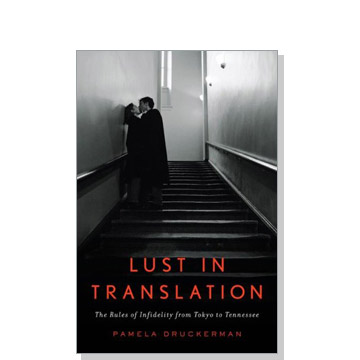
Pamela Druckerman, author of the new book "Lust in Translation," talks about the global allure of illicit sex, the problem with couples therapy, and the universal rules of infidelity.

  • more
    • All Share Services

An international affair

It’s not that Americans cheat any less than the French — in fact they cheat a bit more — it’s just that when Americans do cheat on their spouses they feel so damn guilty about it, it’s a wonder they ever had the affair at all. To Americans, “it’s not the cheating, it’s the lying.” And couples who don’t break up over infidelity often turn to therapy and support groups, which, ironically, frequently encourage cheating spouses to reveal every last detail about their illicit relationships to regain the trust that was lost when their pants came off in the first place.

So goes the American infidelity script, as it is unraveled by former Wall Street Journal reporter Pamela Druckerman in her new book, “Lust in Translation.” Druckerman traveled to 10 countries to investigate, as her subtitle puts it, “The Rules of Infidelity From Tokyo to Tennessee.” Through dozens of interviews with middle-class urbanites, the author, who devotes a chapter to each country she visits, debunks — and sometimes confirms — national myths, stereotypes and pastimes. Along the way she discovers that people in poor countries tend to cheat more than people in wealthy countries, that in America men and women under 40 have nearly equal rates of infidelity, and that everyone, all over the world, sometimes gets hurt. While the evidence she presents is primarily anecdotal and backed up by statistics that even she admits are imperfect, Druckerman still manages to give a structure to national sexual habits, a kind of cultural script for how affairs are supposed to go — even if they don’t always go so smoothly.

Salon called up Druckerman, who now lives in Paris with her husband and daughter, to talk about cheating, cultural mores and why Americans have a harder time getting over an affair than their foreign counterparts.

What made you want to write a book about adultery?

Adultery is a pivotal issue — especially for Americans, but in all cultures — because it’s at the crossroads of public and private life. So you have legislation about it, you have laws dictating sexual behavior, but it’s also … the most secret sex that people have. Americans have gotten more permissive about practically every mainstream sexual issue in the last 30 years — from divorce to homosexuality to cohabitation to premarital sex to having kids out of wedlock. But our thinking about adultery has become even stricter since the ’70s. So there is something special going on in American life about fidelity, and I wanted to look at what that was. It’s kind of the last great sin in America. Last year there was a Gallup-poll ranking of what Americans found morally [disturbing], and adultery was considered worse than polygamy and human cloning.

Why do you think we feel so strongly about it?

I think one of the reasons why we’ve gotten stricter about adultery is because divorce has become a lot easier. When it became easier to divorce, people started expecting a lot more from marriage and they were less tolerant of any violation of the romantic ideal. So that’s where you get the idea that if you cheat on me, even if it’s a one-night stand, it’s over. That is a powerful cultural idea in America, even if people don’t always carry it out.

What were some of your most surprising discoveries?

I wasn’t doing a scientific study; I was going around the world and spending a few weeks in each place and interviewing whoever would talk to me. So I wondered if that would give me a fair enough sense for how people really behave. What I found — and this surprised me — was that in each country there was a lot of variation in the way people behave, but everyone has a few common ideas about how affairs ought to go, when they are justified, how obliged the people who are cheating are to each other, and how affairs should end. There’s a whole cultural script, rules about how to conduct your infidelity. Of course, nobody follows the script exactly. But I found that by talking to people about not just what they did, but what they thought about what they did, you can whittle out the story or the rules in each place.

For instance, in America a married man who is having an affair feels almost obliged to say he’s in an unhappy marriage — whether he is or not. As an American, I assumed that’s what anyone in the world would do to justify cheating. But it turns out people in other places do things quite differently. In China I found that married men are supposed to praise their wives to their potential mistresses to show that they’re good people, that they’re good husbands. In America you seem like a real jerk unless you’re in an unhappy marriage — that’s your excuse for cheating. [Another] thing that surprised me was that over and over again in America people who had cheated on their spouses told me they really weren’t the kind of people who would have an affair. Part of the American script is to say that you’re really not the kind of person who would do it. And the other thing Americans always said at the end of an interview was, “I really hope that by sharing my story with you, I’ll help someone else.” And no one else anywhere in the world said anything like this. They assumed that talking about their infidelity would be an act of public service.

Was there any one universal attitude among all the countries that you visited?

One thing I found was that everyone everywhere gets upset when their partner cheats on them. You hear there is this mythical country — whether it’s France or whether it’s in Africa — where the men run around and the women just don’t care. But I didn’t find that.

The one exception was probably Japan, where I found that women didn’t mind so much if their husbands cheated, but they had to observe an elaborate set of rules about how they went about doing it, one of which was to be extremely discreet. So when Japanese wives found out, they were mad, not because their husbands had slept with someone else, but because they had been indiscreet about it.

You seem shocked that the French weren’t as laissez-faire about adultery as you’d initially thought they would be.

Yes, I had this image of France as this place where husbands and probably even wives play around and it’s just part of life — everyone accepts it, it goes on, and no one makes a very big deal about it. The big example of this is the Mitterrand funeral photo. I thought, well, wow, they have a president whose mistress and illegitimate daughter showed up at his funeral standing next to his wife, that this is obviously a place that is at peace with extramarital affairs. And it turned out not to be the case at all. It turns out Mitterrand’s second family had been a state secret for decades. He had been petrified that the public would find out about it. He had hired a special government team to tap the phones of any journalists that were going to reveal the fact that he had a second family. It was an inside secret and the public didn’t know at all until less than two years before he died. And even then, the release of that [information] was carefully crafted. It turns out that French people don’t cheat very much at all. They might be more tolerant of the idea of infidelity, but in reality they cheat pretty much exactly as much as Americans do, or even slightly less.

Were you surprised that Russia turned out to be the capital of cheating?

I knew Russians had a reputation for not being particularly rule-bound. But the extent to which they totally accepted infidelity very much surprised me. I later found an international poll that said that 40 percent of Russians say that extramarital affairs are either not at all wrong or usually not wrong. The percentage of Americans who say cheating is not at all wrong or usually not wrong is 6. So Americans are at the other end of the spectrum.

Along with geography, do economics play a role in shaping attitudes about adultery?

Definitely. It turns out that in America and other wealthy countries people are mostly faithful. The big divide is between rich and poor countries.

Did you come across a reason for those disparities?

Well, in many of the poor countries I visited there is this cultural story again that men have very powerful libidos and they can’t be expected to control themselves — and there isn’t that same story about women. Another reason men in poor countries might cheat more is simply that they can. That is, they often have a lot more power than their wives, and cheating is one of the ways they express it.

You went into these interviews with American values, listening to these people talk about their own cultural script. Was it hard to understand where they were coming from?

I’m a journalist so I’m used to listening to a lot of people’s different points of views, but there were definitely times when I thought, now you’ve gone too far. For instance, when I was in Indonesia I went to this town in the middle of the island of Java and met this foreign man who was Italian-Brazilian and had moved to Indonesia, converted to Islam hastily, and within the space of a couple of years married four different women, had 12 children with them. And then he was also having extramarital affairs because of the stress of all these young wives demanding things from him. Then he hit on me, and my friend who was interpreting! It was almost comical. Needless to say we said no.

I got the impression that oftentimes when you were talking to men, they took it as if you were almost propositioning them.

Sometimes people were very suspicious; they just assumed that if I was researching this topic it was something that I was interested in myself. One of the most embarrassing moments was not when I was in an exotic country, but interviewing these women in their 70s in retirement communities in Palm Beach. They all had had extramarital affairs and they were delighted to tell me about them. It was some of the best times of their lives. A lot of them married their affair partners and they felt none of the contemporary shame that we feel about cheating. This one woman, and this is not a woman you can exactly imagine in a sexual way, was describing to me how she used to perform oral sex on the guy she was having an affair with in cars in New York City after they would come out of nightclubs. It was like watching your grandmother talk about sex. It was very “Golden Girls.”

Then there were also these Hasidic guys. One guy took me aside and wanted to tell me all about the laws of adultery, and Jewish law, and at a certain point I realized that he was giving much more detail than was required in describing the sexual acts that were and were not permitted in the Talmud.

Was that an uncomfortable moment?

Let’s just say I got up and looked for the potato chips.

Do you think it’s harder for Americans to deal with infidelity than in other cultures?

I think there are aspects of the American experience of adultery that make it much harder to get over. First of all, you have this idea that your spouse would never cheat on you and if he or she does, that means there is a tragic flaw in your marriage that can never be repaired. If that’s your assumption, then when it happens, it’s going to be especially devastating. Americans often told me that “once I discovered that my wife was cheating I realized that we had been living a lie and that our whole relationship was built on a false foundation.”

You talk about America’s “marriage-industrial complex” and the therapeutic idea that the cheater has to reveal everything to their spouse about the affairs to complete the healing process. Did you meet anybody for whom that strategy actually worked?

I can’t say I did a scientific study, but no, I definitely didn’t meet anybody who said, “now that I know exactly how many blow jobs my husband got from his mistress, I feel a whole lot better.” But that idea that marriage ought to be this kind of transparent zone where nothing important is hidden is so powerful that as a quote-unquote solution it has a lot of resonance.

You say one of the reasons you wrote this book was because when you were working in Latin America all of these married men propositioned you, and you found it “repugnant.” After writing this book do you think you’ve become more tolerant of that behavior?

It’s funny. I think there is a puritan part of me that will never go away. So when I hear about cheating in the lives of people I know personally, I’m still a little bit surprised … But now that I have the statistics on how many Brazilian men cheat, and how many Peruvians cheat, and Dominicans, I think I would have a more scientific perspective. Part of the American way of thinking about affairs — and I’m including myself in this — is to think the adulterer isn’t just doing something wrong, he’s also a bad person, a bad guy, and there’s no telling what other bad things he could do if he could cheat. I think my perspective has changed in that respect.

The 30-year-old virgins

It was once a badge of honor. But to the surprising number of adult women today who have not had sex, virginity is nothing but a curse.

  • more
    • All Share Services

The 30-year-old virgins

When Amanda was 26 years old she found herself in a familiar but awkward situation: She was still a virgin and the guy she had been dating for three months didn’t know it. She wasn’t ready to sleep with him yet, but she was close, real close. One night they were at his house, making out on the couch, when he asked her, “When’s the last time you had sex?” The question was blunt and unexpected. She didn’t know how to answer, and she didn’t really want to. “One year? Two years?” She didn’t respond. “Don’t tell me you’re a virgin?” he blurted as he abruptly pulled away. “No offense, but most people do that in high school,” he told her. He acted like a victim, she says four years later, telling her that none of his friends would ever sleep with a virgin, that he’d already slept with two and would never do it again. About a week later they went to the movies together, and afterward, he walked her to the car. She leaned in to kiss him and he backed away, “like I was some disgusting object.”

“It made me scared to date, scared to talk to guys. It was like, ‘Oh my God, they’re all going to do this,’” she says. She still tried, occasionally, and after about a year she met another guy, someone else from work. But then he also didn’t know she was a virgin, and one night when they were practically naked together in bed it happened again, almost in the exact same way. He asked her about former lovers, and while she laughs nervously now as she retells the story, it wasn’t funny then. It reminded her of the last time and she started to cry. But this guy was actually nice about it, telling her things like “That guy was such an asshole” and “You should say you just haven’t found the right guy; be more self-confident.” It made her feel better, and when he left he said he’d call her the next day. But he didn’t call until the following week and things went downhill from there. “He never really said it was because I was a virgin,” Amanda says. “But that was the point when everything shifted.”

Some people may think Amanda is unique, maybe even a freak. But the fact is, there are a surprising number of women — smart, savvy and attractive women — who still haven’t lost their virginity into their 20s or 30s. According to a Centers for Disease Control and Prevention report, 7 percent of unmarried women between ages 25 and 29 have never had sex; neither have 5 percent between 30 and 34 and 4.3 percent between 35 and 39. It’s hard to say how many of these women are actually waiting until marriage, but it’s safe to assume that quite a few aren’t. This month Jane magazine is sponsoring a contest to get a 29-year-old virgin laid, a cheap publicity stunt that misses the bigger point: Why does a “funny, gorgeous” virgin need to place what is essentially an ad for sex at all? There was time when virginity was a prize, a treasure to be guarded and a badge of honor, but now, it seems that for the modern career woman virginity is nothing but a curse. What’s worse, the longer she waits the harder it is to find a guy — not just the right guy, but any guy — to do the honors. Which prompts the question, Has the sexual revolution ironically made it impossible for a mature woman to get laid for the first time?

These days virginity is for kids, something to outgrow during the experimental teenage years. Of course, being a virgin late in the game is nothing new; but in a hypersexualized culture, in which teenage girls are starting to have sex at progressively younger ages and spin the bottle seems to have been replaced by the blow job, to be a virgin in her mid- to late 20s suddenly seems extreme. (According to the CDC report, 44.4 percent of girls between 15 and 19 had sex by the time they were 17, compared with 35.5 percent of women more than 20 years older who lost their virginity at the same age.) Sure, we have young people who are encouraged to wait until marriage no matter when that might be. We have born-again virgins restoring their hymens with plastic surgery, teenagers with promise rings and a government that promotes abstinence education. But most of those people are religious conservatives who are pretty much doing what they always did. The phenomenon of involuntary virgins, on the other hand, exists underground in liberal America, where sophisticated career women are supposed to have active sex lives and gyms offer pole dancing and stripping classes as a kind of aerobics. Where the proliferation of online dating fosters a culture of freewheeling, uncommitted hookups. Where anyone who isn’t doing it is too unhip to know better. “The culture is getting more and more permission to be sexual at any age,” says Shirley Zussman, a sex therapist in New York. “It’s almost a directive from the culture: movies, books, magazines, TV programs. Everybody is saying “Look, this is what’s going on. What about you?”

At parties, especially college parties, conversations tend to revolve around sex, and about the last thing any virgin wants is for her sexuality to be the hot topic or, worse, to risk the chance that someone in the group will talk down to her, as if all she knows about sex is the birds and the bees. Laura, a virgin until she was 25, remembers parties where friends and strangers would trade personal sex stories. “You’re kind of sitting there like, ‘All right, I’ve got nothing to contribute.’ So I would just physically remove myself. Leave, walk around and hopefully people wouldn’t notice.” When she was just 23, Laura went to a New Year’s Eve party where a discussion about sex quickly turned into a contest: Who has slept with the most people? Who has slept with the oldest person? Who was the youngest when he or she first had sex? And so on. So Laura went to wash the dishes. “I remember thinking, ‘What an idiot. I’m washing dishes at a party because I don’t want to be involved in this conversation.’” But it was probably for the best. “I remember one of the guys saying, ‘Man, if I was 24 and a virgin I think I’d go crazy. I think I’d die.’ Then some other guy said, ‘You know the Unabomber was a virgin,” and I’m thinking, ‘Oh my God, they think I’m going to turn into a sociopath because I haven’t had sex at the age of 23.’”

On the men’s lifestyle Web site AskMen.com, relationship correspondent Lawrence Mitchell wrote a column in 2002 called “Should You Date a Virgin?” which advises men to stay away from virgins unless they’re ready for a committed relationship. “When we think virgin, we either recoil or go wild,” he writes. “If you must date a virgin, keep in mind” that in his opinion, “as soon as you invade her space so to speak, her emotions will intensify. She will exact certain expectations on you, whether you know it or not.” He goes on, “An obese thirty-something career woman virgin, for example, is not on the same level as a naäve [sic] 18-year-old virgin with a strict background who has never dated before,” reinforcing the stereotype that there’s something physically or psychologically wrong with a woman who is 30-something and still a virgin.

Mitchell’s assessment rang true one recent night to a 37-year-old California editor, who found out that his very hot date, a lawyer with “bad girl’s body,” was still a virgin at 28. They met at a party and left early so they could be alone at a bar. When he asked her about old boyfriends, she said she was into hard-to-get bad-boy types, the kind who drive race cars and date women for their looks. They sounded like crushes at best, not exactly real boyfriends. Her views on love and sex were so adolescent, so “totally out of the loop,” that even before the cocktails came he figured it out. “Are you a virgin?” he asked. She burst into tears. “I was flabbergasted, astonished and intrigued. I didn’t think it could happen in 2006. I thought it was some cosmic joke, a comedy of errors, that she hadn’t lost her virginity. She thought it was tragic.” He talked her through it and she thought they had a connection. But at the end of the night he wouldn’t sleep with her. “I knew she already had a little crush on me, and if that happened, she’d have an unmanageable crush on me that would be difficult for both of us and end in tears for her.”

So what ever happened to the idea that a man’s ultimate fantasy is to deflower a virgin? Well, if she’s a young, nubile girl the fantasy is still out there. But can you imagine a 30-year-old virgin as the star of Internet-porn spam? What about as one of the 72 virgins waiting for the jihadists up in heaven? University of Texas psychology professor David Buss, author of “Evolution of Desire,” says that one reason an older virgin becomes essentially untouchable is because “people infer that there is something psychologically wrong with the person who substantially exceeds the cultural norm in age and is still a virgin. Perhaps she has deeply rooted sexual hang-ups or some other deep psychological problem.” Or perhaps they just think she’s asexual or frigid. Of course, in many cultures, including those in China, India, Indonesia and parts of our own country, a virgin is still a prize when it comes to finding a wife. Before the advent of birth control, having a virgin bride was the best way a man could make sure that any children she bore would be his own, especially since a virgin was considered less likely to stray later, Buss says.

According to a 2001 study published in the Journal of Sex Research, most people in Western society assume that a people in their mid- to late 20s have already experienced dating and sexual experimentation, an exploration that, for the most part, started when they were teens. Involuntary virgins, on the other hand, may have missed that dating phase in high school (perhaps they were buried in their books) and probably missed it in college too, so once they enter the real world, one with more adults, they start to feel left behind, according to the study by Georgia State University associate professors of sociology Denise Donnelly and Elisabeth Burgess, who surveyed 34 male and female involuntary virgins. A woman who has never had sex can start to feel alienated, like a social pariah, and the last virgin on earth (at least among her peers). This feeling can turn into a barrier to meeting a lover, and the chance that she’ll ever have an intimate relationship starts to fade away.

Donnelly and Burgess’ study found that a big part of sexual development comes from dating as a teenager and that involuntary virginity is a combination of shyness, body-image issues and getting a late start. The problem is, it seems, that kids, teenagers and young adults no longer date — at least not in the traditional sense. “I remember thinking when I was in high school, ‘Yeah if I had a boyfriend I would sleep with him,’” says Katie, a journalist in New York, who didn’t lose her virginity until she was 28. “I thought when I got to college I would have this garden of eligible candidates to choose from. But people didn’t really date. It was a hookup scene I was never really comfortable with.”

Today, women are supposed to give good head, be on top, take it from behind, experience orgasm for an hour; they’re even supposed to experiment with other women. That’s a lot to swallow, so to speak. Performance anxiety can set in, which may make a woman with little to no experience avoid the situation entirely, says Jonathan Berent, a social anxiety therapist who has seen a number of virgins in their 20s and 30s. “In their early 20s they can rationalize it: ‘It’ll happen soon.’ But when they get to their late 20s their caution light is on big time. They get down on themselves and they tend to obsess,” he says. “The deal with sex and intimacy is that people will do anything to avoid being noticeably nervous. And going into a sexual scenario, if you haven’t already had one, you’re going to be noticeably nervous.”

Much depends on the sexual norms of each individual’s social circles when assessing what’s a “normal” age to still be a virgin. For example, a 23-year-old virgin with sexually active friends could feel ancient, but to the man she is dating her virginity might be curious, yet still reasonable. Among the women I spoke to, many started to lie about their sexual status (or at least withhold the whole truth) somewhere in their early 20s, right after they left college. According to Berent, as a virgin approaches her 30th birthday she tends to obsess. “There’s no written rule, but I think that when the woman gets to be in her early 30s, if she doesn’t do it, it’s a tremendous hurdle. But I have seen women lose their virginity at 40,” Berent says.

Amanda finally lost her virginity at 30, but didn’t tell the guy until after the fact. “I couldn’t take the slight chance he’d back out,” she says. They were dating for a month before they had sex. When she finally told him it was her first time, he mentioned that it was something he’d actually wondered about. Eventually, their relationship ended, and while Amanda says this one has been harder to get over than most, she doesn’t regret it. In fact, she’s all the better for it. “I feel much more self-confident in dealing with men and dating,” she says, “although now I’ve moved on to worrying about whether I’ll ever find a lasting relationship.”

Continue Reading Close