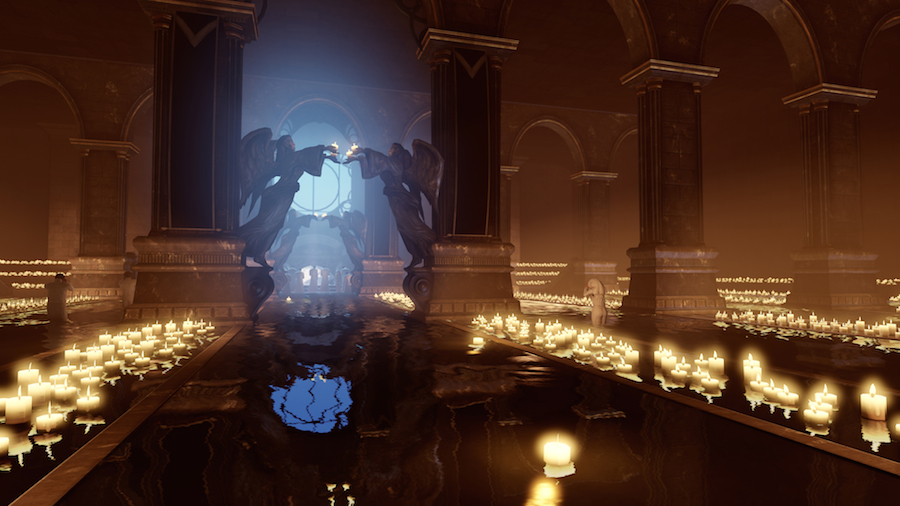

There’s a splendid moment near the beginning of BioShock Infinite. Soon after I click “Play Game” in the opening menu, my character is in a temple for an unknown religion. It’s gorgeously rendered, with torch-lit marble statues and hymns being sung. Cloaked worshipers walk in line, as if hypnotized, through streams of water running across the temple’s floors. It’s a beautiful place, but mysterious—and I want to see more. Yet, I can do it at my own pace, exploring the scene for as long as I want.
This, I think, is something only video games can do.
BioShock Infinite, developed by Irrational Games and released in 2013 by 2K, is far from perfect. Its story soon becomes muddled as the game descends into repetitive combat against wave after wave of robots and racist gunmen. Still, with sales of more than four million copies, its audience surpasses that of any 2013 novel. More to the literary point, many major video-game titles now feature fully developed fictional worlds with characters brought to life by voice actors.
If players of the BioShock games (Infinite is the third in the series) are lured by the graphics and action, they’re also hooked by the question posed by any good tale: What happens next? But there’s another twist as well: What should I do next? BioShock Infinite is a first-person shooter, meaning the world is shown from the player’s perspective, as if it’s through his or her eyes. You don’t control a character on the screen—you are the character.
A decade ago, film critic Roger Ebert famously said this interactive aspect of games prevented them from being art. Indeed, first-person shooters that constantly put you in the line of fire may seem at odds with losing yourself in a novel. But in surprising ways, even violent games like BioShock Infinite or Halo allow immersion in the story much as page-turning thrillers or romance novels do.
In 2014, the best narrative games challenge Ebert’s claim that “serious film and literature” demand “authorial control.” Narrative video games run the gamut from first-person shooters to role-playing games that involve more than blasting another alien to very un-video-game-like stories such as Gone Home. Just as novels were once a new a form of storytelling that included a character’s inner life, narrative games have transformed author-controlled plots with player interaction.
![<em>Portal</em> (Valve)” /></p>
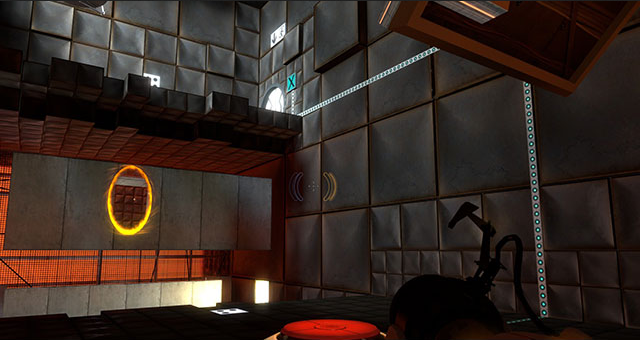
<p><em>Portal</em> (Valve)</p>
<p>Consider <em>Portal</em>, a 2007 game developed by Valve. Its antagonist is a murderous artificial intelligence named GLaDOS, and for most of the game, she’s nothing more than a computerized voice. As played by voice actor Ellen McLain, at first GLaDOS seems innocuous, leading you through a series of puzzles and promising “cake” as a reward. But that all changes the moment she tries to lead you into an incinerator. When you thwart her plans to burn you alive, she desperately keeps up the ruse:</p>
<blockquote><p>We are pleased that you made it through the final challenge where we pretended we were going to murder you. We are very, very happy for your success. We are throwing a party in honor of your tremendous success. Place the device on the ground, then lie on your stomach with your arms at your sides. A party associate will arrive shortly to collect you for your party.</p></blockquote>
<p>GLaDOS is one of the funniest villains I’ve encountered in recent years. And as I progressed through the game’s puzzles while listening to her banter, it was impossible not to get attached to her. She’s a real character—the kind that video games excel at bringing to life.</p>
<p>“Interactivity cannot just be dismissed,” Janet Murray told me in a recent email interview. “It is the essence of the medium.” Murray, a literature professor at Georgia Tech, has been championing digital narratives for decades. In many ways, <em>Portal </em>and a host of other recent games have finally caught up with what she was talking about in her 1997 book <em>Hamlet on the Holodeck: The Future of Narrative in Cyberspace</em>:</p>
<blockquote><p>[W]e rely on works of fiction, in any medium, to help us understand the world and what it means to be human. Eventually all successful storytelling technologies become ‘transparent’: we lose consciousness of the medium and see neither print nor film but only the power of the story itself.</p></blockquote>
<p>Murray’s vision of “expressive” digital art is no longer futuristic. GLaDOS may be a disembodied voice, but she’s a wonderful antagonist. The player’s interaction with her is what builds the story—and such interactivity is precisely what leads to great moments of video-game art.</p>
<h3>From Mario to <em>Mass Effect</em></h3>
<p>Nintendo’s <em>Super Mario Bros.</em> turns 29 this year, and it’s as fun to play now as it was in 1985. But in the last three decades, video games have evolved far beyond the simple pleasures of a plumber stomping sentient fungi.</p>
<p>These days, dedicated gamers don’t treat a game like mere software, with a list of pros and cons that determine its “grade.” <em>BioShock Infinite </em>set the gaming blogosphere aflame with critiques of its depictions of early twentieth-century racism (it’s set in an alternate 1912), among other hot topics. Geek culture has long been fertile territory for fierce debate, but that debate can now sound like a creative writing workshop. Here’s the blogger Azuriel on the game’s use of multiple timelines:</p>
<blockquote><p><em>BioShock Infinite</em> is a game in which all your actions are voided. Everything you struggled to accomplish is erased. None of it happened. Every moral choice you made, every time you refrained from stealing from cash registers, every interracial kindness you demonstrated, never matters because those people/scenarios never exist. It boils down to a ‘it was all a dream’ scenario.</p></blockquote>
<p>Negating a player’s narrative is one of the easiest ways to rile gamers. We expect to control the storytelling in such branching narratives. As Murray told me, “One of the most important features of video games is the ability to replay the same scenario with different choices or different parameters.”</p>
<p>In <em>Hamlet on the Holodeck, </em>she cites the 1993 megahit <em>Myst </em>as a breakthrough with its four distinct endings: You could free one of three characters (two evil brothers named Achenar and Sirrus or their innocent father Atrus) from magical imprisonment or none of them.</p>
<p>By 1995, <em>Chrono Trigger</em>, a role-playing game (RPG) involving many time-traveling characters and a vast fantasy setting, featured more than a dozen endings. Its narrative was more complex than <em>Myst’</em>s, with an ending determined by player choices throughout the game as opposed to a single, clear-cut choice at the very end. Two people playing <em>Chrono Trigger</em> could experience two very different narratives.</p>
<p>But another major aspect of <em>Myst’</em>s appeal—its first-person perspective—was also a part of early combat-driven games like <em>Doom</em>. In <em>Myst,</em> you wandered a photo-realistic world alone, solving puzzles. In <em>Doom</em>, you wandered a series of maze-like levels, gunning down demons. The narrative scope of each was limited. When Valve released <em>Half-Life </em>in 1998, it melded the principles of both into a thrilling first-person story about a scientist running for his life from alien invaders and the soldiers sent to wipe them out. Solving puzzles and shooting aliens were part of the experience, but Valve’s developers used them to tell a larger overall story that made for a better game.</p>
<p><img src= Portal screenshot](http://talkingwriting.com//sites/default/files/Screen%20Shot%202014-04-23%20at%201.28.34%20PM.png)