
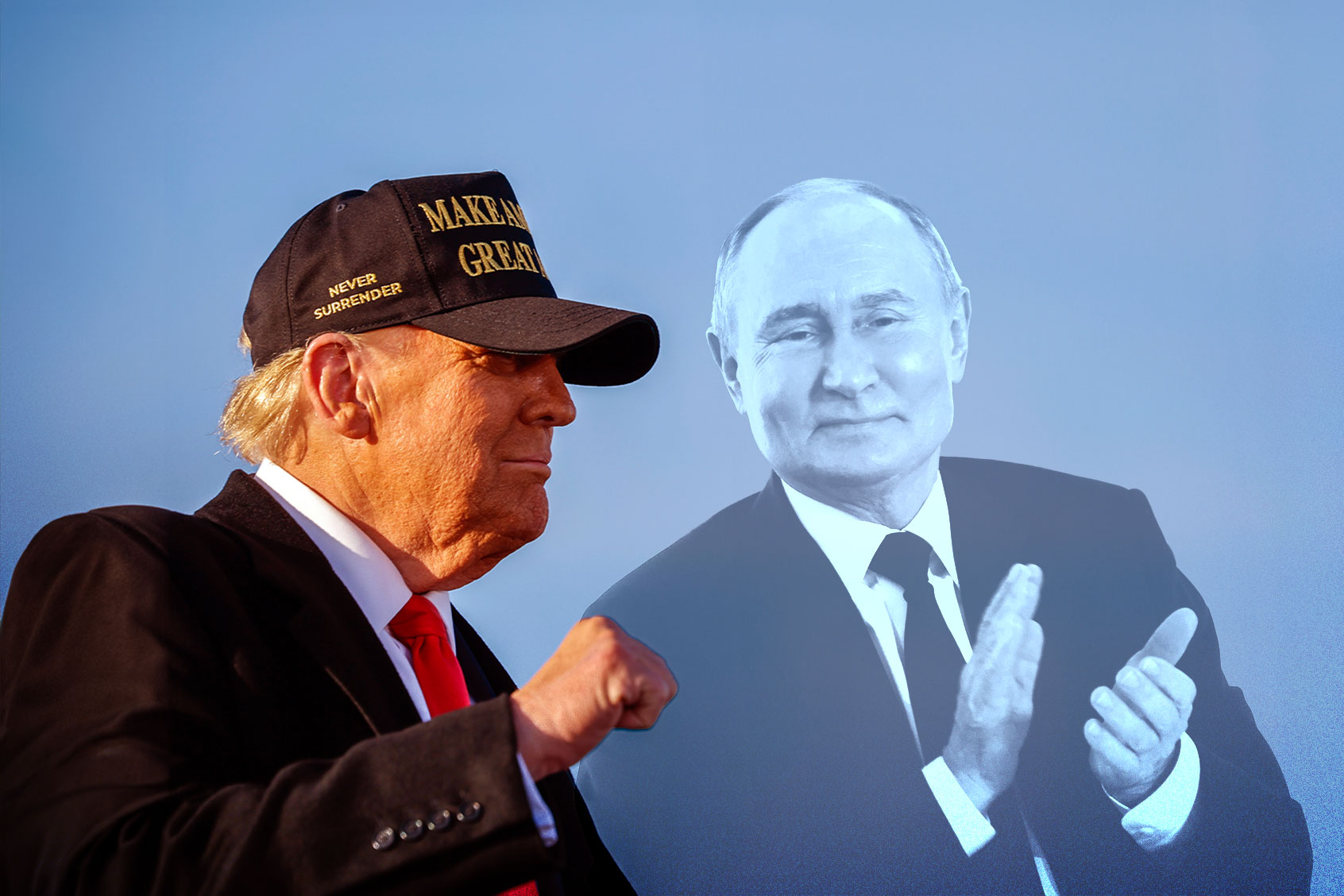

It’s strange: So many years later, here in the United States of America, I feel like I’m living in a country threatening to become like Vladimir Putin’s Russia, which I spent years experiencing earlier in this century. Let me tell you a little something about that.
For decades as a young adult, I lived and traveled in Russia. I was an anthropology doctoral student and human rights worker, studying the effects of Putin’s centralizing policies and of the country’s Christian nationalist media on the everyday lives of Russians. In one of my last projects, I investigated the government’s practice of separating kids with disabilities — and poorer kids generally — from their parents and detaining them in closed institutions. My report detailed how much changes in society when the government excludes swaths of the population from basic services like health care, education and even just access to city streets. The answer? Everything.
That marginalization was part of a governing process aimed at further enriching the wealthiest few and those in power. It reflected the leadership of figures lacking a basic understanding of what all people need and deserve. I consider that a hallmark of a fascist regime.
One of my last evenings in Russia was a chilly November night in 2014 in the northern city of St. Petersburg. Mothers, children, grandparents and teenagers alike stepped with care to avoid slipping on black ice and bumping into — and possibly falling thanks to — large plastic advertisements for fast food, clothing, cosmetic dentistry, plastic surgery and even IVF treatments sticking up like weeds on the cobblestoned sidewalks of the city’s center.
Those glowing placards seemed to replace what had once been a slew of different kinds of people when I first traveled to Russia as a college student in the late 1990s. In the same central train stations of that city, old women then sold carrots and beets from cardboard boxes they had lugged from their country homes. Young women could sometimes be seen in bikinis and stiletto heels (even in that weather!) with beer advertisements scrawled across their chests. Uzbek and Tajik men scrambled to finish construction on new stores, restaurants, and apartment buildings before winter set in. Roma mothers, their babies strapped to their backs in jewel-toned scarves, begged for money for food and housing.
Sometimes, when traffic grew too congested for their liking, Russia’s newly rich — aptly dubbed “New Russians” in the country’s popular press — drove their luxury Mercedes and BMWs onto the sidewalks, forcing pedestrians like me, along with mothers pushing strollers and a few wind-worn men and women hurrying to work, to scatter in panic. Despite the chaos and a significant amount of deprivation, for many I met then, much seemed possible, including working for ever larger companies, migration and new luxuries. Electronic remixes of Western songs like Gwen Stefani’s “If I Were a Rich Girl” and Cher’s “Believe” blasted from vendors’ tinny-sounding boom boxes on repeat.
Central Asian migrants from poorer countries to Russia’s south seemed ever fewer and less visible during the busiest times. Indeed, local authorities were rounding them up and detaining them without warrants, based on appearance and language alone. Sound familiar?
By the time of my last trip to Russia in 2014, however, shiny buildings had been built and older ones renovated. Developers with close ties to Russia’s political elite were even richer, thanks to the country’s growing oil wealth. Roma families were no longer anywhere to be seen, as St. Petersburg’s government had conducted “purges” of the city’s informal Roma settlements. Nor were old women selling their wares on the streets, while Central Asian migrants from poorer countries to Russia’s south seemed ever fewer and less visible during the busiest times. Indeed, local authorities were rounding them up and detaining them without warrants, based on appearance and language alone. Sound familiar?
Having spent years interviewing families who could no longer access this new cityscape with their kids who used wheelchairs or were blind or deaf, all I could think was: “I’m lucky to be able to go home to the United States.”
That last night in 2014, I was also nearing the end of the first trimester of my first pregnancy. I rubbed my still barely visible baby bump as I spotted an old friend from St. Petersburg who was waiting to meet me for dinner at a nearby cafe. As I sat down with her, a waitress approached our table. She noted my American accent and told me with gentle, motherly scorn that I shouldn’t be traveling while pregnant. As if on cue, stomach cramps made me double up. After a trip to the restroom revealed that I was bleeding, I started to wonder if the waitress had been right. Was it possible that my relentless travel had caused me to miscarry — and in a country where I knew women sometimes faced withering criticism and blame for poor pregnancy outcomes? “Just stay with me until I go home,” I implored the baby I carried.
At least my friend understood. Before she gave birth to her healthy son in the 1990s, when Russia’s newly privatized health care system included few viable options for working-class women, it took exhausted, overworked doctors weeks after she started feeling sick during her first pregnancy to determine the baby inside her had actually died. She had an abortion without anesthesia and returned to her teaching job right away to make ends meet. And stories like hers were anything but unique then.
Politicized reproductive health
By 2014, urgent care clinics and hospitals were plentiful enough in large cities like St. Petersburg and Moscow, but many were exorbitantly expensive, even for young Americans like me. Worse yet, the attitudes of medical workers toward women who couldn’t or wouldn’t have babies had not exactly softened under a president — Putin, of course — known for describing women as “guardians of the hearth and linchpins of large families with many children.”
Fearing the worst, my friend snapped into action, calling around to several acquaintances until one located an obstetrician she trusted who traveled from her home on the outskirts of the city to a clinic downtown.
Want more sharp takes on politics? Sign up for our free newsletter, Standing Room Only, written by Amanda Marcotte, now also a weekly show on YouTube or wherever you get your podcasts.
In the 1990s, following the collapse of the Soviet empire, the International Monetary Fund and other global lenders pushed Russia to slash public spending and rapidly privatize state functions as part of the deal for their crucial loans to a society then in trouble. In the end, such changes dismantled the Soviet Union’s social safety net, including universal health care.
Well-connected elites carved up many of the remaining state assets and used them for their own private gain. Included in Russia’s newly privatized health care system were private clinics for the ultra-wealthy offering hotel-like amenities, including private rooms, tea and soft background music. Ordinary Russians who couldn’t afford such ritzy private services used the remaining state clinics, though they were often overcrowded, undersupplied and understaffed in the austere new world so many Russians had no choice but to navigate, especially outside the big cities. What’s more, as anthropologist Michele Rivkin-Fish has pointed out, private health care facilities didn’t mean better quality care, as medical workers and all kinds of public figures tended to encourage married, racially white (Slavic) Russian women to have more children, no matter the dignity and long-term health of women in Russia more broadly.
It would be an understatement to say that, by the time I left Russia in 2014, politics infused every aspect of the country’s life. I’ll never forget, for instance, that a colleague of mine, who researched military abuses against ethnic minorities in Russia’s southernmost republics, had to leave the country to give birth after she received threatening anonymous text messages claiming that she and her unborn child were linked to Islamic insurgents in that part of the country.
While I had some reason to be afraid myself in that context, I wasn’t nearly high profile enough to truly worry, and I was lucky as well. After all, my friend had a friend who indeed had a doctor she trusted. So, in the end, I was able to get an ultrasound, which showed that I still had a healthy pregnancy.
I traveled back to the U.S. and gave birth to my son the very same day that Donald Trump descended that golden escalator to announce his candidacy for president — claiming that thousands of people were awaiting him below when only a few score were there — and launched his bid on the claim that Mexico was sending “rapists” to the U.S.
“Nah,” I thought, as I watched the cooing baby in my arms. “Probably won’t happen.”
I took my boy home and, being a military spouse, struggled with the military health insurance system, Tricare (AKA Try-For-Care), to get coverage for basic costs like a breast pump. (No such luck because, as an insurance representative told me, I was supposed to stay home and breastfeed him directly.) As for medicine for a common mouth infection in newborns, I got it but only after multiple appeals. I was then in an America plagued by privatization, ongoing foreign wars and a lack of corporate accountability, but at least, my family would be OK — for now.
Back in the USA
And here we all are.
I look around at what’s happening in our country and I worry that we may already be on a superhighway to the sort of class- and race-stratified autocracy that it took Russia so many years to become after the Soviet Union collapsed.
I wish I could say that my family — and yours — live in a reality that’s different from the one I left in Russia when I took my pregnant self home in 2014. I look around at what’s happening in our country and I worry that we may already be on a superhighway to the sort of class- and race-stratified autocracy that it took Russia so many years to become after the Soviet Union collapsed.
In particular, in the years since the Supreme Court overturned the right of American women to have abortions in 2022, 41 states have put abortion restrictions into effect, including 14 with outright bans. Some 40% of women now live in states with such bans or significant restrictions. In a handful of states like Idaho and Texas, women and expectant parents have had to cross state lines to get routine miscarriage- or pregnancy-related health care because doctors can face criminal or civil liabilities for providing it. (It may not be coincidental that in states with severe abortion restrictions, infant mortality has gone up significantly, particularly among people of color.) I could go on about the ways this administration and its allies on the Supreme Court and elsewhere are denying poor and middle-class women basic health care, but I’m sure you already get the picture.
Maybe since most Americans haven’t lived under an actual dictatorship the way many Russians have, state capture here is faster and easier, especially in a country with a resurgent evangelical right. (After all, didn’t Jesus say, “Suffer the little children …”?)
New Americans?
These days, many people in my community and in my day job as a psychotherapist have lost hope that Donald Trump’s government can change things for the better. Many tell me that they might not even vote in an upcoming election because government can’t be trusted to tell the truth and act on behalf of ordinary people. I’ve heard folks say that they can rely only on themselves — and maybe loved ones — to help them in crises like driving across state lines for health care. Among some of the highly educated parents I know in my DOGE-stricken Washington, D.C., suburb, I see not mass outrage or the urge to mobilize as much as a desire to homestead and foster a post-apocalyptic self-reliance, much in the style of Cormac McCarthy’s novel “The Road.”
Well, good luck, and thanks for helping Trump consolidate power.
We need your help to stay independent
But for now, the one thing I think we still do have that Russia doesn’t is mass demonstrations like the most recent “No Kings” Day, where a record seven million Americans turned out nationally. We also continue to have a (relatively) free press, which is not to be taken for granted or let go easily. To show up in public as fully human and speak out for others is itself a sign of hope and possibility. Rage-filled political leaders and their followers would not invest so much time in intimidating those who speak out if free speech didn’t matter so much. (Think of that recent Trump-ordered military flyover while Epstein abuse survivors held a press conference outside the Capitol.)
In days marked by so much uncompromising confrontation, I’m reminded of anthropology’s insight that, during a period of upheaval and movement, the people going through it can change significantly, though usually with some risk and pain. Migrations, mass demonstrations, even pregnancy — all of them hold the potential for self-transformation, particularly when people accompany one another on their journeys. The reason we should show up at demonstrations, write op-eds and protest in any way we can imagine is to stand in solidarity with one another, even if we don’t change the minds of the people watching us. (We might, though!) In other words, collective action is its own form of social transformation. It is a way to forge, if not a new America, then new Americans who will not let democracy die without a struggle. Without it, I fear we’re likely to end up with Donald Trump’s version of Vladimir Putin’s Russia — at least, the one I left in 2014.
That’s why what we all do next matters so much. Remember that in a democracy, we the people are the government. Whether we’re finding a service for someone who needs it, offering a friend in need a ride, warning of federal police or National Guard in the neighborhood, speaking out against abuse or just meeting friends for dinner, the exercise of our civil rights is a thread from which our democracy hangs. Such actions also alter the landscapes we hold in our imaginations, whether we like it or not. Simply put, as long as there are more people than military in the streets, the message to those who are scared is simple: This might feel like a foreign land, but you’re not alone.
Read more
about Russia
