
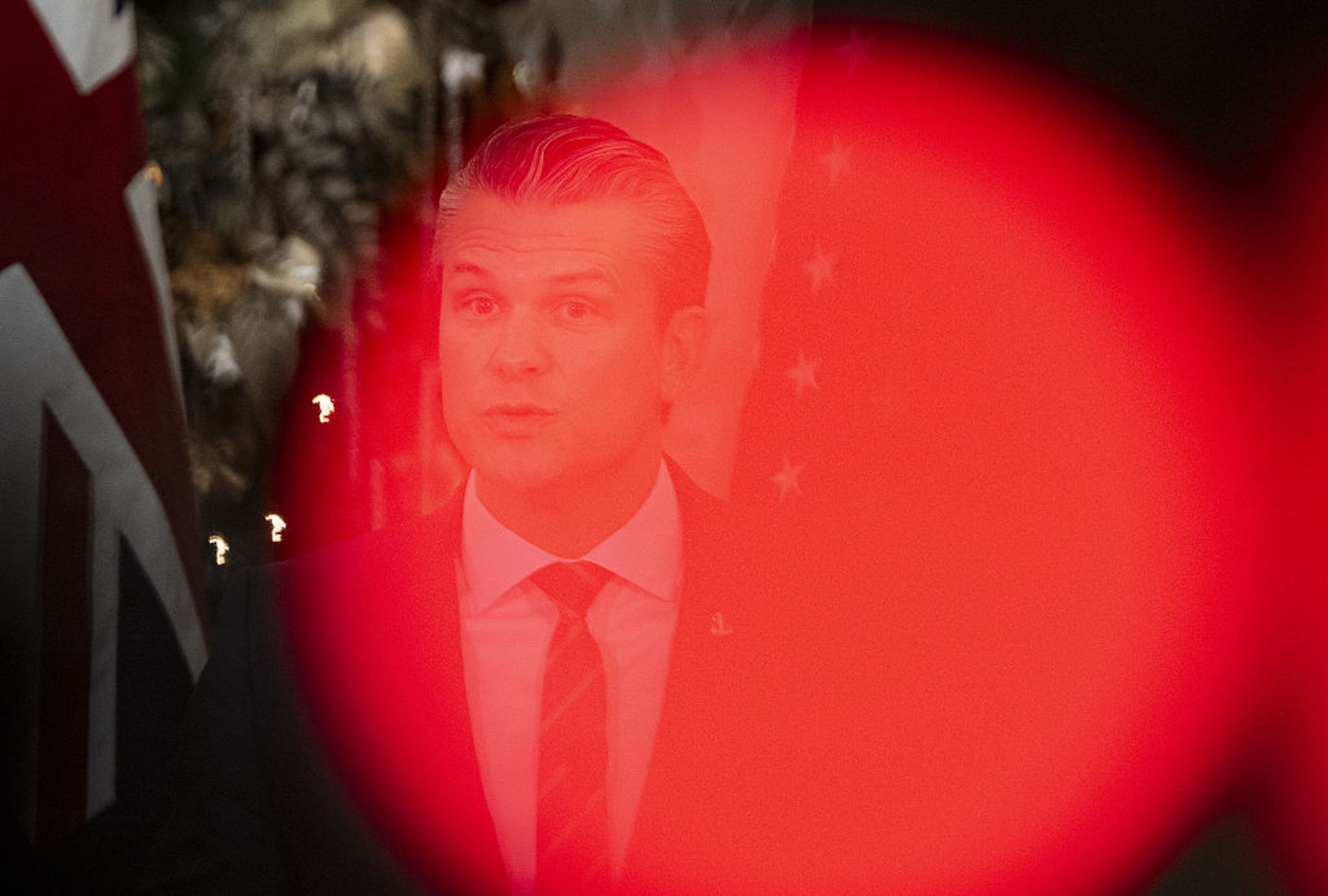

Donald Trump recently told reporters he’d have “no problem” releasing video of U.S. strikes off the Venezuelan coast where two survivors clinging to the shipwreck were shown no quarter. After a first strike, the Washington Post reported that Defense Secretary Pete Hegseth verbally ordered the Joint Special Operations commander to kill them all. (While Hegseth has denied giving such an order and a Navy admiral supported his version of events, congressional investigators have called the video deeply concerning. Such a strike could have violated federal law, the U.S. Code on War Crimes and the Uniform Code of Military Justice prohibiting murder.)
But when asked about the video three days later, Trump denied ever agreeing to release it, telling a reporter, “You said that, I didn’t say that. This is ABC fake news.” He quickly pivoted to say “Whatever Pete Hegseth decides [to release to the media]” will be fine with him.
It was a safe punt. Hegseth has fought media access to the Pentagon like no defense secretary before him, and he will keep spinning his alleged “kill everyone” strikes, his Signalgate publication of war plans and every other military crime he can get away with until he can be stopped.
Even while reports emerged on Wednesday that the House panel investigating the boat strike planned to end its probe, the full House passed a defense bill to release the video of the strike. The legislation will now go to the Senate. If signed into law by Trump, the bill would withhold 25% of Hegseth’s travel budget until his orders and videos for all the boat strikes — nearly two dozen in all — are released.
Since he took office in February after being narrowly confirmed by the Senate, Hegseth, a former Fox News bobblehead with barely-there military credentials, has fought the release of any Pentagon information that he hasn’t choreographed.
Since he took office in February after being narrowly confirmed by the Senate, Hegseth, a former Fox News bobblehead with barely-there military credentials, has fought the release of any Pentagon information that he hasn’t choreographed. In September, he announced a new department policy that essentially required journalists to get his permission before they publish. Journalists were required to sign pledges acknowledging that if they asked the wrong questions, or probed into department employees in any way that could elicit the wrong kinds of information, they could be labeled a national security risk, lose their Pentagon press badges and be blocked from the Pentagon.
When Hegseth announced the change, credible media outlets cried foul. The New York Times called it an attempt to “constrain how journalists can report on the U.S. military, which is funded by nearly $1 trillion in taxpayer dollars annually,” adding that the public has the “right to know how the government and military are operating.” The National Press Club also weighed in, stating, “For generations, Pentagon reporters have provided the public with vital information about how wars are fought, how defense dollars are spent, and how decisions are made that put American lives at risk. That work has only been possible because reporters could seek out facts without needing government permission.”
Even MAGA-centric outlets Fox News and Newsmax refused to sign the pledge. On Dec. 4, the Times put teeth into their criticism and filed suit to restore media access to the Pentagon.
Hegseth’s reach for a “media oath” smacks of prior restraint, a type of government censorship before publication that has long been deemed unconstitutional. Several early cases examined when national security interests were strong enough to overcome First Amendment freedoms in times of war. During World War II, the popular saying “Loose lips sink ships” reflected an awareness that advance public disclosure of military secrets could be dangerous.
But in 1971, the Supreme Court held that prior restraint on speech by the government is unconstitutional, requiring an “exceptional” showing of “grave and irreparable” danger. In The New York Times vs. the United States, the Nixon administration tried to block publication of the Pentagon Papers by arguing that publication of classified documents about the Vietnam War would endanger national security, necessitating prior restraint to protect vital security interests. The Supreme Court ruled that the public’s right to know outweighed the danger of publication, and that vague security claims aren’t enough to censor the press.
Want more sharp takes on politics? Sign up for our free newsletter, Standing Room Only, written by Amanda Marcotte, now also a weekly show on YouTube or wherever you get your podcasts.
In order to support an issuance of prior restraint today, the government must prove that publication would cause inevitable, direct and immediate danger to the United States. In Hegseth’s alleged “kill everyone” bombings, it’s hard to fathom how releasing video after the fact would jeopardize anything other than his own spin, as all the victims are dead, their ships obliterated and Trump himself has repeatedly posted snuff videos of the violence in the Caribbean.
Blind to irony, both Hegseth and Trump have personally modeled why some military secrets should not be published, at least not in advance of the act. In March, Hegseth’s Signal chat, which mistakenly included the Atlantic editor Jeffrey Goldberg, published U.S. plans of an impending attack in Yemen, including the exact time and location. The information could have easily led to an ambush or counter attack costing American lives. In June, Trump posted that the U.S. knew where Iran’s enriched uranium was stockpiled, giving Iran advanced warnings to move it before the bombing began — which Iran did.
Both Trump and Hegseth seriously jeopardized national security by releasing military plans in advance of attacks, which no media outlet has sought the right to do.
Nonetheless, Hegseth’s new media restraints require Pentagon approval before public release of even unclassified information, because “unauthorized disclosure… poses a security risk that could damage the national security of the United States and place personnel in jeopardy.”
We need your help to stay independent
After 80 years of free press access to the Pentagon and the military professionals who work there, Hegseth has granted himself sole authority to determine when journalists pose “national security risks.”
Based on a journalist’s “receipt, publication, or solicitation of any ‘unauthorized’ information,” the defense secretary has unbridled discretion to block, eject and blacklist them. This amounts to authority to revoke reporters’ access to the Pentagon for engaging in lawful newsgathering, which is an illegal, prior restraint to stop speech before it happens.
Hegseth’s purge of the Pentagon press corps is now complete. He has replaced all credible media outlets with MAGA content creators, whom he welcomed to the Pentagon earlier this week for press briefings. These MAGA influencers, despite their lack of reporting or military beat experience, are the “new Pentagon press corps.” They include representatives of LindellTV — which is owned by MyPillow CEO and major Trump donor Mike Lindell — and Frontlines by Turning Point USA, as well as conspiracy theorist and Trump whisperer Laura Loomer, and Tim Pool, who was paid to produce videos for a company secretly funded by the Russian government.
All of them signed Hegseth’s pledge without hesitation.
Read more
about this topic
