
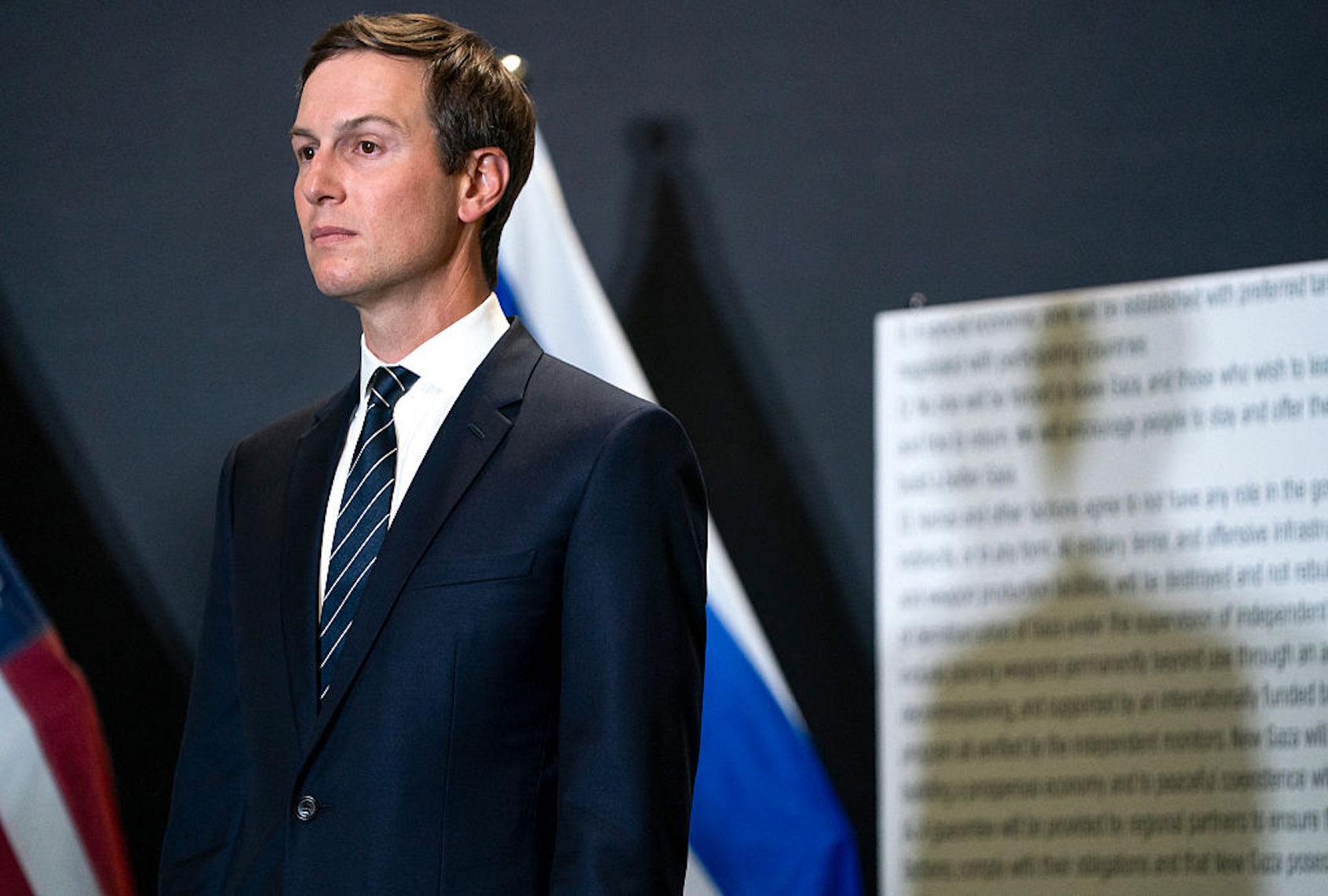

The speed and scale of Jared Kushner’s re-emergence can’t be overstated. In the first year of Donald Trump’s second presidency, his son-in-law is casually consolidating economic and political power with staggering speed. Kushner has positioned himself at the center of the biggest media merger in years and at the fulcrum of White House foreign policy, all while taking in multi-billion-dollar investments from autocratic governments.
On Monday, Paramount Skydance — run by David Ellison, a billionaire Trump has openly urged to reshape the news industry in his favor — launched an unprecedented bid to acquire Warner Bros. Discovery by initiating a hostile takeover after losing an earlier bidding contest to Netflix. Paramount’s offer draws heavily from Kushner’s investment firm, Affinity Partners, and from the sovereign wealth funds of Saudi Arabia, the United Arab Emirates and Qatar. These Middle Eastern autocracies are principal investors in an acquisition that would give them — and Kushner — influence over some of America’s most powerful news and cultural engines: CNN, HBO, Warner Bros. Pictures and the vast library of Warner content that shapes the national (and international) imagination. The partnership is unprecedented. Not even Rupert Murdoch’s right-wing media empire was capitalized by foreign monarchies seeking political leverage.
After leaving the first Trump administration, Kushner raised over $3 billion for Affinity Partners, including $2 billion from the Saudi government’s Public Investment Fund. The Saudis’ own advisers reportedly warned Crown Prince Mohammed bin Salman that Kushner’s record did not justify such an investment, but the crown prince overruled them. The UAE and Qatar soon followed, adding another $1.5 billion to the pot. As of late 2024, Kushner had still not produced meaningful returns for these foreign governments, yet he had paid himself at least $157 million in fees. Forbes now calls him a billionaire.
The breathtaking scale of the Paramount–Warner bid makes the stakes even clearer. The sovereign wealth funds of Saudi Arabia, Abu Dhabi and Qatar are collectively offering around $24 billion to help the takeover, more than the entire current market value of Paramount itself.
These are autocracies investing in the infrastructure of American political communication, and they are doing so through the president’s son-in-law. You could not design a more direct conflict of interest. Paramount is even trying to structure the deal to avoid federal review by arguing that foreign investors would have no “voting rights,” a fiction so flimsy it should insult the intelligence of any serious regulator.
After the Wall Street Journal reported that Ellison had promised to deliver political obedience, telling Trump he would make “sweeping changes” to CNN once the deal closed, White House press secretary Karoline Leavitt sneered that CNN “would benefit from new ownership.” Both she and Trump also publicly berated CNN anchor Kaitlan Collins this week.
Taken together, this is the authoritarian playbook in its purest form. Trump has not even attempted to disguise his intentions.
Taken together, this is the authoritarian playbook in its purest form. Trump has not even attempted to disguise his intentions. He has said outright that he believes CNN should be sold, that its current leadership is “corrupt or incompetent” and that no media company should be allowed to continue “spreading poison.”
The president has long been obsessed with CNN. Before Trump first took office in 2017, Kushner, whose application for a top-secret clearance was initially rejected after an FBI background check raised concerns about potential foreign influence, was the point person for securing favorable coverage from right-wing outlets like Sinclair. Kushner, who owned the iconic New York Observer for a decade, personally solicited then-CNN head Jeff Zucker about changing the composition of the network’s political panels — but Zucker refused. Beyond CNN, Kushner is credited with orchestrating Spanish-language network TelevisaUnivision’s rightward shift ahead of the 2024 election, which saw Trump’s electoral performance among Hispanic voters subsequently improve.
Now, members of Congress from both parties have raised alarms about this new deal. Sen. Mike Lee, R-Utah, who leads a Senate subcommittee on antitrust, said on X that the deal raised “a lot of antitrust red flags” and that he would hold “an intense antitrust hearing.” Senate Majority Leader John Thune, R-S.D., said the Justice Department should take a “hard look” at the deal. And Sen. Elizabeth Warren, D-Mass., noted that the deal “looks like an anti-monopoly nightmare.” If Netflix were to buy Warner Bros. Discovery, it would own two of the top three largest streaming services, Netflix and HBO Max. This market power could allow Netflix to raise prices for its subscription services, which have already been rapidly increasing.
But Kushner’s influence is not limited to the media; it reaches into the heart of U.S. foreign policy. Just weeks ago, he re-emerged as a central actor behind Trump’s new Gaza initiative, a plan that has produced a fragile ceasefire, a prisoner exchange and a partial Israeli withdrawal. Kushner has taken a victory lap, claiming that his “deep personal relationships” in the region made the deal possible. And in a marked convergence of his political and economic interests, the Gulf states underwriting Kushner’s private equity fund are the same governments now partnering with him on Middle East diplomacy.
Want more sharp takes on politics? Sign up for our free newsletter, Standing Room Only, written by Amanda Marcotte, now also a weekly show on YouTube or wherever you get your podcasts.
Kushner has also quietly inserted himself into Trump’s Ukraine diplomacy. In late November, he and White House envoy Steve Witkoff met with Vladimir Putin in Moscow for five hours. Kushner and Witkoff, neither of whom hold formal government positions, were allowed to meet with the Russian president before even some Cabinet-level officials. The pair then joined Ukrainian officials in separate talks in Geneva and Miami. This is privatized foreign policy: diplomacy conducted by men whose incentives are not in the public interest.
Kushner’s Affinity Partners — again, funded primarily by autocratic regimes — is also behind the largest leveraged buyout in history, a $55 billion effort to purchase video game giant Electronic Arts. The deal, announced on the same day Trump revealed his 20-point plan to end Israel’s war in Gaza, will require approval from the Committee on Foreign Investment in the United States (CFIUS), the same body Trump allies have spent years attacking when it targeted Chinese investments.
All the while, as Kushner maneuvers behind the scenes, the right-wing assault on media independence continues to escalate. Ellison, who settled a $16 million lawsuit with Trump earlier this year over former Vice President Kamala Harris’ October 2024 interview with “60 Minutes,” has overseen a political makeover at CBS. He created an ombudsman role and filled it with a longtime Trump ally with no journalism experience, hired conservative pundit Bari Weiss to run the newsroom and even bought Weiss’s The Free Press for $150 million.
We need your help to stay independent
And despite giving what was seen as a peacemaking interview to Norah O’Donnell on “60 Minutes,” Trump has continued to berate CBS publicly, furious that the network recently aired a “60 Minutes” interview with Rep. Marjorie Taylor Greene, R-Ga., whom he now considers insufficiently loyal following her recent critiques of him. In Trumpworld, there is no such thing as editorial independence — only obedience or betrayal, which are the hallmark of state capture in regimes like Viktor Orbán’s Hungary. There, over a period of more than a decade, Orbán worked to successfully weaken the independence of the judiciary, leverage control over independent media outlets, wear down and cripple independent institutions — including universities — funnel government funds to regime loyalists and redraw the electoral system to his favor.
Since Donald Trump returned to office in January, he has been doing the same at lightning speed.
This is unfolding as the Supreme Court considers cases that could severely weaken independent federal agencies like the Federal Trade Commission and CFIUS, which exist precisely to prevent the sort of conflicts of interest that Kushner embodies. If the Court hobbles those institutions, as many predict will happen, Trump and Kushner will inherit both the power and the regulatory vacuum to reshape the American economy and media environment with virtually no oversight.
Republicans spent years screaming about former first son Hunter Biden’s foreign business ties. And yet here stands Jared Kushner: a man who has made a small fortune from a large one, who positioned himself as a “deal-maker” while outsourcing U.S. foreign policy to the highest bidder, who now wants to help pick which news organizations survive and which are purged.
Kushner’s sudden, sweeping reappearance is not a coincidence or a comeback. It is a consolidation. He’s back to lead a hostile takeover of our information ecosystem.
Read more
about this topic
