
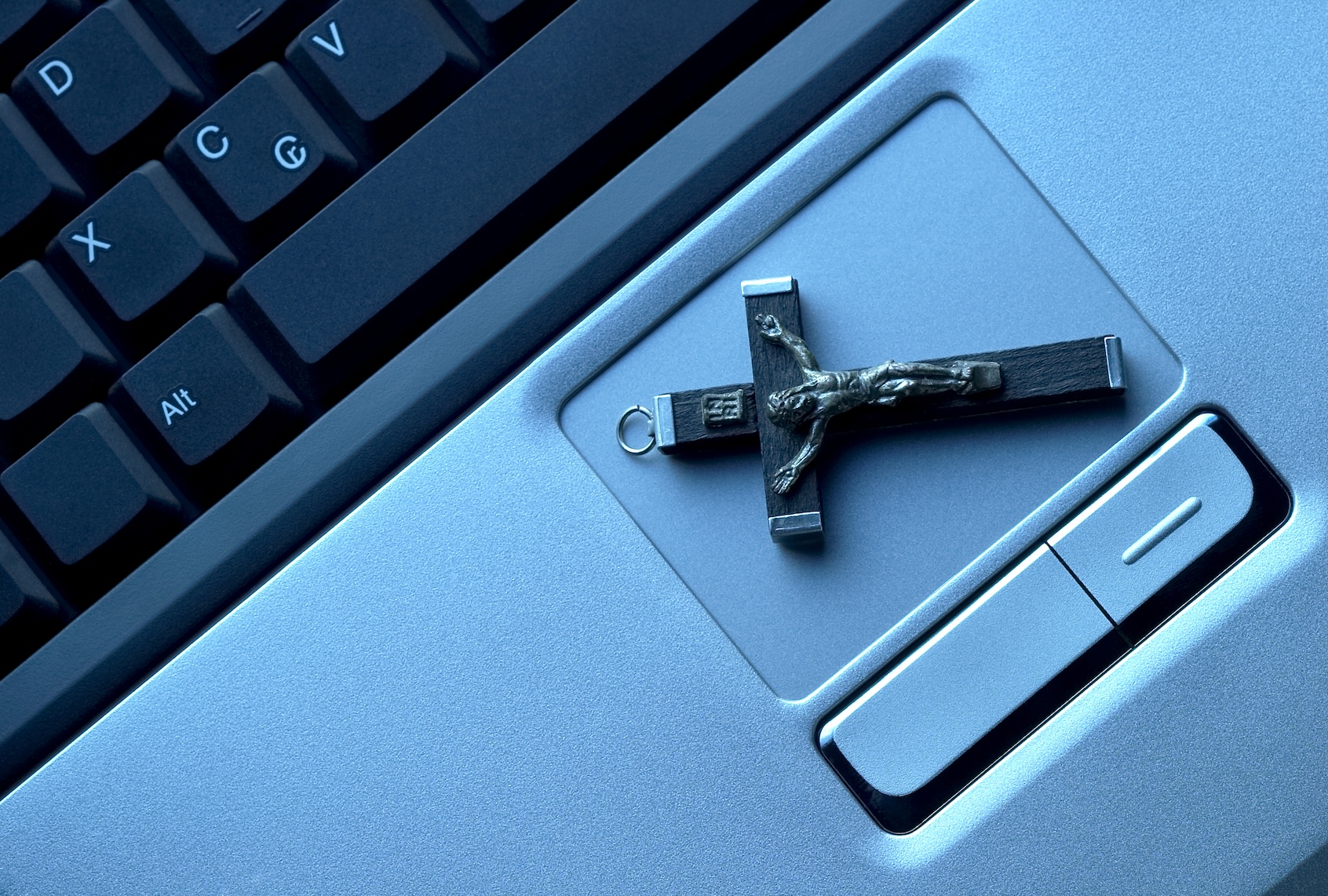

Earlier in December, podcaster Joe Rogan suggested that Jesus Christ might return in the form of an artificial intelligence. While this moment garnered attention online and in the press, it’s actually just the tip of the iceberg in terms of the effect that AI is having on religious belief in highly online corners of American society.
In the viral Rogan clip, the host says “Jesus was born out of a virgin mother. What’s more virgin than a computer? If Jesus does return, you don’t think he could return as artificial intelligence? AI could absolutely return as Jesus.”
The response to the clip online was largely mockery or criticism of Rogan for his cozy relationship with tech oligarchs, like billionaires Elon Musk and Peter Thiel. But the notion of an AI Jesus is not as fringe as it might seem.
Robert Geraci, a professor of religious studies at Knox College who has authored multiple books on technology and religion, told Salon in an interview that religious beliefs that incorporate AI are becoming increasingly mainstream.
“The apocalyptic AI mindset is now present in our culture in a way that someone who might be currently or formerly religious can now rely on that as a kind of groundwork for putting their thoughts together, for putting a worldview together,” Geraci said.
On one level, AI Jesuses — there are many — are already here. There is no shortage of websites or apps that offer access to a large language model that offers some sort of spiritual advice based on Christian teachings. Even the Catholic Church has experimented with AI Jesus, with a Swiss church in Lucerne experimenting with a Jesus-like chatbot that was set up to speak with churchgoers in a confessional-style setting.
“With the rise of AI, we’re having to kind of re-argue where authority comes from.”
The project, dubbed “Deus in Machina,” was an experiment aimed at seeing how people responded to the interaction with the chatbot, which was trained on biblical texts, and to explore “critical questions about ethics, spirituality, humanity, and personhood in the era of AI,” according to the researchers’ report on the experiment.
The collision of AI and religious belief has, however, gone far beyond experiments with chatbots and AI renderings of Jesus. Beliefs around the AI “singularity,” loosely defined as the point at which AI is capable of improving itself, have reached a fever pitch, with predictions often mirroring apocalyptic predictions and which are sometimes directly inspired by The Book of Revelation. Official religions that worship AI date as far back as 2017.
In Geraci’s analysis, religious beliefs about a coming AI superintelligence have broken Silicon Valley containment — and while they might have originated in the tech world, they’ve been able to graft themselves onto a preexisting apocalypticism in American culture and American Christianity in particular. This has been helped along by the fact that there are swaths of Americans who consider themselves Christians, but who don’t interface with traditional authority figures when it comes to faith.
A recent survey from the American Bible Society found that while 64% of Americans say they are Christian, only 55% of them attend Church. Although many of these self-identified Christians may be engaging with their religious traditions in a more casual way, others have turned to online spaces for religious community and guidance. Geraci said that this is a phenomenon that has been on the rise for decades, but has been supercharged by AI.
“It’s still the case that just about anybody can get online and tell you whatever they happen to think about authentic Catholic doctrine, or what it means to be a true Muslim, or whatever else, right?,” Geraci said. “That’s all over the internet, but people have also kind of accommodated the idea that they may not constitute an authority. Now with the rise of AI, we’re having to kind of re-argue where authority comes from.”
We need your help to stay independent
Some of these arguments are going on in academic spaces while others occur in the context of mass media, especially that with a conservative slant. For example, conservative pundit Tucker Carlson recently asked OpenAI founder Sam Altman about his own spiritual and religious convictions and how Altman and OpenAI decide on which ethical values to give preference to in ChatGPT. The episode title, “Sam Altman’s Dystopian Vision to Replace God With AI,” hints at Carlson’s own attitude towards the topic, which strikes a stark contrast with Rogan.
Despite the hostility to AI’s influence on religion among people like Carlson , it’s also clear that millions are still seeking religious advice from chatbots, with the New York Times reporting in September that just one app, Bible Chat, racked up more than 30 million downloads.
Paul Hoffman, a pastor and professor of biblical studies at Samford University, told Salon that while chatbots might be able to provide information about religious texts, he doesn’t think they’re able to provide the wisdom that traditional authoritative voices on spirituality might be able to.
“What we want in life isn’t just information. We want wisdom, and for me, wisdom is applied knowledge. It is something that transcends the moment, and it’s something that’s handed down. Information is ‘What’s the weather? How’s the stock market?’ Wisdom is ‘What is the best way to live? How do I handle this difficult situation?’” Hoffman said.
Hoffman added that, as a pastor and theologian, he was concerned by not just the religious questions people ask AI, but also by the sorts of beliefs that Christians might be forming about AI. Hoffman specifically addressed the notion that AI might become godlike and the idea floated by Rogan, that Jesus might return as AI.
“Christianity is deeply predicated on the idea that the one we worship and the one we revere lived a fully human life, a fully embodied life, and so now we have people that are delving back into an ancient heresy that was called Gnosticism, that divides body and spirit,” Hoffman said.
In Hoffman’s view, the ability for beliefs that are traditionally regarded as heretical to spread among self-identified Christians is deeply tied to two phenomena. The first is the dechurching of self-identified Christians (the trend identified in the American Bible Society), in which people identify as Christians but do not attend church. Dechurching has been trending upward for more than two decades in the U.S. and the COVID-19 pandemic only accelerated things.
Start your day with essential news from Salon.
Sign up for our free morning newsletter, Crash Course.
The second is that, traditionally religious identities like “evangelical Christian,” for example, have, for some, become cultural signifiers for some segment of the population. Hoffman explained that there’s an ongoing debate about how to make sense of self-identified Christians who don’t engage in regular practice and are not part of a religious community, like a church.
The question of whether podcasts or similar content are replacing churches has also been open for more than a decade. And though it’s clear that podcasts haven’t led to the wholesale abandonment of churches in the United States, it’s also clear that, for some, listening to podcasts has in effect replaced listening to a sermon on Sundays, with one key difference being that they don’t foster the same type of community that a physical church does and may not have the same sort of authority figures as a traditional religious community.
In Geraci’s view, the orientation of some believers towards podcasts and other niche online communities is a key part of the rise of novel religious beliefs, including those that concern AI.
“The technology does give people new ways to look at the world, and that gives them new opportunities, religiously, to build new kinds of community, and the internet allows them to find that community,” Geraci said. “If you have an idea that’s close to unique and you get on Reddit and start talking about it, pretty soon, you’re gonna find the other eight people who have that idea and maybe a few other people join. Before you know it, you have a small community of like-minded believers around whatever that thing is.”
Read more
about religion and techonology
