
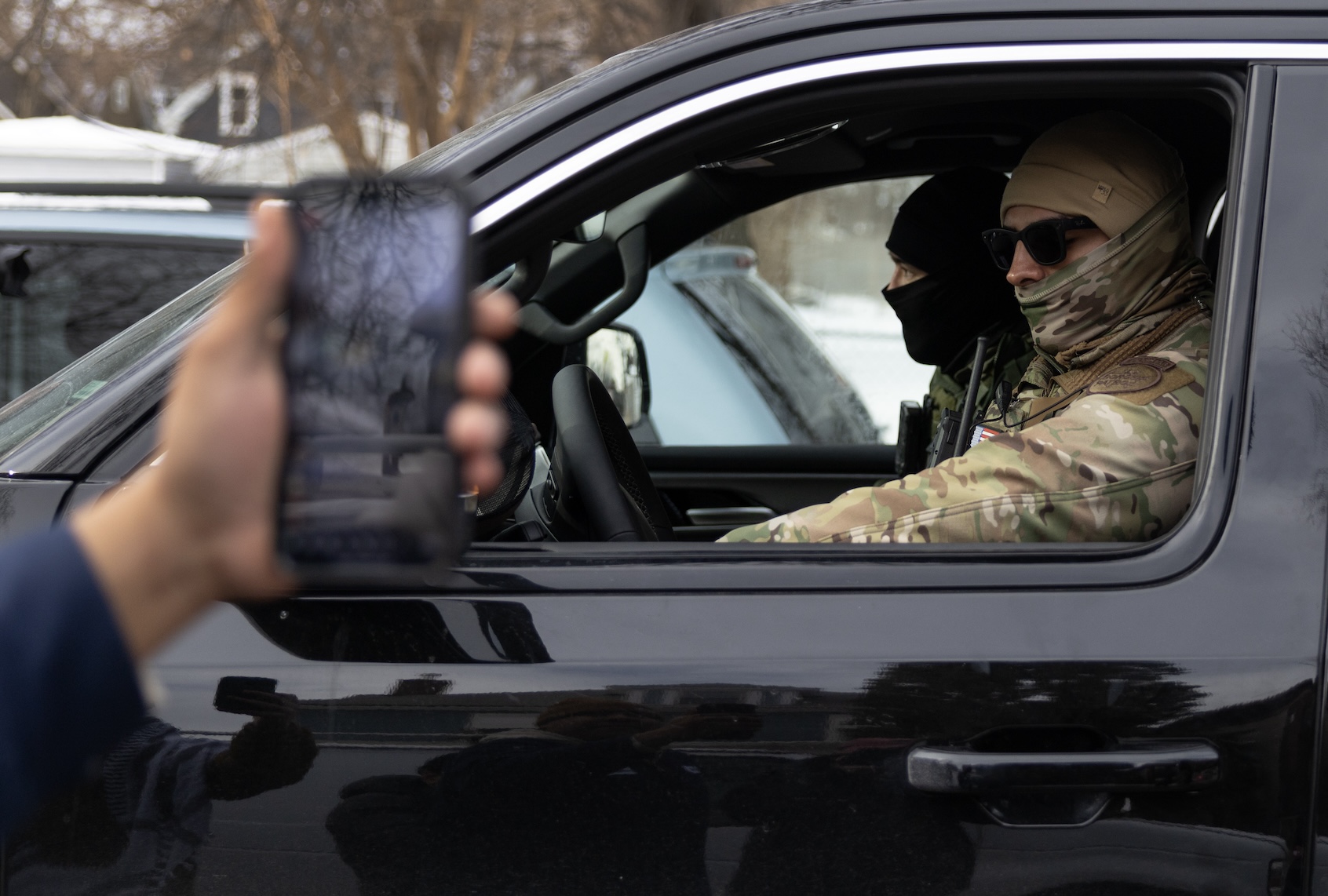

The suddenness, scale and violence of Immigration and Customs Enforcement raids over the last year have prompted neighborhoods and volunteers to either record raids in progress or preemptively stand guard near areas where raids might take place, such as schools with immigrant children. This accountability led to the numerous videos that captured the moment when ICE officer Jonathan Ross shot and killed Renee Nicole Good in Minneapolis last week, sparking a nationwide outpouring of anger and grief.
Good had been monitoring an elementary school as students were being dropped off before Ross stepped in front of her vehicle and shot her. Human and civil rights advocates who spoke to Salon have called this a classic example of law enforcement foisting on their victim a “deadly dilemma,” forcing the person to appear as aggressive or insubordinate and giving agents an excuse to react violently.
Before Good’s death, other civilians across the country who were recording or watching ICE had been threatened, physically assaulted and arrested, amplifying the sense among critics that ICE officers, the broader law enforcement establishment and the Trump administration view themselves as above the law and capable of getting away with it.
Nevertheless, critics say that ICE, and other institutions have followed a similar playbook used by police states, maintaining the thinnest pretexts to justify their behavior in a way that gives, in theory, plausible deniability, and signals to critics that they’re too powerful to need a perfect alibi.
“They typically cite these vague concepts of obstruction, interference with an investigation, incitement in protest cases, entirely inapplicable statutes, presumably to sound official,” Seth Stern, advocacy director of the Freedom of the Press Foundation, told Salon. “Let’s say somebody is following an ICE vehicle to record what the officers are doing, which does not actually fall under a stalking statute, to state the obvious. It is not stalking to follow a law enforcement officer to document what they’re up to — that’s constitutionally protected conduct. But more often than not, ICE officials on the ground, and higher-ups alike, will cite those loose concepts to intimidate and later justify their actions on social media or unofficial statements.”
“If anything, I’ve seen people reaffirm their commitment to continue documenting ICE and CBP activity because they see it as an essential form of holding on to whatever justice and democracy still exists.”
Federal court rulings have reaffirmed the right of citizens to observe and record police activity in public areas under the First Amendment. Civilians with little knowledge of statutes and court rulings or experience in dealing with law enforcement have proven, in many documented cases, to be fairly resilient against those kinds of tactics. But generally, they still operate with fewer defenses than professional journalists, and might, due to uncertainty over repercussions, put away their camera or delete their footage when confronted by an armed officer.
Organizations like Carolina Migrant Network and the League of United Latin American Citizens (LULAC) have been working to not only educate people about their rights when filming or watching ICE agents, but train them on how to effectively document the evidence while avoiding personal injury and unlawful arrest.
In one video, LULAC advises recorders to keep their camera focused on agents rather than their victims, verbally narrate the facts, strategically capture key information like badges and street signs, and potentially limited themselves to note-taking and other support roles while someone less at risk handles the recording. While some people might find themselves as unexpected witnesses of an ICE raid, other volunteers, such as those working with the Carolina Migrant Network, have formed or joined rapid-response text groups to coordinate movement and to be able to arrive on-site soon after an alert goes out.
Start your day with essential news from Salon.
Sign up for our free morning newsletter, Crash Course.
“What happened in Minneapolis could have happened here in Charlotte, could have happened in Chicago, could have happened anywhere. It wasn’t shocking to folks who have been doing the work for a long time, because they’ve witnessed firsthand what ICE is capable of doing,” Stefania Arteaga, co-founder and co-director of the Carolina Migrant Network, told Salon. “If anything, I’ve seen people reaffirm their commitment to continue documenting ICE and CBP activity because they see it as an essential form of holding on to whatever justice and democracy still exists.”
The widespread protests over Good’s death are an example of just how far people have been pushed, but Arteaga expressed her wish that such outrage could be found earlier.
“There was a prevailing attitude that everything was good and dandy again until we found ourselves once again under a Trump administration where we’re being forced to confront the history of the United States and their treatment of immigrants and other minority groups,” she said. “More than before, white America is reckoning with the fact that ICE and the Department of Homeland Security didn’t start under Trump. But the fact that it took this long really shows the lack of humanity that is given to immigrants, immigrant voices, immigrant stories and immigrant life.”
During the Obama and Biden administrations and the first Trump administration, ICE used family separation, raids and physical and verbal aggression against immigrants, but were more prone to brush off witnesses as mere annoyances. The second Trump administration has overseen a marked increase in permissibility for particularly brazen actions, with the Department of Homeland Security making it official policy to prosecute those who videotape ICE agents and post the content on social media. While federal courts have usually ruled against newer or intensified ICE policy as unconstitutional or in violation of existing statutes, ICE has found ways to continue forcefully handling any perceived threats to their mission.
In the case of Good, ICE has maintained the narrative that they were acting in self-defense, even though they had surrounded her vehicle and threatened her before she attempted to drive away. The tactics ICE used against Good are recognizable across the country against people who may have narrowly avoided her fate. Sometimes, agents would issue contradictory orders which would force someone to risk serious danger either way; other times, they might trap cars, snatch people’s phones, and otherwise escalate the intensity of a confrontation, hoping, critics say, to make their victim panic.
We need your help to stay independent
“I had a scenario where an agent called the police on me. They are intentionally trying to frame the situation in ways that are completely disingenuous,” Arteaga recalled.
Meanwhile, state legislatures across the country have passed bills designed to codify limitations on the ability of civilians to hold ICE and law enforcement accountable. One popular proposal has been to ban recording police activity within a certain distance — usually around 25 feet. Those laws, which go far beyond punishing actual obstruction and interference, have largely been struck down by the courts as unconstitutional. As with the earlier court rulings that reaffirmed the right to record ICE agents, however, those decisions provided little deterrent for them to use a thin pretext to target immigrants and neighborhood volunteers.
“Law enforcement agencies are all public institutions, and allowing the wider public to see what they’re doing and potentially object to what they’re doing and recognize that what they’re doing is wrong is not legally actionable interference,” Stern said. “That’s the purpose of good journalism, to expose wrongdoing and alert the public that their officials are not behaving as they should.”
“To the extent that officers consider journalism in and of itself to be obstruction,” he continued, “those are probably officers who should be obstructed.”
Read more
about policing in America
