
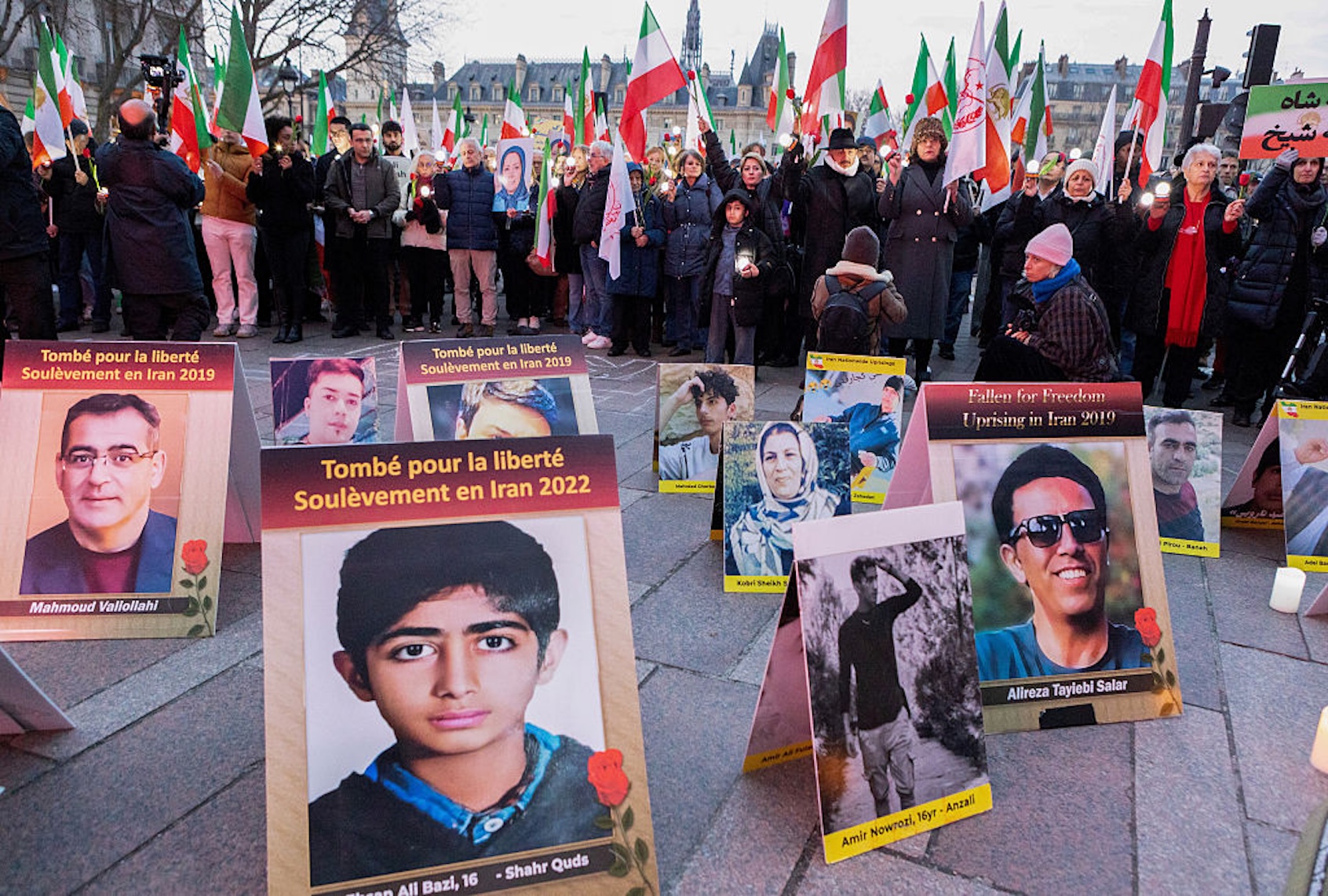

Over the past three weeks, Iran has crossed a terrifying threshold. The U.S.-based Human Rights Activists News Agency has verified that as of early Thursday, at least 4,902 protesters have been killed, with many more feared dead, and 24,000 arrested since the anti-government protests began on Dec. 28. But credible reports from Iranian journalists, which are unverifiable due to the country’s internet blackout, indicate that the death toll could be much higher, exceeding 16,500. If true, this would be more than five times the number of casualties during the Iranian Revolution, which unfolded over 13 months in 1978-79.
In response to the most recent uprising, the Islamic Republic has returned to its most reliable tactic: cutting off the internet and severing communication to impose a blackout that isolates the population and allows atrocities to unfold unseen. This is not crowd control; it is eradication.
After weeks of violent clashes and despite sustained information blackouts, disturbing evidence has surfaced — images of body bags stacked in large numbers, protesters shot at close range and others beaten to death. Multiple independent accounts report that families are being forced to pay to reclaim the bodies of loved ones, transforming grief itself into another instrument of state control. Investigations by Amnesty International and Human Rights Watch, echoed by international news outlets, further allege that security forces have raided hospitals, arresting the wounded and transferring them to detention centers where they face torture and forced confessions. On top of this, a heavy military and security presence remains in cities and towns across the country.
As executions, mass arrests and disappearances take place beyond public view, families in the vast Iranian diaspora wait in agonizing uncertainty, unable to reach loved ones or access information. This is how the regime operates when it believes scrutiny has lifted, and it highlights the importance of traditional media. When a government silences an entire nation, journalism becomes more than reporting — it’s a lifeline and protection.
Supporting Iran means more than statements of concern. Iranians need unrestricted internet access. They need technologies like Starlink to break censorship and traditional media to amplify what social media has revealed and what it can no longer transmit. Iran’s people have had their voices forcibly silenced. If the world does not speak for them, their suffering will be buried alongside the truth.
Iranians need to know the world is watching.
The struggle for a free Iran belongs to all who value freedom. As authoritarianism advances globally, Iran’s fight is a reminder that liberty must be defended wherever it is threatened, whether that be in Tehran or Minneapolis.
Much of the mainstream Western media has referred to these demonstrations as protests. As an Iranian-American who knows the history of my ancestral country, I call them a revolution, one that is rooted in memory as much as rage.
Much of the mainstream Western media has referred to these demonstrations as protests. As an Iranian-American who knows the history of my ancestral country, I call them a revolution, one that is rooted in memory as much as rage. The Iran I know and the Iran on the nightly news have never aligned. In our family albums, relatives stand shoulder to shoulder with visitors from around the world, dressed with the ease and confidence of a country open to possibility. On television, the image shifts to choreographed crowds in rigid uniforms chanting “death to America.” I recognize the script each time: the regime’s propaganda spectacle, not the nation’s soul.
So for years, to myself and to anyone willing to listen, I have repeated the same correction: That is not Iran. Those are not its people.
But the Iran I know is rising again, guided by courage and a collective remembrance of what it once was — and what it is always capable of being. The voices that filled its streets earlier this month were not only cries of protest; they were affirmations of identity. They were the sound of a people remembering themselves.
More than 2,500 years ago, Cyrus the Great’s vision of governance — ruling through tolerance rather than terror — reshaped the ancient world. He understood that stability grows from dignity, not domination, and his decrees affirmed that all peoples and beliefs had a rightful place under the law. Persians, Jews, Christians, Muslims, Zoroastrians, Baha’is and those of every background were entitled to live in peace. Cyrus embedded the idea that freedom of belief and protection of minorities are the bedrock of just societies. This philosophy did not remain confined to history. It became a model. The principles articulated under Cyrus became the first human rights charter that continues to influence traditions and charters adopted by other nations centuries later.
That heritage of justice carried forward through Iran’s culture, poetry, scholarship, and enduring openness to the wider world. In the modern era, those values were visible in daily life as the shah’s White Revolution brought Western inclinations to the fore. Men and women moved freely through shared public spaces. Universities welcomed co‑ed student bodies. Women chose how they lived and how they dressed. Cities thrived as centers of art, cinema and music. The works of poets like Rumi and Hafez remained internationally celebrated, their voices recognized as among the great masters of world literature. Iran stood confident, outward‑looking and deeply connected to global culture.
That openness was visible to the world. In 1975, Frank Sinatra performed one of his largest concerts in Tehran. The following year, Elizabeth Taylor attended an Iranian film festival. Andy Warhol traveled to Iran to paint Empress Farah in 1977.
Want more sharp takes on politics? Sign up for our free newsletter, Standing Room Only, written by Amanda Marcotte, now also a weekly show on YouTube or wherever you get your podcasts.
These were not trivial spectacles. They were proof of a society comfortable with exchange, expression and modernity. Of course, beneath that outward confidence, unease was building among segments of the population. Conservative clerics such as the exiled Ayatollah Ruhollah Khomeini watched these cultural shifts from afar, waiting for a moment when public discontent could be harnessed and the Iran that was embracing modernity could be pulled sharply off its course.
In modernizing and Westernizing Iran, the shah provided Khomeini with such an opening. But Mohammad Reza Pahlavi was also an autocrat, and he was slow to introduce political reforms. SAVAK, his secret police, sometimes harassed and imprisoned dissidents on the left. Corruption was widespread, and his focus on oil production helped create a growing economic disparity across Iran’s population, which many scholars believe allowed the anti-secular conservative faction to grow their influence and build an opposition.
The shah’s monarchy and his very modern Iran were violently overthrown in 1979. But the Islamic Republic did not merely replace a political system; it imposed a totalizing ideology designed to control thought, behavior and identity that Iranians have lived under for 47 years. Arbitrary arrests, torture, executions and forced confessions became tools of governance. Joy is treated as defiance. Independent thought is punished. Society has been reshaped into an Orwellian reality where truth is dictated, history is rewritten and loyalty is enforced through violence.
Yet submission was never total. Even in the harshest seasons of repression, a quiet generosity persisted. When Anthony Bourdain traveled to Iran in 2014, he admitted his astonishment. “I am so confused,” he said. “It wasn’t supposed to be like this. Of all the places, of all the countries, all the years of traveling, it’s here, in Iran, that I am greeted most warmly by total strangers. People have been ridiculously nice to us.” That warmth was not an exception — it was a revelation of who Iranians are beneath the machinery of the Islamic state.
We need your help to stay independent
Their hospitality carries a message the regime cannot censor: Iranians long to reconnect with the world that was pushed away from them. Such kindness is a quiet act of defiance, a reminder that the Islamic Republic is not the heart of Iran — and that it never was.
Less than two weeks after Khomeini assumed power in 1979, women took to the streets to protest his decree requiring the hijab to be worn. Twenty years later, students demonstrated against press censorship and called for liberalization and reforms. The Green Movement erupted in 2009 after election fraud shattered public trust. In 2019, protests spread amid economic collapse and corruption. Following the killing of 22-year-old Mahsa Amini, who died in police custody in 2022 after she was arrested for allegedly defying the hijab mandate, the Woman, Life, Freedom movement was ignited, and Amini’s death became a global symbol of state cruelty.
Each uprising was answered with unrestrained force. Security units moved quickly, sweeping thousands into mass arrests, firing live rounds into crowds and unleashing the Basij and the Gasht-e Ershad, the religious and morality police forces, to enforce terror at the street level. Some protesters were killed in plain sight and others vanished behind prison walls. Many simply disappeared, their fates swallowed by silence.
But this moment is different. There is a steely clarity in this uprising. Iranians are no longer asking the regime for reform. They are asserting ownership of their country, with young people raised under repression standing beside elders who remember freedom. Their unity is grounded not in outrage alone, but in a conviction to reclaim their inheritance.
Read more
about this topic
