
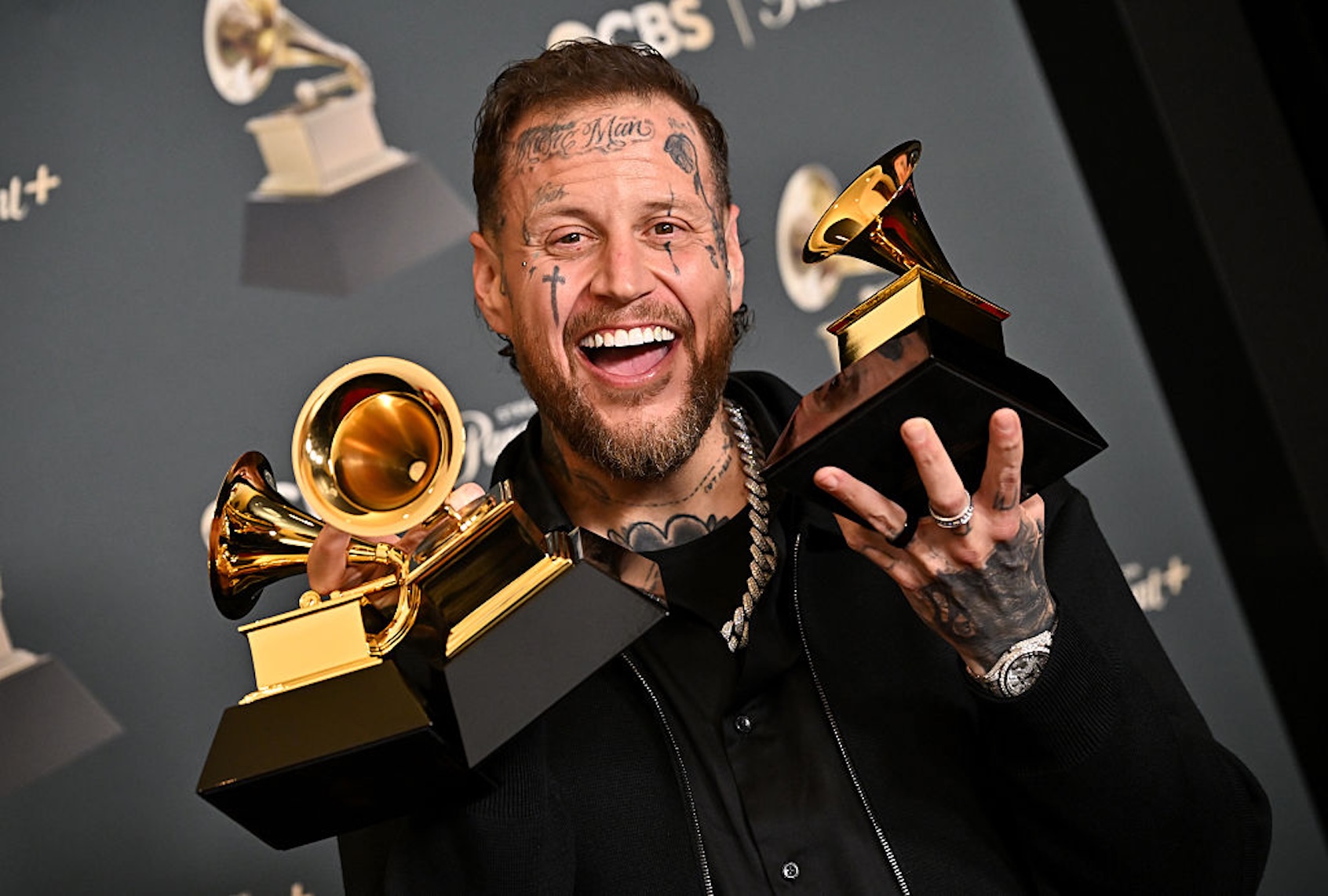

I know more than a few dumb rednecks. When you hail from one of the top 10 swamp cities in northeastern Florida, it’s just about impossible not to have a few in your circle. At one point in my life, I held spare keys to the homes of multiple men who had lost fingers in fireworks accidents. I’ve spent many nights playing video games with people who’ve purchased more pet snakes than they’ve cast ballots. I’m friendly with zero country superstars, but I’m acquainted with a Jelly Roll or two.
The country singer and rapper who bears that name inspired outrage at the Grammys on Sunday. In an interview backstage after collecting three awards, Jelly Roll was questioned about his stance on Donald Trump’s ongoing Immigration and Customs Enforcement operations. The chart-topper responded that he was not the man to ask about politics.
“You know, I’m a dumb redneck,” he said, claiming that he hasn’t “watched enough” to form a coherent position. “People shouldn’t care to hear my opinion. I didn’t have a phone for 18 months… I hate to be the artist that’s that aloof, but I’m so disconnected from what’s happening.” He promised reporters that he does “have a lot to say about it” and would do so “on the internet” next week.
To those of us who do possess phones and pay attention, at least intermittently, to the news, Jelly Roll’s response may seem impossible. On a night when many of his fellow musicians made direct statements against ICE and Trump’s anti-immigrant crackdown, the “aw, shucks” balking sounds cynical — and like a convenient dodge intended to not alienate fans. Jelly Roll’s pop-country fanbase undoubtedly includes many MAGA die-hards, along with quite a few outraged moderates and maybe even some liberals. Closing down the chat with a promo for a “loud and clear” statement coming in the next week certainly didn’t help.
Jelly Roll’s shiftiness on the subject is understandable to anyone with a passing knowledge of the politics of country music, a genre that has always leaned conservative.
But Jelly Roll’s shiftiness on the subject is understandable to anyone with a passing knowledge of the politics of country music, a genre that has always leaned conservative. At 41, the man born Jason DeFord’s entire career has taken place in the wake of a particularly hard conservative turn.
After Sept. 11, a wave of jingoistic hoo-rah anthems by the likes of Toby Keith and Darryl Worley set a tenor of unquestioning patriotism that radio country still hasn’t backed away from. The George W. Bush-era’s default Republicanism had hitmakers like the Zac Brown Band bringing “Chicken Fried,” their song about backyard parties, to a somber halt while they snapped off a salute to the troops and the flag. The ascension of Donald Trump hasn’t seemed to force a lot of reflection in Nashville. Instead, many songwriters have added the president’s signature lib-owning sneer to petty hits like Aaron Lewis’ “Am I The Only One?” and Jason Aldean’s “Try That In A Small Town.”
In this environment, it’s even-money that any new Colton, Hunter, Colt or Luke to climb the country charts leans conservative. Nashville assumes a conservative audience, and that audience assumes they’re hearing from a fellow traveler. It would hardly hurt Jelly Roll to walk the red carpet in a color-coordinated cap.
Want more sharp takes on politics? Sign up for our free newsletter, Standing Room Only, written by Amanda Marcotte, now also a weekly show on YouTube or wherever you get your podcasts.
The distant cousins I see mirrored in the “Son of a Sinner” singer might be clouding my judgement, but given how much of a lay-up a full-throated endorsement of Trump would have been for Jelly Roll, I have to believe him when he says he “didn’t know politics were f**king real until I was in my mid-20s, in jail.” Besides, there’s ample evidence that unvarnished, off-the-cuff statements can hurt musicians more than they help.
Take Chappell Roan. The unabashedly progressive pop star faced a wave of criticism in 2024 when she refused to endorse Kamala Harris for president due to the Biden administration’s support of Israel’s war in Gaza. The online harassment she endured led her to cancel several tour dates.
Jelly Roll didn’t even need to look into the recent past to see the pitfalls of making impromptu remarks. He just needed to look down the red carpet on Sunday at Jack Antonoff.
The super-producer caused a stir when he wore an anti-ICE pin on his jacket — but couldn’t seem to offer a satisfying reason for his stance. “It’s terrible, you know,” he told Variety. ““I mean, it’s time to…it’s just…for every reason you could imagine, I would think.”
We need your help to stay independent
Antonoff’s response earned jeers on social media. One X user jokingly wondered if he had borrowed the jacket. Another decried the Taylor Swift collaborator’s “performative ‘activism,’” calling it “incredibly disappointing.”
This is a truth that’s been lost in the politically polarized and overheated Trump era: The average American is not exactly a political newshound. A record number of Americans pledge allegiance to neither of the two major political parties. Turnout has ticked upward from its nadir in the 1990s, but around one in every three Americans never vote in presidential elections. Presumably, that also includes a couple of pop stars.
The “shut up and sing” cohort is wrong, of course. But imagine yourself on the other side of the microphone. “Sing and shut up” can look awfully appealing after you’ve seen what can happen when one of your fellow musicians gets it wrong.
Read more
about music and politics
