

Time is a curious construct in Donald Trump’s second term. It’s hard to believe that it was only one month ago that the U.S. staged a military incursion in Venezuela and abducted Nicolás Maduro, the country’s president, and his wife, bringing them back to America to stand trial. At the time, this seemed like a world-altering event. Now it has almost completely disappeared from the news due to all that’s happened — in Minneapolis, in Iran, in Greenland — in the weeks since.
Today, it’s just business as usual in the Trump administration.
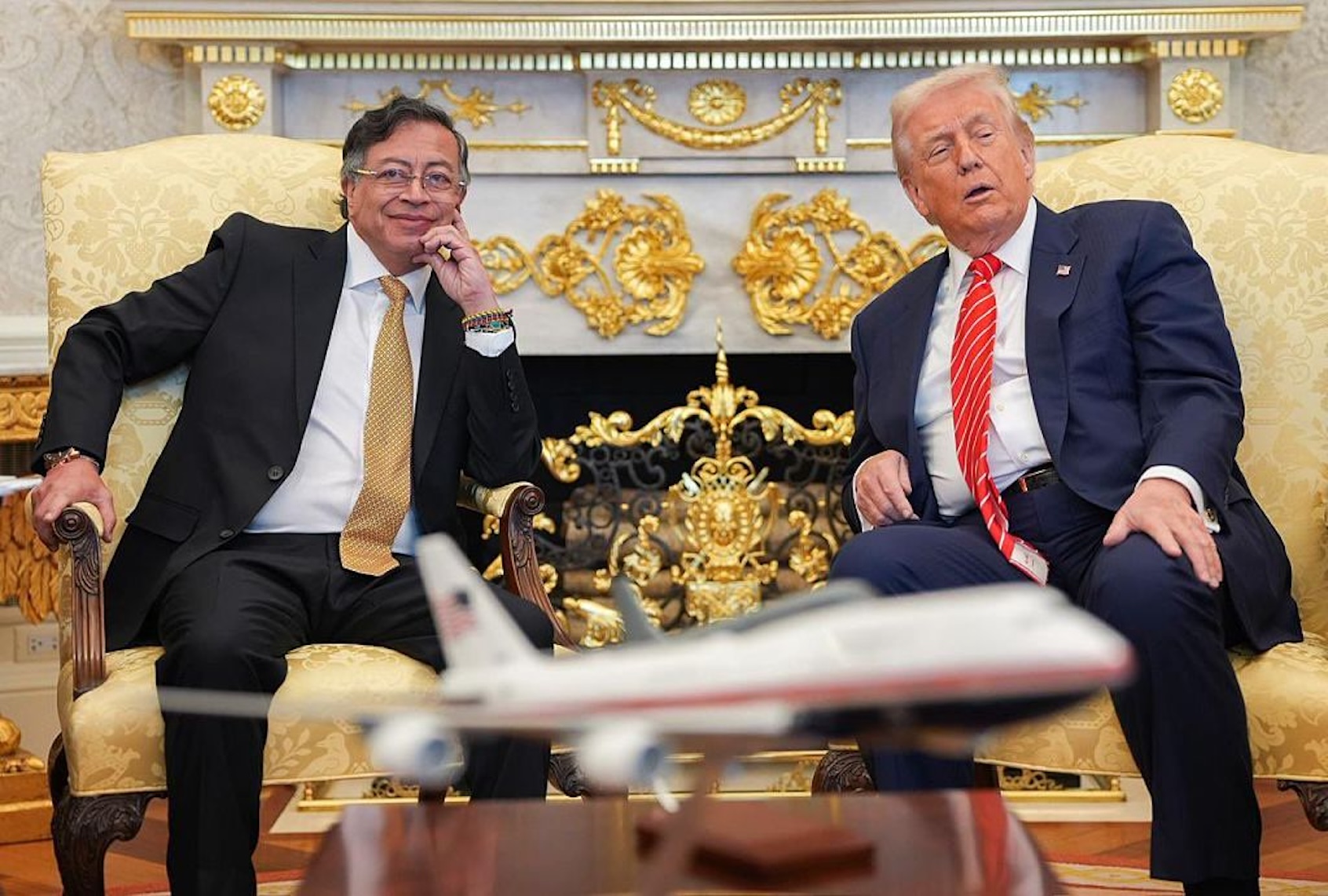
On Tuesday the president met with Colombian President Gustavo Petro in the White House, and considering the harsh words exchanged between them over the past year — Petro was a “lunatic” and a “sick man,” Trump said, while Petro accused Trump of being a fascist and “complicit in genocide” — nobody knew what to expect. But Trump signaled all would be well in advance of the meeting, suggesting that his action against Maduro had cowed the Colombian leader, who would now be content to serve as the president of a docile, vassal state of the U.S.
Apparently Trump was right. The meeting was hailed as a massive success with both of them exchanging hats and autographs, and the president pronouncing his Colombian counterpart as “terrific.”
The descriptor was a long way from the days when Trump was warning that Petro “had better watch his a*s” and musing that invading Colombia “sounds good.” Since it’s easy to flatter Trump — and he doesn’t seem to care about anything beyond what’s happening in the current moment — we can’t know whether this shift in rhetoric is temporary or will be permanent. If he finds it to his benefit to launch another broadside against Petro, he won’t hesitate to do it.
Latin American countries are all adjusting to the knowledge that the U.S. is now openly proclaiming its dominance of the Western hemisphere and that Trump will be exercising his power in erratic ways for the remainder of his term.
But for the moment, things have calmed in the region. Latin American countries are all adjusting to the knowledge that the U.S. is now openly proclaiming its dominance of the Western hemisphere and that Trump will be exercising his power in erratic ways for the remainder of his term. All eyes are on Venezuela to see exactly how this bold infringement of national sovereignty shakes out.
As Petro was traveling to Washington, Delcy Rodríguez, Venezuela’s interim president, met with U.S. chargé d’affaires Laura Dogu to talk about the future. One might have thought such talks would have taken place before now, but the fact that they haven’t is indicative of the administration’s lack of serious day-after strategy. No one still seems to know the plan.
Last fall, while the U.S. was assembling a large naval task force to patrol the waters off the Venezuelan coast and randomly blowing up small boats at sea — claiming without proof that they were running drugs — back channels had formed. The Guardian reported in January that Rodríguez and her brother Jorge, the head of the National Assembly, agreed in advance to cooperate with the Trump administration once Maduro had been deposed. Suspicions had been raised that this was the case, especially considering how blithely Trump accepted the woman who his own Drug Enforcement Agency had been tracking for years as a drug-running criminal. Then again, he had also just pardoned Juan Orlando Hernández, the former president of Honduras, who had been sentenced to 45 years in prison on charges of trafficking tons of cocaine to the U.S., so all of Trump’s caterwauling about drugs was clearly not something he actually cared about.
Rodríguez is considered a canny politician who some contend is much less ideological than her leftist history implies. According to the Guardian, her conversations with the Trump administration took place through a back channel in Qatar over the course of months. She reportedly made it plain that she would cooperate with the U.S. after Maduro was exiled or taken into custody, but would not participate in the operation itself. (Rodríguez has denied any cooperation.)
The most important requirement, at least from the administration’s perspective, was her agreement to work with oil companies that the U.S. was determined to bring into the country, ending years of ill will and legal complications. Trump’s plan to make Venezuela great again by taking over their oil fields, though, has encountered roadblocks. American oil companies, the president assumed, would jump at the chance to get in there right away, but that hasn’t happened. There is apparently little incentive to jump into a potentially unstable and unreliable situation, especially considering that someone like Rodríguez, with a fiery political history, is running the place.
Want more sharp takes on politics? Sign up for our free newsletter, Standing Room Only, written by Amanda Marcotte, now also a weekly show on YouTube or wherever you get your podcasts.
All the while, the interim president has been speaking out of both sides of her mouth, sucking up to Washington, promising full cooperation and releasing some political prisoners, while telling her own people and other countries in the region that she is completely independent and fighting back against U.S. control. Just last week, Rodríguez told a group of oil workers in a widely-televised speech, “Enough already of Washington’s orders over politicians in Venezuela!” When asked about it, Trump shrugged and said that he hadn’t heard her remarks but that he believes they have a very good relationship.
So far, Rodríguez has had nothing to say about democracy, economics, profiteering or how she might deal with the corruption of Venezuela’s major institutions. But that’s not surprising, since she was in the middle of it all as a long-time member of both the Maduro and Hugo Chavez regimes. She is protecting the status quo and seemingly has no interest in reform. At this point, one might assume the U.S. is fine with that — as long as she agrees to keep the oil flowing and doesn’t cause them any trouble.
In the event she does, the administration has made no bones of the fact that they are prepared to launch military actions. Trump has even threatened to mete out a “worse fate” than Maduro’s if Rodríguez fails to please him.
We need your help to stay independent
The rest of Latin America is watching and waiting. With the exception of Argentinian President Javier Milei, one of Trump’s most fervent foreign allies, most countries in the region consider Maduro’s seizure and arrest an ominous violation of international law and potentially the first step on the way to realizing America’s stated imperial ambitions. They, too, can read the New York Times, in which Trump declared that the only limit to his global power is “My own morality. My own mind. It’s the only thing that can stop me.”
During that interview, he took an off-the-record call with Petro. The Times’ reporters characterized the call as “an example of coercive diplomacy in action” — which is just a fancy way of saying that Trump said to Petro, “Nice little country you have there, would be a shame if anything happened to it.”
This week, after his meeting with the president, Petro walked out of the White House wearing a red MAGA hat to which he had added an “S” with what must have been one of the presidential Sharpies. “Make Americas Great Again,” the edited cap read.
Apparently, Petro has gotten with Trump’s program.
Read more
about Trump and Latin America
