
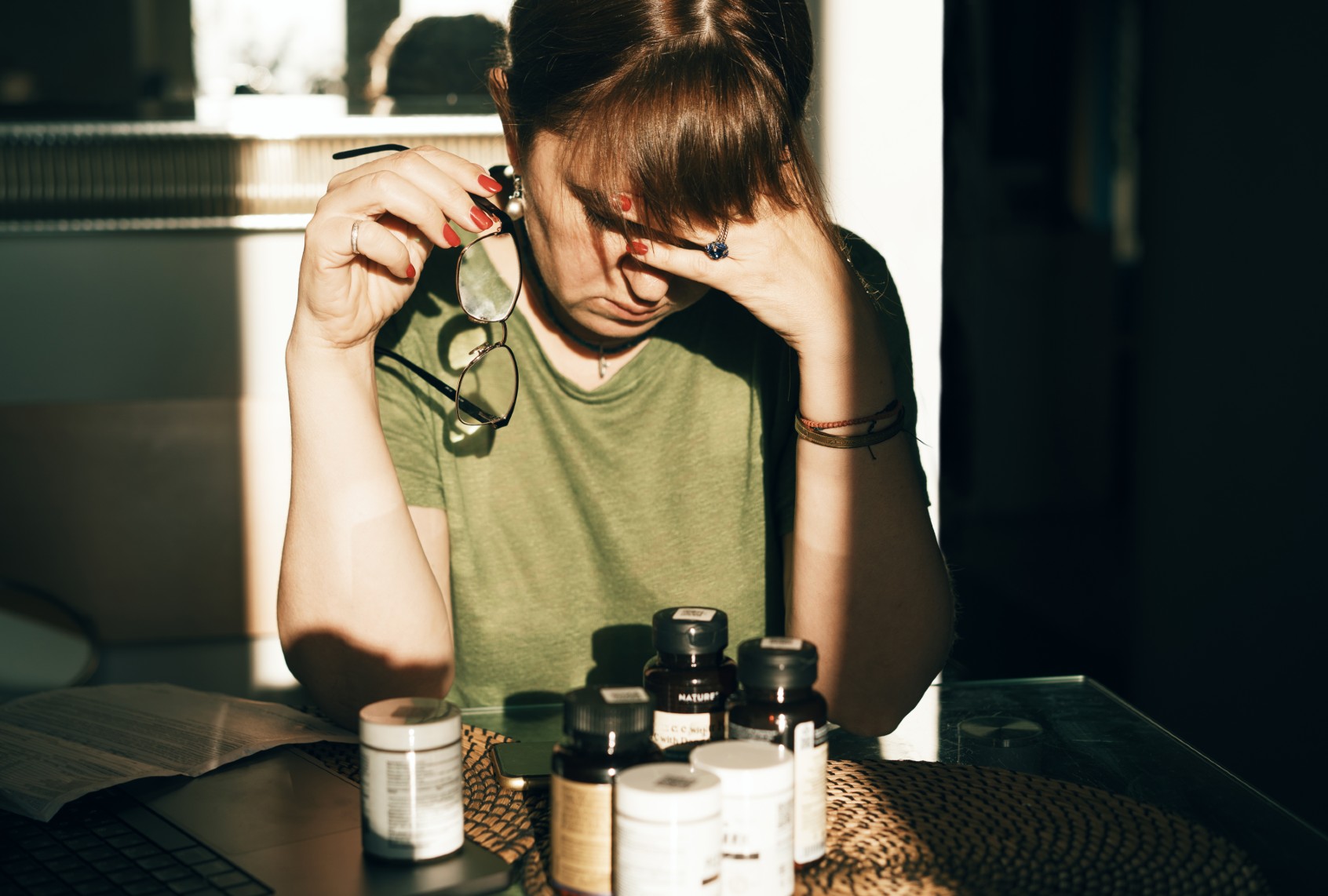

“I had hip pain so bad I couldn’t stand up for longer than 15 minutes. I had brain fog. My teeth were literally falling out of my head. I was having crazy sugar cravings and pursuing donuts like they were Tinder dates.” Portland musician/photographer/filmmaker Alicia J. Rose is recounting a stretch of time in her 40s when her body seemed to go haywire and doctors never mentioned that she might be experiencing perimenopause. “I had absolutely no idea what was happening to me until the hot flashes started.”
Physician and menopause specialist Aoife O’Sullivan had a similar experience in her early 40s. “My life and my body were falling apart and I couldn’t understand what was happening,” she says. “Six years of medical school, 3 years as a family-medicine resident in Ireland, another 3 years of residency over here. That’s 12 years of fantastic medical education. There was maybe one lecture on menopause: Hot flashes, night sweats, and you should be absolutely delighted that you’re not going to have periods anymore.”
Women often say aging makes them feel invisible; to the medical establishment, they often are.
Stories like these have proliferated in recent years on Reddit forums and Substacks, on podcasts and in support groups, among friends and strangers in the whisper network women find on their own because, as Halle Berry noted when lobbying for more research, “Our doctors can’t even say the word.” Gen X women were never warned that they might start experiencing symptoms like overwhelming fatigue, heart palpitations and joint pain in the decade leading up to menopause. O’Sullivan recalls the day she first heard the term perimenopause: “I was lying on the couch, I had no energy, had left my job, was looking at the dishwasher thinking ‘I don’t even know if I can unload that thing.’ And then, on Instagram, these women” — menopause experts Dr. Louise Newson and Dr. Heather Hirsch — “were talking about perimenopause. I started medical school in 1995. I had never heard the word.”
There are 34 symptoms of perimenopause and menopause. Less than 7% of medical residents are confident they have enough knowledge to help patients with either. Women often say aging makes them feel invisible; to the medical establishment, they often are. The shame and stigma of women’s aging runs deep, and intergenerational dialogue is scarce. I learned what menopause was from my favorite young-adult author, Norma Klein; others recall encountering it in books like “Our Bodies, Ourselves” and “Passages.” And too many of us, says Rose, watched the older women in our lives struggle in silence. “Our mothers were brought up to trust doctors, and doctors told [our mothers] that this” — the hot flashes, night sweats, bloating, irritability, pain, panic attacks and muscle atrophy — “was normal. And so that’s what Gen X learned, too. I attributed all of my symptoms to aging, when in fact it was 100% hormone deficiency.”
Perimenopause is often described as puberty in reverse: Instead of a surge in hormones, it’s a cessation, but it can be equally unpredictable and just as confusing. Rose, who booked music venues in San Francisco and Portland through the 2000s while also recording and performing as avant-garde accordionist Miss Murgatroid, was part of a thriving scene of women and AFAB musicians. Like her, many spent years of their 40s “down for the count”; when she began playing music again and reconnected with them in recent years, she realized they had something in common: hormone-replacement therapy. “We were back. We were creative. We were all flourishing again.”
This sense of creative rebirth inspired Rose, an established photographer and filmmaker who in 2015 created the acclaimed webseries “The Benefits of Gusbandry,” to start work on a film about punk women in midlife. “We had people on board, we had shoots lined up, and then my producer connected me to Aoife,” who invited Rose to the Portland Menopause Conference. “That,” she says, “was where I was radicalized.”
The rise and fall of the Holy Sh*t Drug
As with all whisper networks, women in peri/menopause share crucial information and tips (say, the fact that a tiny amount of topical estrogen cream resolves urinary-tract infections) but also share the frustration and anger about the knowledge void that made a whisper network necessary to begin with. Why didn’t we know that perimenopause fu*ked you up this bad? Why are doctors waving off our symptoms and making us feel crazy? Why are we just expected to live like this?
Up until 2002, we weren’t. The physical and mental impacts that occur as women’s bodies stop producing estrogen were familiar to health-care providers, and hormone-replacement therapy, developed and marketed in the 1940s and popularized in the 1960s, was the established standard of care. Then came the Women’s Health Initiative, a long-term, $625-million dollar NIH study of women’s health in midlife that enrolled 161,000 women between the ages of 50 and 79 into two randomized groups that both took synthetic hormones. In 2002, the study was abruptly suspended and its findings blasted from medical journals and mainstream news outlets alike: Hormone-replacement therapy was dangerous.
The FDA rolled out guidelines requiring products containing any kind of estrogen, at any level, to include a “black box” warning, the agency’s most stringent kind, that listed alarming risks: increased incidence of breast cancer, increased risk of stroke, increased risk of heart disease and cognitive impairment. Women taking HRT were told by their doctors to stop. Almost overnight, the 40% of menopausal women using HRT plummeted.
Want more from culture than just the latest trend? The Swell highlights art made to last.
Sign up here
In November 2025, the FDA held a press conference and made an unexpected announcement: It was rescinding its 2003 guidance and removing the black-box warning. “We are going to stop the fear machine steering women away from this life-changing, even lifesaving treatment,” stated FDA head Marty Makary.
So what happened in the intervening years? To start with: manipulation of data, conflation of relative risk and actual risk, overgeneralization, dramatics, anti-factual claims presented under the aegis of protecting women’s health and, most crucially, the creation of a media panic that effectively cut women off from hormone therapy for more than two decades. “They knew damn well what they were doing,” O’Sullivan says tartly. (Since the details are too numerous to cover here, she recommends Dr. James A. Simon’s barnburner of a presentation about the debacle, which unfolds like an action movie both in length and in jaw-dropping moments.)
“Before 2002, estrogen was the Holy-Sh*t drug, where women realized they actually didn’t have to suffer through menopause, didn’t need to have double hip replacements in their 50s,” Rose says. “Women were [being] prescribed estrogen like any other drug you’d be prescribed for a deficiency. It wasn’t a debate.”
The menopausal cone of silence
In the years after HRT was taken largely out of circulation, it sometimes seemed to have never existed at all. Women with symptoms of perimenopause were shrugged off; those who inquired about hormone replacement were often told that their doctors “didn’t believe” in HRT, as though it were Santa Claus or the Easter Bunny.
Peri/menopause has finally arrived in the zeitgeist, loud and bold and ready to lay waste to the decades of erasure and misinformation that has surrounded it.
This is a phenomenon, O’Sullivan says, that’s rare in other areas of medicine. Primary-care doctors who in other cases would look up symptoms or refer patients to a specialist minimized or simply dismissed this one. “There is nowhere else where a doctor who knows nothing about a condition says, straight up, with absolute confidence, ‘That’s not real.” In her essay “The Whiny Woman,” menopause specialist Dr. Mary Claire Haver recalls being a medical intern who, stumped by the symptoms of a patient in her 40s, turned to her chief resident for advice and was told that the patient was a “WW.” “Women at this age — they just tend to have a lot of somatic complaints. There’s not much we can do. Pat her on the knee and tell her to drink some water and get more rest.’”
“I had been trained to mistrust women’s experiences,” Haver writes. “Not by one professor, not by one resident, but by a medical culture that labeled women unreliable narrators of their bodies.” The stigma and shame experienced by patients like hers silos women in cones of silence. “I was ashamed of [needing] vaginal estrogen,” recalls Rose. “I felt like that was my failure as a woman” — a feeling familiar to the 2 million women annually who have entered perimenopause in the years since HRT was downgraded from miracle to monster.
Enter the menopunks
After the conference where Rose found her mind blown (it has since been expanded and rebranded), she was exhilarated, pissed off and suddenly making a very different movie — still about musicians in midlife, but also what it looks like when women reclaim their creativity and their power at a time when a culture defined by men’s wants and desires stops seeing older women as people. “Menopunks” is a movie about hormonal optimization that follows three of Rose’s musical peers as they begin 6 months of HRT under O’Sullivan’s guidance, and an exposé meant to shatter the cone of silence and make clear what was taken from women by the WHI debacle. And for Rose, “Menopunks” is not just a movie but a movement — “a full-throttle, hormonal revolution.”
Peri/menopause has finally arrived in the zeitgeist, loud and bold and ready to lay waste to the decades of erasure and misinformation that has surrounded it. There’s “Riot Women,” Sally Wainwright’s new BritBox series about menopausal women who push back against the bleakness and discombobulation of midlife by forming a punk band that literally screams for HRT. Apple TV/Amazon Prime recently debuted “Balance,” a four-part docuseries about the global epidemic of misinformation and silence around perimenopause and menopause. Halle Berry and Naomi Watts joined Oprah Winfrey for a 2025 special, “The Menopause Revolution”; Watts’ subsequent turn on the Ryan Murphy legal howler “All’s Fair,” meanwhile, was a chance to draw attention to the issue, as well as to stealthily promote her menopause wellness brand, Stripes.
We need your help to stay independent
As “Menopunks” moves through production, Rose’s podcast of the same name, which launched in November, has drawn in listeners around the world with guests like Margaret Cho, Corin Tucker, and Lidia Yuknavitch. Rose has been contacted by thousands of women who say that the project makes them feel, for the first time, excited to own their peri/menopause experience. “Menopunks” has even inspired a viral comic.
Rose acknowledges that it’s going to take a lot more than Makary’s condemnation of the WHI fear machine to undo two decades of damage — especially given that the FDA head himself is a wild card whose views, some of which align with those of his beef tallow-chugging boss, are already getting side-eye from the medical establishment. But she thinks we should take the win and boost the signal regardless. “People have been debunking the WHI study for years, [but] it hasn’t gained traction until now,” she says. “This didn’t start with me. I’m just a musician who wanted to know why her tube of vaginal estrogen cream came with a PROBABLE DEMENTIA warning.”
More than anything, Rose wants “Menopunks” to spark some measure of redress: “My dream is that people finally and fully understand the scale of this violation,” she says. “This didn’t just affect the United States. It affected the world.”
Read more
about aging
