
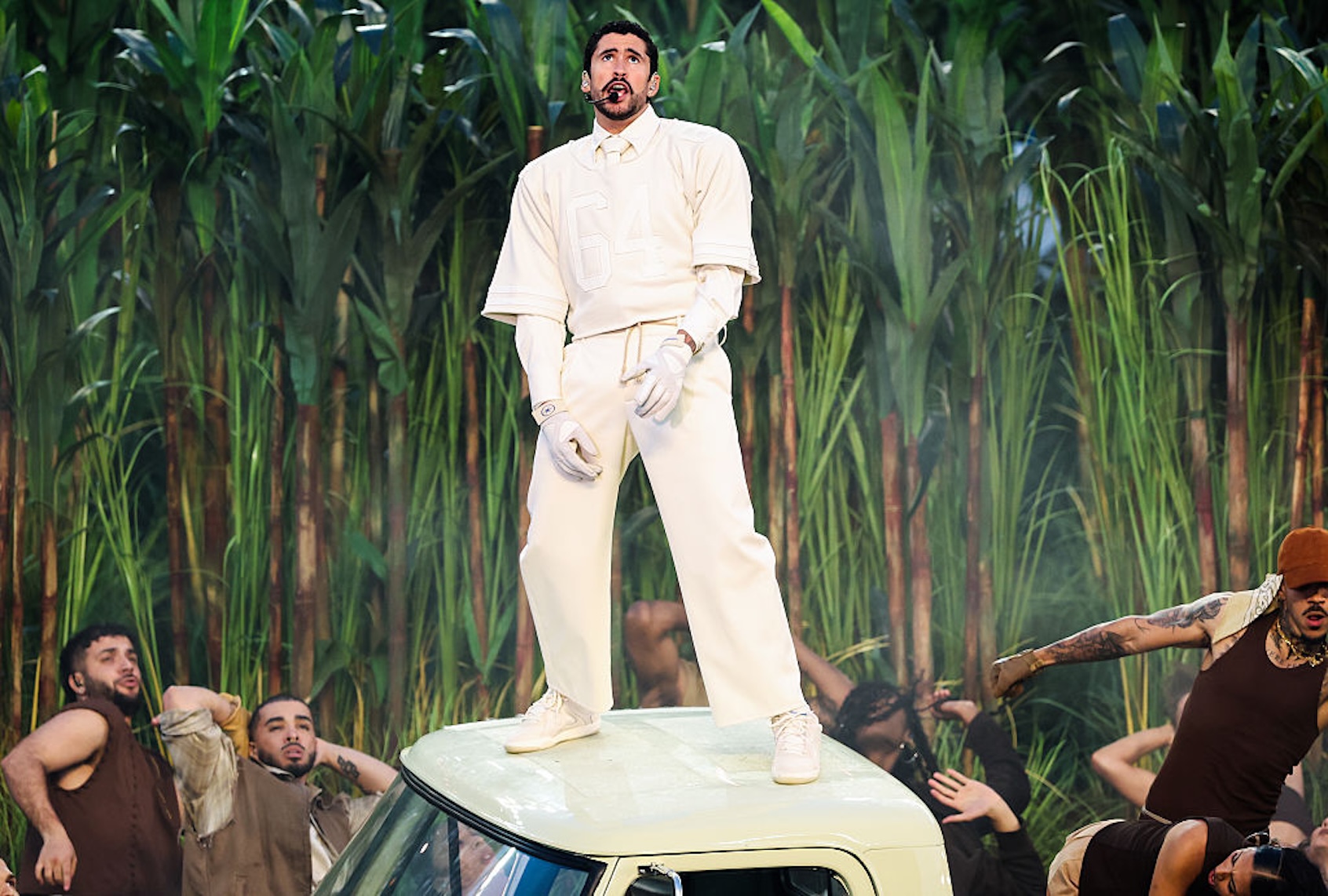

From the moment it was announced that Puerto Rican music phenomenon Bad Bunny would headline the Super Bowl LX halftime show, it was inevitable that, in a country on edge, the musical interlude at “America’s Game” would open another front in the ongoing culture war. After all, what could enrage reactionaries more than a confident, gender-bending, anti-colonial Puerto Rican performing in Spanish on the country’s most mythologized stage?
To MAGA, Bad Bunny is a kind of Mare, the evil spirit from Scandinavian folklore intent on draining the right of their energy — which means that there was plenty of material for fake outrage following the performance. But one faux-critique quickly emerged as the overwhelming MAGA favorite: The Super Bowl is American, and Americans speak English.
This message was not only coming from random MAGA zealots on Truth Social and X. Podcast host Megyn Kelly called Bad Bunny performing in Spanish an “insult to the heartland.” On Fox News, conservative radio host Sid Rosenberg lamented, “not one word of English, not one word of English, one word!” This choice of outrage speaks volumes about the role of language in American white nationalism and the long historical ties between “American First” and “English-only” — connections deep enough that the pervades the whole of American culture.
Let’s be clear: the English language is in no danger of disappearing in the United States. A nation demographically dominated by the descendants of immigrants from every corner of the world is one of the most linguistically homogenous on earth.
Let’s be clear: the English language is in no danger of disappearing in the United States. A nation demographically dominated by the descendants of immigrants from every corner of the world is one of the most linguistically homogenous on earth. Over 90% of people living in the U.S. are proficient in English, and nearly 60% of immigrants arrive speaking proficient English, a designation due in no small part to its status as a global lingua franca. Fox News hysterics aside, nearly everyone in this country, immigrant and native-born alike, can speak English just fine.
What is actually troubling is the number of native-born Americans who can speak only English. Most research suggests that a mere 6.5% of those born in the U.S. can speak any language other than English — a shocking statistic that puts the country far behind peer nations, and serves as a glaring indictment of American education, curiosity and sophistication that should be a source of national shame. Yet, somehow, this problematic statistic and all that it symbolizes doesn’t even register. Even progressive Americans, those quick to point out the ways in which the U.S. follows in the wake of other countries with respect to healthcare, workers protections and vacation time, don’t seem all concerned with America’s linguistic failure.
This is not an accident. While it may be the most strident nationalists shouting “English-only,” monolingualism is part of American national identity, a strange concession to unity in a “nation of immigrants.” Of course, language has always played a role in nationalist movements. Language was one of the key characteristics that was first used to even define a nation when the concept began to emerge in the 17th century. But the idea of linguistic commonality among members of a nation-state was not ever a demand for monolingualism.
Even in pre-Civil War America, monolingualism was rare. Martin Van Buren, the first president to be born a U.S. citizen, spoke Dutch as his first language, as did Sojourner Truth. As early as July 6, 1776, German, French and Russian translations of the Declaration of Independence were being circulated. In 1795, the House of Representatives even considered a motion to print laws not only in English but also German, owing to the large German-speaking population of the new nation.
Want more sharp takes on politics? Sign up for our free newsletter, Standing Room Only, written by Amanda Marcotte, now also a weekly show on YouTube or wherever you get your podcasts.
The American turn to monolingualism did not occur until after the Civil War, when new immigrants from southern and eastern Europe began to arrive in large numbers: Italians, Poles, Greeks and Ashkenazi Jews. These new arrivals were greeted with hostility and fear that they would transform America and its culture beyond recognition. For the first time, the demand that new arrivals “learn English” began to emerge, part of a wider nativist trend that also led to the height of the Ku Klux Klan. Moreover, and perhaps more importantly, these new immigrants, aware of the ways in which “English” was being used as code for “American,” discouraged their children from learning their native-language.
This was a watershed. It was the moment the United States lost what could have been one of its greatest advantages: a rich mosaic of multi-generational heritage language speakers. If Americans speak English, the unspoken logic went, the most American among us speak only English.
We need your help to stay independent
While many nations had previously defined themselves by a shared language, Americans came to see English not just as the national language, but monolingual English as part of their identity. Flash forward to the early 1980s, when the nationalist, nativist and arguably white supremacist movement to make English the official language of the U.S. began to take shape. The rallying cry was not “English First” or “English Officially,” but “English Only.” Only English. No other language was to be considered acceptable in American public life.
In this long history of forced English-language assimilation, Puerto Rico remains an outlier. Despite being under U.S. control since 1898, the island continues to be a Spanish-speaking nation. In fact, a desire to maintain the Spanish language in Puerto Rico is routinely cited among the reasons many do not wish to pursue statehood. Puerto Ricans are Americans who for over a century have resisted the pressure to become monolingual English-speakers.
This brings us back to Bad Bunny and his Super Bowl moment, which offered a powerful artistic and political statement about the role of Puerto Rican and Latin culture in American life. It is no accident that those itching for more ammunition in the country’s slow-burn cultural conflict immediately reached for the question of language. But in a mere 13 minutes, Bad Bunny showed the shallowness of America’s history of monolingualism and the dark impulses underpinning it: nativism, forced assimilation, isolationism and white supremacy. His performance was a reminder of this country as it once was: diverse in language and dialect, paying tribute to one’s cultural heritage while simultaneously celebrating the opportunities America, in its best moments, offers its immigrants. And this all came in the middle of a very boring football game.
Read more
about this topic
