
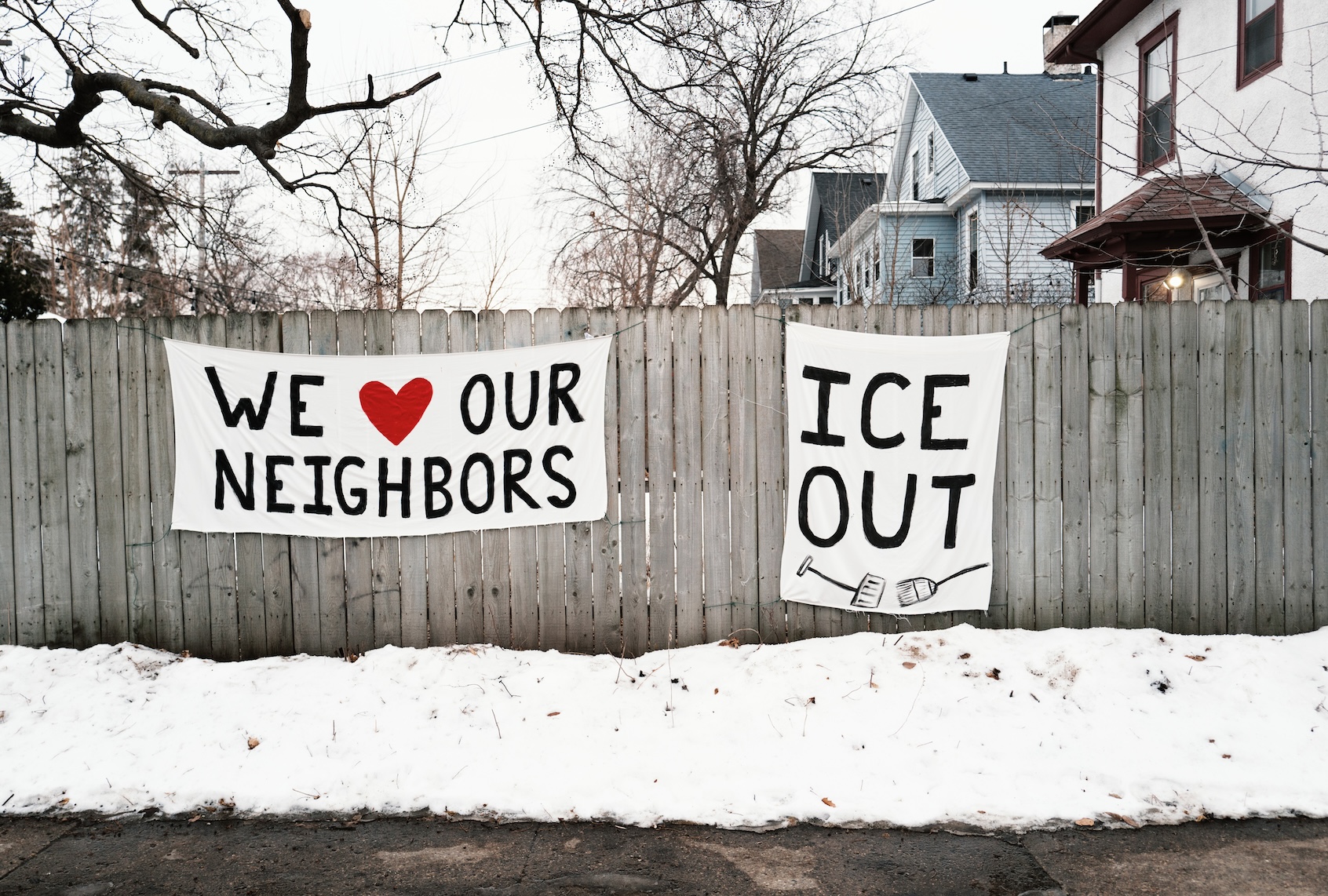

Minnesotans, after weeks of dealing with Immigration and Customs Enforcement, have developed strategies for dealing with the agency’s occupation of the city and now, Americans from across the country are attending training from Minnesota-based organizations to prepare for when ICE comes to their city.
On Wednesday evening, the Twin Cities chapter of Indivisible, a nationwide grassroots progressive advocacy organization, hosted a training on how to be an effective constitutional observer of ICE operations. In Minnesota alone, some 23,000 people have received the training, according to the organization.
The training, which had more than 200 attendees, was one of many hosted by the group, which itself hosts only a fraction of all ICE-related trainings in the Minneapolis-St Paul area.
The Immigrant Defense Network, a Minnesota organization that has helped train organizers who administer and assemble materials for the trainings, is even going on tour to 30 cities in the Midwest, which will feature trainings for how to legally respond to and observe ICE.
The training on Wednesday specifically focused on observing and documenting ICE, and covered the role of the observer in immigration enforcement contexts. It addressed issues like how to tell a judicial warrant from an administrative warrant, how to inform people of their rights when ICE is attempting to detain someone, and how to stay safe when ICE officers become aggressive and violent.
It also addressed relatively recent developments in ICE’s occupation of the city. For example, the trainer discussed how ICE officers have been impersonating protesters and people from Invisible and other activist groups to gain others’ trust. They also advised that, if someone is providing support to immigrants as well as responding to ICE, they use two different vehicles, as ICE is now tracking the license plates of people they have interactions with, which could help officers identify the location of immigrants they’re targeting.
The training, however, focused on two topics: what to document during an ICE operation and the legal landscape around immigration enforcement.
Organizers have said that the feeling on the ground is that it’s not one single tactic that is effective at combating ICE, but the combination of many tactics.
Trainees were advised to take notes, video record and to narrate their video with factual statements concerning the size of the situation, the activity of officers, the specific location, the uniform of the officers, the time of day and any equipment that they are using.
In terms of the legal landscape, trainees were told to inform people of their rights in statements in the formulation of “you have the right to ‘X.’” The trainer said that ICE officers have taken more direct statements like “you don’t have to open your door” as obstruction and used them as an excuse to arrest observers.
Trainees were supplied with a reference booklet covering most of the same topics discussed in the training, as well as a set of numbers to call in case of different events. In cases of ICE abuses, trainees were told to call an ACLU number to give them details for a preexisting lawsuit filed by the organization. In the case of their own arrest, trainees were told to call the National Lawyers’ Guild. And, they were also given a hotline to call if someone is arrested and in need of legal representation in an immigration case.
What became abundantly clear was that, while some of the training materials and strategies were being developed by a state-level organization, the bulk of the action was being organized much more locally.
We need your help to stay independent.
The IDN, for instance, has a system to alert trained observers to respond to ICE action, and notifies people based on their proximity to the action. The bulk of the response to ICE actions, however, is being organized in neighborhood-level chats in Signal, an encrypted messaging app., These group chats allow organizers to track ICE’s movement through their community and respond appropriately. They’ve also allowed people to organize things like court accompaniment, protection for religious services and food drives.
Observation, however, is only one role in the constellation of responding to ICE, with the goal being to create and preserve evidence. Other groups are providing nonviolent civil disobedience training, for example, which organizers describe as calling attention to the injustice of the current policy. Protesters who chant and blow whistles, which is often aimed at calling attention to an ICE operation and warning people in the area of their presence.
Start your day with essential news from Salon.
Sign up for our free morning newsletter, Crash Course.
In conversation with Salon, organizers have said that the feeling on the ground is that it’s not one single tactic that is effective at combating ICE, but the combination of many tactics, which creates an environment in which officers are constantly interacting with protesters and where ICE activity is constantly being met with a response.
These tactics include things like “commuting,” where people tail ICE throughout the day to keep track of the movements and activity, rapid response, where protesters and observers alike respond rapidly to ICE operations, and hotel protests, where people make noise outside of hotels where ICE is staying, in order to keep them awake.
Combined with a bad work environment, complaints of incompetent management, and widespread public disapproval of ICE, in no small part due to the killings of multiple Americans by immigration enforcement, and it’s clear why morale is low among officers.
One organizer shared a story in which ICE officers had stopped in their neighborhood, only to almost immediately leave after being met by a crowd of observers and protesters armed only with their voices and whistles. Before they left, the officer repeatedly said, according to the organizer, “Don’t whistle at us.”
“They literally left because they didn’t want to face it, you know … Maybe they’re just tired of it, and they were just like, ‘This isn’t worth it.’ So they just got back in their car, and they left,” the organizer said.
Read more
about ICE and immigration
