
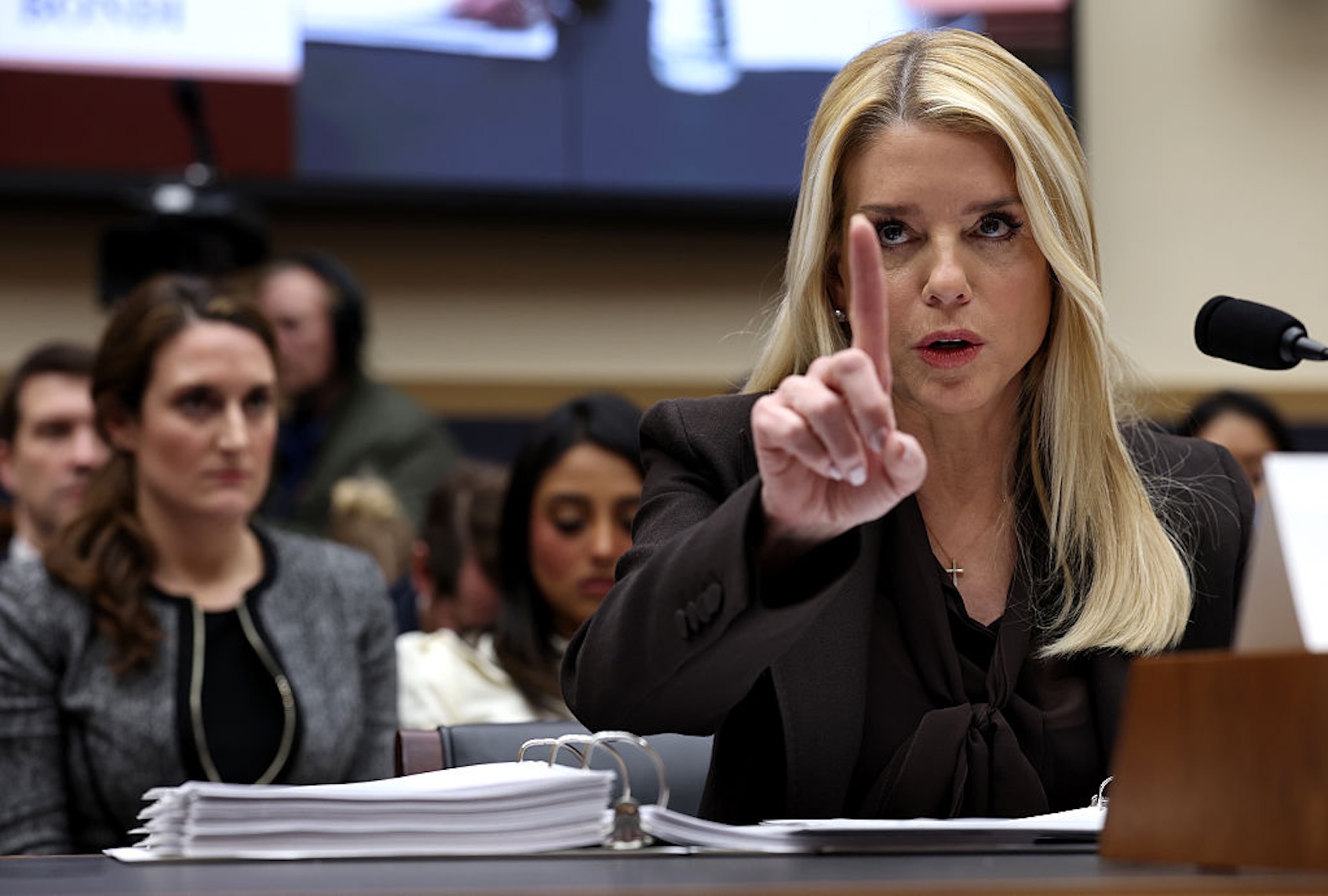

On Wednesday America was subjected to a monumentally outrageous performance by one of the most powerful people in the federal government — and for once it wasn’t by Donald Trump. Pam Bondi was called to Capitol Hill to appear before the House Judiciary Committee, and she chose to behave like a bratty schoolgirl having a temper tantrum in the principal’s office. If the stakes weren’t so high, it would have been almost comical to see an adult behave so childishly in such a formal setting. As it was, the attorney general embarrassed herself, the Justice Department and the country with the insulting, irrational attitude she apparently adopted to impress her boss and mentor, who has worked to shatter the rule of law.
The next Democratic-appointed attorney general will have a mess to confront and clean up. They will need their ethical, intellectual and political wits about them to craft reforms and regulations, and to restore a sense of confidence in the department’s independence.
The next Democratic-appointed attorney general will have a mess to confront and clean up. They will need their ethical, intellectual and political wits about them to craft reforms and regulations, and to restore a sense of confidence in the department’s independence. But they can also look to the not-too-distant past for inspiration.
There was a time when Americans considered the attorney general to be one of the most distinguished, consequential appointments in government. Occupants of the office were assumed to be people of high integrity and good character, qualities considered necessary to remind Americans of the commitment to dispense justice fairly and impartially.
Of course this was not always the case. The office of the attorney general is a political position tasked with carrying out the priorities of the president, and that may inevitably lead to at least the appearance of partisanship. It also opens the door to abuse of power by a president inclined to go there.
Richard Nixon’s behavior during Watergate brought those prospects into clear focus. The president attempted to use the Justice Department to block investigations into the break-in at the Democratic National Committee headquarters, as well as many other abuses that slowly came to light as the scandal unfolded. Nixon’s order to fire special prosecutor Archibald Cox, who had been appointed to head the investigation, prompted Attorney General Elliot Richardson to resign, followed swiftly by Deputy Attorney General William Ruckelshaus, in what became known as the Saturday Night Massacre, crystallized for the public the corruption at the core of Nixon’s presidency.
After Nixon’s resignation in August 1974, Congress realized that reforms were needed to insulate the Justice Department from political pressure by the White House. Years of congressional investigations and in-depth reporting had made the country aware of massive abuses of power by the executive branch. J. Edgar Hoover, who led the FBI for 48 years, had established a personal fiefdom devoted to consolidating power and pursuing his own personal obsessions, sometimes with blackmail and coercion. The intelligence community was implicated as well, along with Nixon’s exploitation of the Internal Revenue Service and other agencies for partisan and personal gain.
The result was the Ethics in Government Act of 1978, which was passed by Congress to, among other provisions, prevent conflicts of interest and create the Office of the Independent Counsel, a position designed to be insulated from political pressure by the president. (The independent counsel statute was allowed to expire 20 years later following the debacle that was the Starr Investigation in the late 1990s.)
Presidents Gerald Ford and his successor Jimmy Carter took up the mantle of reform, instituting new norms and rules designed to rein in an out-of-control presidency. Edward H. Levi, a respected legal scholar who served as Ford’s attorney general, began working to mend the department from within, which included limiting the scope and power of the FBI. His successor Griffin Bell, who served under Carter, came up with the idea of making the Justice Department a “neutral zone,” which was designed to formalize the idea that the White House would not directly involve itself in any law enforcement decisions. This led to new oversight mechanisms, including the Office of the Inspector General and the Office of Personal Responsibility, to keep the abuses in check. Carter’s administration instituted the most sweeping reforms of the civil service since 1883’s Pendleton Act, which replaced the spoils system and created a professional, merit-based system.
According to Harvard Law School professor Jack Goldsmith, with the exception of the Independent Counsel Act and the War Powers Resolution — legislation from 1973 that required congressional authorization for military intervention — those reforms held up quite well, even as various presidents attempted to push the envelope.
In retrospect, George H.W. Bush’s pardons of Iran-Contra participants was an early attempt by the executive branch to circumvent the post-Watergate reforms. But it wasn’t until the election of Donald Trump that the full scope of the reforms’ inadequacies in the hands of a real tyrant became obvious. Having had no ethical boundaries in his business and personal life, he saw no purpose in observing any such guidelines in government.
Want more sharp takes on politics? Sign up for our free newsletter, Standing Room Only, written by Amanda Marcotte, now also a weekly show on YouTube or wherever you get your podcasts.
One of Trump’s first scandalous acts as president was firing James Comey. The FBI director ran afoul of Trump early on when he refused to publicly state that the president was not under investigation in the Russia probe or to let his newly-named National Security Adviser Michael Flynn off the hook for lying to the bureau. Since then, Trump has never looked back in treating the norms and rules established after Watergate as rubbish. He would simply ask if he had the power to do something and that would be all he needed to know, ethics and traditions be damned.
In his second term, Trump hasn’t even bothered to ask that question. He simply does what he wants, and if the courts tell him he can’t, only then might he consider pulling back. When it comes to Bondi’s Justice Department and Kash Patel’s FBI, the results are clear. As Salon’s Sophia Tesfaye laid out in detail, the department is being decimated from top to bottom. The brain drain is overwhelming, with hundreds of career prosecutors being fired or leaving voluntarily; they are being replaced by unqualified lackeys and loyalists.
The wreckage left behind is what will await the next Democratic attorney general who, with an equal commitment from Congress, will have no choice but to reform the entire department from the bottom up. At the end of Trump’s first term, the New York Times’ Peter Baker reported that Goldsmith and former Obama White House Counsel Bob Bauer created a bipartisan blueprint for what such a rebuilding would require. They proposed to restrict the president’s pardon power and private business interests, enhance protections for journalists and give more powers to future special counsels among other things.
We need your help to stay independent
Sen. Adam Schiff, D-Calif., and others in the Congress have similarly drawn up plans to overhaul the ethics rules and create various mechanisms to prevent the gross abuses of power that Trump and his loyalists are practicing. According to Baker, these would include “limits on a president’s authority to use declarations of national emergencies to take unilateral action; more protections for inspectors general and whistle-blowers; and an accelerated process to resolve disputes over congressional subpoenas.”
With a Supreme Court determined to give presidents more power rather than less, even in light of Trump’s absolute monarchical power grab, it remains to be seen whether any of these restraints will come to fruition. Democrats will have to do everything in their power, including such bold acts as expanding the high court, to make it work. If they don’t, the damage done by Trump will be permanent.
Once they have seen the door is open to abuse, future tyrants will eagerly walk through it — and there are plenty more waiting in the wings and willing to take advantage of what Trump has wrought.
Read more
about the Justice Department
