
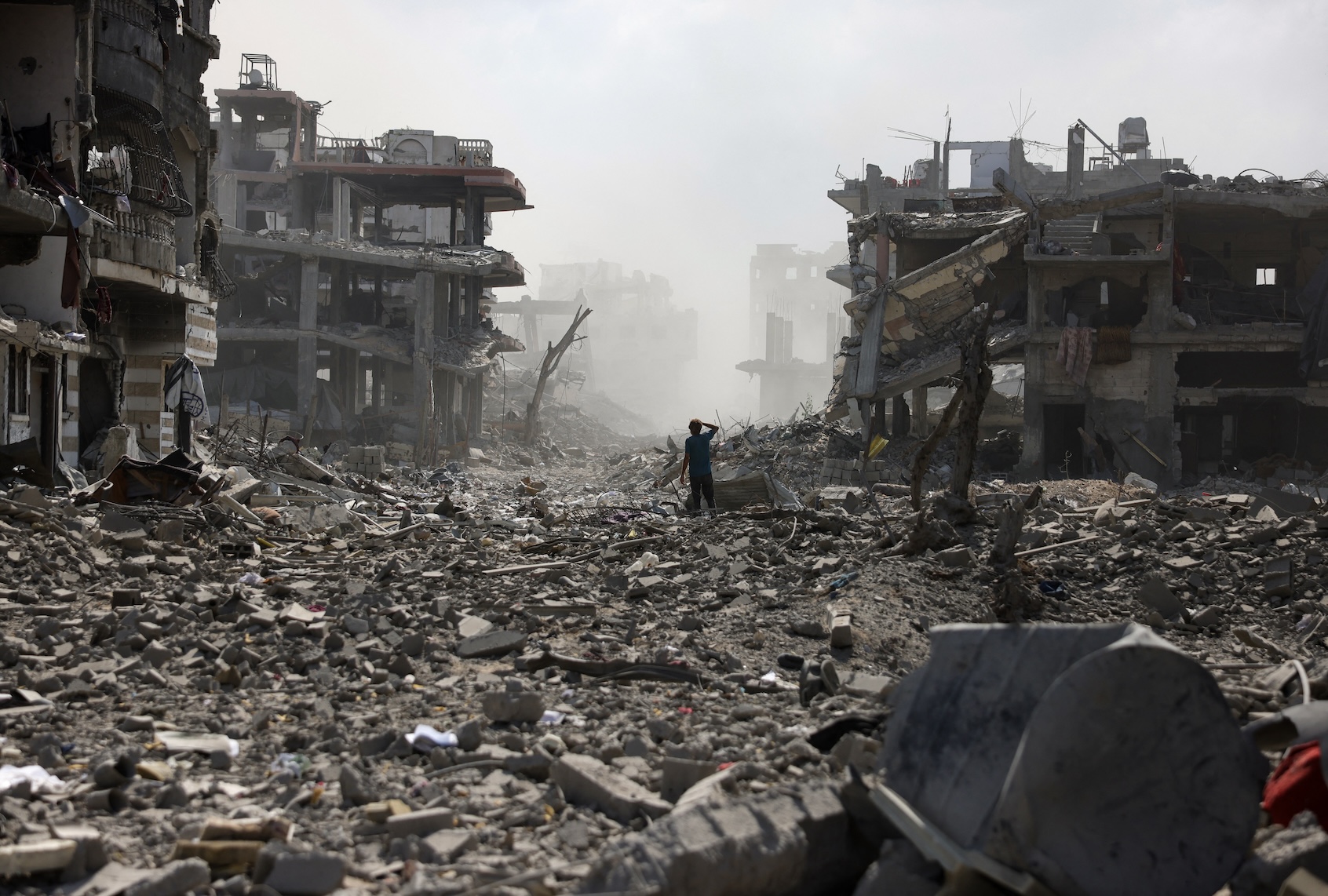

Last weekend, on the third day of Ramadan, an Israeli airstrike killed at least two Palestinians in the latest breach of a ceasefire agreement signed in October 2025. The total number of Palestinian deaths since the ceasefire has reportedly surpassed 600, not counting those succumbing to starvation or disease as a result of Israel’s continuing partial blockade. While the Israel-Palestine conflict has slipped away from the center of media attention in the U.S. over the last few months, it remains a fraught political issue that continues to affect how Americans vote, and how they perceive both culture and politics.
According to polling and analysis, including the Democratic Party’s still-secret internal report about how the Gaza issue affected Kamala Harris’ 2024 campaign, the deaths of tens of thousands of Palestinian civilians has shifted the political paradigm on the U.S. relationship with Israel, its longtime ally or proxy in the Middle East.
Bruce Robbins, a professor of English and humanities at Columbia University, has written about the evolution of how the world and its literature understands and recognizes mass violence in his 2025 book “Atrocity: A Literary History.” More than a decade earlier, Robbins also wrote and directed the documentary “Some of My Best Friends Are Zionists,” built around interviews with prominent Jewish American activists and intellectuals, including playwright and screenwriter Tony Kushner, philosopher Judith Butler and author Gary Shteyngart. He recently spoke with Salon about the struggle to recognize atrocity and confront the powers that seek to justify it.
This interview has been condensed and lightly edited for clarity.
A significant body of your work explores the “atrocity” as a category of moral judgment. When did tension between national duty and universal morality reach a breaking point, and atrocity emerge as a moral scandal?
I started thinking about the concept of atrocity in part because my father was a bomber pilot during World War II, and he was fighting the Nazis, which I thought was an excellent thing to do. He was doing what [commanding officers] told him to do, which was to fly bombers, but a natural part of that at the time was bombing cities. And I don’t think bombing your targets was considered an atrocity if you were fighting Nazis, even if those targets were cities with civilians in them.
So I had very mixed feelings about my father’s role in World War II, because I did not think it was a good thing to bomb noncombatants. When I use the word “atrocity,” I’m thinking of mass killing of noncombatants. I was fascinated by the fact that what seemed to me an atrocity was not seen in general by everybody in the U.S as an atrocity. So there’s the question of, do you only see something as an atrocity if other people do it? Or do you also see it as an atrocity when your side does it?
“Do you only see something as an atrocity if other people do it? Or do you also see it as an atrocity when your side does it?”
That became, I think, a major question after the bombings of Hiroshima and Nagasaki, events of mass death and destruction on an unprecedented scale for the amount of time it took. There were people who just saw it as part of the war effort, and there were people who were really, really scandalized. When John Hersey’s account “Hiroshima” filled an entire issue of the New Yorker in 1946, following six survivors around Hiroshima and what they saw in the moment of the explosion and then afterward, Albert Einstein bought 1,000 copies and started passing them out to everybody he could think of, because he thought, this was clearly an atrocity, and this is something that we really need to discourage people from ever, ever doing again.
So a lot of what I talk about is how it came to pass that people were able to identify something as an atrocity — not if it was done to them, but if it was done by their side to somebody else — which seems to me one of the great moral moments in the history of humanity, if you think that humanity has a moral history at all.
Are we seeing another moral moment now, with respect to Palestine? There appears to be a much more heated and immediate protest movement and debate in this context. Israel has attempted to frame its actions as part of a just war, in defiance of most of world opinion. What makes the reaction in the U.S. to this different from the aftermath of the atomic bombings?
In the immediate aftermath of Oct. 7, when people evaluated what Hamas had done to civilians on the Israeli side, that was certainly labeled as an atrocity. But the Israeli response to that was mass killings of civilians and bombings of their homes, day after day after day after day, and the images of it were transmitted via social media, which is to say uncurated, to young people. People were getting information without waiting to have it curated by the usual gatekeepers of newspapers, TV stations and so on. So this became a kind of moral paradigm for an entire generation. Things have quieted down after the supposed ceasefire, which is not actually a ceasefire. People stopped paying the same kind of attention. But it seemed to me that here was a series of atrocities actively supported by the United States, militarily, politically, diplomatically, where a lot of people in America looked at this and said, “This is an atrocity to which we are contributing directly.” And that was a major moral moment.
Has there been an evolution where a dynamic is flipped? Where before a sense of national unity had to be overcome before one could see atrocity, but now the very fact that the United States is culpable seems itself to be fueling righteous anger.
Yes, the United States is objectively responsible for what’s happening in Gaza. The students at Columbia, where I teach, were objecting in part to people from the Lockheed Martin board of trustees who are also in the university’s board — Lockheed Martin, as you probably know, sells a lot of the hardware to Israel that they have used in the bombing of Gaza. So why was the board of trustees not willing to talk with the students about what Columbia’s endowment was invested in? Maybe because some of the people on the board of trustees were themselves personally invested or ideologically invested in stuff that was happening.
Start your day with essential news from Salon.
Sign up for our free morning newsletter, Crash Course.
The board isn’t the way it is because of the students, but there is still a sense of proximity. There are atrocities happening in Sudan right now. What the Iranian government has been doing to protesters is definitely an atrocity. Horrible, horrible things. But it’s just not exactly the same thing when your own government is committing atrocities and you by extension feel directly responsible.
People in general are conscious of atrocity now, but why might some people still support what a reasonable person would call an atrocity?
One of the ways I’d like to go with your question is the extent to which we personalize nations, and we think that what’s done to the “bad” nation is somehow legitimate. I’ll give you an example from the course on atrocity that I taught at Columbia, where I showed a documentary about the rape of Nanjing in the winter of 1938 and 1939. There were probably more Chinese civilians killed by the Japanese military in the rape of Nanjing than were killed in Hiroshima and Nagasaki combined. So, we talked about that, and then we talked about the bombing of Hiroshima and Nagasaki. And I asked the class, “Do you think that the bombing of Hiroshima and Nagasaki was justified as payback for what the Japanese military had done in Nanjing?”
One guy said, “Absolutely, the Japanese deserved it.” And other people in the class started arguing and said, you know, “How can you possibly say such a thing?” This all said something about people’s moral common sense — that you’re punishing a nation by killing its civilians, that it’s the nation as a whole that is genuinely responsible for what is done by its military, if only because they didn’t protest against the military that was representing them. Most of the class held that what happened in Nanjing was horrible, and the people who committed it should be held responsible, but you don’t hold them responsible by killing 150,000 Japanese civilians. So to the extent that I’m engaged in a project of education, one of the things I want to educate people away from is this personalizing of nations, because it can lead to all sorts of horrible things.
“In the modern context, I have a lot of trouble recognizing the humanity of people who say a five-year-old child is guilty for having elected Hamas.”
Going back to ancient times, it was not considered a moral offense to kill the children of your enemy. The sense of individual personhood was not what it is today, and you could absolutely feel that the children of your enemy were part of the same unit as your enemy. There was an awful lot of that, which was not labeled an atrocity. No moral rule was being violated when you murdered children.
In the modern context, I have a lot of trouble recognizing the humanity of people who say a five-year-old child is guilty for having elected Hamas. A five-year-old child probably doesn’t know there’s such a thing as Hamas and definitely was not granted a vote. The Israeli public, on the whole, has supported Israeli military violence in Gaza. If they were thinking with any rationality, they would be thinking, those five-year-old survivors, the ones who are not dead but who lost family members, who lost limbs, whose entire neighborhoods were completely destroyed, turned to rubble — what are they going to think in 10 or 15 years about the Israelis?
I’m tempted to think this is by design. What experts have said is that Netanyahu has encouraged Hamas because having a Hamas that behaves badly is extremely useful to staying in power and mobilizing the country against Hamas. It gives them an excuse to avoid recognizing any legitimate claims to self-determination on the part of the Palestinians.
I feel like there’s another phase in the evolution of atrocity now, where opposition to Israel’s actions in Gaza is no longer framed as demonstrating universalist morality in spite of the fact that Israel is an “ally” — like the way some people might have opposed the atomic bombings even though they were dropped by “us” — but rather a reframing of Israel, and perhaps other states, as pariahs.
I do think that Israel has lost a lot of its moral legitimacy. With the younger generation, in particular, you can tell that by voting patterns or polling patterns. I made a little documentary film a few years ago, in which I interviewed an Israeli historian named Shlomo Sand. He’s kind of proud to be Israeli. One of the things he told me is that for years, he had opposed the Boycott, Divestment and Sanctions or BDS initiative, on the grounds that this was a problem that progressive forces inside Israel were going to have to deal with themselves.
After a certain point, he changed his mind and became a supporter of BDS. And the reason he changed his mind is that he thought: “We are a hopeless society. We are not going to change ourselves. The only thing that will change us is pressure from the outside. So BDS is exactly what we need. Please go ahead and boycott us.”
Could you share some insights about what sections of U.S. society have historically, or in more recent times, been particularly attuned to the idea of atrocity — the reality of it, not just the concept — as a moral scandal?
There is definitely a rising percentage of Jews who identify what the Israelis have done as an atrocity. Many of them have been at the forefront of protests and encampments. You’ve heard the expression regarding the Holocaust: “Never again” means that genocide should never be inflicted on anyone. The other one that I mentioned already is young people who have not been propagandized adequately or insulated from their sense of moral outrage when they see the killing of civilians in Gaza. One thing I’ve noticed at Columbia is that there are a lot of students from what we used to call the Third World, who maybe can see what you’re calling the American global order from the outside a bit, who have been quicker than other people. To point the finger and say, “This is wrong.”
We need your help to stay independent.
There have been unions, including the UAW, which represents the graduate students at Columbia. There’s a tradition, actually, in the UAW in particular when it comes to this kind of activism, back in the old days with the Vietnam War. They were willing to take some critical distance from American foreign policy. There have been Protestant churches in particular, and some Catholic churches too, that have been way up front in taking their role as moral arbiters seriously. That was true back in the 1980s, for example, where they set themselves up as sanctuaries for people coming from Latin American countries which were terrorized by death squads paid for by the United States government.
The Trump administration, you have mentioned before, is tearing up the rules-based order. At the same time, Joe Biden was desperate to portray himself as an upholder of the rules-based order, but still enabled Israel’s war in Gaza. Does the rules-based order matter anymore if it’s being used as a shield by anyone?
I think the rules we’ve got are pretty good if people were to follow them, but we have a government that has completely ignored a rules-based order — bombing the nuclear facilities in Iran, bombing Yemen, blowing ships out of the water with no legal right to do so around Venezuela. This is not the rules-based order. One of the things that I learned in doing the research for the “Atrocity” book is how recent and fragile what we’re calling the rules-based order is.
I’ll give you an example: For most of human history, there was no moral principle that said conquering another territory and taking it as yours and doing what you want in it was wrong. It is an accomplishment of modern thinking to get to the point where we said, “You can’t go around conquering territory, and to conquer a territory doesn’t mean you have a right to the territory.”
This is a relatively new idea, and it’s obviously not being observed all the time, because there are countries like Putin’s Russia, which framed its invasion of Ukraine as reclaiming territory. Still, the rule doesn’t make exceptions for violent conquest, and the global community in general has not accepted that invasion. I’m a fan of that new way of thinking.
Read more
about Gaza
