
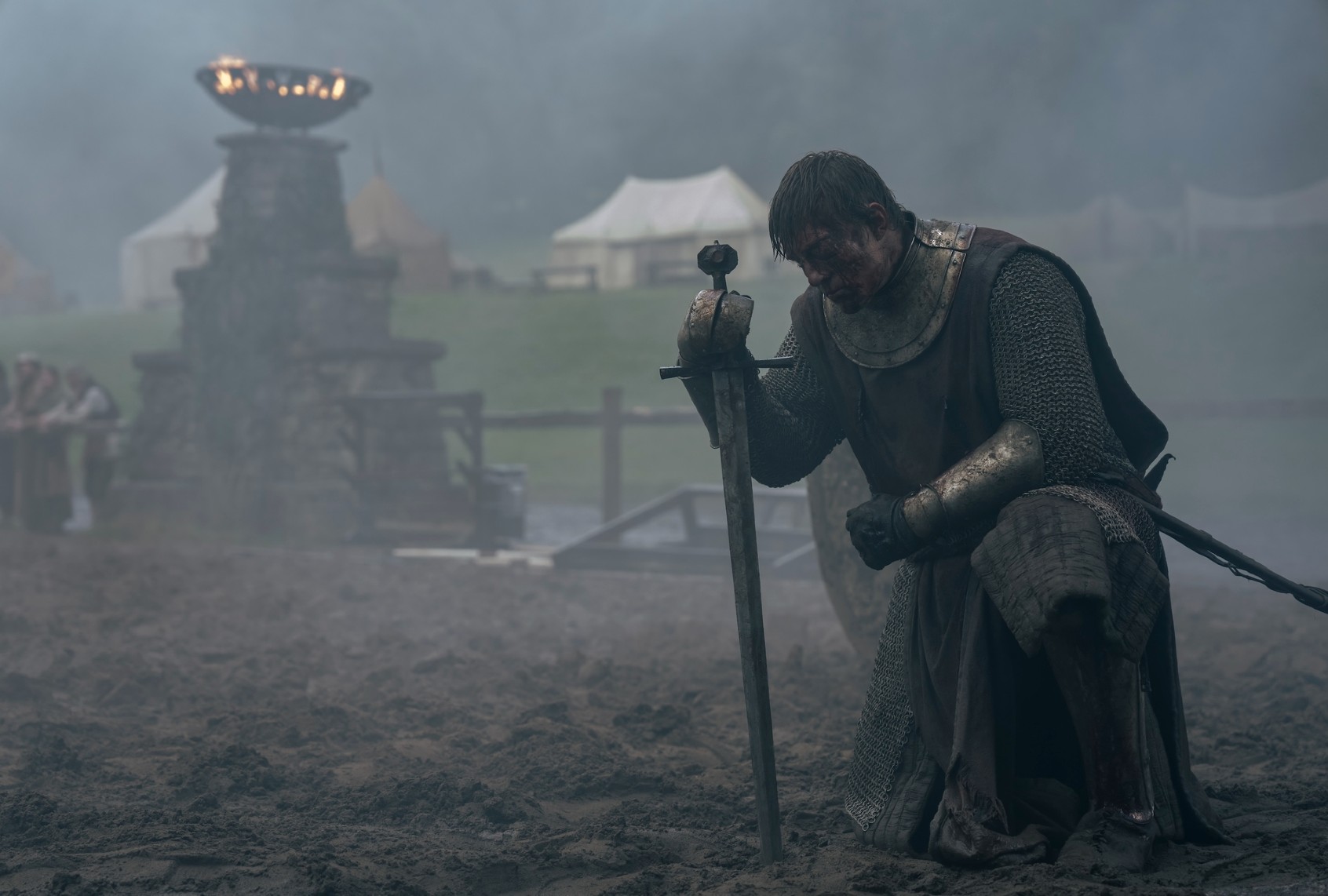

One mocking fart directed at Duncan the Tall in the fifth episode of “A Knight of the Seven Kingdoms” reveals two truths: that Lord Bracken and many of his mirthful peers view their knightly vows as no more sacred than a cloud of smelly gas, and that the flatulence of a highborn noble sounds just as unimpressive as that of a commoner. The novella the HBO show is based on has Bracken blow wind through his mouth rather than his backside, but the point remains the same, and so does Dunk’s response: “Are there no true knights among you?”
The vow of a knight does not say to “defend the weak and innocent . . . especially if you have a crush on them.” But George R.R. Martin abhors a perfect soul, and loves a human heart in conflict with itself and the world.
Dunk (Peter Claffey) seems more indignant and heartsick than frightened that no one will join him, as if the soul of knighthood is at stake rather than his own body. When he strikes Prince Aerion (Finn Bennett) in an outburst of protective rage, Dunk believes he is fulfilling his vow to defend the weak and innocent; anyone who takes his side in his trial of seven against Aerion, regardless of true motive, is publicly accepting the sanctity of those vows and Dunk’s moral righteousness. Those people would have had plenty of time to weigh their chances. That is much unlike Dunk, acting out of sheer impulse on the night he heard Tanselle (Tanzyn Crawford) scream.
Dunk, a hedge knight who cannot abide the strong preying on the weak, might have intervened regardless of his romantic feelings for Tanselle, the Dornish puppet master who treated him kindly. Nevertheless, from a semantic perspective, this particular relationship complicates the act as one of pure knighthood; after all, the vow of a knight does not say to “defend the weak and innocent . . . especially if you have a crush on them.” But George R.R. Martin abhors a perfect soul, and loves a human heart in conflict with itself and the world. “What is duty against the feel of a newborn son in your arms, or the memory of a brother’s smile?” Maester Aemon, Egg (Dexter Sol Ansell) and Aerion’s long-living brother, asks in “A Game of Thrones,” Martin’s first Westeros novel. “We are only human, and the gods have made us for love.” Dunk, somehow, has stumbled into a way to fulfill both duty and love, for true duty, and indeed any moral value a person holds dear, is the fruit of their own spirit, not a mere abstraction they remember but cannot understand.
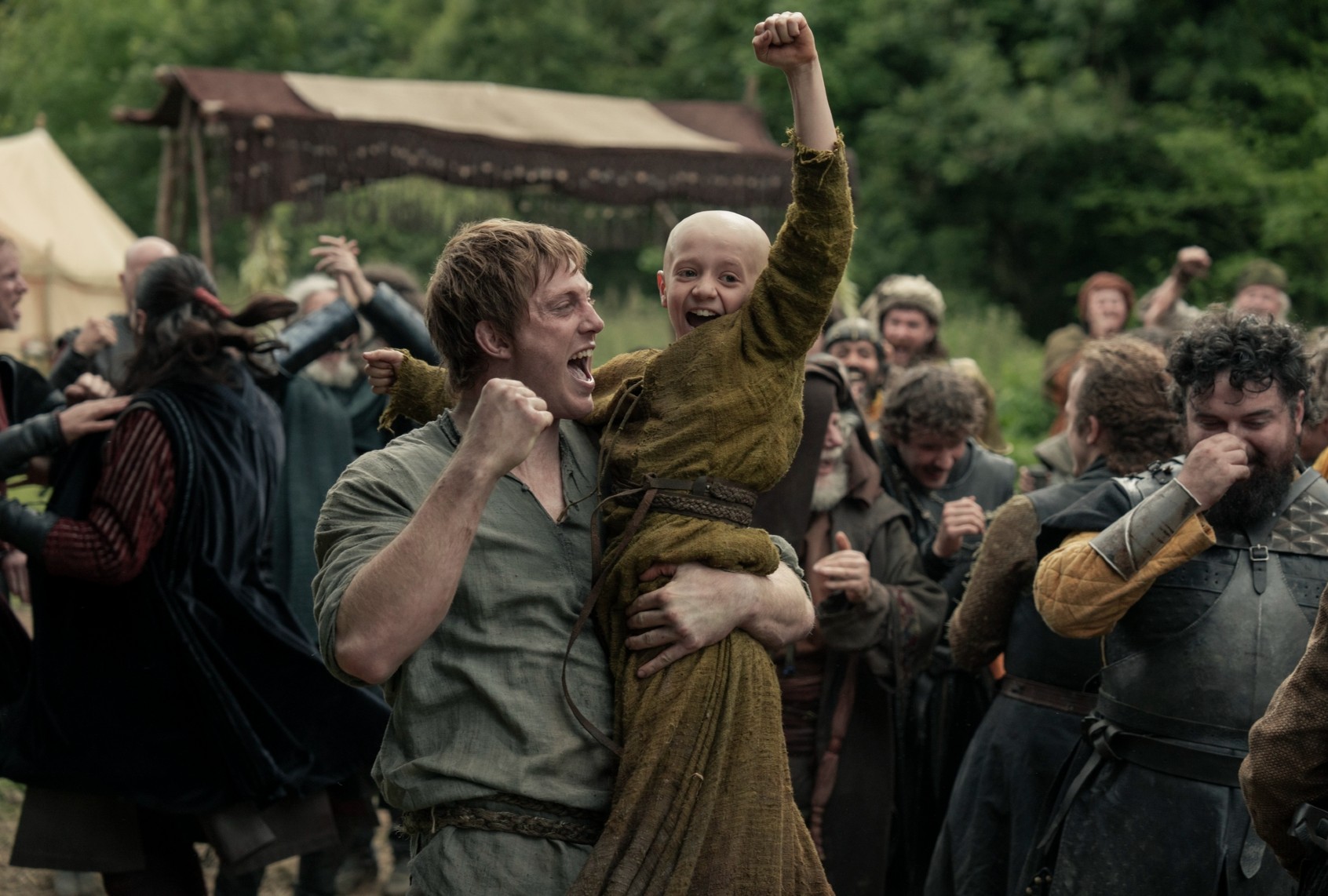
(Steffan Hill/HBO ) Peter Claffey and Dexter Sol Ansell in “A Knight of the Seven Kingdoms”
In the world of Martin’s books, even the most duty-bound characters must find their compass in the shadow of life and memory. Ned Stark cannot bring himself to tell King Robert of Joffrey’s illegitimacy, because he is traumatized by dead Targaryen children wrapped in bloody cloaks; Brienne of Tarth wanders the Riverlands for a vow made to a woman now dead, because a life of ridicule has turned her inwards in a quest to embody a true and loyal knight, even without recognition. Later, alone and faced with the choice of a losing battle against seven brigands or abandoning a group of frightened orphans to their fate, Brienne decides that she has “no chance, and no choice.”
Want more from culture than just the latest trend? The Swell highlights art made to last.
Sign up here
Brienne is technically wrong, of course. She could have fled if she really wanted to, just like Dunk could have stayed in the tent with Raymun Fossoway (Shaun Thomas) rather than going to Tanselle and committing lèse-majesté. On the matter of survival, though, she speaks for Dunk and countless characters who risked and suffered death to save the lives of others. For Dunk, leaving Tanselle to Aerion would have meant killing the knight within himself — a spiritual suicide that would render his continued breaths both meaningless and tormented.
Men like Lord Bracken and Prince Aerion feel no such internal stakes. Flaunting their knighthood as a mark of status but discarding it the moment it requires true honor, they treat their vows only as an invented tradition, a set of rituals to legitimize their own power. Dunk is almost certainly lying about his own legal status as a knight — a theory further confirmed by a scene of Dunk acknowledging himself as a fraud, then another of him unsuccessfully asking Arlan of Pennytree (Danny Webb) to dub him. Nevertheless, this man, grown out of Flea Bottom’s gutters, appropriates the tradition by holding his vows as a representation of lived reality, rather than as a mere ritual or badge of social class. Duncan the Tall walks knowing what it is like to be small, hungry, and powerless, but also unburdened by the pragmatism and vanity of power and wealth, which so often buries a noble’s sense of morality and love.
Martin writes in “The Hedge Knight” that Aerion “could vanquish Ser Duncan the Tall, but not Dunk of Flea Bottom.” In this instance, Martin refers to Dunk’s brawling instincts, but the line is just as true for the hedge knight who offers up his common body to be battered for his vows, while most lords of Westeros sacrifice their spiritual integrity to protect their own material interests.
We need your help to stay independent
Dunk’s impulsive willingness to die for a doomed cause gives the trial its tragic weight, but it is Prince Baelor (Bertie Carvel) stepping onto the field that provides its institutional blessing, proving honor can survive, in some form, at the pinnacle of Westerosi society, and it was Dunk’s selfless courage that earned him a dragon’s allegiance. Baelor, a politician and a feudal dynast, might understand on some level that by fighting with Dunk, he is, in his own way, upholding the dignity of the crown and keeping the commoners placated. But in a world where brutality or indifference often provides an easier, less immediately dangerous path, Baelor putting himself in danger for a hedge knight is exactly the kind of noblesse oblige that Dunk feels is worthy of his loyalty.
Duncan the Tall walks knowing what it is like to be small, hungry, and powerless, but also unburdened by the pragmatism and vanity of power and wealth, which so often buries a noble’s sense of morality and love.
For the hedge knight who inspired Baelor’s intervention, the motives are more reflexive. Martin, a self-described romantic, likes to reward characters such as Dunk who perform good deeds without expecting reward. Sansa Stark, in moments of natural, sometimes self-loathing empathy, offers mercy to people she should fear or despise, and finds reciprocation in their own warped forms; Ned Stark, the father who surrendered his precious honesty to protect Sansa from Joffrey’s wrath, receives his own posthumous gift: the unshakeable loyalty of bannermen who will die for his children. Dunk, though wounded and despairing of Baelor’s death, wins his trial and becomes a legend that characters in “A Song of Ice and Fire” recall as a true knight.
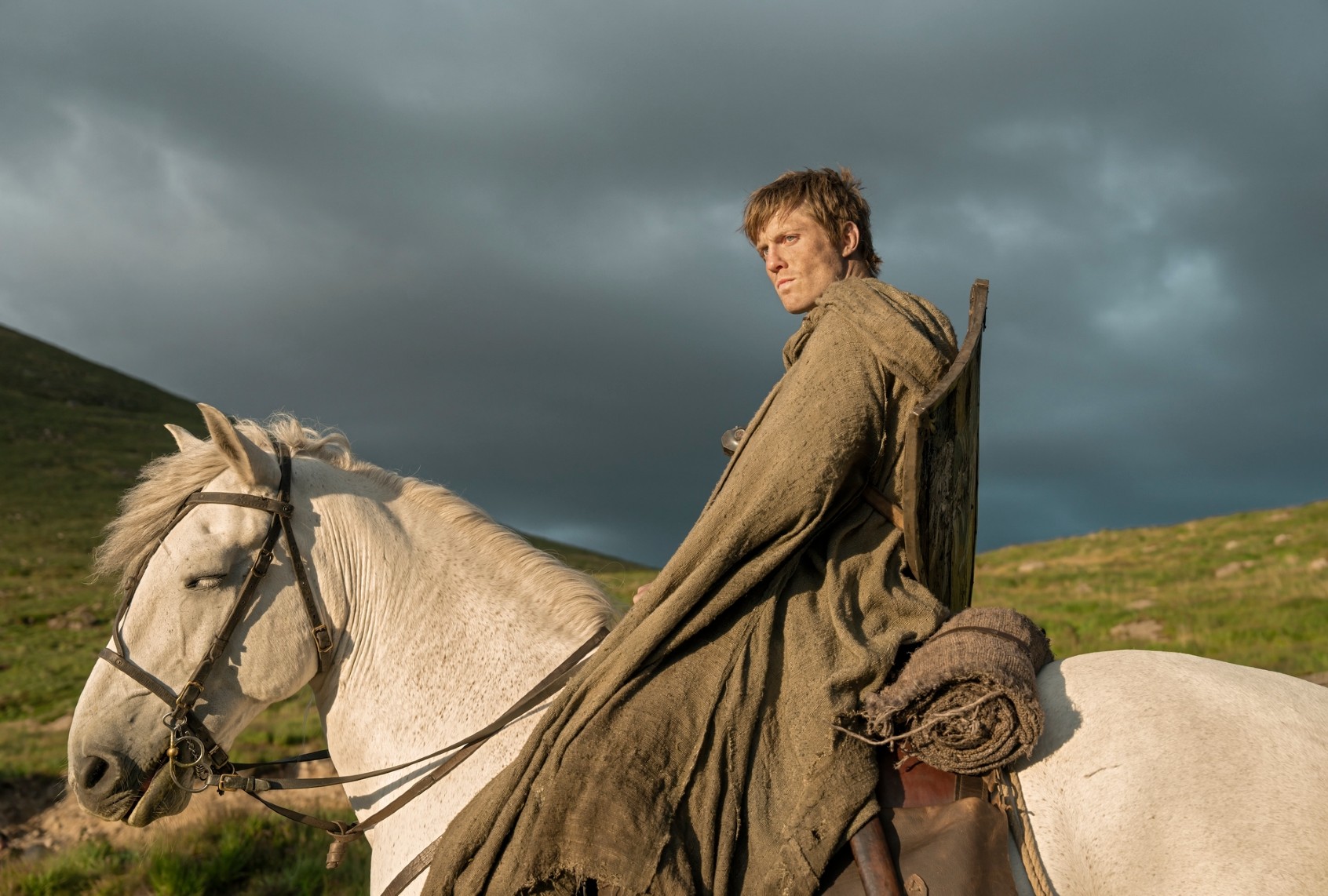
(Steffan Hill/HBO) Peter Claffey in “A Knight of the Seven Kingdoms”
Baelor’s grieving son sees Dunk differently from those characters. “Baelor had it in him to be a great king,” Valarr (Oscar Morgan) tells Dunk in the season finale. “Why did the gods take him and leave you?” Maekar (Sam Spruell), Baelor’s younger brother, later tells Dunk exactly what he sees in the future: “Each time a battle is lost or a crop fails, fools will say Baelor would not have let it happen . . . but the hedge knight killed him.”
Dunk wonders if the realm will need a hedge knight’s foot even more than a prince’s life. For all his introspection, Dunk wrongfully justifies his own survival as a transaction — a king-to-be traded for a commoner. Baelor did not don his son’s plate and fight for an innocent man because the gods demanded a trade for the future; he did it because to do otherwise would have tarnished both the standing of his just rule and the same man Valarr and Maekar are mourning. Even Maekar’s political analysis cracks when confronted with the visual of Baelor standing in the mud with borrowed armor, fighting off Duncan’s foes, and of the assembled commons cheering for the hedge knight. Baelor of all people knows the smallfolk would react poorly to their beloved prince letting injustice beget more injustice. A single, highly public moral failure could undo everything.
While the motives that drive a knight are often human, political, or both, the logic is as miraculous and irrational as a muddy hedge knight crawling out from under a fallen dragon. Not everyone has it in them to be a knight like Duncan the Tall, Brienne of Tarth, or even Sansa Stark. But in a society that consistently punishes good people, simply trying to make the songs real is worthy.
Read more
from the world of George R. R. Martin
