
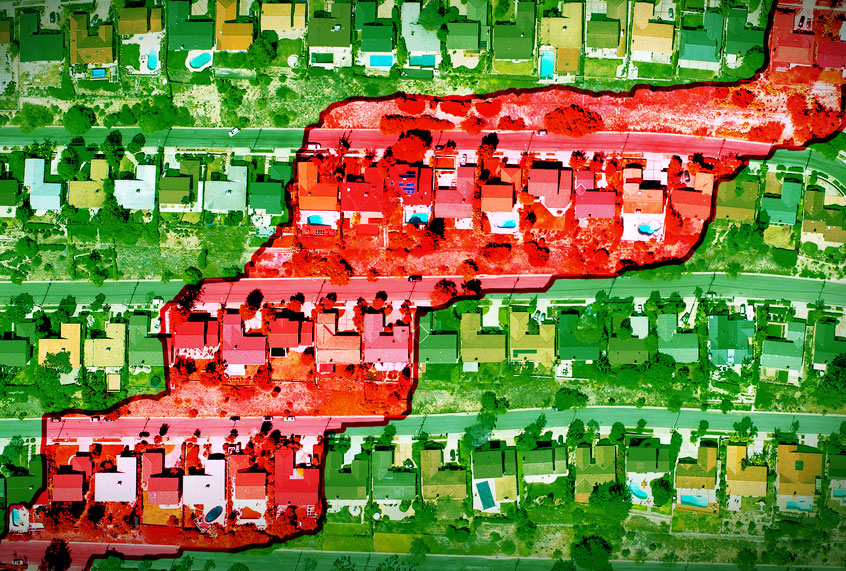

For decades governments and private institutions have redlined Black citizens from financial services, severed their neighborhoods with hostile infrastructure, and enacted other policies designed to impoverish and disempower marginalized groups. Though some of those practices still exist in some form, emerging public consciousness and civil rights activists have put increasing pressure on policymakers to take steps to rectify this.
One method, practiced in cities like Detroit, has been to demolish swathes of empty buildings abandoned by white flight, allowed to decay by a tax-starved municipal government, and withheld from Black residents by “blockbusting” agents selling them only after massive markups. The logic, according to its proponents, is to make space for majority-Black populations to flourish. But in “Demolishing Detroit: How Structural Racism Endures,” author Nicholas Caverly records his observations and research from field work in Detroit, arguing that those demolitions have largely maintained rather than removed racial inequities.
Caverly, a professor at University of Massachusetts, Amherst, recently spoke to Salon about the problem of demolition in its current form, and the potential for a model with more community input.
This interview has been condensed and lightly edited for clarity.
Your research covers decades of policy where empty buildings have been torn down en masse with the idea that their removal will heal racial inequities. You’ve also said that it’s much more complicated than what policymakers claim.
There’s been about 200,000 empty buildings torn down since the 1970s, and the goal is informed by the idea that racist disinvestment is a problem and white flight is a problem, and empty buildings are a physical scar of that problem. And so could we just tear these things down and address the problem? I spent a couple of years talking to city residents, demolition workers, and unsurprisingly, it’s a lot more complicated than that. It’s not just about saying, how do we tear down the remains of inequities that we know that have existed in the past, but also the fact that when you’re tearing things down, you’re creating new problems too, new kinds of anti-Black distributions of economic opportunity, environmental contamination, and so on.
I think Detroit is kind of emblematic of uneven conditions that we see across the United States, and the kinds of questions we should be asking about what happens after the demolition takes place. Is this land that should be funneled into big, private development projects, in a way that might reproduce the same systems? Or is this land that could be kind of held in stewardship, or some kind of community-scale needs? What would it look like to actually change the way that land is managed in Detroit?
What do arguments in favor of mass demolition miss, and why are they persuasive anyway?
We have all these empty buildings that are monuments to white racism. So if we look at the way that we got hundreds of thousands of empty buildings into Detroit, these are things that are connected to longstanding property regimes that channeled home ownership opportunities towards white families and away from families of color. These things have been talked about a lot in the United States. So there’s an idea that if we could just tear them down, that would create a clean slate and we could move forward — the same logic that is applied to Confederate monuments.
“There isn’t necessarily one future after you tear something down — it’s contested, and it’s open to people to try to shape what the future of their city looks like.”
In the latter case, it’s a question of who do we censor in our public spaces, how we make sure our public spaces are accountable to people. But simply tearing down a statue or tearing down an empty building doesn’t change this underlying system. It can produce a kind of symbolic change, but it doesn’t necessarily change the structural conditions. And that is something people recognize on the ground. Like when I would talk to people, they would raise concerns about how the demolition contaminates the ground around them. It’s got poisonous lead in it from paint. So we have to be careful, and also think of how to build different kinds of systems. We’d have to think about what it looks like to produce actually equitable distributions of resources and distributions of burden.
In Detroit, which you build your study around in your book, what are the processes by which land is then converted into a given purpose — and do those processes give a hint to the public over the intended purpose?
I think absolutely it provides a hint. For example, the Detroit demolitions for a while were managed by an institution called the Detroit Land Bank Authority. They no longer manage demolition, but they are the titleholder to publicly-owned land, and are still the largest single landowner in the city of Detroit. The goal of the Land Bank Authority was to create a single titleholder that would be able to package up and create large development, facilitate large development projects. And while the Land Bank Authority has been able to kind of affect some of those projects by bundling pieces of property together to make them interesting to a highly highly-capitalized developer, they have also struggled because the kind of contiguous empty land that you might anticipate might appear after a demolition is never fully empty. There’s sometimes people who live there, or there are different owners of record.
Start your day with essential news from Salon.
Sign up for our free morning newsletter, Crash Course.
And so the Land Bank wasn’t able to fulfill a lot of its desires for big development. What that opened the door for people to think about what it would look like to build things like community land trusts, a kind of common opportunity of stewardship. I think that the scale of empty land in Detroit has opened up some really interesting conflicts that show us that there isn’t necessarily one future after you tear something down — it’s contested, and it’s open to people to try to shape what the future of their city looks like.
You’re skeptical of the claim that Black communities in general will benefit from municipal demolition in the form that it has taken, not least because it’s such a broad categorization. So who are actually the main beneficiaries from these demolitions and subsequent lack of care in development?
I think that it depends on how we’re going to classify benefit. There was a big hope with demolition because of the way it was framed for city residents, especially starting around 2014, which is when there was this big influx of federal funding for building demolitions in Detroit and also other places like Milwaukee, Baltimore and Stockton. Federal funds were shifted to demolition from a variety of other things. And there was an argument that if we shift funds into demolition, we’re going to increase property value and create jobs. These are seen as net goods in the United States.
It is true that property values increased in Detroit following demolitions, and that is good if you own your home and you’re able to pay increasing taxes for it. It wasn’t so great for people who didn’t own their home and who had to deal with spiking rents. It isn’t so great for people who are having difficulty paying their rising tax bills. And it didn’t necessarily address many of the concerns that Detroiters had around making sure there was affordable and accessible housing. We would like quality housing to be something that people can afford.
You’ve gone in detail about specific mechanisms of demolition, like algorithms, for example. For mapping, pricing, contract processes and so on. Could you explain how those actively reproduce class and racial hierarchies?
Demolitions, as I said, were framed as a way of increasing property value. That was one of the things that helped to authorize more than $250 million in federal money for demolitions in Detroit, as well as hundreds of millions of dollars across the United States. And that meant that public institutions that organized demolitions had to provide a lot of data to show that the buildings they were tearing down were increasing property value in ways that would kind of ripple out.
Home ownership in the United States, as you know, was created on racist terms. They were provided to white possible homeowners and denied to most everybody else, especially Black possible homeowners. And those are inequalities that continue to exist in our contemporary housing landscapes. They are inequalities that continue to exist in part because of the ways that mortgages are approved or denied. And so demolition administrators saw increasing property value as a way to create this kind of algorithmic change in the underwriting landscape for people applying for mortgages or home renovation loans in Detroit.
We need your help to stay independent
They thought that demolition was an investment in expanding access to home ownership, which it did do. If we look at the number of mortgages that were issued in Detroit following demolitions, they did increase. And yet, that didn’t actually address the concerns that many Detroiters had, which was that housing was unaffordable, and that access to high-quality housing was incredibly limited. And so part of what I write about when I’m talking about algorithms is how when we have these algorithmic ideas of equity or equality in which the goal is to equalize access to homeownership, but we don’t interrogate the very thing that’s at the heart of homeownership, which is that homes are not accessible to everybody. We pass by the opportunity to invest our resources in other kinds of things like producing more housing.
Are there any models that you have in mind for what steps governments should take to actually help communities and not only improve their material conditions, but institutionalize their say in the policy process?
If we had we wanted to think about what are some best practices, I’m going to give two things. Number one is to create systems that actually listen to people, not just saying, well, we’re interested in community input, but then we’re not going to give it any actual power. So this might range from participatory budgeting to participatory planning, that gives meaningful input to people who show up in their communities. We’ve got lots of evidence for how that isn’t an effective way of of changing who is centered within our ideas of policy and our ideas of urban design.
One way that I saw that come up in Detroit is people talking about what to do with contaminated soil produced by demolitions. People would say, “well, we’ve got to figure out what to do with the soil. We don’t want it to just go get dumped on some other community that is, for example, living next to a landfill or something; we should try to imagine a broader distribution of soil.”
And then as far as broad things that I could point to or a place that I could point to, I think of Montgomery County, which is in Maryland just outside of D.C., which had some longstanding laws that did not address some really big problems. But over the past 40 years or so produced some really meaningful investments in social housing, public transportation, public art, education. And I think looking into those kinds of examples in which people, decades ago, came together in moments like the Civil Rights era and created a local way of trying to create more livable and just cities in Montgomery County.
Read more
about housing
